Translate

Showing posts with label Julian Vasquez Heilig. Show all posts

Saturday, February 14, 2026

Bad Bunny Knows the Truth. Do We? by Julian Vasquez-Heilig | December 2, 2025

Friends:

I encourage everyone to read this excellent and clarifying piece by Dr. Julian Vasquez-Heilig. It is essential reading in this moment. He reminds us that when scholars write about colonialism—including the ongoing colonial condition of Puerto Rico—they are not speaking metaphorically. Colonialism is not rhetorical flourish. It is a material history of conquest, land dispossession, racial hierarchy, economic extraction, political subordination, and epistemic control. It structures governance, shapes citizenship, and defines whose knowledge is legitimized and whose is subordinated.

When Mexican American and Latina/o Studies scholars analyze colonialism in Texas, the Southwest, or Puerto Rico, they are not engaging in abstraction. They are naming concrete histories of annexation, treaty violations, segregation, linguistic suppression, and policy regimes that continue to shape lived experience. To dismiss or sideline that scholarship is not an academic disagreement—it is a refusal to confront the structural foundations of the present. 

Colonialism is not a metaphor. It is a living architecture of power, and scholarship that names it performs a public service that universities should defend—not suppress. Unless, of course, the university itself is operating within the very colonial logic Dr. Vasquez-Heilig describes: disciplining knowledge, privileging Eurocentric canons, and policing which histories are allowed institutional authority. At that point, the silencing—as we are evidencing right now with respect to our Ethnic Studies Departments at UT Austin—is no longer ironic. It is confirmation.

-Angela Valenzuela


by Julian Vasquez-Heilig | December 2, 2025


Most people in the continental United States do not understand why coloniality remains an urgent issue in Puerto Rico. They recognize the island through images of beaches and Bad Bunny, but they rarely understand its political reality. What is colonially? Puerto Rico remains an unincorporated territory of the United States, a status created by early twentieth century Supreme Court decisions. These decisions placed Puerto Rico in a category that allowed federal control without granting full rights to the people who live there.

People born in Puerto Rico are United States citizens, yet they cannot vote for the president unless they leave the island. They also have no voting representation in Congress, although Congress has unilateral power over Puerto Rico’s laws, economy, and governance. Federal agencies and congressional bodies can impose decisions that reshape every public institution on the island. This includes education, where policy decisions frequently arrive without local electoral accountability.

This political structure reveals why coloniality is not a metaphor in Puerto Rico. It defines the island’s daily reality. The absence of democratic representation means that Puerto Rican communities do not have full control over their island. Decisions are often dictated rather than deliberated, which purposefully places enormous strain on its residents. These realities formed the foundation of Patricia Virella’s 2025 Mistifer Lecture and shaped the urgency of her message.

Opening the Conversation

The 2025 Mistifer Lecture, delivered in San Juan by Dr. Patricia Virella of Montclair State University, was one of the most historically grounded and future oriented presentations I have heard in many years. The lecture insisted that education cannot be understood apart from the political structures that control it. Virella opened by reminding the audience that schools are not isolated from systems of power. They reflect the ideologies and histories that surround them.

She asked a set of questions that framed the emotional and intellectual trajectory of her talk. She asked the audience what they would have done if they lived during historical periods of explicit colonial brutality. She asked whether they would have resisted or remained silent. Virella drew the audience in by refusing to allow distance between past and present. She invited everyone to consider courage not as an abstract concept but as something that reveals itself through daily decisions. The questions created a moral framework that guided the rest of the lecture. They reminded the audience that historical analysis is incomplete without present day context.

Julian Vasquez Heilig and Patricia Virella after her lecture
Puerto Rico as Case and Mirror

Virella emphasized that Puerto Rico is both a case study and a mirror. She explained that Puerto Rico’s educational history is inseparable from the broader history of colonial administration in the United States. The island’s schools were used to impose cultural, linguistic, and political assimilation beginning in the early twentieth century. These practices were not accidental or misguided. They were intentional efforts to restructure identity and align communities with external American authority.

She challenged the audience to see Puerto Rico not as an exception but as a site where the true nature of American governance becomes visible. The island reveals how the United States has historically exercised power over populations without granting full democratic rights. This reality creates a mirror that reflects patterns still present in the mainland. It forces educators to confront the possibility that colonial logic appears everywhere in the democratic project.

Her framing made the room eerily quiet because it revealed the stakes of education. She explained that schools do not merely reproduce knowledge. They reproduce systems of power unless leaders make intentional choices to disrupt that cycle. Puerto Rico became a lens for understanding how power shapes schooling in ways that are both explicit and subtle.
Education as Freedom Work

Virella opened her slides with Monique Morris’s declaration that “Education is freedom work.” She explained that this statement carries significant weight in Puerto Rico because public schooling has long been used to shape political identity. She reminded the audience that when schooling is used to impose identity, it becomes an instrument of control rather than liberation. That tension has defined Puerto Rican education for more than one hundred years.

She displayed a 1902 Puerto Rico Herald headline that described the U.S. Commissioner of Education as the “absolute king” of the island’s schools. The article listed practices designed to break cultural continuity, including military style marching and forced recitation of patriotic songs. The policy also encouraged teachers to degrade the Spanish language in order to elevate English. These practices were not hidden or subtle. They were publicly declared objectives of the colonial administration.

The room grew tense as Virella explained that these policies were part of a larger strategy to reshape Puerto Rican identity through schooling. The audience confronted evidence that coloniality within education has always been deliberate in the United States. Virella’s point became unmistakably clear. Education may be freedom work, but only when communities have authority over their own stories.

Coloniality as a Living Structure


Virella repeated that coloniality is not an artifact. It is a living structure that continues to shape schools today. She described coloniality as a system of governance that creates dependence on external authorities while undermining local capacity. She showed how this structure appears in curriculum mandates, school closures, teacher evaluation systems, and policy reforms imposed from outside of communities. These patterns reveal how control operates through institutions rather than only through overt political statements.

She explained that contemporary reforms in Puerto Rico must be understood within this historical context. Policies framed as modernization often reproduce long standing beliefs about Puerto Rican incapacity. These policies assume that communities cannot govern themselves and therefore require external intervention. Virella made clear that such assumptions are rooted in colonial logic that treats Puerto Ricans as subjects rather than citizens.

Monday, March 03, 2025

US Department of Education Tattle-Tale Line: Let’s Flood It with the Truth by Dr. Julian Vasquez-Heilig

Friends,

I agree with Dr. Julian Vasquez Heilig that we need to respond to this weaponization of DEI by the U.S. Department of (Mis)education. We must all speak our truths now.

-Angela Valenzuela


US Department of Education Tattle-Tale Line: Let’s Flood It with the Truth

Julian Vasquez Heilig March 2, 2025 


In yet another attempt to weaponize the federal government against diversity, equity, and inclusion (DEI) efforts in education, the U.S. Department of Education—at the urging of Moms for Liberty and other far-right extremist groups—has launched the “Stop DEI Portal” (https://enddei.ed.gov).

This taxpayer-funded snitch line is designed to invite anonymous complaints against public schools, colleges, and universities that are actively working to create inclusive and equitable environments for all students. Their goal? To stoke fear, intimidate educators, and dismantle efforts to address racial, gender, and socioeconomic inequities in education.

Let’s be clear: this is not about stopping discrimination—it’s about silencing efforts to eliminate it.

But here’s the thing: if this portal is truly meant to address discrimination, then let’s make sure it serves that purpose.

Let’s Turn the Tables: Report REAL Discrimination

If the Department of Education wants reports of discrimination, let’s give them exactly that. But let’s report real, documented cases of discrimination—the kind that actually harms students and families every single day, especially in underregulated charter and voucher-funded schools.

Here’s what they don’t want reported, but what we should be flooding their portal with:

1. Discrimination Against Students with Disabilities

• Many charter and voucher schools systematically exclude students with disabilities, either by refusing to provide necessary accommodations or pushing them out with discriminatory discipline policies.

• Special education students in voucher programs often lose their federal protections under the Individuals with Disabilities Education Act (IDEA) when they transfer to private schools.

• Some schools refuse to admit students who require additional supports, effectively segregating students with disabilities from their peers.

📌 If you or someone you know has experienced this, report it here: https://enddei.ed.gov

2. Discrimination Against LGBTQ+ Students

• In some states, charter and private schools receiving taxpayer-funded vouchers have explicit policies that allow them to deny admission to LGBTQ+ students or expel them for their identity.

• LGBTQ+ students often face harassment, deadnaming, misgendering, and bullying—sometimes by school officials—without intervention.

• Books and curriculum that acknowledge LGBTQ+ history and experiences are being banned, erasing the existence of LGBTQ+ students and families from the classroom.

📌 If you’ve seen LGBTQ+ students being targeted or erased, report it here: https://enddei.ed.gov

3. Racial Discrimination and Segregation in Schools

• Many charter and private schools resegregate students by race and income, creating de facto segregation that mirrors the Jim Crow era.

• Black and Brown students face harsher disciplinary actions than their white peers for the same behaviors.

• AP African American Studies, ethnic studies courses, and other curriculum that acknowledges systemic racism are being banned or watered down, denying students an accurate understanding of history.

📌 If you have evidence of racial discrimination in schools, report it here: https://enddei.ed.gov

4. Discrimination Against Low-Income Students

• Voucher programs siphon public dollars away from neighborhood schools, making it harder for low-income students to access well-funded, high-quality education.

• Private voucher schools are not required to provide free or reduced-price lunch programs, effectively shutting out students who rely on school meals.

• School choice programs increase economic segregation, allowing affluent families to access better resources while leaving lower-income students in underfunded public schools.

📌 If you know of schools pushing out or underfunding low-income students, report it here: https://enddei.ed.gov

Weaponizing the Portal Against Its Own Purpose

The Stop DEI Portal is not about protecting students—it’s about political theater and furthering a radical agenda to dismantle public education.

Conservative groups like Moms for Liberty, the Heritage Foundation, and other well-funded organizations have pushed for Project 2025, a policy plan designed to eliminate federal civil rights protections, dismantle DEI initiatives, and privatize public education.

They want to create a parallel education system where only privileged, wealthy families benefit—while marginalized students are left behind.

What You Can Do Right Now

✅ Step 1: Submit REAL complaints to the Stop DEI Portal

Visit https://enddei.ed.gov and report discrimination against students with disabilities, LGBTQ+ students, students of color, and low-income students.

✅ Step 2: Share this far and wide

Encourage educators, parents, and students to flood the portal with real discrimination complaints.

✅ Step 3: Support organizations fighting back

Groups like Our Schools Our Democracy (OSOD) and the Network for Public Education (NPE) are exposing the harms of privatization and the discriminatory practices of charter and voucher schools.

✅ Step 4: Stay engaged in the fight to protect public education

The NPE/NPE Action Conference on April 5-6 in Columbus, Ohio is bringing together educators, advocates, and policymakers to discuss how to defend public schools and stop the Project 2025 playbook. I’ll be there.

There’s no time to sit on the sidelines. The Stop DEI Portal is just the beginning of a much larger battle. If we don’t fight back now, the next generation will inherit an education system built on exclusion, discrimination, and privatization.

Let’s make sure the truth is louder than deception.

🔗 Submit your complaint now: https://enddei.ed.gov

🔗 Support OSOD and the Network for Public Education

🔗 Register for the NPE/NPE Action Conference before spots fill up!

This is about more than DEI. This is about democracy, justice, and the future of public education. Let’s fight back—together.

Dr. Julian Vasquez Heilig

Julian Vasquez Heilig drives change, delivers results, and disrupts inequityView all posts by Dr. Julian Vasquez Heilig


Thursday, January 28, 2021

Education Experts Advocate for Suspending High-Stakes Testing, Seek Equitable Alternatives - Higher Education

Last Tuesday's Town Hall described briefly below may be viewed online at https://www.youtube.com/watch?v=pzZjtg6ODs8&feature=youtu.be  

You can also find and view it under "Spotlight" on FairTest's home page, https://fairtest.org.

-Angela Valenzuela

Education Experts Advocate for Suspending High-Stakes Testing, Seek Equitable Alternatives - Higher Education

The National Center for Fair & Open Testing (FairTest) held a virtual town hall this week to urge individuals to sign a petition calling for high-stakes testing to be suspended in spring 2021.

Given the unprecedented and disparate situations under which students have been learning due to the ongoing coronavirus pandemic, the panelists agreed that test results would only highlight inequities in public education. One huge consideration is the logistics of bringing students back to school, which can be dangerous for their health and well-being.

“To get all the students tested is very difficult, nearly impossible,” said Dr. Julian Vasquez Heilig, dean of the College of Education at the University of Kentucky. He said high-stakes testing is inherently discriminatory.


Dr. Julian Vasquez Heilig

“It is the right thing for us to pause and reassess the regimes of testing that we see nationwide and state-to-state,” he added.

FairTest has long advocated against what it calls the biases of standardized testing.

During Tuesday’s panel, experts noted that many students, particularly low-income students, don’t have access to technology at home. Some students have been loaned computers by their schools, but the schools would need to recall those computers for testing purposes.

“It’s not possible to combine in-person testing with remote testing and get accurate information,” said Dr. Lorrie Shepard, distinguished professor of education at University of Colorado. She noted that, while testing proponents use the word “equity,” she cannot get a direct answer on what they will do with the scores to serve an equitable purpose.

“What we need are instructionally grounded assessments that are tied to a unit of instruction,” said Shepard.

Dr. Roxana Marachi, associate professor of education at San Jose State University, said students have been calling out the invasive tactics of online proctoring. To ask third through eighth graders and 11th graders to test in a home environment with a camera on them throughout a test will produce intense anxiety and negatively impact results, she added.

U.S. Representative Jamaal Bowman, a member of the House Education Committee, said these tests are often created by third parties, for-profit vendors, and not by teachers or educators.

“If teachers do not show certain scores on these particular tests, the teacher is rated ineffective,” said Bowman, who favors cancelling the current annual testing system. “Public schools are rated ineffective and then they are closed in favor of the charter school lobby, which is also a market-based, for-profit lobby.”

Dr. Jack Schneider, an assistant professor of leadership in education at University of Massachusetts Lowell, said that the U.S. is obsessed with standardized testing, which he argues distorts education.

“That’s because of how narrowly we measure and also because of the high stakes we attach to those measurements,” he said. “The things we do measure tend to correlate strongly with demographic variables like family income, race, parental educational attainment. The consequences of this measurement regime tend to land really inequitably across our communities. Where do schools get shut down? It’s in Black and Brown communities and poor communities.”

The panelists were also challenged to offer meaningful and relevant alternatives to high-stakes testing. Heilig said there are a number of alternatives, such performance assessments and portfolios. In a portfolio assessment, students demonstrate what they’ve learned for a group of teachers.

“There are a lot of ways we can do this at the local level using the expertise of the educators who are actually closer to the work that students are doing,” he added.

Marachi said assessment needs to be local, done by teachers and done in an authentic and organic way. Assessments should motivate students and contribute to learning, she said.

Roberto Jimenez-Rivera, a member of the Chelsea School Committee and a political organizer for the Boston Teachers Union, said that the public has to rethink testing as a form of competition.

“It has to be a collaboration to get as many people as possible prepared,” he said. “If we continue to focus on a Bell curve — pitting schools and students against each other to be the best using these assessments that we know are broken, supporting systems that consistently place students of color and their schools at the bottom — students of color are always going to be at the bottom because they’re at a resource disadvantage.

“When I think about what we can do instead of testing, I think we need to invest in our schools to make sure that our poor communities have access to the resources of wealthy communities,” he added. “Otherwise, it doesn’t matter what the assessment is. It’s going to give us the same results.” 


Thursday, July 26, 2018

Dallas ISD Did Something Amazing, and Everyone Should Know About It

So happy for Dallas Independent School District (DISD) schools which now only has two schools on the "Improvement Required" list.  What they did to get there was implement the Accelerated Campus Excellence program.  Since its inception in 2015, DISD focused on "Improvement Required" schools by doing the following (from DISD's ACE website): 
"...strong school leadership, effective teachers, and high expectations for both students and staff. The ACE plan incentivizes top teachers and principals to work at the district’s highest-need schools to ensure that effective teachers are in the classrooms where they are most needed."

Special emphasis in all of these schools additionally consisted of a lot of extended school days and after-school tutoring. Here's a list of all ACE schools.  

Do remember an earlier piece, as well, of Trini Garza Early College High School where the campus was recognized as one of the nation's top schools for low-income students, meaning that great things are happening under Superintendent Michael Hinojosa's leadership.

Also remember that this was a district that tried to railroad Home Rule policy that would have charterized the entire district!  Read this piece by Bonnie Lesley of Texas Kids Can't Wait titled, "Patrick's S.B. 2: Charter Schools and Home Rule Districts." Also see this related July 29, 2014 post by Dr. Julian Vasquez Heilig.

Congratulations to Dr. Hinojosa and all the Dallas teachers and staff that made this happen.  This isn't good news at all for the corporatizers and privatizers, the Education Management Organizations (EMOs) that depend on bad test scores to shame, blame, close down, turn around, and charterize public schools in order to "save" public education. This will keep them at bay, for now.  And that's a good thing.

-Angela Valenzuela

Dallas ISD Did Something Amazing, and Everyone Should Know About It


Fresh from his runoff win Saturday, Justin Henry was sworn in as the trustee for Dallas ISD District 9 before the school board worked its way through Thursday’s agenda. The district announced preliminary school accountability ratings revealed a significant drop in Improvement Required schools (Photo courtesy: Dallas ISD).

Super nerdy confession: The original title of this piece was “Dallas ISD May Have Just Done Something Miraculous.”
But then I remembered a long senior year where my Honors English teacher insisted that we study S.I. Hayakawa’s “Language in Thought and Action,” a book about semantics so revered it’s currently in its fifth edition.
I may not remember much from high school coursework, but I do remember that book, and what it taught about language, and why the words we choose can impact the message. And miracle is not the right word, really, for what has happened in Dallas ISD.
You see, four years ago, 43 of the district’s 230 schools were labeled Improvement Required in the state accountability ratings — meaning that those schools weren’t just at risk, or struggling, but that they had actually failed to meet state standards.
Thursday night, at the district’s monthly school board meeting, district superintendent Michael Hinojosa told trustees that the district expects that the Texas Education Agency will confirm that the district has only three IR schools in the entire district.
Three.
And while that just might be the lowest number and the quickest turnaround of any urban district in the state, it’s not a miracle. Don’t call it one.
Why? Because a miracle implies that people didn’t work hard to achieve this — that some nebulous divine being or luck changed the tide for thousands of Dallas ISD students. It was neither of those things, and to use the word miracle — or any form of it — is semantically wrong and factually insulting.
Because to achieve that kind of win, that kind of impressive benchmark, takes a lot of work — an incredible amount of work. Work by teachers and aides at those schools, work by students, work by parents, work by principals and assistant principals, and work by district staffers under Jolee Healey, who oversees the Accelerated Campus Excellence program. After all, part of ACE includes a lot of extended school days and after-school tutoring, and all of that takes time and effort.
That ACE program, by the way, is so obviously successful that other districts are adopting it, too, including Fort WorthGarland, and Richardson.
And these successes took patience. Because see, in 2015 — three years ago, the district’s IR count only declined to 37 from 43. Changes and reforms — like the ACE program — required some patience and time, and that small success was maybe not enough for some of the district’s fiercest critics.
But then by 2016, the district almost halved that number to 21, and then last year, it dropped to 13.
But this year’s drop to three may be even more of a win than that — Hinojosa told officials Thursday night that two of the schools are in the appeals process, which means that number could drop to a measly one IR school.
One, out of 230 schools. And the three schools? Two are in their first year of IR status, and the other is in the second year. This means that Carr and Titche elementaries, which were at the threshold of being shut down by the state, are off the IR list this year.
Whether it shakes out to be one, two, or three IR schools this year, Dallas ISD has achieved a success that other urban districts in the state can’t boast of. And do you know what that means for parents who live within the Dallas ISD attendance zone?
Thanks to the reforms and changes that brought about these changes, you can be even more assured that the district is likely even closer to being able to guarantee it’s ready to teach every single child that enters one of its 230 front doors.
It means that despite the moving parts and imperfections that every urban school district can face, Dallas ISD is by and large on an incredibly right path.
And that bodes well for a city that will be home to these future adults who will work, live, buy or rent a home, and play here.
Bethany Erickson is the education, consumer affairs, and public policy columnist for CandysDirt.com. Contact her at bethany@candysdirt.com.

Wednesday, May 17, 2017

National Data Show that Neighborhood Schools Outperform Charters by Dr. Julian Vasuez Heilig


Recent analyses of the National Assessment of Educational Progress (NAEP), our nation's most credible "report card" by Dr. Julian Vasquez Heilig show that as a whole, charter school students underperform relative to students in non-charter, neighborhood public schools.  The results are particularly stark at the 12th grade level.  

Policy implications?  We need to continue funding and supporting public schools, rather than trying to dismantle them through charters and we need to start "poaching" the charter schools to get these students back.  We also need as a polity to stop acting like "consumers" and assume ownership over public education where we as communities have rights and responsibilities and a great deal of work to do. 

Be thoughtful about who you elect to represent you on your school boards.  Make sure who funds them.  Hopefully, not charter companies because then they're beholding to them and they open up our districts to ever more charter contracts and expansion.  And consider running yourself for the school board.  And you should be able to win on the basis of what you do for, in, and with your community.  You shouldn't have to rely on these dollars either.

Angela Valenzuela

National and Urban NAEP Results: Neighborhood Public Schools 23, Charters 4

With increased attention and resources given by President Donald Trump and Secretary of Education Betty Devos to charter schools as an alternative to neighborhood public schools, it is crucial to analyze whether or not students who attend charter schools actually exhibit better education performance results compared to non-charter neighborhood public school students. While standardized test measures are not the most complete or ideal to analyze student outcomes, they can play a role in analyzing whether or not charter schools do truly deliver better performance for students.
This post utilizes data from the National Assessment of Educational Progress (NAEP). The NAEP is conducted by the National Center for Education Statistics and the U.S. Department of Education. The NAEP was “first administered in 1969 and is the largest continuing and nationally representative assessment of what our nation’s students know and can do in subjects such as mathematics, reading, science, and writing.” Standard administration practices are implemented to provide a common measure of student achievement and is consider “the nation’s report card.”
For this blog post, the NAEP Data Explorer tool was used to compare student performance results at the national and large city level. Composite scale scores were compared for charter schools vs. non-charter neighborhood public schools at the “large cities” level due to the fact that the majority of charters are located in urban areas. We consider the Data Explorer’s publicly available composite reading, mathematics, and science scores for 4th, 8th, and 12th graders over the course of six years (2009-2015). This post includes a school-level analysis due to the fact that the student-level data is not publicly available online (For student-level NAEP data comparisons see for example School Sector and Academic Achievement: A Multilevel Analysis of NAEP Mathematics Data).
Results
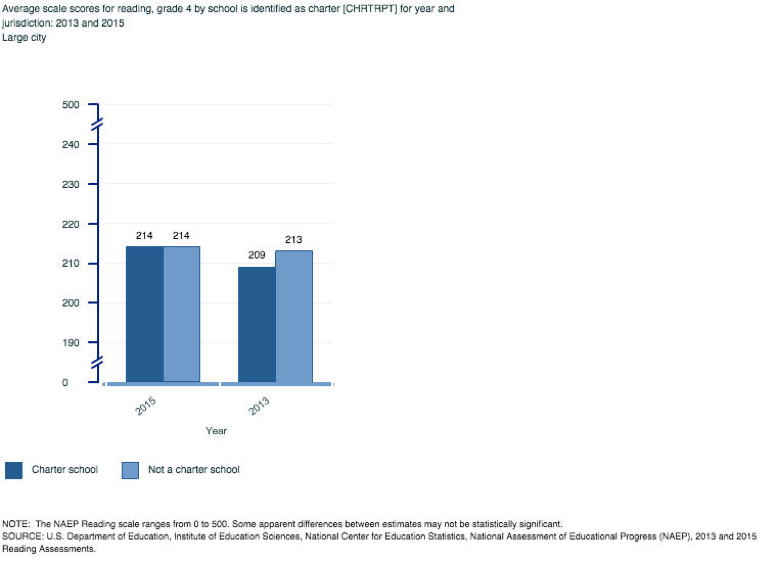
One would most likely suspect from the current positive public discourse about charter schools that they would display higher national and large city NAEP performance when compared non-charter neighborhood schools, however, this is not actually the case when examining achievement data at the school level. Out of the 28 total comparison tests run, only 4 times did charters produce higher composite score averages than non-charter neighborhood public schools— 8th grade reading and math in the years 2013 and 2015. There was a tie in the large city comparison for 4th grade reading in the year 2013 as charter schools and non-charter neighborhood public schools displayed the same average composite scale scores. In the other 23 cases charter schools produced lower average composite scores on the NAEP (math, reading, science) than non-charter neighborhood public schools.

What were the average differences between charters and non-charter neighborhood public schools? Overall, the 18 comparisons utilizing national samples of non-charter neighborhood public schools displayed composite scores 9.3 points higher on average than charter schools. For the ten available comparisons using samples from large cities, non-charter neighborhood public schools displayed composite scores 0.3 points higher on average than charter schools. Thus, the predominant finding is that non-charter neighborhood public schools outperform charters in the NAEP results on average.
The stark difference in student achievement between charters and non-charters is extraordinarily large in the final year of high school. The national comparisons in the 12th grade show about ~20 point differences favoring non-charter neighborhood public schools in reading, math and science over charters. Of note, the 12th grade comparisons are only at the national level because data for comparisons were not available at time of writing for large cities in the NAEP Data Explorer.
In conclusion, the school-level national and large city NAEP results drawn from the Data Explorer are informative for the public discourse as charter schools are presently being presented as a superior alternative to the public school system. These descriptive school-level results from the NAEP Data Explorer suggest that the relationship between charter schools and improved student performance is not being realized nationally and in large cities. As a result, the present conversations promoting outstanding overall success of charter schools clearly need to be reconsidered and reframed.
4th Grade Composite Score Comparisons (National and Large City)
Mathematics
4th Grade Composite Score Comparisons Mathematics
4th Grade Composite Score Comparisons Mathematics large city
Reading
4th Grade Composite Score Comparisons (National and Large City) reading
4th Grade Composite Score Comparisons large city reading.png