Translate

Showing posts with label Latina/o teachers. Show all posts

Wednesday, November 29, 2017

More Latinas are becoming teachers and reshaping our nation's classrooms


More Latinas are becoming teachers and reshaping our nation's classrooms

Latinas in education make up the largest category of Latina professionals.

by Stephen A. Nuño /
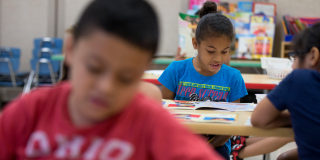

File photo of children at the Mary D. Lang Kindergarten Center in Kennett Square, Pa.Matt Rourke / AP file

The growth of the Latino population in the United States will have a lasting cultural and intellectual impact beyond the arts, food and celebrations. More and more, it's Latina teachers who our shaping our classrooms and our children's education, argues Glenda Flores, a sociologist in the Department of Chicano/Latino Studies at UC Irvine.
In her new book Latina Teachers: Creating Careers and Guarding Culture, Flores' research shows the impact of the growing numbers of Latinas who are going into teaching.
Latinas in education make up the largest category of Latina professionals, outpacing the next largest category, nursing, by three times. Data from the Department of Labor shows that Latinas make up the fastest growing non-White group to be entering the teaching profession.
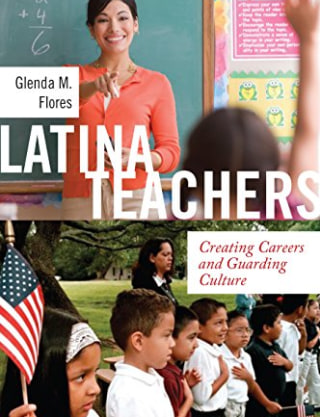
 Latino Teachers: Creating Careers and Guarding Culture New York University Press
Flores writes that the influx of Latinas in education comes from a confluence of historical and social factors she calls the class ceiling. Difficulties in balancing family obligations along with managing structural social forces of gender, ethnicity, and demographic changes channeled Latinas into education.
Women of Latino origin are more than 18 percent of teachers in California, creating a "Latinization" of the profession, whereas they were once a token of the profession in the 1980s.
Beyond the language barriers that Latina teachers help bridge are culture-specific pedagogies that go unappreciated when the teaching population is not diverse. One aspect Flores brings attention to is children with immigrant parents who seek help from their parents on their math homework. Mathematics, says Flores, is not a universal language, and approaches to problem-solving in division and multiplication, for instance, often differ in the United States than they do in Mexico. Immigrant parents who were trained to solve problems using different techniques, Flores found, were hampered when trying to help their children. Latina teachers, however, were able to recognize this from their own experiences with math and were more open to alternative methods that ultimately served the students better.

Related

Emma Cadena is a self-identified Latina teacher born to an Irish mother and Mexican-American father. Her blond hair and green eyes may seem out of place in Santa Ana, where Latinos make up 78 percent of the population and have an all-Latino city council, but Cadena was raised by her father in Santa Ana. Her classroom is adorned with lessons in Mexican culture, from the Diego Rivera painting on her classroom wall to her ensemble of Mexican crafts, including Day of the Dead skeletons and a Lucha Libre mask. Cadena also hangs a poster of Cesar Chavez in her classroom, the civil rights leader who helped lead the struggle to unionize farm workers in California and a reminder of how Latinos have shaped our national history.
California has gone through a demographic transformation since the time of Governor Pete Wilson's infamous politicization of immigrants through Proposition 187 in the 1990's, the law that institutionalized citizenship screening processes for access to public services, such as education.
Latinos now make up 52 percent of all K-12 students in California. According to Pew Research, 64 percent of the Hispanic population in California is native born. Astonishingly, the median age of this group is 19 years, less than half the median age of foreign-born Hispanics, which is 43 years old. The median age of non-Hispanic whites in California is 45 years old. In other words, despite any future walls on the border with Mexico, it won't do much to prevent the Golden State from turning a golden brown.
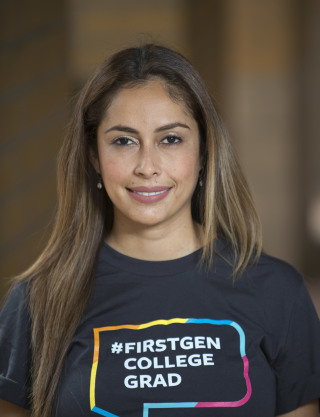
 Glenda Flores Steve Zylius / UCI Steve Zylius / UCI
While California was going through rapid demographic changes, the need for bilingual teachers also grew throughout the 1980s and 1990s, until bilingual education was eventually banned by law in 1998. However, the demand for these teachers, along with the shifts in population, had created a perfect storm of sorts that established a pathway for Latinas into the field.
California recently reinstated bilingual education with the passing of Proposition 58, ending the English-only teaching era that is sure to continue California's transformation. Today, California students are twice as likely than other Americans to speak a language other than English, at 45 percent.
Flores says she became interested in education, because growing up in Santa Ana she too thought about becoming a bilingual elementary school teacher. However, as she continued her education she got a Ph.D. at the University of Southern California and began looking at statistics, noticing the trends in Latina teachers. She began her research to see how these trends were impacting students and her research landed her a job as a professor at UC Irvine's Department of Chicano/a Studies.

Related

Recent headlines have focused on the political gains made by Latinas — in Virginia, Elizabeth Guzmán and Hala Ayala recently made history as the first Latinas elected to the state's House of Delegates, beating Republican male incumbents. Latinas made headlines in Santa Barbara, CA and Topeka, KS as well; Cathy Murillo became the first Latina mayor of Santa Barbara and Michelle De la Isla the first one in Topeka.
But leadership in government is not the only sphere impacted by growing numbers of Latinas running for office. Flores' research in Santa Ana, CA illustrates that our children's formative years will be increasingly shaped by Latinas, as well.

FOLLOW NBC LATINO ON FACEBOOK, TWITTER AND INSTAGRAM.

Monday, August 08, 2016

How to 'Grow Your Own' Teacher Workforce - SXSWedu Panel Proposal

Help us share our new text - Growing Critically Conscious Teachers - and promote the broader Grow Your Own Teacher movement before a global audience at South by Southwest—SXSWedu 2017. 

To support our work:  Create a PanelPicker account, and then Vote for our proposal.

The public voting period begins today—August 8, 2016.

Details:

While SXSW is known for showcasing new technology, research shows that all
too often, the excitement of innovation and constant change leaves many
Latino/a students, and other people of color stuck in the shallow end of
the tech pool.

Sadly, the same is often true for "innovation" within human resources, where market-based ideologies promote "efficiencies" that actually increase barriers between caring, committed, and critically conscious applicants within our communities, and school district hiring managers (Principals, HR Staff).

As a consequence, far too often our students of color are being led by
teachers who do not share their background, and are not prepared to
approach teaching from a critically conscious or culturally relevant
perspective.

However, within the SXSWedu conference, there are categories for both equality and leadership, and we plan to "share research and case studies that outline how innovative school districts disrupt traditional hiring practices to recruit and retain highly qualified, diverse teachers eager to embrace critical and culturally relevant pedagogies."

Please promote this important session, and hopefully you will be able to join us during Spring Break 2017 as we share this important research with a global audience of influential educators.


Thanks to EPP Doctoral student, Michael Barnes, for suggesting this together with this great under 2-minute presentation that I encourage you to listen to.

Angela Valenzuela, Ph.D., 
UT Professor and Director,
National Latino/a Education Research and Policy Project (NLERAP [pronounced "Nel-rap"]), the organization that originated this Grow-Your-Own Latina and Latino teacher education pipeline.

Wednesday, January 06, 2016

Book Announcement: Valenzuela, A. (Ed.) (in press). Growing Critically Conscious Teachers: A Social Justice Curriculum for Educators of Latino/a Youth


Blog Readers, Friends, and Colleagues:

I am happy to announce this edited volume, currently in press with Teachers College Press and the National Latino/a Education Research and Policy Project (co-pub.) (April, 2016, expected publication date) with a Foreword by Dr. Sonia Nieto and an Afterword by Christine Sleeter.  It is titled, Growing Critically Conscious Teachers: A Social Justice Curriculum for Educators of Latino/a Youth. View the wonderful endorsements below by Antonia Darder and Linda Darling-Hammond.

Thanks to all of the contributors (see Table of Contents below).  This has truly been a labor of love.

Many thanks, as well, to the gifted Latina artist, Tanya Torres, for her permission for me to use "Cacibayagua," this symbol of a Taino goddess, for the book cover.

It represents well what this volume conveys, namely, that growing critically conscious teachers isn't simply about creating pathways for them into the teaching profession, but also about growing consciousness—or concientización, as expressed by the late Brazilian educator, Paolo Freire.

Here are artist Tanya Torres' words about "La Cacibayagua."

Cacibayagua
by Tanya Torres

"From Cacibayagua came the majority of
the people who settled the island."
Fray Ramón Pané

I thought the cave Cacibayagua, from which the Taínos are said to have come, might be a place of earth and river water from whose veins flows life.

Cacibayagua is earth, and she is also water.
Like the Black Virgin, she is the color of the Earth.

Water, cave, virgin goddess, like the ancient
Goddess, mother of all.

The Relación of Fray Ramon Pane


Contents

Foreword Sonia Nieto 

Acknowledgments

Preface: Uses of the Handbook

1.   True to Our Roots: NLERAP and the Grow Your Own Teacher Education Institutes Initiative
Angela Valenzuela

2.   Teacher Capacities for Latino and Latina Youth
Carmen I. Mercado

3.   Teaching for Critical Consciousness: Overarching Topics, Themes, Frameworks, and Instructional Activities
Adele Arellano, José Cintrón, Barbara Flores, and Margarita Berta-Ávila

4.   PAR Entremundos: A Practitioner’s Guide
Julio Cammarota, Margarita Berta-Ávila, Jennifer Ayala, Melissa Rivera, and Louie Rodríguez
5.   Social Justice Education Project (SJEP): A Case Example of PAR in a High School Classroom 
Julio Cammarota

6.   Conclusion: El Árbol/The Tree: Returning to the Root 
Angela Valenzuela 

Afterword Christine Sleeter


Endorsements:
Growing critically conscious teachers: A social justice curriculum for educators of Latino/a Youth provides the elemental sparks for essential conversations about culturally responsive teaching and the well being of youth in our communities. Through a variety of critical perspective the volume raises significant questions that must be at the forefront of Latino education. This excellent volume is a must read for teachers truly committed to educational practices of social justice in schools today.
-->
Antonia Darder

Leavey Endowed Chair of Ethics and Moral Leadership

Loyola Marymount University


In this wonderful book, Angela Valenzuela and her colleagues have condensed a wealth of knowledge about how successful teachers of Latino/a children and other students of color, can be prepared and supported to transform their students’ lives.  Addressing some of the most pressing problems in teaching and teacher education, this inspirational collection is a must read for all who care about teaching for social justice.
 
-->
Linda Darling-Hammond
Charles E. Ducommun Professor of Teaching and Teacher Education
Emeritus at Stanford University and President of the Learning Policy Institute

You may learn about my other books and publications here.