Translate

Showing posts with label authentic learning. Show all posts

Monday, May 23, 2016

Portfolios hold new promise for schools

Good piece on portfolio-based assessment in Maine.  New free, online technologies like Google Tools suite make this actionable.  It addresses criticisms folks have of old-school assessment that made use of extensive, tedious binders that are no longer necessary with today's technologies that provide exciting possibilities for millennials today—many of whom come to school already "wired" for this.  It's the educators that need to get their skills upgraded, myself included.

Here's a good website that illustrates the use of Google Tools: Tactical Technology Collective

-Angela

Portfolios hold new promise for schools

New digital tools let teachers, students assess work more comprehensively


A teacher at Howe Elementary School in Wisconsin, above, shows a student the steps of how to submit a digital artifact into his own e-portfolio. (Photo: Photo credit: Digital Student Portfolios, Matthew Renwick/Thinkstock.com: 123dartist)
The 3,000 students in rural Maine’s Regional School Unit 19 begin compiling electronic portfolios of their schoolwork in pre-K, when the district issues every child a Google account.
In the elementary years, teachers snap and upload digital photos of handwritten work. In the upper grades, students accustomed to electronically documenting their school lives habitually upload essays and lab reports and record video of their oral presentations.
“By the time you hit middle school, the students are just doing it because that’s the way we do business,” says Kern Kelley, the Maine district’s technology integrator.

Decades ago, portfolio assessment—using samples of classroom work to document students’ progress toward learning goals—meant finding room for bulging binders stuffed with paper. But digital technologies that make it far easier to collect, curate, share and store student work have dismantled the physical barriers that once made portfolio assessment daunting. Schools are now taking a fresh look at the practice.

“The technology is so powerful,” says Mark Barnes, a former Cleveland-area teacher who now runs educational publishing company Times 10. “It gives educators an opportunity to create an ongoing conversation about learning.”

A new climate

Artists have always carried work samples in portable cases known as portfolios, and in the 1970s and 1980s, progressive educators began incorporating the idea into assessment programs. In the 1990s, Vermont and Kentucky experimented with statewide portfolio assessment systems, with mixed results.
State-level experimentation largely ended in 2002, when the federal No Child Left Behind Act (NCLB) ushered in a demanding annual standardized-testing regime. States abandoned alternative assessments, including portfolios, in favor of multiple-choice tests, says Stuart Kahl, founding principal of assessment company Measured Progress.
But the national climate has changed. Common Core and the state-level academic standards based on it stress the higher- order thinking skills and project-based learning that advocates say portfolio assessment promotes. NCLB’s replacement, the Every Student Succeeds Act (ESSA), permits states to incorporate alternative methods, including student portfolios, into their annual assessment programs.
ESSA takes effect amid a growing backlash against federally backed Common Core-linked standardized tests. That pushback, advocates say, won’t change portfolio assessment systems, which are often locally developed and designed to respect individual, non-standardized choices.
“When you can show parents a product, like an essay that started as a rough draft and was really clunky and then you show the growth, it’s a big win,” says Marty Creel, who started a pilot program as an administrator in Maryland’s Montgomery County Public Schools. “You don’t see people opting out of portfolio assessments.”
Whether they document the learning process or showcase the final product, portfolios offer richer insights than a set of test answers can, advocates say. “It’s an actual reflection of real work, rather than something that’s contrived and inauthentic,” says Robert Kuhl, principal of High Tech High Media Arts, a San Diego charter school.
Choosing which items to include in portfolios requires students to think about their own development in a way that traditional assessments don’t. “The portfolio is really the students showcasing their work, their growth over time—telling their own story of their learning,” says Helen Barrett, a retired education professor at the University of Alaska-Anchorage.
And unlike standardized tests, which parents and teachers often see as time- consuming distractions, the work showcased in a portfolio grows directly from classroom instruction. Portfolios are “inherently more fair and more useful” than standardized tests, Kuhl says. “The tests are incredibly discriminatory, and they’re a poor measure of whether or not one should graduate from high school,” he says.

User-friendly technology

With the aid of user-friendly and often low-cost technology, schools are turning to digital portfolios to track assignments, communicate with parents, and help students reflect on their own educational progress.
Using free software like the Google Tools suite, or fee-based online systems offered by various companies, students can compile portfolios that include everything from essays on Shakespeare to photos of ceramics projects to videos of a state championship sports game. And digital portfolios stay with students as they move through school and graduate, possibly providing raw material for college applications and resumes.
In Maine’s Regional School Unit 19, teachers take photographs of handwritten work using digital cameras equipped with special memory cards that wirelessly upload pictures. The district is experimenting with Wi-Fi equipped pens that can send teachers digital copies as students work through math problems.
Each year, students build voluminous electronic archives out of which they curate a smaller set of required assignments, entering links to each item into a spreadsheet that teachers can access at grading time. Students can access the same links later, for a refresher on past material. “Basically, a student is building their own knowledge base of everything they’ve ever done, and it’s a click away,” says Kelley, the technology integrator.
At 350-student Howe Elementary School in the Wisconsin Rapids Public Schools in Wisconsin, teachers use the FreshGrade electronic portfolio system to document six writing assignments each year.
Teachers can upload photos of young children’s handwritten work, audio of students reading their own compositions aloud, or video of conversations between teachers and students about their writing strengths and weaknesses.
Then, parents receive electronic notifications on their smartphone or computer of the postings and can access their children’s portfolios. “It has given parents a broader view into how their child is doing,” says Principal Matthew Renwick. “Parents aren’t just looking at a test score.”
In rural Grandview School District in Washington state, Grandview High School’s college and career readiness program requires every student to undergo a pre-graduation “exit interview” with a panel of community volunteers.
Students can draw on their digital portfolios—which include work samples, SAT scores and reflections on required job-shadowing assignments—to answer questions about their high school experience and future goals. “As we know as professionals, we have to be able to sell ourselves and be proud of the work that we have put forth,” says principal Kim Casey.

Drawbacks, challenges

Portfolio assessment has its challenges. Teachers need training in how to use digital platforms and how to plan assessments so they can provide students with “actionable feedback,” rather than just a number or percentage from a test, says Creel, now Discovery Education’s curriculum and instruction team leader.
Portfolio assessment remains principally a classroom- or school-based approach. And teachers and educators can expect high hurdles if they try to use it as a broader-based accountability tool. Such hurdles can be practical—Vermont’s 1990s-era portfolio assessment system encountered problems ensuring school-to-school consistency in grading.
But the barriers can also be philosophical: Portfolio assessment is designed to record student growth, encourage reflection and honor the idiosyncrasies of personal choice—not to promote standardization and uniformity.
Indeed, that’s the very source of its power, advocates say. Portfolio assessment “is more time-consuming than putting scan sheets through a computer,” says Barrett, the retired Alaska professor. “But on the other hand, from the student’s point of view, it’s much more rewarding. And who are we trying to benefit anyway?”

Deborah Yaffe is a freelance writer in New Jersey.

Wednesday, January 06, 2016

Book Announcement: Valenzuela, A. (Ed.) (in press). Growing Critically Conscious Teachers: A Social Justice Curriculum for Educators of Latino/a Youth


Blog Readers, Friends, and Colleagues:

I am happy to announce this edited volume, currently in press with Teachers College Press and the National Latino/a Education Research and Policy Project (co-pub.) (April, 2016, expected publication date) with a Foreword by Dr. Sonia Nieto and an Afterword by Christine Sleeter.  It is titled, Growing Critically Conscious Teachers: A Social Justice Curriculum for Educators of Latino/a Youth. View the wonderful endorsements below by Antonia Darder and Linda Darling-Hammond.

Thanks to all of the contributors (see Table of Contents below).  This has truly been a labor of love.

Many thanks, as well, to the gifted Latina artist, Tanya Torres, for her permission for me to use "Cacibayagua," this symbol of a Taino goddess, for the book cover.

It represents well what this volume conveys, namely, that growing critically conscious teachers isn't simply about creating pathways for them into the teaching profession, but also about growing consciousness—or concientización, as expressed by the late Brazilian educator, Paolo Freire.

Here are artist Tanya Torres' words about "La Cacibayagua."

Cacibayagua
by Tanya Torres

"From Cacibayagua came the majority of
the people who settled the island."
Fray Ramón Pané

I thought the cave Cacibayagua, from which the Taínos are said to have come, might be a place of earth and river water from whose veins flows life.

Cacibayagua is earth, and she is also water.
Like the Black Virgin, she is the color of the Earth.

Water, cave, virgin goddess, like the ancient
Goddess, mother of all.

The Relación of Fray Ramon Pane


Contents

Foreword Sonia Nieto 

Acknowledgments

Preface: Uses of the Handbook

1.   True to Our Roots: NLERAP and the Grow Your Own Teacher Education Institutes Initiative
Angela Valenzuela

2.   Teacher Capacities for Latino and Latina Youth
Carmen I. Mercado

3.   Teaching for Critical Consciousness: Overarching Topics, Themes, Frameworks, and Instructional Activities
Adele Arellano, José Cintrón, Barbara Flores, and Margarita Berta-Ávila

4.   PAR Entremundos: A Practitioner’s Guide
Julio Cammarota, Margarita Berta-Ávila, Jennifer Ayala, Melissa Rivera, and Louie Rodríguez
5.   Social Justice Education Project (SJEP): A Case Example of PAR in a High School Classroom 
Julio Cammarota

6.   Conclusion: El Árbol/The Tree: Returning to the Root 
Angela Valenzuela 

Afterword Christine Sleeter


Endorsements:
Growing critically conscious teachers: A social justice curriculum for educators of Latino/a Youth provides the elemental sparks for essential conversations about culturally responsive teaching and the well being of youth in our communities. Through a variety of critical perspective the volume raises significant questions that must be at the forefront of Latino education. This excellent volume is a must read for teachers truly committed to educational practices of social justice in schools today.
-->
Antonia Darder

Leavey Endowed Chair of Ethics and Moral Leadership

Loyola Marymount University


In this wonderful book, Angela Valenzuela and her colleagues have condensed a wealth of knowledge about how successful teachers of Latino/a children and other students of color, can be prepared and supported to transform their students’ lives.  Addressing some of the most pressing problems in teaching and teacher education, this inspirational collection is a must read for all who care about teaching for social justice.
 
-->
Linda Darling-Hammond
Charles E. Ducommun Professor of Teaching and Teacher Education
Emeritus at Stanford University and President of the Learning Policy Institute

You may learn about my other books and publications here.

Saturday, October 31, 2015

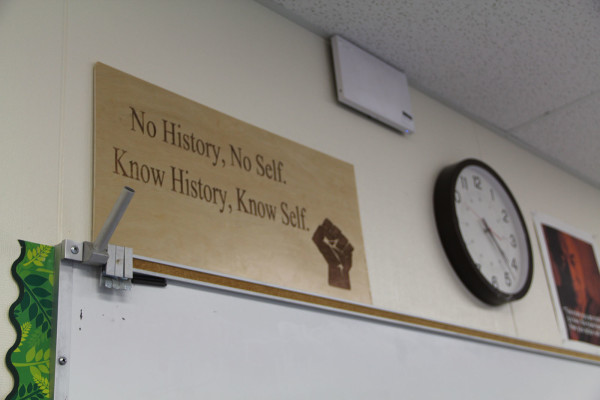
“No History, No Self. Know History, Know Self.”

“No History, No Self. Know History, Know Self.”

This is the sign that appears on Leona Kwan's ethnic studies classroom in Oakland Unified School District's (OUSD).  It could be a slogan for the ethnic studies movement that has gained momentum across the United States, most especially Texas and California.  Although it has been inspired by the struggle over Mexican American Studies in Tucson Unified, it is a deeper, decades-long struggle that finds expression in the presence of Mexican American Studies programs and departments in universities nationwide.

To wit, many of us in Texas are organizing through our National Association for Chicana and Chicano Studies (NACCS) Tejas Foco statewide organization that hosts an annual conference taking place this February18-20, Lone Star College-Kingwood with a focus on the preservation of "traditions, oral history, customs, dichos, folklore, language, food, religion, literature, music, education, folk art, Chicana/o history and how they affect our everyday lives and identity." Simultaneously, February 17-20 the Texas Association for Chicano in Higher Education (TACHE) annual conference is also taking place with a similar focus: ¡Adelante! Latinos on the Rise: Remembering our Past, Leading our Future.  A recent statewide conversation on merging the bilingual education and Mexican American Studies agenda spearheaded by Texas State University professor Dr. Christopher Milk also took place in El Paso, Texas, at the Texas Association for Bilingual Education's annual meeting.
 
NACCS Tejas Foco has become a very large, well-attended conference in Texas due in no small part to the excitement of teaching Mexican American Studies at all levels of the educational system in Texas.  While we still have to fight for inclusion at the State Board of Education level, as well as in textbooks, generally, our community doesn't have to wait for our officials to do the right thing in the meantime.  And this is what is happening in California, too.

While it is regrettable that on October 9, 2015, Governor Jerry Brown vetoed a bill (authored by Assemblyman Luis Alejo) calling for ethnic studies statewide in California despite its support by state senate and house Democrats, school districts are nevertheless taking a lead.  In OUSD—as in San Francisco, LAUSD, Pico Rivera, and most University of California campuses—the policy only requires its teaching of it at the high school level, but encourages it at elementary and middle school levels.

This is a great piece on so many levels.  It speaks to the value of ethnic studies, generally, and specifically, to Oakland Unified School District's (OUSD) take on it: Not anyone can teach it; and it's as much about the content as it is about the authentic caring relationships between teachers and students.  This approach helps children to feel both powerful and seen.

Angela Valenzuela
c/s

Ethnic studies courses to be offered at all OUSD high schools

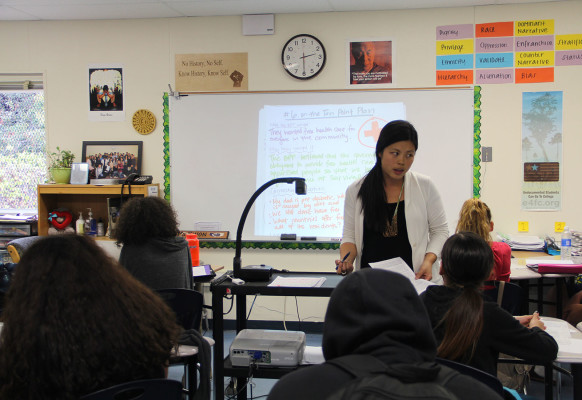
Leona Kwon, the ethnic studies teacher at Castlemont High School, explains an assignment to her students.
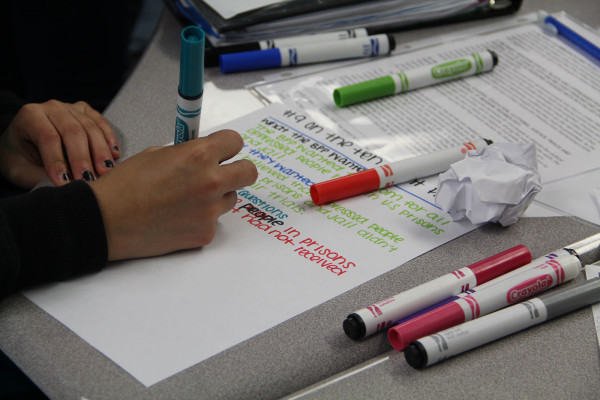
Students work in pairs, sheets of paper littering their desks. Each pair is assigned to dissect a different section of the Black Panther Party’s Ten-Point Program. Posters of Malcom X, the Dalai Lama and Che Guevara line the walls. A wooden sign above the whiteboard, made by a former student, reads “No History, No Self. Know History, Know Self.” In this Castlemont High School ethnic studies classroom, that’s the objective: gaining knowledge of one’s history and community helps students feel more connected and empowered.
“In terms of social studies content, there is no content that is more directly relevant to students’ lives or more academically rigorous,” said Leona Kwon, an ethnic studies teacher at Castlemont. “There might be these words that are really big, like ‘institutional oppression,’ but once you explain the concept, students can understand that right away because it reflects so much of their lived experience.”
Thanks to an Oakland Unified School District (OUSD) school board vote Wednesday night, within the next three years ethnic studies classes, like this one, will be offered at all Oakland high schools. The course may count as an academic graduation credit, and though the policy does not specify the course will be a graduation requirement, the possibility has been discussed by the board in previous meetings.
According to the district’s new policy, presented to the board by Young Whan Choi, civic engagement coordinator for OUSD, ethnic studies courses create “higher overall academic achievement, boosts in social emotional learning, increases in self-efficacy, higher graduation rates, and a reduction in drop-out rates.” The policy encourages elementary and middle schools to incorporate an ethnic studies curriculum, but will only require district high schools to offer the course.
The course, a general survey that will cover the histories of many groups of people, will be piloted by a small group of teachers during the 2016-2017 school year. A group of teachers is currently updating the framework for ethnic studies that will be used by teachers to develop the curriculum for their schools.
Recently, both local and statewide initiatives pushing schools to offer ethnic studies courses gained ground. This fall, San Francisco public schools began to offer ethnic studies classes in all high schools. However, on October 9, Governor Jerry Brown vetoed a bill, authored by Assemblyman Luis Alejo (D-Salinas) and supported by state senate and house Democrats, calling for the creation of a statewide ethnic studies curriculum.
For the OUSD, specific details about the proposed curriculum are not set in stone. At Castlemont, one of the few schools in the district that now offers an ethnic studies course, all 9th grade students take the class taught by Kwon, which she has taught for five years. Throughout the year, she focuses on concepts like personal identity and systems of privilege, which helps students think about how the different parts of their identities can effect their personal experiences and understand those experiences within a historical context. The course also focuses on the idea of race as a social construct—or that individuals who share a particular racial identity can be very physically diverse—and discussion of levels of oppression within society.
After taking the ethnic studies course, students “are able to place themselves within a historical context” said Kwon. “Through ethnic studies, they have such a better, more critical understanding of how society functions, both currently and historically, that is also very, very empowering.”
Michelle Flores, a 10th grade student at Castlemont, believes that her experience last year in Kwon’s classroom was key to her growth as a student and an individual. “Most people don’t know the real history. They know the dominant narrative,” said Flores. “It made me want to prove the stereotypes wrong. It made me want to give back to my community and teach my community about all the oppression that we’re going through, especially institutional oppression.”
“It just opened my eyes to the world,” said Taejin Kim, another 10th grade student at Castlemont.
“And now every time we see a Disney movie, it’s like ‘Whoa, they just said something racist there!’” said Flores.
Students from other OUSD high schools have also called for ethnic studies courses. At the October 14 school board meeting, student director Darius Aikens expressed his interest. “It gives students the ability to feel powerful,” said Aikens. “I don’t have ethnic studies at Oakland High, but I would like to have ethnic studies at Oakland High.”
One of the challenges the board has faced as it considered including ethnic studies in the curriculum at all Oakland high schools is finding the right teachers for the course. At the October 14 meeting, staffing was a main concern cited by board members. Director Hinton-Hodge (District 3) recalled the beginnings of the African American Male Achievement Initiative in 2010, a program dedicated to addressing the needs of African American students by offering an after-school mentoring program focusing on African history and culture. According to Hodge, before the program was introduced, African American students did not feel like they were being acknowledged or being given equal access to opportunities in the general education classrooms.
“Young people, young black boys, didn’t feel as though they were seen. They didn’t feel like people valued them, they didn’t feel as though that they could really learn,” Hodge said.
Hodge, who also said she was excited about the possibility of developing a system-wide ethnic studies curriculum, said she wants staffing to be carefully considered. “I don’t want to be pessimistic by any means, but I don’t want to see an investment in a curriculum when people don’t authentically care … with their heart and really love each one of our children who walk in there.”
“Not just anybody’s going to be able to teach this,” said Director Torres (District 5). “So we don’t want anybody saying, ‘Well I need a job and there’s this opening so I want to do this work.”
Kwon’s students say she is fully invested in creating a welcoming space for her students. “She’s really passionate about her job—that’s what makes her so amazing,” said Flores. Both Flores and Kim mentioned times when they missed class and immediately received a text from Kwon asking if they were OK.
Compassion like Kwon’s students see in her might benefit any classroom culture, but for an ethnic studies class, where issues like privilege and oppression are frequently discussed, sensitivity is key, Kwon says, and it is important that her classroom remains a safe space. “So much of ethnic studies is not just the content you teach, but how you teach it,” said Kwon. “It comes down to your relationships and sort of the culture you set up in your classroom.”

Monday, July 06, 2015

This Is What a Student-Designed School Looks Like

This newly created high school (school within a school) in Great Barrington, Massachusetts deserves a close read and I also recommend listening to the 14-minute, student-developed video below.

It's called the "Independent Project," which is somewhat misleading because while appropriately focused on students' motivations, passions, and cultivating their talents and developing new ones, it is also very oriented to the collective—important and germane to 21st century work environments, as well as to a humanitarian, critical, democratic, and social justice framework.

While this "experiment" may seem and feel new, radical, and totally organic—especially to the students, faculty, and leadership—it is actually recasting a research-based approach that already exists—most notably, among the New York Performance Standards Consortium (NYPSC) schools. Although they do administer a standardized test beginning in the 11th grade that the students must pass to graduate (i.e., most typically the English Language Arts Regents exam), the NYPSC schools otherwise get an annual waiver from New York's regimen of standardized tests—an affordance that is not available anywhere else in the country, at present, under NCLB.

I am personally familiar with three of these schools and find them to be nurturing, rigorous, intellectually challenging places, and "high stakes" in ways that map on well to the Independent Project discussed herein. In these environments, students are held accountable for their learning and their ideas and they must be publicly defensible. For more information, check out "New York Performance Standards Consortium Fact Sheet" (January 28, 2014). Also check out this earlier, related blog post In Kentucky, Moving Beyond Dependence On Tests.

Far from anything close to "educational anarchy," this school is engaged in serious project-based learning (PBL) that consists of both authentic learning opportunities for youth and authentic assessment which I fully support and again, is research based. Assuming that this school in Massachusetts actually has no connection to NYPSC schools or literature, what is really encouraging and pleasing is that the very model of schooling that these students "independently derived," already exists and with great success. Most positively, this approach suggests what could be a new, valid direction in public school reform.

Incidentally, Texas, State Rep. Mary Gonzalez actually had a bill along these lines (HB 406) in the last legislative session that would have created a pilot program of select high schools in select districts to develop and implement schools like these. Unfortunately, however, the bill did not come out of committee so we'll have to continue pursuing this for the next legislative session in 2017.

In any case, PBL and authentic learning and assessment have served NYPSC high school students quite well, resulting in dramatically better outcomes for all students, despite the greater presence of special needs children than in the general population. To wit, these schools evidence higher attendance, graduation, and college attendance rates than the general school population in New York City.

As a reform measure in what is also called, "inquiry-based learning," it must get coupled with smaller class sizes, individualized instruction, teacher planning time, and professional development opportunities. (There's a lot more to this, but this give you an idea of just how involved a move in this direction is.) In NYPSC schools, it's hard to get lost and fail. It practically creates a system where student failure is mythic. It's not so much whether you graduate, but when. In short, making schools learning friendly, curriculum friendly, teacher friendly, and student friendly holds tremendous promise for all the outcomes that we care about in education.

I can see how this idea could get hijacked by those wanting to eliminate public education (extreme homeschooling?) or who rhetorically misrepresent this as either "lacking in accountability" or as schools no longer needing teachers, justifying less investment in teachers or teaching. Actually, the opposite is true: A whole lot more is expected of teachers; they're just needed differently—more as facilitators, coaches, and guides—together with an enhanced capacity to truly evaluate youth where the latter is not an event—as it is under the current system—but rather an everyday affair. Particularly with the amount of time that it will take to make a shift like this in a way that is valid from a research-based perspective, is actually not a call for less, but rather more teacher work and involvement and as a corollary, greater district investment in teachers' professional development.

There is no reason why our entire state or country could not move in this direction. We have been so ensconced in our high-stakes testing and accountability systems that we have a lot of un-learning and new learning to do. We also know that this will not happen overnight. That's why a pilot study that is time delimited, transparent, with an evaluation, up for state review, and so on is a good first step for Texas. In fact, we should begin right now organizing learning communities on assessment that are inclusive of district leaders, teachers, community members (the key stakeholders of the reform), and our universities where much of this knowledge and memory of inquiry-based education exists.

We need state leaders like Representative Gonzalez in the legislature and in our school districts and communities far and wide to say, "Yes, we want to be accountable...yes, we seek equitable educational outcomes and better schools, but we need to make a fundamental shift in how our students are assessed." These inquiry-based approaches to education are definite signposts to not only a brighter—but also an immensely do-able, future.

-Angela Valenzuela

This Is What a Student-Designed School Looks Like

by Luba Vangelova /July 14, 2014


Independence Project/ image from Charles Tsai's movie
The Independent Project/ image from Charles Tsai’s movie
When Sam Levin was a junior at Monument Mountain Regional High School in Great Barrington, Mass., he realized that two things were in short supply at his school: engagement and mastery. He also noticed that he and his peers were learning plenty of information, but not much about how to gather or create their own data. And he noticed that students were unhappy. So he took it upon himself to design a school where students would feel fully engaged, have an opportunity to develop expertise in something, and learn how to learn.
“He came up with a plan where the core areas could still be studied, but in a way where students were more of the driving force,” explains guidance counselor Mike Powell. The administration decided to take a chance on a semester-long pilot project, and The Independent Project debuted in the fall of 2010.
The pilot involved eight students — sophomores, juniors and seniors — chosen on the basis of written applications and interviews. “The idea was that it was for students who could manage their time well, were looking for something more than the traditional program, and had a passion for learning,” says Powell, who served as the group’s primary adviser. Academic performance didn’t matter — the group included straight-A students as well as students who were failing many of their classes. The group was fairly diverse in other ways, too, with the students hailing from a range of blue-collar and white-collar family backgrounds.


Their time, other than daily group meetings, was theirs to manage. “This was pretty unheard of — teens being alone most of the day,” Powell notes.
They explored math, science, social science and literature topics that interested them, choosing one question each week, researching it, and presenting their findings to the group. They also chose books to read, discuss and write about in some form; worked on a semester-long individual project on a subject that excited them (the only requirement was that the project require effort, learning and mastery); and collaborated on a three-week-long group endeavor (they decided to make a video about education and their project). They were responsible for giving a final presentation about their project, which helped to give them a specific goal to work toward.


Sam Levin, creator of the Independence Project.
Sam Levin, creator of the Independent Project.


As the adviser, Powell checked in with the group every morning; he also offered logistical support and helped the students locate resources. Three other faculty members — a science teacher, a math teacher and a social science teacher — served as an advisory committee, meeting with the students for one period a day to help them in whatever way was needed, such as to talk through some of the more complex ideas presented in a research book. The students also consulted other teachers and outside experts as needed. When members of the community were asked to share their knowledge, “the vast majority of the time, they came running,” Powell says.

CHALLENGES ALONG THE WAY
The program encountered some bumps. “We struggled with how to do peer-to-peer constructive criticism,” Powell says. “It’s a bit different in a classroom, where there’s a teacher setting boundaries and helping create structure. They found doing that with peers challenging. But that was a big part of the program—they had to be accountable for what they were doing. … They’re teens, so to think that at that age they will always make good choices and manage their time well is not realistic. Even adults aren’t like that.”
It was also difficult for some other faculty members to accept that students were earning credit for such an amorphous undertaking. So the group tried to be transparent and made their final presentations — which ran the gamut from performances to cooking a large meal — open to the public.
At the end of the semester, “everyone was satisfied – the parents, the students, and the school,” Powell says. The project’s “White Paper” notes that parents “were very aware of what was going on in the program because the kids were talking about school at home much more than they ever had in the past.”
“There were so many moments where you could see students being inspired,” Powell says. “And they learned that with that much control comes a great deal of responsibility, to manage time and be accountable.”
The school chose to continue the program, which runs for one semester each year and involves nine to 12 students who receive credit and a pass/fail. “It was really risky, because we didn’t know how colleges would interpret this on a transcript,” Powell says. “But so far we’ve had only an overwhelmingly positive response,” including from highly selective colleges, such as Oxford and Williams, that have accepted graduates.
Nevertheless, not a lot of students apply to participate in the project. “They know it involves more work [than taking regular classes] and that they have to push themselves to do it,” says science teacher Daniel Gray, who served as the group’s primary adviser this year. (He also had prior experience with this type of model—he had studied democratic education and then helped introduce some of those principles to a public middle school.)
Most high school students are neither interested nor ready for such an experience, he says. But he adds: “I think that if they had been given progressively more responsibility over the years, they would be ready. My seventh- and eighth-graders, after a year or two, they got it, and they were more mature than you would expect them to be at that age.”
APPLYING LESSONS LEARNED
Although some teachers at Monument Mountain remain skeptical, the majority of them now support the program. Some have even copied elements of it, for example letting English students choose which books to read. It has also spawned “positive” discussions about the most appropriate role for teachers, Powell says.
There have been a number of refinements over the years. One has been to hold the program in the spring, to avoid a sudden and tough transition back to taking regular classes where students can no longer control what they’re learning. And the number of faculty assigned to the project was reduced to three and then (for scheduling reasons) two. Each group has also introduced its own twist — this year the students had even more leeway and no subject-area requirements. The constants have been the weekly research question, the books component, and the individual endeavor, which has ranged from vocational pursuits such as building a kayak, to artistic tasks such as writing a novel, to scientific explorations such as examining how Western and Eastern medicine deal differently with Lyme disease.
Securing assistance from teachers sometimes proved challenging. “It’s something most students aren’t used to doing,” says Logan Malik, a just-graduated senior who organized the program this year. “Instead of a teacher telling you what to do, you’re telling the teacher what you’re learning, what you want information on, and when you want to meet. And then they would have to do some prep.” Nevertheless, “teachers were very willing to help us, even if it was on their own time.” (The students also served as “a first-grade support group for each other,” Gray says.)
Although he’s heading to college to study pre-med, Logan’s individual endeavor this spring was to learn classical guitar. He watched a YouTube tutorial to learn the proper fingering and then practiced about four hours a day. He says he would never have been able to dive into the activity like this if he’d continued with his rigorous course load, and learning it over a summer wouldn’t have been as productive without a group and some structure. The Independent Project work kept him busy, he says, “but the busy-ness was easier to get through, compared to slaving through something you don’t want to be doing and don’t value as much.”
The stress was also less, because the evaluations (other than the final pass/fail) were formative rather than summative — intended not to judge, but to help students improve their work.
It was challenging sometimes to stay on task to meet deadlines that were not enforced by authorities, Malik says, “but we did well overall.” The students tried to be flexible and fair, and to account for the natural ebb and flow in people’s attention and motivation levels, as well as unexpected complications. Extensions were granted to students who asked for more time to research a question. “Once the person was given an extra week, they felt they needed to do more, and they worked hard,” Malik notes. Other times individuals were given a pass to give them a chance to get back on track. In the past, when tensions have arisen or the group’s energy has seemed particularly low, the group has literally taken a hike, while discussing their goals and potential improvements to the program.
Malik enjoyed many of his regular classes and sees this program as a complement rather than a complete replacement for them. “For a lot of subjects, like chemistry, it’s good to be taught by someone, so the structure of the class helps. And in social science, it’s good to be introduced to ideas by someone who understands those ideas really well.” But The Independent Project offers benefits that aren’t available in an adult-led classroom, he adds. “It really establishes an idea of what self-motivation is. There is critiquing, but it all comes back to you. That’s really valuable.”

CHANGES IN STUDENTS
Students who have gone through the program ask more questions and have a greater awareness of how to answer them; construct their questions more carefully; became more thoughtful in the way they consider ideas and evaluate sources; and became better at managing their time.
The “White Paper” also notes that the project instills a “sense of ownership of their education has stayed with the students long after the program ended. Although some students have continued to struggle academically, feedback from parents has suggested that they are pursuing more interests outside of school than they were before The Independent Project.”
It continues: “That is not to say no one will fail; any program or system will contain failure. In fact, in the pilot of the Independent Project one student struggled to complete the work, and did not receive full credit for the program … The goal, then, is to not make The Independent Project so that no one fails, but to make it so fewer people fail than in the current system, and to make success in The Independent Project carry more intellectual meaning than success often does in the current system.”
The program doesn’t require a lot of additional resources, and other public schools have visited Monument Valley to find out how to replicate it. (A professional filmmaker has also produced a video about it.) Powell says it requires administrators who are open to focusing education on students, rather than teachers or a curriculum. But he offers a caution: “Because the focus is on the student, that’s where you need to start. This came from a student and was pushed by him, through all the red tape. A program like this probably won’t be terribly successful if it’s teacher-driven. If a group of adults want to replicate this, … I would have conversations with the students about it, and see how they respond and where they take it. If students are interested in the concept, it will guide itself.”
Meet some of the students in this video created by Charles Tsai.


Friday, March 13, 2015

A. Maceo Smith New Tech High School - Uptown Funk Dance

Thanks to Dayna Martin who operates her own blog for sharing.  This awesome, shared dancing experience took place at A. Maceo Smith New Tech High School in Dallas, Texas let by theater teacher Scott Pankey (scroll down to view). I love this teacher's straightforward description of project-based learning (PBL):

 “We are a project-based school — there are only two in the
Metroplex — and that means you give the students a project, put them in
teams, and they have to come up with solutions. They had three weeks to
work on it, then present as a group what they learned.”
 PBL is apparently being practices in two Dallas schools only and in many educators' opinions, needs to go nationwide as an alternative to our current high-stakes testing status quo.  PBL poses a challenging problem or question that enables a capacity for sustained inquiry.  It's an authentic, meaningful kind of question or problem that engages students' voice and agency.  Reflection, critique, revision, mid-course corrections—again, sustained inquiry is key.  

At its best, and as a part of what is meant by authentic learning, it not only engages issues that are personally meaningful to youth, but it also engages a public issue that is further assessed in some form by the public.  This could be a dissertation-like defense of one's "product" that brings in our community as observers/evaluators of this work (now that's authentic accountability!) or it could be one where—as in a project like this—the whole world can literally see what got learned, produced, developed, co-constructed in a school classroom (or classrooms) in a way that marries assessment with creativity, and products (or "deliverables") with community and help make the world a more fair, beautiful, interesting, and better place for all.  

Plus, knowing beforehand that the world is going to gain access to this product is truly as "high stakes" as you can get—but in a meaningful kind of way.  It's being "accountable" in a different kind of way—one that challenges youth and connects to their experiences rather than labeling and demoralizing them as the current high-stakes testing status quo does.

We can actually work to build a policy framework for this.  Several of us are in fact doing so currently in the Texas State Legislature with State Rep. Mary Martinez' House Bill 406 that should see the light of day soon.

I think that most of you will agree that all children and youth under the guidance of prepared, committed teachers like Mr. Scot Pankey can learn at high levels if we will only give our schools, teachers, and students a chance together with the preparation, space, time and resources to do so.

-Angela

#pbl #TxLege #LatinoEdu #EdPolicy

Pop Culture Blog

Bruno Mars on A. Maceo Smith teacher, students’ ‘Uptown Funk’ video: ‘I cried’


Published: