Translate

Showing posts with label TACHE. Show all posts

Tuesday, September 11, 2018

Chicana(o) Studies and the Creative Activity of Being

Cool statement in the column below by Gustavo Arellano on Cal State L.A.'s Department of Chicana(o) and Latina(o) Studies, celebrating its 50th anniversary.  

"Chicana(o)" itself draws unnecessary criticism, primarily because it isn't an identifier for many who call themselves "Mexican American," "Latina/Latino," or "Hispanic."  It's a regional term to a great extent with Chicana(o) being more of a California, than Texas, term, but which is also used throughout the Southwest, and to some extent, in Mexico, too.  I don't want to understate any of this as "Chicana(o)" is still a viable term today, Texas included.  Take for example, the Chicano/Hispanic Law Students Association at the University of Texas at Austin, or Chicana/o Studies at The University of Texas at El Paso. Many of us also regularly use the term either in our teachings or as a matter of course.

However, it's also a generational term associated with civil rights, as reflected in organizations today like the Texas Association for Chicanos in Higher Education) which was founded in 1974 in the heyday of the "Chicana(o) Movement" (also referred to as the "Mexican American Civil Rights Movement").

I became a "Chicana" back in the early 1970s when I was in middle school in my West Texas hometown of San Angelo.  I was already a Mexican American, but I chose to identify with the Chicana(o) Movement not only because my family, especially my grandparents, were always involved in the defense of civil rights in my hometown community, but also because it connected me to the Mexica (pronounced "Me-shica" [or "Aztecs"]) which is believed to be the source of the term: "Me-xicana(o)" became "Xicana(o)," or Chicana(o).  (Note: There are other theories on the origins of the term, but this seems to me to be the most logical.)

According to Mexico's census bureau, Instituto Nacional de Estadísticas y Geografía (INEGI), in 2015,  25,694,928 people in Mexico, or 21.5% of Mexico's population, self-identified as indigenous, with well over 1.5 million speakers of Nahuatl, the language of the Mexicas, alone.  That is why the migrant stream tends to be more darkly hued, rather than fair-skinned.  Despite their construction as "immigrants" in the context of a nation state that is itself a modern idea that represents the smallest part of the history of peoples native to this continent, they are actually "migrants" that have always navigated the continent, North and South, East and West sin fronteras, without borders.

That said, for many Chicana(o)s, "Aztec" is a metaphor for the deep, ancestral identification with, and connection to, the peoples of this continent, as a whole.

As with all Ethnic Studies courses, in general—and as the column below lays bear—despite its critics, Chicana(o) Studies is unapologetic and here to stay.  

Chicana(o), or Mexican American Studies, moves our youths' imaginations away from paralysis and powerlessness toward "the creative activity of being" as eloquently expressed by Lugones (2010) in her pathbreaking analysis of gender.

Shouldn't this be what all education is about?

Thanks to Juan Tejeda for sharing.

Angela Valenzuela


Up for a fiesta? On Thursday, Cal State L.A. will hold a shindig complete with a mariachi, a new song by ’70s punk icon Alice Bag, and a keynote speech by labor activist Dolores Huerta. The occasion is the 50th anniversary of the school’s Department of Chicana(o) and Latina(o) Studies — their grammar, not mine — the nation’s first such department.
The nostalgia will be heavy, but so will the sense of accomplishment. Although college attendance rates for Latinos are still too low, Cal State L.A. showed a partial solution that still works: education by Chicanos, for Chicanos, to improve themselves and the community as a whole.
There’s always been a cadre of critics of the ethnic studies concept, but Chicano studies has drawn particular disdain because of that unapologetic approach. Opponents claim this type of curriculum teaches students to believe they’re perpetual victims of white America and preaches self-segregation and seditious behavior. Writer and historian (and Cal State Fresno professor emeritus) Victor Davis Hanson is typical of such naysayers; he once wrote that programs “too often graduated zealous advocates who lacked the broad education necessary to achieve their predetermined politicized ends.”
In other words, Chicano studies just creates dumb activists.
I used to be such a skeptic. I ridiculed Chicano studies as achieving little more than inspiring third-generation Mexican Americans from Whittier to change their name to Xipe or Xochitl from Bryan or Yennifer. And there remains a strain of quien-es-mas-woke groupthink among scholars that I find counterproductive and a waste of time.
There’s always been a cadre of critics of the ethnic studies concept, but Chicano studies has drawn particular disdain because of that unapologetic approach.
But on its golden anniversary, it’s time to recognize Chicano studies not as a movement apart from the state, but very much of California. Cal State L.A. sparked a revolution that extended far beyond the ivory tower.
My epiphany came earlier this decade, when Cal State Fullerton’s Chicana and Chicano Studies Department invited me to teach a class on the history of Mexican Americans in Orange County. Over a semester, I taught students hidden histories and forgotten heroes — and then made them ask why those stories never made it into the official narrative of Southern California. Why, for instance, do city fathers and amateur historians pass off O.C.’s era of citrus ranching as a bucolic, fragrant yesteryear — but skip over the Mexicans who picked oranges and lemons for pennies and were forced to live in segregated communities? Why do they accuse Chicano studies professors who expose such nasty aspects of being historical revisionists? Indeed, who is the revisionist in this context?
By teaching Chicano studies, I learned its real agenda. Its mandate is to push students to explore, question and act based on empirical truth, no matter how inconvenient that may be to others. We expect them to come away with a sense of pride in an ethnic group long disparaged. And although my fellow teachers may be loath to admit it, Chicano studies’ ultimate purpose is to instill a bootstrap philosophy even conservatives can love: Help your community by first improving yourself.
That mentality worked wonders. Mexican Americans wrote themselves into history books as something other than gay caballeros, evil bandidos, spicy señoritas or faceless farmworkers. As it evolved, Chicano studies became interdisciplinary, the better for students to see there are many ways to help society and realize there is more to learning than what’s in a classroom. Courses now address public health, education, politics and even math (the Mayas were one of the first societies to use the concept of zero, after all).
Chicano studies also forced Mexicans in the United States to confront our own pathologies. For instance, it taught solidarity with Mexicans who immigrated to the United States illegally — something we take for granted nowadays, but that was downright revolutionary in the late 1960s when the United Farm Workers railed against “wetbacks.” Professors have been the de facto older brothers and sisters to students who are the first in their family to attend college — some of whom are encountering Latino professionals for the first time. Female scholars have tackled machismo; LGBTQ profes, homophobia. A new generation of undergrads has pushed Chicanosauruses like myself to question our own privilege and inherent biases.
I haven’t taught a Chicano studies class in years. But I keep in touch with many of my students, who went on to become police officers and journalists, social workers and small-business owners, teachers and real estate agents. They might not use my lecture lessons day-to-day, but I know the class and other courses they took helped them on the road to success — because many of them continue to tell me so.
The California Legislature is trying to make one semester of ethnic studies a statewide high school graduation requirement and a bill funding pilot programs is headed to the governor’s desk this week. Those who oppose the idea obviously have never taken a Chicano studies course. I urge them to do so. They’ll find a roomful of young Latinos learning that they, too, are a part of this state and country and should contribute to it. What a radical concept.
mexicanwithglasses@gmail.com. Twitter: @GustavoArellano

Saturday, October 31, 2015

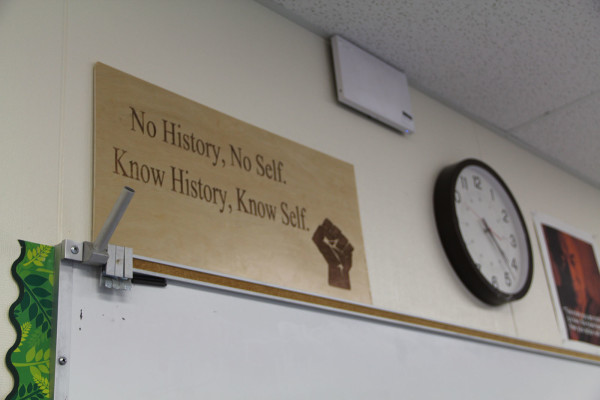
“No History, No Self. Know History, Know Self.”

“No History, No Self. Know History, Know Self.”

This is the sign that appears on Leona Kwan's ethnic studies classroom in Oakland Unified School District's (OUSD).  It could be a slogan for the ethnic studies movement that has gained momentum across the United States, most especially Texas and California.  Although it has been inspired by the struggle over Mexican American Studies in Tucson Unified, it is a deeper, decades-long struggle that finds expression in the presence of Mexican American Studies programs and departments in universities nationwide.

To wit, many of us in Texas are organizing through our National Association for Chicana and Chicano Studies (NACCS) Tejas Foco statewide organization that hosts an annual conference taking place this February18-20, Lone Star College-Kingwood with a focus on the preservation of "traditions, oral history, customs, dichos, folklore, language, food, religion, literature, music, education, folk art, Chicana/o history and how they affect our everyday lives and identity." Simultaneously, February 17-20 the Texas Association for Chicano in Higher Education (TACHE) annual conference is also taking place with a similar focus: ¡Adelante! Latinos on the Rise: Remembering our Past, Leading our FutureA recent statewide conversation on merging the bilingual education and Mexican American Studies agenda spearheaded by Texas State University professor Dr. Christopher Milk also took place in El Paso, Texas, at the Texas Association for Bilingual Education's annual meeting.
 
NACCS Tejas Foco has become a very large, well-attended conference in Texas due in no small part to the excitement of teaching Mexican American Studies at all levels of the educational system in Texas.  While we still have to fight for inclusion at the State Board of Education level, as well as in textbooks, generally, our community doesn't have to wait for our officials to do the right thing in the meantime.  And this is what is happening in California, too.

While it is regrettable that on October 9, 2015, Governor Jerry Brown vetoed a bill (authored by Assemblyman Luis Alejo) calling for ethnic studies statewide in California despite its support by state senate and house Democrats, school districts are nevertheless taking a lead.  In OUSD—as in San Francisco, LAUSD, Pico Rivera, and most University of California campuses—the policy only requires its teaching of it at the high school level, but encourages it at elementary and middle school levels.

This is a great piece on so many levels.  It speaks to the value of ethnic studies, generally, and specifically, to Oakland Unified School District's (OUSD) take on it: Not anyone can teach it; and it's as much about the content as it is about the authentic caring relationships between teachers and students.  This approach helps children to feel both powerful and seen.

Angela Valenzuela
c/s

Ethnic studies courses to be offered at all OUSD high schools

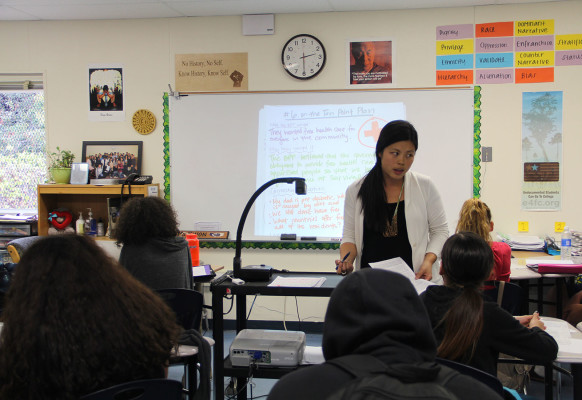
Leona Kwon, the ethnic studies teacher at Castlemont High School, explains an assignment to her students.
Students work in pairs, sheets of paper littering their desks. Each pair is assigned to dissect a different section of the Black Panther Party’s Ten-Point Program. Posters of Malcom X, the Dalai Lama and Che Guevara line the walls. A wooden sign above the whiteboard, made by a former student, reads “No History, No Self. Know History, Know Self.” In this Castlemont High School ethnic studies classroom, that’s the objective: gaining knowledge of one’s history and community helps students feel more connected and empowered.
“In terms of social studies content, there is no content that is more directly relevant to students’ lives or more academically rigorous,” said Leona Kwon, an ethnic studies teacher at Castlemont. “There might be these words that are really big, like ‘institutional oppression,’ but once you explain the concept, students can understand that right away because it reflects so much of their lived experience.”
Thanks to an Oakland Unified School District (OUSD) school board vote Wednesday night, within the next three years ethnic studies classes, like this one, will be offered at all Oakland high schools. The course may count as an academic graduation credit, and though the policy does not specify the course will be a graduation requirement, the possibility has been discussed by the board in previous meetings.
According to the district’s new policy, presented to the board by Young Whan Choi, civic engagement coordinator for OUSD, ethnic studies courses create “higher overall academic achievement, boosts in social emotional learning, increases in self-efficacy, higher graduation rates, and a reduction in drop-out rates.” The policy encourages elementary and middle schools to incorporate an ethnic studies curriculum, but will only require district high schools to offer the course.
The course, a general survey that will cover the histories of many groups of people, will be piloted by a small group of teachers during the 2016-2017 school year. A group of teachers is currently updating the framework for ethnic studies that will be used by teachers to develop the curriculum for their schools.
Recently, both local and statewide initiatives pushing schools to offer ethnic studies courses gained ground. This fall, San Francisco public schools began to offer ethnic studies classes in all high schools. However, on October 9, Governor Jerry Brown vetoed a bill, authored by Assemblyman Luis Alejo (D-Salinas) and supported by state senate and house Democrats, calling for the creation of a statewide ethnic studies curriculum.
For the OUSD, specific details about the proposed curriculum are not set in stone. At Castlemont, one of the few schools in the district that now offers an ethnic studies course, all 9th grade students take the class taught by Kwon, which she has taught for five years. Throughout the year, she focuses on concepts like personal identity and systems of privilege, which helps students think about how the different parts of their identities can effect their personal experiences and understand those experiences within a historical context. The course also focuses on the idea of race as a social construct—or that individuals who share a particular racial identity can be very physically diverse—and discussion of levels of oppression within society.
After taking the ethnic studies course, students “are able to place themselves within a historical context” said Kwon. “Through ethnic studies, they have such a better, more critical understanding of how society functions, both currently and historically, that is also very, very empowering.”
Michelle Flores, a 10th grade student at Castlemont, believes that her experience last year in Kwon’s classroom was key to her growth as a student and an individual. “Most people don’t know the real history. They know the dominant narrative,” said Flores. “It made me want to prove the stereotypes wrong. It made me want to give back to my community and teach my community about all the oppression that we’re going through, especially institutional oppression.”
“It just opened my eyes to the world,” said Taejin Kim, another 10th grade student at Castlemont.
“And now every time we see a Disney movie, it’s like ‘Whoa, they just said something racist there!’” said Flores.
Students from other OUSD high schools have also called for ethnic studies courses. At the October 14 school board meeting, student director Darius Aikens expressed his interest. “It gives students the ability to feel powerful,” said Aikens. “I don’t have ethnic studies at Oakland High, but I would like to have ethnic studies at Oakland High.”
One of the challenges the board has faced as it considered including ethnic studies in the curriculum at all Oakland high schools is finding the right teachers for the course. At the October 14 meeting, staffing was a main concern cited by board members. Director Hinton-Hodge (District 3) recalled the beginnings of the African American Male Achievement Initiative in 2010, a program dedicated to addressing the needs of African American students by offering an after-school mentoring program focusing on African history and culture. According to Hodge, before the program was introduced, African American students did not feel like they were being acknowledged or being given equal access to opportunities in the general education classrooms.
“Young people, young black boys, didn’t feel as though they were seen. They didn’t feel like people valued them, they didn’t feel as though that they could really learn,” Hodge said.
Hodge, who also said she was excited about the possibility of developing a system-wide ethnic studies curriculum, said she wants staffing to be carefully considered. “I don’t want to be pessimistic by any means, but I don’t want to see an investment in a curriculum when people don’t authentically care … with their heart and really love each one of our children who walk in there.”
“Not just anybody’s going to be able to teach this,” said Director Torres (District 5). “So we don’t want anybody saying, ‘Well I need a job and there’s this opening so I want to do this work.”
Kwon’s students say she is fully invested in creating a welcoming space for her students. “She’s really passionate about her job—that’s what makes her so amazing,” said Flores. Both Flores and Kim mentioned times when they missed class and immediately received a text from Kwon asking if they were OK.
Compassion like Kwon’s students see in her might benefit any classroom culture, but for an ethnic studies class, where issues like privilege and oppression are frequently discussed, sensitivity is key, Kwon says, and it is important that her classroom remains a safe space. “So much of ethnic studies is not just the content you teach, but how you teach it,” said Kwon. “It comes down to your relationships and sort of the culture you set up in your classroom.”