Translate

Showing posts with label Latino segregation. Show all posts

Saturday, October 09, 2021

How George I. Sánchez helped dismantle Texas’ segregated schools for Latinos

It's so important for us to remember the many sacrifices of our ancestors like the legendary Dr. George I. Sanchez who dedicated his life to the fight against the segregation of Mexicans and Latinos. The building where I work at the University of Texas at Austin is named after him. I fear that people aren't either knowledgable or aware of either this history or his advocacy that directly impacted the school, life, and career trajectories of literally thousands upon thousands of school-age children subjected to Jim Crow policies and practices for generations. 


In addition to advocating for school integration, he opposed mental testing, and advocated strongly for bilingual education. He was a scholar-activist par excellence. Historian Julie Leininger Pycior described Dr. Sanchez as "the most important Mexican American intellectual of the civil rights generation."


To deepen your understanding of not solely this history but his many contributions, I encourage you to read the book by Dr. Carlos Blanton titled, "George I. Sánchez: The Long Fight for Mexican American Integration." One of my earlier posts similarly reflects on Dr. Sanchez' life and career. Primarily through the many students that he mentored and the research-based policies and practices he supported, his influence lives on, thankfully.

 -Angela Valenzuela

How George I. Sánchez helped dismantle Texas’ segregated schools for Latinos

Proponents of separation said it was necessary because Mexican Americans were not as smart as Anglo students, or were deficient in the English language. The former UT professor fought those claims.


By Estrella HernándezOctober 7, 2021


By the 1940s, over 120 Texas school districts had segregated schools for Latino children.

“They didn’t openly tell you the truth… that is, we don’t want Mexican kids sitting next to Anglo kids,” historian Ricardo Romo said.

Instead, proponents for separation pointed what they said were the students’ deficiencies in the English language. And to overall intelligence.

“The majority of schools around the country pretty much accepted that there were people with high intelligence and then there were people with low intelligence. And among the people with low intelligence, as they call it, were Mexican Americans and American Indians,” Romo said.

Romo, the former president of the University of Texas at San Antonio, has studied the life of George I. Sánchez. He says Sánchez challenged the use of IQ tests conducted in English to justify the intelligence argument.

“Whether it was Japanese, Navajo, Spanish, it didn’t make any sense and it seemed shocking to me when I read that. How, can anybody think that you could actually test intelligence… [using a test written] in a foreign language, it just doesn’t make sense,” Romo said.

Sánchez was an educator himself and would become known as the father of bilingual education.

George I. Sánchez was born in Albuquerque in 1906. He did well in school and, after graduation, began on his path towards teaching. He earned a bachelor’s degree in New Mexico, his master’s at UT-Austin, and then his doctorate in education from UC-Berkeley. At the time he earned his final degree in 1934, there were only a handful of Latino academics across the country.

“George I. Sánchez was one of the leading scholars in the 1940s, 50s, and 60s in education,” Romo said.

Sánchez saw the inequities of school systems in New Mexico and Texas. He found that rural schools got little funding and offered very little to Spanish-speaking students.

“He was one of the few that questioned it. Everybody just took it, accepted it,” Romo said.

Word War II shined new light on the issue. When the demand for fighting men meant getting non-English speaking Latinos into uniform, it became clear speaking Spanish did not equate with a deficiency.

“Many of them were stronger in Spanish than in English, and were tested differently and they thought, ‘this guy is intelligent,’” Romo said.

But there was still work to be done.
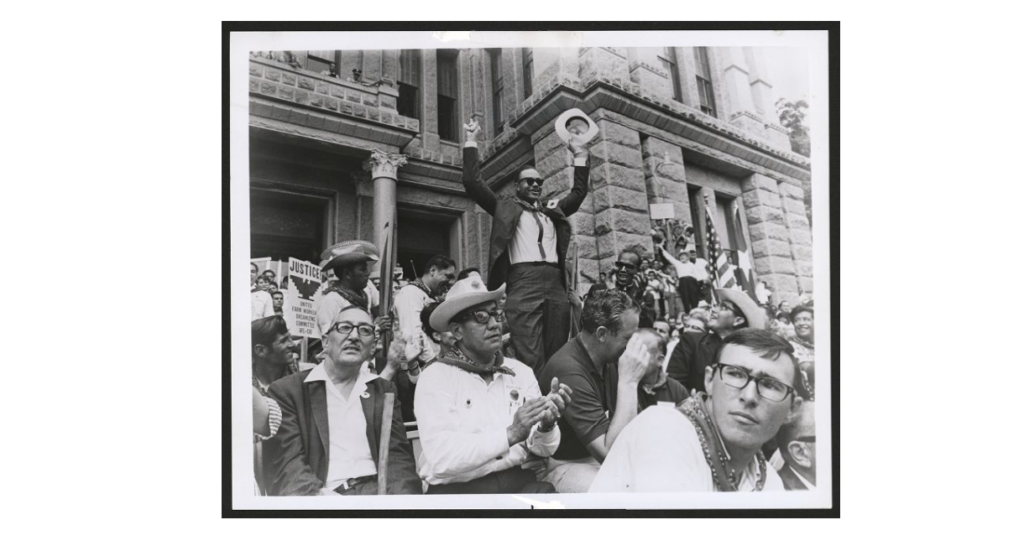
Courtesy Voces Oral History Center

Sánchez (far left) at a demonstration at the Texas Capitol.

In 1940, Sánchez left New Mexico to become a professor of Latin American studies at UT-Austin. His fight for equal educational opportunities for Mexican American children flourished.

“He fought against segregated schools, which were many… many across the state up until the 60s,” Romo said. “And those are the things that he saw as unfair, illogical, not good for how we prepare our Latino students to be leaders.”

Sánchez worked with Mexican American organizations to challenge discrimination through the courts. Some of the early cases of school desegregation were fought in California and in Texas. Still, Texas continued to argue that the Spanish-speaking children needed separate schools.

In 1941, Sánchez served as national president of LULAC. A decade later, he founded the American Council of Spanish Speaking People, a civil rights organization which funded litigation involving discrimination against Mexican Americans.

“His whole plan was to create an organization that would fight for the justice,” Romo said.

Sánchez also served as an expert witness in many legal cases involving Latinos.
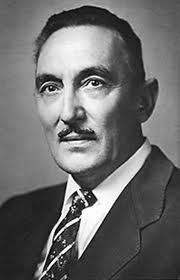
George I. Sánchez, Courtesy Voces Oral History Center

“He had been a lifelong absolute champion for Mexican Americans and someone you could count on to be in the battle for equal treatment,” Romo said.

Sánchez died in 1972. But he had a lasting influence on his students and the educational landscape. In 1995, UT-Austin named its education building in his honor.

This story was produced n collaboration with the Voces Oral History Center at UT Austin’s Moody College of Communication as part of Texas Standard’s recognition of Hispanic Heritage Month.

Saturday, January 30, 2016

Latino School Segregation: The Big Education Problem That No One Is Talking About

As is indicated in this piece, it is interesting that there isn't much of a discourse around school segregation in the Mexican American or Mexican-origin community.  My parents' generation growing up in West Texas was definitely aware of segregation. Heck, crossing the railroad tracks to the other side of town risked life and limb.  For the guys, forget dating the white girls.  You could get beat up or killed for doing so.

I'm sure that school segregation was easier to see back then because it aligned to segregation and discrimination in other areas like hotels and restaurants where your money as a Mexican wasn't good.  All the way through the 1940s and 1950s, there simply weren't jobs for Mexicans.  The majority survived by going on the migrant stream.  This, of course, took the children out of schools for several months out of the year.

Despite this lack of an explicit discourse today, I am regularly told by many of my students at UT from South Texas or certain places in San Antonio that they didn't realize that schooling was different in other places: It's what you are used to and come to expect—unless, of course, you find yourself outside of this environment, invariably representing a wake-up call for them.  

As our students acquire a more critically conscious perspective, that's when they begin to connect the dots with respect to the politics and policies pertinent to public education, how schools get funded through property taxes, together with histories of redlining, racial covenants, housing discrimination, loan discrimination, gentrification, displacement, and the like. 

It doesn't have to be this way, but you pretty much have to go to college to get to this place of understanding the history and context of Latino school segregation.  So if our communities seem to not have an opinion, well, they've been schooled in such a way that they're NOT supposed to have one—to have a standpoint.  From a majoritarian standpoint, the degree to which the masses of brown and black people do not evolve this consciousness, all is good and well in America.

This (mis)education of an entire community into a narrowed sense of its own possibilities leaves in tact current constellations of power and with that, our highly unequal status quo.

Angela Valenzuela
c/s


Latino School Segregation: The Big Education Problem That No One Is Talking About

Separate and unequal.

10/26/2015 10:49 am ET | Updated Oct 26, 2015


Don Bartletti/Los Angeles Times via Getty Images 
In 2004, student Hector Flores (left) marched through the rain near Hoover Elementary in California. The walk commemorated Mendez v. Westminster, the case that led to California being the first state in the nation to end school segregation.
Nearly a decade before the Supreme Court ruling in Brown v. Board of Education made segregated schooling of black students unconstitutional, a group of five Mexican-American families in California fought for integrated schools in Mendez v. Westminster.
It was 1946. For years, the state's Mexican-American students had languished in inferior "Mexican schools" to which they were assigned based on name and complexion. Plaintiffs in the case argued that the segregation of Mexican-American children violated their right to "equal protection" under the Constitution, noting that their schools were severely under-resourced compared to nearby white schools, and the plaintiffs' experts testified on the negative impact segregation has on children's self-esteem. Defendants in the case -- four school districts -- argued that Mexican students had poor hygiene, carried diseases and were intellectually inferior.
The case -- which was decided in the plaintiffs' favor -- never made its way to the Supreme Court, and thus its impact was never felt on a federal level. But soon after, California became the first state to ban state-sponsored school segregation.
It's now 2015, and while much has changed in California, much has remained the same. Segregation is no longer based on official policies or law -- called de jure segregation -- but based on voluntary housing or schooling choices. Still, the Golden State remains the most segregated one in the country for Latino students, according to research from the UCLA's Civil Rights Project, which studies civil rights issues.
To be an average Latino student in California today means that you likely attend a school that is 84 percent nonwhite, with high rates of concentrated poverty. It means you live in a two-tiered society where only 20 percent of Latino students taking the SAT in California are deemed college-ready, compared to 41 percent of students statewide.
California's situation is extreme. Its Latino population is exceptionally large and exceptionally segregated. But the state's issues are symptomatic of a long-term, nationwide trend of Latinos quietly becoming the most segregated minority population of students in the country, the UCLA center has found.
In 2011, the typical Latino student attended a school that was 57 percent Latino, according to the UCLA research. Comparatively, an average black student student attended a school that was 49 percent black. A typical white student attended a school that was 73 percent white.

Why Is No One Talking About This?


There is a dearth of research on how segregation impacts Latino students specifically, although there are plentiful data on how racial isolation impacts African-Americans. As efforts to address African-American segregation have faltered, public discourse on growing Latino segregation remains elusive.
“Schools that are integrated better reflect our values as a country.” John King, U.S. Department of Education

"We’ve been through a demographic revolution with almost no policy attention to the racial dimensions of these changes," Gary Orfield, co-director of the Civil Rights Project at UCLA, told The Huffington Post. "It's not exactly true that anyone is paying attention to black segregation either -- we’re a third of the century into kind of doing nothing and a quarter of the century into systematically dismantling what we did earlier."
Little attention has been paid to the issue of Latino segregation because segregation has historically been a black-white issue, said Patricia Gándara, Orfield's co-director at the Civil Rights Project.
Brown v. Board of Education focused specifically on African-American students. In 1973, the Supreme Court ruling in Keyes v. School District No. 1, Denver, Colorado, recognized that Latino students also have a right to integrated schools, but the case had minimal impact. When African-American and white students were being bussed away from their neighborhood schools to help achieve racial balance, Latinos were mostly ignored.
"We’re stuck in a black-white paradigm that doesn’t work quite the same way for Latinos," Gándara said.
Jennifer Lee, an associate professor of sociology at the University of Indiana, predicts that in the coming years, we will start to see more research about the schooling of Latino students.
"With this increase in the Latino population I think there are lots of scholars who are very interested the Latino student community. It just takes time," she said. "We can't extrapolate studies on African-American students to Latino students."
With little research on the topic, it is difficult to come up with potential fixes.
"We have to really understand what it is we’re studying," said Lee. "We can't assume the mechanisms are the same across different populations -- or all Latino students."
David Garcia, an associate professor at Arizona State University, ran for the state's superintendent of public instruction in 2014 and lost. During his campaign, he did not hear the issue of school segregation brought up once, he said, "not even by minority groups."
"The entire discussion from how we come to study it really comes out of the South and in the '60s and blacks and whites," said Garcia. Meanwhile, Western states -- those that typically have some of the largest populations of Latino students -- are studied less frequently.
Research on the issue of Latino school segregation is also somewhat complicated by the diversity within this group of students, Garcia noted. Latino students may experience segregation differently depending on when they came to this country or where their family is from, for example.
"I think first and foremost in the conversations I've had, people want to know how Latino students are doing" in school, Garcia said. "Who they are attending with does not rise to the level of public discussion." 

AP Photo/Gosia Wozniacka
In this June 26, 2013, photo, students eat lunch during the school's summer program at Jefferson Elementary School in Sanger, California. The Sanger Unified School District, which was once named as one of the lowest-performing in the state, is now known for its success in educating its predominantly Latino student body: It graduated 94 percent of its Hispanic students in 2012, 20 percent more than the state average.


Is Anyone Doing Anything About Latino Segregation?

U.S. Secretary of Education Arne Duncan largely ignored the issue of school segregation during his work under the Obama administration, but there is some speculation that his replacement, John King, will put the issue back on the political map. King, who will start in the job in December, served as the state education commissioner in New York before spending the past few months as an adviser to Duncan.
In New York, King enacted a grant program that will use $25 million to encourage more affluent students to attend certain high-poverty, struggling schools. In September, he emphasized the importance of integrated schools at a National Coalition on School Diversity conference.
Schools that are integrated better reflect our values as a country,” he said in a speech.

It is now impossible to ignore the role that Latino students play in the issue of school segregation. If King does focus his attention on school diversity, it is likely that the issue of Latino segregation will receive more attention than it ever has before.