Translate

Showing posts with label Ricardo Romo. Show all posts

Tuesday, June 14, 2022

Uvalde Strong: A Community Comes Together to Heal by Ricardo Romo, Ph.D Jun 12, 2020

Such a beautiful and touching recent reflection by Dr. Ricardo Romo on his and his wife, Harriett's, visit to Uvalde. The library is an excellent place to center a lot of resources for the children.  Go to his earlier piece titled, "Latino Children Benefit From Uvalde’s Public Library," to learn more about his advocacy and ways you can support the families and community.

For ease, here is an image with QR codes that will allow you to make a contribution.

-Angela Valenzuela


Uvalde Strong: A Community Comes Together to Heal


Ricardo Romo, Ph.D Jun 12, 2020


Time can be the friend or the enemy of grief. We often hear that time will heal and that all things will pass. I wondered if that is true as I walked through the Uvalde Memorial at the town's main plaza.  It seemed that time stood still for those who came to pay respects that afternoon in 102-degree Texas summer weather. Everyone, including me, moved slowly and emotionally among the 21 crosses with names and tributes to the murdered students and teachers of Robb Elementary. Many who brought flowers and stuffed animals to the memorial that afternoon came from other places. My drive to Uvalde from San Antonio took less than two hours. The return trip seemed to be so much longer. 

Uvalde Memorial Plaza. Photo by Ricardo Romo 

My wife Harriett and I went to Uvalde Saturday, June 11, days after the horrific events of  May 24, 2022. We had wanted to go sooner, but we were told by friends who lived there that the town was overwhelmed by reporters, police officers, and visitors from out of town related to those killed. The streets were crowded with barricades still present around the school and near the town square. 

What brought us to Uvalde that Saturday was a food distribution event by the San Antonio Food Bank.  Harriett is on the Board and volunteered to help. When we arrived early that morning, the lines of cars were long for the 10 am opening. Uvalde is a poor community and many do not have the funds to feed their families. Cars drove by slowly, some waiting for two hours as the food was handed out to local families and the elderly. 


San Antonio Food Bank in Uvalde. June 11, 2022. Photo by Ricardo Romo 

We were also in Uvalde that weekend because of our efforts to assist El Progreso Memorial Library with its resources and summer programs. I am honored to be the Lead Volunteer for the Memorial Library fundraising campaign which began this month following the tragic events of May 24. I noted in an earlier newsletter that the children of Uvalde would be spending more time in the library with schools closing.  My generation and several after me have always considered schools safe havens.  Today the parents of children from Robb Elementary do not plan for their children to attend summer school, or perhaps even enroll this coming fall. Who can blame them.


Memorial window to Uvalde's children killed May 24th. Photo by Ricardo Romo 

At the Memorial Library, we met with our friend Dr. Mendell Morgan, Director and Head Librarian, and several library board members.  We learned of the pressing need to provide more learning activities for the young children of Uvalde. Many of the children who come to the library are bilingual, some are monolingual [Spanish only] and need literacy instructions and tutoring. Many of the books that have been donated recently are bilingual, which is a great benefit to children and parents. The library is receiving offers of assistance from several retired educators to set up literacy classes and mentoring opportunities. 


El Progreso Memorial Library. Photo by Ricardo Romo 

The library’s strong internet connections are a tremendous help to children who do not have computers in their homes or whose homes do not have access to the internet. The library is also known for its creative programs and innovative incentives encouraging children to read.  Bright painted bicycles lined up in a row inside the library serve as a reminder that children in different age groups who read the most books in the summer reading program would be rewarded with a bike prize. The librarians have set aside a table with free books for children and families who need reading resources in their homes. In the staff section of the library, thousands of books lay stacked on the floor, new donations from local and non-residents alike. As we watched, amazed at the generosity of so many, a pickup truck with 12 large boxes of books arrived to deliver more books.  The staff is both overjoyed and overwhelmed with the donations and the work before them to process the books, place them on the shelves, and properly thank the donors.  


Free books are offered by  El Progreso Memorial Library. Photo by Ricardo Romo 

The children we saw at the library on our visit represent Uvalde’s future. The next generations of educators, city and state officials, political representatives, lawyers, and medical providers are checking out books this summer at El Progreso Library. We owe the children of Uvalde great reading opportunities. Reading leads to learning and knowledge as well as healing. The healing from the tragic events at Robb Elementary School will be ongoing for years, maybe even decades. But we can do something for Uvalde’s children now. If you have extra children's books on your shelves or wish to donate to assure that an ample supply of books is available for children this summer, do so now.

Story Hour at El Progreso Memorial Library. Photo by Dr. Mendell Morgan.

Subscribe to Latinos in America

By Ricardo Romo  ·  

Saturday, October 09, 2021

How George I. Sánchez helped dismantle Texas’ segregated schools for Latinos

It's so important for us to remember the many sacrifices of our ancestors like the legendary Dr. George I. Sanchez who dedicated his life to the fight against the segregation of Mexicans and Latinos. The building where I work at the University of Texas at Austin is named after him. I fear that people aren't either knowledgable or aware of either this history or his advocacy that directly impacted the school, life, and career trajectories of literally thousands upon thousands of school-age children subjected to Jim Crow policies and practices for generations. 


In addition to advocating for school integration, he opposed mental testing, and advocated strongly for bilingual education. He was a scholar-activist par excellence. Historian Julie Leininger Pycior described Dr. Sanchez as "the most important Mexican American intellectual of the civil rights generation."


To deepen your understanding of not solely this history but his many contributions, I encourage you to read the book by Dr. Carlos Blanton titled, "George I. Sánchez: The Long Fight for Mexican American Integration." One of my earlier posts similarly reflects on Dr. Sanchez' life and career. Primarily through the many students that he mentored and the research-based policies and practices he supported, his influence lives on, thankfully.

 -Angela Valenzuela

How George I. Sánchez helped dismantle Texas’ segregated schools for Latinos

Proponents of separation said it was necessary because Mexican Americans were not as smart as Anglo students, or were deficient in the English language. The former UT professor fought those claims.


By Estrella HernándezOctober 7, 2021


By the 1940s, over 120 Texas school districts had segregated schools for Latino children.

“They didn’t openly tell you the truth… that is, we don’t want Mexican kids sitting next to Anglo kids,” historian Ricardo Romo said.

Instead, proponents for separation pointed what they said were the students’ deficiencies in the English language. And to overall intelligence.

“The majority of schools around the country pretty much accepted that there were people with high intelligence and then there were people with low intelligence. And among the people with low intelligence, as they call it, were Mexican Americans and American Indians,” Romo said.

Romo, the former president of the University of Texas at San Antonio, has studied the life of George I. Sánchez. He says Sánchez challenged the use of IQ tests conducted in English to justify the intelligence argument.

“Whether it was Japanese, Navajo, Spanish, it didn’t make any sense and it seemed shocking to me when I read that. How, can anybody think that you could actually test intelligence… [using a test written] in a foreign language, it just doesn’t make sense,” Romo said.

Sánchez was an educator himself and would become known as the father of bilingual education.

George I. Sánchez was born in Albuquerque in 1906. He did well in school and, after graduation, began on his path towards teaching. He earned a bachelor’s degree in New Mexico, his master’s at UT-Austin, and then his doctorate in education from UC-Berkeley. At the time he earned his final degree in 1934, there were only a handful of Latino academics across the country.

“George I. Sánchez was one of the leading scholars in the 1940s, 50s, and 60s in education,” Romo said.

Sánchez saw the inequities of school systems in New Mexico and Texas. He found that rural schools got little funding and offered very little to Spanish-speaking students.

“He was one of the few that questioned it. Everybody just took it, accepted it,” Romo said.

Word War II shined new light on the issue. When the demand for fighting men meant getting non-English speaking Latinos into uniform, it became clear speaking Spanish did not equate with a deficiency.

“Many of them were stronger in Spanish than in English, and were tested differently and they thought, ‘this guy is intelligent,’” Romo said.

But there was still work to be done.

Courtesy Voces Oral History Center

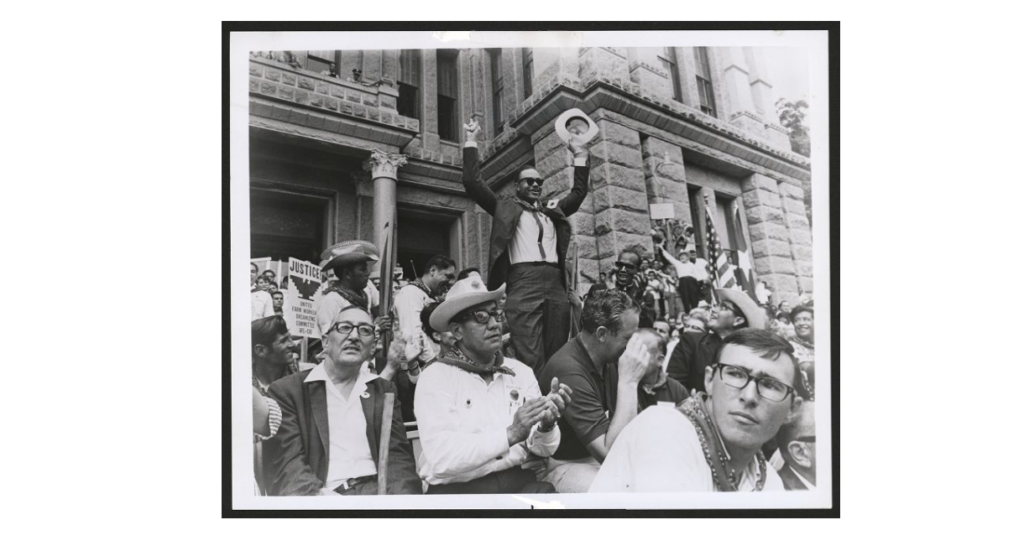
Sánchez (far left) at a demonstration at the Texas Capitol.

In 1940, Sánchez left New Mexico to become a professor of Latin American studies at UT-Austin. His fight for equal educational opportunities for Mexican American children flourished.

“He fought against segregated schools, which were many… many across the state up until the 60s,” Romo said. “And those are the things that he saw as unfair, illogical, not good for how we prepare our Latino students to be leaders.”

Sánchez worked with Mexican American organizations to challenge discrimination through the courts. Some of the early cases of school desegregation were fought in California and in Texas. Still, Texas continued to argue that the Spanish-speaking children needed separate schools.

In 1941, Sánchez served as national president of LULAC. A decade later, he founded the American Council of Spanish Speaking People, a civil rights organization which funded litigation involving discrimination against Mexican Americans.

“His whole plan was to create an organization that would fight for the justice,” Romo said.

Sánchez also served as an expert witness in many legal cases involving Latinos.

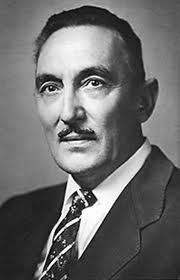
George I. Sánchez, Courtesy Voces Oral History Center

“He had been a lifelong absolute champion for Mexican Americans and someone you could count on to be in the battle for equal treatment,” Romo said.

Sánchez died in 1972. But he had a lasting influence on his students and the educational landscape. In 1995, UT-Austin named its education building in his honor.

This story was produced n collaboration with the Voces Oral History Center at UT Austin’s Moody College of Communication as part of Texas Standard’s recognition of Hispanic Heritage Month.

Wednesday, September 29, 2021

"Becoming Mexican American," by Ricardo Romo, Ph.D.

Such a beautiful reflection on what it meant to become "Mexican American" in San Antonio by former University of Texas San Antonio President Ricardo Romo.  It demonstrates a shift in understanding of "Mexican," as a national-origin  identifier to one of "Mexican American," as an ethnic identifier. It is a process. For first-generation immigrants, theirs is an experience of understanding what "Mexicanidad" (or Mexican-ness) means in a U.S. context. In short, although the same term, "Mexican" or "Mexicana/o" gets used, but they mean different things.

Dr. Romo's mention that "Mexican" was a term that entered from outside the lexicon of his community attests to not only the fact that people were primarily Spanish speaking but also that this term was imposed. This brought to mind a statement made by a newly-arrived Mexican student who expressed being troubled about having come to the U.S. to "learn" that "Mexican" is a dirty word.

I shared with her and the rest of the class that there is a long history to this and that the term—even as it represents a source of pride—is nevertheless inflected by vexed Anglo-Mexican relations in the Southwest. 

One sees, for example, people avoiding it altogether, opting for "Hispanic," "Latino," or "Latinx," because the word, "Mexican"—especially when accompanied by pejorative adjectives like "dumb," "greasy," or "dirty"—was intended as a slur. What may further reside at the subterranean, civilizational level, is a negation of Mexico itself, compounded by the fact that the term is of Indigenous origins. That is, the "Mexica" (pronounced me-SHEE-ca) are the Aztec, Nahuatl-speaking people whose very existence threatens the Eurocentric myths of both countries. 

-Angela Valenzuela 


Becoming Mexican American

By Ricardo Romo, Ph.D. | Nov. 1, 2020

The United States seemed far away to the families living in the farming communities of Union, Sabinas, and Agujita in northern Coahuila during the early 1900s. Those wishing to make a new life in the United States had to make a 80 mile trip to Eagle Pass, Texas.

There were no automobiles in any of the surrounding Mexican communities and the railroad tracks had not yet reached the rural areas. Coming to the United States meant walking or riding the entire distance in a horse carriage. Prior to the Mexican Revolution, most of the small farmers from these communities considered this to be too dramatic a step.


Francisco “Pancho” Saenz bought his business in 1937--at the height of the Great Depression. Francisco Saenz [on the right]: Auto Parts store on El Paso Street. 1940s. [Romo Family Photo]

Mexicans came to the United States because profound “push” forces dominated their daily lives. The “push” factors of the early 20th century were a result of civil unrest, war, and political oppression in Mexico. A long and harsh dictatorship in Mexico eventually led to a revolution, which resulted in the exodus of thousands of Mexican between the years 1910-1930. In the 1920s thousands from the Central states of Mexico also left because of religious persecution.

I often wondered why my grandparents came to the United States. My conversations with them revealed the obvious: like many other migrants of that time in Mexico, they left a homeland plagued by violence and with hopes of finding work elsewhere. It is not all that clear that they were seeking a new life elsewhere or in pursuit of the American Dream. They were undecided initially about their future. Unlike the immigrants from Europe and Asia,

Mexicans were close enough to the homeland that if work did not materialize or became unsteady, they were prepared to return. Many actually came to the United States thinking they would earn money and then return to Mexico after the armed conflict ended to buy a small property or start a business.


Maria Saenz Romo, sister of Francisco Saenz, and well known Midwife. Photo taken at her El Paso Street home only five houses away from Kerr Hill Auto Parts. [R.Romo family photos]

My four grandparents were born in Mexico. Two came from the Sabinas region of the northern state of Coahuila. Both of my parents grew up in the Westside of San Antonio, a Mexican barrio where everyone, it seemed, had a connection to Mexico. No one had a television, so our only music and news came from two local Spanish language radio stations.

Mexican barrios like ours and those in other U.S. cities were often called “Little Mexico.” In Dallas, for example, so many Mexican moved into the “Little Jerusalem,” a Jewish neighborhood, that after 1910 it soon became known as “Little Mexico.” But there was nothing little about our barrio in San Antonio, which the US Census estimated as the second largest Mexican American community in the United States after Los Angeles in 1960. Those from outside our barrio called us Mexican, and we referred to ourselves as “La Raza.”

There is much about what I saw and learned in my early years in San Antonio that reveals the extent of our Mexicanism. I grew up surrounded by a large extended family, and they influenced much of my early understanding of Latino culture and society. My “Tio Pancho” was one such influencer.


Kerr Hill Auto Parts owned by Francisco Saenz. 1940s. [R. Romo Family photos]

My uncle, [Tio] Francisco “Pancho” Saenz, came to the United States at the age of 18 with his sister, Maria Romo, and his brother in law, Benito Romo, from the Sabinas region of Coahuila. The three immigrated in 1913 crossing into the United States at the Eagle Pass international border.

Tio Pancho initially worked as a farm laborer, but found a job in a garage as a young man when the family moved to San Antonio. With his savings, Tio Pancho bought his own garage and auto parts store in 1937. Tio Pancho was a frequent “guest DJ” with KCOR. On the radio he told stories about serving in the Mexican Revolution, catching huge fish in the Gulf of Mexico, and knowing the latest juicy stories about Mexican movie stars and popular singers.


Tio Pancho--”El Gavilan Pescador,” loved fishing and hunting and enjoyed telling his fishing stories on the local Spanish-language radio. [R.Romo family photos]

“Tio Pancho” was a popular fellow in our Westside barrio. From the mid 1930s to the time of his death in 1965, he had one of the few Mexican-owned auto parts sales and repair shops in the city. He had radio time on the only Mexican station in town. His sister Maria was one of the most respected midwives in the barrio. His brother Cruz owned a popular night club “El Gaucho” across the street from Tio Pancho’s auto shop on El Paso Street and his younger brother Martin owned several fried chicken drive-inns.

If my grandmother and her brothers believed in the American Dream, they didn’t say. If the American Dream meant being financially successful, creating their own businesses, buying a home, and raising children who attended school, they more than lived this dream.

Although they gave up on returning to Mexico, they never gave up on their idea that family was the Mexican way. My grandmother and her two brothers helped bring my great grandmother, Estefana Cardenas, to the United States. She lived next door to her son’s auto parts store, five houses from her daughter’s home, and across the street from her younger son’s night club.

Today, the auto parts store, Kerr Hill Auto Parts, continues in its 83rd year with the help of Tio Pancho’s son Frank, his wife Vicki, and their son Frankie, They moved the store one block south to Guadalupe Street where they have a larger lot for the garage and auto repair business. These are tough times for small family businesses, and the fourth generation has no interest in keeping the business active after the son, wife and grandson of Tio Pancho retire.


Frank Saenz, Jr., [center] son of Francisco Saenz, with cousins Robert Romo, left— and Ricardo Romo [R] . [R.Romo family photos 2015]

Tio Pancho’s family story is one of many from this Westside barrio. This family did not have strong long-term ties to Mexico, but managed to bring some Mexicanism to San Antonio via their radio experience and interaction with other Mexican customers and family members. All continued to speak Spanish, and Maria Romo, the midwife, learned very little English as nearly all of her clients spoke Spanish.

Tio Pancho’s family contributed to the Mexican American experience, as did thousands of other first generation Mexicanos in the United States. They passed on Mexican values of strong family ties, a respect for hard work and entrepreneurship, an appreciation for being bilingual in Spanish and English, and the importance of higher education.