This blog on Texas education contains posts on accountability, testing, K-12 education, postsecondary educational attainment, bilingual education, immigration, school finance, environmental issues, and Ethnic Studies at the state and national levels. It addresses politics in Texas. It also represents my digital footprint, of life and career, as a community-engaged scholar in Texas.
Here is a reference, a report on what happened in Uvalde that you can read in its entirety here.
The report was authored by Rep. Dustin Burrows, Chair, Rep. Joe Moody Vice-Chair, and the Honorable Eva Guzman, Public Member.
I was surprised to learn that the gunman, who previously attended Robb Elementary, entered the very fourth-grade classroom where he was once a student himself. He so needed help and assistance that he apparently never received.
This ongoing story out of the Mansfield Independent School District located south of Fort Worth, Texas, illustrates the nonsense involved in the fight against this community's very legitimate fears of school violence. It manifests as a conservative backlash against socioemotional learning (SEL)—motivated by a political action committee—that Republicans once supported as a response to mass shootings.
As stated herein, back in 2018, this was not at all "a liberal takeover of the suburban school system, but [was established] at the urging of Republican Texas Gov. Greg Abbott and the Trump administration." It was a reform that gave the appearance of responsiveness to school violence without having to legislate on gun reform.
And now, this much-needed reform of SEL in our schools is getting viewed as an entry point to allegedly harmful, "woke" ideologies that, apparently, some of these Mansfield parents fear even more than guns.
If these parents really understood both SEL and Critical Race Theory (CRT), they would understand the extremism of their own views. Not only is CRT NOT taught in our schools, but if it were, it would work positively to deflate and minimize inter- and intra-personal conflict because of the intellectual understandings and tools it would provide. It helps students to have an educated analysis of power dynamics in society, and how they can exercise their own agency to help make the world a better place.
I should know. I teach CRT and students' main reaction over many years of teaching it is feeling like they've been denied this knowledge. Pretty much without exception, students tell me that they wonder why they have to go to college to first learn this when it could have been ever so helpful earlier on in their lives. Teachers are the quickest to make such statements and how they could have been better teachers had they learned these things earlier.
The best part of this piece is learning about the Social Emotional Learning Alliance for Texas. A cursory look at their website speaks volumes of how SEL can and should be beneficial to all.
All of this is so unfortunate. In a societal context where so many, including children, have experienced so much loss and tragedy, may Mansfield ISD be a testament to how outsized racial fears can impede much-needed, life-saving policies and practices. I hope that parents and school board members are able to better effectively and intelligently anticipate and challenge the work of political action committees that seek little more than to sow fear and division.
In 2018, GOP politicians promoted social and emotional education as a tool to stop mass shootings. Now some conservative activists are arguing those programs are not a solution to school violence, but a cause.
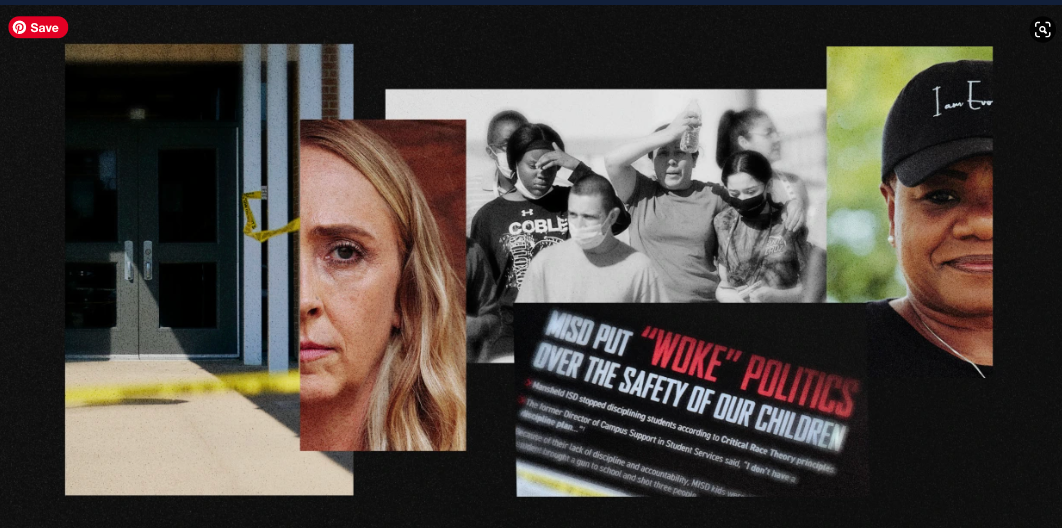
This spring, thousands of residents in the Mansfield Independent School District received political mailers that blamed a recent school shooting on “woke” school policies, inflaming partisan divides ahead of a heated school board election.Illustration by NBC News; Zerb Mellish; NYT via Redux; AP
July 18, 2022, 7:00 AM CDT / Updated July 18, 2022, 2:07 PM CDT
ARLINGTON, Texas — In October, after a student opened fire at Timberview High School in North Texas, wounding two classmates and a teacher, parents in the Mansfield Independent School District initially rallied together, praying publicly for the victims and praising officials for reacting quickly to prevent a worse tragedy.
But six months later, a different narrative began to spread through this suburban Dallas school district, one that put the blame for the shooting on a new district approach to disciplining students. It started with political mailers sent to thousands of homes.
“MISD put ‘woke’ politics over the safety of our children,” the flyers read in all caps, above a news clipping about the Timberview shooting, which reportedly resulted from a fight between two Black students. The flyers, paid for by a conservative political action committee, warned that the Mansfield school district had “stopped disciplining students” based on “Critical Race Theory principles.” As a result, it said, “kids were nearly killed.”
But the Mansfield mailer omitted a key detail: Some of the local school policies that it was attacking were initially implemented three years ago, not as part of a liberal takeover of the suburban school system, but at the urging of Republican Texas Gov. Greg Abbott and the Trump administration.
The mailers reflected a growing belief among some conservative parents, both in Mansfield and nationally, that school programs meant to address students’ emotional well-being have become vehicles for indoctrinating children with progressive ideas about race, gender and sexuality. The flyers, sent in mid-April ahead of a school board election, also previewed how some prominent Republicanswould respond one month later after the mass shooting at Robb Elementary School in Uvalde, Texas — making a visceral connection between anti-racism initiatives in schools and parental fears about the physical safety of their children.
The fight in Mansfield reveals how quickly conservative messaging has evolved when it comes to hot-button debates over education, racism and school violence.
In the wake of school shootings in Texas and Florida in 2018, many Republican leaders, including Abbott, enthusiastically endorsed efforts to expand school-based social emotional learning programs, which they viewed as a way to prevent mass shootings without taking action on gun reform. Pointing to reams of academic studies, advocates say these teaching and disciplinary approaches help students cope with adversity while steering them away from violence.
Since last year, however, those educational concepts have been swept up in a movement to rid schools of initiatives meant to address racism and inequity — a conservative backlash that experts say is now threatening the very programs that Republicans once presented as a solution to school violence.
Since last year, however, those educational concepts have been swept up in a movement to rid schools of initiatives meant to address racism and inequity — a conservative backlash that experts say is now threatening the very programs that Republicans once presented as a solution to school violence.
The flyers were paid for by a conservative political action committee.Zerb Mellish for NBC News
Far-right groups and grassroots parents have attacked social emotional learning — and related practices such as restorative discipline, which focuses on character development rather than punishment alone — as a “Trojan horse” for critical race theory, an academic study of racism that some on the right have used to label lessons on racism and gender that they find objectionable.
Conservative activists have seized on the fact that some social emotional learning programs encourage children to celebrate diversity, sometimes introducing students to conversations about race, gender and sexuality. And opponents take issue with one of the underlying goals of such initiatives: to reduce racial disparities in school disciplinary outcomes.
As a result, some Republican lawmakers who previously supported social emotional learning have soured on the concept. Several GOP-controlled state legislatures have considered bills to ban social emotional learning from schools. And many of the Republican proposals for stopping mass shootings following the massacre in Uvalde have instead focused on empowering schools and police to crack down harder on students who show signs of violence.
“It’s sort of ironic that these groups are throwing social emotional learning under the bus when these are the very things that our kids need now, and they need them now more than ever before,” said Donna Lord Black, who leads the Social Emotional Learning Alliance for Texas, a nonpartisan group that advocates for these programs in schools.
The result of this sudden partisan reversal: Education experts say one of the few bipartisan solutions to school violence has been reduced to another culture war talking point — one with the emotional power to potentially turn out voters while driving a deeper wedge between them.
In Mansfield — a quickly diversifying suburban school district that encompasses some areas that are majority Black, and some areas that are majority white — the political mailers blaming the Timberview shooting on “woke” school policies stirred intense feelings among residents.
The flyers included an image of a white child cowering in a school hallway under the words, “Restore safety. Restore sanity. It’s time for a new school board."
VanDella Menifee believes the flyers were meant to divide the community. Zerb Mellish for NBC News
VanDella Menifee, the mother of a Black student who was at Timberview on the day of the shooting, said the mailers incorrectly implied the district had stopped disciplining non-white children at a high school where three-quarters of the students are Black or Latino.
“I believe those flyers were designed to play to parents’ fears and to divide this community,” Menifee said.
Mindy Stonecipher, a white mom who has criticized Mansfield’s social emotional learning and disciplinary policies, said she shared Menifee’s concerns about the political mailer, which she called “extreme.”
But Stonecipher, who leads a group of concerned parents called Voices for Mansfield, said she agrees with the flyer’s underlying point. She argues that Mansfield’s embrace of social emotional learning has tied up educators with new responsibilities and left some feeling powerless to discipline unruly students — ultimately, making classrooms less safe.
“This is a giant social experiment,” Stonecipher said. “And the public school system is the lab."
‘A pathway to hope’
The shooting at Timberview High School on Oct. 6 started with a fight between two students, according to police and video of the classroom brawl later posted on social media. After a teacher broke up the altercation, witnesses told police that one of the students, an 18-year-old senior, walked over to a backpack, pulled out a handgun and opened fire.
A teacher and two students were wounded; no one was killed. One of the teens spent two weeks in the hospital recovering. The accused shooter was arrested and charged with three counts of aggravated assault with a deadly weapon.
At a town hall meeting two weeks later, Bruno Dias, the school district’s director of safety, security and threat management, gave a presentation outlining Mansfield’s efforts to prevent classroom violence. That included a threat assessment and social emotional learning program implemented under a 2019 Texas law that was passed with broad bipartisan support and signed by Abbott following a mass shooting at Santa Fe High School near Houston.
“It is a requirement, it is a mandate, and we are excelling at it,” Dias said of the program. “It is important to note that we’ve been able, in multiple cases, to turn what could have become a pathway to violence as it relates to students into a pathway to hope because of this threat assessment process."
Volunteers pray with crosses to memorialize the victims of a mass shooting at Santa Fe High School in Texas on May 21, 2018.Scott Olson / Getty Images file
Under the program, a team of educators, administrators and counselors are tasked with assessing threatening or self-destructive student behavior and, when appropriate, providing resources to help them cope with underlying issues — such as mental health struggles, instability at home or food insecurity — instead of simply doling out punishment.
Conservative opponents of social emotional learning say those ideas sound good on paper, but they worry that applying these approaches to discipline means that schools will stop holding students accountable when they misbehave. Adding fuel to those fears: School districts often struggle to articulate exactly how these academic philosophies work in practice.
NBC News asked to speak with Mansfield administrators to learn how the school system’s social emotional learning efforts work, both in terms of education and discipline, but the district declined. In a written response to questions, district spokesperson Donald Williams denied that Mansfield had stopped disciplining students under the programs.
“Students who violate the student code of conduct face disciplinary consequences,” Williams wrote. “Restorative practices (i.e. writing a letter of apology, community service, etc.) may be implemented as part of that process.”
Little is known publicly about the events that led up to the Timberview shooting, including whether any of the students involved in the fight had previously been disciplined or counseled as part of the district’s social emotional learning programs.
But that didn’t stop a conservative political action committee from tying those issues together ahead of school board elections this spring.
Patriot Mobile Action, a PAC run by a Texas-based cellphone company that markets its products to Christian conservatives, spent more than $400,000 backing 11 school board candidates in the suburbs surrounding Fort Worth who the group said would “protect our children” and “keep critical race theory out of our classrooms.” That included four candidates running for the Mansfield school board: Craig Tipping, Keziah Valdes Farrar, Bianca Benavides Anderson and Courtney Lackey Wilson.
All four candidates were pictured and named on the back of the Patriot Mobile flyer that blamed the Timberview shooting on district disciplinary policies, along with the words: “Give our kids a safe education, not a ‘woke’ education.”
Patriot Mobile Action and the four board candidates did not respond to interview requests.
All four went on to win seats on the seven-member Mansfield school board this spring, giving them a majority.
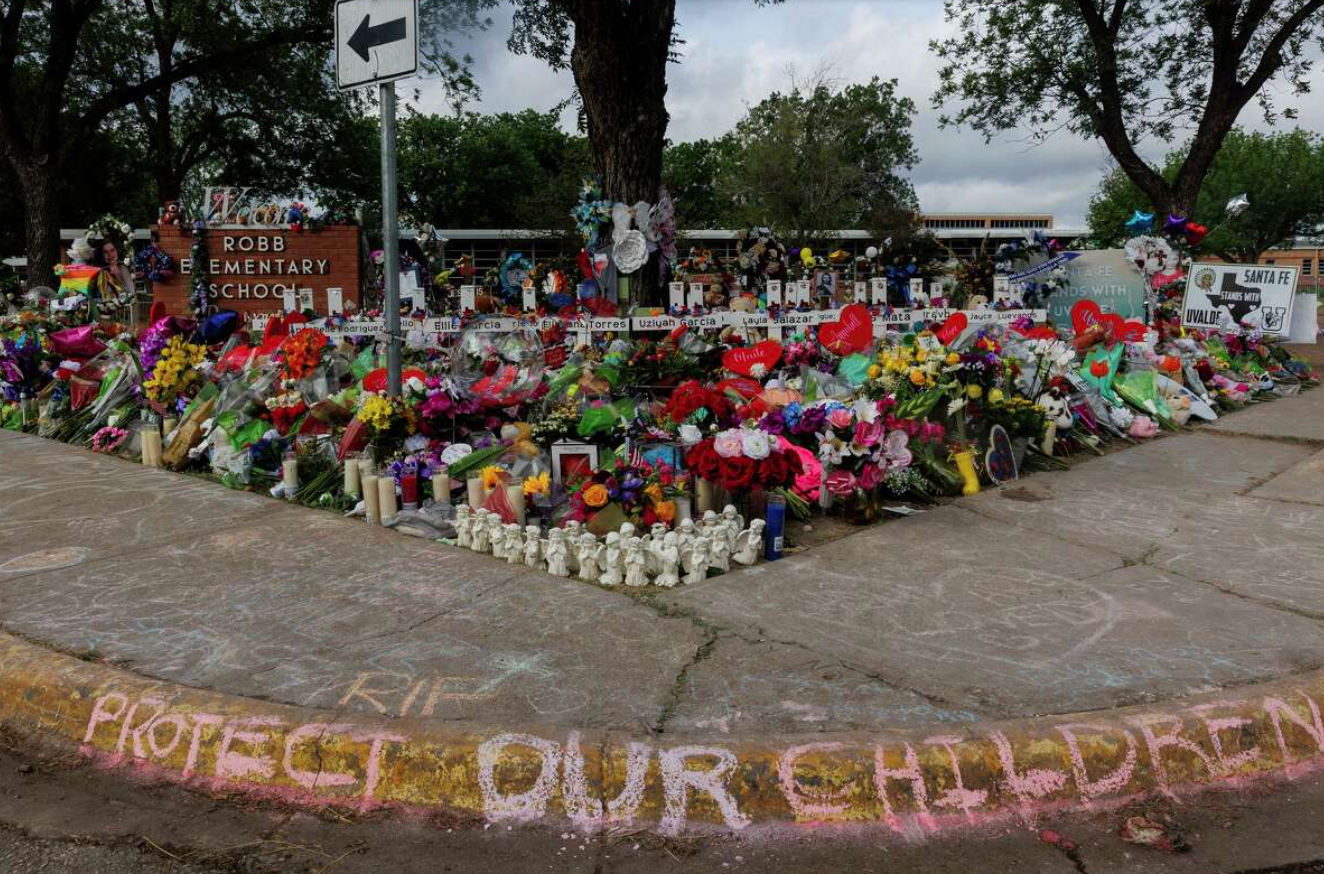
Seth Garza and his daughter, Lilly, pause at a memorial dedicated to the 19 children and two adults killed during a mass shooting at Robb Elementary School in Uvalde, Texas.Brandon Bell / Getty Images file
‘Our kids will pay the price’
The tactic of tying anti-racism and emotional education programs to school violence was echoed in the reactions of some national conservative figures to the May 24 shooting in Uvalde, which killed 19 students and two teachers.
U.S. Sen. Ron Johnson, a Republican from Wisconsin, blamed the shooting on critical race theory, “wokeness” and a failure to teach values in schools. That same week, Donald Trump Jr. tweeted that schools should get rid of “gender studies or critical race theory ‘teachers’” and replace them with armed guards.
The political shift can also be seen in school safety proposals from some Texas Republicans since Uvalde. Rather than prioritizing school-based programs to support the emotional needs of troubled students, as was the case in 2018, some Republican lawmakers in Texas have argued that the state should focus on implementing harsher disciplinary policies.
“I’m going to make a statement that’s gonna get me hate mail,” state Sen. Charles Perry, a Republican from Lubbock, said during a recent legislative hearing focused on the Uvalde shooting. “Not all kids belong in the classroom anymore.”
And at a news conference at the Texas GOP Convention last month, state Rep. Steve Toth, a Republican from the Houston region, suggested that what happened in Uvalde might have been prevented if not for school disciplinary policies that he said have been pushed by the “woke left” — including a Texas law passed with bipartisan support in 2013 and signed by former Gov. Rick Perry that limits the ability of school police officers to issue criminal citations to students.
Flanked by teachers and parents who say restorative disciplinary initiatives have made their schools less safe, Toth said he plans to introduce a bill that would appoint a committee composed of educators, prosecutors and local law enforcement officials to review reports of student misconduct. That way, he said, authorities will have an opportunity to identify patterns of dangerous behavior before it’s too late.
“Look, I don’t want to see a kid go to jail for being caught with some pot,” Toth said in an interview. “I don’t want to see a kid go to jail because he gets into a fight with another kid. That’s clearly not the intent here. But if you’ve got a kid that is violent and is consistently violent, and they’ve been violent towards other children and teachers, then we either have to reach that kid or we have to remove that kid. They shouldn’t be in the classroom. Period.”
It’s not clear whether school disciplinary practices were a factor in the shooting in Uvalde. The Texas Education Agency announced in June that it is reviewing “every aspect” of the 18-year-old gunman’s educational history, looking for signs of misconduct and missed opportunities to intervene.
Last month, Abbott and other state leaders announced that they had reallocated about $100 million to improve school safety in response to the shooting. About half of the money was set aside to equip school police officers with bullet-resistant shields. The second-largest expenditure, about $17 million, is for school districts to buy silent panic alert technology to notify law enforcement during emergencies.
Another $10 million was set aside to increase teen access to mental health services in schools and expand a rehabilitation program for juvenile offenders.
“The State of Texas is acting swiftly to ensure our schools are secure and that children, teachers, and families across Texas have the support and resources they need to be safe as we work to prevent future tragedies like the heinous crime committed in Uvalde,” Abbott said in a statement.
His office did not respond to questions about whether the governor continues to support social emotional learning as part of the solution to school violence.
Judge Angela Downes, chair of the American Bar Association’s Standing Committee on Gun Violence, said she’s disturbed that one of the few bipartisan approaches to addressing school safety in recent years has become so politicized.
Downes has been an outspoken advocate for social emotional learning and restorative disciplinary practices, both in her work with the bar association and while dealing with juvenile defendants as a municipal judge in a North Texas town.
“What I found is that kids really did not have coping mechanisms or tools in order to navigate some of the things that were happening in their lives,” Downes said. “And so I really saw as a judge that social emotional learning, whether it’s in an educational setting or in the community, could provide some tools to help them deal with challenges and adversity in a healthy way.”
Her support isn’t based only on firsthand observations. Downes noted that dozens of academic studies have found that social emotional learning programs have resulted in better academic outcomes and lower rates of student misconduct.
Despite the evidence, she worries that state officials in Texas and elsewhere might roll back social emotional learning requirements, or that local school districts will eliminate or water down their programs.
“Our kids will pay the price,” she said.
‘Fearmongering at its worst’
Karen Marcucci, Mansfield’s school board president from 2018 until 2020, said she was outraged when she found the Patriot Mobile flyer in her mailbox. For years, Marcucci, a lifelong Republican, said she and her fellow board members had overseen efforts to improve educational and disciplinary outcomes for students from all backgrounds.
Social emotional learning and restorative discipline were important components of that work, she said. Those programs, she said, were designed and implemented with input from parents and community members.
"It makes me angry," former Mansfield school board president Karen Marcucci said of the mailer that blamed the Timberview shooting on school disciplinary policies.Zerb Mellish for NBC News
Marcucci stepped down from the school board in May, deciding not to run for re-election after nearly 10 years on the board. She noted that Patriot Mobile Action is based in Grapevine and has close ties to conservative activists in Southlake — two nearby cities with no direct connection to Mansfield schools.
“The people that are making these allegations aren’t part of our community,” said Marcucci, whose daughter attends classes at Timberview. “All they tried to do was try to incite people and make them anxious and angry. It was fearmongering at its worst.”
Without mentioning the PAC or the mailer, Mansfield administrators addressed the controversy at a school board meeting last month.
During a presentation about disciplinary outcomes, David Wright, Mansfield’s assistant superintendent of student services, acknowledged that the district had heard criticism of its restorative disciplinary practices.
But he denied that administrators had stopped disciplining students, noting that the district had issued more out-of-school suspensions in 2021 than in 2018.
“It’s about healing, it’s about justice, it’s about redemption,” Wright said, referring to the district’s efforts with social emotional learning. “What it’s not about is, it’s not in place of discipline. It’s not a substitute. It’s not an either-or — it’s both, really.”
Stonecipher, the mom who has spoken out against social emotional learning programs, said she doesn’t know anyone who disagrees with those goals.
“On the surface, it teaches the students to take responsibility for treating others with respect, empathy and compassion,” Stonecipher said. “Many of us would not argue these points."
Mindy Stonecipher, a mom who has criticized Mansfield's social emotional learning and disciplinary policies, also shared concerns about the Patriot Mobile mailer but agreed with its underlying argument.Zerb Mellish for NBC News
But in practice, Stonecipher said, she believes that Mansfied’s social emotional learning programs have become a vehicle for liberal ideas and that the initiative is taking up time that would be better spent teaching children the basics of math, science and reading.
She said her group has heard from current and recently retired Mansfield teachers who say the initiatives have added to their workload and left them at times afraid to discipline students for unruly behavior — ultimately leaving classrooms less safe.
“Many of them don’t want to teach the social emotional learning lessons,” Stonecipher said. “And they know this sort of discipline is not working. The teachers know that, and I think we have to listen to the teachers.”
Marcucci said she’s also heard feedback from school employees — though like the current teachers who spoke to Stonecipher, Marcucci said none were willing to speak to a reporter because of the tense political climate at Mansfield. Teachers and counselors have told her that social emotional learning does require more work, Marcucci said, but that ultimately it leads to better outcomes for students.
Now she worries that those programs could be rolled back under the new school board.
“It makes me angry,” Marcucci said. “The district shouldn’t be done with the work in this area, because there’s still a lot more work to do.”
CORRECTION (July 18, 2022, 3:07 p.m. ET): A previous version of this article misstated when Karen Marcucci’s term as president of the Mansfield school board ended. She was president from 2018 to 2020, not 2018 to 2022.
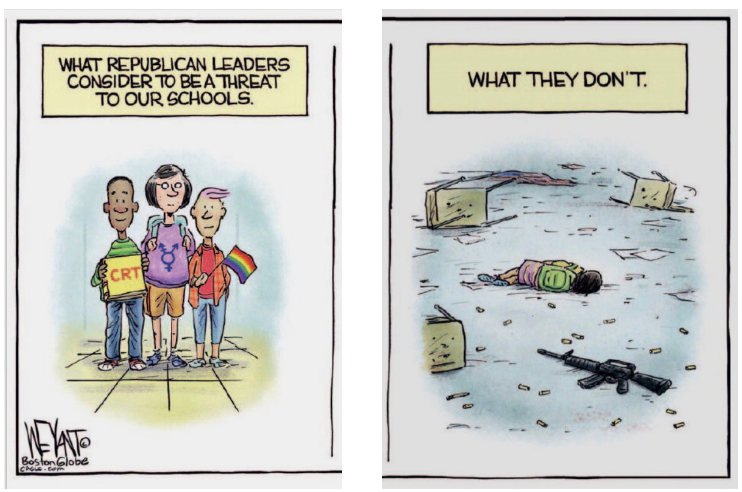
Excellent toon imagery. Thanks to my sister-in-law for sending.
Abbott's expressions of sorrow ring hollow. As President and Jill Biden were praised for their visit to Uvalde, Gov. Greg Abbott was booed by the community in Uvalde at last Sunday's press conference.
While Republican leaders marshal weapons of mass distraction by getting us all to focus on "shiny objects" like opposing transgender kids and Critical Race Theory, they give those of us in policy more work with ever more things to have to focus on instead of what we all should actually be doing like addressing gun policy. Without a doubt, gun policy today IS education policy.
I have been involved in the Texas legislature for at least two decades. Greg Abbott and the Republican leadership know exactly what they're doing.
It's their playbook. This is intentional.
EVERY legislative session, without fail, it's predictable.
That is, they mobilize fear by dropping bombs like anti-abortion, anti-CRT legislation, anti-immigration, build the wall, and so on, so that we in the advocacy community are all kept super busy challenging them. Our focus instead should be on all that we need to do in other areas of policy to keep our children, teachers, families, and communities safe and healthy, beginning with what should already have been, the elimination of what are real weapons of war that are mowing down our children, teachers, and communities.
Heck, read the Texas Tribune piece below to learn that in Gov. Abbott's 7.5 years in office, we have had 6 mass shootings. And then he and his party have the gall to scream at Beto O'Rourke for interrupting his SIXTH press conference to express a widely shared view that this was predictable and that not just health, but also gun policy is necessary, beginning with outlawing AR-15 weapons, background checks, red flag laws, and so on.
The responsible thing of any leader at this juncture to do is to call a special legislative session that will address all of the above, as well as building a new school in Uvalde as Robb Elementary will, as it should, get razed to the ground.
Doing what is responsible will actually help Uvalde in its healing. For anyone with a heart, with true compassion, this should be motivation enough.
He must acknowledge that what he does or doesn't do will not only impact Uvalde, but a traumatized nation, as a whole. Kids and teachers everywhere must be feeling a bit afraid of their schools. Such fears threaten to undermine the historic role that schools have played, in the words of John Dewey, as "laboratories for democracy."
Times like these call for a central role of good government and courageous leaders and politicians willing to do all that must be done. Failure to do so disqualifies this governor and his party from continued "leadership."
Prayers are in order, but for Greg Abbott himself. He needs to stop mystifying Texans with his empty platitudes, papering us over with cliché expressions of solace and concern.
The burden of history and circumstance are upon him and the Republican Party leadership. He and the Lt. Governor must act now, even as we all hold him and them to account.
After previous mass killings during his more than seven years in office, Abbott has pledged that lawmakers and his administration would search for solutions. He made no substantive suggestions Wednesday.
Six mass shootings have occurred in Texas during Gov. Greg Abbott’s 7½ years in office. He has offered prayers and condemned each.
The murders of five police officers in Dallas were “acts of cowardice.” The killing of 26 in Sutherland Springs was a “horrific act.” The high school shooting in Santa Fe that took 10 lives was an “act of evil.” The slaying of 23 at an El Paso Walmart was a “senseless act of violence” while the shooting deaths of seven in Midland-Odessa three weeks later were a “senseless and cowardly act.”
The slaughter of 21 at an elementary school in Uvalde was a “senseless crime,” which, Abbott added at a news conference Wednesday, “could have been worse.”
In the past, Abbott has suggested state leaders could do something — would do something — to prevent the next mass shooting. That same call to action was missing from the governor’s remarks at Uvalde High School. Though at times his voice wavered in anger, Abbott made no specific proposals for the coming legislative session to address gun violence.
He raised no issue with the fact that the alleged shooter had been able to purchase two rifles and 375 rounds of ammunition without raising suspicion. He suggested mental illness drove the troubled young man to violence and called for increased access to health care.
"I asked the sheriff and others an open-ended question … ‘What is the problem here?’” Abbott said. “And they were straightforward and emphatic — they said we have a problem with mental health illness in this community and then they elaborated on the magnitude of the mental health challenges they are facing in the community and the need for more mental health support in this region.”
But Abbott also said authorities were unaware of any criminal or mental illness history of 18-year-old Salvador Ramos that could have identified him as a potential threat.
Abbott said there was “no meaningful forewarning of this crime” other than Facebook posts Ramos made minutes before the shooting that he was going to target an elementary school. The social media company clarified that these were private messages Ramos exchanged with someone else.
Abbott praised the “amazing courage” of law enforcement personnel, without which he said the death toll would have been higher. Department of Public Safety Director Steve McCraw said a school resource officer “engaged” Ramos outside, yet did not fire his weapon nor prevent Ramos from entering the building through a back door.
As he has in the past, Abbott rejected calls for stricter gun laws, arguing that cities and states which attempt to limit access to firearms still suffer from gun violence.
“I hate to say this, but there are more people shot every weekend in Chicago than there are in schools in Texas,” Abbott said. “We need to realize that people who think, ‘Well, maybe if we implement tougher gun laws, it’s going to solve it,’ Chicago, LA and New York disprove that thesis.”
Abbott on Wednesday praised the Legislature’s efforts in the 2019 session to improve school safety. These laws, suggested by a task force Abbott had created after the Santa Fe shooting, improved mental health resources for students and made it easier for teachers to arm themselves. None restricted Texans’ access to firearms.
Some of the task force’s more ambitious ideas, like allowing courts to seize guns from individuals deemed unsafe to themselves or others, never gained support in the Republican-dominated Legislature.
“We consider what we did in 2019 to be one of the most profound legislative sessions, not just in Texas, that we’ve seen in any state in addressing school shootings,” Abbott said. “We will continue to discuss with legislators all the potential avenues and pathways we can take to make sure schools will be even safer going forward.”
Texas' recent string of deadly mass shootings has sparked public debate about gun rights — and a host of laws aimed at preventing the next one. See how lawmakers responded and how Texans felt in the aftermath with our timeline.
* Information about the shooting at an elementary school in Uvalde is preliminary.
“I don’t know which is worse, going through the motions when you have no intention of passing commonsense gun reform after a tragedy or just deciding that that’s not even worth mentioning,” Golden said.
A spokesperson for the Texas State Rifle Association said she could not comment on reforms the governor hasn’t yet proposed.
Beto O’Rourke, the Democratic nominee in this year’s race for governor, angrily confronted Abbott at the news conference. O’Rourke, who has called for a prohibition on the type of assault rifle Ramos allegedly used, blamed Abbott for not taking meaningful actions after previous mass shootings.
“You are doing nothing,” O’Rourke said. “You are offering up nothing. You said this was not predictable. This was totally predictable when you choose not to do anything.”
Other Republicans on the stage denounced O’Rourke, who was escorted from the venue by police.
The Uvalde shooting took place 10 years after the only deadlier massacre at a U.S. elementary school, in Newtown, Connecticut, in 2012.
That incident prompted Connecticut state lawmakers to pass some of the strictest gun control laws in the country. The legislation, which passed with bipartisan support, required background checks on all gun sales, limits the size of ammunition magazines and created a registry of suspects convicted of gun crimes. Then-Gov. Dan Malloy, a Democrat, said he did not believe the measures would stop all mass shootings.
“That, however, cannot be the test that determines whether America chooses to act or remain complacent,” Malloy said in 2013. “These measures will surely save many lives.”
Disclosure: Facebook has been a financial supporter of The Texas Tribune, a nonprofit, nonpartisan news organization that is funded in part by donations from members, foundations and corporate sponsors. Financial supporters play no role in the Tribune's journalism. Find a complete list of them here.