Translate

Showing posts with label banned books. Show all posts

Wednesday, July 31, 2024

A User’s Guide to All the Banned Books in Texas by Dan Solomon, TEXAS MONTHLY

Just came across this article from 2022 on banned books in Texas Monthly. Banning books is so medieval and actually untenable for the digital natives that Gen Z represents. This means that our youth can't actually be kept from learning from "banned books," considering the era we live in with so many of these accessible at young people's fingertips. If anything, banning books draws attention to books that youth might not otherwise read. 

It's good to know that organizations like PEN America and school librarians are fighting back as covered in this article authored by David Montgomery in EdWeek titled, "Librarians Fight Back Against Efforts to Ban Books in Schools."  Two organizations spearheading this are Moms for Liberty and No Left Turn in EducationCommenting on banned books specifically in Texas, Texas Library Association Executive Director Shirley Robinson notes that they've not experienced challenges like these in the last 40 years. 

I recently met Moms for Libros founder Lissette Fernandez at a conference organized by PEN America in Orlando, Florida. Her organization is an obvious response to Moms for Liberty that you can learn about here from this August 13, 2023 piece on NBC Miami titled, "Moms for Libros: how the educational disputes raging in Florida will affect young learners this school year."

This won't last forever. In the meantime, do consider that reading these texts is more important now than ever. Not that parents shouldn't have a say, but that we should not establish blanket, willy-nilly policy on the basis of exceptional, individual concerns.

Angela Valenzuela

A User’s Guide to All the Banned Books in Texas

Discussions of race or sex, or just the wrong vibes, seem to be all it takes to number a book among the 801 bannings in Texas this year.

Dan Solomon


Over the past year, schools and libraries around the country have been banning a whole lot of books. And while this is a nationwide phenomenon, no state’s schools have embraced the practice of declaring certain stories and perspectives forbidden to their young people the way that Texas’s have. According to a list compiled by the literature and human rights nonprofit PEN America, between July 1 of last year and June 30, Texas has seen 801 bannings. That’s a huge number! Compare that with, say, Alaska or South Carolina, which have banned one book each. (In both instances, it’s Maia Kobabe’s award-winning comic book memoir Gender Queer, which has also been banned in nine districts in Texas.)

That figure—801 banned books—refers not to individual titles but rather to the number of times any school district has issued a ban. Some titles, such as Gender Queer, appear multiple times, having been banned from Canutillo (fifteen miles northwest of downtown El Paso) to Clear Creek, 785 miles to its east. Others, such as Brent Sherrard’s Final Takedown—a slim, out-of-print volume from a small Canadian publisher about a kid who faces time in juvenile detention—appear but once (in San Antonio’s North East Independent School District, the most avid banner of books in the state). Some are banned in school libraries, others in classrooms. Some have been removed pending an investigation that the school district may or may not have the time and resources to conduct in a timely manner. Most have been banned by administrators, while others are the result of a formal challenge from a parent or other community member. In any event, the guiding principle remains the same: to ensure that students are not exposed to ideas that their elders do not want them to consider, by making it increasingly difficult to access the volumes in which those ideas are contained. (Teenagers are, of course, famously respectful of such rules, and rarely seek out such materials on their own.)

As the full list from PEN America indicates, book banning has become a popular cause among some in our polarized electorate—but this wasn’t always the case. Back in the halcyon days of, er, March 2021, some of Texas’s political leaders fervently opposed the idea of book bans, when the topic was the decision of Dr. Seuss Enterprises, publisher of the work of Theodore Geisel under his famous pen name, to no longer publish new copies of a handful of the author’s titles that included racist stereotypes. (Ted Cruz sold signed copies of Green Eggs and Ham in protest!) That may as well have been a lifetime ago, however, as the length and breadth of the list indicates. Texas has banned books about boys and books about girls, and books where the gender is more of a swirl. It’s banned books about sex and books about race, and books about those whose white hoods hide their face. It’s banned classics, and new books, and books in-between; it’s banned best-sellers, award winners, and books rarely seen. It’s banned books about what the Nazis did to the Jews, and beloved old books by the great Judy Blume. It’s banned comics, and prose books, and books full of poems; it’s banned slim volumes, and it’s banned hefty tomes. Texas has banned a huge number of books, indeed! And here’s a quick guide to the ones schools don’t want kids to read.

A PEN America notes, these are just the incidents that have been reported to the group—the reality of book bans likely extends further throughout the state. But here are some trends.

Books about gender identity and homosexuality

Kobabe’s Gender Queer, which explores the author’s journey to the realization that their identity is beyond the gender binary, is one of just a handful of books to appear nine times on the list. It’s hardly the only book about gender identity and same-sex romance to find itself banned in a Texas school or library, however. George M. Johnson’s “memoir-manifesto” about his coming out, All Boys Aren’t Blue, appears seven times; Susan Kuklin’s 2014 nonfiction collection of interviews, Beyond Magenta: Transgender Teens Speak Out, appears five times, as does Mike Curato’s comic book memoir Flamer. Even titles that seem downright clinical in their examination of the history of gay folks in America make the list—Jaime A. Seba’s Gay Issues and Politics: Marriage, the Military, & Work Place Discrimination, a 64-page explanation of its eponymous topic, has been banned twice. Four books by different authors with the title Gender Identity have all been banned in at least one district. It’s not just weighty titles getting banned, either—L.C. Rosen’s queer rom-com Jack of Hearts (And Other Parts) has been banned in eight districts, while The Breakaways, Cathy G. Johnson’s lightweight graphic novel about a kids’ soccer team, is banned in six because it includes a transgender boy among the players.

Books that are about straight people but have some sexual content

As the controversy around The Breakaways indicates, book-banners seem to contend that any depiction of gay or transgender characters—or nonfiction explorations of those identities—is inherently inappropriate for kids. When it comes to straight, cisgender folks, though, things have to get a bit more specific. Books such as Ashley Hope PĂ©rez’s Out of Darkness, Jesse Andrews’s Me and Earl and the Dying Girl, and Lauren Myracle’s l8r, g8r all appear on the list (nine, seven, and four times, respectively) for touching on sexual themes, featuring teens who talk about sex, or depicting sexual abuse. For nonfiction, books that discuss sex or its consequences openly tend to make the list—titles include Margaret O. Hyde’s Safe Sex 101: An Overview for Teens, Donna Lange’s Taking Responsibility: A Teen’s Guide to Contraception and Pregnancy, and Chloe Shantz-Hilke’s My Girlfriend’s Pregnant! A Teen’s Guide to Becoming a Dad (which seems like a useful book for kids in that situation!). And abortion, in any context, can get a book banned: Melody Rose’s Abortion: A Documentary and Reference Guide and Johannah Haney’s The Abortion Debate: Understanding the Issues, relatively straightforward histories, are on the list, as are books on the history of Roe v. Wade. Even dad-friendly political thrillers can land on the list if abortion comes up—bestselling author and occasional Fox News contributor Richard North Patterson’s Protect and Defend received an administrator’s challenge as well.

Books about race

The fervor around “critical race theory,” which describes an academic framework not taught in public schools, means that it doesn’t matter how well regarded a book about race is—such titles are all over the list of banned books. Between the World and Me, Ta-Nehisi Coates’s National Book Award–winning book-length letter to his young son about growing up Black, is on the list, as is his We Were Eight Years in Power: An American Tragedy, which features essays on race in America. One needn’t be a National Book Award winner to get on the list for writing about race, either—Duncan Tonatiuh’s history book for young readers, Separate Is Never Equal: Sylvia Mendez and Her Family’s Fight for Desegregation, makes the list, as does Mychal Denzel Smith’s memoir Invisible Man, Got the Whole World Watching: A Young Black Man’s Education. Ibram X. Kendi’s books How to Be an Antiracist and Stamped From the Beginning: The Definitive History of Racist Ideas in America are both banned in multiple districts. Fiction bannings include some of the most acclaimed books in American literature: Toni Morrison’s Beloved and The Bluest Eye, Sherman Alexie’s The Absolutely True Diary of a Part-Time Indian, and white author William Styron’s The Confessions of Nat Turner have all been removed from libraries. Poetry isn’t exempt, either—And Still I Rise, the third collection of poems by the great Maya Angelou, is on the list, as well.

Books about political violence, historical or speculative

If you’re a student who wants to learn about the history of the Ku Klux Klan, you may need to look outside of your school library to find the most acclaimed book on the subject for young adults: Susan Campbell Bartoletti’s They Called Themselves the KKK: The Birth of an American Terrorist Group isn’t on the shelves in three districts. Understanding how those roots affect the U.S. today might be a challenge too—Vegas Tenold’s Everything You Love Will Burn: Inside the Rebirth of White Nationalism in America, which traces the history of racist violence from the early days of the Ku Klux Klan to the events in Charlottesville, Virginia, in 2017, is also on the list in two districts. Art Spiegelman’s Pulitzer Prize–winning history of the Holocaust, the comic book Maus, appears on the list, as does Ari Folman’s graphic adaptation of Anne Frank’s Diary of a Young Girl. Even in fiction, books that explore fascist violence are verboten—the DC Comics graphic novel V for Vendetta, by legendary comic book creator Alan Moore, is banned in three districts for some reason. (The film adaptation, which similarly deals with anti-fascist themes, is also banned in China and Russia.)

Books where the vibes are wrong

For decades, Judy Blume’s Then Again, Maybe I Won’t, a puberty story from a boy’s perspective originally published in the seventies, has been a classic of the coming-of-age genre. The book hasn’t changed over the past fifty years, but frank storytelling about the issues high school students face frequently makes a book a target in Texas. Books about teen misfits such as Rainbow Rowell’s Eleanor & Park or Stephen Chbosky’s The Perks of Being a Wallflower both appear. Perennial banned-book list titles such as Of Mice and Men make an appearance, as does John Irving’s The Cider House Rules. The DC Comics graphic novel Y: The Last Man also makes the list, maybe because it’s a science fiction story about everyone with a Y chromosome dying, and that’d be a bummer? Hard to say for sure, but in addition to banning books because they acknowledge that teens think about sex, or out of a desire to disappear queer folks and discussions of race from the conversation, some stuff makes the list just because of, like, vibes.

Wednesday, July 10, 2024

On Books and Expanding the Powers of the Mind: Adam and Michele Rifkin's "Last Train to Fortune," by Angela Valenzuela, Ph.D. July 10, 2024

Friends, 

I'm thrilled to share a story of personal good fortune that supports the promotion of an incredible education-themed film featuring the legendary Malcolm McDowell, which is currently being considered for multiple film festivals.

The film celebrates the power of books and empowerment as a counter to the misguided anti-intellectual book ban movement prevalent today. Enjoy!

-Angela Valenzuela


On Books and Expanding the Powers of the Mind: Adam and Michele Rifkin's 
"Last Train to Fortune"

by

Angela Valenzuela, Ph.D.
University of Texas at Austin
July 10, 2024

James Paxton & Malcolm McDowell. Photo credit: Greg Gorman

It’s not every day that one gets asked by a Hollywood filmmaker—in this case, Adam Rifkin—to write a story about a film herecently directed, based on a screenplay written by his mother, former English teacher, Michele Rifkin, in 1986. Nor is it common to be asked to write a “story” instead of a film review about an epic, education-themed Western movie, namely, Last Train to Fortune (LTTF), produced by Brad Wyman, best known for “Monster” (2003), which won Charlize Theron an Oscar. 

The unexpected request was from Strategic Communications director, Daniel Delson, writing on behalf of Adam Rifkin. Its sense of urgency and care caught my attention.

As book bans are all over the national news, I’m writing to offer an interview with Hollywood director Adam Rifkin and legendary actor Malcolm McDowell to discuss their yet-to-be-released film, LAST TRAIN TO FORTUNE (LTTF) – not for a film review – for a story about this issue. At a time when books are being banned across the country, kids are addicted to TikTok, and education itself is under attack, LTTF serves as a wakeup call to audiences that knowledge sets us free, and that books are an enduring symbol of that freedom – a theme that couldn’t be more relevant than it is right now. (May 9, 2024)


Adam Rifkin. Photo credit: Greg Gorman

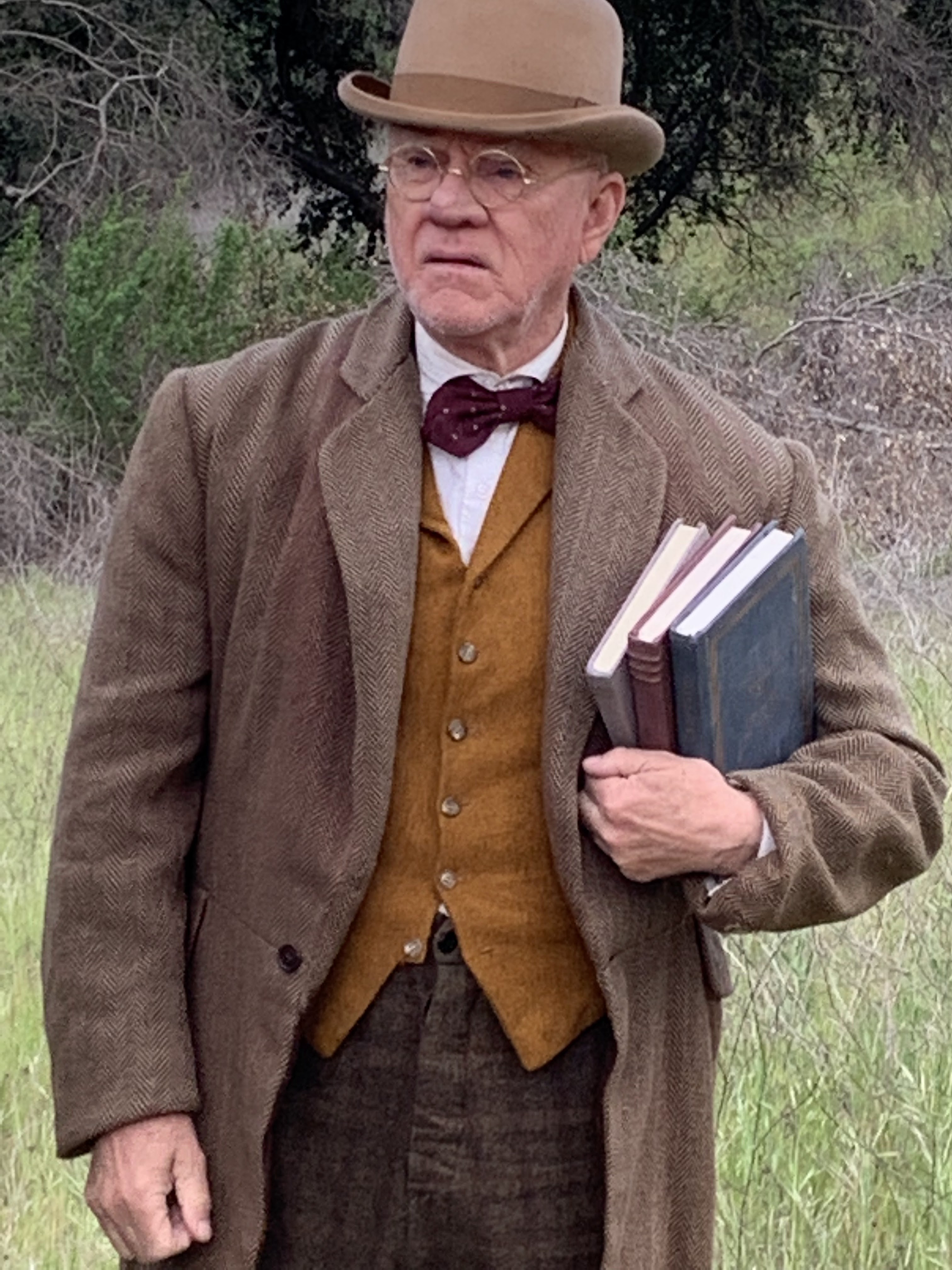
The message went on to describe the film’s setting which was the post-Civil War Old West of the early 1870s. The movie features the talented young actor James Paxton as the gunslinger, Jedidiah Dooley, and the legendary Malcolm McDowell as Cecil Caldecott Peachtree, an affable, book-bosomed, bibliophile and English teacher from London who suddenly finds himself incongruously positioned as a strange person in a new and vast land embarked on securing his new teaching position in a remote, little town invitingly named “Fortune.”

Malcolm McDowell.
Photo credit: Greg Gorman

Daniel also mentioned actresses Bernadette Peters, Mary Steenburgen, and the exciting young talent, Laura Marano. Together with gunfights, saloon brawls, and horse chases, the film promises to be a crowd-pleaser for all ages. Adam and Michele Rifkin’s LTTF is also destined to rank highly among other inspiring, education-themed films such as Stand and Deliver (1988), Dead Poets Society (1989), Precious Knowledge (2011), and Radical (2023). Besides being a Western movie, what distinguishes it from others is that it comes with its own promise of fortune in a reading list of Western canonical texts comprised primarily of English authors. The film should ignite discussions in academia and the public about the foundational relevance of a liberal arts education.

Daniel further divulged that Malcolm McDowell “happens to give one of the finest performances of his storied career.” I viewed this as no small feat, considering his career-defining, award-winning roles in the movies, “If…” (1973), and “A Clockwork Orange” (1971). My interest was piqued. But what story do I tell? I decided to trust the process given the positive premise in the story. I viewed the film multiple times by myself and with family members and interviewed Adam, Michele, James, and Malcolm, interacting regularly with Daniel by email throughout.

It has been an exceptional experience connecting with wonderful people and getting the winding, behind-the-scenes story about moving from screenplay to film that was 38 years in the making. This degree of access breaks down the mystique surrounding the filmmaking process, portraying actors and filmmakers as genuine human beings with their own challenges, victories, and struggles. 

I found the timeliness of their film to the current context of book bans and the current attack on public education to be intriguing and uncanny. What impressed me, even more, was their sincere desire to insert themselves through the film into this critical juncture in our nation’s history, offering a fresh, viable, and redemptive story. It advances a worthy cause for the enduring and liberating knowledge that elevates the human condition. James emphasized this point in our conversation, "It's not often that we get the chance to make a movie like this, one that is positive and makes a difference in the world.”

Books and knowledge do set us free and book bans are abhorrent. Well-funded schools and resource-rich classrooms are a must and great teachers are necessary, and competent teaching should not be a luxury but part and parcel of what a great education can and should be. Not that all educators need to rise to Cecil’s stratospheric level of the consummate “pedagogue,” but rather that they are intentionally cultivated, mentored, and liberated, as teachers, within caring institutional structures to impart their craft. James affirmed this by calling the film “a love letter to teachers.”

I shared with Daniel, Adam, and Michele that it was interesting that they had chosen me to write about the film. After all, I am both an English major and a policy advocate in Texas, calling for the inclusion of Ethnic Studies history and literature in state curriculum. 

The canon of Western literature is indeed the fortune or treasure to which we are all entitled. “All too frequently, as racial and ethnic minorities, we are denied access to this curriculum. Or we’re given a reduced version of it,” I shared. “The book with the hole in it,” I told a smiling James. 

This experience led me to reflect on the timeless nature of human experiences, blending suffering with triumphs and at times, salvation, from our self-sabotaging paths toward self-destruction, a theme taken up by the movie. Abiding truths such as the principles of freedom and the equal worth of all people remind us of our shared values and the continuous struggle to uphold them throughout history.

The Ethnic Studies cause of which I am a part nevertheless questions public school curriculum standards that already privilege this canonical knowledge at the expense of the histories and great works of literature of still underrepresented groups. My thoughts, however, were only partially formed during our initial conversations so I did not fully elaborate further. Plus, I was more in a research, data-gathering mode. What nevertheless emerged was a built-up tension to which Fareed Zakaria in his New York Times best-selling text, In Defense of a Liberal Education (2015), gives voice. 

Zakaria acknowledges the need for a core curriculum based on time-honored knowledge while also questioning how to incorporate new truths for the sake of humanity. Ultimately, the nagging tension that I felt between the film’s love of the canon, which I share, and the need to continuously “perfect the union” was not just intellectually, but relationally, resolved in my final interview with Malcolm.  

However, first, the plot after which I discuss the interviews, within which I discuss my own story that is pertinent to the aforementioned core tension in liberal education (Zakaria, 2015).

Plot. The LTTF is centered on an endearing, highly educated British school teacher named Cecil Caldecott Peachtree who finds himself in a fix when he misses the last train to Fortune where he is expected to serve in the new school term as its one-room-schoolhouse teacher. Stranded with his luggage in the middle of nowhere and dreading the idea that he will have to wait two days for the next train to arrive, a disconcerted Cecil instinctually sits down to read Homer’s Odyssey. Meanwhile, a gunslinger named “Dooley” silently walks up to him and shoots a gaping hole in his precious book.  

Malcolm McDowell
Photo credit: Greg Gorman

Cecil is shocked by this near-death experience and is especially disturbed when Dooley ransacks his suitcase full of book classics and takes one of his most precious belongings, a gold pocket watch that his father had given him. The timeless piece malfunctions throughout the film with its quirky cover unexpectedly flipping open throughout the movie, as if it were a muse, seamlessly bridging the gap between past, present, and future. It subliminally reminds Cecil, with its engraved quote from the ancient Greek philosopher and former slave, Epictetus, of his time-sensitive duty:  “Only the educated are free.” Cecil’s watch symbolically connects the ancient past with Fortune’s promising potential to be a wellspring for the creative impulse, bridging time and inspiring future generations.

Upon seeing that Cecil has nothing else of value but “stupid books,” to which the desperate and comical Cecil takes umbrage—he cleverly cajoles Dooley into taking him on his horse to Fortune. In exchange, Dooley can expect Cecil’s first-month salary upon arrival. Here is where Cecil’s and Dooley’s own odyssey begins. Both ride on Dooley’s horse, share one blanket, and slog Cecil’s books in saddlebags and later, in their only blanket, on their rugged, treacherous journey to Fortune.

Interviews. I accepted Daniel’s offer to interview Adam’s lovely mother, Michele, a teacher of many years who devoted her life to nurturing young minds. Adam commented on how he and his mother are already close, but how the movie brought them closer. “Getting to direct my mother’s words was a thrill, as well as getting to work with all these wonderful actors. It was exciting.” “What an exceptionally unique gift,” I thought, for this accomplished filmmaker and actor to fulfill his mother’s dream of bringing this film to fruition despite a series of fits and starts, including the difficulties of funding independent films, as Malcolm had later shared.

From Adam and James, I learned of how James’ father whom he dearly loved passed away, impacting plans they originally had of him playing Dooley. Adam and his growing team, including Bernadette Peters and producer Brad Wyman decided that James could take his father’s place in the film considering that he was back home from New York University where he had been studying theater and acting. 

I asked James what he thought the goal of the movie was and he said it was getting kids off TikTok and social media and for them to read books. I expressed that the texts featured in the movie aren’t just any books, but representative of the English literary canon. “Why should any young person want to read them?” I asked, in all sincerity. He responded by expressing his love of classical literature which he sees as “philosophy,” that elevates the imagination and makes us better human beings. When he said this, I reflected on a similar comment Adam had made, “We hope students will come out of the movie and pick up a book and read.”


Malcolm McDowell & James Paxton
Photo credit: Greg Gorman

James shared how pleasurable it was to work with Malcolm, who became his real-life mentor as a result of the movie. 


Malcolm was generous, offering helpful pointers and suggestions throughout the filming process. James further expressed loving the opportunity to ride horses and the very idea of making a Western, saying, “Who doesn’t like a Western?” The whole experience was nothing short of thrilling. “Plus, he said, it’s not just any film. It’s one that means something positive for these times.” This brought to mind Adam’s response to one of my questions in an email where he says,


CECIL is passionate about books and reading and tries to inspire DOOLEY, a fearsome though illiterate gunslinger, who is CECIL’S reluctant guide across the plains, that literature and education offer windows into countless other worlds and important new ideas. Additionally, how an education is the perfect tool to open new opportunities for DOOLEY, who is currently on a path of self-destruction. DOOLEY couldn’t be less interested and thus, their opposing viewpoints on the topic not only create tension between the two men, but their relationship is a microcosm for the larger debate involving the importance of education versus the current anti-intellectualism sentiment. (Rifkin, May 27, 2024)

James then shifted to Dooley’s relationship with Cecil in the film where Dooley came to see an erudite Cecil as his mentor who could have given up on Dooley for his untamed, gun-toting bravado and penchant for violence. Instead, Cecil’s fascinating presence and spellbinding charm matched by his love of books, wins over an incredulous Dooley with his learned wisdom that “the pen is mightier than the sword,” meaning in Dooley’s case, his gun.

Elaborating further, what Paxton loved most about the relationship between Cecil and Dooley was the former’s unwavering nonjudgmental expressions of care toward Dooley, who he so deeply wanted to impress with his great books of literature that helped form the Western literary canon, as it is known today. I couldn’t help but connect to my own research on authentic caring as a dynamic that motivates the achievement of Mexican-origin youth (Valenzuela, 1999). That is, when teachers and students are in meaningful, caring relationships, children and youth thrive. Gun-slinging cowboys are no different.

Malcolm McDowell, James Paxton, & Producer
Brad Wyman. Photo credit: Greg Gorman

I reveled in Cecil’s effervescent aliveness about Homer’s “Odyssey,” Jonathan Swift’s “Gulliver’s Travels,” Charles Dickens’ “Oliver Twist,” Herman Melville’s “Moby Dick,” Henry David Thoreau’s “Walden,” Jane Austen’s, “Pride and Prejudice,” and Shakespeare’s “Julius Caesar,” marshaled throughout the film with well-chosen quotes that whimsically punctuated the dust, blood, and beauty of the American Southwest.

By the time I spoke with Malcolm McDowell in my last interview, I was prepared to articulate the apprehensiveness that arose for me in my initial understanding of LTTF. Our conversation was fast and furious as he only had a few minutes to talk. I told him that I loved the film and was enthralled by his performance and that I wished the film great success. 

I explained that I am an English major, a university professor, and a leader in the Ethnic Studies movement in Texas and how I, among many others, have been advocating for greater inclusion of the history and literature of U.S. minorities in Texas’ state curriculum. “Wonderful,” he responded. “As an English major,” I continued, “I read almost all of the texts that Cecil mentioned and loved reading the classics.” I asked him why Miguel de Cervantes, author of Don Quijote and a contemporary of William Shakespeare, didn’t make it into the movie. “There are many books that unfortunately didn’t make it in,” he said. “Only so many could fit into Peachtree’s suitcase.” 

I moved on to a point of convergence when Malcolm expressed an appreciation of Charles Dickens’ writings, considering him one of the greatest English writers of all time. Referring to “The Selected Works of Charles Dickens,” another book that Cecil Peachtree had to shed along the way, he mentioned, A Tale of Two Cities. What Malcolm didn’t know is that Charles Dickens hits all kinds of buttons for me. I quipped, “I can hardly even think of A Tale of Two Cities without wanting to cry.”

My deep connection to Charles Dickens bubbled up emphatically. I knew that our time was limited, and I wanted Malcolm and, by extension, Adam, Michele, and James, to understand my analysis in light of my own experience, having grown up as a Mexican girl from West Texas:

I was tracked and teachers held very low expectations of me. None expected me to go to college. A teacher, Mrs. Eli, however, changed my life. Other students and I accidentally ended up in her eleventh-grade honors, English classroom. She tried to get her teaching assignment changed on the first day of class as this was a mistake. She complained to the principal but to no avail. She returned unhappily to our classroom and said, “Well, I’m not going to teach you any differently than I teach my honors students!"

If it had not been for Ms. Eli, I wouldn’t have fallen in love with literature and sought my own fortune through education. I read the Romantic poets, Yeats, Keats, Wordsworth, Thoreau, and Shakespeare’s Hamlet and Macbeth. The only term paper that I ever wrote in high school was in her class and it was on Charles Dickens. This assignment took me to my local university library and made the idea of going to college tangible (see Valenzuela, 2011). I even got certified to teach English at the secondary level, while minoring in Spanish. 

Malcolm responded with “ohs” and “ahs” as I spoke which I took to mean that he was impressed or perhaps surprised that a college professor who teaches education policy today originated from this kind of background. He felt like a kindred spirit who, like me, couldn't have enjoyed the conversation more.

Malcolm shared with me his experiences attending public schools in England and how public schools are different there, a topic I would have loved to pursue had we had more time. It factored curiously into his award-winning movie, “If…” (1967) which I recently watched, and that we both agreed shared some similarities to LTTF as critiques of public education, albeit only at the highest level on the larger purposes of education. I learned that it was the film that catapulted Malcolm to fame.

With my schooling experiences and this conversation on education behind us, I then spoke frankly to him about how some viewing audiences might critique the film as defending or pushing a specific curriculum and how it was important to anticipate this. “And not just any curriculum,” I shared, “but a Eurocentric, culturally chauvinist one that aligns with and reinscribes the values and preferences of the colonial settlers seeking to bring ‘civilization’ to the frontier.”

Malcolm readily acknowledged that history is overflowing with grisly tales of unspeakable violence and cruelty, but that Cecil Peachtree is different. “Yes,” I agreed and shared with him that the insight I bring will be helpful as this movie opens to diverse audiences, many of whom feel distant and alienated from the Western literary canon. 

Malcolm McDowell and Mary Steenburgen
Photo credit: Greg Gorman
I conveyed how our schooling experiences combined with our struggles as racial and ethnic minorities for inclusion in state curriculum “teach us” repeatedly that our knowledge production and literary achievements are inferior when nothing could be further from the truth. “My question is whether the movie is pushing a curriculum or is it centered primarily around the idea that education is about expanding the imagination and encouraging young people to think skillfully and dream?” With Zakaria’s (2015) book in mind, I further shared with Malcolm that I am highlighting a central tension in liberal education to which the film directly speaks.

This process of writing “a story” or “my story” helped me to realize that my protests are primarily against a “hard,” as opposed to a “soft,” attachment to the Western literary canon, with “hard” meaning to the exclusion of all other literary traditions. “We have over 50 years of literary and knowledge production as Mexican Americans, yet we face tremendous challenges in getting represented in state curriculum despite the great diversity of youth in our state.” But for a lack of time, I would have said how this stance is itself the embodiment of cultural chauvinism and ongoing colonialism—even as I sensed that Malcolm grasped my critique based on my earlier reference to colonial settlers. In contrast, a “soft” attachment, would be inclusive of other histories and works of literature.

I flatly insisted on my interpretation of LTTF as a soft approach, citing the exquisite campfire scene where flickering flames cast dancing silhouettes on a radiant Cecil who tenderly conveys to Dooley his life’s purpose and calling to be a teacher as follows:

You see, the purpose of teaching-it isn’t just to force students to memorize facts and dates. It’s to inspire. To unlock that little door hidden deep within us all that gives us permission to dream. To dream of a better life for ourselves and a better future for all.

“Malcolm,” I excitedly said. “This soft version is an argument for Ethnic Studies.” The core idea is one of giving us all permission to dream, to expand the powers of the mind, and to empower all our youth, as opposed to advancing a special curriculum.” I was suggesting that it’s not an either/or proposition, but rather a both/and one, together with a lifelong commitment to wrestle with this tension. “It’s a healthy one,” I concluded. Our conversation ended on this high note of enjoying and celebrating our literary and intellectual traditions, albeit in an inclusive, expansive manner.

Zakaria (2015) confesses that he has eased up over time with respect to this central tension. A liberal education is less about the “furniture” of the mind about which we need to be concerned, but rather about expanding its powers as noted in the “Yale Report of 1828” that grapples with the possibilities of a liberal, as opposed to a as opposed to a more instrumental curriculum designed for specific professional work. Zakaria offers the following telling statement from the 1828 debate—one of the most influential documents in the history of American education—over the perpetual tension between the purposes of education: 

The primary object of a Collegiate education, is to lay the foundation of a superior education. Its ultimate end is to teach the art of fixing the attention, directing the train of thought, analyzing a subject proposed for investigation, following with accurate discrimination the course of argument, balancing nicely the evidence presented to the judgment, awakening, elevating, and controlling the imagination, arranging with skill the treasures which memory gathers, and of arousing and growing the powers of genius. (cited in Zakaria, 2015, p. 52)

Cecil’s muse, qua watch, offers viewers the film’s final word when it pops open and reminds us of Epictetus’ complete statement that provides wisdom for the ages and a fitting way to conclude:

We must not believe the many, who say that only free people ought to be educated, but we should rather believe the philosophers who say that only the educated are free. 

-Epictetus, The Discourses (1998)


References


Films.


Anderson, Lindsay, director. If.... Paramount Pictures, 1968.

Kubrick, Stanley, director. A Clockwork Orange. Warner Brothers, 1971.

Menéndez, Ramón, director. Stand and Deliver. Warner Bros, 1988.

Palos, Ari Luis, and Eren Isabel McGinnis, directors. Precious Knowledge. Dos Vatos Productions, 2011.

Rifkin, Adam, director. Last Train to Freedom. Peacetowne Productions in association with Creative Media Arts, 2024.

Weir, Peter, director. Dead Poets Society. Touchstone Pictures, 1989.

Zalla, Christopher, director. Radical. 3Pas Studios, Epic Magazine, the Lift, 2023.


Texts.


Cervantes, Miguel. Don Quixote. Simon and Schuster, 2016.

Epictetus. The Discourses. Vol. 1. Oxford: Clarendon Press, 1998.

Valenzuela, Angela. Subtractive schooling: US-Mexican youth and the politics of caring. State University of New York Press, 1999.

Valenzuela, Angela. "How a Teacher Turned a ‘B’ Track Class into Honors." Faces of Learning: 50 Powerful Stories of Defining Moments in Education, edited by Sam Chaltain, Jossey-Bass, 2011.

Zakaria, Fareed. In defense of a liberal education. WW Norton & Company, 2015.


Malcolm McDowell and Mary Steenburgen
Photo credit: Greg Gorman


Thursday, November 16, 2023

House OKs Racial Profiling, anti-immigrant SB 4 along party lines & Donald Trump is Headed to the U.S.-Mexico border this weekend

Tuesday night's vote for Senate Bill 4 (SB 4) was disheartening. When we say that Texas is very much looking like a fascist state, this is not at all hyperbole but increasingly a lived dystopian reality. 

In brief, this is a border criminalization bill that imposes harsh consequences for individuals entering the nation, with penalties ranging from misdemeanors to felonies, contingent on factors such as the frequency of reentry.

This follows the passage this week of SB 3, a $1.54 billion plan to construct 50 miles of a state border wall. However, the Senate must give approval to the House's version of the bill that incorporated several amendments.

Governor Abbott will surely sign this premeditated abuse of power embodied in SB 4, potentially, and very likely, violating individual rights under the U.S. Constitution while simultaneously getting enacted in defiance of federal immigration policy. “The power to enforce immigration is unquestionably exclusively a federal power," expresses State Rep. Victoria Neave Criado (D-Dallas). Republicans don't care as they think they can win this in the Supreme Court. And if it hurts innocent people in the process, so be it. They're all "aliens" anyway, they must reason—which is how the see many Texans, by the way.

Gov. Abbott and House and Senate Republicans will most surely characterize this as one of their crowning achievements. It's racist and white supremacist, of course, especially considering how as per this New York Times piece published this week titled, What It Means to Be a Texan Is Changing in Surprising Ways. The piece is about the ascendancy of Black, Latina/o and Asian people in our state astride the declining population of white people with leadership that seeks and wants Apartheid. 

The irony is that the people that their bills target— including tomorrow's HB 1 voucher bill that will get taken up on Friday—are overwhelmingly people's who are either of this continent of hemisphere. In contrast, those doing the legislating are exact same colonizers of old, of overwhelming Western European descendancy.

This is the kind of history and knowledge that Republicans banned via House Bill 900 in the context of the regular 88th (2023) Texas Legislative Session. Add DEI (SB 17) that passed last session to the list of yet another attack on diversity and the diverse knowledge in higher education to which DEI attaches.

And to top all of this off, because our governor just can't get enough of Donald Trump who currently has 91 charges against him per the Washington Postcheck out this notice of his upcoming visit to Edinburg, Texas, on Sunday, Nov. 19th at noon. Read today's piece in the Houston ChronicleDonald Trump heading to the Texas border this weekend for campaign event with Gov. Greg Abbott.


Texas Gov. Greg Abbott, right, listens to former President Donald Trump's address during a tour 

to an unfinished section of the border wall on Wednesday, June 30, 2021, in Pharr, Texas.

Brandon Bell/TNS

The advocacy community isn't giving up and rolling over, my friends. And yes, there are people of color, including Blacks and Latinas/os that support all this animus against their own communities. If we understand white supremacy as an ideology, then this redounds precisely to the "color" of one's ideology—much of which is an artifact of manufactured self hatred in some measure created both by what is taught and learned in our schools, as well as by what is not taught or learned.

My main point here is that it all connects. And ultimately, that we need to vote these so-called state leaders out of power. 

-Angela Valenzuela

#SayNoToFascism #Fascism #SB4 #SB3 #SayNoToVouchers


“My task is to get this bill out of here and on the
governor’s desk as soon as possible,” Rep.
David Spiller, R-Jacksboro, said
 of Senate Bill 4. 
JAY JANNER/
AMERICAN-STATESMAN

IMMIGRATION

House OKs SB 4 along party lines

Measure to let state arrest, deport suspects


The House on Tuesday night passed the bill — which has been debated several times in both legislative chambers in recent weeks — by an 83-61 party line vote despite opposition from Democratic lawmakers and rights advocates over concerns the legislation is too broad and it could potentially affect everyday Texans through the state’s attempt at immigration enforcement.

“Senate Bill 4 is the broadest, most invasive piece of legislation to ever potentially challenge the very nature of our federal and state power,” said Rep.

Victoria Neave Criado, D-Dallas, during the debate over the bill on the House floor Tuesday. “The power to enforce immigration is unquestionably exclusively a federal power.”


“Senate Bill 4 is the broadest, most invasive piece of legislation to ever potentially challenge the very nature of our federal and state power,” said Rep. Victoria Neave Criado, D-Dallas. JAY JANNER/AMERICAN-STATESMAN


SB 4 would require people accused of illegally crossing the state’s southern border outside of a port of entry to accept a magistrate judge’s order to return to Mexico or face prosecution, with possible penalties ranging from a Class A misdemeanor to a second-degree felony.

Rep. David Spiller, R-Jacksboro, who sponsored the bill by Sen. Charles Perry, R-Lubbock, which advanced to the lower chamber after a late-night Senate session last week, defended the legislation as necessary to address the immigration crisis at the border.

Spiller, who rejected two dozen proposed amendments, said he felt it was important to advance the bill without any changes from the Senate version to not delay it getting to Gov. Greg Abbott to sign into law.

“My task is to get this bill out of here and on the governor’s desk as soon as possible,” Spiller said. “Because if I’m wasting my time and know that it’s going to be a delay, I’m going to have trouble sleeping tonight.”

On Wednesday, Abbott signaled his intent to sign the bill into law, calling the legislation “historic progress.” He and Lt. Gov Dan Patrick congratulated and thanked Spiller and the House for passing the bill, calling it the one of the strongest border security proposals ever passed in Texas.

“SB 4 will require criminal background checks and the collection of fingerprints and photographs of those arrested for crossing the border illegally,” Patrick said in a statement on X, formerly Twitter. “The illegal crosser can be jailed or ordered by a magistrate to be returned to the border. If they violate the order and return to Texas, they will face even harsher penalties.”

Opponents of SB 4 argue the legislation is an affront to federal law, gives nonfederal law enforcement officers broad permission to arrest and deport those living in the state who might be accused of having illegally crossed the border, and is an invasion into the lives of the state’s Hispanic and migrant communities.

Neave Criado, who chairs the House Mexican American Legislative Caucus, argued that the bill is a political avenue to challenge U.S. Supreme Court precedent on immigration law.

“SB 4 intends to challenge the decade-long holding of Arizona vs. United States given the new makeup of the U.S. Supreme Court,” Neave Criado said.

Around 6:15 p.m. Tuesday, after more than 6 hours of debate, Rep. Jared Patterson, R-Frisco, made a parliamentary motion to cut discussion on the bill, allowing the legislation to jump forward to its first vote by the full House.

“This is the same bill that we debated until 4 a.m. just a couple of weeks ago,” Patterson said before the motion was approved along party lines. “Hours and hours and hours of debate on a bill that is critically important to the future of the state.”

Neave Criado, who argued against ending debate on the bill, said: “We won’t be able to have an opportunity to lay out amendments because you’re cutting off our time. You’re cutting off our hands; you’re cutting off our feet; you’re trying to silence our voices.”

After the House moved the bill forward with an initial vote Tuesday, the members then paused and began a new legislative day, allowing the chamber to take a second and final vote on SB 4 that night and advancing it to Abbott to sign into law.

Using the same parliamentary procedure, House members also passed SB 3 — a $1.54 billion proposal to build 50 miles of state border wall — though the Senate will have to sign off on the lower chamber’s version of the bill.

‘Inaccurate arrests may occur’

Despite SB 4 carving out certain locations where law enforcement officers could not target people believed to have illegally entered the country — including in schools, churches, hospitals and facilities that provide forensic medical examinations for sexual assault survivors — Rep. Donna Howard, D-Austin, tried to codify an amendment to allow an undocumented person to be exempt from arrest while attending a medical treatment or a forensics exam with a family member.

“This is going to prevent people from getting the forensic exam because their family member cannot be there with them, and that is a horrific thing to have to go through,” Howard said before her amendment was rejected along party lines. “We’re willing to send a bill that has this damaging impact without considering adding this amendment, even if it means it delays things a bit. I can’t quite understand that.”

Rep. Salman Bhojani, D-Euless, in a last-ditch effort to limit the bill’s authority, asked lawmakers to include an amendment to require peace officers to verify a person’s immigration status before making an arrest.

He said that without that amendment, the onus is on everyday Texans to prove they belong in the country as opposed to law enforcement officers having the burden to prove that there has been an offense.

The amendment, which Bhojani said was needed to avoid possible instances of racial profiling, failed along party lines with Democrats proposing several changes to the bill before it was finally passed.

“Without proper verification of an individual’s legal status, inaccurate arrests may occur,” Bhojani said. “I would hate to penalize anyone who has followed our laws and has done everything right.”

In closing arguments, many Democrats rose to plead against the bill. Rep. Joe Moody, D-El Paso, reflecting on the many immigration and border fights during his tenure, said Tuesday night’s vote weighed heavily on him and communities across Texas.

“Members, I’ve walked off this floor defeated many times,” Moody said. “And I was telling myself and others around me that I have enough hope to keep fighting, and I’m going to try to tell myself that tonight; I don’t know if I believe it.”