I strongly encourage readers to spend time with this visionary and extraordinarily important work from the Stand Up for Science Foundation, which is doing much more than documenting attacks on science: it is mapping the larger political architecture behind them and insisting that science, democracy, accountability, and the public good must be defended together.
In brief, the Project 2025 playbook lays out an authoritarian governing agenda organized around several mutually reinforcing strategies: redirecting public funding and institutions to align with presidential priorities; advancing Christian nationalist and culture-war governance; politicizing knowledge and expertise by weakening peer review and discrediting scientists and scientific institutions; deconstructing the administrative state while outsourcing key public functions to the private sector; reducing regulatory constraints and steering public resources toward favored industries; intensifying border and immigration control; and weakening checks and independent oversight by limiting the authority of advisory boards, career experts, and independent agencies.
Taken together, these strategies concentrate executive power, install ideologically aligned operatives in key government positions, and expand the influence and power of tech-right interests—the BIG winners here. The net effect is a reconfigured system in which political loyalty increasingly shapes agency leadership, scientific inquiry, public funding, and institutional independence.
This first chapter that I'm sharing today traces how Project 2025, expanded executive power, Christian nationalist politics, tech-right influence, attacks on independent expertise, weakened oversight, and the redirection of public funding fit together as parts of a broader governing strategy; crucially, it is only the opening chapter of a larger manifesto organized around four stages—Assessment, Accountability, Deconstruction, and Reconstruction—aimed not simply at restoring what has been damaged, but at building a stronger and more resilient scientific and democratic order.
Stand Up for Science deserves enormous credit for naming these connections so clearly and for coupling diagnosis with a forward-looking vision of science as a public good. While we're at it, let's all add "techno fascism" to our vocabulary as it captures well a great part of what is afoot.
I urge readers to follow their continuing analyses, policy work, and updates directly at the Stand Up for Science Foundation.
So illuminating and inspiring.
-Angela Valenzuela, Ph.D.“The great challenge confronting a conservative President is the existential need for aggressive use of the vast powers of the executive branch to return power—including power currently held by the executive branch—to the American people. Success in meeting that challenge will require a rare combination of boldness and self-denial: boldness to bend or break the bureaucracy to the presidential will and self-denial to use the bureaucratic machine to send power away from Washington and back to America’s families, faith communities, local governments, and states.”
-Russell Vought, Chapter 2, Mandate for Leadership:The Conservative Promise (Project 2025), 44.
Saying that Project 2025 contained a coherent plan for the science and research enterprise would be imprecise. Coordinated by the Heritage Foundation as a presidential transition project, Project 2025 laid out hundreds of conservative policies intended to transform the mission and operations of White House offices and federal agencies, including independent regulatory bodies. The authors were explicit in their vision for a conservative government that would deliver on four promises: the family as the centerpiece of domestic policy, a dismantled administrative state, closed borders, and the right to enjoy the “blessings of liberty”1. Science was not a subject so much as a tool, valuable when it served the authors’ revision of an agency and expendable when it did not. Individual chapters are dedicated to the U.S. Department of Agriculture, Department of Energy, Department of Health and Human Services, and Environmental Protection Agency, with special attention to the National Institute of Standards and Technology, National Oceanic and Atmospheric Administration, and the U.S. Global Change Research Program. Agencies are largely described as incompetent, overregulated, and “woke,” with many of their functions proposed for outsourcing or transfer to the private sector. The most consequential chapter was written by Russell Vought, then president of the Center for Renewing America, as part of the volume’s opening section, “Taking the Reins of Government.” That chapter supplied the theory of executive control—using the White House, and Office of Management and Budget in particular, to direct the agencies. Without it, much of what has since transpired across the federal research system would have been far harder to carry out.
With the blueprint in place, what followed were the actors required to enable the plan and the staff required to execute it. Agenda-setting for science and technology wasn’t a simple hand-off but a product of political bargaining that ultimately carved off a decisive part of the federal science and research enterprise to the tech-right: a tight-knit group of Silicon Valley billionaires and their operatives that spent years at odds with Trump. The current state of campaign finance and Trump’s readiness to sell a seat at the table for the right prices made the reconciliation between the tech-right and the President possible. Elon Musk, the largest donor of the 2024 cycle, was granted special access to the government and with him brought in the Department of Government Efficiency, which gutted the U.S. Agency for International Development and became a blunt instrument for canceling billions in federal grants. Some of the other actors, like Peter Thiel, stayed behind the scenes, but were nevertheless successful in installing their operatives as political appointees in the Executive Office of the President. Still, OMB via Russell Vought holds unprecedented sway on the staffing and the direction of federal funding in scientific agencies.
Christian Nationalism, Techno Fascism, and Unfettered Executive Power
The MAGA political base, conservative think tanks, and the tech-right converge around a shared interest in expanding executive power, stripping the administrative state, and dismantling regulations to ultimately transform government to fit their own designs. That overlap has produced an unlikely partnership of interest groups that share the same enemy in the concept of democracy but diverge greatly in their motivations and their desired end state.
A very visible bloc of partners in the conception of Project 2025 were Christian-right organizations that heavily shaped the document by promoting Western Christian ideas of family, sex, education, and religious liberty. Though not explicitly naming their worldview, the whole document is oriented around a Christian moral order that its authors treat as under attack by leftists who, by their account, have captured the government bureaucracy. Project 2025 turns this moral imperative into an executive agenda: restore biblically-based gender norms, treat diversity, equity, and inclusion initiatives as a warrant for firings and grant terminations, and protect Christian schools and churches from the administrative state.
Russell Vought, director of the Office of Management and Budget and a principal architect of Project 2025, sits at the center of the effort to dismantle what conservatives call the deep state. He has embraced the label Christian nationalist as a description of his worldview and calls himself a “radical constitutionalist.”2 In his account, too much power has migrated to Congress, the courts, and the career bureaucracy. The presidency, he argues, was meant to hold the whole executive power, not to manage a semi-independent administrative state. That is the operational core of his Project 2025 chapter on “Taking the Reins of Government”. Vought views independent agencies, insulated civil servants, and appropriated spending that a president opposes as constitutional errors to be reversed, including by refusing to spend money Congress has enacted. He frames this as a return to the Constitution’s original design after two centuries of drift. Since early 2025, we have seen how this theory of power has been executed with little to no regard to law and statutes.
Christian nationalist views are reflected throughout Project 2025, and the authors do not hide their intention to restructure government around a religious moral order. In some chapters they are explicit. The Department of Health and Human Services chapter was written by Roger Severino, who directed HHS’s Office for Civil Rights in the first Trump administration. Severino, a lawyer by training, drove civil rights rollbacks on sex, gender and abortion, and created the Conscience and Religious Freedom Division within HHS in 20183. In this chapter, Severino writes:
“Protect faith-based grant recipients from religious liberty violations and maintain a biblically based, social science–reinforced definition of marriage and family. Social science reports that assess the objective outcomes for children raised in homes aside from a heterosexual, intact marriage are clear: All other family forms involve higher levels of instability (the average length of same-sex marriages is half that of heterosexual marriages); financial stress or poverty; and poor behavioral, psychological, or educational outcomes.”Severino argues that federal health and welfare policy should be rooted in biblical teaching and in a selective reading of social science that supports a particular view of gender and sexuality. Read in its entirety, Project 2025 is a rejection of secularism and of the separation of church and state that has been the foundation of religious freedom in the United States. It is not surprising that Project 2025 contains no serious discussion of the science enterprise. A research system organized around open inquiry and scientific evidence would be antithetical to the vision the project seeks to impose.
For the tech-right, the motivation is a different idolatry altogether: unencumbered technology and profit. Where the Heritage Foundation authored a vision of governance rooted in a desire for a Christian state, tech oligarchs became the willing suppliers of funding and personnel. Over the past several years, Silicon Valley billionaires who once disdained Trump have rallied behind him. Trump has taken money in politics to a new level of corruption by creating a pay-to-play system, where a Super PAC donation or a contribution to his ballroom can buy a cabinet position or a government contract. Watchdog reporting in 2026 found that more than half of known corporate donors to the White House ballroom project received new or expanded federal contracts totaling more than $50 billion in six months, including firms such as Palantir, Microsoft, Amazon, and Google.4,5
This alignment of ultra-wealthy entrepreneurs with Trump’s authoritarian government is what Gil Durán calls “tech fascism.”6 Silicon Valley discovered in Trump a way to seize power rather than evade it. Tech fascism, as Durán explains, offers AI, crypto, defense tech, and surveillance systems as tools the government can use toward authoritarian goals. In exchange for money and those tools, the tech oligarchs gain unfettered access to data, the power to surveil, more opportunity to profit, and a seat at the table to influence policymaking. Under Trump 2.0 the worldview of the technofascists finds an unexpected bedfellow in Christian nationalists and together they have effectively tapped the fear and insecurities of Trump’s MAGA base to ensure that the culture war continues to be their focus.
What we now see, nearly two years into a second Trump term, is a more coherent and aggressively law-defying strategy to turn the highest public offices into instruments of corruption and profiteering for a small circle of elites. The number of ultra-wealthy people holding power in this administration is unprecedented, and it is the most extreme expression yet of money in politics. Public Citizen found that the administration has appointed at least 57 people with assets of “as much as” $100 million to run federal agencies or serve as U.S. ambassadors – eight of them are billionaires now in public office.7
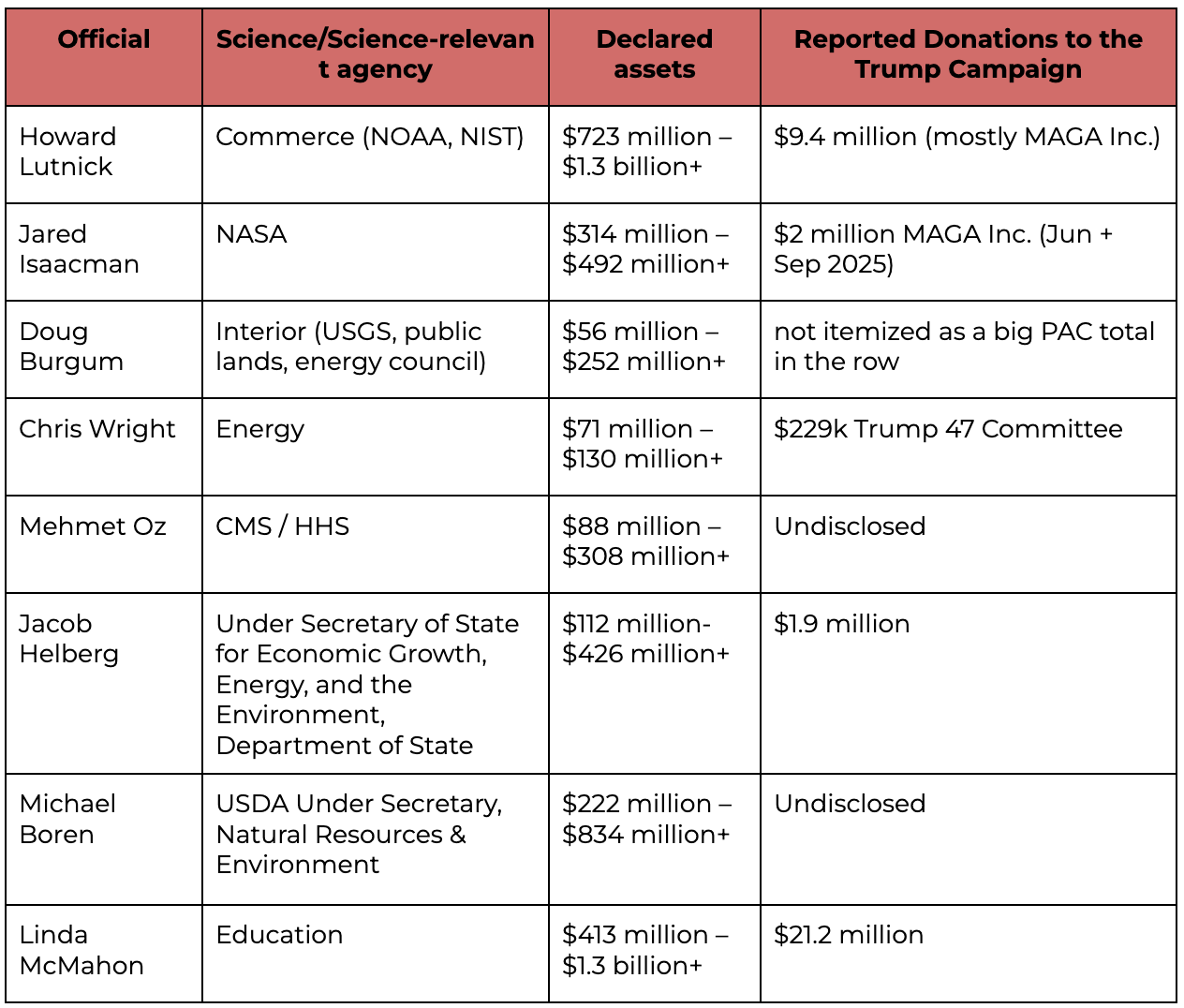
It is no secret that influence can be bought in Washington and that political appointments are often a result of political bargaining. What is distinctive in Trump 2.0 is scale and concentration: a cluster of extremely wealthy appointees now sit atop agencies that set research priorities, grant rules, and technical standards. Access to senior science positions can be purchased with generous donations, proof of loyalty, or proximity to tech oligarchs. Public Citizen reported that Jared Isaacman, now administrator of NASA, directed roughly $2 million to Trump-aligned political vehicles around the period of his nomination. Some appointments, like Robert F. Kennedy, Jr's, follow a more traditional route of political bargaining. He exited the 2024 presidential race, endorsed Trump, and delivered a vaccine-skeptical donor network and the Make America Healthy Again constituency and was subsequently appointed secretary of HHS. Other science-relevant appointments drew on the same donor milieu associated with the so-called tech-right. The table below summarizes publicly reported assets and Trump-aligned contributions for a cross-section of those officials. It illustrates how contemporary campaign-finance arrangements have enabled the ultra wealthy to hold formal authority over the public scientific enterprise.
Table 1. List of Agency Heads and their Reported Assets and Contributions to Trump Campaigns
Nowhere is the tech-right more visible than on the President’s Council of Advisors on Science and Technology, the outside body that is mandated to advise the president on science and technology. Past councils mixed university researchers, national lab leaders, and industry experts. Previous administrations, such as the Obama-era PCAST, met about six times a year and ranged across biomedicine, climate, education, and computing. The Trump administration rechartered PCAST in January 2025 and named 13 members in March 2026. The task force is co-chaired by Office of Science and Technology Policy Director Michael Kratsios and AI/crypto adviser David Sacks. The sole academic is John Martinis, a UC Santa Barbara quantum physicist and Nobel laureate who also works with Google. The rest are big tech’s biggest names: Oracle’s Larry Ellison and Safra Catz, Nvidia’s Jensen Huang, AMD’s Lisa Su, Meta’s Mark Zuckerberg, Google co-founder Sergey Brin, Dell’s Michael Dell, Andreessen Horowitz’s Marc Andreessen, Coinbase co-founder Fred Ehrsam, two nuclear CEOs (Oklo and Commonwealth Fusion), and investor and podcaster David Friedberg. So far the council has met only once, and as an advisory body it looks largely symbolic. But the access these pay-to-play seats on the Council provide is significant. As the Revolving Door Project reports, a place on PCAST gives these executives a sanctioned channel into the White House and, at times, direct access to cabinet members—the kind of access other companies pay lobbyists to chase.
The administrative state is being bent toward a conservative moral order and a tech-right vision of unregulated innovation. Ideas that threaten “traditional values” on sex, gender, reproduction, and climate are treated as illegitimate. At the same time, the tech right is pulling what remains of civilian federal science money toward AI and adjacent technology. In the imperfect status quo, the scientific community still had meaningful leverage to inform the science and research agenda. This is no longer the case.
