Translate

Tuesday, March 07, 2017

Why Young Girls Don’t Think They Are Smart Enough

Girls have so much against them.  Important research on this with implications for teaching and parenting.

Angela

Why Young Girls Don’t Think They Are Smart Enough

By the age of 6, young girls are less likely than boys to view their own gender as brilliant.

In our research, published today in the journal Science, we’ve found that girls as young as 6 start to believe that specific activities are “not for them” simply because they think they’re not smart enough. Our research suggests that American children are picking up on cultural stereotypes about brilliance at an early age. Unfortunately, these stereotypes suggest that girls aren’t as smart as boys.

If you try to think of a character in a book or show who is brilliant, you may come up with someone like Sherlock Holmes, Mr. Spock, Sheldon Cooper from “The Big Bang Theory” – or some other man. Of course, there are exceptions, such as Hermione Granger in the Harry Potter series and Lisa Simpson in “The Simpsons.” Most often, though, our cultural stereotypes promote the idea that being intellectually gifted is a male quality.

Even if parents do not explicitly endorse this stereotype, evidence suggests that it affects their hopes for their children. A 2014 report found that American parents Googled “Is my son a genius?” more than twice as often as they Googled “Is my daughter a genius?”

In contrast, questions about physical appearance were relatively more common for girls: Parents Googled “Is my daughter overweight?” about 70 percent more often than “Is my son overweight?”
As it happens, boys are slightly more likely to be overweight than girls. And, even though teachers – like parents – tend to assume that boys have greater “natural ability,” in reality girls do better in school.
Do little girls pick up on what their parents and teachers think about their smarts?
In our most recent research, with the psychologist Lin Bian as lead author, we studied 400 children ages 5 to 7, recruited over the last several years from a middle-class community near the University of Illinois, where one of us was working at the time.

For one study, each of 96 children (half boys, half girls) was told two stories about a person whose gender was not specified. They were told that one was about a “really, really smart” person, and the other was about a “really, really nice” person. Next, the children were shown four pictures (two males and two females) and were asked to guess which one might be the person in the story.

At age 5, boys and girls were equally likely to associate intelligence with their own gender, but that changed quickly. At age 6, girls were significantly less likely to associate brilliance with their own gender. Many of them picked a male character to identify as the really smart person in the story, much as the boys did.

These stereotyped responses were given by both white and nonwhite children, and did not seem to vary as a function of parental education and income.

When we asked children to guess which of four children, two boys and two girls, would get the best grades in school, girls picked mostly other girls. In other words, the girls we tested were aware that girls do better in school than boys, but that didn’t change their ideas about who’s “smart.”

Our research also suggests that these stereotypes may have lasting effects. Once internalized, they begin to guide girls’ interests away from things that they perceive as “not for them.”
In another part of the research, 64 children ages 6 and 7 (half boys, half girls) were shown two unfamiliar board games and told that they were either for children who are really smart or for children who try really hard. They were then asked four questions to measure their interest in the games.
When told that a game was for really smart children, the girls showed less interest and motivation than boys. This didn’t have anything to do with the game itself: When we described the exact same game as being for kids who try really hard, girls were just as interested in it as boys.

The difference between 6-year-old boys and girls appears to be related to their emerging stereotypes: We found that 5-year-old boys and girls — whose beliefs about brilliance were not yet differentiated — were equally interested in the game for really smart children.

In later life, these differences in children’s perceptions are likely to be consequential. In fact, in a paper we published in the journal Science in 2015, we found that women are underrepresented in fields thought to require brilliance – fields that include some of the most prestigious careers in our society, such as those in science and engineering. It may be that the roots of this underrepresentation stretch all the way back to childhood.

What is to be done? Research provides some clues. The psychologist Carol Dweck has written that emphasizing the importance of learning and effort — rather than just innate ability — for success in any career might buffer girls against these stereotypes. The relevant stereotypes, already in place at the age of 6, seem to fixate on who is supposed to have innate ability. If innate ability is seen as secondary, then the power of these stereotypes is diminished. Other research indicates that providing girls with successful role models might similarly “inoculate” them, boosting their motivation and protecting them from the idea that they are not intellectually competitive. One study even suggested that witnessing a more equal distribution of household chores could help balance the career aspirations of boys and girls.

Early and consistent exposure to such protective factors – and to the countless contributions made by women – may have the best chance of convincing little girls that they are, in fact, smart enough.

Monday, March 06, 2017

They were guillotined 72 years ago today. And they deserve remembering.

Inspiring story of a brave young woman during Nazi Germany.  Also consider viewing this Youtube video of this great, hour-long lecture by Liverpool John Moores University Professor Frank McDonough's at his Inaugural Lecture titled, "Sophie Scholl: A woman for all seasons."

Angela Valenzuela
The White Rose
Sophie Scholl and members of White Rose

One of the most disturbing, heart-rending and thought-provoking films we have ever seen was “Sophie Scholl – The Final Days”.

The movie covers the efforts of a resistance group fighting the Nazis called “White Rose” Although the White Rose is well known in Germany, it is not well known overseas.

Der Weissen Rose was a group of mostly students at the University of Munich in Bavaria. Some were studying philosophy. Most, but not all, were religious in some way. Some of the boys had done military service but were allowed to do stints at university between stints on the Eastern Front. This experience provided them with more knowledge of what was actually going on than the average person living in Germany at the time, and it appalled them, but in their courageous resistance they still come across as young and somewhat naïve. It is this naivety that has made the White Rose so appealing. The operated from “pure” theological and philosophical intellectual opposition to National Socialism, to fascism, to dictatorship, to the war, and to the slaughter of Europe’s Jews.

To believe that there was very little resistance to Hitler inside Germany is a serious misunderstanding. Resistance to the Nazis began, of course, before they even came to power, and continued during the thirties and throughout the war.

Serving members of White Rose

Resistance came from political groups of the left, centre and even conservatives, from unions, from churches and religious people, from within the government and branches of the military. Several attempts were made to assassinate Hitler both by groups and individuals. Although it did not succeed in overthrowing Hitler or ending the Nazi tyranny, the resistance did have an impact on the war and the ultimate defeat of the fascist regime.

Why does it seem otherwise? Well, the Nazi regime set out systematically and ruthlessly to destroy all opposition. Thousands of the people who would have been part of an even more effective resistance movement fled into exile soon after Hitler came to power. Many more were perfectly understandably frightened by the danger and sank into silence and inaction.
Sophie Scholl was guillotined, as was her brother, another brother was lost on the Eastern front. In a final meeting, Scholl's father told her he was proud of her and not to regret her sacrifice. She replied that she would see them again in Heaven.
Sophie Scholl was guillotined, as was her brother, another brother was lost on the Eastern front. In a final meeting, Scholl’s father told her he was proud of her and not to regret her sacrifice. She replied that she would see them again in Heaven.
Yet many did not and paid the price. At least 5,000 were executed and many more spent time in prison. Some were simply murdered.
There was a feeling within Germany that people really shouldn’t undermine the government during wartime
Many ordinary Germans saw members of the resistance as traitors because that was what almost every source of information available to them told them they were.
Unlike in the countries Germany tried to conquer, the resistance had to assume that much of the population actually supported the government and would report their activities from a sense of duty or from totally justified fear, thus making their actions even braver. Nevertheless, their writings struck a chord with many in the community.
The nations fighting Germany during World War II also decided not to publicise the German resistance to Hitler during or after the war. The insistence on unconditional surrender and the strategic bombing raids which caused so many civilian casualties made it necessary to see Germany as guilty as a nation rather than as itself a victim of Nazi tyranny. The allied armies knew about the resistance and benefited from it but did not want to praise it, at least initially.
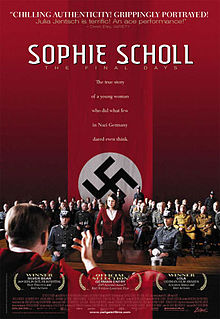
MovieSophieSchollSo the story of Sophie Scholl and her family and friends remained almost un-talked about until about the 1970s, when the German community started to discuss the war years more openly, and then again in 2005 when the remarkable film about the events was released.
You can watch the entire film, in its original German, with subtitles, below.
If you haven’t seen it, we cannot recommend it highly enough, but we warn you that it is gut wrenching.
Nevertheless, if you haven’t seen it, find a couple of hours, pour yourself a strong drink, and watch it. Those that died deserve to be remembered.

When people discuss the White Rose it has been suggested they were a brave but ineffective resistance movement. That is, in fact, not true. When they were active they caused the regime considerable annoyance. Although many who received the leaflets in the mail handed them in to police, many did not, and the regime had to deal with the fact that those who handed them in may have read them.
Sophie Scholl was an ordinary girl - devoutly Catholic, she fell in love with one of her fellow conspirators, she loved the countryside, she adored her parents. She was very ordinary, just very, very brave.
Sophie Scholl was an ordinary girl – devoutly Catholic, she fell in love with one of her fellow conspirators, she loved the countryside, she adored her parents. She was very ordinary, just very, very brave.


They managed to establish branches in Berlin and particularly Hamburg where sadly many of Hamburg White Rose met the same fate.
The White Rose also had a role in a student uprising in Munich— which was quickly suppressed.
After their execution graffiti appeared on walls in Munich: “Ihr Geist lebt wieter” “Their Spirit Lives On”.
Others carried on the fight. Copies of the leaflets were smuggled out to the Allies and later dropped in their tens of thousands by bombers over German cities.
An example of the leaflets (there were a total of five) is produced below. The courage of young people who could make these arguments against the might of the Nazi Reich simply beggars belief. Especially as they operated in the sure and certain knowledge that one day they must be caught, with their horrifying deaths as the inevitable result.
Many brave people died during the Second World War. These young Germans were amongst the bravest.
THE THIRD LEAFLET
Salus publica suprema lex (Public safety is the supreme law)
All ideal forms of government are Utopias. A state cannot be constructed on a purely theoretical basis; instead, it must grow and develop in the same way an individual human being matures. But we must not forget that at the beginning of every civilization the state already existed in a rudimentary form. The family is as old as man himself, and out of this initial bond man, endowed with reason, created for himself a state founded on justice, whose highest law was the common good. The state should reflect the divine order, and the highest of all utopias, the Civitas dei, is the model it should ultimately resemble. We will not compare the many possible states here—democracy, constitutional monarchy, monarchy, and so on, but one issue needs to be made clear and unambiguous; every human being has the right to a just state, a state that safeguards the freedom of the individual as well as the good of the whole. For according to God’s will, man should be free and independent, while fulfilling his natural duty of living and working together with his fellow citizens, and strive to achieve earthly happiness through self-reliance and self-motivation.
But the present “state” is the dictatorship of evil. “Oh, we’ve known that for a long time,” I hear you object, “and it isn’t necessary to bring that to our attention again.” But, as I ask you, if you know that, why do you not rouse yourselves, why do you allow these men in power to rob you step by step, both openly and in secret, of one of your rights after another, until one day nothing, nothing at all will be left but a mechanized state system presided over by criminals and drunkards? Is your spirit already so crushed by abuse that you forget it is your right—or rather, your moral duty—to eradicate this system? But if a man can no longer summon the strength to demand his right, then he will definitely perish. We would deservedly be scattered over the earth like dust in the wind if we do not marshal our powers at this late hour and finally find the courage we have lacked up to now. Do not hide your cowardice behind a cloak of expedience, for with every new day that you hesitate, failing to oppose this offspringof Hell, your guilt, like a parabolic curve, grows higher and higher.
Many, perhaps most, of the readers of these leaflets cannot see clearly how they can mount an effective opposition. They cannot see any avenues open to them. We want to try to show them that everyone is in a position to contribute to the overthrow of this system. Solitary withdrawal, like embittered hermits, cannot prepare the ground for the overthrow of this “government” or bring about the revolution at the earliest possible moment. No, it can only be done through the cooperation of many convinced energetic people—people who agree on the means they must use to attain their goal. We have few choices as to these means. The only one available is passive resistance. The meaning and the goal of passive resistance is to bring down National Socialism, and in this struggle we can’t shrink from any means, any act, wherever it is open to attack. We must bring this monster of a state to an end soon. A victory for fascist Germany in this war would have inconceivable and terrible consequences. The first concern of every German is not the military victory of Bolshevism, but the defeat of National Socialism. This must be the first order of business; its greater imperative will be discussed in one of our forthcoming leaflets.
And now every resolute opponent of National Socialism must ask himself how he can most effectively fight against the present “state”, how he can inflict the most damaging blows. Through passive resistance, without a doubt. We can provide each man with a blueprint for his acts; we can only make general suggestions, and he alone will find the best way to achieve them.
Sabotage armament industries, sabotage every assembly, rally, ceremony, and organisation sponsored by the National Socialist Party. Obstruct the smooth functioning of the war machine (a machine designed for war that is then used solely to shore up and perpetuate the National Socialist Party and its dictatorship.) Sabotage in every scientific and intellectual field involved in continuing this war—whether it be universities, technical colleges, laboratories, research stations, or technical agencies. Sabotage all cultural institutions that could enhance the “prestige” of the fascists among he people. Sabotage all branches of the arts that have even the slightest dependence on National Socialism or serve it in any way. Sabotage all publications, all newspapers, that are in the pay of the “government” and that defend its ideology and help disseminate the brown lie. Do not give a penny to public fund-raising drives (even when they are conducted under the guise of charity), for this is only a cover. In reality the proceeds help neither the Red Cross nor the needy. The government does not need this money; it is not financially interested in these fund-raising drives. After all, the presses run nonstop, printing as much paper currency as is needed. But the people must never be allowed to slacken! Do not contribute to the collection of metal, textiles and the like. Try to convince all your acquaintances, including those in the lower social classes, of the senselessness of continuing, of the hopelessness of this war; of our spiritual and economic enslavement at the hands of the National Socialists, of the destruction of all moral and religious values; and urge them to adopt passive resistance.
Aristotle, Politics: “Further….[a tyrant] should also endeavor to know what each of his subjects says, or does, and should employ spies everywhere…and further, to create disunity and division in the population: to set friend against friend, the common people against the notables, and the wealthy among themselves. Also he should impoverish his subjects; the maintenance of guards and soldiers is thus paid for by the people, who are forced to work hard and have neither the time nor the opportunity to conspire against him…Another practice of tyrants is to increase taxes, after the manner of Dionysius at Syracuse, who contrived that his subjects paid all their wealth into the treasury within five years. The tyrant is also inclined to engage in constant warfare in order to occupy and distract his subjects.
Please make as many copies of this leaflet as possible and pass them on!

Sunday, March 05, 2017

Historians as Expert Witnesses: Can Scholars Help Save the Voting Rights Act?

Friends:

Great piece for all my historian friends by Kritika Agarwal for the news magazine of the American Historical Association.  She details how history and historians have been vital to the provisions of  the Voting Rights Act because they have the tools, including quantitative and statistical skills, as well as the knowledge to demonstrate discriminatory intent which is what courts and judges want.  

Because testifying as an expert witness is so involved, consuming much time and effort, younger scholars are often discouraged from taking this on.  If higher education institutions counted this toward merit and promotion, it would be easier to recruit more expert witnesses, Agarwal suggests.

In short, we really need more scholars who can serve as expert witnesses in this area of law.


Angela Valenzuela


Historians as Expert Witnesses: Can Scholars Help Save the Voting Rights Act?

Kritika Agarwal, February 2017 / Perspectives on History, Then and Now: The AHA Annual Meeting

Shortly after “Bloody Sunday” in Selma, Alabama, in March 1965, civil rights activists outside the White House demand voting rights for African Americans. Library of Congress

In January, the US Senate gathered for confirmation hearings on the nominee for attorney general, Jeff Sessions, who was denied a federal judgeship by a Senate committee in 1986 due to charges of racism. Of particular concern during the hearings, therefore, was how dedicated Sessions would be to enforcing what’s left of the Voting Rights Act. Potential problems for voting rights advocates wouldn’t stop with Sessions’s confirmation, though. Since the early 1980s, historians’ trial testimony has been crucial to the expansion of voting rights. Today, the number of historians with the expertise and research background that lawyers prefer is declining.

Peyton McCrary recently retired from the Civil Rights Division of the US Department of Justice, where he coordinated expert witness testimony in voting rights cases. “Historians have played significant roles [in voting rights cases] for 36 years now,” he said during the session “Historians as Expert Witnesses,” organized by the National History Center at the 2017 AHA annual meeting in Denver. As about 15 attendees listened, McCrary and his co-panelists Orville Vernon Burton and J. Morgan Kousser (along with chair Alan Kraut) explained what made historians so valuable as expert witnesses.

“Nobody but a historian could possibly figure out the intent underlying the adoption of the law in question.”

Historians first testified in a voting rights case in Bolden v. City of Mobile, which went to trial in 1976. As McCrary wrote in the Southern University Law Review, the plaintiffs sought to overturn the practice of at-large elections in Mobile, Alabama, and historians were not initially consulted. In 1980, the Supreme Court ruled that it wasn’t enough for the plaintiffs to show the effect of at-large elections; they also had to show that the intent behind the practice was discriminatory. The Court remanded the case to federal court. It was there, wrote McCrary, that attorneys called on historians and political scientists to show that at-large elections exclude minority representation and result in vote dilution. McCrary and Kousser presented detailed evidence about the history of elections in Mobile; the court eventually ruled against the city’s use of at-large elections.

Since Bolden, historians have become a near-constant presence in voting rights cases, which generally hinge on two questions. First, was a voting qualification or procedure adopted with racially discriminatory intent? Second, does the “totality of the circumstance of the local electoral process” (Section 2 of the Voting Rights Act as amended in 1982) suggest that an adopted voting qualification or procedure has had the effect of denying minorities the opportunity to vote or has diluted their voting strength? Historians’ expertise has provided evidence for assessing intent and totality of circumstance. At first, said McCrary at the session, “nobody but a historian could possibly figure out the intent underlying the adoption of the law in question.” Only historians had the professional skills to analyze historical sources, gather evidence, understand context, and arrive at meaningful conclusions. And historians used a variety of documents to get at the root of intent, including city records, census data, geographic records, legislative records, and newspaper coverage.

Historians’ testimony has had significant impact in voting rights cases. American University’s Allan Lichtman has testified in over 75 civil and voting rights cases (and was actually unable to attend the annual meeting due to an impending trial). In League of United Latin American Citizens v. Perry (2005), the Supreme Court cited an expert report of his in ruling that a congressional district in Texas violated the Voting Rights Act. In an interview, he also recalled a small but symbolic redistricting case involving Dallas County, Alabama (the seat of which is Selma), in which his testimony led the Court of Appeals “to require a system of fair districts to be drawn.” “I drew those districts in what became known as the Lichtman Plan,” he said. “In fact, one of the former white members of the [county] commission said, ‘If we adopt this plan, we might as well change the name of Dallas County to Lichtman County, Alabama!’ And he did not mean that in a complimentary way.”

Serving as an expert witness doesn’t necessarily follow an academic historian’s typical practice on the job. On the one hand, testimony must be based on evidence and meet professional standards of the discipline. On the other, appearing on the witness stand is part of an adversarial process, unlike the generally collaborative and collegial nature of the academy. “It’s not like giving an academic paper,” said Lichtman. Lawyers from the opposing side often produce counter-testimony from other experts, attempting to tear holes in the historians’ analysis. Lichtman also said that historians must “have the expertise to write and present analysis and information in a way that a layperson attorney and a layperson judge can understand.”

It isn’t hard to find historians taking part in cases involving Indian treaty rights, water rights, or European war crimes trials. Perhaps the best-known case is Brown v. Board of Education. Historians including John Hope Franklin, C. Vann Woodward, and Alfred H. Kelly assisted the NAACP in developing the argument that Congress and the states had anticipated public school desegregation in ratifying the 14th Amendment. The most contentious might be the sex discrimination case Equal Employment Opportunity Commission v. Sears, Roebuck and Company. Historians Rosalind Rosenberg and Alice Kessler-Harris testified on opposing sides, with the courts ruling that Sears had not engaged in sex discrimination in its hiring, promotion, and payment practices.

Historians who serve as expert witnesses in voting rights cases are frequently skilled in quantitative analysis, particularly in determining “racial polarization.” “The degree to which voting patterns were racially polarized is an important factor and is often referred to by judges as the linchpin of a voting rights case,” said McCrary. Determining whether voting is racially polarized usually requires statistical analysis of electoral data on the precinct level. In other words, historians in such cases perform statistical analysis and frequently call on research in other disciplines, particularly political science and sociology. Historians who can do this sort of work are rare. “I’ve had to explain to lawyers that there is no one with experience in testifying on the intent question in voting rights cases who isn’t either already collecting Social Security or is about to,” said McCrary. “They need new blood.”

“We are three old guys,” said Kousser. “We’ve testified for a long time in voting rights cases, and there are very few younger people coming up to take our places when we die.” Steven F. Lawson, professor emeritus at Rutgers, who has also served as an expert witness in voting rights cases, agrees. In an interview after the annual meeting, he said, “You’ll notice that this group—if you add me to it—and a few others who’ve [testified], consist exclusively of men. And, oddly enough, they’re white men.” Lawson explained that there was no “conspiracy” behind this—historians who’d begun testifying in voting rights cases in the 1980s and beyond were historians “who studied the political process and were interested in institutions like the courts.” When they were brought in on cases that proved successful, lawyers kept asking the same group of historians to testify. “They had a proven record,” said Lawson, and “success brought with it a certain type of repetition.” Furthermore, he explained, among younger scholars entering the discipline in the 1980s and the 1990s, a shift in research interests from formal political history to social and cultural history resulted in fewer historians with the requisite research background to testify in voting rights cases.

At the panel, Kousser emphasized that testifying was a “civic exercise” and one way for historians to “affirm our public purpose.” While testifying as an expert witness can be financially lucrative, it does not benefit scholars in an academic context, which often discourages younger historians from getting involved. Kousser recommended that such work be taken into account in hiring, promotion, and tenure decisions, in recognition of the fact that expert witness testimony requires an immense commitment of time and energy. If there were a clear benefit to their careers, panelists believed, younger historians and women would consider serving as expert witnesses. 

There have been conferences and institutes to encourage and train historians, but Kousser said that these needed to happen in a more systematic fashion. Lawson also suggested that agencies that bring voting rights cases to court (including the ACLU, LULAC, NAACP, and the Department of Justice) must do a better job recruiting younger scholars from diverse groups to testify. Finally, McCrary noted that historians need to do better in equipping younger scholars with the tools, particularly quantitative and statistical skills, that would generate expertise to testify in voting rights cases. As a new administration moves into Washington, DC, and as the future of the Voting Rights Act hangs in the balance, these historians’ call could help determine the fate of the right to vote.

Kritika Agarwal is associate editor, publications, at the American Historical Association. She tweets @kritikaldesi.

Our State Should Tap into the Rainy Day Fund

This is not a natural, but human-made disaster. Here's Dick Lavine's summative comment with which many of us agree:
 
Not tapping the fund, Lavine said, will be another example of the Legislature opting for “self-inflicted” fiscal crises. “It was created exactly to prevent harmful budget cuts,” he said.
 Texas' Rainy Day Fund is a large fund—a projected $12 billion. Our lawmakers should tap into it rather than cut vital support to our institutions and programs.

Angela

Past fiscal decisions, not just oil slump, root cause of budget woes


Highlights

  • State lawmakers are preparing to make severe cuts despite the fact that the Texas economy is growing.
  • Past decisions, including a tax cut and a transportation funding set-aside, are tying the Legislature’s hands.
  • GOP lawmakers disagree over whether to tap the rainy day fund, which is projected to reach almost $12 billion.
As they prepare to make budget cuts to state agencies and public universities that could limit such services as chronic disease and tobacco use prevention programs and eliminate others like the University of Texas’ Bureau of Economic Geology, many Texas lawmakers are lamenting the position they’ve found themselves in this legislative session.
The budget pinch, however, is primarily the product of decisions lawmakers made in recent legislative sessions, not forces beyond their control.
Although low oil and gas prices have put a significant dent in tax revenue, other sectors have grown enough to ensure that the Texas economy is still expanding overall and that the state unemployment rate remains low, which should be good news for lawmakers. But budgeting measures adopted by the GOP-controlled Legislature — especially a $2.6 billion tax cut for businesses and a $4.7 billion set-aside for highway projects in 2015 — have left lawmakers with less money to dole out in 2018 and 2019 than they did for the current two-year budget.
“It’s not a natural disaster. It’s a man-made disaster,” said Dick Lavine, fiscal analyst for the left-leaning Austin think tank Center for Public Policy Priorities. “It’s one thing to say, ‘What can we do? This is the global oil market.’ It’s another to say, ‘We made these decisions, and as it turns out, it’s really going to cause us a lot of pain.’ You have to take responsibility.”
After factoring in population growth and inflation, the state Senate’s initial $213.4 billion budget proposal would amount to a 7.9 percent cut compared with current spending, according to the Legislative Budget Board. The $221.4 billion House plan would be a 5.6 percent cut in spending.
Texas already spends less per resident than all but three other states, according to Census Bureau data.
Despite the prospect of making cuts during a period of economic growth, Republicans say they have no regrets about the decisions they’ve made in recent years.
TEXAS POLITICS DELIVERED EVERY DAY: Sign up for our Texas Politics email
“They create a little bit of challenges for us, if you will, as we look to this budget session, but no regrets about them at all,” House Appropriations Committee Chairman John Zerwas, R-Richmond, said. “They are things that are very, very important. I’m glad we did them.”
To limit the impact of the belt-tightening, Zerwas and House leaders are pushing for the state to consider tapping the Economic Stabilization Fund, better known as the rainy day fund. But conservative hard-liners are vowing to make do without tapping the reserve, which is projected to grow to $12 billion in the next budget cycle.
Without taking money from the state’s substantial reserves, lawmakers will likely enact severe cuts across government.
The state’s top three leaders — Republicans Gov. Greg Abbott, Lt. Gov. Dan Patrick and House Speaker Joe Straus — last year instructed state agencies to submit budget proposals with 4 percent cuts, and most of those recommendations were folded into the House and Senate’s initial budget plans. They exempted several programs, including the beleaguered Child Protective Services, public schools and border security.
The Senate’s proposal, authored by Finance Committee Chairwoman Jane Nelson, R-Flower Mound, includes an additional 1.5 percent across-the-board cut.
‘Shortsighted’
In the wake of an oil and gas boom that flushed state coffers, lawmakers in 2015 went on a spree of tax cutting and spending on GOP priorities.
They cut the state franchise tax on businesses by 25 percent, costing $2.6 billion over two years; green-lighted a vote on a constitutional amendment that will redirect to transportation projects $4.7 billion in state sales tax revenue from general funding that could pay for schools, prisons and health care services; spent an unprecedented $800 million on the state’s border security campaign; and expanded the local property tax homestead exemption, a move the state pays for on the back end when it shores up school district budgets.
Even though it was already becoming clear that the fat times were coming to an end — prices for the benchmark West Texas Intermediate crude oil had already plummeted from above $100 per barrel to about $50 by the start of the 2015 legislative session — lawmakers adopted those measures knowing that they would have significant ongoing costs to the state.
LIKE US ON FACEBOOK: Our Lone Star Politics page brings Capitol news to your Facebook feed
The cost of the business tax cut will grow substantially over time, while the set-aside for the highway fund will take up to $5 billion in sales tax revenue each two-year budget cycle. Lawmakers have the option of undoing the transportation set-aside with a supermajority vote in both chambers, but they are unlikely to do so after voters’ overwhelming approval of the constitutional amendment that approved it.
“It looked good to have a $4 billion tax cut for your campaign flier, but that probably was shortsighted,” state Rep. Donna Howard, D-Austin, said of the package of tax and fee reductions approved in 2015. “At that point, we already knew we were going to have a downturn.”
Howard said Republicans overcommitted the state in 2015 as “part of the overall strategy of creating a problem” to justify cuts later.
Dale Craymer, executive director of the business-backed Texas Taxpayers and Research Association, applauded the franchise tax cut and the transportation spending but said the timing was “unfortunate.”
“Hindsight is always 20/20 and if the Legislature knew two years ago what it knows now, they probably would have obligated less of the surplus and deferred the highway commitment out a bit further,” Craymer said.
The tax cut, he said, is no more to blame for the budget crunch than automatic increases in spending for programs like Medicaid, the state-federal health care provider for low-income residents that the state has little control over, and the global oil market.
“There was concern at the time that oil prices were below what the budget was built on, and that was part of the reason they were willing to leave $4 billion unspent,” he said of the budget’s surplus, which is separate from the rainy day fund. “There was hope the prices would rebound, and ultimately they never rebounded.”
At the beginning of the 2015 legislative session, Texas Comptroller Glenn Hegar predicted oil would trade at about $65 per barrel in 2016 and $69 per barrel in 2017, assumptions that factor into the estimate of how much money lawmakers can spend. When oil prices continued to crater after the legislative session, he lowered those projections by about $15 each.
The state is now projected to finish the budget cycle with only about $1.5 billion unspent, and much of that could be used up in a supplemental budget, a stop-gap measure to plug holes in the current budget that is approved before lawmakers tackle the next two-year cycle.
Is it raining?
As lawmakers decide to what extent they want to cut their way out of the shortfall, a key decision will be whether to tap the rainy day fund.
Not tapping the fund, Lavine said, will be another example of the Legislature opting for “self-inflicted” fiscal crises. “It was created exactly to prevent harmful budget cuts,” he said.
Although Craymer disagrees with Lavine over why the state has a shortfall, they agree on the solution: “The state is short of money, and it’s got a huge stockpile,” Craymer said.
Straus’ initial budget plan is about $4 billion higher than the amount of money Hegar has projected the state has to spend, and House leaders have been signaling that the way to make the numbers work will be tapping the rainy day fund, which was created in 1988 after an oil bust and is largely funded by revenue from oil and gas production taxes.
Tapping it won’t be easy.
Zerwas, the top House budget-writer, last week pressed the governor’s staff on the rainy day fund. He complained that conservatives have been arguing that the fund should only be used during disasters and asked for Abbott to take a stand.
“It’s an extraordinary amount of money,” Zerwas said at a committee hearing. “To have $12 billion in the Economic Stabilization Fund and for it to be characterized as a disaster relief fund, I think there needs to be some direction from the governor.”
“We are more than willing to discuss any scenario that the committee would like,” said Steven Albright, Abbott’s budget director.
“So I don’t feel like I got an answer,” Zerwas responded.
“No, that’s a fair assessment,” Albright said to laughter.
Asked for comment, Abbott spokesman John Wittman pointed to the governor’s State of the State address at the beginning of the legislative session, in which he said, “I’m confident we can balance the budget without looting the rainy day fund.”
Patrick, who leads the Senate, has criticized the House budget, saying it can only be balanced through tax increases or transfers from the rainy day fund and he’s not interested in either.
Tea party-aligned Republicans also have argued that tapping the fund will hurt the state’s credit rating. Representatives from Hegar’s office, however, have testified that the fund is so large that taking several billion dollars from it wouldn’t hurt the state’s credit and using that money for productive purposes, such as infrastructure improvement, might actually improve the state’s standing with the ratings agencies.

Save Texas Schools Rally, March 25, 10-12:00PM


Dear Save Texas Schools Supporters,

Get ready to rally on Saturday, March 25 from 10 am to noon at the Texas State Captiol!

Texas schools struggle with cuts and underfunding, even as property taxes soar. We support a proposal to send $1.5 billion from the state that will help, while a broken school finance system is fixed, and oppose measures, such as vouchers, that transfer funding from public to private schools. That's why we're rallying on March 25th!

Texas children spend too much time testing, time that could be spent learning. We are partnering with friends from TAMSA and other groups who are leading the charge for our children. That's why we're rallying on March 25th!

Our struggling schools face punitive sanctions and an A-F grading system that do more to harm than help schools. We believe community-based supports that build up, like Community Schools, is the right way forward. That's why we're rallying tomorrow!

We believe every student, no matter their situation or family background, deserves a great education and a caring and safe school. That's why we're rallying!

If you live in driving distance of the State Capitol, get in the car or on the bus, grab your family and friends and some posters, and change the future for Texas children. We have an amazing group of speakers, the media will out in force, and legislators will be listening.

Leading up to the rally, we'll also have several calls to action as committee hearings get going on key legislation.

See you on March 25th. Spread the word!

Sign up on Facebook

Register for Save Texas Schools at savetxschools.org

Follow Save Texas Schools on Facebook

Follow Save Texas Schools on Twitter


Save Texas Schools · United States

Archbishop Gustavo Garcia-Siller, Statement on Immigration from the Diocese of San Antonio.

Department of Communication
Archdiocese of San Antonio
Statement of Archbishop Gustavo Garcia-Siller, MSpS, and Auxiliary Bishop-elect Michael Boulette in regards to President Donald Trump’s announcements on immigration
January 27, 2017


In fulfilling his campaign pledges, President Donald Trump has recently signed executive orders that will dramatically alter the refugee program in the United States, build an expansive new border wall on our boundary with Mexico, and heighten immigration detention. This is not something that is unexpected or surprising; he is doing exactly what he said he would do during the election. However, it is truly disheartening and profoundly disappointing to see these actions ultimately come to fruition.
While being promoted as a response to safety concerns in this country, these are unprecedented announcements that will punish the majority of immigrants who want to come to America -- the land of the free -- for a better future.
In a letter sent to President Trump prior to his inauguration, Pope Francis wrote, “Under your leadership, may America’s stature continue to be measured above all by its concern for the poor, the outcast and those in need who, like Lazarus, stand before our door.” The faithful must continue to pray for wisdom for our country’s leaders; that their decisions are guided by spiritual and ethical values, especially, our Holy Father states, “At a time when our human family is beset by grave humanitarian crises demanding far-sighted and united political responses.”
Over the past several months, we have seen the fear and heard the heart-wrenching stories from many families who may be impacted by these initiatives. They have approached us and we have been spending time talking to them, comforting them the best we can, and praying for them constantly. They don’t know what’s going to happen; if parents are going to be separated from their children. We share in their pain and sadness.
Our archdiocese and Catholic Charities agency, along with other groups and dioceses across the country, will continue to stand in solidarity with refugees, immigrants, and their families. We will work for responsible and comprehensive immigration reform. All agree that change needs to take place, but it must be carried out in a humane manner which respects the dignity of the human person. Certainly concerns about security must be strongly addressed, but not through political measures which do more harm than good.
The U.S. Conference of Catholic Bishops has a working group to closely monitor executive memoranda and legislation on immigration, and we will both be working closely with other bishops -- as well as leaders from other faith communities -- on these issues in the days, weeks, and months ahead. I (Archbishop Gustavo), will be especially involved through my role as chairman of the USCCB Committee on Cultural Diversity. We cannot escape our responsibilities to the poor and vulnerable who are desperately fleeing their countries to escape violence.
While acknowledging the rights of the nation, we are also called to compassion for the weak and those in need. Let us pray that all in our nation will be filled with that compassion and concern for the stranger.
#
Contact: Jordan McMorrough Office: 210-734-1634 Mobile: 210-489-0193 Email: jmcmorrough@archsa.org

School vouchers are not a proven strategy for improving student achievement: Studies of U.S. and international voucher programs show that the risks to school systems outweigh insignificant gains in test scores and limited gains in graduation rates

School vouchers are not a proven strategy for improving student achievement: Studies of U.S. and international voucher programs show that the risks to school systems outweigh insignificant gains in test scores and limited gains in graduation rates: Summary Betsy DeVos, the new U.S. secretary of education, is a strong proponent of allowing public education dollars to go to private schools through vouchers, which enable parents to use public school money to enroll their children in private schools, including religious ones. Vouchers are advanced under the rubric of “school choice”—the theory that giving …

The Executive Order That Affects Every Latino… Regardless of Citizenship

History repeats itself.  Mass deportations happened in the 1930s as captured in this book by
Cal State L.A. Professor Francisco Balderrama & Raymond Rodriguez titled,  Decade of Betrayal: Mexican Repatriation in the 1930s during the Hoover Administration with 60 percent of those affected being American citizens.  Note from the piece below that "Since 2003, over 20,000 U.S. citizens have been detained and/or deported by mistake."

I have a friend who during this time period was separated from her mother shortly after birth with her mother's good friends raising her on the U.S. side of the border. Although her mother, a U.S. citizen, eventually made it back to the U.S., it was profoundly consequential, creating emotional detachment issues that impacted her relationship with her mother for a lifetime. Very sad.

Go to this link to listen to an excellent, in-depth NPR interview of Dr. Balderrama regarding exactly how "repatriation," a euphemism for "deportation," was carried out. Also read this piece below.

Angela Valenzuela
c/s


The Executive Order That Affects Every Latino… Regardless of Citizenship

California, 1936 (Library of Congress Prints and Photographs Division)

Shortly after taking the oath of office, President Donald Trump issued an executive order that expanded the definition of a criminal offense under immigration law. At first glance, this did not mean much to those living in the United States. On a closer look however, this meant that any individual who does not “look American,” speak proper English, or assimilate into the American way of life would be targeted for deportation. For most American history buffs, this was reminiscent of what happened in the 1930s.
It wouldn’t be the first time U.S. citizens have been targeted for deportation. From 1926 to 1936, over a million people were “repatriated” back into Mexico. Of that million, an estimated 60% were U.S. citizens. The Mexican Repatriation became a mass deportation movement in which Mexican Americans were rounded up and deported without due process. Even the U.S. Citizen and Immigration Services site partially acknowledges this fact.
In short, individuals were either deported or encouraged to leave the country and back into their “homeland” without a chance to defend their rights in the United States. Thousands of individuals left behind their entire life’s work and were sent to a country that they had never been a part of or in some cases had not been to for over 20 years. Back then, the rhetoric behind the Mexican Repatriation was that immigrants were taking American jobs and nothing was being done about it.
The Mexican Repatriation was not the only example. In the 1950s, “Operation Wetback” was another high-profile deportation program of Mexicans. As one source says, “It is difficult to estimate the number of people forced to leave by the operation. The INS claimed as many as 1,300,000, though the number officially apprehended did not come anywhere near this total. The INS estimate rested on the claim that most undocumented immigrants, fearing apprehension by the government, had voluntarily repatriated themselves before and during the operation.”
In 2015, candidate Trump cited “Operation Wetback” in a 60 Minutes interview, where he said that his deportation plan would be “humane.”
Now, candidate Trump is President Trump and the same rhetoric looms over his immigration policies as we re-enter what once was considered two dark chapters of American history.
Casa Grande, Arizona, 1936 (Library of Congress Prints and Photographs Division)

Since 2003, over 20,000 U.S. citizens have been detained and/or deported by mistake. Because law enforcement officials have broad discretionary power in who they think is a threat to society, thousands of individuals (including U.S. citizens) are often caught in the deportation trap.
This year, the Texas Legislature introduced Senate Bill 4, which allows for law enforcement officials in cities, counties and college campuses to keep a person in custody while the U.S. Immigration and Customs Enforcement (ICE) agency looks into their immigration status. The bill would also promote stop-and-frisk practices, which in turn leads to racial profiling and create more chaos in Mexican American communities. Despite testimony from police chiefs who claimed that the bill would make their relationship with the community more strenuous, the bill passed the Senate along party lines (20-11). Regardless of what party you identify with, the bill would make sure many Latinos in Texas are stereotyped into custody.
Earlier this week, Secretary of Homeland Security John Kelly signed guidelines to fulfill the President’s campaign promise to remove and deport undocumented immigrants. Although the guidelines are meant to target undocumented immigrants, thousands of American citizens will be caught in the crosshairs.
If history is any indicator as to what that means, Mexican Americans should fear being targeted by law enforcement officials and more importantly, risk being deported under public policy that runs contrary to our American values.
***
Mauricio García is a civil rights advocate and a law student at Texas Southern University. He holds a Master’s in Public Administration from the University of Texas Rio Grande Valley, and received Bachelor of Arts in government, history, international relations and Latin American studies from the University of Texas at Austin. He tweets from @maurygarcia92.

Friday, March 03, 2017

Constituents Say “No” to Huffines’ Neoliberal Nirvana: Vouchers and School Privatization for the Rich at Taxpayers’ Expense and the McDonaldization of Public Education For Poor


by Angela Valenzuela

Now here is a disturbing, if revealing, story about one our Texas senators named Don Huffines (R) who represents District 16 in the Dallas, Texas area, a senate district, by the way, that has some of the wealthiest school districts in the state, referred to in the Texas Education Code as “Chapter 41 districts” that have a significant tax advantage well after paying into Texas’ recapture fund for distribution to the vast number of “property-poor,” Chapter 42 districts in the state of Texas.

And now representatives like Senator Huffines want to further extend that advantage via education savings accounts (ESAs) that receive state taxpayer payments or school credits—which is what SB3, a bill on which he is a co-author is all about.  SB3 also happens to be a priority of Governor Abbott and Lt. Governor Patrick.

Clearly, however, not even in their own school districts do folks feel similarly.  Check out how he treats his own constituents of color, including PTA parents and students in Richardson ISD who are asking him questions about vouchers: Senator Caught On Tape Yelling At Kids During A Private School Voucher Discussion (recorded on Monday, February 27, 2017; read transcript here).


This incident even caused Texas House Member Jason Villalba to Tweet:

"Is it time for new leadership in #SD16?" Villalba tweeted. "I am a little tired of hearing how my own state Senator is incapable of almost every duty he has."

Shameful.  Tsk tsk.  Wasn’t the whole point of the Republican-led, education reform movement in the form of high-stakes testing and accountability to create a system where demography would not be destiny?  From the mouth of the "Education President," George W. Bush himself, remember the highly-touted rationale for Texas-style accountability? "All children count!"   

Geez, this agenda even involved swiping the "No Child Left Behind" slogan from national civil rights leader Marion Wright Edelman, founder and director of the Children's Defense Fund— sneaky, calculated move to mask its real intention of labeling, ranking, shaming, and blaming public schools to justify taxpayer dollars going into the for-profit sector.

Regrettably, even civil rights organizations of repute in the broader Latino community drank and continue to drink the Kool-Aid despite extensive evidence to the contrary of its harms alongside significant political challenges against it involving large numbers of top education leaders and school districts throughout our state and nation (see FairTest.org, as well as this blog). I even have a whole book about this.

That said, if you are a politician and you do not even want to talk to people who are being reasonable with you—and who are understandably concerned about school vouchers since this connects to their children's futures--you are being dismissive—which is how racism, sexism, and classism frequently get manifest.  

I guess it’s easier to lash out at students and parents than to own up to your own narrow interest that seeks to further privilege the already privileged in our state.  Perhaps Huffines' wealthy constituents themselves are feeling the pinch of private schools and could really benefit from dipping into the public purse to pay for their children’s tuition to places like Hockaday and St. Mark’s that surfaced in his diatribe.  Check out their websites and tuition.  The parents of these K-12, private-school children pay annually what many parents pay annually for their children’s four-year, university education.

To read another take on this, read this piece in Texas Monthly’s Burka Blog, Will Vouchers Save the Schools or Starve Them? Senator Huffines’s outburst to students shows the fervor of the debate. February 28, 2017 by R.G. Ratcliffe.


The best thing about what happened here with parents is that Huffines exposed his willingness to sacrifice his own, not-so-well-endowed constituents to the altar of school privatization even if accomplished at their expense.   
If you see the video, it’s interesting to see how anything outside of what he thinks is good public policy for the state of Texas like fairness and equal access to a quality or even elite education for all is an inconvenient challenge to the neoliberal Nirvana that he wishes upon us all: Vouchers and school privatization for the rich and the McDonaldization of public education for poor.  

What great recipe out of the Republlican playbook for disenfranchinsing the “have-nots” while simultaneously securing their incumbencies.

C'mon, Huffines.  The math is easy.  From the video, we practically even have this stated in your own words:
Vouchers=the best education you can buy

Kudos to the Richardson District PTA, parents and students!  Maybe he ruined your day, but you pressed him on an issue of grave concern to us all. Hopefully, your courageous questioning has helped to put this agenda to rest this legislative session.  We can only hope.


#TxLege @RichardsonISD #PTA

Thursday, March 02, 2017

Bannon Admits Trump's Cabinet Nominees Were Selected To Destroy Their Agencies.

As former Texas Governor Rick Perry assumes U.S. Department of Energy head today—the one that he vowed to abolish—we should all seriously consider this administration's the wish for "deconstruction of the administrative state,” mentioned at last week's CPAC event as an explicit goal of this administration.  Similarly, the new Betsy DeVos agenda at the DOE is similarly bent on school "deconstruction" or privatization.  Key quotes:
Bannon knows that there is no realistic substitute for these Federal agencies. When Bannon talks about dismantling the "Administrative state,” what he's really talking about is allowing corporations and industry the absolute right to do whatever they want, whenever and wherever they want, regardless of its harmful impact on American citizens. “Deconstruction," in the pie-in-the sky fevered dreams of the Heritage Foundation, means exactly what it sounds like, as the report linked above illustrates— a process by which no Agency regulation for protection of the public may occur without Congressional approval. In practice, with the current composition of the Republican-dominated Congress, this amounts to complete corporate predation, the absolute elimination of our ability as citizens to halt corporate malfeasance. In essence, he’s talking about corporate-enforced slavery, aided and abetted by a Congress corrupted through and through with corporate largesse.

Bannon is a fanatic, a clear and present danger to the America we all know and care about. Unfortunately, his fanaticism, poured into the ear of someone as fundamentally incurious and vain as Donald Trump, brings us closer to the wholesale destruction of this country than any of us could have expected in our lifetimes.

I like what someone Tweeted in response:  


Hand him a glass of Flint water, and see if he drinks it.
 
Enough!  Here's a petition that you may want to consider signing to get him removed from the National Security Council.  I just did.

Angela Valenzuela
c/s


Donald-Trump-Steve-Bannon-Stephen-K-Bannon-White-House-Jan-2017-Swearing-in-Getty-640x480.jpg


At CPAC this week Stephen Bannon, the Chief Advisor and intellectual heft behind the Twittering infant that sits in the Oval Office, provided a little glimpse of the future he has planned for all of us. 

In the clearest explanation for why nearly all of Trump’s cabinet choices are known mostly for despising and attacking the very Federal agencies they’ve been designated to lead, Bannon explained—in very clear language--that they weren't appointed to lead these agencies, but to destroy them:
Atop Trump’s agenda, Bannon said, was the “deconstruction of the administrative state” — meaning a system of taxes, regulations and trade pacts that the president and his advisers believe stymie economic growth and infringe upon one’s sovereignty.
“If you look at these Cabinet nominees, they were selected for a reason, and that is deconstruction,” Bannon said. He posited that Trump’s announcement withdrawing from the Trans-Pacific Partnership was “one of the most pivotal moments in modern American history.”
The crippling or wholesale elimination of Federal agencies that ensure we receive such things as clean air, clean water, fair labor laws, fair housing standards, anti-discrimination laws, financial protections, food and drug safety, national education standards and the like, has been a goal of far-right “thinkers" for decades. Their rationale, propagated by corporate and industry-funded think tanks such as the Heritage Foundation, has always been that that the existence of these “unelected" agencies represents a mortal threat to American “sovereignty and self-government."  This is exactly the line Bannon was peddling at CPAC today. It is delusional, right-wing garbage.

The reality is that these extensions of the Executive Branch—the Department of Labor, the Department of Health and Human Services, the Environmental Protection Agency and the Department of Education, for example-- exist to serve the interests of all the American people, performing the painstaking and complex  task of regulating the very things that make all Americans’ lives worth living. They perform this function because history has clearly shown that neither the Congress nor the states are remotely up to the task of doing it. They have neither the time, the expertise, the manpower, or the ability to handle such mammoth responsibilities in a country of 330 million people.
For example, these are the Department of Labor’s core functions:
The purpose of the Department of Labor is to foster, promote, and develop the welfare of the wage earners, job seekers, and retirees of the United States; improve working conditions; advance opportunities for profitable employment; and assure work-related benefits and rights. In carrying out this mission, the Department of Labor administers and enforces more than 180 federal laws and thousands of federal regulations. These mandates and the regulations that implement them cover many workplace activities for about 10 million employers and 125 million workers.
When EPA responds to a massive toxic waste spill or a Deepwater Horizon explosion, or simply tells a coal company that it can’t pollute the surrounding air and water with its carcinogens, it is taking on a task on behalf of all Americans, not just the locals who happen to be affected.  When the Department of Health and Human Services administers a nationwide program of medical care for the elderly, it is responding to the needs of all Americans, not just the well-off.  

The nature of “Federal” agencies is just that—to preserve uniformity throughout the country so that (in theory at least) no single state or locality is treated with preference over others. The hundreds of thousands of people who work for these agencies are there because of their expertise and their dedication. They are not politicians.  They are not “elected." But they do work for all of us.

Bannon knows that there is no realistic substitute for these Federal agencies. When Bannon talks about dismantling the "Administrative state,” what he's really talking about is allowing corporations and industry the absolute right to do whatever they want, whenever and wherever they want, regardless of its harmful impact on American citizens. “Deconstruction," in the pie-in-the sky fevered dreams of the Heritage Foundation, means exactly what it sounds like, as the report linked above illustrates— a process by which no Agency regulation for protection of the public may occur without Congressional approval. In practice, with the current composition of the Republican-dominated Congress, this amounts to complete corporate predation, the absolute elimination of our ability as citizens to halt corporate malfeasance. In essence, he’s talking about corporate-enforced slavery, aided and abetted by a Congress corrupted through and through with corporate largesse.

Bannon is a fanatic, a clear and present danger to the America we all know and care about. 
Unfortunately, his fanaticism, poured into the ear of someone as fundamentally incurious and vain as Donald Trump, brings us closer to the wholesale destruction of this country than any of us could have expected in our lifetimes.