Translate

Friday, January 09, 2026

UT Didn’t Just Reject a $100,000 Endowment. It Entrenched Discrimination, by Angela Valenzuela, Ph.D.

UT Didn’t Just Reject a $100,000 Endowment. It Entrenched Discrimination

by 

Angela Valenzuela, Ph.D. 

January 9, 2026

The University of Texas at Austin didn’t just turn down a $100,000 endowment for Hispanic scholars. It chose fear over law, optics over mission, and political compliance over institutional integrity.

As reported by Lily Kepner in the Austin American-Statesman, Daniel Acosta—a former UT Pharmacy professor, founding director of the College of Pharmacy, former dean, and senior federal scientist—offered to endow a scholarship to support Hispanic doctoral students and help address UT’s persistent underrepresentation of Hispanic faculty. 

He pledged $40,000 himself; the College of Pharmacy reportedly raised the remaining $60,000 because it believed in the goal. Then UT and Texas Exes quietly shut it down.

The excuse was Texas Senate Bill 17. But here’s the truth UT doesn’t want to say aloud: SB 17 does not apply to Texas Exes. There was no legal barrier. Employment law experts confirmed it. This was not compliance—it was appeasement of the governor, the Legislature’s far-right bloc, and a political movement determined to purge diversity from public life.

And appeasement has consequences.

Latinas and Latinos now make up more than 40% of the state, yet their representation among the faculty at UT remains stuck at 10.5%, with even deeper underrepresentation in elite research fields like pharmacy. 

Acosta himself was only the second Hispanic professor in the College of Pharmacy when he joined UT in the 1970s. Fifty years later, UT still hasn’t fixed the pipeline—and when a Loyal Longhorn offers to help with private dollars, the university recoils.

As UT professor Liliana Garces warns, so-called “color-blind” policies don’t end discrimination—they entrench it. By refusing to acknowledge race at all, institutions simply preserve unequal structures while pretending neutrality. UT’s decision does exactly that.

Let’s stop pretending this is about the law. UT has already gone far beyond what SB 17 requires, erasing race-conscious efforts not because they’re illegal, but because administrators are afraid. Afraid of politicians. Afraid of headlines. Afraid of defending the very principles they once celebrated when diversity was politically safe.

This is not leadership. It is institutional cowardice.

UT didn’t lose a donation. It lost moral authority. It told Hispanic students and future scholars that representation is expendable, belonging is conditional, and equity is negotiable. In a state whose future is unmistakably Latino, that message is not just wrong—it is reckless.

And appeasement has consequences. It raises the question of how many other equity-focused gifts have been quietly blocked or abandoned—and whether UT has imposed an unofficial ban on lawful donor initiatives. That question demands public disclosure and independent oversight, not silence.

But flagships don’t drift with political tides. Flagships lead. They set a course rooted in mission, not fear. They confront the hard challenges of their state, refuse to shrink from serving all its people, and uphold equity and inclusion as central to educational excellence—not as optional extras. 

UT’s stated values include leadership, individual opportunity, and responsibility to serve as a catalyst for positive change (see Mission and Values statement). Yet in refusing a donor-funded initiative to expand representation at a time when the state’s demographics are shifting and UT’s faculty remains far from representative, the university revealed how far it has strayed from that mission. What was once a flagship of bold ideas and public purpose now appears content to avoid controversy rather than champion justice.

And they're dragging the future of public higher education in Texas with it.

After years trying to create a scholarship at UT's College of Pharmacy for Hispanic scholars, Texas Exes denied it because of its diversity focus, a donor said.

By ,Staff Writer


Daniel Acosta, former UT Pharmacy professor, sits in the living room of his home in Central Austin on Monday, Jan 5, 2026. Acosta's recent attempt to establish an endowment to help Hispanic graduate students and address the lack of diversity in the pharmacy faculty at the University of Texas at Austin was denied amid DEI scares.

Aaron E. Martinez/Austin American-Statesman

Daniel Acosta was the top pharmacy class graduate at the University of Texas in 1968. After pursuing his doctorate in Kansas, he returned to the Forty Acres as the inaugural director of the College of Pharmacy. He taught from 1974 to 1996 as the college's second Hispanic professor and went on to become a dean at the University of Cincinnati and the deputy director of the Federal Drug Administration’s Toxicology Center.

Daniel Acosta, former UT Pharmacy professor, looks through emails in his home in Central Austin on Monday, Jan 5, 2026.

Aaron E. Martinez/Austin American-Statesman


The rejection of Acosta’s endowment, funded by his own $40,000 donation and another $60,000 he said was raised by the College of Pharmacy, is the latest casualty of an increasingly anti-DEI climate fostered by President Donald Trump and conservative Texas leaders, which has jeopardized programs designed to counter decades of unequal access to education and wealth.

UT spokesperson Mike Rosen confirmed that Senate Bill 17, a 2023 anti-DEI Texas law, prevents the university from accepting such scholarships because a provision that prohibits any “special benefit” conferred based on race, sexual orientation or gender.

REWIND: What UT lost with SB 17: American-Statesman’s guide to changes due to Texas' anti-DEI law

But the law does not apply to the alumni-group Texas Exes, which has worked with Acosta since March 2025 and had sent him an agreement for a named scholarship to be awarded to a doctoral student in pharmacology or toxicology from a “diverse or underrepresented background.” 

A Texas Exes spokesperson declined to comment. The board has not adopted an official policy on accepting — or denying — new race-based scholarships. The nonprofit still offers dozens of specialty scholarships, including some based on race, region, interests, sexuality, academic interest and network membership, according to its website.

Although conservative politicians say diversity, equity and inclusion practices illegally discriminate against white individuals, Kell Simon, an employment lawyer who specializes in anti-discrimination law, said there is no legal reason he knows of that would block the Texas Exes from accepting the scholarship. 

The Trump administration has made diversity, equity and inclusion, a “boogeyman,” in part through executive orders that declare the practices “illegal,” Simon said. But Simon’s office fields almost no hiring complaints related to such practices, he said.

“In my line of work, I do not see DEI policies or practices hurting anybody,” Simon said. “From a legal perspective, it’s nothing more than an ideology. I don’t think there’s any law that would say, ‘No, you can’t establish a scholarship.’”

RELATED: UT’s independence tested as politics reshapes Texas higher ed — again

‘It all unraveled’

The percentage of Hispanic faculty at UT has increased in the last decade and currently sits at 10.5%, exceeding the national average and other research public universities of comparable size. Hispanic people are now the largest demographic group in Texas, making up more than 40% of its population and roughly one-third of Austin's population.

A photo of the UT tower is displayed in the home office of Daniel Acosta, former UT Pharmacy professor, in his 
home in Central Austin on Monday, Jan 5, 2026.

Aaron E. Martinez/Austin American-Statesman


Four UT System institutions were founding members of the Alliance of Hispanic Serving Research Universities in 2022, promising to grow opportunities for Hispanic students and scholars. UT received the Seal of Excelencia, a designation awarded nationally for an institution’s commitment to Hispanic students, in 2020, 2021 and 2023, but it was not recertified after the university took steps to comply with Texas’s anti-DEI law.


“Back then diversity was a good word,” said Acosta. “Now, it’s a bad one.”

MORE: Second Texas university system to restrict race and gender courses

Acosta and DEI proponents say faculty and the student body should reflect the population of Texas, and he worries that the College of Pharmacy’s majority-white faculty composition will discourage future scholars like himself from seeing themselves in the field.

Wanting to help with his own resources, Acosta approached the college more than four years ago about a scholarship for Hispanic doctoral students who wanted to continue as professors at UT. He already had established a graduate fellowship fund at UT’s College of Pharmacy to help fund travel for research and wanted a new initiative specifically to improve faculty diversity.

He said the college was initially enthusiastic about the idea. While Acosta planned to contribute $40,000 to the endowment, he said the College of Pharmacy told him the school found private donors to fund the last $60,000, believing in his vision of a more diverse faculty. 

The college did not respond to requests for comment on the $60,000, but emails reviewed by the Statesman show that officials were in communication with Acosta over several years.

In 2024, Acosta said, he and the college were ready to sign an agreement with UT.

“That’s when it all unraveled,” he said.

REWIND: One year under SB 17: A timeline of how Texas' anti-DEI law swept through UT, the state

SB 17 — pitched as a bill to end DEI in hiring, programs and offices — took effect Jan. 1, 2024. In implementing its measures, officials froze or changed at least 131 scholarships across UT System and Texas A&M University System institutions, which could no longer have race or gender criteria, the Dallas Morning News reported.  

But the law only impacted public universities, not nonprofits. The Texas Exes, which administers $4.6 million in scholarships at UT each year, held meetings with Acosta and drafted an agreement to accept his endowment with diversity as part of the criteria, Acosta said. Emails between the Texas Exes and Acosta support that account. 

At their first meeting in March 2025, still nervous about the scholarship’s future, he drafted questions to ensure the nonprofit could accept his funds and diversity requirements without fear of repercussions. Acosta said he was reassured.

“Texas Exes was our savior,” he said. 

At that time, Texas conservatives urged universities to follow the letter and “spirit” of SB 17 in letters and posts on X. Some threatened presidents’ jobs and the funding of their institutions if schools were out of compliance with the law. The pressure campaign intensified nationally when Trump returned to the White House last January, seeking to end DEI practices in one of his first executive actions.

REWIND: Texas senators threaten no new university funding until schools fully comply with DEI ban

Although Acosta received an agreement from Texas Exes over the summer, he did not hear from them for several months. Multiple emails show Acosta going back and forth with Texas Exes officials over the details before then. In late November, College of Pharmacy officials asked to meet with him. 

“I thought I was signing the papers,” he said. But instead, the officials told Acosta that Texas Exes was taking a break from accepting new race-based scholarships, and his proposal would not proceed, Acosta said.

“They’re scared,” he said. “They didn’t know what to do.” 

RELATED: UNT, TAMU make changes impacting LGBTQ, ethnic studies before lege. Will others follow?

What UT will miss

Simon says DEI practices and diversity scholarships are “entirely legal,” despite increasing political pressure to end them and the fall of affirmative action, which applies to how race is used in college admissions. But Texas Exes isn’t alone in avoiding DEI-related activities. A December Pro-Publica report found that more than 1,000 nonprofits erased language from diversity, equity and inclusion in their tax filings this year, presumably to avoid unwanted scrutiny or attention.

MORE: ‘This was politics’: How UT slashing its DEI programs crushed careers, halted a life’s work

Liliana Garces, a UT professor who studies educational inequities and policy, said all students benefit from a diversity of perspectives, and a diverse faculty body helps bring students of color “a sense of belonging for their experiences and validation.” In studying the impact of SB 17 on Texas, she has seen “more restrictive” compliance standards than what the law mandates, such as removing mention of race at all.

But the resulting color-blind policies ignore discrimination, she said, and result in “entrenching discrimination as opposed to addressing it.” 

“We’ve grown up in a society that is entrenched by so many different barriers to opportunity on the basis of race, and these are policies that help address those differential opportunities for students so that they can come and be more fully included in our campus and be able to contribute,” Garces said. “And what we know from decades of research is that when we have those very different perspectives and backgrounds and experiences in the classroom is that it enriches everyone’s education.”

Acosta ultimately decided to fold his donation into his current endowment funding that supports travel for any college of pharmacy PhD student, having already donated half of his pledge and unsure if and when his diversity focused scholarship would be considered.

“I’m holding out hope that it won’t be permanent,” Acosta said about the pause. He still counts himself a “Loyal Longhorn,” his home office complete with a photograph of the lit-up UT Tower.

PAST: Texas SB 17 bans DEI in colleges. So why did UT end a program for undocumented students?

Acosta thinks of young people like himself, who are just starting out, but facing more barriers than he did as tuition and selectivity in higher education admissions increases. He thinks of them asking, “It’s there a place for me? Is it still the same way it was 50 years ago? Shall I even try?”

“I’d like to think we can do better and encourage young people,” Acosta said. “That’s my hope.”

Lily Kepner
Higher Education Reporter

Lily Kepner started at the American-Statesman in October 2023. She has appeared on BBC, NPR and Texas Standard to talk about her coverage, which has spanned the impact of state laws and politics on the University of Texas, pro-Palestinian protests, free speech, the anti-DEI ban, LGBTQ student belonging and more. Kepner graduated with honors from Boston University's College of Communication in 2023, where she received the college's highest awards for writing and journalism leadership and led the award-winning student newspaper as Editor-in-Chief. In her time with the American-Statesman, she contributed to reporting that won an Edward R Murrow Award for breaking news, won the School Bell Award for Outstanding Feature from Texas State Teachers Association, and Critics Choice for Best of Austin in the Austin Chronicle. Previously, she has been published in USA Today, The Boston Globe, The National Catholic Reporter and GBH. Kepner is passionate about accountability and service journalism and encourages anyone to reach out to her to tell their story or share a tip.


Wednesday, January 07, 2026

Texas Already Ran the Voucher Experiment—And the Results Should Alarm Us, by Angela Valenzuela, Ph.D.

Texas Already Ran the Voucher Experiment—And the Results Should Alarm Us

by

Angela Valenzuela, Ph.D.
January 7, 2026

Governor Greg Abbott’s successful push to pass school vouchers in the last legislative session (see Senate Bill 2), allows families to use public taxpayer dollars for private school tuition or related costs—a move he described as empowering for families. But Texas has already run a version of this experiment. And the evidence should give lawmakers and the public serious pause. Sadly, the advocacy community—comprised of students, families, educators, faith leaders, disability advocates, civic organizations, and policy experts—standing in opposition to the bill were ignored and the narrative that treated privatization as reform—regardless of the evidence—won out.

In “Texas Already Gives Public Ed Dollars to Private Operators. Here’s How That Worked Out,” authored by Josephine Lee in the Texas Observer documents how Texas’ Senate Bill 1882 charter “partnership” program—sold as a turnaround strategy for struggling public schools—has instead produced worse academic outcomes, weak oversight, and massive diversion of scarce public funds to private operators. While vouchers are now being sold as something new, SB 1882 reveals what actually happens when public education dollars are routed to private hands with few strings attached.

Passed in 2017, Senate Bill 1882 allows school districts to avoid state takeover by turning campuses deemed “failing” over to nonprofit charter operators or universities. These arrangements function much like vouchers in practice: public funds flow to private entities operating outside the full scope of public accountability, while school districts remain responsible for facilities, transportation, special education, and other core services. The risk is privatized; the costs remain public.

The results have been sobering. Charter operators received more than $735 million in state and federal funds, often with higher per-student allocations than district-run schools. Yet most partnership schools failed to improve academically. A majority of campuses that exited the program remained academically failing, many performed worse than before privatization, and nearly all missed the academic benchmarks written into their contracts. As multiple school board members acknowledged, the charter operators did not outperform traditional public schools—calling into question the very premise of privatization.

Equally alarming is the lack of regulation and financial accountability. Senate Bill 1882 partnerships operate under a separate, far weaker section of the Texas Education Code than either traditional public schools or open-enrollment charters. Oversight is largely contractual rather than statutory, creating space for missing audits, operating deficits, excessive administrative overhead, and six-figure executive salaries—all funded with taxpayer dollars. In some cases, operators were newly formed nonprofits with no proven track record, and some failed even to meet basic legal or reporting requirements in Texas.

This experiment unfolded against the backdrop of chronic underfunding. Texas already ranks near the bottom nationally in per-pupil spending, yet Senate Bill 1882 schools unlocked extra state funding, siphoning resources away from district-managed schools at a time of inflation, teacher shortages, and campus closures. In San Antonio ISD alone, more money was paid to private operators than the district’s annual deficit—even as the district shuttered schools and cut services.

This is precisely the danger posed by Abbott’s voucher program—only now at a much larger scale. As Lee’s reporting makes clear, privatization does not add resources to public education; it fragments and drains them. It does not strengthen accountability. It weakens democratic governance instead by shifting decision-making away from elected boards into private hands. Nor does it solve systemic inequities; it exacerbates them by diverting funds from the neighborhood public schools that serve the vast majority of Texas students.

Perhaps most troubling is the coercive logic underlying both Senate Bill 1882 and vouchers. Districts did not freely choose privatization; they were cornered by a punitive accountability system that threatened state takeover. Faced with closure or outsourcing, districts handed over schools and public dollars—even when evidence of success was thin or nonexistent. Vouchers now extend that same logic statewide, accelerating disinvestment under the banner of “choice.”

Texas has already tested what happens when public education dollars are handed to private operators with minimal guardrails. The results are now unmistakable: weaker oversight, inferior outcomes, and a steady hollowing out of public education. Abbott’s voucher program is not a new reform—it is the expansion of a failed one, and Texas students and communities together with taxpayers, will pay the price.

Texas Already Gives Public Ed Dollars to Private Operators. Here's How That Worked Out

by Josephine Lee, Texas Observer, May 13, 2025


At an April 2017 committee hearing in a meeting room tucked away in the Capitol’s underground extension, state Senator Paul Bettencourt, a bespectacled Houston Republican, touted a proposal of his then called Senate Bill 1882.

The bill was meant to “turn around” public schools the state had deemed failing by tapping nonprofit charter school operators to take over and implement “innovative practices,” Bettencourt promised. The new system would be a “model of efficiency,” New Braunfels Republican Donna Campbell added to a chorus of bipartisan support. Co-author José Menéndez, a San Antonio Democrat, later told the Texas Observer that he aimed to tap into charter operators’ “highest expertise.”

At the hearing, one public school advocate warned of the proposal’s high cost and lack of accountability, and another requested more protections for public school employees, but their testimonies were largely ignored, and SB 1882 passed.

Since then, 27 school districts across Texas have struck deals under the statute, allowing nonprofit organizations and a few public universities to collect taxpayer dollars to operate 129 public schools. Some cash-strapped school districts were simply motivated to participate by extra funding made available under the program, while others avoided impending state takeovers by inking their contracts. Under a 2015 law (strengthened in 2021), the Texas Education Agency (TEA) can depose an elected school board and take over a district if even one of its schools receives a failing rating (F, D, or Improvement Required) for five consecutive years in the state’s “A-F Accountability” system. SB 1882 created an escape hatch for districts—if they turned over their failing schools.


    José Menéndez (right) on the Senate floor in 2017 (Sam DeGrave)


Sunday, January 04, 2026

Why Aren't Professors Braver? Fear and Self-Censorship in Academe, by Paul Bloom, Chronicle of Higher Education

 Friends:

I'm finally getting around to reading this piece that is listed by the Chronicle of Higher Education as one of its most widely read articles last year. There's a lot to unpack here—and I encourage you to read this engaging essay in its entirety—but the bottom line for Canadian emeritus professor, Paul Bloom, is that the academic system makes caution rational. 

Expressed differently, self-censorship is not a moral failure of individuals. It is a predictable response to a culture that penalizes dissent through informal but powerful mechanisms. The path forward, Bloom suggests, lies not in demanding heroism, but in dismantling the "habits of punishment" that make honesty costly.

Bloom points, for example, to a set of informal, normalized practices in academic life that quietly discipline behavior—even when no formal rule has been broken. These include being labeled “difficult,” being excluded from collaborations, receiving hostile peer reviews unrelated to scholarly merit, being quietly passed over for leadership roles, or being deemed “not a good fit” in hiring and promotion decisions. None of these actions require justification, and none violate academic freedom on paper—but together they create a powerful deterrent against speaking openly.

Perhaps, as Bloom suggests, part of the solution lies in cultivating greater generosity toward those with whom we disagree—even as I remain troubled by his tendency to conflate disagreement with perpetual conflict. I am a professor, too, teaching in the classroom for 35 years and what he describes does not characterize my experience. I attribute that to great leadership—something missing in Bloom's narrative. I do wonder though, as Bloom suggests, differentials in levels of interpersonal acrimony may very well be field-specific.

Rebuilding academic life around disagreement as a normal and productive condition of knowledge production is an appealing ideal. Yet this aspiration is far easier to articulate than to realize, particularly in a context where many academics are either politically naïve or insufficiently prepared for policy advocacy—even when their own professional autonomy, institutional integrity, and material interests are directly at stake.

To be sure, universities reward compliance far more consistently than individual or collective resistance. However, another layer that Bloom fails to address is that many faculty members have little experience organizing, building coalitions, or pushing back against institutional power in sustained ways. I nevertheless very much appreciate, if brief, learning of Bloom's experience and am grateful for this opportunity to weigh in on such an important topic.

If you're in Texas, a faculty member, adjunct, graduate instructor, researcher, or higher education professional, a good first step is to join Texas AAUP-Texas AFT. Membership offers:

  • Collective protection in the face of politically motivated dismissals.

  • Advocacy for academic freedom and shared governance.

  • A community committed to defending higher education as a space of inquiry, not intimidation.

Spaces like AAUP matter because they offer what individual courage cannot: collective protection, shared strategy, and the capacity to push back against informal, normalized, habits of punishment practices.

Deeper still, the implication is straightforward and sobering. If the goal is to protect academic freedom and robust inquiry, the problem is not whether professors are brave enough. The problem is an emerging regime of governance that makes risk avoidance a rational professional posture.

Addressing that reality requires identifying and contesting complaint channels inscribed in policies like Senate Bill 37 that invite surveillance and centralized oversight that sidelines faculty judgment, together with discourses that recode politics as procedure. Only then can disagreement become a normal and productive condition of knowledge rather than a liability to be managed.

If universities have made caution rational, then an additional task before us is to make solidarity rational as well. Academic freedom will not be preserved by silence, nor restored by nostalgia—it will endure only if faculty and academic workers organize to defend it together. Sí se puede! Yes we can!

-Angela Valenzuela


Why Aren't Professors Braver? Fear and Self-Censorship in Academe.


By Paul Bloom | September 24, 2025 |Chronicle of Higher Education


Ireally like professors. I’m a professor, my wife is a professor, and most of my friends are professors. I heard about a retirement community in Arizona that’s specifically for professors, and if I ever end up in a retirement community, that’s where I’d like to go.

It’s not just that professors are my people; I think there are objectively good things about us. We tend to be pretty smart. We are sometimes socially inept, but in a sweet way. We are genuinely excited about ideas — professors spend a lot of time thinking about questions such as the origin of the universe, the nature of truth, the evolution of species, and whether Shakespeare discovered the unconscious. We are often generous. For instance, many professors spend a lot of time mentoring students in ways that aren’t requirements of the job and don’t lead to any tangible rewards. And we are a peaceable lot. If you’re sitting at a bar, minding your own business, and some drunk takes a swing at you, the drunk is unlikely to be a professor.

But I don’t think we are very brave. We don’t tend to be troublemakers. I’m not denying that many of us say and write things that upset the public. Professors make bold and shocking claims — there is no immaterial soul; there are many genders; Shakespeare didn’t write Hamlet; empathy makes the world worse; and so on. Philosophers are particularly provocative in this regard. I’ve heard them argue that babies don’t feel pain, that dogs and chairs don’t exist (because the only things that really exist are elementary particles), that atoms are conscious, and that life is terrible and we’d all be better off dead. Bold stuff!

But this boldness has its limits. It doesn’t typically extend to interactions with our colleagues. We want them to like us, and so we work to avoid their disapproval. We don’t want to make trouble.

I started thinking about this when I read the reactions to this recent paper. Cory Clark and her co-authors first interviewed 41 professors (including me) to get a list of taboo topics in psychology, and then did a more quantitative survey of 470 other professors, asking questions about self-censorship. Here’s their summary of what they found.

Professors strongly disagreed on the truth status of 10 candidate taboo conclusions: For each conclusion, some professors reported 100-percent certainty in its veracity and others 100-percent certainty in its falsehood. Professors more confident in the truth of the taboo conclusions reported more self-censorship. Almost all professors worried about social sanctions if they were to express their own empirical beliefs. Tenured professors reported as much self-censorship and as much fear of consequences as untenured professors, including fear of getting fired.

(The list of taboo statements included “Biological sex is binary for the vast majority of people,” “Racial biases are not the most important driver of higher crime rates among Black Americans relative to white Americans,” and “Transgender identity is sometimes the product of social influence.” Perhaps not surprisingly, almost all of them had to do with sex or race.)

Professors’ boldness doesn’t typically extend to interactions with our colleagues. We want them to like us, and so we work to avoid their disapproval. We don’t want to make trouble.

When this paper was released, it got a lot of play on social media, and many people asked: Why are professors such cowards? Why are even tenured professors, people with the most secure jobs on Earth, so unwilling to speak their minds?

There is a story from the psychiatrist and blogger Scott Alexander that nicely sums up how professors think. He tells of a professor who signs a political statement in his department that he clearly disagrees with. When asked why he signed it, the professor said that he expected everyone else in his department would sign it, so it would look really bad if he didn’t.

But why did the professor think everybody else would sign? His answer:

Probably for the same reason I did.


Noam Chomsky is one of the great troublemakers in academe, and he has wondered why his colleagues aren’t more like him. He blames schooling. To become an academic, you have to do very well in high school and college, and this selects for a certain sort of submissiveness. In Chomsky’s view, as put forward in his book Understanding Power, “the whole educational and professional training system is a very elaborate filter, which just weeds out people who are too independent … and who don’t know how to be submissive. … [The schools] reward discipline and obedience, and they punish independence of mind. … Most of the people who make it through the education system and get into the elite universities are able to do it because they’ve been willing to obey a lot of stupid orders for years and years.”

Put crudely, if you are the sort to say fuck you to your professors, refuse to do assignments that you see as stupid, or even push back in milder ways, you’re not going to get perfect grades and glowing recommendations. And so you’re unlikely to get into a top graduate program, which means you’re not likely to end up in academia.

Is it the case that only docile people make it through the educational system with nothing but gold stars? Or does the educational system influence the personality of certain people, making them docile? Maybe both? Nature and nurture, baby!

Chomsky might be right. But students who wish to pursue nonacademic pursuits such as medicine and law also benefit from a spotless academic record. If academics are more docile than doctors and lawyers, then we need to look elsewhere for an explanation.

The explanation I like better has to do with the nature of academe and the importance of not pissing people off.

Let me tell you about a search committee I was once on. We were looking at senior candidates, and someone’s name came up — a person of considerable accomplishment. And then a member of the committee said something like, “I hear she’s difficult. Not really a good colleague.” And we all moved to the next person, because we had a lot of names, so why waste our time on someone that we weren’t all enthusiastic about?

If you’re a colleague of mine at any of the universities I’ve ever worked at, you might think that you remember that meeting. You probably do, because this has happened in every senior search committee meeting I’ve ever been in. Sooner or later, we end up talking about how likable the candidates are — to put it in more professional terms, about what sorts of colleagues they are — and, sooner or later, someone will express their concern that one of the candidates wouldn’t be a good personal fit with our department, and they’re dropped from consideration.

Is it the case that only docile people make it through the educational system with nothing but gold stars? Or does the educational system influence the personality of certain people, making them docile? Maybe both?

This sort of negative screening is less likely to happen for junior searches, where we’re looking at graduate students and postdocs, because such candidates aren’t as well known. Here, the cues to collegiality come mainly from the letters; it’s a rare letter that doesn’t talk about how nice the candidate is, about their warmth, generosity, and so on. Young people are more vulnerable to negative screening when they come up for tenure, because by then, they are better known.

The point here is not just that it’s good to be liked. I’m sure that helps, but I’ve seen people secure great jobs due to their accomplishments as scholars and scientists, even if they weren’t especially popular. Instead, the point is that it’s bad to be disliked — even by a small proportion of people. If 90 percent of the field adores you and 10 percent will describe you as “difficult,” you’re likely screwed, career-wise.

What does this have to do with bravery, troublemaking, and self-censorship? Well, some academics really don’t like people who don’t share their political and moral views. And so the pressure not to be disliked translates into pressure to self-censor.

The negative effects of having unconventional views aren’t limited to search committees. A 2012 study of about 800 social psychologists found that conservatives (about 6 percent of the sample) fear the negative consequences of revealing their political beliefs to their colleagues, and so they shut up about them. They are right to do so. The same study finds that many of these nonconservative colleagues, particularly the more liberal ones, tended to agree that if they encountered a grant or paper with “a politically conservative perspective,” it would negatively influence their decision to award the grant or accept the paper for publication. They also tended to agree that if they had to choose between a conservative candidate and a liberal candidate, they would select the liberal one. And it gets worse:

At the end of our surveys, we gave room for comments. Many respondents wrote that they could not believe that anyone in the field would ever deliberately discriminate against conservatives. Yet at the same time, we found clear examples of discrimination. One participant described how a colleague was denied tenure because of his political beliefs. Another wrote that if the department “could figure out who was a conservative, they would be sure not to hire them.”

The focus of their study was the effect of having conservative views, but I’ll add that there are nonconservative views that can get you into trouble as well. It does not help your career, for instance, to be seen as strongly anti-Israel. (See here for a case where a professor was allegedly denied tenure for his pro-Palestinian views and activities.)

In the paper on taboo topics, Clark and her colleagues report that while most professors are upset at the censorious nature of their colleagues, a minority believe that a proper response to someone who expresses a taboo view is “ostracism, public labeling with pejorative terms, talk disinvitations, refusing to publish work regardless of its merits, not hiring or promoting even if typical standards are met, terminations, social-media shaming, and removal from leadership positions.”

Given this censorious minority, the reasonable response is risk aversion. Don’t say anything that will piss off these colleagues — and that includes not making statements that they find politically or morally unacceptable. If you’re not careful in this way, you run the risk of not being hired, not getting tenure, and having your career damaged in all sorts of other ways.

Italked about this with a couple of friends, and they raised the issue of exceptions. There are professors in our field who are troublemakers, who pick fights with their colleagues over ideological issues, and who are known for their heterodox views.

These exceptional people fall into different categories.

1. They got jobs and tenure before they got controversial. It’s now difficult or impossible for them to move, but they made it in under the wire.

2. They aren’t in traditional arts and sciences departments, such as psychology, but instead are professors in other parts of the university, like business schools and law schools, where there is more tolerance for troublemakers.

3. They are geniuses. Chomsky is the best example here. Putting aside his political writings and activities, which landed him in jail more than once (how’s that for troublemaking?), he has made enormous contributions to linguistics and cognitive science. In my view, he’s the most important intellectual alive. He is also highly polarizing, worshipped by many in academe and hated by many others. So, I don’t know — maybe the rules change if you’re as smart as Chomsky?

These categories may overlap. Chomsky became an assistant professor in the department of modern languages and linguistics at the Massachusetts Institute of Technology in 1957; he retired from his faculty position in 2002. Could he have left MIT for another top university if he wanted to? This might seem like a dumb question — for much of his career, he was one of the most cited scholars alive, and I know that many faculty members at other top universities would have killed to have him in their departments. But I do wonder if his many haters among faculty and administrators would have prevented any offer from being made.

Should more professors be troublemakers?

The answer is not an obvious yes. There is value in agreeableness, after all. Nothing gets done when people are constantly fighting. Research teams, in particular, benefit from a sense of shared mission, and there is a downside to intellectual diversity, particularly when everyone is highly vocal about their contrasting perspectives. It would be amazing to have a Chomsky in my department; I’m not sure how we’d fare if we had two or more.

I also believe that self-censorship is sometimes a good thing. If I had a colleague who was in favor of slavery or wanted to exterminate the Jews or thought women should not be permitted to work, I would hope that he or she would have the good sense to refrain from expressing these views. Some believe that certain topics that academics actually think about fall into this category. This article, for instance, argues that the harm that ensues when certain scholars debate trans issues is so severe that it outweighs any intellectual benefit that their views might have. I disagree, but it’s a concern worth taking seriously.

Still, I believe that academics err in the direction of being too censorious and too self-censoring. The taboo topics in my field aren’t at all like “slavery is good,” and would benefit from more open debate.

Should more professors be troublemakers? The answer is not an obvious yes.

Some think otherwise. When the paper on taboos was released, one prominent scholar was disgusted by its implication that there is something inherently wrong with self-censorship. “New paper argues researchers should NOT consider real world implications of their work,” she wrote on X, “presumably because the freedom to make empirically unfounded statements like women [are] ruining science with the rubbish brains evolution gave us is more important than preventing mass murder.”

I assume the particular taboo statement she was talking about is this one: “Men and women have different psychological characteristics because of evolution.” Now, first, note that this is not exactly the same as “women are ruining science with the rubbish brains evolution gave us.” And second, while I do agree that mass murder is worse than self-censorship (I’m more of a utilitarian than a free speech absolutist), I don’t see this as a fair description of the choice that academics face.

Just by the way, I’m surprised that this statement ended up on the list. My view is that, yes, some sex differences are due to evolution, particularly those that involve sexual preferences, nurturance, and aggression. Others disagree. Are certain views on this issue really taboo? If so, they shouldn’t be. I think I’m right (of course), but I don’t want to win the scientific debate because my opponents are afraid to express their views, just as I assume they don’t want to win because I’m afraid to express mine.

Ireally don’t know if professors are more timid than real-estate agents, accountants, nurses, and so on. If I’m right, our timidity arises from a fact about our profession — the career cost of offending even a small proportion of the people who are in power. But maybe this is also true for other jobs. If so, it’s a more general problem. Something is lost if real-estate agents, say, feel that they will be punished if they express their views on Israel-Gaza.

But it matters even more when it comes to professors. We are in the truth business, after all. The freedom to explore offensive ideas is so central to our profession that we have been given the protection of tenure — we can’t be fired, no matter what we say and who we piss off. It’s a great loss if we squander this opportunity and privilege.

Some will say the solution here is obvious: Professors should be braver. They should speak their minds regardless of the costs of doing so.

My solution is different. I think other professors should stop imposing these costs. We should be more generous toward those with whom we disagree, more receptive to the possibility that they are right, and, most relevant to the issue here, we should break the habit of punishing them.

How do we change academic culture to make this happen? I don’t know, so I’ll close with a sad little joke.

—How many psychiatrists does it take to change a light bulb?

—Just one. But the light bulb must want to change.

A version of this essay originally appeared on the author’s Substack Small Potatoes.


A version of this article appeared in the October 31, 2025, issue.
We welcome your thoughts and questions about this article. Please email the editors or submit a letter for publication.


From Unipolar Dominance to Multipolar Contestation: What the Venezuela Strike Reveals by Angela Valenzuela, Ph.D. January 4, 2025

From Unipolar Dominance to Multipolar Contestation: What the Venezuela Strike Reveals

by

Angela Valenzuela, Ph.D.

January 4, 2025

Many of us in the United States are asking a familiar but increasingly urgent question: Where is all of this going? The reported U.S. military strike on Venezuela and the claims surrounding the detention of President Nicolás Maduro have reignited debate not only about legality and executive power, but about the deeper geopolitical moment we now inhabit. While the immediate focus has been on the shock and uncertainty of the action itself, its broader significance becomes clearer when read alongside the growing evidence that the world is moving—unevenly but unmistakably—away from a unipolar order toward a multipolar one (Valenzuela, 2026).

A recent PBS analysis posted below carefully distinguishes what is known from what remains uncertain, while underscoring the extent to which the action has unsettled international norms surrounding sovereignty, due process, and the use of force without broad multilateral consent (PBS NewsHour, 2026).

Regardless of how the administration justifies the strike, the episode revives long-standing concerns about anti-democratic unilateralism and the erosion of international legal frameworks that were designed precisely to prevent powerful states from determining the fate of others on their own terms.

An accompanying Spanish-language YouTube analysis places this moment in a wider historical frame, arguing that such actions may represent not a resurgence of U.S. dominance, but rather the beginning of the end of an epoch in which a single power could decide the destiny of entire regions without consultation or consequence. 

From this perspective, the intervention appears less as an expression of strength than as a misreading of contemporary global realities—ones increasingly shaped by multiple centers of power, competing norms, and resistance to externally imposed solutions. This interpretation aligns closely with earlier analyses I have shared about the growing tension between unipolar assumptions and multipolar conditions, where legitimacy is no longer conferred by force alone but by negotiated authority and international recognition and respect (Wolff Commentary–Fan Made, 2026)

Public discussion following the strike reflects these anxieties. In a widely read Reddit thread asking whether insurgency or civil conflict might follow U.S. action in Venezuela, contributors repeatedly returned to historical patterns showing that externally imposed political outcomes often lack domestic legitimacy and generate prolonged instability rather than resolution (Reddit, 2026). 

While commentators varied in their predictions, there seems to be broad agreement on one point: military intervention may alter leadership structures quickly, but it rarely addresses the underlying political, economic, and social fractures that produced crisis in the first place. Even in the absence of a full-scale civil war—which would be horrible for the people of Venezuela—sustained resistance, fragmented authority, and long-term insecurity remain real possibilities when governance is perceived as imposed rather than collectively determined.

Taken together, these perspectives suggest that the Venezuela strike cannot be understood in isolation. It is occurring at a moment when the United States is attempting to act through logics forged in a unipolar era, even as the global context increasingly resists such logics. 

For starters, in a multipolar world, unilateral actions carry higher costs—including those shouldered by U.S. taxpayers—and often accelerate the very instability they seek to contain. What is at stake, then, is not only Venezuela’s future, but the emerging power and credibility of international norms in our hemisphere, as well as the viability of governance models rooted in consent rather than coercion.

This moment also invites reflection closer to home. The assumptions that underwrite unilateral foreign intervention—faith in top-down control, dismissal of contextual knowledge, and impatience with deliberation—are mirrored in domestic policy arenas, including education, where complex social problems are often reduced to blunt administrative fixes. 

Understanding the shift from unipolar to multipolar power helps illuminate why such approaches increasingly fail, both internationally and domestically. It points instead toward the necessity of pluralism, negotiation, and accountability as conditions for durable solutions in an increasingly interconnected world.

What unfolds next in Venezuela is uncertain. What is clear is that the world in which one nation could act as sole arbiter of others’ political futures is outdated, fading. The question before us is whether U.S. policy will adapt to this reality—or continue to clash with it, at significant human, taxpayer, and geopolitical cost.

References

PBS NewsHour. (2026). What we know about Venezuela after reported U.S. military action and Maduro’s detention. https://www.pbs.org/newshour/nation/what-we-know-about-a-u-s-strike-that-captured-venezuelas-maduro

Reddit. (2026). Do you think insurgency/civil war will occur after the U.S.’s actions in Venezuela? r/PoliticalDiscussion. 
https://www.reddit.com/r/PoliticalDiscussion/comments/1q371ky/do_you_think_insurgencycivil_war_will_occur_after/

Valenzuela, A. (2026, January 2) From Fossil Fuels Dependence to Shared Futures: What Venezuela’s Pivot Teaches Us [Blog]. https://texasedequity.blogspot.com/2026/01/from-fossil-fuels-dependence-to-shared.html

Wolff Commentary–Fan Made. (2026, January 3). Richard Wolff: DOCUMENTOS FILTRADOS Revelan el VERDADERO Motivo de Trump para INVADIR Venezuela [Video]. https://www.youtube.com/watch?v=s8CUUK3NtV0


Associated Press Writer Danica Kirka in London contributed to this story.

WASHINGTON (AP) — In a lightning military strike, the U.S. captured Venezuelan President Nicolás Maduro and his wife, Cilia Flores, and spirited them out of the country to face justice in the United States.

Now President Donald Trump says the U.S. is "going to run" Venezuela until a transition of power can take place, but it's not clear what that will mean on the ground in the South American country.

The overnight operation left Venezuela reeling, with its leadership uncertain and details of casualties and the impact on its military still to emerge. Much is still unknown about how the U.S. ouster of Maduro will ricochet across the country and the region.

Here's what we know — and what we don't.

Rising U.S. pressure, then an overnight attack


Helicopters fly past plumes of smoke rising from explosions Jan. 3, in Caracas, Venezuela, in this screen grab obtained from video obtained by Reuters. Video obtained by Reuters/via Reuters. Note: This picture was processed by Reuters to enhance quality.

Helicopters fly past plumes of smoke rising from explosions Jan. 3, in Caracas, Venezuela, in this screen grab obtained from video obtained by Reuters. Video obtained by Reuters/via Reuters. Note: This picture was processed by Reuters to enhance quality.

Explosions rang out and low-flying aircraft swept through Venezuela's capital, Caracas, early Saturday. At least seven blasts were heard in an attack that lasted less than 30 minutes. The targets appeared to include military infrastructure.

Venezuelan ruling party leader Nahum Fernández said Maduro and Flores were captured at their home within the Ft. Tiuna military installation outside Caracas.

READ MORE: U.S. strikes Venezuela and says leader Maduro has been captured and flown out of the country

Venezuelan officials said people had been killed, but the scale of casualties was unclear.

The attack followed months of escalating pressure by the Trump administration, which has built up naval forces in the waters off South America and since early September has carried out deadly strikes on alleged drug-smuggling boats in the eastern Pacific and Caribbean. Late last month, the CIA carried out a drone strike at a docking area alleged to have been used by drug cartels.

Maduro facing U.S. terrorism charges

Trump said during a news conference Saturday the U.S. would run the country and gestured to officials arrayed behind him, including Secretary of State Marco Rubio, Defense Secretary Pete Hegseth and Dan Caine, chairman of the Joint Chiefs of Staff, and said they'd be the ones doing it "for a period of time."

Trump claimed the American presence was already in place, although across Venezuela's capital there were no signs that the U.S. had taken control of the government or military forces.

WATCH: Trump holds news conference after announcing U.S. has captured Venezuelan leader Maduro

Trump claimed that Venezuelan Vice President Delcy Rodríguez had been sworn in as president shortly before he spoke to reporters and added she had spoken with Rubio.

"She is essentially willing to do what we think is necessary to make Venezuela great again. Very simple," Trump said.

But during a televised address after Trump's news conference, Rodriguez made no mention of talking to Rubio, of taking over the presidency or of cooperating with the U.S. State television has not shown a swearing-in ceremony and during her address, a ticker at the bottom of the screen identified her as the vice president.

Instead, she demanded the U.S. free Maduro, called him the country's rightful leader and said what was happening to Venezuela "is an atrocity that violates international law."

Rodriguez left open the door for dialogue with the U.S., while seeking to calm ruling party supporters.

"Here, we have a government with clarity, and I repeat and repeat again … we are willing to have respectful relations," she said, referring to the Trump administration. "It is the only thing we will accept for a type of relationship after having attacked (Venezuela)."

Armed individuals and uniformed members of a civilian militia took to the streets of a Caracas neighborhood long considered a stronghold of the ruling party. But in other areas of the city, the streets remained empty hours after the attack. Parts of the city remained without power, but vehicles moved freely.

Trump offered no details on what U.S. leadership in Venezuela would mean or specify whether it would involve more military involvement.

The State Department did not immediately respond to questions about how the U.S. would run Venezuela, what authority it would use to administer it or whether it would involve any American personnel — either civilian or military — on the ground in Caracas or other areas of Venezuela.

The future of Venezuela's oil infrastructure

Trump mentioned the country's oil infrastructure repeatedly during the news conference. He suggested there would be a substantial U.S. role in Venezuela's oil industry, saying that U.S. oil companies would go in and fix the broken infrastructure.

And Trump said the U.S. would use revenues from oil sales to pay for running the country.

"We're going to get reimbursed for everything that we spend," he said.

The U.S. charges against Maduro

According to an indictment made public Saturday, Maduro is charged alongside his wife, his son and three others. Maduro is indicted on four counts: narco-terrorism conspiracy, cocaine importation conspiracy, possession of machine guns and destructive devices and conspiracy to possess machine guns and destructive devices.

Authorities allege powerful and violent drug trafficking organizations, such as the Sinaloa Cartel and Tren de Aragua gang, worked directly with the Venezuelan government and then sent profits to high-ranking officials who helped and protected them in exchange.

Maduro and his wife were initially taken to a U.S. warship and then flown by plane to New York on Saturday afternoon.

It was not immediately clear when they would make their first court appearance or where they would be detained.

How the U.S. operation played out

Trump gave some details of the operation during a Saturday morning interview on "Fox and Friends," and he and Caine went into more depth during the news conference.

Trump said a few U.S. members of the operation were injured but he believed no one was killed.

READ MORE: How U.S. forces captured Venezuelan leader Nicolás Maduro in Caracas

He said Maduro was "highly guarded" in a presidential palace akin to a "fortress" and he tried to get to a safe room but wasn't able to get there in time.

Trump said U.S. forces practiced the operation ahead of time on a replica building, and the U.S. turned off "almost all of the lights in Caracas," although he didn't detail how they accomplished that.

Caine said the mission had been "meticulously planned" for months, relying on work by the U.S. intelligence community to find Maduro and detail how he moved, lived, ate and what he wore.

The mission involved more than 150 aircraft launched across the Western Hemisphere, Caine said. Helicopters came under fire as they approached "the target area," he said, and responded with "overwhelming force."

Questions over legality


The U.S. does not recognize the jurisdiction of the International Criminal Court, and the legal implications of the strike under U.S. law were not immediately clear.

The Trump administration maintains that Maduro is not the legitimate leader of Venezuela and claims he has effectively turned Venezuela into a criminal enterprise at the service of drug traffickers and terrorist groups.

READ MORE: Maduro's capture and Trump's claim that U.S. will run Venezuela raise new legal questions

Mike Lee, a U.S. senator from Utah, said on X that the action "likely falls within the president's inherent authority under Article II of the Constitution to protect U.S. personnel from an actual or imminent attack."

But some Democrats were more critical.

Sen. Tim Kaine, a Virginia Democrat, said in a statement, "President Trump's unauthorized military attack on Venezuela to arrest Maduro — however terrible he is — is a sickening return to a day when the United States asserted the right to dominate the internal political affairs of all nations in the Western Hemisphere."

How opposition leader Machado figures in Trump's plans


Venezuelan opposition leader and Nobel Peace Prize winner María Corina Machado had intended to run against Maduro in the 2024 presidential election, but the government barred her from running for office. She went into hiding and wasn't seen for nearly a year.

Trump said Saturday that he hadn't been in touch with Machado and said it would be "very tough" for her to lead Venezuela.

"She doesn't have the support within or the respect within the country. She's a very nice woman, but she doesn't have the respect," Trump said.

Lawless reported from London. Associated Press Writer Danica Kirka in London contributed to this story.


Friday, January 02, 2026

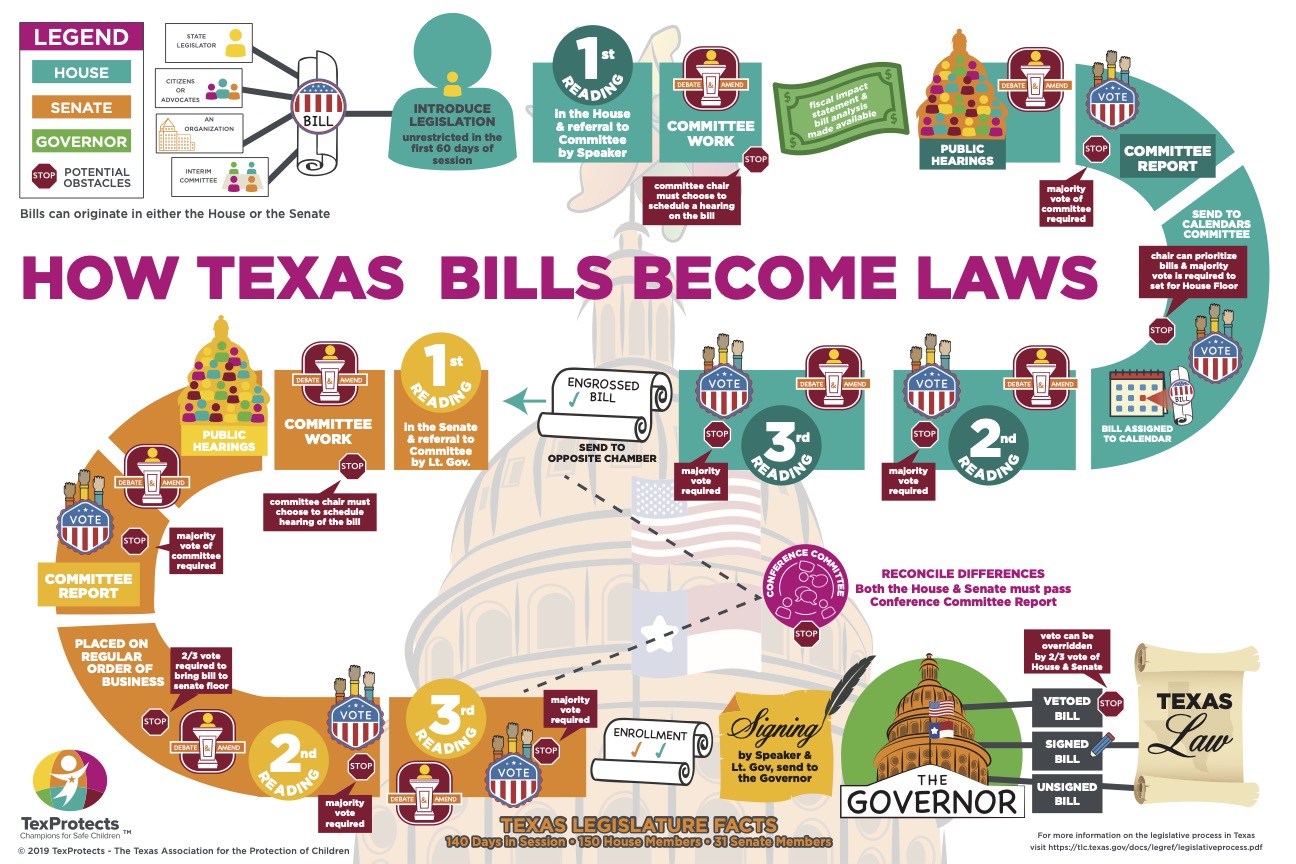
How a Texas Bill Becomes Law, by TexProtect [Infographic]

Friends,

I just came across this clear and accessible infographic on how a bill becomes law in Texas, courtesy of TexProtects. TexProtects is a nonpartisan organization known for translating complex policy processes into accessible tools that support informed civic engagement—especially on issues affecting children, families, and schools. It is thusly an extremely helpful resource, especially in the context of their advocacy for children (see TexProtects website).

While the infographic doesn’t capture every nuance (most notably, that the same or “companion” bill can be filed in both chambers), it offers a strong, user-friendly overview of a process that often feels opaque.

Process Explanation for a bill's legislative journey is the following:

A bill becomes law in Texas only after navigating a long and uncertain path. While literally thousands of bills get filed each session, only a few make it to the governor's desk.

The process begins when a legislator files a bill in either the Texas House or the Texas Senate. In practice, identical or nearly identical companion bills may be filed in both chambers at the same time—a common strategy to increase the chances that at least one version advances.

Once filed, the bill is referred to a committee with jurisdiction over the subject matter. This referral is one of the most consequential stages of the process. Committee chairs largely control what gets heard, and many bills never move beyond this point.

If a chair decides to proceed, a committee hearing is scheduled. This is the primary moment for public participation. Advocates, experts, agency officials, and community members can testify, placing their perspectives into the official record. After the hearing, the committee votes on the bill. It may advance (often with amendments), be delayed indefinitely, or be effectively killed. The majority of bills stall here.

When a bill passes out of committee, it moves to the full chamber where it was filed. Legislators debate it, propose amendments, and vote. If it passes, the bill then goes to the other chamber, where the entire process repeats: committee referral, possible hearing, committee vote, floor debate, and floor vote. Passage in one chamber does not guarantee passage in the other.

If the House and Senate pass different versions, a conference committee made up of members from both chambers is appointed to reconcile the differences. The compromise version must then be approved again by both chambers.

Only after this does the bill reach the governor’s desk. The governor may sign it into law, veto it, or allow it to become law without a signature by taking no action within the required time frame. If signed—or not vetoed—the bill becomes law and is implemented by the relevant state agencies.

What this explanatory version makes clear is that lawmaking in Texas is neither linear nor guaranteed. It is shaped by gatekeeping, timing, political priorities, and sustained public pressure. That is why tools like this TexProtects infographic matter. They demystify power, help communities identify where intervention is possible, and reinforce the importance of civic literacy at moments when decisions affecting education, children, and youth are made quickly—and sometimes quietly.

—Angela Valenzuela


Source: TexProtects


From Fossil Fuels Dependence to Shared Futures: What Venezuela’s Pivot Teaches Us, by Angela Valenzuela, Ph.D.

 From Fossil Fuels Dependence to Shared Futures: What Venezuela’s Pivot Teaches Us

by

Angela Valenzuela, Ph.D.

January 2, 2026

Venezuela’s recent decision to block oil exports to the United States while prioritizing markets in Asia marks a significant moment in global political economy—one that mainstream U.S. media have only partially addressed. A particularly clear and illuminating explanation is offered in the video published on December 31, 2025 titled, ¡Ãšltima hora! Venezuela bloquea exportaciones de petróleo a EE. UU.: lo que los medios no contarán (Breaking News! Venezuela Blocks Oil Exports to the U.S.: What the Media Won’t Tell You) by THAN Noticias, which situates this move within the broader context of U.S. sanctions, energy geopolitics, and a shifting multipolar world (THAN Noticias, 2024).

Read through this lens, Venezuela’s oil pivot is not simply a story about energy markets or foreign policy. It is a reminder that we live in an era of shared futures—in which sanctions, climate decisions, migration flows, and economic instability do not stop at national borders, but circulate through communities, classrooms, and institutions far from their point of origin.

As the analysis explains, decades of U.S. reliance on Venezuelan heavy crude—especially by Gulf Coast refineries designed for it—have been disrupted not simply by market forces, but by sustained sanctions that have failed to produce regime change even as it resulted in enormous suffering by Venezuelans, prompting millions to migrate to other countries, including the United States—demonstrating how policies framed as “foreign” quickly become domestic realities in societies shaped by shared economic and human futures.

Weisbrot & Sachs (2019) offer an excellent scholarly analysis on the complexity of responses to sanctions by targeted countries. Reviewing the evidence from the Global Sanctions Data Base, they find broad agreement that sanctions tend to reduce trade, investment, growth, and stability in target states, with effects that can persist long after sanctions end—but that these harms do not reliably translate into political compliance. Targets frequently respond by diverting trade and finance to third countries, shielding favored firms, forming new alliances, and sometimes retaliating—adaptation that can dilute sanctions’ leverage.

In this vein, Venezuela has redirected exports toward China and India, diversified its trading partners, and increasingly conducted transactions outside the U.S. dollar. This outcome reflects a broader pattern identified in the research literature: sanctions often incentivize adaptation and realignment rather than political compliance.

Why should an education blog care? Education is one of the primary institutions where shared futures are either acknowledged or denied—where students learn to see global crises either as someone else’s problem, or conversely, as collective challenges requiring cooperation, historical understanding, and ethical responsibility. One also learns how power operates through ostensibly technical—frequently blunt—policy tools, offering educators concrete case studies for teaching policy analysis, political economy, and global inequality.

Most importantly, this moment underscores two urgent imperatives. First, all nations—including the United States—must accelerate investment in clean and renewable energy technologies. Continued dependence on fossil fuels entrenches geopolitical conflict while delaying the climate transition that future generations will inherit. Second, sustainable global futures require diplomacy grounded in empirical evidence and mutual respect rather than coercion alone. 

Education has a vital role to play here: preparing students not only to understand these systems, but to imagine and build alternatives rooted in cooperation, sustainability, and shared responsibility in an increasingly multipolar world. Hence, despite sanctions, what impacts Venezuela impacts all of us in the U.S.

Disclaimer: I am not an economist so if I've missed anything or if anyone has anything to add, by all means state in the comment box below. Abundant thanks to Dr. Tony Baez for sharing this video with me. I had been meaning to look into this. I'm glad that I did. Happy New Year, everyone!

References

Global Sanctions Data Base. https://www.globalsanctionsdatabase.com/

THAN Noticias. (2024). ¡Ãšltima hora! Venezuela bloquea exportaciones de petróleo a EE. UU.: lo que los medios no contarán [Video]. YouTube. https://www.youtube.com/watch?v=xyb53JhDvX0

Weisbrot, M., & Sachs, J. D. (2019). Economic sanctions as collective punishment: The case of Venezuela. Center for Economic and Policy Research. https://cepr.net/images/stories/reports/venezuela-sanctions-2019-04.pdf