Translate

Showing posts with label Senate Bill 3. Show all posts

Monday, March 09, 2026

Nikole Hannah-Jones Comes to UT Austin: History, Democracy, and the Next Generation of Truth-Tellers

FREE AND OPEN TO THE PUBLIC


Tomorrow evening at 5:30 PM at the Bass Lecture Hall located at the LBJ School for Public Affairs, the University of Texas at Austin will host one of the most influential journalists and public intellectuals of our time. Nikole Hannah-Jones will speak at Bass Lecture Hall, bringing her powerful voice on history, democracy, and racial justice to campus at a moment when these conversations feel more urgent than ever.

Hannah-Jones is best known for creating The 1619 Project, the landmark initiative published by The New York Times that reframed the story of the United States by centering the legacy of slavery and the contributions of Black Americans to the nation’s democratic ideals. For this work, she received the Pulitzer Prize for Commentary in 2020, helping spark a national conversation about history, memory, and the meaning of democracy itself.

Notably, the book associated with this project—The 1619 Project: A New Origin Story—holds a unique and troubling distinction in Texas. Under Texas Senate Bill 3, it is the only specific book referenced in statute language as material that cannot be used to fulfill curriculum requirements in Texas public schools.

At a time when books are being challenged, curricula scrutinized, and honest discussions of race and history increasingly politicized, Hannah-Jones has remained steadfast in her commitment to rigorous historical inquiry and public dialogue. Her work reminds us that democracy depends not on comfortable myths, but on our willingness to confront the past honestly.

Tomorrow’s event will also feature two powerful voices from our own community.

Joining Hannah-Jones is Cameron Samuels, a youth leader and master’s student at the LBJ School of Public Affairs whose advocacy for intellectual freedom and student rights has resonated nationally. Samuels represents a generation of young organizers who understand that the fight over knowledge—what can be taught, read, and debated—is inseparable from the future of democracy.

Also participating is Karma Chávez, chair of the Mexican American and Latino Studies Program at UT Austin and a leading scholar whose work examines migration, social movements, and rhetorical strategies of resistance. Chávez’s scholarship reminds us that the struggles over voice, belonging, and justice have always been deeply connected to the power of narrative.

Together, these three speakers—together with Jonathan Friedman of PEN America as their moderator—represent something important: the intersection of journalism, scholarship, and youth activism in the ongoing struggle over how we tell the story of this country.

Events like this matter. Universities should be places where difficult histories can be explored, debated, and understood—not silenced. They are spaces where students encounter ideas that challenge them to think more deeply about the society they inhabit and the future they hope to build.

If you are in Austin, consider attending. Conversations about democracy, truth, and historical memory are not abstract academic exercises—they are part of the living work of citizenship.

And tomorrow evening, that conversation will unfold right here on the Forty Acres.

Friday, January 02, 2026

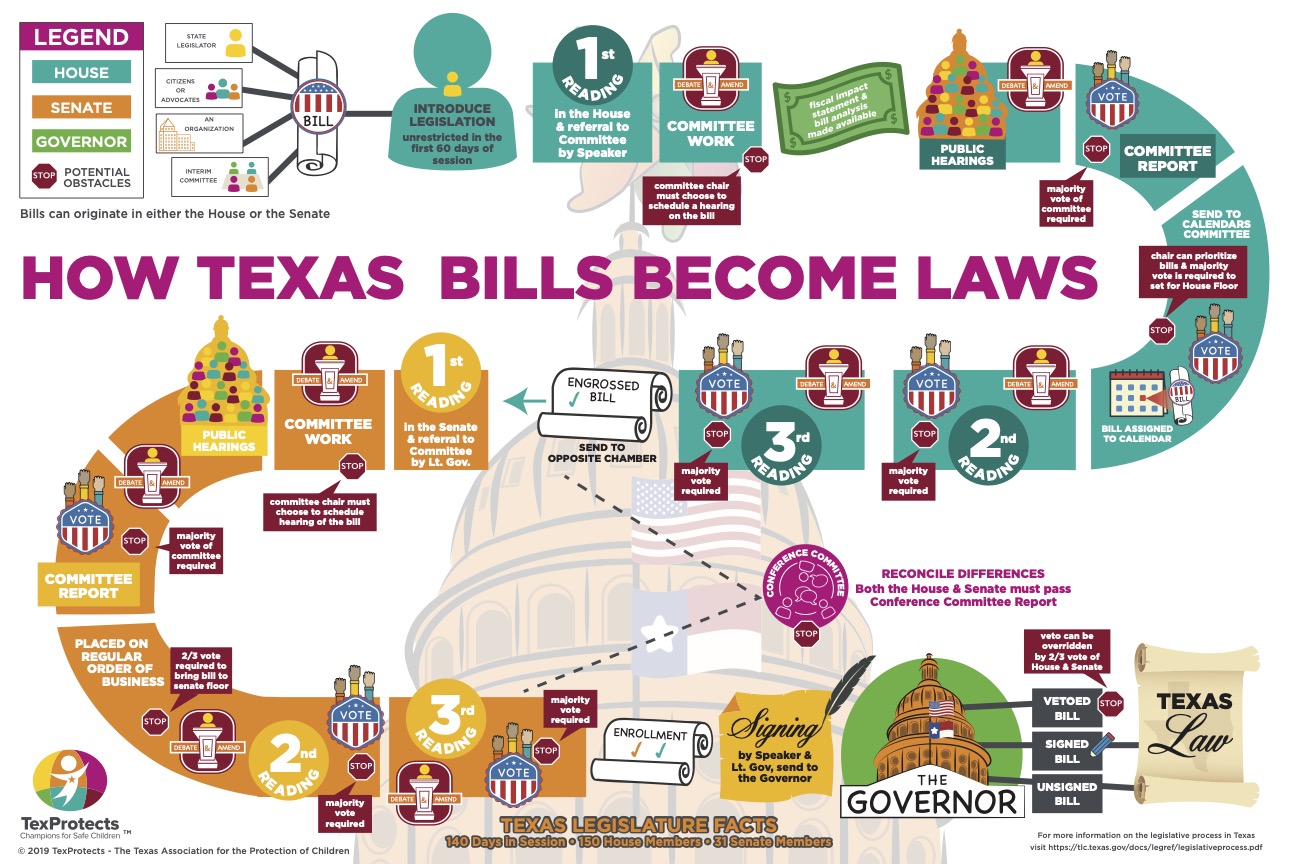
How a Texas Bill Becomes Law, by TexProtect [Infographic]

Friends,

I just came across this clear and accessible infographic on how a bill becomes law in Texas, courtesy of TexProtectsTexProtects is a nonpartisan organization known for translating complex policy processes into accessible tools that support informed civic engagement—especially on issues affecting children, families, and schools. It is thusly an extremely helpful resource, especially in the context of their advocacy for children (see TexProtects website).

While the infographic doesn’t capture every nuance (most notably, that the same or “companion” bill can be filed in both chambers), it offers a strong, user-friendly overview of a process that often feels opaque.

Process Explanation for a bill's legislative journey is the following:

A bill becomes law in Texas only after navigating a long and uncertain path. While literally thousands of bills get filed each session, only a few make it to the governor's desk.

The process begins when a legislator files a bill in either the Texas House or the Texas Senate. In practice, identical or nearly identical companion bills may be filed in both chambers at the same time—a common strategy to increase the chances that at least one version advances.

Once filed, the bill is referred to a committee with jurisdiction over the subject matter. This referral is one of the most consequential stages of the process. Committee chairs largely control what gets heard, and many bills never move beyond this point.

If a chair decides to proceed, a committee hearing is scheduled. This is the primary moment for public participation. Advocates, experts, agency officials, and community members can testify, placing their perspectives into the official record. After the hearing, the committee votes on the bill. It may advance (often with amendments), be delayed indefinitely, or be effectively killed. The majority of bills stall here.

When a bill passes out of committee, it moves to the full chamber where it was filed. Legislators debate it, propose amendments, and vote. If it passes, the bill then goes to the other chamber, where the entire process repeats: committee referral, possible hearing, committee vote, floor debate, and floor vote. Passage in one chamber does not guarantee passage in the other.

If the House and Senate pass different versions, a conference committee made up of members from both chambers is appointed to reconcile the differences. The compromise version must then be approved again by both chambers.

Only after this does the bill reach the governor’s desk. The governor may sign it into law, veto it, or allow it to become law without a signature by taking no action within the required time frame. If signed—or not vetoed—the bill becomes law and is implemented by the relevant state agencies.

What this explanatory version makes clear is that lawmaking in Texas is neither linear nor guaranteed. It is shaped by gatekeeping, timing, political priorities, and sustained public pressure. That is why tools like this TexProtects infographic matter. They demystify power, help communities identify where intervention is possible, and reinforce the importance of civic literacy at moments when decisions affecting education, children, and youth are made quickly—and sometimes quietly.

—Angela Valenzuela


Source: TexProtects


Thursday, August 10, 2023

Have Democrats reached the limits of White appeasement politics? by Perry Bacon, Jr. WAPO

Such an insightful piece by Bacon (2021) in the Washington Post. It's helpful to conceptually juxtapose white appeasement—or white privilege and comfort—to white grievance. It shows up in the concept of "electability." Another good example is when Obama chose Biden as his running mate to allay white fears of a browning America about which Phillips (2018) and others (e.g., Perez Huber) have written.

White appeasement also shows up in bills like Senate Bill 3, Texas' anti-Critical Race theory bill, where school teachers, administrators, and school staff are expected to not make any individual feel "discomfort, guilt, anguish, or any other form of psychological distress on account of the individual ’s race or sex."

First of all, to the extent that this is happening, if it is happening, this would be an equity issue that school leaders need to address. My larger point is how the politics of white comfort are real and that politicians, in particular, need to be aware of these dynamics so as to not shut out the very voices from whom they receive support.

Much food for thought.

-Angela Valenzuela

References

Perez Huber, L. (2016). Make America great again: Donald Trump, racist nativism and the virulent adherence to white supremacy amid US demographic change. Charleston L. Rev.10, 215.

Phillips, S. (2018). Brown is the new white: How the demographic revolution has created a new American majority. The New Press.


Have Democrats reached the limits of White appeasement politics?

By Perry Bacon, Jr. November 11, 2021 | Washington Post
(Neil Jamieson for The Washington Post)

There is a flip side to the White grievance of the right — and it’s one of the most important but under-discussed aspects of American politics.

In the decades since the passage of the Civil Rights and Voting Rights acts in the 1960s, the Republican Party has embraced a strategy of White grievance, perennially pushing policies and rhetoric that imply that the United States has gone too far in supporting civil rights causes and people of color. The 2021 version of this strategy is Republicans attacking how public schools teach about race and racism, with conservatives often falsely suggesting that White students are being told that they should be ashamed of their race.

The Democratic Party, to its credit, has remained committed to civil rights. It wants to be aligned with people of color. But Democrats also want to win elections in a White-majority country. So, party leaders for decades have informally adopted a strategy of White appeasement — by which I mean they have frequently taken actions, often subtle, to demonstrate to White Americans that they aren’t too tied to civil rights causes and people of color. Sometimes this means Democrats taking a stance on a racial issue to align with views of moderate and conservative White people; other times it is Democrats avoiding a stance on a racial issue for the same reason. The Democrats’ White appeasement is their countermove to the Republicans’ White grievance.

But the questions of if, when and how Democrats pursue White appeasement politics have always been contested within the party. And right now, that debate is perhaps more relevant than ever before.

Certainly, there is a real case that Democrats need to prioritize wooing White voters — and by whatever means necessary. The Republican Party is growing increasingly radical, raising the stakes for the country in the 2022 and 2024 elections. Even as the United States becomes more racially diverse, White Americans remain about 70 percent of voters overall and make up an even larger bloc in key swing states such as Pennsylvania and Wisconsin. Democrats can’t win presidential elections or control of the Senate if they lose too many White voters to the GOP.

At the same time, the limits and dangers of Democratic White appeasement are serious and substantial. Past policies adopted by party leaders to appeal to White voters have hurt people of color in deep and lasting ways. And many of those moves didn’t actually attract many White voters, either. Centering White voters now could push the Democrats away from a recent positive trajectory that includes increasingly embracing candidates of color and aggressive efforts to address racial inequality. Further, such a shift might not even be necessary. In 2020, Democrats won the House, Senate and presidency with their coalition of people of color and White Americans with more progressive views on racial issues.

Look for it, and you can see that many debates within today’s Democratic Party are at core about how much the party must appease moderate and conservative White people vs. how far those same Whites can be pushed to accept the goals and aspirations of people of color before switching their votes to Republicans.

The nomination of Joe Biden, a White man in his 70s, was in many ways a concession to America’s White majority — but he was a package deal that also included the Black and Indian American Kamala D. Harris, and later the most racially diverse Cabinet ever and an administration that regularly consults with the young and diverse “Squad” in the House.

President Biden’s bipartisan infrastructure bill in part can be seen as an attempt to appease more moderate and conservative White people — while his reconciliation package, with its child care and preschool provisions, is targeted at vital party activists who are women and people of color.

Until recently, Biden was strongly defending the Senate filibuster, an anachronism that empowers senators from small, disproportionately White states to prevent policy from shifting too much — but he has shifted and now favors reforming the filibuster for legislation on voting rights, an issue of deep resonance among Black voters.

Biden vs. the Squad. Infrastructure vs. preschool. The filibuster vs. voting rights. These aren’t cleanly White vs. Black, but these are racialized issues nonetheless. They capture a fundamental question: How White does the Democratic Party need to be?

From Sister Souljah to Title 42.

The idea of White appeasement is certainly not new, even if it is often not acknowledged directly or referred to with a pejorative such as “appeasement” — the term “electability” is often invoked instead, obscuring that the swing voters at issue are almost all White. This is in part because American political coverage has traditionally involved White reporters covering White politicians and strategists as they seek to win over those White voters. All three groups might not notice examples of White appeasement and, if they did, have little incentive to describe them directly.

The story of the post-1960s Democratic Party is in some ways the story of a party trying to precisely calibrate the levels of White appeasement necessary to win and hold power.

In the 1970s, Democratic officials, including Biden as a senator from Delaware, started echoing concerns from White Americans that aggressive school integration policies (“busing”) had gone too far. In the 1980s, a bloc of centrist and mostly White, male Democrats created the Democratic Leadership Council, an organization that sought to develop candidates and policies who in their view would help overcome the perception that the party was too dominated by what was described back then as “special interests” (code for Black civil rights activists, the labor movement and other left-leaning constituencies). Democrats also altered their presidential nomination process during this period, creating superdelegates and a “Super Tuesday” of primaries in the South, moves intended to block very liberal candidates and boost those who might appeal to more conservative Whites.


Democratic presidential candidate Bill Clinton speaks at a Rebuild America conference in Washington in June 1992. At right is Jesse Jackson, whose Rainbow Coalition sponsored the event. During the speech, Clinton criticized rapper and activist Sister Souljah. (Greg Gibson/AP)

Those changes helped steer the party to then-Arkansas Gov. Bill Clinton in 1992. Clinton was careful to make clear that he was not too closely aligned with Black people and causes. During the campaign, at a conference sponsored by the Rev. Jesse Jackson — the leading Black political figure of that era — Clinton sharply criticized rapper and activist Sister Souljah for an inflammatory comment she had made, as well as Jackson for inviting her to speak. The target was as much Jackson as Sister Souljah, as centrist Democrats felt the party needed to distance itself from the civil rights leader. As president, Clinton signed into law limits on welfare benefits and substantially increased punishments for some crimes. Those moves were intended to signal to White voters that Democrats, like Republicans, viewed some of America’s racial inequalities as rooted in self-inflicted problems in Black communities, as opposed to discriminatory policies and systemic racism.

After losing with another Southerner (Al Gore in 2000) and a war veteran (John F. Kerry in 2004), neither of whom appealed to White swing voters as much as Democrats hoped, party leaders and voters for the first time embraced a non-White candidate in Barack Obama.

But Obama’s rise and presidency certainly didn’t come without some White appeasement. During his 2008 campaign, Obama gave a long speech explaining that he did not share some of the more controversial racial stances of the Rev. Jeremiah Wright, who conducted Obama’s wedding. Looking to make the prospect of his presidency less jarring to conservative Whites, Obama only really considered White men for his running mate. Biden’s record of being not particularly liberal on racial issues made him an ideal fit.


President Barack Obama, right, and Vice President Joe Biden, left, have a beer with Harvard scholar Henry Louis Gates Jr., second from left, and Cambridge, Mass., police Sgt. James Crowley in the Rose Garden of the White House on July 30, 2009. (Alex Brandon/AP)

During his first year as president, Obama famously held a “beer summit” media event to essentially apologize for criticizing police officers who arrested Black Harvard professor Henry Louis Gates Jr. in front of Gates’s house. His administration carried out a huge number of deportations of undocumented immigrants. He spoke about race much less than his predecessors had during his first term. He declared in 2012: “I’m not the president of Black America.”

The Democrats nominated Hillary Clinton in 2016, again not choosing a White man. But she, too, seriously considered only White men for her running mate, settling on Virginia Sen. Tim Kaine. When Clinton lost, many in the party spent four years casting about for a White male candidate to run in 2020, looking at people who likely would not have been considered presidential material but for their race and gender (former congressman Beto O’Rourke of Texas, for instance) before settling on Biden. “A substantial faction of the Democratic Party reliably blames any loss on the party’s commitments to diversity and civil rights,” said University of Denver political scientist Seth Masket.

Biden has actually been more racially liberal than his Democratic predecessors, but he has also done his share of White appeasing.

During his general election campaign, the president repeatedly condemned rioting amid the George Floyd protests. The overwhelming majority of the protests were peaceful, and almost no one actually favors rioting, but Biden felt compelled to reassure White Americans that he didn’t like violent protests. As president, he initially refused to increase the number of refugees allowed to enter the United States from Trump-era levels. He has kept in place a harsh Trump-era policy of using a provision called Title 42 to block some migrants from seeking asylum within the United States, on the grounds that covid-19 is a public health crisis and that migrants could exacerbate it.

“There’s been this hierarchy of what battles to fight and which ones to avoid, and this is guided by White appeasement — what policy will not offend White swing voters,” said Steve Phillips, a progressive activist and senior fellow at the Center for American Progress. “It very much dominates policy and political strategy among Democrats.”

“The Democrats have been doing these kinds of things for a long time,” said Stanford University political scientist Hakeem Jefferson.

All of these moves aren’t normatively bad, or indefensible. Democratic officials likely took some of the steps above out of conviction as much as or perhaps even more than political calculation. Many Democrats in the 1980s wanted the party to increase jail sentences because they felt it would be a deterrent and reduce crime, electoral considerations aside. It was probably politically wise for Obama to distance himself from the idea that he should be especially beholden to Black people, but I have no doubt he wanted to be thought of as a leader of all Americans, not just Black ones. Some Democratic appeasement moves have been strong on the merits (Biden was the most experienced of the 2020 Democratic presidential candidates). A few of them might have been truly electorally necessary (Obama picking a White male running mate and distancing himself from Wright in 2008), although presidential elections are complicated, and the winner is determined by a range of factors.

It’s important to note, too, that sometimes non-White Democrats acknowledge the electoral virtues of White appeasement and at times participate in it themselves. For example, many of the Black Democratic voters who embraced Biden during the 2020 primaries openly stated that they backed him in part because they believed he would appeal to White voters. And it’s in the interests of Democratic Party leaders for prominent non-White figures to take the lead on some appeasement. For example, it’s harder for pro-immigration advocates to slam the Biden administration’s policies when Vice President Harris and Cuban American Homeland Security Secretary Alejandro Mayorkas are so heavily involved in implementing them.

Finally, while White appeasement is largely about race, it intersects with other identity issues as well. When Democrats try to appeal to conservative White voters, they often end up playing down the interests of women, LGBTQ Americans and non-Christians in addition to people of color. The 2008 vice-presidential selection process was not going to end with a female running mate for Obama, even if she were White. Twelve years later, with Democratic primary voters looking for the presidential candidate who would appeal most to White people with conservative views on racial issues, Harris in particular was disadvantaged. But I’m not sure that candidates such as Sen. Cory Booker (N.J.) or Sen. Amy Klobuchar (Minn.) had much of a chance, either.

“The conventional wisdom is that we have a racially conservative party and a racially liberal party,” said LaFleur Stephens-Dougan, a Princeton University political scientist. “But in reality, we have one party that is explicitly racist and another party that is to the left of the other party, but certainly not a party of racial liberalism.”

Is it time for a new approach?


Let’s ask the question directly: Don’t the Democrats have to do some appeasement of White voters to win in America? I think they probably do, because White people are the majority of voters. But Democrats should be really careful about when and how they do it.

First, and most important, Democratic officials need to avoid White appeasement, particularly on policy issues, that will have long-lasting and damaging effects on people of color. American schools remain deeply segregated by class and race and students who attend heavily segregated schools usually do worse academically. So Democrats who embraced the pullback from aggressive school integration helped cause profound damage. The Clinton-era crime bill was part of a broader set of tough-on-crime policies enacted by Democrats and Republicans that has left Black men significantly more likely than White men to have served time in jail. The Clinton-era welfare bill made it harder for low-income families to get public benefits if the parents weren’t working, punishing children for adults’ actions. The Obama-era deportations reached unnecessarily high levels. They also did not help Obama get Republican votes for his broader immigration agenda.

“For the last 50 years, Democratic politicians who believed that their campaigns’ dog whistling was an unfortunate, but harmless necessary expedient to win election found themselves having to walk the talk when they were in office,” said Michael Podhorzer, a senior adviser at the AFL-CIO, the nation’s largest labor federation.

Democrats are now trying to get money to children in households where the parents don’t have jobs, make the criminal justice system less punitive and deport fewer undocumented immigrants, correctives that are a clear sign that past White appeasement in these areas went too far.

They are also in danger of making the same mistakes again. Trying to rebut the charge from Republicans that they are anti-police (and thereby in effect anti-White) that emerged from last year’s protests, Democrats in some cities and states are opposing aggressive efforts to reform law-enforcement practices. This is a mistake. Democrats could end up stopping police reform before it gets going, perpetuating corrosive and abusive practices and potentially resulting in more horrible police killings like those of George Floyd and Breonna Taylor last year.

Second, even if an act of White appeasement isn’t going to have a clear negative policy impact, Democrats need to stop trashing people of color, their leaders and their causes as part of their strategy. Party officials may not be able to say publicly, “We are making Decision X to appeal to White voters with conservative views on racial issues.” But they shouldn’t lose sight of the actual problem, either — that many White people aren’t comfortable with vocal people of color and civil rights causes. Instead, Democrats often go beyond giving White people a pass for their racism; they frequently seek out opportunities to criticize people of color. It’s morally abhorrent to punch down at less powerful Bill Clinton should have found a way to demonstrate that he was more conservative than Black activists that didn’t involve rebuking Jackson, highlighting a month-old comment from a rather obscure figure (Sister Souljah) and likening her to white supremacist David Duke. The Democrats of today who go out of their way to rebuke members of the Squad should stop doing that. After the 2020 election, Democratic officials shouldn’t have rushed to blame activists who advocated defunding the police for the party’s underwhelming results in congressional races, rather than scrutinizing the performance of the party’s candidates and leaders.

If the Biden administration doesn’t want more immigrants to enter the country because too many voters oppose immigration, the administration could acknowledge that political reality. But it should not invoke a public health crisis such as covid-19, effectively reinforcing the racist trope that migrants are disease carriers.

Third, the Democrats should just do less White appeasement because the electoral benefits of the strategy are much smaller now than they were in previous eras.

A woman holds a sign opposing U.S. immigration policy at a migrant-led protest in Nogales, Mexico, on Nov. 8. (Caitlin O'Hara/Reuters)

American voters are much more polarized by party than they were two or three decades ago, and there are many fewer swing voters. Much of the partisan polarization is about racial views — Democrats, including White ones, are well to the left of Republicans on questions such as whether they support the Black Lives Matter movement. So it would be hard for the party to move far enough to the right on racial issues to swing many GOP-leaning voters to their side. “Everybody knows where the parties stand on these issues,” said University of Washington political scientist Jake Grumbach.

And that racial polarization is reinforced by leaders in the Democratic Party (as well as the GOP) taking clear stands in terms of race. Yes, Bill Clinton had some genuine and strong ties to the Black community. But Biden was Obama’s vice president; promised during the campaign to appoint a Black woman to the Supreme Court; won the Democratic primary in part because of overwhelming support from Black voters; strongly embraced the protests after the police murder of George Floyd; and picked a woman of color as his running mate. There is a reason Biden specifically thanked Black voters in his victory speech once he was declared president-elect.

Because the Democratic Party of today takes such pride in its embrace of people of color and civil rights causes, it would be very politically dicey for Biden or another major party leader to single out, say, Rep. Cori Bush (D-Mo.) for criticism.

“Clinton was able to pick a fight with Jesse Jackson and show the racists that he was willing to put a Black leader in his place,” the Nation’s Elie Mystal wrote recently. “But in 2021, I don’t know whom Biden is supposed to pick a fight with and win. William Barber? Ayanna Pressley? His own vice president, Kamala Harris? … It’s not as easy to isolate and denigrate Black leaders for white applause as it used to be.”

Increased racial polarization means that Democrats often don’t get many political benefits when they make White appeasement moves, and the costs they incur from prioritizing civil rights and people of color aren’t as high as they might have been a few decades ago. Hillary Clinton’s choice of Kaine as her running mate in 2016 didn’t help her win White voters. In last year’s presidential election, despite specifically choosing a candidate (Biden) for his potential appeal to White voters without college degrees, Democrats won a smaller percentage of the White non-college vote than in 2008.

After decades of running White candidates in key races in the South, Democrats embraced Raphael G. Warnock for the Senate race in Georgia, even though Warnock is a Black pastor with a history of fairly blunt comments on race. There is little evidence Warnock’s race cost him votes — he actually did slightly better than Jon Ossoff, the White Democrat who also won a U.S. Senate seat in the state in January. The Georgia results, and others in recent elections, suggest Democrats should once and for all stop seeking out White candidates and sidelining Black ones on a theory that the former will help them win White voters.


The Rev. Raphael G. Warnock speaks during a campaign rally in Jonesboro, Ga., on Nov. 19, 2020. Warnock was elected to the U.S. Senate in January. (Kevin D. Liles for The Washington Post)

Finally, Democrats should consider alternatives to constantly trying to ignore racial issues or move to the right on them. “We don’t really know what an alternative strategy [to White appeasement] would be and if it would work,” said Princeton’s Stephens-Dougan, “because the Democrats haven’t ever really tried it.”

What might such an alternative look like? Democrats could embrace more non-White candidates like Obama and Warnock, in part because they are likely to be more knowledgeable about race-based issues such as critical race theory and therefore better able than White candidates to combat GOP grievance tactics. They could emphasize that lots of ideas that are often lumped in the “civil rights” or “Black” bucket, such as voting access, integrating schools by class and race, and reducing police killings, will benefit large numbers of White people, too, particularly those with lower incomes. They could become even more closely aligned with the labor movement, as there is evidence that union membership pushes White people to be more supportive of policies that benefit people of color. They could, instead of sidestepping issues such as critical race theory when Republicans bring them up, take them on directly.

“Instead of ignoring race while Republicans beat us silly with it, Democrats must confront it and explain that powerful elites and special interests use race as a tool of division to distract hard-working people of all races while they get robbed blind,” Democratic strategists Tory Gavito and Adam Jentleson argued in a recent New York Times op-ed. “Then pivot back to shared interests.”

Opinion by Perry Bacon Jr.: Raphael Warnock, the freshman senator not playing it safe

2022 and 2024

In last week’s Virginia gubernatorial election, Republican Glenn Youngkin defeated Democrat Terry McAuliffe in a somewhat surprising setback for Democrats, considering that Biden won the state by 10 points last year. Youngkin ran in part on White grievance, attacking critical race theory in particular, along with the broader idea that America is too fixated on racial division. McAuliffe accurately criticized Youngkin for using a “racist dog whistle” in running on critical race theory.

Youngkin blew out McAuliffe among White voters, which has stirred conversation about whether the Republican won because he appealed to White racial anxieties and McAuliffe did not.

What lessons to take away from the Virginia results is an important question because of where American politics is headed in the next few years. The 2022 elections are likely to be difficult for Democrats, both because the president’s party usually struggles in midterms and because of Biden’s declining approval rating. Republicans will campaign in 2022 by casting Democrats as too beholden to people of color — that’s what they always do, after all. Then, 2023 will start the Republican presidential nomination process, during which GOP hopefuls will employ a White grievance strategy — assuming of course the party doesn’t simply give the nomination to former president Donald Trump, a constant and effective practitioner of White grievance politics.


Supporters of Virginia gubernatorial candidate Glenn Youngkin in Chantilly, Va., on election night on Nov. 2. Youngkin defeated Democrat and former governor Terry McAuliffe. (Salwan Georges/The Washington Post)

To do well in 2022 and 2024, the Democrats need to win a lot of White voters, including some who have less-than-progressive views on racial issues. The temptation will be strong to go over the top, perhaps even unconsciously, in terms of White appeasement, essentially running a 2020s version of Bill Clinton’s campaigns. After all, given Republican anti-democratic radicalism, the stakes are extremely high. And Biden, his inner circle and other top officials in the Democratic Party generally are White, older people who embraced the Democrats’ White appeasement in previous eras.

I would be dismayed to see Democratic congressional candidates or Biden, in the run-up to 2022 and 2024, publicly attacking the Squad or Black Lives Matter, walking back commitments to address racial inequality and reform policing, or adopting more anti-immigrant rhetoric or policies. If Biden opts not to run in 2024, I would be sad to see the Democrats give only White male candidates a real chance at the nomination.

The Virginia race is instructive here. Democrats nominated McAuliffe over several other candidates in the Democratic primary, including two Black women. During his general election campaign, McAuliffe reversed his previous support for a key plank of police reform — getting rid of qualified immunity, a legal doctrine that limits civil suits against officers. So Virginia Democrats took steps right out of the White appeasement playbook — run a White male candidate, move right on racial issues — and lost.

Looking beyond Virginia, some Democratic White appeasement is probably still necessary in a country where a person like Trump won the presidency once, nearly did so a second time and remains a viable candidate. Even with a heavily polarized electorate, there are swing voters whom Democrats could lose (and did in Virginia). There are also conservative Whites and Latinos who aren’t frequent voters but could be motivated to turn out by an effective GOP grievance campaign — something that may have happened last year, when Trump won millions more voters than he did in 2016. So while it’s impossible to say precisely how much appeasement is needed, a Democratic candidate for president or statewide office in a swing state probably can’t advocate reparations or drastically cutting police funding and expect to win. When Harris was asked this year if America is a “racist country,” the only answer she could give and remain a viable future candidate for president was no — the one she gave. In this era, the pressures for White appeasement likely do not end up with Democrats taking racist actions like they have in the past, but rather limit how anti-racist they can be.

And that’s a real problem. White appeasement leads to policies that hurt people of color. It incentivizes public humiliations of prominent people of color. It results in civil rights causes and candidates of color being sidelined. And it’s of limited and diminishing electoral value. The party needs to stop and think hard — every single time — before it turns to this deeply troubling, increasingly outmoded reflex.

Democratic White appeasement should be narrow, careful and, most importantly, rare.

Monday, November 01, 2021

Rep. Matt Krause's Campaign for Attorney General Scrutinizes Texas School Districts for Texts on Race and Sexuality

Compliments of the Voice of the Mainland blog, here is specific detail on the specific request by Ft. Worth Rep. Matt Krause who is running for attorney general for texts purchased by school districts, including award winners, that address issues of race and sexuality [also read: Analysis: Matt Krause’s campaign for attorney general comes with a reading list]. This amounts to a new level of scrutiny of Texas public schools that falls on the heels of anti-CRT bill, Senate Bill 3, that promises to earn him a measure of notoriety. 

Accordingly, read my earlier post titled: "Texas House committee to investigate school districts’ books on race and sexuality." You can't make this stuff up.

Glad to see the the Austin Independent School District not going through with this primarily since there's already a link to the requested information [read: "Austin ISD dismisses Texas lawmaker's probe into books on race, sex"]. 

Requests like these that are designed to bolster the political aims of lawmakers are not only a cost to taxpayers, but involve an inordinate amount of time—and for what purpose other than to polarize society even more? The Rs have reached the limits of their political leadership if this is all they have, pestering superintendents and local school boards for narrow, political ends.

-Angela Valenzuela

***

Editor: Texas State Representative Matt Krause is asking several Texas schools to conduct an assessment of books in their library and see if any of these books are in their library system, how many copies and the amount of dollars expended by the school district to purchase those books. The public has no knowledge what Rep Krause intends to do with the outcome of his investigation. Maybe noting. Maybe burn the books. Maybe deduct the amount spend on the books from the school district's budget. We do not know. Anyway, book burning seems to be making it's way into Texas education, maybe not as an act, but as a threat.

The text of his message is below. The full letter can be linked to here.


1. Please identify how many copies of each book in the attached Addendum your

District possesses and at what campus locations including school library and

classroom collections. Please identify the amount of funds spent by your District to 

acquire the books identified in request No. 1 above.

3. Please identify any other books or content in your District, specifying the campus

location and funds spent on acquisition, that address or contain the following topics:

human sexuality, sexually transmitted diseases, or human immunodeficiency virus

(HIV) or acquired immune deficiency syndrome (AIDS), sexually explicit images,

graphic presentations of sexual behavior that is in violation of the law, or contain

material that might make students feel discomfort, guilt, anguish, or any other form of

psychological distress because of their race or sex or convey that a student, by virtue

of their race or sex, is inherently racist, sexist, or oppressive, whether consciously or

unconsciously.

Your prompt attention to this request is appreciated, and I request a written response via 

email by November 12, 2021. If you have any questions, please contact me or the 

Committee’s General Counsel, Darren Keyes.

Sunday, July 25, 2021

The Push for Lesson-Burning in Texas Classrooms Comes as No Shock to Those in the Long Fight for Mexican American Studies

This post is a really good followup to my earlier post today titled, "Today It’s Critical Race Theory. 200 Years Ago It Was Abolitionist Literature. The common denominator? Fear of Black liberation." As University of Texas UT History Professor Monica Muñoz Martinez notes, curricular censorship has a deep history in our state that attaches closely to the legacy struggle for the teaching of Mexican American Studies in our schools.

Dr. Muñoz Martinez also explicates House Bill 3979 that passed during the regular legislative session. She also weighs in on its "cleaned up" version Senate Bill 3 (HB 178) from our Special Legislative Session that wraps up soon.  This version removes helpful amendments put forward by democrats in the regular session.

It's possible that Gov. Abbott will call another special session in hopes that democrats make their way back to Texas from Washington so that he and conservative legislators can move forward with their nefarious agenda to disenfranchise the students through curricular censorship and residents of our state through voter suppression.  

White supremacy is the through line, the thread that connects the past to the present. White legislators say that they're not racist. However their rhetoric is empty since they are not anti-racist, opposing racist policies and practices. There is no neutral ground here because policies are inescapably reflective of power relations and imbalances of society, imbalances that find expression in the race and gender makeup of a legislature that allows one race-gender group to rule over the others.

Yes, it all connects, and the solution is always more diversity and inclusion and most especially, more democracy. Not less.

Great job, Dr. Muñoz Martinez! 

We need all our historians to speak up!

-Angela Valenzuela

The Push for Lesson-Burning in Texas Classrooms Comes as No Shock to Those in the Long Fight for Mexican American Studies


by Monica Muñoz Martinez |  Education, Race/Ethnicity - Women's Media Center 7/20/21

When a right-wing policy group recently tweeted last month a list of 21 phrases for detecting Critical Race Theory (CRT), the backlash was so strong that it was soon removed. The tweet, however, is part of a long campaign to preserve the myths of white supremacy and to squash truth, accuracy, and the right to a quality education.

The post by the Texas Public Policy Foundation was on the heels of Republican legislators passing in the Lone Star State a bill known as HB 3979. Signed into law by Governor Greg Abbott, HB 3979 includes provisions to rewrite social studies requirements, undermines diversity and inclusion trainings, dictates how teachers can talk about the history of racism and slavery, and prohibits schools from accepting private funding for professional or curriculum development.


When HB 3979 was being debated this past spring, more than 200 historians, myself included, released an open letter, warning that the bill would leave students in Texas without an understanding of how race and gender have shaped U.S. laws and policies. Therefore, they would be deliberately misinformed and academically disadvantaged.

HB 3979 dictates that “with respect to their relationship to American values, slavery and racism are anything other than deviations from, betrayals of, or failures to live up to, the authentic founding principles of the United States, which include liberty and equality.” On principle, most people would agree that slavery and racism are moral failures in U.S. history. But what this provision does is dictate how history can be interpreted. It prohibits teachers from discussing topics such as how white supremacy has impacted U.S. history, systemic racism, or the long legacies of slavery and xenophobia. The law also bans teaching the award-winning 1619 project , making it clear that legislators aim to censor factually-based interpretations of history. Instead, teachers will be forced to discuss slavery and racism as marginal to U.S. history.

These restrictions are a muzzle. They make it impossible to truthfully teach about the Texas Declaration of Independence, the Texas Constitution, and the writings and speeches of founding figures, like Stephen F. Austin and Sam Houston, who were guided by their racial antipathy towards Indigenous, Mexican, and Black people.

In Texas, this campaign to further obscure the roots of slavery and racism was evident in a special legislative session earlier this month. Republican legislators doubled down by proposing HB 178 SB3 in the Senate ). This bill would remove amendments added to HB 3979 by Texas House Democrats that mandated students learn the centuries-old history of white supremacy and, unequivocally, that white supremacy is “morally wrong.” HB 178 also struck through mandates for students to learn about federal legislation like the Fugitive Slave Act of 1850 and the Indian Removal Act , and landmark civil rights cases like Mendez v Westminster and Hernandez v Texas.

These efforts to gag teachers reflect a long agenda of fostering inequity through public schools. In the 19th century, Manifest Destinythe belief that white Americans were ordained by God to dominate North America, became the basis for violently displacing Indigenous, Mexican, and Chinese people in the U.S. west. This embrace of racial superiority was used to justify wars, craft laws, and shape institutions like public education. The history of how white Americans conquered the West and of events like the Alamo were whitewashed and taught to students as a narrative of progress that erased or celebrated genocidal violence, colonization, and slavery. It depicted white men as noble heroes and all others as enemies of Anglo civilization .

Public schools in the late 19th and early 20th century were a tool of colonization and conquest. Indigenous children were ripped from their parents and placed in boarding schools, an act of violence we have yet to remedy. In Texas, laws forbid Black students from benefiting from school funds there and lawmakers targeted Mexican escuelitas, local community schools that were both bilingual and bicultural. Lawmakers passed “English Only” laws to prohibit teaching in Spanish, and they segregated schools.

Texas-Mexican journalists criticized Anglo politicians and landowners for denying civil rights and for relegating Mexican Americans to cheap labor. One article in 1910 charged that Anglos were excluding Mexican children from schools and trying to create an ignorant class. Journalists also warned that Anglo vigilantes and law enforcement were using violence to try to “condemn the Mexicans to a condition of beasts of burden.”

Laredo journalist, suffragist, and teacher Jovita Idar , in particular, took personal risks advocating for racial justice . In 1914, when El Progreso newspaper caught the attention of Texas governor Oscar Branch Colquitt for its criticism of him, he ordered the Texas Rangers to shut it down. In defiance, Idar refused to allow the Rangers into the offices of the paper. The Rangers returned the next day and destroyed El Progreso’s printing press.

During the Civil Rights movement—over 50 years after Idar stood up to the Rangers—Mexican American students in cities from Los Angeles to Houston and rural towns like Crystal City and Uvalde walked out of schools calling for desegregation, an end to corporal punishment for speaking Spanish in schools, more representation in faculty and administrations, and for their history to be reflected in curriculum. Now, at a time when more accurate accounts of history are becoming mainstream, supporters of HB 3979 and other “lesson-burning” bills are wildly claiming that students are being taught “ a souped-up version of Marxism,” or lessons that shame white people . Teachers who follow guidelines that have been outlined by professional organizations and the Texas State Board of Education are being dangerously misrepresented as “indoctrinating” students. This right-wing agenda to control how history is taught in public schools is predictably stoking fear. Some groups are making it alarmingly easy for parents to “report” teachers or schools that might be teaching Critical Race Theory. They are not encouraging parents to share concerns with school administrators, but to, instead, submit reports to the same groups that are fear-baiting and stirring misguided anger around CRT and so much more.

The Texas Public Policy Foundation listed a sweeping set of “buzz” terms for CRT that included colonization, ally, identity, social justice, and equity, diversity, and inclusion. The graphic it posted made it abundantly transparent that the agenda here is to target diversity and inclusion programs , stifle conversation about social justice, white privilege, and systemic racism, and track even the mention of Black Lives Matter in schools. Any professional historian would know that it is impossible to teach topics like the American Revolution, slavery, westward expansion, Jim Crow, women’s suffrage, World War II, or the history of Civil Rights movement without using at least one of the falsely flagged terms.

We’ve seen this playbook before. Opponents of CRT are parroting the hysteria of politicians in 2010 that accused Mexican American studies courses of encouraging students to “hate” America and of promoting racism against white Americans. This was followed by Arizona politicians outlawing Mexican American studies, only to have a federal judge rule that the law violated students constitutional rights because both “ enactment and enforcement were motivated by racial animus.” The frenzy now is around trying to keep these histories out of any classroom, not just ethnic studies.

While the damage of HB 3979 will be far-reaching, we cannot overlook the threat to Mexican American and African American studies in Texas and elsewhere. Since the 1960s , students, parents, and historians have demanded that school districts offer ethnic studies courses in K-12 grades, in large part because the contributions of Mexican American, African Americans, Asian American, and Indigenous peoples in Texas were made absent in school lessons. The benefits have gone far beyond historical accuracy. Research has shown that students who take Mexican American studies courses are more likely to graduate and pass standardized tests , are more civically engaged, and even develop more self-confidence.

In Texas, Mexican American Studies and African American studies courses are approved by the State Board of Education. And that’s the way it should have remained, instead of state lawmakers passing legislation to revise curriculum standards .

When HB 3979 becomes law on Sept 1st, students in Texas will lose out on a quality education and teachers and school administrators will most likely feel the wrath of parents that have been intentionally misled. They will also carry the unjust burden of having to defend the basic principle of teaching the truth, as we are already seeing .