Translate

Monday, January 06, 2025

Free lunches, brain breaks and happy teachers: why Estonia has the best schools in Europe

Friends:

Lots of takeaways regarding Estonia becoming an educational powerhouse. For starters, kindergarten is subsidized and equitable so that children enter schools on more equal footing. They also have universal free school lunches as an expression of their pragmatism and values. 

This exemplifies the true essence of "equity" and underscores why it deserves our unwavering support. Clearly, for Estonia, the impact of income disparities persist such that this is a work in progress about which they are intentional and mindful.

Estonian schools have smaller class sizes, especially in foreign language, including English classes, and specialized subjects, allowing for more opportunities to speak and personalized attention. Teachers enjoy a lot of autonomy, albeit combined with their attainment of advanced degrees. Schools themselves are empowered to chart their own approaches to meeting national standards. How refreshing!

I like how their technology and digital tools are embedded throughout the curriculum, and includes the teaching of coding, robotics, and fostering digital literacy, in general.

Their focus on creativity translates into heavy doses of arts, music, and a nurturing attention to students' well-being that follows from this. Students can acquire cooking, knitting, and other practical skills. "Brain breaks," outdoor learning, critical thinking and student-centered, flexible curriculum, combined with fewer standardized exams creates space for discussion, student participation, and building strong teacher-student relationships. They also value attractive, roomy learning environments for learning.

They are not without their challenges like teacher shortages and low salaries. Estonia’s focus on equity, autonomy, and student engagement nevertheless remains a model for educational success.

Reducing the number of tests children need to take would be a great first step in transforming public education into more nurturing spaces. Policymakers everywhere need to give this piece a close read. School visits to Estonia may be in order, too.

Thanks to my colleague, Dr. Chris Milk, for sharing.

-Angela Valenzuela


Free lunches, brain breaks and happy teachers: why Estonia has the best schools in Europe


How did a small, relatively poor country become an educational powerhouse? Creativity, autonomy and a deep embrace of the digital age

by Emine Saner

Today’s subject in the sci-fi class at Pelgulinna State Gymnasium is Blade Runner. Thursdays are “voluntary” lesson days, where students at this upper secondary school in Estonia’s capital, Tallinn, can choose from a range of subjects; others taking place today include a rights and democracy course, programming and creative writing in English. The seven 17-year-old students in the sci-fi lesson have just finished watching 30 minutes of the film and are preparing to discuss it when I sneak in at the back, switching to perfect English for my benefit. “We’ve talked about Jungian archetypes, persona and the superego,” says Triin, one of the students. “It has been really helpful for me to understand the different aspects of being human and how to create deeper characters.” They’ve also studied Brave New World and 2001: A Space Odyssey. In the few minutes I am there, the students touch on US history, child labour, empathy and more. “I have so many questions,” says Triin.

Me too. How did Estonia, a small country that is relatively poor compared with most of the EU, become an educational powerhouse? In the Organisation for Economic Co-operation and Development’s Programme for International Student Assessment (Pisa) rankings, which measures 15-year-olds’ abilities in maths, reading and science, the top spots are held by a handful of Asian countries, but Estonia ranks next – the best in Europe. Its teachers are highly educated, the focus is on social and personal skills as much as academic learning and the typical curriculum is packed with a wide range of subjects, from robotics to music and arts. British politicians are taking note. In 2022 Labour’s shadow education secretary, Bridget Phillipson, visited to see what Estonia is doing right.

Gunda Tire, who leads international assessments for Estonia’s education and youth board, says the country’s success is partly thanks to its mix of history and geography. “We have had the Swedes, Danes, Russians, Germans, a lot of people coming and going. Estonians, if they wanted to survive, had to be smart, and they understood that education would take them forward. It was the same when we were under Soviet occupation.”


Gustav Adolf Grammar school where children get ‘brain breaks’. 
Photograph: Sandra Süsi

One of the abiding principles, she says, is equality – universal free school lunches are as much ideological as they are practical. And almost all children attend kindergarten, which is heavily subsidised, so that by the time they start school at the comparatively late age of seven, disadvantages are not as entrenched. Autonomy is also fundamental. “We have given schools the ability to decide for themselves.”

When Estonia embraced the digital age, schools were part of that. As far back as 1997, the country launched an initiative called Tiigrihüpe (Tiger Leap), to upgrade computer resources and provide internet access to schools. “We trained a lot of teachers, connected all the schools and gave them computers,” says Tire. “The idea is not to have an IT class, but to have digital skills incorporated everywhere.” Many children learn coding and robotics, and everything from textbooks to communication with parents is digital. Instead of disruptive students facing harsh discipline, says Tire, Estonian schools tend to have a more nurturing approach – it is common to take children out and teach them in a small group with a separate teacher, and most schools have a psychologist and counsellor.

Creative subjects are just as valued, Tire explains: “They all have to take arts and music, and [what we call] ‘technology’ – in other words, they learn how to cook, knit, things like that. If we allow kids that, their wellbeing and sense of accomplishment increases. We don’t think that that’s irrelevant. Some countries say: ‘We took out the music lesson to teach more maths.’ But look at a sheet of music and you will not think it is less complicated.” Creative subjects, Tire points out, can foster all kinds of skills such as teamwork and problem-solving. She smiles when she remembers watching teenage boys at a large festival last year enthusiastically taking part in folk dances they’d learned at school. “It’s a physical activity, gives you joy, and you are in a group and have to use communication skills.”
This generation want to be included in the conversation’ … Pelgulinna State Gymnasium. Photograph: Hendrik Osula/The Guardian

To progress into upper secondary, the equivalent of sixth form, students take just three exams – maths, Estonian and a subject of their choice – rather than the pressurised workload when taking many GCSEs in the UK. Could you imagine having to take eight or more exams, I ask Cordelia Violet Paap, a 17-year-old student at Pelgulinna State. She looks shocked and says: “That’s a lot. I’d be a lot more stressed.”

Paap says her school’s ethos of creativity “is a lot more enjoyable than the very orthodox way, where you just sit in a classroom and listen.” To counter any notions that this is too liberal, Targo Tammela, 17, who has just come from a Nordic history class, says there “is still discipline, you still have to pass every test.” Neither has particularly embraced Estonia’s much-admired digital education, but it is still a big part of their learning, they say. Tech is readily available, and most learning resources and tests are online. “There are a few cons, because you can get lazy with it or get lost in the internet,” says Tammela. “But the pros outweigh it.”

It’s early afternoon and at the Gustav Adolf Grammar school in the old part of Tallinn, the school day is already over for many students. I wait at the front gate for the headteacher and watch young children walking off home by themselves, or with friends. “They tend to be very independent,” says Henrik Salum, the (young, jeans-wearing) head.

Behind the historical facade, the school – it educates children aged seven to 15 and this site is for the younger students – has been redeveloped, with plenty of space and light. There are punchbags in one area, which is also used for dance lessons; table tennis in another. The huge central atrium, where children have their lunch, has a piano and a stage for performances. Students sit on the tiered step seating, doing schoolwork or chatting. The atmosphere is friendly and relaxed.

Are there behavioural problems? “Of course,” says Salum. “Every day there is some sort of incident where you have to talk to students about how to respect others and how to behave. We have certain students we need to keep a closer eye on and we work with parents a lot, but overall I think the students tend to appreciate their environment.” It looks pretty harmonious to me. Two children are playing chess in one of the wide corridors and there are neat piles of cushions everywhere to be used for socialising, or for whenever one of the teachers fancies a change of scene and wants to hold their lesson outside the classroom.

In an Estonian class, there is quiet as a group of eight and nine-year-olds work on their own summaries of a book they’ve just read, which is up on the big screen. In another classroom, 12 and 13-year-olds are focusing on English vocabulary. There are just 16 children in this class. Class sizes are usually up to 28 students, but foreign languages are taught in smaller groups, so everyone has the chance to speak and participate.

‘Universal free school lunches are as much ideological as they are practical’ … the canteen
at Pelgulinna State Gymnasium.
 Photograph: Hendrik Osula/The Guardian


In Maria Toom’s class of 10 and 11-year-olds, some of the children have stayed back to speak to me – all in excellent English. What do they remember of kindergarten? It was fun, they say. “We had sleep breaks,” says one girl, Laura. Here they get “brain breaks” instead, she says – several times in a lesson, their teacher, known by her first name, will give them a break for a bit of movement, or to play a game.

“One of the key elements of the Estonian educational system is that schools and teachers have a lot of freedom,” says Salum. There are standards they need to meet, but how they achieve that is up to them. Toom has access to tablets and laptops for the children, but she is just as likely to take a lesson outside, or on the roof terrace, with paper and pencil – not to study nature (although they do that, too), but because it’s nice to learn maths outdoors. “I think it gives freedom and it means that students have the flexibility to learn everywhere,” she says.

As we walk around the school, every student says “tere” (hello) to Salum, and one girl comes up to him and throws her arms around his middle. “Some want a high five,” he says. “As long as students are smiling and saying hello then everything is fine. If they stop doing that, I know I’m in trouble.” When Salum was at school, it was more traditional but he says the students appreciate a less hierarchical atmosphere. “We tend to view our students as colleagues so we work together, we involve them.” Many of the school’s teachers are former pupils, which he likes.


Pelgulinna State Gymnasium is one of 13 new secondary schools built by the state in the last 5 years. Photo: Hendrick Osula, The Guardian

The main problem for Salum, and many other heads, is the lack of teachers. Despite the positives of the system, there are still workload and recruitment issues. Why, when teachers are required to have a master’s degree (kindergarten teachers must have a bachelor’s degree), would they earn a comparatively low salary when they could go into a higher-paying job, such as in Estonia’s healthy digital industry? Earlier this year, Estonia’s teachers held their first strike for many years.

Teachers’ pay “is a problem all over the world,” says Kristina Kallas, Estonia’s education minister, when I meet her in her office. “The education system is always under resources pressure.” There are two main issues at the moment, she says. “One is the economic recession, and the other is that any budget surplus goes to defence, because we are in a very precarious situation.” All eyes are on Estonia’s neighbour, Russia, and the situation in Ukraine.

Kallas thinks the strength in Estonia’s education system is because “it’s built from the bottom-up, not run by [central government], and it never was. The education system is older than the state.” Are there politicians who would like to have more control over it? “Surprisingly not,” says Kallas. “Everybody leaves [education] to the experts. Teachers and universities debate it, sometimes publicly and there are arguments about whether it should be done this way or the other way, but it’s not the politicians.”

There are issues that Kallas has her eye on. During the pandemic, Estonian children didn’t fare too badly because they were already well set up for digital learning, but since then, there has been a worrying number of teenage boys dropping out. And although there isn’t an elite private school system, higher-earning families often move to be near the best schools, pushing others out. “This is a trend I don’t like because it works against the reasons why our education system is strong – equity is important,” says Kallas.

‘If you don’t click with the students, it doesn’t matter what you do’ 
… Agne Kosk. Photograph: Hendrik Osula/The Guardian


Pelgulinna State Gymnasium is clearly one of the better schools. It only opened last autumn – one of 13 new secondary schools built by the state in the last five years, and it’s beautiful, with the focus on space, light and natural materials, especially wood. One room has rows of large screens where students can work in small groups and share presentations, and there are comfortable nooks built into the wall, complete with power points, where students can cocoon themselves. There are also 300 bicycle parking spaces, cool pink bathrooms, trees growing indoors and a comfortable library. A small reminder that all is not entirely perfect in this idyll is this morning’s class in the lecture theatre, where several army officers are offering “defence education”, including preparation, communications and looking after neighbours; these courses were introduced to Estonian upper secondary schools last year.
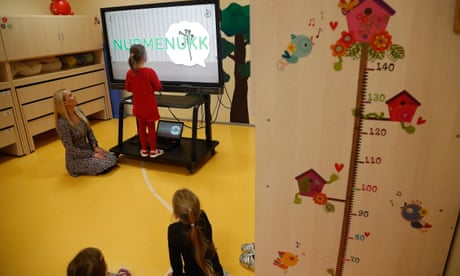


‘It’s not just childcare’: focus on early years education sets Estonia apart

Read more


The teachers use a mix of practises, says Agne Kosk, head of languages, who was leading the sci-fi course. “This generation want to express their opinion, they want to be included in the conversation, to know all sides of the issues. Teaching by regurgitating a textbook doesn’t work any more.” She says a good relationship with her students “is number one. If you don’t click with the students, it doesn’t matter what you do”. Estonia’s education system seems particularly geared up to nurturing that, from the informal and creative approach to the mostly happy teachers.

In her sci-fi class, there is clearly a great relationship – the students have created their own hashtag, written on the whiteboard, which translates as “Agne is cool”. Kosk asks them what notes they made when they watched the first part of Blade Runner, and this sparks a discussion about whether or not they’d fail an empathy test (which would mark them out as one of the film’s non-human replicants), what it means to be human and a bit about film history (is this, one of the students asks, one of the first films to have flying cars in it?). It’s time to watch some more. Lights down – the students fix their attention on the screen.

Saturday, January 04, 2025

A New Year's Reflection on Cecilia Ballí's NYTimes story on "Charro Days" and what "This Glorious Celebration Shows What Border Communities Can Be"

Friends:

Instead of the hideous, iron-gated wall along the U.S.-Mexico border championed by Trump and Texas' Governor Abbott—marked by violence, death, and tragedy for many seeking refuge from hardship and striving for a better life—let's envision a more positive and affirming approach to the U.S.-Mexico border. This is where art and the enduring beauty of cultural traditions come into play.

Journalist and cultural anthropologist Cecilia Ballí shares a beautiful story appearing in the New York Times about Brownsville's annually celebrated "Charro Days." A "charro" is a traditional Mexican horseman known for ornate attire, including fitted pants, intricately embroidered, fitted jacket, and a sombrero. Charros are known for "charreadas," or rodeo-like events that are Mexico's national sport. They're worth going to if you've never been to one.

As a side note, "charros" are analogous to, yet distinct from, "vaqueros," or "cowboys." It is important to recognize that vaqueros were the original cowboys of the American Southwest, predating the stereotypical image of the white, Marlboro-looking man popularized by Western films. Both charros and vaqueros are skilled horsemen and work with livestock, but charros are deeply intertwined with Mexican traditions, culture, and formal attire. 

Their role may extend beyond ranch work entirely such as through equestrian events and competitions.  In contrast, vaqueros were primarily members of the American working class of their time, with attire that was more functional than aesthetic. 

Not only do women participate in charrería, known as "escaramuzas"—together with silver threads and ornate sombreros, but the sport is gaining traction in the U.S. as you can learn from this CBS morning news story. A distinctive talent is riding sidesaddle and equally daunting and competitive "horesmanship" (or "horsewomanship"). Escaramuzas get scored on what they're wearing and may become rodeo queens. Check out this pertinent documentary titled, "Escaramuzas: The Elegant Tradition of the Mexican Charrería & Charreada."

Charrería dates back to the haciendas of the 1500s and is recognized by UNESCO as an "Intangible Cultural Heritage of Humanity." This designation acknowledges charrería not only as a sport but also as a rich cultural expression that reflects Mexico's history, values, and artistic heritage. 

A UNESCO designation further means that charrería has achieved international acclaim despite challenges like assimilation and urbanization, while simultaneously contributing to its preservation and ensuring its transmission to future generations as a powerful symbol of Mexican cultural identity. 

As beautifully recounted by Ballí, Brownsville's "Charro Days" is an annual fiesta, established in 1937, that celebrates the shared Mexican heritage of the border region.that U.S. assimilation policies have wanted us as U.S. Mexicans to ignore or somehow forget altogether. In the educational arena, I term this "subtractive cultural assimilation"—or simply, "subtractive schooling," to convey how priorities, policies, and practices have systematically sought to eviscerate our language, culture, and identities.

Thanks to the vision and leadership of Brownsville's business leaders, "Charro Days" defies subtractive cultural assimilation with its redemptive annual fiesta that began in 1937, celebrating a shared Mexican heritage across the border—a heritage U.S. assimilation policies have often pressured Mexican Americans to overlook. This year’s event, scheduled for February 20 to March 1, 2025, serves as a vibrant reminder of the power and beauty of cultural traditions. As Ballí’s account suggests, why should we ever stop celebrating something that not only fosters conviviality but also showcases the resilience and richness of our culture? 

The answer is clear. Transforming the border into a space of dialogue, connection, and aesthetic beauty empowers a community that state and national policies have historically sought to marginalize.

Finally, and most importantly, heartfelt thanks to Cecilia Ballí, whose work consistently reminds us of the transformative power of art, culture, and aesthetics. Through her storytelling, she demonstrates how, when guided by visionary leaders, these forces can heal divisions, uplift communities, and, indeed, save the world.

Happy New Years, everybody!

-Angela Valenzuela


This Glorious Celebration Shows What Border Communities Can Be


June 8, 2024 | New York Times


Thalía Gochez for The New York Times

By Cecilia Ballí | Photographs by Thalía Gochez

Ms. Ballí is a journalist and cultural anthropologist who is writing a book about competitive high school mariachis in South Texas. She wrote from Brownsville, Texas. Ms. Gochez is a Salvadoran Mexican American photographer based in Los Angeles.

The sky was muddy gray when I arrived at the Sams Memorial Stadium parking lot on a cool February afternoon. As soon as I parked, a school police officer appeared in a golf cart to rush me to the front of the parade line. I clambered aboard, one hand holding my large white Mexican sombrero rimmed with gold embroidered roses, the other scooping my thick, long skirt.

I was there for Charro Days, a festival that honors Mexican culture and our city’s intimate connection with Matamoros, Tamaulipas, across the border. As an alumna of the Brownsville school district, I’d been invited to serve as grand marshal of the children’s parade.

I felt regal dressed in a bright salmon pink traje de charro, a modified version of the traditional Mexican horseman outfit worn by mariachis and ranchera singers. As we whizzed by the century-old red brick buildings of my junior high campus, norteño music wafting from nearby speakers, my eyes welled up and I felt a lump in my throat.

via Cecilia Ballí

Every year, right around Lent, life slows down in my hometown, and for eight glorious days we celebrate Charro Days. The first time I took part in the festival was in 1983, when my twin sister and I danced in the children’s parade to “La Cacahuata,” a norteño folk song, with our schoolmates.

During this week, residents often show up to work or school dressed in traditional Mexican clothing. Some wear charro outfits — the costume from central Mexico most associated with national identity. Others dress as chiapanecas and china poblanas, jarochas and tehuanas, in the blouses and skirts typical of the south. And there are lots of tamaulipecas, the fringed suede jackets of Tamaulipas.

To outsiders, it may all seem like a caricature of Mexican culture, but for Brownsville natives this is a time when we get to take pride and joy in who we are, in a country where it sometimes feels difficult to do so.


In the coming months, as the presidential campaign gets in full swing, Americans will no doubt be bombarded with visions of a broken U.S.-Mexico border. (Just this week President Biden issued an executive order that temporarily blocks most migrants from seeking asylum.)

What will be missing are portraits of the beautiful border some of us know — a place of community, continuity and celebration.

I like to say the border begins in Brownsville, where President James K. Polk first provoked a war with Mexico.

In April 1846, after the U.S. annexation of Texas, Polk dispatched 4,000 soldiers into the Nueces Strip in South Texas, ordering a land and water blockade of Mexican troops and civilians. Mexico claimed the border ran along the Nueces River in Corpus Christi, while the United States insisted it was the Rio Grande, 150 miles to the south.

When Mexican forces crossed the Rio Grande attempting to break the blockade, Gen. Zachary Taylor sent a small force to meet them. The Mexican Army fired, killing 11 American troops. Polk then convinced some skeptical members of Congress that it was an invasion.


Charro Days fiesta in Brownsville, Texas, February 1942.Credit...Arthur Rothstein, via Library of Congress

The war ended two years later, with the Treaty of Guadalupe Hidalgo, which required Mexico to cede 55 percent of its territory to the United States. Soon surveyors began the task of demarcating the new border from the Gulf of Mexico to the Pacific Ocean, which was nearly 2,000 miles long.

Thus the U.S. Southwest was born, marking the beginning of American westward expansion.

As children, we didn’t learn much about our city’s pivotal role in the construction of our nation, but the repercussions of that history hung over us. Both sides of my family, the Ballís and the Hinojosas, had been in the region since the 1700s and once owned vast tracts of land that, as was true for most Mexican American families in the region, they lost over time to Anglo land grabbers. My paternal grandfather was raised in Texas but moved to Matamoros in the late 1910s, during a period of intense racial violence against Mexican Americans.

While the national boundary changed, the border remained fluid. My parents were born in Matamoros. After they married, they got jobs as seasonal farmworkers. Eventually they saved enough to build a home in Brownsville.

Even though a vast majority of students I went to school with in the 1980s were Mexican American, there was a strong pressure to assimilate. In first grade, my teacher gave me a C in English because I spoke too much Spanish with my friends.

On Sundays, we crossed the international bridge to visit our grandparents on their small ranch outside Matamoros, which had an outhouse and no running water. We ate tamales and celebrated Christmas there. At night, my grandmother lulled us to sleep with Mexican folk tales.


Mexican culture was the salve that helped blunt the pain of growing up in poverty and of my father’s eventual cancer diagnosis and premature death.

Living in Brownsville I was able to be both deeply Mexican and deeply American — and crossing the border showed me that it was possible to hold those two identities at once. I learned to shift between countries, cultures, societies and political systems, ultimately giving me a stronger sense of myself.

Charro Days was founded in 1938, the brainchild of a local white businessman who wanted to stimulate the economy during the Great Depression, draw tourists and cultivate civic pride. It eventually morphed into a four-day fiesta that included parades, street dances, fireworks, a carnival, a rodeo and motorboat races.

It soon captured the nation’s imagination. National Geographic wrote about it. Paramount and Universal showed reels of the event in theaters across the country. By the 1950s, radio and television networks were broadcasting some of the festivities from coast to coast.

Around the same time, the main parade began crossing over into Matamoros, which also held its own events. In 1954, the U.S. government began opening the Gateway International Bridge in downtown Brownsville, which connects the two cities, so revelers could cross back and forth freely during the festival.

But our binational ties would wear thin as the border became harder to cross.

Beginning in the early 1980s, hundreds of thousands of Salvadorans and Guatemalans fleeing civil wars poured into Brownsville and across other parts of the border. The Reagan administration responded by prosecuting religious activists who provided them safe harbor.

As world economies became more interconnected, the movement of people and goods across national borders increased. The attacks of Sept. 11, 2001, further changed the nature of border enforcement. The Department of Homeland Security was established in 2002; the Border Patrol eventually doubled in size.

In communities like Brownsville, these changes were felt intimately. Many residents stopped going to Matamoros, afraid of growing violence among Mexican drug cartels. With waits in customs lines to get into the United States now stretching for hours, many Matamoros residents also lost the incentive to come to Brownsville.


After my grandmother died in 2022, my family, too, lost our anchor across the border. So, when the school district invited me to participate in this year’s parade, it was a chance to reconnect with an older Brownsville that I missed.

I arrived in town a few days early to attend Fiesta Folklorica, an evening event where the children who will dance in the parade perform for their families. Dozens of little girls in elaborate costumes stomped on the wooden dance floor and swirled their colorful skirts furiously, like butterflies ready to fly.

That morning, the White House announced that Mr. Biden would be coming to Brownsville the same day as the children’s parade to underscore his policy wins. For a moment, we weren’t sure if his visit would interrupt our celebration. It’s a form of theater that border communities are familiar with: politicians visiting, flanked by border agents and cameras.

The record numbers of migrants and refugees are undeniable. In the 2023 fiscal year, which ended in September, Customs and Border Protection apprehended over 2.4 million people at the southwest border, many of them hoping to gain asylum.


Border communities are sandwiched between the issue, the politics surrounding it and the often misguided policies, which can prove unhelpful or even make the situation worse.

In the end, the children’s parade went on as planned. When I arrived at the meeting point that day, the young costumed dancers were lining up behind the car I would ride in. They were a picture of sheer beauty and joy, decked out in red lipstick with flowers and bows on their heads.

“I like your dress!” one little girl yelled, pointing at me. “You’re so pretty!” another one said. I laughed and asked if I could take their picture.

A mile away, the Rio Grande meandered languidly. On the grounds of the old Amigoland Mall, carnival operators added finishing touches to the mechanical rides that would begin receiving thousands of guests that evening.


My car lurched forward and what followed was a sweet, nostalgic blur. Spectators on metal folding chairs cheered. Children dressed as small charros and charras flashed toothy grins and waved. One little boy with a mustache penciled on his upper lip took off his cowboy hat, twirled it chivalrously and bowed.

All the while local, state and federal agents lurked at every street corner: hulky tactical vehicles and men in camouflage with radios, buzz cuts and bulletproof vests. It was emblematic of all the increased policing we’ve seen on the border.

A woman waved, and I realized it was Mrs. Gomez, my former kindergarten teacher. A couple of bandmates from high school called out my name.

But it was my mom, aunts and cousins who screamed the loudest when I passed by them in front of the old Majestic Theater. Fourteen blocks from where it started, the parade ended at the Gateway International Bridge — the bridge that had defined our lives.


As the festival wound to a close, I visited with Rosendo Escareño, the director of Charro Days Inc., the main organizer of the festival, and Henry LeVrier, the group’s board president. They described the simple satisfaction they get watching children enjoy themselves at the parades with their parents, as so many generations did before them. Every cycle builds the tradition. “It becomes a really huge memory for us,” Mr. Escareño said, “and that’s why we’re here, 87 years strong this year.”

While the country becomes increasingly divided over the border, during Charro Days, those of us from Brownsville have something that still brings us together. In one another’s waves along the parade route, in our approving gazes, we saw ourselves. We belonged to the same thing, the same place. A place called home.


Cecilia Ballí is a journalist and cultural anthropologist based in San Antonio. She is writing a book about competitive high school mariachis in South Texas.

Thalía Gochez is a photographer based in Los Angeles. The photographs of the Children’s Parade were taken during the Charro Days festival in Brownsville, Texas, this year.


The Times is committed to publishing a diversity of letters to the editor. We’d like to hear what you think about this or any of our articles. Here are some tips. And here’s our email: letters@nytimes.com.

Follow The New York Times Opinion section on Facebook, Instagram, TikTok, WhatsApp, X and Threads.

Wednesday, January 01, 2025

On the Uses and Abuses of Identity Politics: The philosopher Olúfẹ́mi O. Táíwò on the academy, the elite, and the future of politics

Friends:

Happy New Year! Wishing all a peaceful and blessed 2025. I'm happy to introduce you to philosopher Olúfẹ́mi O. Táíwò, author of Elite Capture: How the Powerful Took Over Identity Politics (and Everything Else). In this Chronicle of Higher Education piece, journalist Rebecca Tuhus-Dubrow interviews Philosophy professor Táíwò on identity politics.

The interview mentions where the phrase, "identity politics," originated. It emanates from a queer, Black feminist collective termed the "Combahee River Collective." I like how he defines identity politics, as being about...
"Who you are, where you stand in society, affects what you know, it affects what you want, it affects what you can do. Those are things worth self-consciously taking into account."
I refer you, as well, to an excellent Boston Review piece where Táíwò expresses his greatest concern about elites involving the (mis)use of identity politics:
"Identity politics is deployed by elites in the service of their own interests, rather than in the service of the vulnerable people they often claim to represent."

Both pieces ground their critique of identity politics in alignment with the intent behind the Combahee River Collective's use of the phrase. They viewed it as positive and desirable when marshaled in the context of coalitions to address common problems across difference. It was never about fostering group exclusivity where one identity group only works with others who look like, or identify with, them. 

In the Tuhus-Dubrow Chronicle interview, Táíwò suggests that virtuous political struggles focus on outcomes over process, meaning the attainment of concrete goals like, for example, forming a union. He then asks us to consider that "outcomes" can further include things like people in the struggle caring for each other more. I love this, however, it's confusing to me since I see caring, mutuality, and trustworthiness as optimally always both means and ends, instead of as either-or.

For Táíwò, elite capture is a kind of "system behavior," instead of a conspiracy. My only concern here is that any close reading of Nancy MacLean's Democracy in Chains, Jane Mayer's Dark Money: The Hidden History of the Billionaires Behind the Rise of the Radical Right, or, for that matter,
Project 2025: Mandate for Leadership, the Conservative Promise—that crystalizes the decades-long, neoliberal agenda investigated by MacLean and Mayer—we must consider that atop system dynamics are nefarious plans to de-democratize, corporatize, and privatize our institutions and society. 

Eyes wide open, my friends. These are mutually inclusive, right? There is a system with system behaviors happening in it, including systemic racism, classism, etc. together with the expression of elite preferences that cut across race and class "differences" among the elite. However, real politics are also always at play among and by elites (as well as non-elites) in the political and policy making arenas.

The interview is confusing to me in places, but is overall helpful in thinking about things like tokenism and paternalism to avoid in politics. 

To conclude, I have read and highly recommend Táíwò's excellent book, Elite Capture. Great for the college classroom.

-Angela Valenzuela


On the Uses and Abuses of Identity Politics: The philosopher Olúfẹ́mi O. Táíwò on the Academy, the elite, and the future of politics.


By Rebecca Tuhus-Dubrow | Chronicle of Higher Education
MAY 11, 2022


In the past few years, the Georgetown University philosopher Olúfẹ́mi O. Táíwò has gained notice for his lucid, subtle writing on such subjects as identity politics, climate change, reparations, and more. He first garnered broad attention with a 2020 essay for the British magazine The Philosopher that explored the limitations of “epistemic deference”: that is, calls “to ‘listen to the most affected’ or ‘centre the most marginalized.’”

In practice, Táíwò wrote, such calls often mean passing the mic to someone like him, because he is Black — even though he is also a tenure-track professor who grew up among the highly educated Nigerian diaspora. Amplifying certain voices on the basis of group membership, he argued, could serve as a merely cosmetic change, leaving structural problems unaddressed. What’s more, compulsory deference is no way to forge authentic relationships. “The same tactics of deference that insulate us from criticism,” he wrote, “also insulate us from connection and transformation.”

Now, building on that essay as well as a related piece in Boston Review, Táíwò has published a short book: Elite Capture: How the Powerful Took Over Identity Politics (and Everything Else). Elite capture, he explains, is a concept that emerged from the study of developing countries. It initially referred to the tendency of the upper class to gain control over foreign aid; in other words, the rich get richer. But the concept has also come to encompass the ways that elites appropriate political projects and monopolize attention.

Elite capture, Táíwò says, is “not a conspiracy” but rather “a kind of system behavior.” Systems are a major theme of the book, a theme Táíwò develops by drawing on the philosophy of games. Another motif is his impatience with the symbolic gestures and efforts to avoid “complicity” that have come to take precedence, in his view, over actual political outcomes.

Elite Capture incorporates sociology, history, and folklore; Táíwò finds pertinent lessons in sources ranging from “The Emperor’s New Clothes” to the Cape Verdean independence movement. For all his focus on the traps systems set for us, he holds out hope that we can recognize those traps and escape them. “Despite all our social programming, we can just do things,” he writes. “We can do the thing that will be punished; we can ignore the potential reward, choose the smaller prize.”

I spoke with Táíwò recently about deference politics, the gamification of contemporary life, and how he sees elite capture playing out in higher education.

Early in the book, you distinguish between the original intent of identity politics and the ways that it’s been distorted. You write that the term was popularized by the 1977 manifesto of the Combahee River Collective, a queer, Black, feminist, socialist organization, and “it was supposed to be about fostering solidarity and collaboration.”

So [the cofounder] Barbara Smith says that when the Combahee River Collective was theorizing around this idea of identity politics, what they were talking about was a kind of right to start somewhere. A right to take your own experiences seriously when you’re thinking about your agendas, your actions, your priorities. Also a sort of political origin, a starting point. You could start off by thinking about your priorities and still end up in coalition with other people, working in concert with other people, and collaborating. And they in fact did that.

But some people have takfen up identity politics in ways that are anti-coalitional in various ways. I don’t think the anti-coalitional impulse is very promising, politically speaking.

Monday, December 30, 2024

Introducing Dr. Siddhartha Mukherjee, Prize-Winning author of "The Emperor of All Maladies: A Biography of Cancer" and "The Song of the Cell"

Friends:

I am a great admirer of Dr. Siddhartha Mukherjee, the Pulitzer Prize–winning physician and author of several books, most notably "The Emperor of All Maladies: A Biography of Cancer." I highly recommend the audiobook version
. He needs no introduction in the field of oncology, meaning a focus on cancer prevention and treatment, but rather to those in my corner of the universe who might not yet be aware of this luminary.

What makes 
Mukherjee a rock star is that he is able to share his vast scientific knowledge and explorations about cells and cancer in language that is not only accessible but also very engaging. I appreciate how he intersperses history, storytelling, and classical literature into his accounts, showing how the liberal arts or humanities expand thought that we otherwise think of as "scientific" or "technical."

At the risk of sounding cheesy, I confess that reading 
The Emperor of All Maladies swept me off my feet.  His storytelling was so vivid and inspiring that, for fleeting moments, I found myself imagining a different life—one where I, too, might have pursued the path of a scientist with his blend of passion, brilliance, and the arts.

I caught myself fantasizing about what it might take to make such a career change now, captivated as I was by the beauty and purpose he brings to his meticulous pursuit of the science of healing. Somewhere, I read that he teaches his students to view each cell as a garden with its unique structure and singular beauty. Some, of course, get off the grid and cause harm. This is the stuff of greatness.

His latest book is "The Song of the Cell: An Exploration of Medicine and the New Human is the focus of this piece that came out a year ago in the Stanford Magazine. The story mentions how Mukherjee co-founded biotech ventures, advancing therapies like CAR-T in India to harness the immune system against cancer. His research is visionary and compassionate. I hope and trust that his explorations will ignite new generations of scientists equally desirous to unravel life's mysteries in ways so compelling and humane.

I hope that Dr. Mukherjee's research and writing are helpful to others as much as they've been to me. Happy New Year, everybody!

-Angela Valenzuela

Song of the Scientist

Photography by Bill Wadman | Dec. 2023 | Stanford Magazine

Begin at the beginning, inside a cell. That’s where the mystery starts. Float around in the protoplasm for a while, inspecting the nucleus, looking for broken cogs, rusty machinery. Squeeze through the membrane pores and inspect the surface proteins there. Cells tell stories if you look closely enough. If you know how to read them. 

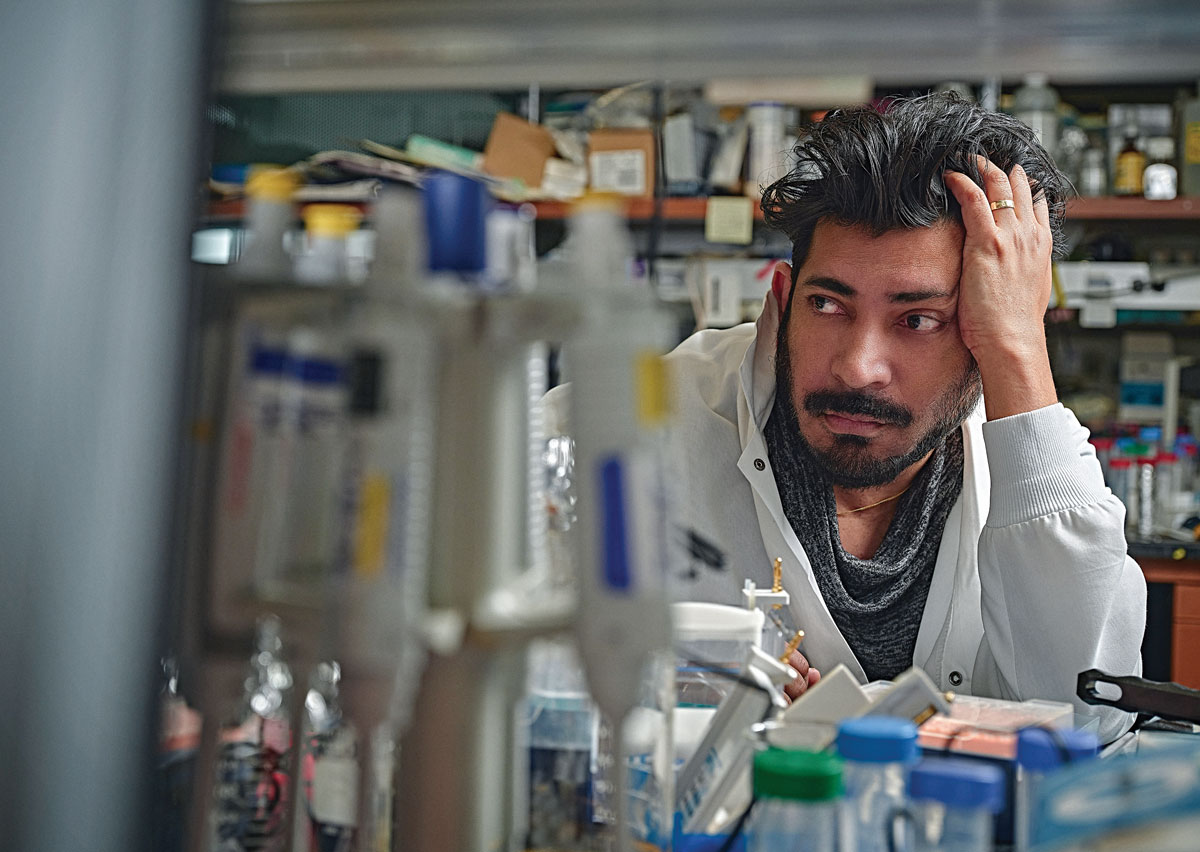
“Cells speak to me, especially blood cells,” says Siddhartha Mukherjee, ’93, the Pulitzer Prize–winning physician-author. He’s seated at a microscope in his Columbia University oncology lab on a snowy winter morning, peering inside white blood cells—immune cells designed to fight off infections—in a smear of bone marrow on a glass slide. Cancer can hijack these cells, destroying the body’s ability to fight infection. He describes these mornings in his latest book, The Song of the Cell. 

“On Monday, I arrive much earlier than my patients, when the morning light is still aslant across the black slate of the lab benches. I close the shutters and peer through the microscope at blood smears,” he writes. “The slides are like previews of books, or movie trailers. The cells will begin to reveal the stories of the patients even before I see them in person.”

Mukherjee, both a hematologist and an oncologist, transforms the stories hidden within our cells into massive, bestselling books that explore what it means to be human in a world where cells define all life. His three best-known titles journey first through the history of cancer, then genes, and finally cells, building metaphors and asking weighty questions about the foundations of science and where it is headed. Then he takes what he learns from his explorations in writing and returns to the laboratory with new ideas for treating patients. Those explorations, in turn, feed his work with four biotech start-ups he co-founded—three in the United States and one in India—that are developing therapies for leukemias and other blood cancers. 

“Sid thinks big and sees big,” says Atul Gawande, ’87, himself the author of four bestselling books on medicine, a surgeon, and a friend of Mukherjee’s. “He’s able to see the entire landscape of cancer, the gene, and then the cell, and then on and on. He’s driven by understanding at the molecular level what our lives are like as an organism, and even at the societal level. That’s how he makes sense of the world.” 

‘Sid thinks big and sees big. He’s able to see the entire landscape of cancer, the gene, and then the cell, and then on and on.’

From the microscope room, Mukherjee walks down a hall, past the lab’s work benches, into his office. The phone rings. It’s his wife, the sculptor Sarah Sze, calling from across town, where she’s installing an exhibit at the Guggenheim Museum, to remind him to pick up one of their daughters after school—they have two, ages 13 and 18. (In 2016, Vogue magazine ran a photo of Mukherjee and Sze in her New York studio under the headline “Meet the Most Brilliant Couple in Town.”) The pair were recruited together to Columbia in 2009, where Mukherjee is an assistant professor of medicine and Sze is a professor of visual arts. 

Mukherjee apologizes for his messy office, but it’s not messy, really, just a reflection of the many different directions his mind spins. Leaning back in his chair, he surveys the books and papers scattered across his desk, which is next to an overfilled bookshelf. History, medicine, science, literature—he quotes from across disciplines not only in his writing but also in his daily conversations. He has a particular fondness for the playwright Anton Chekhov, who, he likes to point out, was also a physician. “I read all the time,” he says. He reads in bed, at the kitchen table, in his lab, on planes. That’s how he writes, as well—whenever he gets a free moment. He nods toward what he calls “his famous red writing bed.” It’s a cot, now faded orange, covered with an old quilt. 

Mukherjee’s books, beginning with The Emperor of All Maladies, which tells a history of cancer and won the 2011 Pulitzer Prize for general nonfiction, are talked about in the scientific community “with some kind of awe,” says Irving Weissman, a Stanford professor of pathology and of developmental biology who is renowned for his stem cell research. The Gene, Mukherjee’s 2016 bestseller, charts the discovery of the basic unit of heredity, from Gregor Mendel’s wrinkled peas to the genetic engineering tool CRISPR. And The Song of the Cell, published in 2022, is a 496-page crash course in cellular biology—one that helps readers understand the significance of medicine’s cellular therapies and the promise they hold for treating anything, or maybe everything, that ails us.

Book jacket for The Emperor of All Maladies

What’s special about Mukherjee, Weissman says, is that he thinks deeply about the world of science and medicine and can translate that to the public. “Being creative in two fields and having the desire to try to help people with your creativity—well, I think that encapsulates Sid.” 

Life’s Work

Mukherjee was fascinated with cells early on. But then he was interested in so many things. Born in Delhi in 1970, he trained as a singer of Indian classical music, learned languages easily, and explored everything from science to poetry to art to philosophy. He remembers a biology teacher who talked about the big unanswered questions in the field, like how do your cells take on different functions, since they all contain the same DNA? How do they form an organism?

As an undergraduate at Stanford, he worked in the lab of Nobel laureate Paul Berg, famous for his recombinant DNA research that led to gene splicing and helped launch the biotech industry. He liked how Berg’s career brokered the worlds inside and outside the lab. “Paul was one of the global leaders in what is now the field of the ethics of genetics,” Mukherjee says. “I was very interested in ethics.” After graduating, he moved to England to attend Oxford University on a Rhodes scholarship, where he lived the life of a scientist, immersed in the world of immune cells, T-cells, and cell surface proteins. His PhD in immunology provided some of the keys to unlocking future therapies. To truly understand medical science, though, he believed he needed to learn from patients as well, so he moved to Boston, where he enrolled in medical school at Harvard. 

During an oncology fellowship at the Dana-Farber Cancer Institute in Boston, Mukherjee faced daily life-or-death decisions about patient treatments. That’s when he started keeping a journal, trying to make sense of so much suffering. The Emperor of All Maladies draws from those experiences—“an epic story that he seems compelled to tell, the way a passionate young priest might attempt a biography of Satan,” wrote Jonathan Weiner in a New York Times review of the book. 

“[As] I emerged from the strange desolation of those two fellowship years, the questions about the larger story of cancer emerged with urgency,” Mukherjee wrote in the book’s prologue. “How old is cancer? What are the roots of our battle against this disease? Or, as patients often asked me: Where are we in the ‘war’ on cancer? How did we get here? Is there an end? Can this war even be won?” Mukherjee spent five years reading scientific papers and history books, and interviewing physicians, scientists, and patients. Among his chapters are the stories of Atossa, the Persian queen whose Greek slave cut off her cancerous breast, and the primitive radiation and chemotherapy treatments of the early 20th century. 

“I was thinking, ‘Who is going to read 600 pages on cancer?’ ” Sze recalls. “ ‘It sounds like a real downer.’ ” She admits now that she couldn’t have been more wrong.

The book begins on May 21, 2004, just after Mukherjee’s patient Carla Reed was admitted to the cancer ward on the 14th floor of Massachusetts General Hospital. The 30-year-old kindergarten teacher and mother of three from Ipswich, Mass., was diagnosed as having acute lymphoblastic leukemia (ALL). ALL grows out of the bone marrow, where it produces white blood cells that don’t look normal under a microscope. Reed’s were broken cells, unable to fight off infections. And they would multiply quickly, crowding out the healthy blood-forming cells needed for life. “Leukemia is cancer of the white blood cells—cancer in one of its most explosive, violent incarnations,” Mukherjee wrote. “Its pace, its acuity, its breathtaking, inexorable arc of growth forces rapid, often drastic decisions; it is terrifying to experience, terrifying to observe, and terrifying to treat.”

That first day in the hospital, Mukherjee told Reed her chances of survival were 30 percent and that chemotherapy would begin immediately. He would infuse toxic chemicals into her body repeatedly over the coming months. She slept poorly, her hair fell out, she couldn’t eat. Treatment after treatment, lying on a table, she told Mukherjee she often wondered whether she would ever wake up. 

“Walking across the hospital in the morning to draw yet another bone marrow biopsy, with the wintry light crosshatching the rooms, I felt a certain dread descend on me,” Mukherjee wrote, “a heaviness that bordered on sympathy but never quite achieved it.” It wasn’t the first time he’d realized the need to create space for himself, separate from his patients. In 2002, he’d attended an exhibition at the Museum of Fine Arts, Boston, where he met the artist. They fell in love, and after their wedding in 2004, Sze remembers her new husband being overcome by worry for his patients. But she also remembers how, even then, he continued to think on a grand scale. Late one night, she joined him for dinner at the hospital cafeteria.

“Everyone was in scrubs, looking worn out,” Sze remembers. “We were having something like mac and cheese, I don’t know, it was all looking very grim. He told me: ‘There are two things I want to do. I either want to write a book about cancer or start a hospital in India.’ I thought, ‘Great, sweetheart, there goes your beeper.’ ”

Reed would fully recover, rejoining the life of her family. For Mukherjee, watching such transformations were among the most “sublime moments of my clinical life.” He set out to recapture that feeling again and again.

Family Stories

The Gene elevated public discussion about genetic research, just as The Emperor had done for cancer. “First the idea of the gene had to be invented. Then the physical entity, present in each cell of our bodies, in every living thing, had to be discovered,” wrote James Gleick in a New York Times review. “The story of this invention and this discovery has been told, piecemeal, in different ways, but never before with the scope and grandeur that Siddhartha Mukherjee brings to his new history.”

Book jacket for The Gene

In the story, Mukherjee writes of family distress and mental illness as he explores the intersections of biological inheritance and historical trauma, of genetics versus the environment. “Madness has been among the Mukherjees for generations,” he writes. In Delhi, he and his older sister grew up in a home that included their paternal grandmother and an uncle, her adult son, who had schizophrenia. Another of his uncles had bipolar disorder. Mental illness was seen as a family affliction. In the book, he recalls his grandmother, Priyabala, with reverence. “She weathered the buffets of heredity with something more than resilience: a grace that we, as her descendants, can only hope to emulate.” He dedicated The Gene to his grandmother and to Carrie Buck, a young woman forcibly sterilized in 1927 under Virginia’s eugenics law.

A few years later, Mukherjee turned his writerly attentions from the gene to the cell. It happened during the COVID-19 pandemic, when he was immersed in broken cells and surrounded by sickness, the ambulance sirens a constant wail outside his New York office window. He was desperate for a world of cohesion and symmetry, so he wrote about the need for balance within cells. He probed how human health depends on cellular connection, much like it does on human connection. And that brought to mind how much he had missed his family during his first year at Stanford, a story he tells in The Song of the Cell. 

Through exchanging letters with his dad, he learned more about the migration journey he’d taken. Sibeswar, known as Shibu, had fled his home in East Bengal (now Bangladesh) with his mother and four brothers just before the partition of India in 1947. The upheaval was one of the most violent in world history. “Partition was the big story [that] loomed on our lives for a long time,” Mukherjee says. “It was such a traumatic event.” Through the letters, Mukherjee began to understand how hard his father had worked to build a new sense of belonging in Delhi. In the winter of Mukherjee’s frosh year, Shibu sent him a plane ticket home to India, knowing his son would need comforting. “My father was there, as he would be year after year, when I returned, with a white shawl draped around himself, and an extra one to wrap around me,” Mukherjee writes.  “Coming back. Belonging.”

The Song of the Cell follows the history of scientific inquiry that eventually discovered life was built out of the microscopic units we call cells. Mukherjee’s narration keeps readers swimming through protoplasm, the living part of a cell, with its nucleus, cytoplasm, and organelles. Mukherjee discusses the ethical debates that have surrounded novel technologies such as in vitro fertilization, stem cell transplants, and gene cloning. And he explores the concerns surrounding modern-day advances in genetic manipulation, urging caution in the new world of CRISPR, a power­ful gene-editing technique that he and other scientists use in their labs but that also could be used in the creation of designer babies. 

“He’s very artful in telling stories that make you feel the humanity behind the science stories,” says Tyler Johnson, a Stanford clinical assistant professor of medicine in oncology and a science writer. “He’s able to demystify the inner workings of DNA and cellular metabolism in a way that is faithful to the science but comprehensible to people who are not scientists.”

Making Therapies

Mukherjee, dressed in a blue plaid suit and a black collarless shirt, with a gold ring on each hand, gets up out of his chair and strides through his office door, headed down the hall to the heart of his lab, the benchwork rooms with beakers and centrifuges and jeans-clad scientists growing cancer cells and creating therapies.

Mukherjee’s lab studies the biology of blood development in premalignant and malignant diseases such as myelodysplasia, which often advances to acute myelogenous leukemia (AML), a cancer characterized by an overproduction of immature blood cells that take over the bone marrow and pour into the bloodstream. About half a dozen projects in the lab aim to fight these diseases by using new gene-editing approaches such as base editing, which helps scientists more precisely target small, cancer-linked mutations. Most of the projects are focused on improving treatments for AML, the deadliest form of leukemia. 

Abdullah Mahmood Ali, an assistant professor of medical sciences at Columbia who collaborates with Mukherjee, updates him on the progress of an experimental therapy to treat AML—a variation on bone marrow transplants that protects healthy cells from the toxicity of treatments that can kill not only cancerous cells but also healthy ones. Using CRISPR, the scientists took blood stem cells from a bone marrow donor and tweaked the cell surface proteins, which communicate with other cells, to make them “invisible” to targeted immunotherapy. Think of it as an invisibility cloak, Ali explains. The therapy is undergoing human testing at Vor Bio in Boston, a biotech start-up that Mukherjee founded.

Mukherjee in the lab

‘My primary interest is human therapy. I like to make medicines. It’s the most exciting thing you could ever do.’

“My primary interest is human therapy,” Mukherjee says. “I like to make medicines. It’s the most exciting thing you could ever do.” When he’s in the clinic, Mukherjee treats the “sickest of the sick”—patients who have undergone chemotherapy and bone marrow transplants and still relapsed, says Azra Raza, a physician-scientist who researches blood cancers at Columbia. He then brings his motivation to cure them into the lab. “Someone like Sid comes around once in a generation,” Raza says. “He has an incredible mass of information in his head. He thinks quantum leaps ahead of other people.”

Returning Home

It’s late afternoon, and the light in Mukherjee’s office begins to fade. But Mukherjee is still thinking and talking and making plans. He talks about the art scene in New York City, visiting museums on weekends. He admits, a bit sheepishly, that he also has artistic talents. In fact, some of his obsessive doodling of molecules appears in his books. He grins. Sure, he’s obsessive about his work, but he loves his life outside the office. He and Sze throw elaborate dinner parties in their Manhattan apartment, for which he cooks. Sze describes how, when her husband likes a dish at a restaurant, he dissects it, smelling it, tasting it, talking to the chef if he can’t figure out how it was made—and then re-creates it at home. “It’s a good metaphor for how he looks at life,” Sze says. “He’s always kind of sniffing out good ideas. Always on the prowl for things to be cracked open and solved.” 

The family travels every year to New Delhi. Mukherjee’s father and grandmother have passed, but his mother still lives in the home where he grew up. He also makes regular trips to Bengaluru, where his start-up Immuneel Therapeutics treats leukemia patients who have relapsed with chimeric antigen receptor T-cell (CAR-T) therapy, an approach that uses the body’s own immune system to ambush cancer cells. CAR-T therapies have been available in the United States for about a decade, treating certain blood cancers—though not AML—at a cost of around $400,000 per patient, but weren’t available in India. The first clinical trial at Immuneel plans to include up to 24 pediatric and adult patients.

“This is the first child that we treated,” Mukherjee says. He’s looking at a photo of a 9-year-old boy in India attached to an IV bag. “This is me opening his therapy line,” Mukherjee says proudly. “He was very, very sick, close to dying.” One year out from his CAR-T therapy, his cancer was in remission. 

Again, Mukherjee’s cell phone starts ringing. When he hangs up, he’s strangely still. The constantly moving fingers, combing through his hair, twiddling pens, touching items on his desk, riffling papers, doodling, suddenly cease moving.

“I just heard about a friend who is dying,” he says. (Author and historian Patrick French died the next day in London.) Slouching low in his chair, Mukherjee discards his shoes, and rests his stockinged feet on the quilt-covered writing bed. He’s a great compartmentalizer, he says. That’s how he does so many things. But sometimes worlds collide, like this moment in this lab where he makes medicines and learns about a friend he can’t save. He looks at his feet resting on the cot, then touches the quilt, lovingly.

“It’s hand-blocked,” he says. “It’s special, from India, a work of art.” 


Tracie White is a senior writer at Stanford. Email her at traciew@stanford.edu.