Translate

Showing posts sorted by relevance for query Nazario. Sort by date Show all posts

Tuesday, November 25, 2014

Unaccompanied minors bring hope, past trauma to American schools

Unaccompanied minors bring hope, past trauma to American schools

By

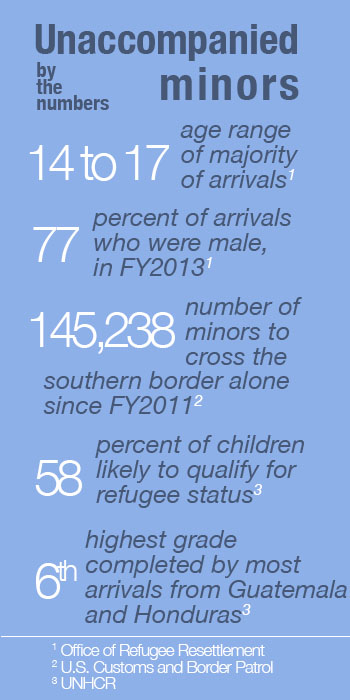
Brandon, who did not want to give his last name because of a pending deportation hearing, is one of 66,127 young people traveling alone who were caught on their way across the U.S.-Mexican border between Oct. 1, 2013 and Aug. 31, 2014.
In 2011, U.S. Customs and Border Patrol began to see a sharp rise in the number of unaccompanied children coming from Guatemala, Honduras and El Salvador. So far in fiscal year 2014, the number of unaccompanied minors caught on the southern border is more than triple the number apprehended in 2010.
Like most new arrivals, Brandon is a here for a complex web of reasons: to flee wanton violence, to escape grinding poverty, and to reunite with family living in the U.S.
Whatever their reasons for coming, the vast majority of the newly arrived children — both the ones the government caught on the way here and the unknown number who made it across without getting picked up by Border Patrol — are now attending the one American institution legally bound to serve them: public schools.
Arriving After Trauma
A majority, 58 percent, of the children arriving here have left war-like conditions that could qualify them for international protection as refugees, according to a recent report by the Office of the United Nations High Commissioner for Refugees, commonly known as UNHCR. The international agency recommends a thorough screening of each arriving minor to determine if he or she qualifies for that protection. Buffeted by shouting matches in Washington, D.C. and several state capitals, that process is underway.
In the meantime, schools across the country are enrolling large numbers of newly arrived Central American students and trying to figure out the best way to serve them.
Related: Q&A with Elizabeth Yelen: Traumatized children have trouble learning – here’s how to help
Many new arrivals have had little formal schooling. A majority stopped attending school after sixth grade, according to UNHCR. In addition to learning English and the subject matter of their various classes, they also must learn to raise their hands to answer questions, change classes when a bell rings and never wander the halls without a bathroom pass. And there are still those normal teenage concerns: remembering one’s locker combination and flirting, now in a new language.
Half of the 390 students at Oakland International High School have arrived in the U.S. from Central America in recent years. Many of them came without a parent or guardian. (Photo: Lillian Mongeau)
A full introduction to all of the requirements of attending school, along with continued support and understanding as students figure things out, will help with this massive shift, said Mary Beth Klotz, director of education practice at the National Association of School Psychologists. So will trauma-informed instruction that takes the new students’ background into account.
Even those who are here more for economic opportunities than out of fear have undertaken a long journey without parents before arriving in a foreign land. And teachers should keep in mind that students who have been here for quite a while still may not be fully settled in, Klotz said.
“There may be a honeymoon period where (students) are absorbing everything new and it may take a while to absorb it before behaviors come out that are concerning,” like tearing up a frustrating assignment or crying at the slightest provocation, Klotz said.
Both reactions are common for people who have survived trauma, Klotz said.
Klotz said she would urge teachers and other school staff to avoid rushing to judgment if a student has emotional problems after only a few weeks in a new country. “It’s really going to take time,” she said.
‘Cobbling Together Resources’
California received 4,680 children from detention centers between Jan. 1 and Aug. 31, 2014 according to the federal Office for Refugee Resettlement. (That gave California the third-largest number of children from detention centers, following New York, with 4,799 children, and Texas, with 6,217.) It’s impossible to calculate how many others have arrived without notifying officials.
Click to enlarge
Click to enlarge


Continue reading here.


Interpreting and reporting for this story were contributed by Jasmín López.
This story was written by The Hechinger Report, a nonprofit, independent news website focused on inequality and innovation in education. Read more about California education.

Tuesday, April 11, 2017

Solving Illegal Immigration [For Real] | Sonia Nazario | TEDxPennsylvani...


A must-see TedTalk presentation by Sonia Nazario titled,

Solving Illegal Immigration [For Real] | Sonia Nazario | TEDxPennsylvaniaAvenue

.  She's a hero of mine.

Angela

Wednesday, July 11, 2018

Do You Care About the Rule of Law? Then Act Like It, by Sonia Nazario, NYTimes July 11, 2018

This New York Times story by Pultizer prize-winning journalist and author of Enrique's Journey, Sonia Nazario, about our current border crisis, including the Adelanto Detention facility located n the Victor Valley area of the Mojave Desert in California.  After reading this excellent argument that the solutions aren't here on the border and that we should ourselves care about and implement the "Rule of Law" without with we are no different from brutal dictatorships, consider reading another NYTimes piece that came out a couple of weeks ago that explores alternatives to detention titled, "There’s a Better, Cheaper Way to Handle Immigration.  It spells out the regular, normalized abuse that families are experiencing in detention centers.  
This has been happening, my friends, for a long time.  Obama detained children with their parents, too!  However, the family case management program that Nazario mentions is an excellent, cost-effective alternative.  She also mentions two other ICE programs that actually work.
"ICE has two programs that use electronic ankle monitors, biometric voice-recognition software, unannounced home visits, telephone reporting and global positioning technologies to track people who have been released from detention while their cases are being heard, at a cost of 30 cents to $8.04 per person per day. In 2013, 96 percent of those enrolled appeared for their final court hearings, and 80 percent of those who did not qualify for asylum complied with their removal orders."
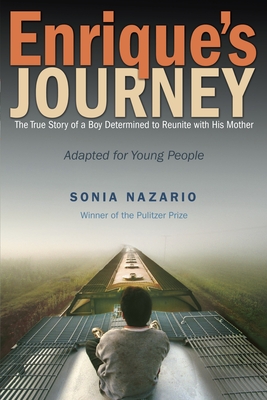
Unlike many in this debate, she has a deep understanding of the problem as her book Enrique's Journey that is a first-hand account of the treacherous journey from Central American to our borders indicates.  
To her excellent recommendations, I would only add that we need a Marshall Plan to re-build violence-ridden, economically-challenged Central American countries.  
This would be akin to what our country did for Europe in the wake of unprecedented devastation at the end of World War II.  It buoyed the emergence of the middle class in our own country as we were the only major power left standing.
I know that there are discussions, as well, like regional economic integration of those countries, but I'm not hearing any of this in the news right now, much less the advantages or disadvantages associated with the remedies that Nazario recommends.  Read on.
-Angela Valenzuela

Do You Care About the Rule of Law? Then Act Like It


By Sonia Nazario
Ms. Nazario writes about immigration and asylum.


ADELANTO, Calif. — Moisés Valentín, a pastor at the Christian and Missionary Alliance, and I drove two hours outside of Los Angeles, to the middle of nowhere, high in the Mojave Desert. There, surrounded by sage scrub brush and crowned in concertina wire, was the Adelanto Detention Facility, the nation’s largest prison for adult immigrants. Many of the people detained there are seeking asylum, running less toward the American dream than away from a Central American nightmare.
Pastor Valentín wasn’t there to save their souls. He goes twice a month to try to save them from the United States government, which is treating them with unspeakable cruelty in violation of its own laws.
Opponents of immigration have long had one rallying cry: rule of law! But most of the people seeking asylum at the Adelanto Detention Facility followed the law to a T. They presented themselves at ports of entry on our southern border and asked for asylum. The Trump administration seems to be using every tactic possible to prevent them from gaining that asylum, even if they clearly qualify.
This spring Attorney General Jeff Sessions told immigration judges that they must rule on at least 700 cases a year. There’s no way they can realistically consider the evidence and still meet that quota; it’s much faster to just reject people’s claims. Then last month Mr. Sessions announced that domestic and gang violence — the most common reasons for fleeing Central America — would generally no longer qualify someone for asylum.
The Trump administration is not just changing the rules; it’s making a mockery of them.
It is illegal to bar people seeking asylum from our ports of entry, but we have effectively done just that. It is illegal to penalize asylum seekers, but we have criminally prosecuted them for “illegal” entry and violated their rights to due process by taking away their children. Last week, a federal court in Washington ruled that the Trump administration can’t indefinitely lock up asylum seekers who are awaiting a court hearing — but we are continuing to do the same thing to thousands of others.
Instead of supporting people running from harm, we have built a machine designed to psychologically break them in the hopes that they will give up and go home.
This gutting of our asylum system has been going on for some time. In the immigration courts, which decide asylum cases for people who are caught or turn themselves in at the border, 45 percent of applicants were rejected in the 2012 fiscal year. In 2017, asylum denials jumped to 62 percent.
The result? People are being sent back to danger, even to their deaths. Before we let the Trump administration tighten the screws even further, we need to ask ourselves: Do we want this done in our name? Are we willing to trash our own laws in order to try to seal the border?
At Adelanto, Pastor Valentín and I met with Mayra Lucrecia Arriola Hurtarte, a 29-year-old woman from Guatemala. She has been in detention for three and a half months, after applying for asylum as a victim of domestic violence.

“My husband tortured me,” she said simply. She said he regularly choked her until she passed out. He would cut himself and make her drink his blood. She showed me the fingers he had broken. She raised her blue uniform to reveal two letters — the first two of his name — that her husband had carved into her belly.
It got worse. She said he stuffed his hand up her vagina, saying he was trying to pull her womb out. Another time he held her down and rammed a knife up her vagina.

That’s when she left him. She moved 15 times in a year, but he always found her. She called the police on him more than a dozen times, but they said: “Those are private matters. We can do nothing.” After her husband tried to run her over with his car, the officer in charge of her case frankly advised her, “You should leave the country.”  So she did. And when she presented herself at the San Ysidro, Calif., port of entry to ask for safety, she said, the Border Patrol agent sneered. “Why are you leaving your husband? There’s no asylum for that!”We also spoke with Irma Carillo Gregorio, 25, who fled Guatemala with her husband, Antonio Ramos, and their 3-year-old daughter, Karla Sofia Ramos. Someone was calling their phone, threatening to exterminate their entire family if they didn’t pay him $400 in extortion money every month. They changed the number, but the calls continued. They grew potatoes on a small plot of land; they didn’t have the money.

The family fled through Mexico, where they were stopped by police officers and separated. Ms. Carillo made it alone to the San Ysidro port of entry on May 20 and asked officials: Can you help me find my family? She answered yes when asked if she wanted asylum.

When she arrived at Adelanto on June 1, she learned that her husband had entered at San Ysidro five days earlier, and that officers there had torn Karla Sofia away from him. She cried as she explained how it took nearly two months to learn that her daughter was in a foster home in Texas.
She just spoke to her for the first time last week, and was allowed to talk for two minutes.
“Who are you?” the little girl asked.
“I am your mother!” she said.
The girl started sobbing and couldn’t speak for the rest of the call.
These women are living in hell, but they have, at the very least, a chance to make their case for asylum. More and more migrants are being denied that. Instead, our government is chanting Melania’s motto: “I really don’t care.”
Some emboldened Border Patrol agents are turning away people outright. Sorry, they say, the United States is full, try again later. Or, we don’t give asylum any more.
For two weeks, in 105- to 107-degree heat, around 100 migrants, including children, have been waiting in Nogales, Mexico, across the Arizona border, where a measly three families are processed a day, said Joanna Williams, the director of education and advocacy for the Kino Border Initiative. The wait to cross into California is even longer — up to a month. There are encampments in Tijuana with more than 1,000 families waiting to be processed.
This is treacherous turf on which to hang out. One of the biggest revenue streams for Mexico’s cartels is kidnapping people, including thousands of Central Americans, each year. They demand ransoms, prostitute girls, enslave boys. In Reynosa, Ms. Williams said, these cartels are systematically stalking migrants who have been turned away from the border.

Her group aided one 49-year-old man who had been kidnapped, raped and tortured by the Sinaloa cartel. After his family paid $1,200 in ransom, his tormentors released him by the border with a message: If we see you again, you’re dead. But when he told Border Patrol agents, “My life is in danger,” Ms. Williams says they laughed at him, processed him for illegal re-entry and booted him back to Mexico.

It is a violation of America’s immigration laws to turn away someone who says he is in danger without providing access to a credible fear interview or a reasonable fear interview — the first step on the path to asylum or protection.
Ms. Williams also reported that a 43-year-old Mexican woman, who showed Border Patrol agents documents attesting to the fact that her brother’s kidnappers had left his body parts strewn on her patio and were now stalking her, was turned back five times without being given a credible-fear interview.
When asked to respond, a representative of the Border Patrol said, “No one is being denied the opportunity to make a claim of credible fear or seek asylum,” and that sometimes agents are forced to limit access because the port of entry is at capacity or detention space isn’t available.
Say you aren’t simply turned away; you may still be pressured not to follow through with a credible-fear interview. According to Lindsay Toczylowski, the executive director of the Immigrant Defenders Law Center, which represents migrants in Adelanto, immigration officials “are using kids as hostages to get people to give up their claims.”
They take the children, and then tell the parents that if they agree to deport on their own, “you can see your kid at the airport,” Ms. Toczylowski said. “But if you choose to seek asylum, we will hold you for months; we don’t know when you will see your child.”
Say you stick to your guns and get that credible-fear interview; you’ll still probably fail. Late last month, Kids in Need of Defense, a nonprofit on whose board I serve, rushed a team of lawyers to the Port Isabel Service Processing Center in Texas, which was thought to have the largest number of women separated from their children at the border. It tracked 26 credible-fear interviews conducted there. Two-thirds failed, including that of a Honduran woman who was assaulted and threatened for being a political activist, a case that in the past would have been a slam dunk.

Five years ago, nine in 10 asylum seekers were released during their court hearings, often with an ankle monitor, but now nine in 10 are held indefinitely in horrible places. The point is to push people to the breaking point so they’ll give up their legal rights.
Adelanto is one of the deadliest immigration prisons in the United States. Three people perished there in a three-month period last year. According to Michael Kaufman, a lawyer with the American Civil Liberties Union of Southern California, medical care at Adelanto suffers because the company that owns it, the GEO Group, cuts corners to save money. Women there told me there are maggots and mold in the food sometimes. The prison pays $1 for a day of work cleaning or in the kitchen.
GEO disputed what it called “baseless allegations,” and said detainees work voluntarily and are paid according to guidelines set by Congress. Immigration and Customs Enforcement said that it provides timely access to medical treatment for all detainees.
Occasionally detainees crack under the strain: Last year at Adelanto, a Haitian woman tried to hang herself and a Russian woman tried to kill herself using nail cutters. Adelanto, like most immigration prisons, is so isolated that most detainees don’t have a lawyer. Nine in 10 asylum seekers with no lawyer lose; nearly half with a lawyer win.
Despite all this, what they have fled is so terrifying that many are willing to stick it out at Adelanto for months or years.

These are the people we created the asylum and refugee systems for. After World War II, Americans faced a moral reckoning. We had refused to allow a ship of 900 Jewish refugees to dock at our shores, sending it back to Europe, where more than 250 died in the Holocaust. We ignored a proposal to let 20,000 Jewish children come here. Americans swore: never again. We would not stand by as people died, when we and other countries could help them.

We spearheaded the drafting of the 1951 Refugee Convention and signed on to the 1967 Refugee Protocol. Under Article 33 of the convention, countries agreed not to turn people back to persecution if they had well-founded fears. Article 31 prohibits penalizing undocumented asylum seekers who promptly present themselves to the authorities “and show good cause for their illegal entry or presence.” Both provisions are enshrined in our immigration laws.
Of course, it was easier to be righteous when we had fewer people knocking at our door. While the Trump administration informally or illegally blocks asylum seekers, it has also slashed the number of refugees it accepts.
In early July, Dara Lind of Vox reported on new draft regulations by Mr. Sessions. Anyone who spends more than two weeks traveling through Mexico would be ineligible for asylum in the United States, and would be pushed to apply in Mexico. This is a joke on multiple levels.
The average journey through Mexico takes a month, and people are being forced to wait weeks at many ports of entry, so this move would conveniently disqualify most migrants. Then there’s the idea that Mexico is a safe country capable of granting asylum, when last year was its deadliest ever, with 30,000 murders and more than 22,000 Mexicans themselves seeking asylum in the United States. The agency charged with processing asylum claims in Mexico decided only 30 percent of the claims it received in 2017.
My family spent a century fleeing persecution. My father’s family was persecuted in Syria for being Christian and left for Argentina in the 1920s. My Jewish mother fled Poland as a young girl for Argentina; her relatives who didn’t leave were murdered in Auschwitz. I was a teenager in Argentina during the “dirty war,” when the military “disappeared” up to 30,000 people. A close relative was tortured and held in jail for nearly a year. The military killed a good friend, 16 years old, broke all the bones in his face. My mother and I burned our books in the backyard; even “Alice in Wonderland” could make you a target.
I understand what can drive people to risk everything — even the separation of their families — to escape. As Ms. Williams put it: “Families tell me, ‘If we are in our hometown in Mexico, the cartel will rip our kids out of our arms. Here the U.S. government will do it.’”
Or, as Nataly Rivas Escamilla, a 20-year-old asylum seeker from El Salvador told me at Adelanto, “I prefer to be here, locked up, than dead in my country.”

Desperate people can’t be deterred.

Don’t get me wrong; I oppose open borders. What we should do is let asylum seekers cross our borders and then release them — under supervision, monitored by case workers or even ankle bracelets — while their claims are being processed. That’s what the Trump administration was forced to do Tuesday for some migrant families, when a judge orderedthe first round of reunifications of separated parents and young children. If asylum seekers’ claims are rejected, they should be deported. In other words: be openhearted on the front end, giving people a real chance at safety if they need it, and be tougher on the back end. That’s a lot more humane and effective than the current insanity we are engaged in. It also hews to the cry of “Rule of law!”

In the first nine months of this fiscal year, 68,560 families and 37,450 unaccompanied children were apprehended at our southern border. That’s not a “flood.” It’s one football stadium of people. We can afford that level of compassion in this country.

And we don’t even have to depend on compassion, because we have laws — laws that govern the seeking and granting of asylum. The Trump administration is demanding that immigrants follow the law. The least Americans can do is demand the same thing of their government.

You are either for the rule of law, or you’re against it.

Sonia Nazario, the Pulitzer Prize-winning author of “Enrique’s Journey: The Story of a Boy’s Dangerous Odyssey to Reunite With His Mother,” is a board member of Kids in Need of Defense and a contributing opinion writer.
Wednesday, July 16, 2014

A Refugee Crisis, Not an Immigration Crisis

Excellent reporting by Sonia Nazario. Quotes from within:

"The drugs that pass through Honduras each year are worth more than the country’s entire gross domestic product. Narcos have bought off police officers, politicians and judges. In recent years, four out of five homicides were never investigated. No one is immune to the carnage. Several Honduran mayors have been killed. The sons of both the former head of the police department and the head of the national university were murdered, the latter, an investigation showed, by the police."....TO permanently stem this flow of children, we must address the complex root causes of violence in Honduras, as well as the demand for illegal drugs in the United States that is fueling that violence.
In the meantime, however, we must recognize this as a refugee crisis, as the United Nations just recommended. These children are facing threats similar to the forceful conscription of child soldiers by warlords in Sudan or during the civil war in Bosnia. Being forced to sell drugs by narcos is no different from being forced into military service.

Many Americans, myself included, believe in deporting unlawful immigrants, but see a different imperative with refugees.

The United States should immediately create emergency refugee centers inside our borders, tent cities — operated by the United Nations and other relief groups like the International Rescue Committee — where immigrant children could be held for 60 to 90 days instead of being released. The government would post immigration judges at these centers and adjudicate children’s cases there."

This is not at all "Obama's Katrina." It is his "Mariel boatlift," an exodus of people, children and adults—who like their earlier Cuban counterparts—cannot go home. http://en.wikipedia.org/wiki/Mariel_Boatlift    Sending these 52,000 children who have been in the U.S. since October is, I'm convinced, a death sentence. 

-Angela

The Children of the Drug Wars

A Refugee Crisis, Not an Immigration Crisis


Photo

Credit Edel Rodriguez
CRISTIAN OMAR REYES, an 11-year-old sixth grader in the neighborhood of Nueva Suyapa, on the outskirts of Tegucigalpa, tells me he has to get out of Honduras soon — “no matter what.”
In March, his father was robbed and murdered by gangs while working as a security guard protecting a pastry truck. His mother used the life insurance payout to hire a smuggler to take her to Florida. She promised to send for him quickly, but she has not.
Three people he knows were murdered this year. Four others were gunned down on a nearby corner in the span of two weeks at the beginning of this year. A girl his age resisted being robbed of $5. She was clubbed over the head and dragged off by two men who cut a hole in her throat, stuffed her panties in it, and left her body in a ravine across the street from Cristian’s house.
“I’m going this year,” he tells me.


I last went to Nueva Suyapa in 2003, to write about another boy, Luis Enrique Motiño Pineda, who had grown up there and left to find his mother in the United States. Children from Central America have been making that journey, often without their parents, for two decades. But lately something has changed, and the predictable flow has turned into an exodus. Three years ago, about 6,800 children were detained by United States immigration authorities and placed in federal custody; this year, as many as 90,000 children are expected to be picked up. Around a quarter come from Honduras — more than from anywhere else.

Photo

Cristian Omar Reyes, 11, wants to get out of Honduras “no matter what.” Credit Sonia Nazario

Children still leave Honduras to reunite with a parent, or for better educational and economic opportunities. But, as I learned when I returned to Nueva Suyapa last month, a vast majority of child migrants are fleeing not poverty, but violence. As a result, what the United States is seeing on its borders now is not an immigration crisis. It is a refugee crisis.
Gangs arrived in force in Honduras in the 1990s, as 18th Street and Mara Salvatrucha members were deported in large numbers from Los Angeles to Central America, joining homegrown groups like Los Puchos. But the dominance in the past few years of foreign drug cartels in Honduras, especially ones from Mexico, has increased the reach and viciousness of the violence. As the United States and Colombia spent billions of dollars to disrupt the movement of drugs up the Caribbean corridor, traffickers rerouted inland through Honduras, and 79 percent of cocaine-smuggling flights bound for the United States now pass through there.
Narco groups and gangs are vying for control over this turf, neighborhood by neighborhood, to gain more foot soldiers for drug sales and distribution, expand their customer base, and make money through extortion in a country left with an especially weak, corrupt government following a 2009 coup.
Enrique’s 33-year-old sister, Belky, who still lives in Nueva Suyapa, says children began leaving en masse for the United States three years ago. That was around the time that the narcos started putting serious pressure on kids to work for them. At Cristian’s school, older students working with the cartels push drugs on the younger ones — some as young as 6. If they agree, children are recruited to serve as lookouts, make deliveries in backpacks, rob people and extort businesses. They are given food, shoes and money in return. Later, they might work as traffickers or hit men.
Teachers at Cristian’s school described a 12-year-old who demanded that the school release three students one day to help him distribute crack cocaine; he brandished a pistol and threatened to kill a teacher when she tried to question him.
At Nueva Suyapa’s only public high school, narcos “recruit inside the school,” says Yadira Sauceda, a counselor there. Until he was killed a few weeks ago, a 23-year-old “student” controlled the school. Each day, he was checked by security at the door, then had someone sneak his gun to him over the school wall. Five students, mostly 12- and 13-year-olds, tearfully told Ms. Sauceda that the man had ordered them to use and distribute drugs or he would kill their parents. By March, one month into the new school year, 67 of 450 students had left the school.
Teachers must pay a “war tax” to teach in certain neighborhoods, and students must pay to attend.
Carlos Baquedano Sánchez, a slender 14-year-old with hair sticking straight up, explained how hard it was to stay away from the cartels. He lives in a shack made of corrugated tin in a neighborhood in Nueva Suyapa called El Infiernito — Little Hell — and usually doesn’t have anything to eat one out of every three days. He started working in a dump when he was 7, picking out iron or copper to recycle, for $1 or $2 a day. But bigger boys often beat him to steal his haul, and he quit a year ago when an older man nearly killed him for a coveted car-engine piston. Now he sells scrap wood.
But all of this was nothing, he says, compared to the relentless pressure to join narco gangs and the constant danger they have brought to his life. When he was 9, he barely escaped from two narcos who were trying to rape him, while terrified neighbors looked on. When he was 10, he was pressured to try marijuana and crack. “You’ll feel better. Like you are in the clouds,” a teenager working with a gang told him. But he resisted.
He has known eight people who were murdered and seen three killed right in front of him. He saw a man shot three years ago and still remembers the plums the man was holding rolling down the street, coated in blood. Recently he witnessed two teenage hit men shooting a pair of brothers for refusing to hand over the keys and title to their motorcycle. Carlos hit the dirt and prayed. The killers calmly walked down the street. Carlos shrugs. “Now seeing someone dead is nothing.”
He longs to be an engineer or mechanic, but he quit school after sixth grade, too poor and too afraid to attend. “A lot of kids know what can happen in school. So they leave.”
He wants to go to the United States, even though he knows how dangerous the journey can be; a man in his neighborhood lost both legs after falling off the top of a Mexican freight train, and a family friend drowned in the Rio Grande. “I want to avoid drugs and death. The government can’t pull up its pants and help people,” he says angrily. “My country has lost its way.”
Girls face particular dangers — one reason around 40 percent of children who arrived in the United States this year were girls, compared with 27 percent in the past. Recently three girls were raped and killed in Nueva Suyapa, one only 8 years old. Two 15-year-olds were abducted and raped. The kidnappers told them that if they didn’t get in the car they would kill their entire families. Some parents no longer let their girls go to school for fear of their being kidnapped, says Luis López, an educator with Asociación Compartir, a nonprofit in Nueva Suyapa.
Milagro Noemi Martínez, a petite 19-year-old with clear green eyes, has been told repeatedly by narcos that she would be theirs — or end up dead. Last summer, she made her first attempt to reach the United States. “Here there is only evil,” she says. “It’s better to leave than have them kill me here.” She headed north with her 21-year-old sister, a friend who had also been threatened, and $170 among them. But she was stopped and deported from Mexico. Now back in Nueva Suyapa, she stays locked inside her mother’s house. “I hope God protects me. I am afraid to step outside.” Last year, she says, six minors, as young as 15, were killed in her neighborhood. Some were hacked apart. She plans to try the journey again soon. Asking for help from the police or the government is not an option in what some consider a failed state. The drugs that pass through Honduras each year are worth more than the country’s entire gross domestic product. Narcos have bought off police officers, politicians and judges. In recent years, four out of five homicides were never investigated. No one is immune to the carnage. Several Honduran mayors have been killed. The sons of both the former head of the police department and the head of the national university were murdered, the latter, an investigation showed, by the police.

Photo

Carlos Baquedano Sánchez and his mother, Lovena Lidibeth Baquedano Sánchez, in their home in Nueva Suyapa, Honduras. Carlos is determined to leave. Credit Sonia Nazario

“You never call the cops. The cops themselves will retaliate and kill you,” says Henry Carías Aguilar, a pastor in Nueva Suyapa. A majority of small businesses in Nueva Suyapa have shuttered because of extortion demands, while churches have doubled in number in the past decade, as people pray for salvation from what they see as the plague predicted in the Bible. Taxis and homes have signs on them asking God for mercy.
The United Nations High Commissioner for Refugees recently interviewed 404 children who had arrived in the United States from Honduras, El Salvador, Guatemala and Mexico; 58 percent said their primary reason for leaving was violence. (A similar survey in 2006, of Central American children coming into Mexico, found that only 13 percent were fleeing violence.) They aren’t just going to the United States: Less conflicted countries in Central America had a 712 percent increase in asylum claims between 2008 and 2013.
“If a house is burning, people will jump out the window,” says Michelle Brané, director of the migrant rights and justice program at the Women’s Refugee Commission.

TO permanently stem this flow of children, we must address the complex root causes of violence in Honduras, as well as the demand for illegal drugs in the United States that is fueling that violence.


In the meantime, however, we must recognize this as a refugee crisis, as the United Nations just recommended. These children are facing threats similar to the forceful conscription of child soldiers by warlords in Sudan or during the civil war in Bosnia. Being forced to sell drugs by narcos is no different from being forced into military service.
Many Americans, myself included, believe in deporting unlawful immigrants, but see a different imperative with refugees.
The United States should immediately create emergency refugee centers inside our borders, tent cities — operated by the United Nations and other relief groups like the International Rescue Committee — where immigrant children could be held for 60 to 90 days instead of being released. The government would post immigration judges at these centers and adjudicate children’s cases there.
To ensure this isn’t a sham process, asylum officers and judges must be trained in child-sensitive interviewing techniques to help elicit information from fearful, traumatized youngsters. All children must also be represented by a volunteer or government-funded lawyer. Kids in Need of Defense, a nonprofit that recruits pro bono lawyers to represent immigrant children and whose board I serve on, estimates that 40 percent to 60 percent of these children potentially qualify to stay under current immigration laws — and do, if they have a lawyer by their side. The vast majority do not. The only way to ensure we are not hurtling children back to circumstances that could cost them their lives is by providing them with real due process.
Judges, who currently deny seven in 10 applications for asylum by people who are in deportation proceedings, must better understand the conditions these children are facing. They should be more open to considering relief for those fleeing gang recruitment or threats by criminal organizations when they come from countries like Honduras that are clearly unwilling or unable to protect them.
If many children don’t meet strict asylum criteria but face significant dangers if they return, the United States should consider allowing them to stay using humanitarian parole procedures we have employed in the past, for Cambodians and Haitians. It may be possible to transfer children and resettle them in other safe countries willing to share the burden. We should also make it easier for children to apply as refugees when they are still in Central America, as we have done for people in Iraq, Cuba, countries in the former Soviet Union, Vietnam and Haiti. Those who showed a well-founded fear of persecution wouldn’t have to make the perilous journey north alone.
Of course, many migrant children come for economic reasons, and not because they fear for their lives. In those cases, they should quickly be deported if they have at least one parent in their country of origin. By deporting them directly from the refugee centers, the United States would discourage future non-refugees by showing that immigrants cannot be caught and released, and then avoid deportation by ignoring court orders to attend immigration hearings.
 
Instead of advocating such a humane, practical approach, the Obama administration wants to intercept and return children en route. On Tuesday the president asked for $3.7 billion in emergency funding. Some money would be spent on new detention facilities and more immigration judges, but the main goal seems to be to strengthen border control and speed up deportations. He also asked Congress to grant powers that could eliminate legal protections for children from Central America in order to expedite removals, a change that Republicans in Congress have also advocated.
This would allow life-or-death decisions to be made within hours by Homeland Security officials, even though studies have shown that border patrol agents fail to adequately screen Mexican children to see if they are being sexually exploited by traffickers or fear persecution, as the agents are supposed to do. Why would they start asking Central American children key questions needed to prove refugee status?
The United States expects other countries to take in hundreds of thousands of refugees on humanitarian grounds. Countries neighboring Syria have absorbed nearly 3 million people. Jordan has accepted in two days what the United States has received in an entire month during the height of this immigration flow — more than 9,000 children in May. The United States should also increase to pre-9/11 levels the number of refugees we accept to 90,000 from the current 70,000 per year and, unlike in recent years, actually admit that many.
By sending these children away, “you are handing them a death sentence,” says José Arnulfo Ochoa Ochoa, an expert in Honduras with World Vision International, a Christian humanitarian aid group. This abrogates international conventions we have signed and undermines our credibility as a humane country. It would be a disgrace if this wealthy nation turned its back on the 52,000 children who have arrived since October, many of them legitimate refugees.
This is not how a great nation treats children. 

Sonia Nazario is the author of “Enrique’s Journey: The Story of a Boy’s Dangerous Odyssey to Reunite With His Mother.”