***URGENT. PLEASE DISTRIBUTE WIDELY***
To ALL Texans:
PLEASE HEED THIS WARNING. AS MUCH AS IT HURTS, PLEASE DO NOT GO TO CHURCH, SYNAGOGUE, MOSQUE, TEMPLE OR ANY PLACE OF WORSHIP ON EASTER SUNDAY.
church, mass, synagogue, cathedral, chapel, shrine, temple, or any other place of worship
God gave us good science and scientists, so much so that they are sounding this alarm. Specifically, University of Texas researchers, Emily Javan, Dr. Spencer J. Fox, and Dr. Lauren Ancel Meyers, are desperate to make us aware that the presence of a single case of COVID in your small town or community is noteworthy.
"Using a model developed during the Zika outbreak, the study relied on recent virus data from counties across the country. The implication for states like Texas—where testing is limited, medical supplies scarce, and many counties have few or no confirmed coronavirus cases—is alarming."It's not that our scientists do not value or respect you or your beliefs. They have posted their work online because of the urgency of the situation. No one is questioning anyone's faith or devotion. It's that they really care for us all and feel ethically bound to let us all know what we're facing. We're truly all in this together. Forewarned is forearmed. If you have any questions or concerns, I'm sure that you can reach out to Dr. Meyers directly at LaurenMeyers@austin.utexas.edu
As much as humanly possible, let's let this virus, this Angel of Death, pass over us on passover and beyond.
-Angela Valenzuela
#StayHome #SocialDistancing #Covid—19 #Covid #Texas #Coronavirus
COVID-19 May Be Silently Spreading Across Rural Counties, University of Texas Researchers Believe
A new study suggests that even in communities with few confirmed cases, the coronavirus could be spreading much more quickly than people realize.
April 8, 2020
PETER HOLLEY | TEXAS MONTHLY

Looking at a map of Texas coronavirus cases, there might be a tendency to assume that large swaths of the state, most of them rural and conservative, have mostly been spared from the outbreak.
The big clusters of illness, after all—the ones immediately threatening to overwhelm hospitals and turn grocery shopping into a life or death choice—are in cities like Dallas, Houston, Austin, and San Antonio. Ninety-three Texas counties officially remain, at least per confirmed tests, coronavirus-free, and 28 others have reported only a single case.
That thinking influenced officials like Governor Greg Abbott, who finally issued a stay-at-home order last week after Texas reported 3,266 confirmed cases and the number of cases was increasing by the hundreds across multiple major metropolitan areas.
Abbott had argued that he was protecting the economies and livelihoods of counties without coronavirus cases from shutdown until the data indicated it was necessary. But a new study from researchers at the University of Texas at Austin casts serious doubt on the wisdom of a wait-and-see approach to containment, and underscores how severe the problem could be in rural counties. The study’s authors suggest that U.S. counties with only a few cases or none at all may still have “sustained community transmission” of the virus.
Using a model developed during the Zika outbreak, the study relied on recent virus data from counties across the country. The implication for states like Texas—where testing is limited, medical supplies scarce, and many counties have few or no confirmed coronavirus cases—is alarming.
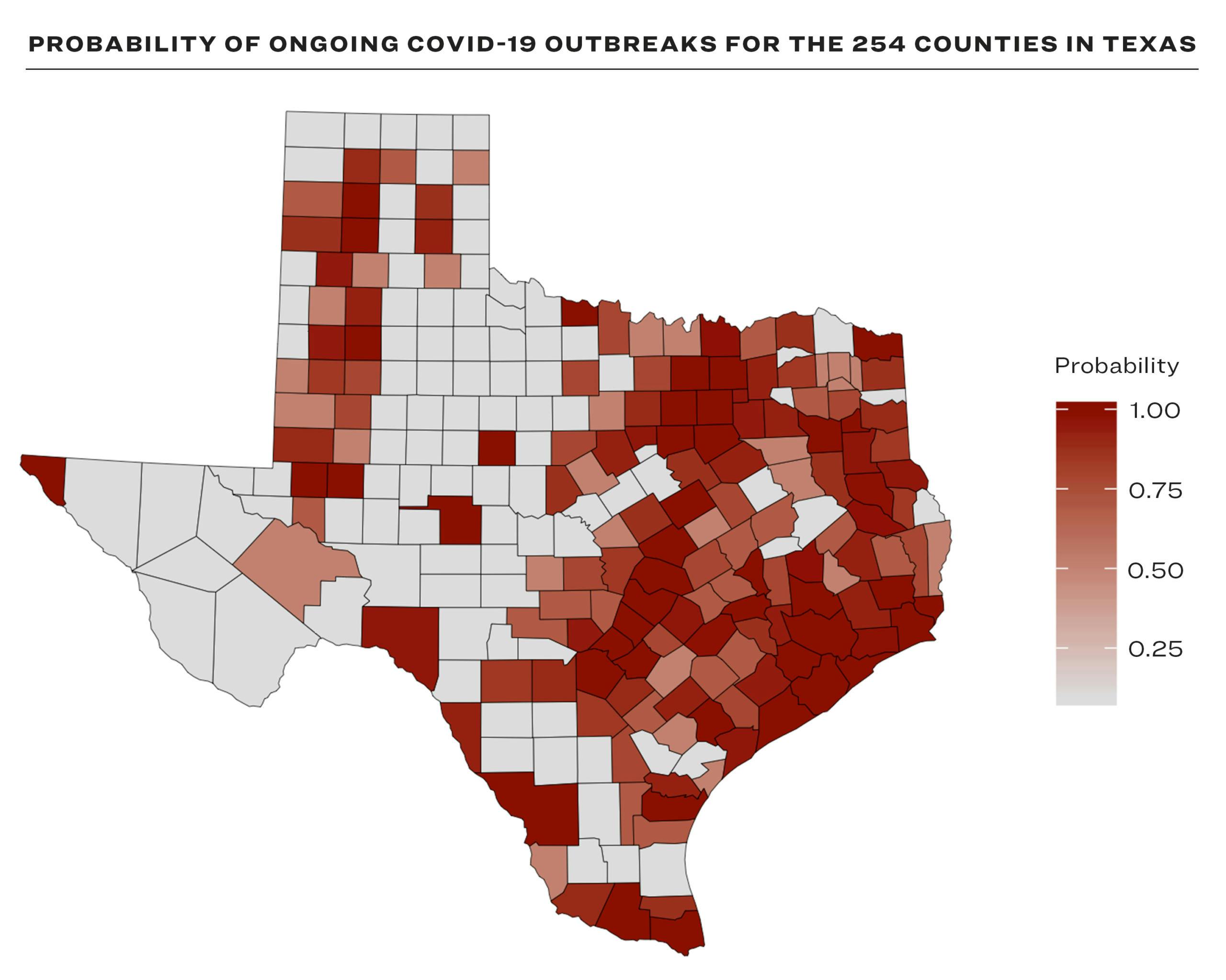
University of Texas at Austin researchers’ map of the probability that the coronavirus has spread in counties across Texas as of April 7.
Courtesy of The University of Texas at Austin
Out of Texas’s 254 counties, 161 have reported COVID-19 cases as of Tuesday. While dozens of counties have reported only a few cases, researchers argue that people living in those areas may still be facing a significant risk. In counties with no cases, researchers conclude that the chance of an “undetected outbreak,” in which there is sustained community transmission, stands at 9 percent. In counties with a single case, like Hansford and Gaines, the chance that an outbreak has already begun jumps to 51 percent, they conclude. In counties with three known cases, such as Milam and Grimes, the chance that an outbreak is unfolding rises to 79 percent.
Though strict distancing is now in place in Texas, the researchers note that other locations around the country have yet to adopt restrictive measures. “What we’re really concerned about is that local governments may be waiting to see a very large number of cases before enacting strict social distancing guidelines,” said Emily Javan, a UT doctoral student who coauthored the study with infectious disease experts Spencer J. Fox and Lauren Ancel Meyers. “By the time you’ve detected one or two cases, there’s already an underlying epidemic—and that’s why you detected it in the first place.”
Though their study, “Probability of current COVID-19 outbreaks in all U.S. counties,” is not yet peer-reviewed, Javan said researchers posted their work online because of the urgency of their findings.
“One case doesn’t seem like very much, but depending on where you live, that may be a large proportion of your community,” Javan said. “The numbers may not seem huge, but you have to place them in context.”
To put it another way: “Going to church with 120 people may not be a good idea if you’re in a small area that only has 120 people,” Javan added. (Notably, although Abbott’s order encourages churches to conduct services remotely when possible, religious gatherings are considered essential services, and are allowed to proceed, under the governor’s order.)
To assess the virus’s potential spread, Javan said researchers used tools developed during the Zika outbreak, another crisis involving a widely spread virus that was difficult to track because of asymptomatic carriers. The researchers, who are still validating their model as new data on cases comes in, admit that they arrived at their numbers—which they label “risk estimates”—based on a principal assumption. That assumption: because of low testing, only one in ten cases across the country is being identified and reported. It may seem obvious in cities, where more people are more likely to interact, that there are many potential carriers, but less obvious in rural areas, where people may assume that a low number of cases means they’re safe.
For policymakers still debating the efficacy of enacting social-distancing measures, those estimates, researchers write, should be treated like the kind of evidence that can be used to make tough decisions. It could also be used to bolster Abbott’s decision to shut down day-to-day life in counties that the virus seemingly hasn’t touched.
“The fate of outbreaks in counties across the U.S. very much hinges on the speed of local interventions,” researchers write. “Early and extensive social distancing can block community transmission, avert rises in hospitalizations that overwhelm local capacity, and save lives.”

