Translate

Showing posts with label In Lak'Ech. Show all posts

Wednesday, September 11, 2024

End Time Beliefs, Dominionism, and President Benito Juarez' Timeless Words to Heal a Divided Nation

Friends:

Here is an important piece by Eric Lane on End Time believers (ETBs). What is important to consider is that ETBs are a mixed bag unto themselves. Back in the 1980s, as I recall, they were termed "Millennialists," referring to Christ's anticipated one-thousand-year reign. I remember focusing on the book of Revelation and end times when I was young and finding it fascinating although simultaneously distressing and ultimately exhausting psychically and emotionally.

I would have lasted longer as an ETB had this not been so draining. In retrospect, I'm glad it was because it took me to a place of redemption that opened my eyes to the vast beauty of life in the moment where individual and group differences became opportunities for me to be more compassionate, loving, and caring.

On a personal level, this meant truly embracing the notion that every way in which I am different is every way in which I am strong. This is an ethic of not just tolerance, but acceptance, that I take into each and every class I have ever taught, as well as into my work in the community.

Lane is correct in linking violence and threats of it to ETBs but what should really get named are "dominionists" who are actually pro-society (not democracy) albeit according to their narrow vision of so-called "Christian principles" as long as they're the ones who are also in charge.

The two go hand in hand. They must be in charge—and not just in the U.S., but globally. This is what makes Trump very dangerous as he is the means to dominionists' perverse agenda a cornerstone of which is indeed controlling women's bodies. It's already playing out in our country.

Look no further than Texas where anti-abortion activists are not happy with families traveling to New Mexico for abortions and women's health care because Texas doctors fear performing certain procedures for which they could get sanctioned. These activists are pushing for restrictions in New Mexico and with some success in some counties. Read"Texas anti-abortion activists pushed abortion restrictions in New Mexico, records show."

Consider, as well, Governor Greg Abbott's pro-voucher legislation as caught up with dominionism and theocracy. Learn about this from an earlier post, "Texas: Two Billionaires Want to Destroy Public Education and Replace It With Christian Schools by Diane Ravitch." And do take time to see CNN documentary, "Deep in the Pockets of Texas," which explores this toxic agenda.

I've already referred readers to a great source on the dominionist agenda via an earlier blog titled, "BOOK RECOMMENDATION: Alberta, Tim (2023). The kingdom, the power, and the glory: American evangelicals in an age of extremism." Relatedly, if you haven't seen The Handmaid's Tale, I encourage you to do so it as it captures through fiction what an extremist dystopian society of their making would look like. It is based on Margaret Atwood's book by this name. You can see all five seasons on Hulu, Prime Video, or Apple TV right now. I also highly recommend listening to Dr. Kevin Kumashiro's keen exposition of dominionism on Bill Ayers' podcast, Under the Tree: A Seminar on Freedom, with Bill Ayers Episode #105, "Project 2025 with Kevin Kumashiro."

Dominionists are the more serious group as far as I'm concerned because they are perhaps witting or unwitting white supremacists who see themselves as having a God-given mandate to establish a theocracy—that is, a system of government led by those that these theists see as "divinely guided." The antithesis is, as Lane mentions, "democratic pluralism," which is a foundation for peace for which many, if not most, of us advocate—to which I might add the hope and promise of a multi-ethnic and multi-racial democracy.

One might argue that as opposed to ETBs, neoliberals, or global capitalists, are ultimately in control. I wouldn't disagree with that as they profit from the divisions that extremist agendas enable. They are playing with fire, however, a potential runaway train that is combustible and dangerous.

The irony in all of this is a lack of Christ's love, caring, and compassion which are so central to the gospel that it's crazy—yet understandable—that this gets overlooked.


View Informative Link
Yet here is where we find truth. The Golden Rule of doing unto others as wewould have them do to us could not be a more urgent ethic. This is, moreover, a foundational principle of this continent as conveyed in the Mayan concept of In Lak'Ech (You are my other me) and as expressed by Mexico's beloved Indigenous president, Benito Juarez, of Zapotec origin, serving between 1858 and 1872, “Entre los individuos, como entre las naciones, el respeto al derecho ajeno es la paz.” ("As between individuals, as well as nations, respect for the rights of others is peace.")

Pin this to your refrigerator door. Have no fear. Trust the power in these words.

As we embark on the celebration of Mexico's September 16th Independence celebration, how appropriate to reflect on Juarez' timeless words to heal a divided nation.

Feliz Diez y Seis de Septiembre! Happy September 16th! 💗

-Angela Valenzuela

How End Time Beliefs Undermine Democracy
by Eric Lane | September 8, 2024

Photo by Shubham Dhage on Unsplash

The rhetoric employed by End Time believers is not just forceful language but an expression of an extreme apocalyptic worldview. This way of thinking perceives the world as embroiled in a cosmic battle between good and evil. In the End Time narrative, political and cultural opponents are not merely individuals with differing opinions but enemies of God, often viewed as agents of Satan or participants in a divine showdown.

Framing Opponents as Evil or Godless

End Time believers operate within a stark black-and-white world. In this dichotomy, they and their allies are seen as the forces of God, while their political or ideological opponents—be they secularists, liberals, progressives, or members of other religions—are depicted as being aligned with evil.

This rhetoric transforms political disagreements into moral and spiritual battles, demonstrating the profound impact of End Time believers' conviction on their perception of reality.

Leaders in this movement use demonizing language to describe their adversaries. Terms like “godless,” “anti-Christian,” “Satanic,” or even “demonic” are common. Political opponents are painted not as people with different viewpoints but as existential threats to the survival of Christian values and, by extension, to God's plan for the world.

Religious Warfare Rhetoric

For End Timers, the Culture war is Spiritual warfare. Many End Time believers see contemporary political struggles, such as the battles over abortion, LGBTQ+ rights, or secular education, as part of a larger spiritual war. These issues are framed not as policy disputes but as clashes between the forces of God and the forces of Satan.

By placing current events within the framework of the apocalypse, End Time believers heighten the stakes, portraying each political confrontation as a precursor to Christ’s return or the arrival of the Antichrist. This sense of urgency makes compromise or negotiation a betrayal, as they see themselves fighting for God’s ultimate plan.

The "Enemy Within"

End-Time believers target secular and liberal politicians. Their rhetoric frequently focuses on politicians who advocate for policies that contradict their perceived Christian values. These figures are often painted as either unwitting pawns of evil forces or as consciously working against God's will, leading to the vilification of the Left.

Progressive movements, particularly those advocating for social justice, LGBTQ+ rights, or reproductive freedom, are often depicted as prompting the charge in a moral and spiritual decline. For example, political leaders who support abortion rights are commonly framed as agents of evil, facilitating a modern-day ‘holocaust’ or acting under the influence of Satan.

Christian Nationalism and Divine Authority

End Time believers claim they defend their political preferences and act under a divine mandate. They believe their political actions align with God’s will, while their opponents oppose both them and God. This gives their movement a theocratic and authoritarian edge as they seek to implement what they believe are God’s laws in place of democratic laws.

By asserting that God's law should take precedence over human-made laws, Christian nationalism inherently undermines democratic pluralism, which depends on the coexistence of diverse viewpoints and the peaceful negotiation of differences.

In this worldview, dissent is not seen as part of healthy democratic debate but as opposition to divine authority, fostering an environment that erodes democratic values in favor of authoritarian control.

They believe God chooses leaders. Thus, certain political figures are often characterized as chosen by God to lead during this critical period before Christ’s return. For example, End Time believers frame figures like Donald Trump as divinely appointed leaders, despite his conduct, because he is advancing a Christian nationalist agenda.

Hostility and the Threat of Violence

When political opponents are cast as enemies of God, it becomes easier for believers to justify extreme action. This rhetoric inspires hostility and, in some cases, violence. For example, the rhetoric surrounding abortion, often framed as "murder sanctioned by the state," has led individuals to justify violent acts against abortion providers, as seen in numerous attacks on clinics and the murder of providers.

Some End Time believers have connections with militia movements and paramilitary groups that prepare for literal battles. They interpret Biblical prophecies about war and persecution as mandates to prepare for armed conflict, especially against what they see as a corrupt or evil government. This is particularly dangerous when combined with contemporary political polarization.

Biblical Justifications for Hostility

In an earlier writing, I described two Jesuses: the Peaceful Jesus and the Warrior Jesus. While many Christians focus on Jesus's peaceful teachings (e.g., the Sermon on the Mount), End Time believers emphasize apocalyptic depictions of Christ, particularly from the Book of Revelation, wherein a militant Christ returns to lead armies. This violent, retributive image of Jesus is used to justify a more aggressive stance against perceived enemies.

By prioritizing this militant Christ in political discourse, believers frame modern political struggles as literal spiritual warfare, escalating rhetoric and fueling conflict. This not only intensifies polarization but also promotes a mindset in which violence is seen as a divinely sanctioned means to achieve political ends. When faith is tied to the belief that physical battles must be fought for divine purposes, it diminishes the possibility of compromise and undermines the democratic process.

End Time rhetoric invokes divine judgment and punishment, implying that those who oppose the End Time worldview will face not just political defeat but eternal damnation. This sense of cosmic justice encourages hostility towards anyone who thinks or believes differently. They are depicted as working against God’s plan.

Consequences of this Rhetoric

By framing every political battle as a holy war, End Time believers not only contribute to the intense polarization in U.S. politics but are also the primary instigators. This makes civil discourse and compromise impossible, as their opponents are wrong and evil.

The dehumanization of political opponents and the apocalyptic urgency surrounding End Time beliefs can lead to acts of violence. The January 6th attack on the U.S. Capitol is a prime example. Many participants carried Christian symbols and saw their actions as part of a divine mission.

When political opponents are framed as enemies of God, End Time believers justify rejecting democratic norms, such as free elections and the peaceful transfer of power. They claim that following democratic processes is less important than ensuring that "God’s will" is carried out, even if that means undermining democratic institutions. This puts End Time believers at war with the U.S. Constitution as it undermines democracy.

End Time believers' rhetoric of framing opponents as enemies of God creates a highly toxic environment that threatens democratic principles like compromise and peaceful governance alongside social stability.

By dehumanizing their opponents and viewing politics through the lens of divine warfare, they create an atmosphere of hostility, leading to radicalization and violence. This is not just a spiritual or religious issue—it’s a political one that poses a direct challenge to the foundations of secular democracy.

Friday, January 28, 2022

Op-Ed: Removing Indigenous concepts from ethnic studies sends a terrible message to California’s students

Glad to see that the LA Times published this op-ed by Sean Arce, Theresa Montaño and Guadalupe Cardona. This is indeed such a terrible decision and needs to get reversed. Don't we all want to promote unifying, community-building values in this current moment of division and polarization? To deny this is to cave-in to the very forces of division against which In Lak'Ech speaks.

This in no way signals religion, but rather a philosophy or cosmology. Native people's didn't even have a word for "religion" until the Europeans came along and insisted on it as part of their assimilationist campaigns that continue into the present. Such irony that this move by liberal leaders in California yet again reinscribes these age-old projects of empire.

-Angela Valenzuela

Op-Ed: Removing Indigenous concepts from ethnic studies sends a terrible message to California’s students

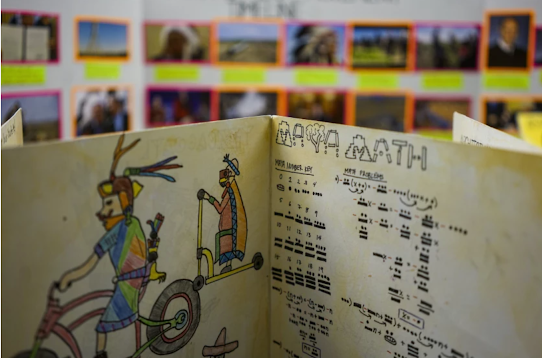
A student’s presentation for their ethnic studies class on display in a Los Angeles classroom.
(Kent Nishimura / Los Angeles Times)

SEAN ARCE, THERESA MONTAÑO AND GUADALUPE CARDONA

Removing the Indigenous concepts In Lak’ech and Ashe from California’s Ethnic Studies Model Curriculum, on the false premise that they are religious, sends a message to all of the state’s students, especially those who are Chicanx, Black and Native, that their cultures are not worth fighting for.

Last September, the Californians for Equal Rights Foundation and three San Diego parents sued the California Department of Education and the California State Board of Education, claiming that In Lak’ech was an Aztec prayer and Ashe was a religious chant. The suit argued that including texts that involved these concepts in the state’s recommended ethnic studies curriculum violated the Establishment Clause of California’s constitution. Last week, even though they denied the allegations and did not admit to any liability, the defendants settled the case to avoid further litigation. They agreed to excise both affirmations from the model curriculum and communicate those deletions to districts, schools and education boards.

The Californians for Equal Rights Foundation, a group that has worked against ethnic studies and anti-racist initiatives in San Diego schools, claimed that one of the In Lak’ech texts referenced in the recommended ethnic studies curriculum was an “Aztec prayer.” That poem, written by Luis Valdez and often used in California ethnic studies classes as an affirmation promoting values such as respect and empathy, is based in Mayan philosophy, not religion. The lawsuit also argued that an Ashe affirmation in the model curriculum was a religious chant, even though Ashe is a concept that refers to the power to effect change that comes from the Yoruba in Nigeria.

There is legal precedent that argues for including In Lak’ech: In Arce vs. Douglas, an Arizona case, the 9th Circuit Court of Appeals ruled that suppressing Indigenous knowledge constituted “racial animus” against Chicanx/Latinx.

Prior to last week’s settlement, less than 9% of the Ethnic Studies Model Curriculum was dedicated specifically to Chicanx/Latinx studies even though 55% of California’s K-12 students are Chicanx/Latinx. Eliminating the In Lak’ech Maya poem and Ashe African affirmation from the curriculum demonstrates both the lack of knowledge that leaders have about those cultures and a disinterest in standing up and fighting for students’ educational well-being, especially Black and brown students. This erasure of Indigenous knowledge is not new — American education is steeped in historical bias and racial trauma.

Many ethnic studies teachers feature In Lak’ech and Ashe in their classrooms to establish a sense of belonging, especially for Chicanx/Latinx and Black students. The removal of the concepts delivers the message to Chicanx/Latinx and African American/Black students that their communities’ knowledge and cultures are illegitimate and unworthy of defending. Notably, Chicanx/Latinx, Black and Native youth constitute the majority of California’s K-12 students but remain subject to a Eurocentric curriculum.

Passing AB 101, which requires California students to take an ethnic studies course prior to high school graduation, was a promise to honor the historical and cultural experiences of Chicanx, Latinx, Black, Asian and Pacific Islander, American Indian and other communities of color. As long as the In Lak’ech and Ashe concepts being taught do not reflect or promote discrimination against any person or group, or teach or promote religious doctrine, they are within the parameters of the legislation.

The majority of California’s student population should not have their cultures subject to erasure every time litigation is threatened. In the end, if our educational leaders remove key principles and concepts from the model curriculum instead of fighting for their inclusion, no matter how long or costly the court battle may be, they are essentially denying California’s students an authentic ethnic studies education and, in this case, dishonoring Indigenous legacies.

Sean Arce is an ethnic studies high school teacher in Los Angeles, the co-founder of Tucson’s Mexican American/Raza Studies Department and a plaintiff in the 9th Circuit case Arce vs. Douglas. Theresa Montaño is a professor of Chicana/o studies and a practitioner and activist in ethnic studies. Guadalupe Cardona is a secondary educator in the LAUSD.

Saturday, January 15, 2022

“The Pandemic as a Portal to a Better World," UT College of Education Fall 2021 Commencement Address by Angela Valenzuela, Ph.D.

Friends:


Happy to share my December 4, 2021 Commencement Address to the UT College of Education graduates—both the video and my actual speech. I was told I did a good job. I certainly did my best. 


Thanks to Jesús Treviño for publishing this on Latinopia.com.  I am also thankful for this opportunity to Dean Charles R. Martinez, Jr. who is pictured here with me in this photo taken afterwards. I could not have been more honored.


I like how it reflects so much of what I have been thinking about over these many months of the pandemic. Congratulations again to our amazing 2021 graduates.  


Enjoy!


-Angela Valenzuela


“THE PANDEMIC AS A PORTAL TO A BETTER WORLD”

by 


Angela Valenzuela, Ph.D.


University of Texas at Austin


December 4, 2021


Angela Valenzuela College of Education 2021 Commencement Speech

Note: View entire ceremony on Youtube.


Buenas tardes. Good afternoon. Today we gather to celebrate the graduation of undergraduate and graduate students from the College of Education at the University of Texas at Austin! Felicidades! Congratulations! Super exciting!


Much gratitude to our students and each family for having accompanied us throughout this difficult time period of a pandemic, an epic Winter storm, a racial justice movement, political division and strife, Zoom and hybrid classes, synchronous and non-synchronous, online, remote, and in-person modalities that have not only given us a new vocabulary and skills, but a new sense of the present. Ongoing news reports have often characterized this moment as an “inflection point.” This means a turning point that can turn in a positive or negative direction. 


We do have a choice and we make choices every day—not just what to do, but who to be. The pandemic reminds us that our beingness—who we are and how we be—is just as important as what we do. 

May we contemplate through these words I share today how this coming together of our doingness and beingness signals the direction that this turning point takes.


Renowned novelist and human rights and ecological movement activist, Arundhati Roy asks, in her April, 2020 essay published in the Financial Times, how we can make the world anew?  The answer, she posits, is in the virus itself, if we will only allow it—through the lessons we have learned—to be a portal to a better world.


To cast this moment in this way is not at all to minimize the uncertainties, stresses, and crises you have experienced throughout—with a good number among us experiencing enormous strife, hardship, and tragic loss in the context of this extended period of illness, lockdown and restrictions. 


To the contrary. We honor you and are mindful of those who are no longer with us, including friends and family members who had plans to be here celebrating your remarkable accomplishments. We trust that they are here with us in spirit today.


Adding to this is a loss of rituals, observances, vacations, family visits, and the like that have taxed our souls and psyches, frequently leaving us feeling de-centered and oftentimes adrift. 


At the same time, we have begun to see the light at the end of the tunnel. Recent news on the imminent COVID variant headed our way complicates matters, making it hard to fully anticipate what lies in store for us in the coming weeks and months. Roy’s notion of a portal to a new, better world holds, nonetheless. 


I think most of us agree that the world has shifted and that many things won’t go back to what we had taken for granted as “normal.” As disconcerting as this thought can be, I want to make a few observations about the pandemic experience that suggest why we should remain hopeful and positive. Specifically, I point to six areas of growth that hold enormous promise for us as individuals and as society, going forward.


  • First, we re-learned the important life lesson of being flexible. Planning is essential. Goals and targets are, as well. However if you’re flexible and adaptable, not only was life easier, but you made the best of a less-than-ideal situation.  And now you are here, an exceptional generation, with a major story to tell about mid-course shifts and adjustments while remaining true to yourself and following your North Star.

  • Second, the pandemic reinforced the notion of just how much we all depend on one another. Despite individualist American lore, no one is ever truly self-sufficient. The reason I am here today is the same reason you are here today. It’s that my parents and family loved me—my grandparents, too—and encouraged me to pursue my wildest dreams.  And you’re all also here because you, too, are loved, deeply loved, and you had a few good teachers. And probably more than just a few. Let’s love our teachers and mentors.

  • Third, so much of what we used to take for granted is now more meaningful. Simple acts of kindness became less random and more sincere—smiles and well-wishes, more heart-warming. 


I feel confident that we as staff and faculty, we all share in the joy of running into our students and into each other in the hallways, during lunch, or in the parking lot. Little did we know that we had it so good when called upon to attend that occasional 8:00AM breakfast-taco staff meeting, that 12:00PM brown-bag talk, or afternoon office hours to meet with you, our gifted and brilliant students. 


I recently met with one such student from our 2020 cohort who said that she wanted to meet me in my office, feeling that she might graduate, never having had the opportunity to see me and talk to me in person. The feeling was heartfelt and mutual. 


  • Fourth, I trust that we all also have a fresh sense and appreciation for “giddiness,” for being “giddy.” Just being in the presence of others, especially dear friends and family, with whom we have not physically interacted in a good while, stimulates that sense of excitement and newness that the word, “giddiness,” conveys. It’s almost child-like.


Above and beyond the obvious delight of graduation, don’t we all feel just a tad giddy right now? Just to be together is wonderful?  Not remotely, but physically?  In the flesh. Don’t your legs feel a little rubbery just to be here in this space today? I know mine do.


It’s a sensation beyond feeling nervous or “jittery.” 


In Spanish, the closest word for “giddy” might be mareada o mareado. Te sientes un poco mareada o mareado hoy? Yo sí! Pero viene de la novedad de estar juntos en persona. My sense of giddiness comes from the novelty of being in person. After all, our last two commencement ceremonies were remote. 


These observations hint at how we ourselves have changed personally and professionally from this experience of a pandemic. Every day of life is precious. Every human being matters. 


May we invoke the sacred way contained in the Mayan concept of In Lak’ech which is the Indigenous version of the Golden Rule. 


Tu eres mi otro yo, 

You are my other me.


Si te hago daño a ti

If I do harm to you,


Me hago daño a mí mismo.

I do harm to myself.


Sí te amo y respeto,
If I love and respect you,


Me amo y respeto yo.

I love and respect myself.


May this wisdom for planetary peace and justice be the beingness that accompanies our doingness.


  • Fifth, in a new way we learned that we could be simultaneously professional and compassionate.


I remember after Spring break in 2020, after things shut down and all seemed in disarray, that a beautiful and naturalistic discourse on “grace” surfaced. “Showing grace,” “having grace, “giving grace” were expressions of love and caring that we certainly heard in our college and I imagine throughout the university.


I remember thinking, “Wow! Did Dean Martinez just say that?” “Did I just hear Dr. Victor Saenz, my department chair, say that?”


Their words of encouragement were the much-needed salve for the soul.


In the schools, we similarly heard a lot about socioemotional learning and how that needed to be our focus. 


Amazing Grace, how sweet the sound. May we all walk a path so wonderfully perfumed.


  • Finally, our appreciation for one another has been enhanced. I have the distinct impression from my own experience these past one-and-a-half years of being out of the classroom and re-entering this fall, that our students were noticeably happier, even excited, about being together. Just being together was its own reward. Even in online environments, I imagine that most of our classrooms were largely experienced by our students as sanctuaries, a special place of comfort, a kind of ironic, if welcomed, “grounding” for a world that has felt upside down.


All of these learnings that speak to the heart provide clues to that grander, expansive vision of that better world that is within reach. We’ve lived it. And how awesome for all of us to imagine ourselves as not solely more credentialed, but more loving, more caring, more forgiving, and more compassionate because our consciousness is less one of separateness and division and more one of greater interrelatedness and interconnectedness where this is not an abstraction, but a lived experience.


Albert Einstein once said that when we experience ourselves as separate from the whole of the universe, this is an optical delusion that places limits on our consciousness. “This delusion,” he said, “is a kind of prison for us, restricting us to our personal desires and to affection for a few persons nearest us. Our task must be to free ourselves from this prison by widening our circles of compassion to embrace all living creatures and the whole of nature in its beauty.” (Ricard & Thuan, 2009, p. 72)


As we emerge from this pandemic and the many lessons we have learned, how provocative and evocative for us to think of the world as more beautiful today than before and ourselves as more comfortable in that empty space that allows us to glimpse into our souls, and grasp our own limitless potential for love, forgiveness, caring and compassion. 


You, our 2021 graduates from the University of Texas at Austin, are the generation of destiny for a world that beckons you to weave creation in the midst of chaos, to author a fresh, redemptive narrative of the human experience that allow us all to survive, thrive, and perfect the union. 


A heartfelt congratulations again to the class of 2021! You made it! 


Godspeed! Love and light! Muchísimas gracias!


Thank you very much!


Hookem!


References


Ricard, M., & Thuan, T. X. (2009). The quantum and the lotus: A journey to the frontiers where science and Buddhism meet. NY: Crown Publishers.


Roy, A. (2020). The pandemic is a portal. Financial Times, 3(4).


Tafolla, C. (2002). In Lak Ech. World Literature Today, 76(2), 114-115.


Social Media


Twitter: @vlnzl

Instagram: @vlnzl

Portfolio: angelavalenzuela.com

Facebook: https://www.facebook.com/vlnzl

Blog: Educational Equity, Policy and Politics in Texas

UT College of Education: Angela Valenzuela, Ph.D.

_______________________________________________

Copyright 2022 by Dr. Angela Valenzuela. Image from Commencement used with permission of UT Austin.


Thursday, April 22, 2021

In lak’ Ech—You are my other me and the American Dream Game

Powerful image by the cartoonist, Horsey, that represents the African American trajectory toward the so-called American Dream—and how divergent and unfair for African Americans in this country. As a teacher, I see this as both useful to instruction on the history of African Americans, but also as a potential classroom activity that could be done for other marginal groups in the U.S. like Mexican Americans, Asians Americans, Puerto Ricans, Central Americans, and Native Americans.

The ultimate point of understanding these histories is for all of us to acknowledge our shared humanity that the Mayans expressed as In Lak' Ech, meaning your are my other me. It includes the Golden Rule of do unto others, but expresses a deeper relationship to all life, including Mother Earth and the universe itself.

In lak’ Ech (Spanish)

Tú eres mi otro yo.
Si te hago daño a ti
Me hago daño a mí mismo.
Sí te amo y respeto,
Me amo y respeto yo.

In lak’ Ech (English)

You are my other me.
If I do harm to you,
I do harm to myself.
If I love and respect you,
I love and respect myself.

I suspect that the Golden Rule as expressed in the Bible and which is core to most, if not all, faiths always included this, but that culture in the span of time eviscerated this deeper understanding to which so many of us are now connecting, given an increasing awareness of potential biocide and ecocide thrust upon us by climate change and the pandemic.

Let's not mince words here, my friends. I am you. You are me. And we are all one with Source, meaning God, Creator, Pachamama, Wakan Tanka, Jehova, or the Supreme Being of your understanding. 

Pedagogically, particularly as taught in the Ethnic Studies classroom, this means decolonizing and disavowing white supremacy that is an ideology that has left no one untouched. That's what a good and virtuous education should ultimately teach—this ancient, life-saving wisdom that we are one with Source. It is with such a foundational understanding that we can all reach, individually and collectively, our greatest and highest good.

-Angela Valenzuela

#EthnicStudiesNow

Sunday, April 16, 2017

My Easter Sunday Reflection

Here is a powerful, Easter blog post by Michael Seifert from Brownsville, Texas titled, "Hallowed be Thy Name,"with ideas that are perfect for a day like today, Easter Sunday, 2017.  It has so many important insights that you really need to read it yourself.  
Quote from within:
"As this Holy Week turns toward the celebrations of the death and resurrection of Jesus the Christ, I believe it appropriate to recognize the holiness of those who have suffered the damning theft of a child by the state. In their own, specific way, they are God-like, having suffered what God knew on Good Friday—the theft of one’s own flesh, the kidnapping of the most-loved one, the loss of a reason to live.

Some of us hope for that day when there is no need for a term for parents who have lost their children. We wait for the day when such an unthinkable moment no longer occurs, when this impossible idea begging for wings to take flight, to pass over and protect so many who yet remain at risk for this tragedy in need of a name
."

My heart felt crushed as I read Seifert's mention of the unfathomable thought of ever losing one's child or grandchild to violence at the same time that the author calls upon us to acknowledge that this very thing is happening at this very moment across the world at alarming, unconscionable levels.

Contemplating the level of agony, pain, and suffering that accompanies this violence is to peer into a fearful and foreboding abyss, this heart of darkness to the point that we seem incapable of either hitting, much less finding, the "re-set" button to turn this cascading flow of violence of epic proportions around.

To avoid falling into this abyss where but for God's grace, any one of us might find ourselves in a "passover situation," or crisis, as Seifert suggests, "begging for wings to take flight, to pass over and protect"—we must get close to the ground to find the truth in the stuff of our everyday, ethical relations and relationships in our families, communities, and work—and how these connect to policies, priorities, practices, and ways of knowing and being in the world.

The trick for me has also been to accept that the dark and evil forces that threaten to engulf are never more powerful than the goodness, magic, and greatness that motivates, heals, and inspires.  A rich, full life of the body, mind, and spirit, in and with community and all our relations, is ours to have, if we can only be open to it.

This requires self-examination, however, as we all have to decide that we want to be among those that promote positive, democratic, social justice values and nurture these sensibilities—not ever for the purpose of numbing ourselves to others' suffering, but rather to advocate for ways of knowing and being in the world that reject the forces of death, violence, destruction, and despair.

These are ways of knowing and being that are so radical, they begin today, in this very moment.  This is a world that we—both individually and collectively—decide on.  It is a place where peace, caring, healing, hope, humility, love of community, and a good spirit abide.  It is one that is in complete observance of other's right to similarly live lives in peace and dignity.

This ethos is conveyed by the Mayan concept of "In Lak'Ech"—which for us is the Golden Rule.  "You are my other me." "Whatever I do to you, I do to me."  "Do unto others as you would have them do unto you." These are universal, redemptive values that when practiced, lead to personal liberation and transformation—both for ourselves personally and the world.

I recommend reading this post in its entirety.  Regardless of our different faiths, religions, or creeds, may we all experience and express that sense of the resurrection, that spirit of renewal and re-birth that is not reducible to a day or an event, but rather to a praxis or practice, a lived, everyday aspect of being in the world—and with policies and priorities to match.


Paz/Peace. And blessings to all. 


Angela Valenzuela
c/s