Translate

Showing posts with label Theresa Montaño. Show all posts

Friday, January 28, 2022

Op-Ed: Removing Indigenous concepts from ethnic studies sends a terrible message to California’s students
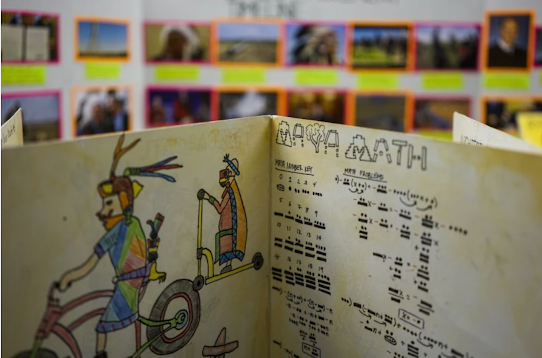
Glad to see that the LA Times published this op-ed by Sean Arce, Theresa Montaño and Guadalupe Cardona. This is indeed such a terrible decision and needs to get reversed. Don't we all want to promote unifying, community-building values in this current moment of division and polarization? To deny this is to cave-in to the very forces of division against which In Lak'Ech speaks.

This in no way signals religion, but rather a philosophy or cosmology. Native people's didn't even have a word for "religion" until the Europeans came along and insisted on it as part of their assimilationist campaigns that continue into the present. Such irony that this move by liberal leaders in California yet again reinscribes these age-old projects of empire.

-Angela Valenzuela

Op-Ed: Removing Indigenous concepts from ethnic studies sends a terrible message to California’s students

A student’s presentation for their ethnic studies class on display in a Los Angeles classroom.
(Kent Nishimura / Los Angeles Times)

SEAN ARCE, THERESA MONTAÑO AND GUADALUPE CARDONA

Removing the Indigenous concepts In Lak’ech and Ashe from California’s Ethnic Studies Model Curriculum, on the false premise that they are religious, sends a message to all of the state’s students, especially those who are Chicanx, Black and Native, that their cultures are not worth fighting for.

Last September, the Californians for Equal Rights Foundation and three San Diego parents sued the California Department of Education and the California State Board of Education, claiming that In Lak’ech was an Aztec prayer and Ashe was a religious chant. The suit argued that including texts that involved these concepts in the state’s recommended ethnic studies curriculum violated the Establishment Clause of California’s constitution. Last week, even though they denied the allegations and did not admit to any liability, the defendants settled the case to avoid further litigation. They agreed to excise both affirmations from the model curriculum and communicate those deletions to districts, schools and education boards.

The Californians for Equal Rights Foundation, a group that has worked against ethnic studies and anti-racist initiatives in San Diego schools, claimed that one of the In Lak’ech texts referenced in the recommended ethnic studies curriculum was an “Aztec prayer.” That poem, written by Luis Valdez and often used in California ethnic studies classes as an affirmation promoting values such as respect and empathy, is based in Mayan philosophy, not religion. The lawsuit also argued that an Ashe affirmation in the model curriculum was a religious chant, even though Ashe is a concept that refers to the power to effect change that comes from the Yoruba in Nigeria.

There is legal precedent that argues for including In Lak’ech: In Arce vs. Douglas, an Arizona case, the 9th Circuit Court of Appeals ruled that suppressing Indigenous knowledge constituted “racial animus” against Chicanx/Latinx.

Prior to last week’s settlement, less than 9% of the Ethnic Studies Model Curriculum was dedicated specifically to Chicanx/Latinx studies even though 55% of California’s K-12 students are Chicanx/Latinx. Eliminating the In Lak’ech Maya poem and Ashe African affirmation from the curriculum demonstrates both the lack of knowledge that leaders have about those cultures and a disinterest in standing up and fighting for students’ educational well-being, especially Black and brown students. This erasure of Indigenous knowledge is not new — American education is steeped in historical bias and racial trauma.

Many ethnic studies teachers feature In Lak’ech and Ashe in their classrooms to establish a sense of belonging, especially for Chicanx/Latinx and Black students. The removal of the concepts delivers the message to Chicanx/Latinx and African American/Black students that their communities’ knowledge and cultures are illegitimate and unworthy of defending. Notably, Chicanx/Latinx, Black and Native youth constitute the majority of California’s K-12 students but remain subject to a Eurocentric curriculum.

Passing AB 101, which requires California students to take an ethnic studies course prior to high school graduation, was a promise to honor the historical and cultural experiences of Chicanx, Latinx, Black, Asian and Pacific Islander, American Indian and other communities of color. As long as the In Lak’ech and Ashe concepts being taught do not reflect or promote discrimination against any person or group, or teach or promote religious doctrine, they are within the parameters of the legislation.

The majority of California’s student population should not have their cultures subject to erasure every time litigation is threatened. In the end, if our educational leaders remove key principles and concepts from the model curriculum instead of fighting for their inclusion, no matter how long or costly the court battle may be, they are essentially denying California’s students an authentic ethnic studies education and, in this case, dishonoring Indigenous legacies.

Sean Arce is an ethnic studies high school teacher in Los Angeles, the co-founder of Tucson’s Mexican American/Raza Studies Department and a plaintiff in the 9th Circuit case Arce vs. Douglas. Theresa Montaño is a professor of Chicana/o studies and a practitioner and activist in ethnic studies. Guadalupe Cardona is a secondary educator in the LAUSD.

Friday, November 26, 2021

Yes, no or ‘huh?’ in talk of critical race theory: One O.C. school district finds concept tough to define

Read here about the current Placentia-Yorba Linda Unified School District  battle over Critical Race Theory taking place right now. I appreciate most in this piece Dr. Theresa Montaño's comments:

Theresa Montaño, a professor of Chicana and Chicano Studies at Cal State Northridge who helped craft an early draft of the state’s ethnic studies curriculum, was not surprised to hear that officials couldn’t settle on a definition of critical race theory. School boards looking to ban the concept are often “responding to a body politic that’s attacking critical race theory, but they have no knowledge of what it is,” she said. “Bans have become a means to “attack some of the civil rights gains like ethnic studies, like anti-racist education.”

“You have to look at the underlying messaging and underlying concepts that [these boards] are really trying to negotiate,” Montaño said.

The underlying message is let's NOT talk about race despite the fact that one can't teach history or Ethnic Studies without addressing race. A constructive conversation that they don't want to have is how best to teach these truths.

Clearly, Ethnic Studies teachers in Ethnic Studies classrooms are among those best equipped to do so. In my many years of teaching Mexican American Studies, Native American and Indigenous Studies, and Critical Race Theory, the overwhelming response is "Why didn't I learn this earlier?" "Why do I have to wait 'til college to learn this?" I have heard high school students who have taken Ethnic Studies in high school ask the exact same thing.

Despite themselves obviously never having taken an Ethnic Studies course, these folks don't want to have a constructive conversation. And they're deaf to critical comments like those expressed about being denied the opportunity to learn the truths of American history. It's particularly troubling to hear educated people saying that they do not want to learn or be educated on such matters.

They seek instead to preempt vital conversations that will actually clear the air by naming the elephant in the living room that the recent racial justice movement laid bare. Beyond the importance of naming the elephant, courses like these equip all our youth with the language, concepts, and frameworks that they need to have if they are to navigate well life's complexities that inescapably attach to the viability of a multiethnic, multiracial democracy.

As I have noted throughout this blog [search "Ethnic Studies"], ample evidence further supports the positive benefits of Ethnic Studies to all the outcomes we say we care about in education, namely, grades, attendance, high school completion, and the decision to go to college.

How does this happen? Information fosters both awareness and insight. Awareness and insight reach beyond what we already know so that we might reach new horizons intellectually and spiritually—and in so doing, becoming a better, more self-aware, and more compassionate human being.

Shouldn't we all want that?

I know that I do. There are no shortcuts here. Under any name, we should collectively espouse a curriculum that helps our youth to survive and thrive. Thanks to Jorge Haynes for sharing this piece with me.

-Angela Valenzuela

By Hayley Smith | L.A. Times | November 24, 2021

Inside a wood-clad meeting room in Orange County, five school board members sat before a sign-waving, opinionated crowd. For more than three hours, the trustees listened, debated and asked questions as they tried to decide whether to ban classroom teaching on a hard-to-define topic not taught in their schools: critical race theory.

The board members of the Placentia-Yorba Linda Unified School District had even turned to the trusted pages of the Encyclopedia Britannica, copying the entry for critical race theory into a public resolution that could become the legal policy of the district.

“I don’t think that this definition is really good,” trustee Marilyn Anderson said after reading the dense entry. “I think it needs to be really specific. It needs to spell out the specific theories that we do not want taught in our district — like that the United States is fundamentally or systemically racist.”

At the end of a long night, the board postponed the vote. But what emerged during their session revealed far more than angst over a “yes” or “no” vote on whether to ban critical race theory. Their meeting offered an up-close look at how an advanced academic concept has been transformed into a politicized slogan framing uncomfortable discussions about how to teach race, racism and equity in schools — and how the quest to define it inside a suburban school board meeting can be a minefield.


Critical race theory is a university- level academic lens for examining how racial inequality and racism are historically embedded in legal systems, policies and institutions in America and is not generally taught in K-12 schools. Yet Republicans have seized on it as a wedge issue painting white people as racist oppressors and people of color as the oppressed. Democrats largely see the conservative drive against critical race theory as racist dog-whistle politics that polarizes broader discussions about reckoning with America’s past.

Against this backdrop, school board members and parents in suburban Placentia-Yorba Linda are trying to figure it all out for their kids.

Although ultimately designed to ban critical race theory, the district’s 14-point resolution was touted as a way to foster a “safe and respectful environment for students.” It said the district “stands by the commitment to teach a complete and accurate account of history while also supporting the cultural integrity of students.”

Friday, September 03, 2021

National LULAC Conversation on Ethnic Studies and Critical Race Theory with Drs. Angela Valenzuela, Theresa Montaño and National LULAC Policy Director Bill Moreno

 Friends,

Happy to share this discussion on Ethnic Studies and Critical Race Theory from today's National Virtual LULAC Conference with Dr. Theresa Montaño and National LULAC Policy Director Bill Moreno serving as our moderator. You can hear our conversation here

The 2021 Virtual Summit itself is excellent! You can watch all LULAC Virtual Summit recordings here:

Virtual Summit Video Gallery

I want to highlight a statement made by Dr. Montaño who reiterates a research-based perspective out of the American Academy of Pediatrics (AAP) on how it is healthy for us to discuss racism in society because it is a "social determinant of health that has a profound impact on the health status of children, adolescents, emerging adults, and their families." You can read the AAP policy statement here: The Impact of Racism on Child and Adolescent Health.

It was awesome to hear Dr. Montaño underscore the importance of LULAC— founded as a civil rights organization in 1929—pointing to the teaching of one of our LULAC co-founders, Jose de la Luz Saenz, in a California Ethnic Studies classroom of which she was aware.

I was pleased to hear this as her mention of this gave me a chance to reflect on UT History Professor Emilio Zamora's translation of Luz Saenz' World War I Diary as per these June 28 and June 29, 2016 blog posts, respectively, written when Emilio and I were in France:*

I like how we squeezed a lot of great information and ideas into a little bit of time that, despite all the anti-CRT rhetoric and bill proposals, most should find encouraging.

Thanks to Bill and Theresa for a great conversation! And thanks to Dr. Zamora for his own contributions and sacrifices to furthering an awareness of our own intellectual and social movement history. Clearly, despite the politics of erasure, we will not allow for this to happen. And thanks to National LULAC for highlighting our session.

Sí se puede! Yes we can!

-Angela Valenzuela


*Source:  Zamora, E. (2014). The World War I Diary of José de la Luz Sáenz. College Station, Tx: Texas A & M Press.


Highlight-Erasing Latinos in Education


 LULAC Virtual Summit 

September 3, 2021
Moderator:
Bill Moreno, Director for Policy & Legislation, LULAC

Speakers:
Theresa Montaño, Professor, California State University Northridge
Angela Valenzuela, Professor, University of Texas