This blog on Texas education contains posts on higher education, as well as preK-12 policy accountability, testing, bilingual education, immigration, school finance, race, class, and gender issues at both the state and national level. It also represents my digital footprint, of life and career, as a community-engaged scholar in Texas.
I enjoyed reading this piece and seems to be a good one to ponder as my blog soon reaches 3 million pageviews! Thanks to all my loyal readers from throughout the world who find it useful. Don't hesitate to reach out to me if you have any questions, concerns, or suggestions. I've been doing this for a long time and plan to continue as long as I can. Heck, it's my civic duty. Now, to this post.
To complexify the analysis of identity in this piece, the author would do well to additionally incorporate Afro-Indigenous, Afro-Latina/o/x, and Indigenous identities to the mix. Why? As I look at all the work that so many of us are doing in our communities, it's fully about honoring and centering our own diverse identities and Indigeneities like we're accomplishing at our Saturday School, Academia Cuauhtli, and our annual Aztech Kidz Code Summer Camp. At our school and summer camp, we don't seek to turn anyone into an Aztec, but rather to use Aztec and Mayan knowledge and wisdom as a point of departure for students to explore their own identities.
Takeaways? Culture is a powerful social construction, especially when we decide as people at a particular point in history to call ourselves. Culture also inescapably evolves both within communities and in the broader society. It's therefore important now more than ever to speak another language or languages and to become culturally and linguistically competent no matter the anti-DEI or anti-CRT racist agenda pursued by Texas Senators. Becoming competent in these ways is definitely empowering, however, it doesn't happen overnight and requires lifelong learning and investment.
The beautiful part of all of this is rather than "being named," which objectifies us as people, the right to name ourselves is an exercise in being powerful human subjects, authors of our own identities and destinies. Expressed differently, the act of self-determination disrupts the harmful aspects of Western colonization like individualism, extractivism, and viewing Mother Earth as expendable.
These epistemologies or ways of knowing, have not served any of us or the planet well. Please don't misunderstand. Collectivism, the opposite of individualism, is fully compatible with innovation, freedom, and autonomy.
Indigeneity helps us to get connected to the root of our identities where the knowledge and wisdom of our ancestors and community reside.
Glad to see that the LA Times published this op-ed by Sean Arce, Theresa Montaño and Guadalupe Cardona. This is indeed such a terrible decision and needs to get reversed. Don't we all want to promote unifying, community-building values in this current moment of division and polarization? To deny this is to cave-in to the very forces of division against which In Lak'Ech speaks.
This in no way signals religion, but rather a philosophy or cosmology. Native people's didn't even have a word for "religion" until the Europeans came along and insisted on it as part of their assimilationist campaigns that continue into the present. Such irony that this move by liberal leaders in California yet again reinscribes these age-old projects of empire.
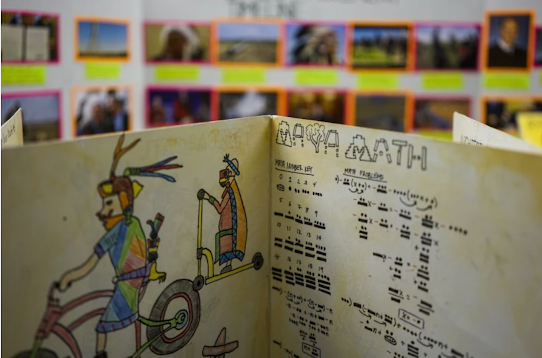
A student’s presentation for their ethnic studies class on display in a Los Angeles classroom.
(Kent Nishimura / Los Angeles Times)
BY SEAN ARCE, THERESA MONTAÑO AND GUADALUPE CARDONA
Removing the Indigenous concepts In Lak’ech and Ashe from California’s Ethnic Studies Model Curriculum, on the false premise that they are religious, sends a message to allof the state’s students, especially those who are Chicanx, Black and Native, that their cultures are not worth fighting for.
Last September, the Californians for Equal Rights Foundation and three San Diego parents sued the California Department of Education and the California State Board of Education, claiming that In Lak’ech was an Aztec prayer and Ashe was a religious chant. The suit argued that including texts that involved these concepts in the state’s recommended ethnic studies curriculum violated the Establishment Clause of California’s constitution. Last week, even though they denied the allegations and did not admit to any liability, the defendants settled the case to avoid further litigation. They agreed to excise both affirmations from the model curriculum and communicate those deletions to districts, schools and education boards.
The Californians for Equal Rights Foundation, a group that has worked against ethnic studies and anti-racist initiatives in San Diego schools, claimed that one of the In Lak’ech texts referenced in the recommended ethnic studies curriculum was an “Aztec prayer.” That poem, written by Luis Valdez and often used in California ethnic studies classes as an affirmation promoting values such as respect and empathy, is based in Mayan philosophy, not religion. The lawsuit also argued that an Ashe affirmation in the model curriculum was a religious chant, even though Ashe is a concept that refers to the power to effect change that comes from the Yoruba in Nigeria.
There is legal precedent that argues for including In Lak’ech: In Arce vs. Douglas, an Arizona case, the 9th Circuit Court of Appeals ruled that suppressing Indigenous knowledge constituted “racial animus” against Chicanx/Latinx.
Prior to last week’s settlement, less than 9% of the Ethnic Studies Model Curriculum was dedicated specifically to Chicanx/Latinx studies even though 55% of California’s K-12 students are Chicanx/Latinx. Eliminating the In Lak’ech Maya poem and Ashe African affirmation from the curriculum demonstrates both the lack of knowledge that leaders have about those cultures and a disinterest in standing up and fighting for students’ educational well-being, especially Black and brown students. This erasure of Indigenous knowledge is not new — American education is steeped in historical bias and racial trauma.
Many ethnic studies teachers feature In Lak’ech and Ashe in their classrooms to establish a sense of belonging, especially for Chicanx/Latinx and Black students. The removal of the concepts delivers the message to Chicanx/Latinx and African American/Black students that their communities’ knowledge and cultures are illegitimate and unworthy of defending. Notably, Chicanx/Latinx, Black and Native youth constitute the majority of California’s K-12 students but remain subject to a Eurocentric curriculum.
Passing AB 101, which requires California students to take an ethnic studies course prior to high school graduation, was a promise to honor the historical and cultural experiences of Chicanx, Latinx, Black, Asian and Pacific Islander, American Indian and other communities of color. As long as the In Lak’ech and Ashe concepts being taught do not reflect or promote discrimination against any person or group, or teach or promote religious doctrine, they are within the parameters of the legislation.
The majority of California’s student population should not have their cultures subject to erasure every time litigation is threatened. In the end, if our educational leaders remove key principles and concepts from the model curriculum instead of fighting for their inclusion, no matter how long or costly the court battle may be, they are essentially denying California’s students an authentic ethnic studies education and, in this case, dishonoring Indigenous legacies.
Sean Arce is an ethnic studies high school teacher in Los Angeles, the co-founder of Tucson’s Mexican American/Raza Studies Department and a plaintiff in the 9th Circuit case Arce vs. Douglas.Theresa Montaño is a professor of Chicana/o studies and a practitioner and activist in ethnic studies.Guadalupe Cardona is a secondary educator in the LAUSD.
This is amazing. Despite the Pandemic, relative to 10 years ago, there was a 160 percent increase in people identifying as Native American, adding 9.7 million Indigenous people to the count. Interesting story on how this happened that you can read about below.
I like the National Congress of American Indians CEO, Dante Desiderio's comments below, “We hope these data inform efforts to ensure that our schools teach more American Indian and Alaska Native history,” he added.
As I think of Native Americans and the U.S. Census, I am forever reminded of the important work by Stiffarm and Lane* who make a cogent case of the U.S. Census being a tool of what they term, "statistical genocide." Shrinking numbers have the impact of reinscribing the false myth of the "vanishing Native American," allowing for further incursions on tribal lands and sovereignty. These are really great news.
-Angela Valenzuela
#IndigenousRevival
#NativeAmericanStudies
Reference
Stiffarm, L.A. & Lane Jr., P. (1992). Demography of Native North America: A suestion of American Indian survival,” in M. Annette Jaimes, ed., The State of Native America: Genocide, Colonization and Resistance. Boston: South End Press.
American Indian and Alaska Native population figures jumped in the U.S. Decennial Census report released in August – a report originally slated for release in April. The outcome quelled fears that pandemic protocol restrictions would doom Native America to be even more undercounted than in previous national surveys.
Census authorities credited improved methodology for a 160-percent increase in people identifying as Indigenous. Their data reflects unprecedented tribal and community mobilization that helped overcome 2020’s heightened odds against inclusive results. From 2010 to 2020, the American Indian and Alaska Native in-combination population increased by 160 percent, according to a U.S. Census Bureau report and findings announced Aug. 12. That is a whopping rise of 9.7 million people. It brings the tally to 2.9 percent of the U.S. population – up from a previous 1.7 percent, or 5.2 million, recorded in the previous Decennial Census of 2010. The leap is more than a little bit due to novel question formulation in the more recent survey, explains Nicholas Jones, Race and Ethnicity Research and Outreach director for the Census Bureau.
Specifically he notes “significant changes from 2010 Census for race and ethnicity question designs, data processing, and coding.” These changes help improve answers to the survey’s Question 7, “What is this person’s race?”
For the first time ever, the checkbox for reporting American Indian and Alaska Native identities included examples. They were: “Navajo Nation, Blackfeet Tribe, Mayan, Aztec, Native Village of Barrow Inupiat Tribal Government, Nome Eskimo Community, etc.” Also for the first time, this checkbox category included a dedicated write-in area to submit such heritage specifics. As in the past, the survey item enabled each respondent to mark an “x” by more than one category. So, for example, an individual could answer Question 7 with White, Black, and American Indian, if desired. Also as in the past, individuals’ responses were based upon self-identification.
Another self-identification point, Question 6 — “Is this person of Hispanic, Latino, or Spanish origin?” — did not concern race, rather origin. So, respondents could identify themselves as, for example, Hispanic and Native, census explainers instructed.
In 2020, an additional 5.9 million people identified as American Indian and Alaska Native together with another race group, such as White or Black. Without that increase in reporting of Native multiracial inhabitants, the American Indian and Alaska Native population alone logged in at 3.7 million for the 2020 cycle. It accounted for 1.1 percent of all people living in the United States, compared with 0.9 percent, or 2.9 million, a decade ago. That’s a 27.1 percent bump, according to the Census Bureau’s calculations.
The bureau has been asking and refining the race question since 1790, only adding the Hispanic origin question in 1970. “These data are required for federal, state, and tribal programs and are critical factors in the basic research behind numerous policies, particularly for civil rights,” it says. Analysts use the findings to evaluate policies, ensure equitable service to all racial groups, and monitor compliance. The U.S Constitution mandates the decennial survey along with legislative redistricting based on it.
Dante Desiderio, the CEO of the National Congress of American Indians, the oldest and largest Native advocacy organization, said he is pleased the 2020 Census shows a surge in the Indigenous ranks. “We hope these data inform efforts to ensure that our schools teach more American Indian and Alaska Native history,” he added.
Native coalition effort to beat the odds against gathering representative information from Indian country. When the Covid-19 pandemic stalled census-taking just three days after its scheduled startup in March 2020, NCAI was among myriad groups and tribal governments that redoubled efforts to gather survey responses.
Native people, especially on reservations and in Alaskan villages, have been historically underrepresented in the census. In 2010, the undercount was nearly 5 percent, more than double that of the next closest population group. In 1990, the survey left out an estimated 12.2 percent of reservation residents. About one in three Native people lives in a hard-to-count census tract, NCAI notes. In 2020, the Census Bureau proposed “count committees”, in which representatives of tribes and other government jurisdictions could partner to promote citizen participation. The Turtle Mountain Band of Chippewa Indians was a trendsetter. The tribe formed a 100-percent tribal-member squad, which sent enumerators door-to-door leaving census information bags. The tribal government backed the effort with $15,000 including explanatory broadcast and internet spots.
When pandemic protocols all but precluded reservation travel in and out of many tribal nations, enumerators donned full protective gear to make their rounds. Turtle Mountain rewarded census responders with prizes. More than 250 vehicles arrived at one tribal event for the headcount. People who stopped by the tribe’s Sky Dancer Resort in Belcourt, N.D. to answer the survey were given cash-value cards.
Tribal representatives explained the motivation during a forum for tribes in the 12-state Denver region of the Census Bureau. “We’ve lost out on tens and tens of millions of dollars in state and federal aid, which would have come to us if the census count would have been more accurate,” Choctaw Nation Chief Gary Batton’s executive communications officer said of the 2010 exercise. At the time of the forum, in July 2020, most of the Northern Great Plains tribes had a response rate that lagged at 15 to 25 percent compared to a national average of 63 percent. Five of the region’s tribes, including the Northern Cheyenne, remained to initiate census taker visits due to pandemic lockdown.
Then, on Aug. 3, Census Bureau Director Steven Dillingham announced the decision to end the national field response operation one month earlier than its Oct. 31 extended deadline. Native Organizers Alliance lobbied to maintain the period be extended due to pandemic delays. Alarm spread throughout Indian Country when the U.S. Supreme Court upheld the decision on Oct. 13, and the director shut down the collection two weeks early.
The NCAI, Native American Rights Fund, and the National Urban Indian Family Coalition condemned the Supreme Court’s action. They said it favored former President Donald Trump’s effort “to suppress the count of Indigenous peoples … and the sacred trust the federal government owes to tribal nations.”
Yet, in the end, Dillingham announced a total response of more than 99 percent. “When Covid-19 turned everyone’s plans upside down, our partners rose to the occasion with creativity and perseverance,” he said.
Buffalo's Fire logo
Talli Nauman is an editor at Buffalo’s Fire. To reach her, email buffalo.gal10(at)gmail.com
I'm happy to introduce you to the work of Lee Klinger that appears in this book by Jacobs, D. T. [Four Arrows] (2006). Unlearning the language of conquest: Scholars expose anti-Indianism in America(University of Texas Press). He is the only non-Native American contributor to this anthology and his work is outstanding. His specific contribution is titled, "Ecological Evidence of Large-Scale Silviculture by California Indians," pp. 153-165. It debunks myths about Indigenous peoples of the Americas as lacking in technological know-how.
Far from it. Silviculture refers to the extraordinary scientific knowledge and wisdom of our Indigenous ancestors to maintain and preserve forests. Modern humans are mostly not even able to think at the level about which he writes and speaks as in this video appearing below. That is, our Native ancestors to this continent tended not only gardens and farms, but actual forests and woodlands. They set trees and forests on fire with great knowledge and intention, yielding the impressive groves of the giant sequoias and redwoods in the Northwestern regions of the country, known as California and Oregon today.
If we are to save ourselves and the planet, we would do well to revitalize and embrace Indigenous languages, wisdom, knowledge, and ways of knowing and being in relation with Mother Earth. Thankfully, as you can hear in this video presentation, this is exactly what Klinger is doing.
Great opportunity by the Harvard Latino Alumni Alliance to attend an event next Saturday, October 17 at 1PM CST, addressing "Indigeneity and the Latinx Community."
Thanks to Irene Gomez for sharing.
-Angela Valenzuela
DESCRIPTION: Latin America is home to over 800 Indigenous groups and 45 million Indigenous people, many of whom have migrated to the United States. Our Indigenous roots are often celebrated, yet the struggles and experiences of Indigenous people are regularly neglected or completely ignored in the mainstream. Join us for a conversation celebrating and unpacking Indigeneity within the Latinx community with Hugo Morales (AB '72 , JD ‘75) and Professors Floridalma Boj Lopez and Américo Mendoza-Mori on Saturday, 10/17, at 2 PM EST/ 11 AM PST. Register HERE.
Racism takes on many forms. Whether it be "the Zapatista rebellion in Chiapas, the emergence of the police communities and autonomous governments in Guerrero and Michoacán, or the emergence of Indigenous movements in several South American countries, among others," one should not assume knowledge about other Indigenous communities that have a different story to tell.
Como integrantes de un pueblo originario en el Sur de México (el Pueblo Mixteco o Ñuu Savi), y en estos años que llevamos ya como educadores y comunicadores comunitarios de nuestra región, una de las dificultades más comunes y poco discutidas que nos ha tocado enfrentar a varias compañeras y compañeros ha sido la romantización de nuestros procesos de resistencia comunitarios, lo cual se ha dado por parte de activistas, comunicadores, académicos, organizaciones y compañeros de otras latitudes.
¿En qué consiste esta romantización de las resistencias de los Pueblos Indígenas? Contrario a la conocida romantización de la pobreza, un discurso que premia o reconoce a quienes afrontan su pobreza sin atacar sus causas estructurales, la romantización de los Pueblos Originarios y de sus luchas es un discurso fundado en un estereotipo, un cliché con el que se invisibiliza la enorme pluralidad de formas de resistencia, simplificando o inscribiendo el concepto de resistencia Indígena a un muy limitado conjunto de características.
Entre esas características se halla la idea o el prejuicio de que las comunidades Indígenas estamos siempre en una clara oposición al Estado y al capital por el sólo hecho de ser Indígenas, o que por nombrarnos (o ser nombrados) como un Pueblo Originario nos hallamos aislados o alejados de la hegemonía cultural de Occidente; al igual que de fenómenos como la globalización o el neoliberalismo. Incluso, con la pandemia causada por el COVID-19, se ha difundido el mito de que los Pueblos Indígenas estamos venciendo al coronavirus gracias a nuestras formas históricas de organización, invisibilizando el hecho de que también hay comunidades que están siendo devastadas por este virus o por sus efectos sociales y económicos.
Esta romantización de nuestras resistencias y nuestra vida en general no es casual, y parece provenir de una lectura superficial y determinista de algunos acontecimientos que han sacudido a México y al mundo entero en las últimas décadas: la rebelión zapatista en Chiapas, el surgimiento de policías comunitarias y gobiernos autónomos en Guerrero y Michoacán, o la emergencia de movimientos Indígenas en varios países de Sudamérica, entre otros.
En resumen, se trata de un discurso que reduce la inmensa pluralidad de luchas y resistencias Indígenas a un conjunto particular de actores y sujetos que han figurado internacionalmente como opositores a políticas de despojo y de explotación capitalista en varias regiones y países. Dichas políticas existen también e indudablemente en la región del Pueblo Ñuu Savi, pero no con las mismas características o la misma intensidad que en un estado como Chiapas o Michoacán (en el caso de México), o en países como Bolivia y Ecuador.
En ese sentido, si bien es un hecho que la lógica del capital es la misma en todo el mundo, las estrategias de despojo y de acumulación capitalista varían dependiendo de la región en que nos encontremos, así como de la historia y cultura de cada pueblo y cada comunidad. Por ello, las estrategias de resistencia al despojo o a otros agravios de una comunidad zapatista en Chiapas o de una organización Indígena en un país como Bolivia o Ecuador, por ejemplo, no han sido ni serán necesariamente idénticas a las que despliega una comunidad Ñuu Savi.
A pesar de que esas diferencias entre pueblos y experiencias parecen obvias, es curioso que no dejan de ser muchas las compañeras y compañeros que alentados por esta visión romántica de lo Indígena y lo comunitario, acuden entusiasmados a conocer y participar en procesos político-comunitarios, con el afán de encontrar o desarrollar un proceso organizativo con una súbita definición política frente al Estado, el capital o la occidentalización de la vida. Esta búsqueda ha terminado en más de una ocasión, en la frustración y/o el abandono de dichos procesos, por muy valiosa que sea la experiencia forjada en ellos, al no haber podido reproducir una experiencia idéntica o similar a la de los Municipios Autónomos Zapatistas en Chiapas o a la de organizaciones Indígenas como las que integran la CONAIE en Ecuador, por poner dos ejemplos conocidos en Latinoamérica.
No es difícil suponer que casos similares a los vividos en el Pueblo Ñuu savi se repiten en otras partes del mundo, conduciendo probablemente al abandono de varios proyectos organizativos o de resistencia, los cuales, más allá del éxito o el fracaso que se puede calificar en ellos –y desde un punto de vista pedagógico- no dejan nunca de ser útiles para discutir, entender y emprender esfuerzos conjuntos para la defensa de la vida, la tierra y el territorio.
En nuestra radio comunitaria, por ejemplo, esta idea romántica de la lucha y la resistencia Indígena ha acarreado varios desencuentros entre el trabajo que ha venido realizando hasta hoy la Radio Comunitaria Ñuu Dee; hay quienes buscan emprender o desarrollar un proceso político como si nuestras comunidades se encontraran bajo el asedio violento y encarnizado de agentes del Estado, de alguna empresa transnacional o de alguna organización delictiva.
A diferencia de comunidades como Cherán en Michoacán, el municipio de Sacamch'en en Chiapas, o los pueblos del Yasuni y la Amazonía que se oponen a la explotación de su territorio en Sudamérica, nuestras comunidades Ñuu savi nos hablan de problemas, necesidades o urgencias que no demandan necesariamente la desaparición del Estado o de la autoridad local, incluso, en algunos casos lo que se exige es la comparecencia de ambos para dar respuesta a esos problemas y a esas necesidades, de tal forma que mucha de la resistencia comunitaria (en la que nuestra radio participa activamente) se traduce justamente en eso: no dejar que los gobiernos (federal, estatal o municipal) pasen por alto sus deudas y responsabilidades históricas con nosotras y nosotros, las siempre olvidadas y olvidados en la historia de este gran país llamado México.
Por todo lo anterior, resulta indispensable y necesario que antes de cualquier cosa se ponga oído a la voz propia de nuestras comunidades, y lo que decimos de nuestras formas o estrategias de resistencia, de lo que buscamos o perseguimos, sin prejuicios ni falsas expectativas, asumiendo un respeto pleno y cabal como hermanas y hermanos, como compañeras y compañeros. Debemos hacernos escuchar, más allá de que lo que se oiga o lo que se vea, aunque no encaje con una particular visión del mundo, o deje insatisfecho política e ideológicamente a más de uno; de lo contrario, además de seguir enfrentando el racismo y la violencia estructural de una elite o clase acomodada, seguiremos viéndonos discriminados ante visiones puristas y románticas de la resistencia Indígena y comunitaria.
--Emiliano Gómez Izaguirre, Se'e Ñuu savi (hijo del pueblo de la lluvia) del Municipio de la Heroica Ciudad de Huajuapan, Oaxaca, Mexico. Cursó la Licenciatura en Ciencias Políticas por la UNAM y la Maestría en Comunicación y Política por la Universidad Autónoma Metropolitana – Unidad Xochimilco. Fue integrante del Centro de Apoyo Comunitario Trabajando Unidos (CACTUS). Actual coordinador de Radio Comunitaria Ñuu Dee en Huajuapan, Oaxaca.