Translate

Showing posts with label Latino identity. Show all posts

Tuesday, July 30, 2024

Latino, Hispanic, Latinx, Chicano: The History Behind the Terms—as my blog soon reaches 3 million page views!

Friends,

I enjoyed reading this piece and seems to be a good one to ponder as my blog soon reaches 3 million pageviews! Thanks to all my loyal readers from throughout the world who find it useful. Don't hesitate to reach out to me if you have any questions, concerns, or suggestions. I've been doing this for a long time and plan to continue as long as I can. Heck, it's my civic duty. Now, to this post.

To complexify the analysis of identity in this piece, the author would do well to additionally incorporate Afro-Indigenous, Afro-Latina/o/x, and Indigenous identities to the mix. Why? As I look at all the work that so many of us are doing in our communities, it's fully about honoring and centering our own diverse identities and Indigeneities like we're accomplishing at our Saturday School, Academia Cuauhtli, and our annual Aztech Kidz Code Summer Camp. At our school and summer camp, we don't seek to turn anyone into an Aztec, but rather to use Aztec and Mayan knowledge and wisdom as a point of departure for students to explore their own identities.

Takeaways? Culture is a powerful social construction, especially when we decide as people at a particular point in history to call ourselves. Culture also inescapably evolves both within communities and in the broader society. It's therefore important now more than ever to speak another language or languages and to become culturally and linguistically competent no matter the anti-DEI or anti-CRT racist agenda pursued by Texas Senators. Becoming competent in these ways is definitely empowering, however, it doesn't happen overnight and requires lifelong learning and investment.

The beautiful part of all of this is rather than "being named," which objectifies us as people, the right to name ourselves is an exercise in being powerful human subjects, authors of our own identities and destinies. Expressed differently, the act of self-determination disrupts the harmful aspects of Western colonization like individualism, extractivism, and viewing Mother Earth as expendable. 

If you have any doubt about this, check out the US wildfire, smoke map: Track latest wildfires, red flag warnings across the US. It's so sad to learn of the terrible devastation with animals losing their habitats and lives and folks losing their homes, well-being, and in some instances, their very lives.

These epistemologies or ways of knowing, have not served any of us or the planet well. Please don't misunderstand. Collectivism, the opposite of individualism, is fully compatible with innovation, freedom, and autonomy.

Indigeneity helps us to get connected to the root of our identities where the knowledge and wisdom of our ancestors and community reside.

-Angela Valenzuela

Latino, Hispanic, Latinx, Chicano: The History Behind the Terms

The effort to coin a term to describe a wildly diverse group of Americans has long stirred controversy.


by Yara Simón
 Original: 

Saturday, April 25, 2020

Mexican Embassy and CAL Opens Doors to Hundreds of Free, Authentic Spanish Language Resources Online

Thanks to my colleague, Dr. Deb Palmer, for sharing information on this treasure trove of online resources to promote Spanish-English bilingualism and biliteracy.

Gracias!!!

-Angela Valenzuela 💖
NEW RESOURCE: Mexican Embassy & the Center for Applied Linguistics (CAL) Opens Doors to Hundreds of Free, Authentic Spanish Language Resources Online

EMBAJADORA MARTHA BÁRCENA


On Monday, the Center for Applied Linguistics in collaboration with the Embassy of Mexico announced the free release of hundreds of online, authentic Spanish language educational materials for language teachers across the United States, including digital textbooks, movies, videos, audioclips, and more. 
“Being bilingual among the Mexican and Mexican American communities in the United States defines our identity and reflects an inescapable reality: we are sister nations united by a common history,” said Mexican Ambassador, Martha Bárcena. “We invite the public to discover RedBilingueMexUS.org so that together we can promote this shared identity through the learning of our languages.” Read the full press release.


Visit RedBilingueMexUS.org


Friday, November 01, 2019

Rudy Ramirez's FuturX Festival Puts Latinx Performance Center Stage

Rudy Ramirez is a brilliant theater director and we are so fortunate to have him here in Austin.  His equally brilliant and beloved mother, Dr. Blandina "Bambi" Cardenas, too.  Due in great part to the existence of the black-white binary—where race for these groups stubbornly equates to "black" or "white," invisiblizing Latinx peoples—we who are Latinx know just how woefully under-recognized in all our complexity we are in society, politics, and the arts.  Through his award-winning theater, Rudy is helping to change this.  And how better than through theater and the arts?  I love this quote from this piece:
"It's necessary to tell stories that say, 'Our beauty doesn't come from fitting into the idea of what a citizen or a woman should be, but rather, our absolute inability to be contained by those words.'" 
To get a taste of his magic, consider attending the FuturX  theater & performance festival next week at the VORTEX Theater.

Congratulations, Rudy! We love all that you do. By attending to our multiple marginalities, your raise silent voices and un-mute unspoken topics that promise to liberate, even as they complexify. Godspeed!

-Angela Valenzuela

Rudy Ramirez's FuturX Festival Puts Latinx Performance Center Stage

The theatrical Renaissance man moves Latinx performance out of the margins
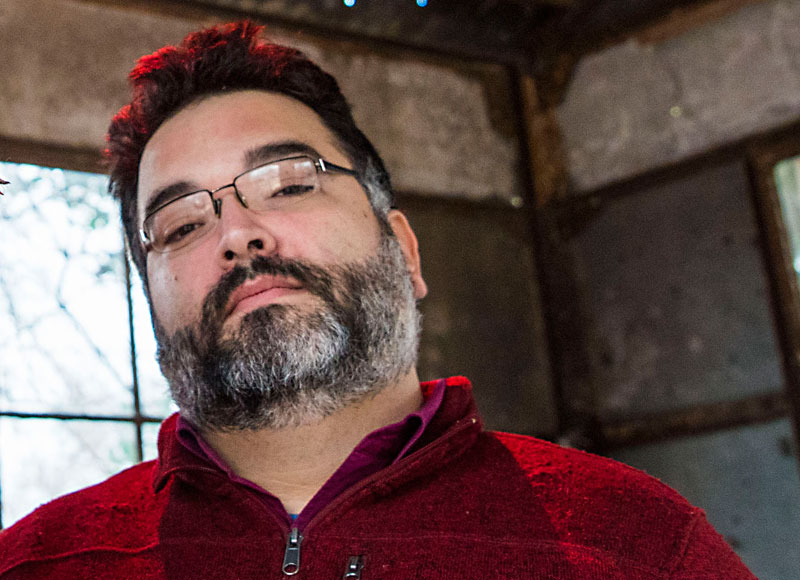
Rudy Ramirez (Photo by David Brendan Hall)

Representation.  Its importance is a hot topic among theatremakers. But when the conversation shifts toward actually achieving it, Rudy Ramirez believes a lot is left unsaid. "People don't tend to think about diversity within communities of color. They don't think it's there." As a member of both the Latinx and queer communities, the award-winning director has time and time again found meaningful onstage inclusion either lacking or nonexistent. "I realized if I was going to talk about Latinx experience in a non-simplified way," Ramirez says, "it'd have to be from my own perspective."
In recent years, Ramirez has led a charge for broader Latinx visibility in Austin's performance scene. Doing so across several mediums, the artist's most notable push began in 2018 in the form of the FuturX Festival, a multi-day showcase of forward-thinking, Latinx-penned performances, including solo shows, plays, improv, and a host of avant-garde work.
Described by collaborators as a "theatrical Renaissance man," Ramirez seems the ideal candidate to organize this event. Since beginning his tenure as Vortex Repertory Company associate artistic director in 2011, the artist has earned a reputation (as well as five B. Iden Payne Awards and a Chronicle "Best of Austin" award) for staging fresh, challenging work. "Rudy has this ability to recognize and summon people's internal power," says actor/playwright Krysta Gonzales. "When you invite people in to see what they have to offer, magic happens."
At its core, FuturX is just that: an invitation to experiences typically hidden from the mainstream. "I'm interested in highlighting the margins of Latinidad," says Ramirez. "Latinx identity in dialogue with, say, indigenous, African American, trans, or queer identity." Considering their affinity for inclusive narratives – the artist is currently directing three: one for bilingual theatre company Teatro Vivo and two for FuturX – it's telling that until 2015, Ramirez hadn't staged a Latinx-written show: "There was no real opportunity to do anything that spoke to my background. Even when I found ostensibly 'Latinx' work, I wasn't connecting with it specifically."
Like many creatives of Mexican descent, Ramirez's heritage isn't exactly simple. Their father descended from a long line of working-class Tejanos and his mother from 20th-century Mexican landowners fleeing political unrest – leaving their son with a complicated understanding of class and race that never aligned with propagated Latinidad narratives. "Chicano theatre is often about certain experiences: being an immigrant or migrant worker. There are experiences of Mexicanidad that I'll never know – and to stage those stories would be appropriative." It doesn't help that these narratives are frequently resolved in predictable ways. "I've always been chafed at those plays that culminate in the embrace of family and tradition – 'Always trust what abuelita says.' As a queer person, I can't readily look at tradition as 'that's where home is.' The home I've mostly made for myself is with friends: my chosen family."
Ramirez would chase his own representation through playwriting, performing their solo piece Promised Land: A Radical Queer Revival in 2009 and the duo show Footnotes for People Who Don't Speak Spanish with Beliza Narvaez in 2011. Then, in 2015, things finally clicked. While directing Tanya Saracho's El Nogalar, a loose adaptation of Anton Chekhov's The Cherry Orchard set against the backdrop of Mexico's drug wars, they saw reflections of their family's unique backgrounds: namely, their father in the hardworking, class-conscious character Lopez. "[Nogalar] addresses prevailing attitudes in upper-class Mexican culture vs. working-class culture. It felt like two halves of myself meeting for the first time."
Today, El Nogalar remains a blueprint for Ramirez's FuturX planning, not only for its thematic freshness, but for how Saracho's writing refuses easy answers. "As terrifying as the drug cartels have been, they're one of the few opportunities for working-class folks to gain wealth in a segregated, caste-like society. Classism is always racism in Mexico, and there's nowhere near enough work about the racism we put on each other." Ramirez's eagerness to complicate conversations surrounding Latinidad would similarly draw them to directing FuturX's first headline performance, (Un)Documents, Jesús I. Valles' poetic solo show that, in addition to foregrounding queer Latinx intersectionality, balanced the question of "Why fight for citizenship if, to exist, it must delegitimize?" against "What happens without it?"
"Tension is one of my favorite words in theatremaking, saying, 'Neither answer is right, so let's sit in that neither-is-right-ness and experience the pull.' Maybe there we'll find something new." This year, in staging Krysta Gonzales' new play Más Cara at FuturX, the director aims to bring that same dramatic tension to another rarely seen experience: Latina womanhood. A fantastical dissection of gender expectation and tradition, 2019's flagship show follows headstrong Latina Alma on a lifelong journey toward self-respect. Her quest is aided by Mexican folklore goddesses Coatlicue, La Llorona, and Tonatzin – themselves representing archetypes of Mexican femininity. "While [Más Cara] is about empowerment for women, it refuses to say, 'And that's when I left my husband, lived my best life, got remarried ....' Sometimes you don't find somebody else, but nevertheless, respecting yourself necessitates that sacrifice."
As each passing rehearsal brings FuturX 2019 closer, Ramirez has been reflecting on how these performances shaped their up-and-coming festival. "It's necessary to tell stories that say, 'Our beauty doesn't come from fitting into the idea of what a citizen or a woman should be, but rather, our absolute inability to be contained by those words.'" While Ramirez will be the first to tell you that representation is a complex, multifaceted subject, it seems that so many of their efforts center on that basic idea of resisting containment, be it in the form of easy answers, tired narratives, or someone else's expectations. "When you're Latinx, so often you're told, 'You're just too much, too emotional, too sexual, too needy ...' I think sometimes the 'too much' is them saying, 'There's too many of you.' Look at some theatre seasons, and apparently, yeah, even one Latinx program is too much." Clearly, there's work to be done, but where better to begin than affording voice to unheard perspectives?
"We want to create work that says, 'I'm not too much. I'm enough,'" says Ramirez. "'And if you don't think so, you'd better get out of the way.'"

Sunday, November 18, 2018

What It Means to Be ‘Latinx,’ and What That Means for America by Julian Castro

So many people are exploring not solely "Latinx identity," per se, but also what it actually means.  Here, Julian Castro reviews a book on the topic by Dr. Ed Morales titled, Latinx: The New Force in American Politics and Culture.

Personally, I like the gender neutral part of the expression and also that it's a millennial development and I really love my millennial students and have two millennial children of my own.

The "Latin" part of the word is the rub for me as it smacks of assimilation as it suggests that we're "Latin," from Europe when we're not.  Even if our genes travelled all of the world, our people did not.  

Moreover, in some situations, "Latinx" can inadvertently participate in the erasure of history.  What comes to mind, in this regard, is the establishment of the "Chicana Caucus" at the National Association for Chicana and Chicano Studies," where some wanted to change the name to the "Latinx Caucus" a few years ago.  This put the caucus in an interesting situation due to its long history of progressive politics, but pushed back on this specific proposal in order to preserve the history of the caucus.

I'm confident that this kind of situation is playing out across many different contexts and is certainly something that must get discussed and negotiated.

That said, what I do like of Castro's reading Morales’ analysis of Latinx identity is that the x is variable, beyond the gender neutrality it clearly represents.  As an umbrella term, it conveys mestizaje, hybridity, and a spectrum of identity.  

My sense of where this will all go at least with respect to everyday social relations is in the direction of "situational ethnicity" where depending on the context, one's ethnic identity either gets displayed or concealed.  In some contexts, Latinx makes sense.  In others, it won't.

I conclude by citing another important work by political scientist Dr. Cristina Beltran, author of the book, The Trouble with Unity: Latino Politics and the Creation of Identity.  I think she nails it when she offers the following:


"Latino," like the category "women," should be reconceived as a site of permanent political contestation. 

This is a reasonable conclusion to draw and this is a good problem to have.  Thanks to Paul Saldaña for sharing.

Angela Valenzuela
c/s

What It Means to Be ‘Latinx,’ and What That Means for America

A crowd at the 2018 Puerto Rican Day Parade in New York City.CreditBebeto Matthews/Associated Press

Image

By Julian Castro
LATINX
The New Force in American Politics and Culture
By Ed Morales 368 pp. Verso. $24.95.
A crowd at the 2018 Puerto Rican Day Parade in New York City.CreditCreditBebeto Matthews/Associated Press

In September, just in time for Hispanic Heritage Month, the Merriam-Webster Dictionary recognized the word “Latinx,” which it defines as “of, relating to or marked by Latin American heritage — used as a gender-neutral alternative to Latino or Latina.” I was happy to see the addition, and also more than a little amused. I thought back to my freshman year of college in 1992. As I sat in a computer room in my dorm working away on an early Macintosh, a red squiggly line immediately appeared underneath the word “Chicano” after I typed it into the paper I was writing about my family’s background. When I hit the spell check to see what the problem was, Microsoft Word had a suggestion: Chicago. “You don’t even exist,” popped into my head. Unfortunately, this wasn’t a new experience. Years earlier, in middle school, I’d been asked to fill out a form that included a question about my background. There were three options to choose from: black, white or other. “Well, I’m not black or white,” I remember thinking, pencil in hand, “but I don’t like the sound of ‘other.’” I left it blank.
For many Latinos, stories like these are all too familiar. In “Latinx: The New Force in American Politics and Culture,” Ed Morales fills in that blank as well as the long, painful, complex and intersectional struggle for identity that has shaped America’s Latino community. As Morales notes, Latinx is just the latest in a series of terms, from Hispanic to Latino/a and even Latin@, employed to refer to individuals of Latin American heritage in an inclusive way.
Reading Morales’s dissection of Latinx identity formation, however, one begins to believe that the x in “Latinx” is more than just a means of providing gender-neutrality. As in algebra, the x is variable. How a Latino or Latina perceives himself or herself — and how he or she is perceived by others — often depends on context. Unhappy with the binary notion of race popular in the United States, Morales offers the concept of mestizaje, or hybridity, that encompasses a spectrum of identity, the result of hundreds of years of intermixing among African, European and indigenous peoples in Mexico, Latin America and the Caribbean. Latinos can be black, white, brown or anything in between. Skin color, national origin, whether one lives in the mainland United States or outside of it, and one’s ability to speak Spanish, not to mention gender and sexual orientation, all play a role in one’s self-concept.
Morales, an adjunct faculty member at Columbia University who describes his own identity as that of a “racialized person living in a U.S. megacity, who has a somewhat ambiguous phenotypical appearance,” proves refreshingly introspective, weaving enough personal biography into the book to pull the work back from veering too far into inaccessible academic jargon. “In my own extended family, there is generally a disdain for blackness,” he writes, and tells of his father, who “traded on Anglo-Americans’ perceptions of his whiteness if it helped him in financial or social transactions, yet sought to avoid complete identification with whiteness when it came to his ‘real’ identity.”
According to the 2010 census, there were 55 million Latinos in the United States, and they made up 23 percent of Americans under the age of 18. Today, although Asian-Americans are now growing more quickly in percentage terms, Latinos are still growing fastest numerically. That means the destiny of the United States and the destiny of the Latino community are powerfully intertwined.
“The American identity will never be fixed and final; it will always be in the making,” Arthur Schlesinger Jr. wrote a quarter century ago in “The Disuniting of America: Reflections on a Multicultural Society.” While Schlesinger’s observation may be true, it is much easier asserted than accepted.
With his boogeyman approach to electoral politics, Donald Trump has deftly exploited anxieties about the impact of America’s changing demographics on our national identity, and no group has been more vilified by Trump for political purposes than Latinos. After declaring in his announcement speech that Mexico was sending rapists and drug runners to our country, months later Trump dismissed questions about the legitimacy of fraud claims against Trump University by insisting that the American-born judge of Mexican descent who was presiding over the case could not do his job right because “he’s Mexican!” His administration has been even worse, cruelly separating families apprehended at the Southern border, failing to adequately respond to Hurricane Maria and then dismissing the deaths of 3,000 Puerto Ricans as mere fantasy concocted by political opponents.
It is no surprise, then, that the Latino community is widely misperceived and is especially in need today of voices to defend and humanize it. In this way, “Latinx” couldn’t be timelier. For one thing, Morales shatters Americans’ view of the community as monolithic. Although nearly two-thirds of Latinos claim Mexican heritage, Puerto Ricans, Cubans and a growing community of Latinos from Central and South America each have unique cultural and political experiences in the United States.
Morales explores these to varying degrees, and, importantly, makes clear that Latinos have been integral to America’s progress for generations, even as they have grappled with relative invisibility, outright rejection of their place in America and internal struggles about their own identity. He reminds us that it was Gonzalo and Felícitas Méndez, the Mexican-born father and Puerto Rican mother of daughter Sylvia Mendez, who challenged California’s separate and unequal “Mexican schools,” winning an appellate court victory in 1946 that paved the way for the Supreme Court’s opinion in Brown v. Board of Education that struck down racial segregation in schools eight years later.
Morales’s writing can be hyperbolic at times. “For an American economy that has been largely stagnant, the opening of Cuba is a last-ditch opportunity to stave off looming worldwide economic disaster,” he writes of President Obama’s efforts to open up Cuba to American investment. Still, the book’s deep dive into the crosscurrents of Latinx identity is a powerful reminder that, as Americans wrestle with questions about who is and who is not “American” — and, indeed, questions about what it means to be an American in the 21st century — the nation can benefit immensely from the robust inclusion and understanding of a community that has spent generations grappling with nearly every facet of its own identity.