Translate

Showing posts with label hybridity. Show all posts

Tuesday, April 15, 2025

Harvard takes a $2B hit after defying Trump administration—Today is a Proud Day in Our Nation's History

Friends:

I wish there were more universities standing up to this bald, partisan agenda, and ever so glad to see Harvard University taking a stand and willing to take a hit for it by the Trump administration. And indeed, it has to the tune of $2 Billion, no less. What is the cost of freedom—the freedom to teach, learn, and conduct research—a question that Harvard's leadership is implicitly answering?

The Trump administration is holding universities responsible for broader cultural shifts that extend far beyond the scope of any single institution, including Harvard. These shifts challenge the outdated notion that identities—whether racial, ethnic, or gender-based—as fixed. In truth, identity is inherently fluid, continually shaped by both political and apolitical forces, by tradition and the evolving demands of the modern world. Attempting to confine such complexity within neatly labeled boxes to appease those in power is not only misguided—it’s ultimately a futile endeavor. 

As Chicana feminists, beginning with the late Gloria Anzaldúa, have long argued, the future of culture is hybridity. Its power extends far beyond the walls of the academy into the streets of Calcutta, the highways of the Americas, the songs of the diaspora, and the quiet rebellions of everyday life. It moves like water—resisting containment, carving new paths, refusing to be still. To reduce it to something static is to deny its essence, for culture lives not in boxes, but in motion, in memory, and in the ever-shifting dance of who we are becoming.

Our colleges and universities are those sanctuaries within which these processes are researched and discussed—spaces where the fluidity of culture is not only acknowledged but actively engaged. In a world increasingly polarized by rigid ideologies and political agendas, universities provide the intellectual freedom and critical distance necessary to explore the complexities of identity, belonging, and transformation. They are among the few places where competing truths can be interrogated, where the past is held up to the light of the present, and where visions for more inclusive futures can be imagined and debated.

As Chicana feminists have long reminded us, hybridity is not a flaw in culture but its future—an ever-expanding, layered process of becoming that defies singular definitions. Universities play a crucial role in cultivating this vision by nurturing curiosity, protecting dissent, and making room for voices that have historically been silenced or ignored. To weaken these institutions under the guise of control or conformity is to endanger one of the last bastions where knowledge is pursued both for its own sake and in pursuit of a more just, humane, and dynamic world. 

The university’s lawyers argued that the Trump administration's demands encroach on long-established university freedoms upheld by the Supreme Court. In their response, they emphasized that the university would not compromise its independence or forfeit its constitutional rights, asserting that neither Harvard nor any other private institution should permit itself to be overtaken by the federal government.

Today is a proud day for Harvard University and our nation's history. What is the price of freedom? It's priceless. Harvard is letting us know.

-Angela Valenzuela


Harvard’s response represents a rare show of resistance to efforts by President Donald Trump’s administration to punish major institutions and law firms he views as hostile. | Scott Eisen/Getty Images


The university said it would not comply with the list of demands that included changes to code of student and faculty conduct.

By Ali Bianco

04/14/2025 03:09 PM EDT

Updated: 04/14/2025 09:33 PM EDT

A Trump administration task force announced Monday that it would block Harvard University from receiving $2.2 billion in federal grants and $60 million in contracts after the Ivy League school defied demands to adopt new policies on student and faculty conduct and admissions.

The Joint Task Force to Combat Anti-Semitism said it was taking the measure because Harvard and other universities had not taken adequate steps to address the harassment of Jewish students in recent years.

“It is time for elite universities to take the problem seriously and commit to meaningful change if they wish to continue receiving taxpayer support,” it said in a statement that came hours after Harvard had defiantly said it would not bow to administration pressure.

Harvard President Alan M. Garber said the unprecedented demands, which include requirements to change disciplinary policies to address antisemitic acts during last year’s protests over the Israel-Hamas war, are unnecessary and infringe on free speech rights.

“No government — regardless of which party is in power — should dictate what private universities can teach, whom they can admit and hire, and which areas of study and inquiry they can pursue,” Garber wrote in the message to the campus community.

Harvard’s response, in the face of a threat of losing billions in federal grants, represented a rare show of resistance to efforts by President Donald Trump’s administration to punish major institutions and law firms he views as hostile.

The loss of federal funding is a significant blow to Harvard and affiliated institutions, such as Mass General Brigham and Boston Children’s Hospital. Other schools, including Columbia University, have opted to accept administration demands to avoid the cuts.

Institutions across the country are facing probes focusing on diversity initiatives and allegations of antisemitism on campus. Trump has particularly singled out Ivy League schools that he has denounced as left-leaning and elitist. The administration has said it is also either reviewing or pausing grants to Brown, Princeton, Cornell and the University of Pennsylvania.

Princeton President Chris Eisgruber, like the leader of Harvard, has said he would resist administration demands.

Former Harvard President Larry Summers told a group of students and alumni last week that the school is positioned to resist because of its nearly $52 billion endowment. “With all of those assets — If Harvard can’t resist, who can?” he said.

The administration sent an updated list of demands Friday to Harvard that would require the university to restructure its governance, eliminate diversity as a consideration in admissions, institute new disciplinary measures for student protesters, and decertify pro-Palestinian student groups. Garber said the school had already adopted measures to address antisemitism and other misconduct that occurred during raucous protests over the war in Gaza.

“The administration’s prescription goes beyond the power of the federal government,” he said. “It violates Harvard’s First Amendment rights and exceeds the statutory limits of the government’s authority under Title VI. And it threatens our values as a private institution devoted to the pursuit, production, and dissemination of knowledge.”

White House spokesperson Harrison Fields said in a statement that the administration was seeking to end “unchecked” antisemitism and that Harvard’s response puts its federal funding in jeopardy.

“Harvard or any institution that wishes to violate Title VI is, by law, not eligible for federal funding,” Fields said.

The letter the administration sent Friday — from the Department of Education, the Department of Health and Human Services and General Services Administration — accused Harvard of failing to “live up to both the intellectual and civil rights conditions that justify federal investment.”

Harvard’s response to the administration defended the university’s commitment to fighting antisemitism on campus, and said the administration disregards” the changes already made by the university. The university’s lawyers said the demands “invade university freedoms” long recognized by the Supreme Court.

“The university will not surrender its independence or relinquish its constitutional rights,” the lawyers wrote in response. “Neither Harvard nor any other private university can allow itself to be taken over by the federal government.”

Bianca Quilantan contributed to this report.


Thursday, December 26, 2019

‘¿Qué Es Una Lengua Pura?': College Class Challenges Negative Perceptions of Spanglish

It really is unfair to Mexican Americans and other brown people that they should be expected to know Spanish when this has been mostly denied to us in this country, particularly as non-immigrant, Mexican Americans—who are, of course, the largest share of all Mexican-origin peoples.
I can speak personally to how this is frequently a painful experience to see not only others' expectations frustrated or disappointed, but to hold oneself up to these same expectations when the support for Spanish is intentionally, via language policy, not there either in the classroom, workplace, social media, or society, as a whole.

And then we're even more shamed when non-Latinos—because of their travels abroad or the benefits from a dual language education program—speak Spanish fluently. This despite the fact that for so many of us, as well, our childhood tongue, our first language, is Spanish. I wrote a whole book about this titled, Subtractive Schooling, that I encourage you to read if anything like this describes you—or even if it doesn't so that you can be informed about the complexities of the situation.

Sadly, most Latin@ children in this country are on the receiving end of implicit and explicit messages that their Spanish and identities are wrong—when nothing could be further from the truth! As suggested herein, when their identities and speech are hybridized, the world is that much more nuanced and rich.

For these reasons, speaking, reading, and writing in Spanish has been a lifelong project for me. Career-wise, as well. I advocate with others in my community to extend language rights and opportunities to children and local, district, and state levels. This is and continues to be a Mexican American Civil Rights agenda supported by pretty much all of our national, Civil Rights organizations (e.g., LULAC, MALDEF, LatinosUS, National Association for Bilingual Education [NABE], and the National Latino Education Research and Policy Project [NLERAPP]).

To help at least some children to not have to endure the pain and humiliation associated with unfair societal expectations, on the one hand, and to celebrate bilingualism and multiculturalism, on the other, we founded a Spanish language revitalization project, a Saturday school named Academia Cuauhtli (Eagle Academy), in Austin, Texas. We want our children to value and speak the Spanish language and for our families to be supported in this way. We also want them to think critically about the many social and historical forces that have worked to delimit our power as individuals and as a community and how to struggle effectively against this.
Another point related to this piece below is that the very concept that there is a pure language is false. Languages that are pure die. Remember Latin? Esperanto? With some estimates as low as 20%, only up to 33% maximum of English is derived from Old English. We don't think about it that way, but we're always "code switching" just speaking the English that we speak. Thanks to Noelia Cortez for sharing. -Angela Valenzuela

‘¿Qué Es Una Lengua Pura?': College Class Challenges Negative Perceptions of Spanglish

  OCT 25, 2019


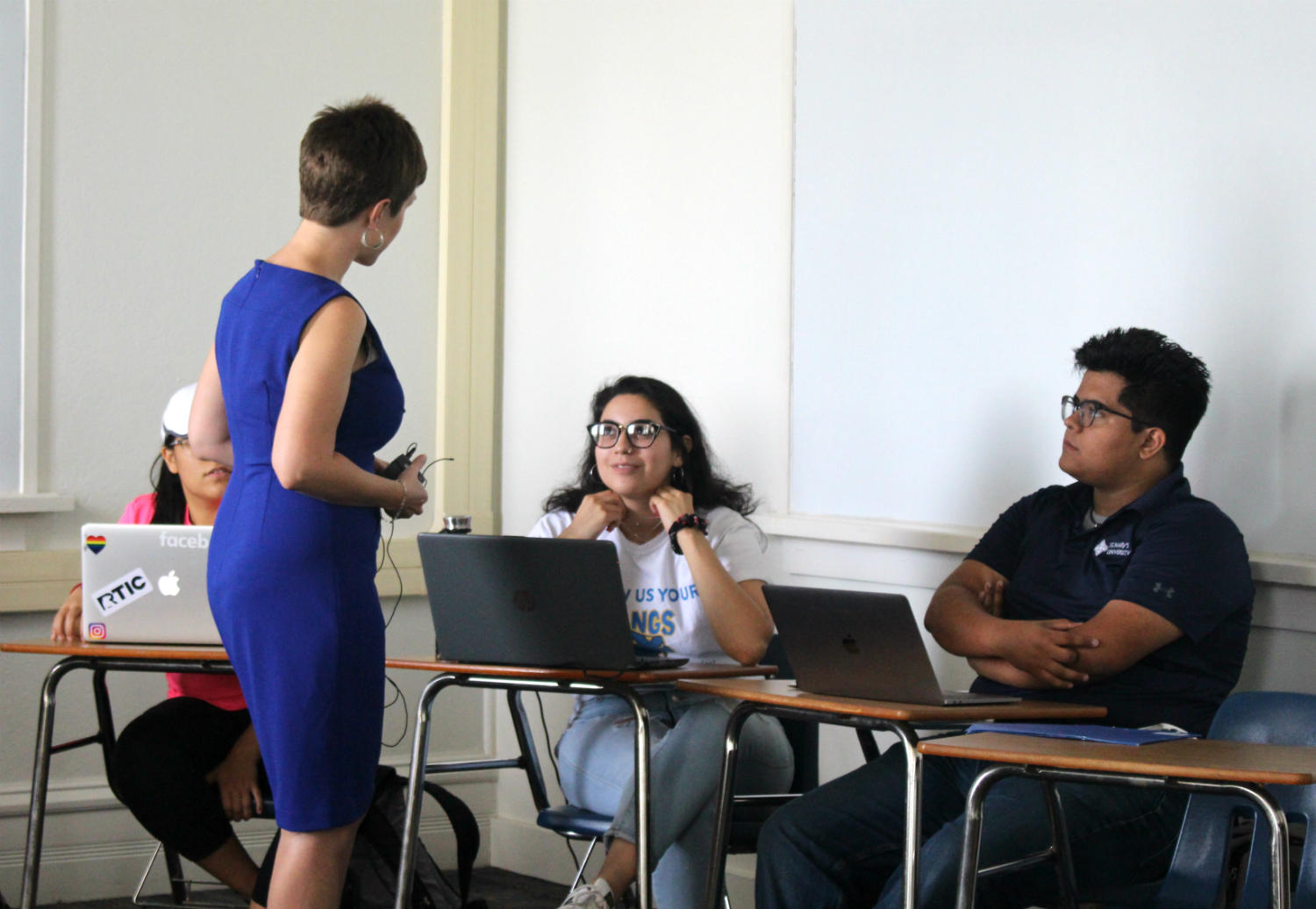
St. Mary's University Professor Meghann Peace speaks to a student in her Heritage Spanish class on Sept. 23, 2019.
CAMILLE PHILLIPS | TEXAS PUBLIC RADIO


College freshman Angie Bravo’s first language is Spanish, but she wishes she were better at it.

The 18-year-old grew up in Laredo, Texas, just across the border from Mexico. Like many of her neighbors, she speaks a version of Spanish influenced by English.


Even in a state like Texas, where nearly 30% of the population speaks Spanish at home, there’s a perception that it’s better to speak “pure Spanish.”

But, as Bravo is learning this semester, there’s nothing wrong with the way she speaks the language. It’s just a different dialect than the one spoken in Madrid or Mexico City.
A Dialect Like Any Other
Instead of focusing on grammar and vocabulary, St. Mary’s University’s Cultural Spanish for Heritage Speakers class covers the history and culture of U.S. Spanish, the dialect commonly called Spanglish.
Professor Meghann Peace set up a recent lesson by asking students to match Spanish words with their languages of origin: Greek, Latin, Arabic, indigenous American tongues.
“What history teaches us is that the only constant is change,” Peace said in Spanish. “Whenever two languages have geographic contact they’re going to influence each other.”
She showed the class quotes about Spanglish from poet Octavio Paz and literary critic Roberto González Echevarria — Paz called it “abominable”; Echevarria called it an “invasion” — and asked the students if they ever get negative reactions like that when they speak in Spanish.
Students in St. Mary's University's Heritage Spanish class look at quotes illustrating negative opinions about the U.S. Spanish dialect commonly called Spanglish.
CREDIT CAMILLE PHILLIPS | TEXAS PUBLIC RADIO

Mary Villines said people who only speak Spanish or English sometimes assume she doesn’t speak their language well if she code-switches.
“But what bothers me is that they only speak one language,” Villines said in Spanish. “Who are you to correct me when you don’t even know what I’m trying to say?”
Peace said that people who speak Spanglish actually know both languages well.
“Spanglish is super systematic,” Peace said in Spanish. “Someone who switches between languages in a single sentence follow the syntax rules of both languages.”
Language and Identity
That explanation resonated with Bravo, who said the class is starting to change her opinion of the way she speaks Spanish.
“It's taught me to be a lot more accepting,” Bravo said. “I'm still aiming to be able to carry a full conversation in Spanish … but I didn't really take into account the rules that we don't speak about, but we understand.”
For her, language is intertwined with the changing way she sees herself.
“When I was growing up, I had a lot of issues being Hispanic. I didn't understand, like, what does it mean to be Hispanic? Should I be Hispanic? Or should I be American? And so I think it's because I struggled with that, that I want to be able to do both,” Bravo said. To be able to speak Spanglish is to be able to say to people that I am Mexican American, and that's okay. I don't have to be either or.”
Bravo said that feels especially important right now “because of the political commotion around what it is to be Hispanic, and all of the violence now being enacted towards the Hispanic groups.”
In August, a man killed 22 people at an El Paso Walmart. The alleged gunman told police when he was arrested that he drove 10 hours to the border town to target Mexicans.
St. Mary's University Professor Meghann Peace shows students how Spanglish speakers follow the syntax rules of both Spanish and English when they code switch on Sept. 23, 2019.
CREDIT CAMILLE PHILLIPS | TEXAS PUBLIC RADIO
The Role of Culture and Society
Bravo’s classmate, Elisha Carrillo, had a different experience with Spanish growing up. But the class is also helping her better understand her family’s relationship to the language.
Carrillo’s family has lived in San Antonio for generations. Her mom and grandma speak Spanish, but they didn’t really teach it to her.  Instead, she learned Spanish in school.
“My grandparents talk a lot about being discriminated in school for speaking Spanish, and, you know, being hit,” Carrillo said. “I think, just like subconsciously, they think we're not supposed to speak that.”
In the 1950s and 60s it was common practice in some schools to punish students for speaking Spanish, even on the playground.  At the time, Texas had an “English only” policy for schools.
For Carrillo, learning Spanish in school is a way to reclaim part of her cultural identity. But, at the same time, she gets frustrated by people who expect her to be able to speak the language.
When she studied abroad in Spain last semester, people were surprised to learn she was American.  When she was little people would walk up to her in stores in San Antonio and ask her questions in Spanish.
“I think people get confused because they assume if you're Brown, you speak perfect Spanish,” Carrillo said. “People everywhere just expect you to be a certain way because of how you look.”

St. Mary's University students discuss code switching with Professor Meghann Peace during their Heritage Spanish class Sept. 23, 2019.
CREDIT CAMILLE PHILLIPS | TEXAS PUBLIC RADIO
Carrillo’s professor, Meghann Peace, said her students know more Spanish than they think they do. Several of them were originally signed up for a more traditional lower-level language class.
“They thought they didn't speak it well. And on the first day, I heard them talking, and I said, ‘Oh, no, no, no. Don't even — don't give me that. You do. You do know this,’” Peace said.
Her goal for the class is for her students to practice writing in standard Spanish, so they can use that dialect if and when they want to. But she also wants them to become more confident in their skills, and be able to defend their use of Spanglish.
“A standard dialect is simply the standard because the people who are in power made it the standard,” Peace said. “Why are we seeing this as something bad or unnatural or an attack against the purity of the language? Which is, of course, silly, because there's no such thing as pure language.”
Peace isn’t the only educator working to normalize Spanglish. According to a 2016 survey by Daniel Villa of New Mexico State University, there are roughly 40 universities across the country that teach a course on U.S. Spanish.
Camille Phillips can be reached at Camille@tpr.org or on Twitter @cmpcamille. 

Sunday, November 18, 2018

What It Means to Be ‘Latinx,’ and What That Means for America by Julian Castro

So many people are exploring not solely "Latinx identity," per se, but also what it actually means.  Here, Julian Castro reviews a book on the topic by Dr. Ed Morales titled, Latinx: The New Force in American Politics and Culture.

Personally, I like the gender neutral part of the expression and also that it's a millennial development and I really love my millennial students and have two millennial children of my own.

The "Latin" part of the word is the rub for me as it smacks of assimilation as it suggests that we're "Latin," from Europe when we're not.  Even if our genes travelled all of the world, our people did not.  

Moreover, in some situations, "Latinx" can inadvertently participate in the erasure of history.  What comes to mind, in this regard, is the establishment of the "Chicana Caucus" at the National Association for Chicana and Chicano Studies," where some wanted to change the name to the "Latinx Caucus" a few years ago.  This put the caucus in an interesting situation due to its long history of progressive politics, but pushed back on this specific proposal in order to preserve the history of the caucus.

I'm confident that this kind of situation is playing out across many different contexts and is certainly something that must get discussed and negotiated.

That said, what I do like of Castro's reading Morales’ analysis of Latinx identity is that the x is variable, beyond the gender neutrality it clearly represents.  As an umbrella term, it conveys mestizaje, hybridity, and a spectrum of identity.  

My sense of where this will all go at least with respect to everyday social relations is in the direction of "situational ethnicity" where depending on the context, one's ethnic identity either gets displayed or concealed.  In some contexts, Latinx makes sense.  In others, it won't.

I conclude by citing another important work by political scientist Dr. Cristina Beltran, author of the book, The Trouble with Unity: Latino Politics and the Creation of Identity.  I think she nails it when she offers the following:


"Latino," like the category "women," should be reconceived as a site of permanent political contestation. 

This is a reasonable conclusion to draw and this is a good problem to have.  Thanks to Paul Saldaña for sharing.

Angela Valenzuela
c/s

What It Means to Be ‘Latinx,’ and What That Means for America

A crowd at the 2018 Puerto Rican Day Parade in New York City.CreditBebeto Matthews/Associated Press

Image

By Julian Castro
LATINX
The New Force in American Politics and Culture
By Ed Morales 368 pp. Verso. $24.95.
A crowd at the 2018 Puerto Rican Day Parade in New York City.CreditCreditBebeto Matthews/Associated Press

In September, just in time for Hispanic Heritage Month, the Merriam-Webster Dictionary recognized the word “Latinx,” which it defines as “of, relating to or marked by Latin American heritage — used as a gender-neutral alternative to Latino or Latina.” I was happy to see the addition, and also more than a little amused. I thought back to my freshman year of college in 1992. As I sat in a computer room in my dorm working away on an early Macintosh, a red squiggly line immediately appeared underneath the word “Chicano” after I typed it into the paper I was writing about my family’s background. When I hit the spell check to see what the problem was, Microsoft Word had a suggestion: Chicago. “You don’t even exist,” popped into my head. Unfortunately, this wasn’t a new experience. Years earlier, in middle school, I’d been asked to fill out a form that included a question about my background. There were three options to choose from: black, white or other. “Well, I’m not black or white,” I remember thinking, pencil in hand, “but I don’t like the sound of ‘other.’” I left it blank.
For many Latinos, stories like these are all too familiar. In “Latinx: The New Force in American Politics and Culture,” Ed Morales fills in that blank as well as the long, painful, complex and intersectional struggle for identity that has shaped America’s Latino community. As Morales notes, Latinx is just the latest in a series of terms, from Hispanic to Latino/a and even Latin@, employed to refer to individuals of Latin American heritage in an inclusive way.
Reading Morales’s dissection of Latinx identity formation, however, one begins to believe that the x in “Latinx” is more than just a means of providing gender-neutrality. As in algebra, the x is variable. How a Latino or Latina perceives himself or herself — and how he or she is perceived by others — often depends on context. Unhappy with the binary notion of race popular in the United States, Morales offers the concept of mestizaje, or hybridity, that encompasses a spectrum of identity, the result of hundreds of years of intermixing among African, European and indigenous peoples in Mexico, Latin America and the Caribbean. Latinos can be black, white, brown or anything in between. Skin color, national origin, whether one lives in the mainland United States or outside of it, and one’s ability to speak Spanish, not to mention gender and sexual orientation, all play a role in one’s self-concept.
Morales, an adjunct faculty member at Columbia University who describes his own identity as that of a “racialized person living in a U.S. megacity, who has a somewhat ambiguous phenotypical appearance,” proves refreshingly introspective, weaving enough personal biography into the book to pull the work back from veering too far into inaccessible academic jargon. “In my own extended family, there is generally a disdain for blackness,” he writes, and tells of his father, who “traded on Anglo-Americans’ perceptions of his whiteness if it helped him in financial or social transactions, yet sought to avoid complete identification with whiteness when it came to his ‘real’ identity.”
According to the 2010 census, there were 55 million Latinos in the United States, and they made up 23 percent of Americans under the age of 18. Today, although Asian-Americans are now growing more quickly in percentage terms, Latinos are still growing fastest numerically. That means the destiny of the United States and the destiny of the Latino community are powerfully intertwined.
“The American identity will never be fixed and final; it will always be in the making,” Arthur Schlesinger Jr. wrote a quarter century ago in “The Disuniting of America: Reflections on a Multicultural Society.” While Schlesinger’s observation may be true, it is much easier asserted than accepted.
With his boogeyman approach to electoral politics, Donald Trump has deftly exploited anxieties about the impact of America’s changing demographics on our national identity, and no group has been more vilified by Trump for political purposes than Latinos. After declaring in his announcement speech that Mexico was sending rapists and drug runners to our country, months later Trump dismissed questions about the legitimacy of fraud claims against Trump University by insisting that the American-born judge of Mexican descent who was presiding over the case could not do his job right because “he’s Mexican!” His administration has been even worse, cruelly separating families apprehended at the Southern border, failing to adequately respond to Hurricane Maria and then dismissing the deaths of 3,000 Puerto Ricans as mere fantasy concocted by political opponents.
It is no surprise, then, that the Latino community is widely misperceived and is especially in need today of voices to defend and humanize it. In this way, “Latinx” couldn’t be timelier. For one thing, Morales shatters Americans’ view of the community as monolithic. Although nearly two-thirds of Latinos claim Mexican heritage, Puerto Ricans, Cubans and a growing community of Latinos from Central and South America each have unique cultural and political experiences in the United States.
Morales explores these to varying degrees, and, importantly, makes clear that Latinos have been integral to America’s progress for generations, even as they have grappled with relative invisibility, outright rejection of their place in America and internal struggles about their own identity. He reminds us that it was Gonzalo and Felícitas Méndez, the Mexican-born father and Puerto Rican mother of daughter Sylvia Mendez, who challenged California’s separate and unequal “Mexican schools,” winning an appellate court victory in 1946 that paved the way for the Supreme Court’s opinion in Brown v. Board of Education that struck down racial segregation in schools eight years later.
Morales’s writing can be hyperbolic at times. “For an American economy that has been largely stagnant, the opening of Cuba is a last-ditch opportunity to stave off looming worldwide economic disaster,” he writes of President Obama’s efforts to open up Cuba to American investment. Still, the book’s deep dive into the crosscurrents of Latinx identity is a powerful reminder that, as Americans wrestle with questions about who is and who is not “American” — and, indeed, questions about what it means to be an American in the 21st century — the nation can benefit immensely from the robust inclusion and understanding of a community that has spent generations grappling with nearly every facet of its own identity.