Translate

Showing posts with label Spanglish. Show all posts

Saturday, March 15, 2025

These Words Are Disappearing in the New Trump Administration, New York Times, March 7, 2025

Friends:

It's good to know the exact words that are disappearing so that they can come back once we have new leadership. It's a weird list, by the way—and very lengthy. Either Trump and DOGE are taking cues from Texas or the other way around, as an earlier published piece that I wrote titled "Monopoly Tycoons in a Game of Jenga: The Censorship of Bodies, Protest, and Speech at UT-Austin" suggests.


Whether UT-Austin or the U.S. government, no list like this should exist to begin with in the "free" world—or any other world, for that matter. And yes, we should be outraged by this since we can't transform reality unless we can name it. I love this appropriate quote by Nisargadatta Maharaj that links our very humanity to the ability to name:

"The mind craves for formulations and definitions, always eager to squeeze reality into a verbal shape."

I know that Trump's list is upsetting for a democratic (lowercase "d") mindset that respects free speech and decries censorship. It upsets me, too. However, the minute I feel my blood pressure rise, I readily take heart in the power of culture itself to overcome this trying moment.

According to cultural theorists like Gloria Anzaldúa, Emma Perez, and Homi Bhabha, culture is powerful. It can and will overcome censoriousness by emphasizing resistance, hybridity,  and the subversive potential of marginalized voices. To understand this, one must first know that, like race, ethnicity, or gender, cultures are neither fixed nor monolithic, no matter how hard one might wish this to be. Rather, they are continuously reshaped through interaction and negotiation, such as when we see this in the continual "re-mixing" of dance, music, food, and artistic expression.

This liminal, in-between space that the late Gloria Anzaldúa terms, "Nepantla," allows for new meanings and interpretations to emerge, challenging rigid, censorious policies and guidelines that seek to control discourse. 

A good example of Nepantla is the Mexican American experience that gave rise to "Spanglish," a fluid linguistic practice that blends Spanish and English. Speaking Spanglish has long been an actual skill that only Spanish-Engligh bilingual and bicultural individuals can speak. They acquired this by navigating multiple linguistic and cultural worlds simultaneously. Such adaptations exist for all languages across all contexts inevitably, historically. That's why not only there is no such thing as a "pure" language, by why those that seek it, die (e.g., Latin, Esperanto, Sanskrit, and Coptic).

Glad to see that "Chicana" and "Chicano" didn't make the list despite how progressive these terms are. The bad news is that this is so because they never made it on any website to begin with. The good news is that we never stopped being Chicana nor Chicano—or Chicanx. Not that we don't also have other identities and identifiers, but rather that we were correct in knowing from the very beginning that we Chicanas/os live entire existences in Nepantla—forever between worlds, entremundos.

Living in Nepantla gives us great skills that we should totally rely on in this current political moment. These have helped us to be better border crossers, traversing linguistic, geographical, socioeconomic, sociopolitical, and sociocultural borders—oftentimes all in the same day. And not always with ease, but criss-crossing nevertheless. 

We were made for this moment! 😁

Additionally, culture has an inherent transformative power that enables individuals and communities to reclaim their agency via storytelling, poetry, and multiple forms of artistic expression, and reinterpretation of dominant narratives. 

The larger point for U.S. society and the world is that instead of running away from culture—that is arguably moving at breakneck speed without anyone's permission—our task as the denizens and caretakers of future generations is to embrace ambiguity, irony, and an ongoing subversion of symbolic orders.

We must also be humble and willing to live with uncertainty. It's good for us all that culture resists simplification and censorship. Moreover, the power of culture, combined with the ease of technology we enjoy today is that alternative perspectives and suppressed histories will undoubtedly, if stubbornly, find a voice.

Separately, as researcher and teacher of teachers, future policymakers, and future school leaders, my main concern is that we not forget about decades of research that views teachers as the crucial link between culture and learning, especially for minoritized students. This basic understanding is ever the more important because our nation is only becoming more culturally and linguistically diverse while the teacher workforce is predominantly white.

Regardless of race, ethnicity, or color, the teacher workforce would do well to step back, reflect, and look at how racial and ethnic relations on the campus or school ground are always informed by cultural exchanges and power dynamics that shape not just student, but teacher, experiences, opportunities, and sense of belonging. This is something captured well in Vivian Paley's classic text White Teacher. Acknowledging these influences, educators can foster more diverse, inclusive, and equitable learning environments.

Do heed this core idea: Cultural exchange, reinterpretation, and hybridity weaken the grip of censorship by making it difficult for any single authority to fully control meaning. This dynamic nature of culture creates opportunities for resistance, dialogue, and the continual evolution of thought, which can and will erode the power of censorship over time.

Successful school leaders and teachers adapt their communication styles to align with students' cultural backgrounds. Theirs is ideally also, always, an ongoing project of building trust and community. 

For the rest of us, yes, let's challenge censorship and censorious policies and practices. However, let's all still live our best lives, everybody, no matter what.

Can't let any of this get us down. I know I don't have time for this and imagine you don't either. See you in Nepantla! 🩷

-Angela Valenzuela

References


Anzaldúa, G. (2004). Borderlands/la frontera. Aunt Lute Books.

Bhabha, H. K. (2012). The location of culture. Routledge.

Chávez, M. S. (2015). Let’s meet in Nepantla: The possibility of third space as a place “others” call home. Journal of Latinos and Education, 14(4), 336-344.

Paley, V. G. (2000). White teacher. Harvard University Press.

Pérez, E. (1999). The decolonial imaginary: Writing Chicanas into history. Indiana University Press.

***


By Karen Yourish, Annie Daniel, Saurabh Datar, Isaac White and Lazaro Gamio 

March 7, 2025

As President Trump seeks to purge the federal government of “woke” initiatives, agencies have flagged hundreds of words to limit or avoid, according to a compilation of government documents.

Reporting was contributed by Julian Barnes, Christopher Flavelle, Dylan Freedman, Apoorva Mandavilli, Katrina Miller and Nicholas Nehamas. See more on: U.S. PoliticsDonald Trump


Notes: Some terms listed with a plus sign represent combinations of words that, when used together, acknowledge transgender people, which is not in keeping with the current federal government’s position that there are only two, immutable sexes. Any term collected above was included on at least one agency’s list, which does not necessarily imply that other agencies are also discouraged from using it.

The above terms appeared in government memos, in official and unofficial agency guidance and in other documents viewed by The New York Times. Some ordered the removal of these words from public-facing websites, or ordered the elimination of other materials (including school curricula) in which they might be included.

In other cases, federal agency managers advised caution in the terms’ usage without instituting an outright ban. Additionally, the presence of some terms was used to automatically flag for review some grant proposals and contracts that could conflict with Mr. Trump’s executive orders.

The list is most likely incomplete. More agency memos may exist than those seen by New York Times reporters, and some directives are vague or suggest what language might be impermissible without flatly stating it.

All presidential administrations change the language used in official communications to reflect their own policies. It is within their prerogative, as are amendments to or the removal of web pages, which The Times has found has already happened thousands of times in this administration.

Still, the words and phrases listed here represent a marked — and remarkable — shift in the corpus of language being used both in the federal government’s corridors of power and among its rank and file. They are an unmistakable reflection of this administration’s priorities.

For example, the Trump administration has frequently framed diversity, equity and inclusion efforts as being inherently at odds with what it has identified as “merit,” and it has argued that these initiatives have resulted in the elevation of unqualified or undeserving people. That rhetorical strategy — with its baked-in assumption of a lack of capacity in people of color, women, the disabled and other marginalized groups — has been criticized as discriminatory.

Indeed, in some cases, guidance against a term’s usage has arrived alongside directives intended to eliminate the concept itself. Federal diversity, equity and inclusion initiatives are one example; the Gulf of Mexico is a very different one.

That shift is already apparent on hundreds of federal government websites. A New York Times analysis of pages on federal agency websites, before and after Mr. Trump took office, found that more than 250 contained evidence of deletions or amendments to words included in the above list.

Here are some notable examples. Words that have been removed are shown in red with strikethroughs, and words that have been added are in green with underlines.

Federal Aviation Administration’s job page


National Park Service’s Stonewall National Monument web page


2021 Head Start memo


Key topics page of State Department’s Office of Global Change


The total number of web pages identified by The Times as having changed is an undercount. The analysis involved searching for changes on more than 5,000 total pages, but it did not capture the entire universe of the federal government’s web presence. In addition, the pages were captured for comparison in early February, and more changes may have been made between then and now.

The president and some of his closest advisers, including Elon Musk, have frequently portrayed themselves as champions of free speech. One of the executive orders Mr. Trump signed on his first day back in office decried what it described as a pressure campaign by the Biden administration to stifle First Amendment rights “in a manner that advanced the Government’s preferred narrative about significant matters of public debate,” by way of putting pressure on tech platforms. “Government censorship of speech is intolerable in a free society,” it continued.

Indeed, the office of the presidency carries with it a tremendous power to drive the discourse. But the pattern of vanishing words established here suggests Mr. Trump and his administration may be more interested in chilling the national conversation — at least when it comes to their own disfavored topics — than in expanding it.

Are you a federal worker? We want to hear from you.

The Times would like to hear about your experience as a federal worker under the second Trump administration. We may reach out about your submission, but we will not publish any part of your response without contacting you first.


NOTE: PLEASE GO TO THIS ARTICLE TO TELL YOUR STORY TO THE NY TIMES 

The Trump Administration’s First 100 Days

Related Content


Thursday, December 26, 2019

‘¿Qué Es Una Lengua Pura?': College Class Challenges Negative Perceptions of Spanglish

It really is unfair to Mexican Americans and other brown people that they should be expected to know Spanish when this has been mostly denied to us in this country, particularly as non-immigrant, Mexican Americans—who are, of course, the largest share of all Mexican-origin peoples.
I can speak personally to how this is frequently a painful experience to see not only others' expectations frustrated or disappointed, but to hold oneself up to these same expectations when the support for Spanish is intentionally, via language policy, not there either in the classroom, workplace, social media, or society, as a whole.

And then we're even more shamed when non-Latinos—because of their travels abroad or the benefits from a dual language education program—speak Spanish fluently. This despite the fact that for so many of us, as well, our childhood tongue, our first language, is Spanish. I wrote a whole book about this titled, Subtractive Schooling, that I encourage you to read if anything like this describes you—or even if it doesn't so that you can be informed about the complexities of the situation.

Sadly, most Latin@ children in this country are on the receiving end of implicit and explicit messages that their Spanish and identities are wrong—when nothing could be further from the truth! As suggested herein, when their identities and speech are hybridized, the world is that much more nuanced and rich.

For these reasons, speaking, reading, and writing in Spanish has been a lifelong project for me. Career-wise, as well. I advocate with others in my community to extend language rights and opportunities to children and local, district, and state levels. This is and continues to be a Mexican American Civil Rights agenda supported by pretty much all of our national, Civil Rights organizations (e.g., LULAC, MALDEF, LatinosUS, National Association for Bilingual Education [NABE], and the National Latino Education Research and Policy Project [NLERAPP]).

To help at least some children to not have to endure the pain and humiliation associated with unfair societal expectations, on the one hand, and to celebrate bilingualism and multiculturalism, on the other, we founded a Spanish language revitalization project, a Saturday school named Academia Cuauhtli (Eagle Academy), in Austin, Texas. We want our children to value and speak the Spanish language and for our families to be supported in this way. We also want them to think critically about the many social and historical forces that have worked to delimit our power as individuals and as a community and how to struggle effectively against this.
Another point related to this piece below is that the very concept that there is a pure language is false. Languages that are pure die. Remember Latin? Esperanto? With some estimates as low as 20%, only up to 33% maximum of English is derived from Old English. We don't think about it that way, but we're always "code switching" just speaking the English that we speak. Thanks to Noelia Cortez for sharing. -Angela Valenzuela

‘¿Qué Es Una Lengua Pura?': College Class Challenges Negative Perceptions of Spanglish

  OCT 25, 2019


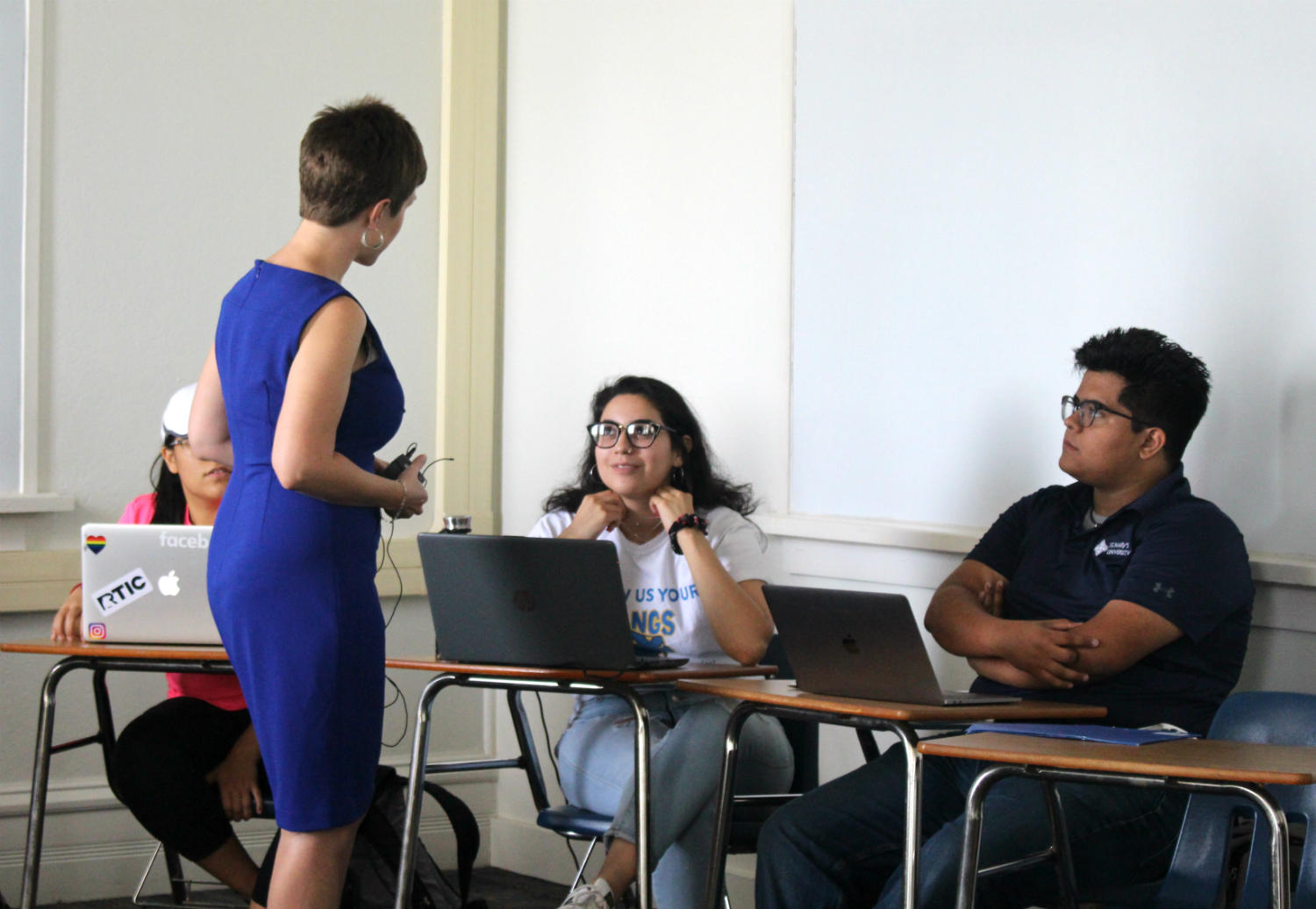
St. Mary's University Professor Meghann Peace speaks to a student in her Heritage Spanish class on Sept. 23, 2019.
CAMILLE PHILLIPS | TEXAS PUBLIC RADIO


College freshman Angie Bravo’s first language is Spanish, but she wishes she were better at it.

The 18-year-old grew up in Laredo, Texas, just across the border from Mexico. Like many of her neighbors, she speaks a version of Spanish influenced by English.


Even in a state like Texas, where nearly 30% of the population speaks Spanish at home, there’s a perception that it’s better to speak “pure Spanish.”

But, as Bravo is learning this semester, there’s nothing wrong with the way she speaks the language. It’s just a different dialect than the one spoken in Madrid or Mexico City.
A Dialect Like Any Other
Instead of focusing on grammar and vocabulary, St. Mary’s University’s Cultural Spanish for Heritage Speakers class covers the history and culture of U.S. Spanish, the dialect commonly called Spanglish.
Professor Meghann Peace set up a recent lesson by asking students to match Spanish words with their languages of origin: Greek, Latin, Arabic, indigenous American tongues.
“What history teaches us is that the only constant is change,” Peace said in Spanish. “Whenever two languages have geographic contact they’re going to influence each other.”
She showed the class quotes about Spanglish from poet Octavio Paz and literary critic Roberto González Echevarria — Paz called it “abominable”; Echevarria called it an “invasion” — and asked the students if they ever get negative reactions like that when they speak in Spanish.
Students in St. Mary's University's Heritage Spanish class look at quotes illustrating negative opinions about the U.S. Spanish dialect commonly called Spanglish.
CREDIT CAMILLE PHILLIPS | TEXAS PUBLIC RADIO

Mary Villines said people who only speak Spanish or English sometimes assume she doesn’t speak their language well if she code-switches.
“But what bothers me is that they only speak one language,” Villines said in Spanish. “Who are you to correct me when you don’t even know what I’m trying to say?”
Peace said that people who speak Spanglish actually know both languages well.
“Spanglish is super systematic,” Peace said in Spanish. “Someone who switches between languages in a single sentence follow the syntax rules of both languages.”
Language and Identity
That explanation resonated with Bravo, who said the class is starting to change her opinion of the way she speaks Spanish.
“It's taught me to be a lot more accepting,” Bravo said. “I'm still aiming to be able to carry a full conversation in Spanish … but I didn't really take into account the rules that we don't speak about, but we understand.”
For her, language is intertwined with the changing way she sees herself.
“When I was growing up, I had a lot of issues being Hispanic. I didn't understand, like, what does it mean to be Hispanic? Should I be Hispanic? Or should I be American? And so I think it's because I struggled with that, that I want to be able to do both,” Bravo said. To be able to speak Spanglish is to be able to say to people that I am Mexican American, and that's okay. I don't have to be either or.”
Bravo said that feels especially important right now “because of the political commotion around what it is to be Hispanic, and all of the violence now being enacted towards the Hispanic groups.”
In August, a man killed 22 people at an El Paso Walmart. The alleged gunman told police when he was arrested that he drove 10 hours to the border town to target Mexicans.
St. Mary's University Professor Meghann Peace shows students how Spanglish speakers follow the syntax rules of both Spanish and English when they code switch on Sept. 23, 2019.
CREDIT CAMILLE PHILLIPS | TEXAS PUBLIC RADIO
The Role of Culture and Society
Bravo’s classmate, Elisha Carrillo, had a different experience with Spanish growing up. But the class is also helping her better understand her family’s relationship to the language.
Carrillo’s family has lived in San Antonio for generations. Her mom and grandma speak Spanish, but they didn’t really teach it to her.  Instead, she learned Spanish in school.
“My grandparents talk a lot about being discriminated in school for speaking Spanish, and, you know, being hit,” Carrillo said. “I think, just like subconsciously, they think we're not supposed to speak that.”
In the 1950s and 60s it was common practice in some schools to punish students for speaking Spanish, even on the playground.  At the time, Texas had an “English only” policy for schools.
For Carrillo, learning Spanish in school is a way to reclaim part of her cultural identity. But, at the same time, she gets frustrated by people who expect her to be able to speak the language.
When she studied abroad in Spain last semester, people were surprised to learn she was American.  When she was little people would walk up to her in stores in San Antonio and ask her questions in Spanish.
“I think people get confused because they assume if you're Brown, you speak perfect Spanish,” Carrillo said. “People everywhere just expect you to be a certain way because of how you look.”

St. Mary's University students discuss code switching with Professor Meghann Peace during their Heritage Spanish class Sept. 23, 2019.
CREDIT CAMILLE PHILLIPS | TEXAS PUBLIC RADIO
Carrillo’s professor, Meghann Peace, said her students know more Spanish than they think they do. Several of them were originally signed up for a more traditional lower-level language class.
“They thought they didn't speak it well. And on the first day, I heard them talking, and I said, ‘Oh, no, no, no. Don't even — don't give me that. You do. You do know this,’” Peace said.
Her goal for the class is for her students to practice writing in standard Spanish, so they can use that dialect if and when they want to. But she also wants them to become more confident in their skills, and be able to defend their use of Spanglish.
“A standard dialect is simply the standard because the people who are in power made it the standard,” Peace said. “Why are we seeing this as something bad or unnatural or an attack against the purity of the language? Which is, of course, silly, because there's no such thing as pure language.”
Peace isn’t the only educator working to normalize Spanglish. According to a 2016 survey by Daniel Villa of New Mexico State University, there are roughly 40 universities across the country that teach a course on U.S. Spanish.
Camille Phillips can be reached at Camille@tpr.org or on Twitter @cmpcamille. 

Wednesday, January 11, 2017

On the National Spanglish Contest...

National Spanglish Contest
This is so very awesome! Just learned about the National Spanglish Contest. Actually, two of our students at UT earned prizes in the college-level competition that they will receive at the 4th National Symposium on Spanish as a Heritage Language in Irvine, CA, taking place on February 17, 2017.


I hope that folks appreciate this in a positive, respectful way. There really is something we know as fluency in the contest of code-switching, which means navigating between English and Spanish, and also that there are entire communities like where I'm from in West Texas that code-switch back and forth regularly.  

One can code-switch correctly, as well as incorrectly, as being able to do so requires mastery in the combining of two different grammar systems.

Remember that the strength of any language is due in large measure to its capacity to adapt. There are few pure languages since pure ones become less relevant or die (e.g., Latin).  Status and power are other significant reasons, as well.

To wit, only a very small percentage of the English language is from the Angles and the Saxons. English otherwise reflects a breathtaking number of influences worldwide and over the course of history, making it today the world language that it is.

In the meantime, students, time to polish up your best Spanglish, creative writing and compete! 

Angela Valenzuela
c/s