Translate

Showing posts with label HB21. Show all posts

Thursday, May 25, 2017

Less Funding and School Privatization are a Retreat from Demographic Trends

I'm re-posting this Texas Tribune piece from a year ago as it speaks to our future as a state (link to the actual piece to view the graphs).  I share this in the wake of the death of HB21 that you can read about here.  Sadly, our legislature can't seem to fund public schools despite decades of court cases that speak to how they're inequitably financed.  In the meantime, our state demographics reveal growth in both numbers and diversity.  


We're all looking at the same trends.  Yet the Senate's response is to not only not adequately fund education—not that HB21 doesn't have its own limitations—but to privatize public education instead.


Less funding and privatization together amounts to a dog-eat-dog world where our human right to a quality education vanishes with education literally reduced to that which one can afford as a consumer.  


How is a consumer society visionary by any stretch of the imagination?  To the contrary.  It represents a retreat from the demographic shifts and realities facing our nation. It also represents meanness and stinginess when we see the challenges facing districts that are on the front lines already, losing revenues to charter schools that don't perform any better, and frequently worse, than public schools.  Plus, since such schools have their own corporate governance structures, you as a consumer are beholden not to a democratically-elected school board, but to a corporation through your signed, contractual agreement.  Good luck with that if your kid differs in any way from the norm.


And then there's what the research shows—which doesn't make a lick of difference with privatization advocates in the Senate.  Go to this link to read a recent analysis comparing neighborhood schools to charters by Dr. Julian Vasquez Heilig.  The results shouldn't surprise you, since this is a struggle that is more about ideology than evidence.


My friends, we must all vote, get others to vote, get involved in the political process, and then vote our interests as a polity.  For starters, this means getting these private school advocates out of power—and frankly, re-committing to democracy lest we become the fascist, corporate state that Benito Mussolini envisioned and wrote about.


Angela Valenzuela

c/s


Young Texans Make Up Most Diverse Generation



If demographics are destiny, the youngest Texans appear destined to make the state dramatically more diverse.
While white Texans still make up the largest racial group, the state's
demographic future is in the hands of younger Texans, according to new
age, race and ethnicity figures released Thursday by the U.S. Census
Bureau. The
estimates, which track population change from July 2014 to July 2015,
show that older generations of Texas are more white while younger Texans
are much more likely to be part of a racial or ethnic minority group.
Almost 68 percent of Texans aged 19 and younger are non-white. That's
a reversal of the racial breakdown among Texans 65 and older, almost
two-thirds of whom are white while only about 36 percent are people of
color.


Both of those breakdowns stand in contrast to the state’s overall share of Texans — 57 percent — that are non-white.


The new figures, particularly the diversity among young Texans, fuel predictions
that Texas may be the next state where Hispanics become a plurality,
comprising the largest racial or ethnic group though not a majority. If
that happens, Texas would join New Mexico and California.
As of July 2015, Hispanics made up 38.8 percent of the state's population while white residents made up 43 percent.
The state’s white, black
and Hispanic populations all grew in size last year, but the overall
share of white Texans continued to drop slightly. And it was the
Hispanic population that grew the fastest.
Nationally, the continued
growth of the Hispanic population is due largely to natural increase —
Hispanic parents having more babies — and not immigration from other
countries. Research by the state demographer
has shown
that while people born in Latin American countries continue to make up
the largest group of immigrants in Texas, the rate at which they are
moving to the state has decreased in the past decade.
Once again, Starr
County — located in the Rio Grande Valley along the Texas-Mexico border
— had the highest share of Hispanics in the country with 95.8 percent,
followed by several other border counties. 
But the recent rapid growth in the Hispanic community is not limited to the border region.
The state's urban cores
have seen consistent growth among the Hispanic population. Among the
state's 25 most populous counties, suburban counties surrounding
Houston, Austin and Dallas have experienced the fastest growth in
Hispanic residents since 2010.
This analysis includes people who are identified as non-Hispanic white, non-Hispanic black or Hispanic.
Correction: As originally published, the second chart
accompanying this story showed incorrect numbers for all the county by
county statistics on fastest Hispanic population growth.

Monday, May 22, 2017

Texas Senate puts voucher-like program in school finance bill: Let's STOP HB21

Disgraceful.  House Bill 21 started out as a decent, do-able school finance bill, but now that its in the Senate, it has become a voucher bill.  This Texas Tribune piece by Aliyya Swaby (below) does a pretty good job of detailing the 11th-hour derailing of this bill by the Senate.  Succinctly, it allows for our hard-earned taxpayer dollars that would otherwise go to public school funding and gives it to private schools.  Very, very sad and shameless, to boot.

Lt. Governor Dan Patrick and many of our pro-privatization senators are bad news for public education and democracy in Texas.  Committee on Public Education Chair, Dan Huberty and many others put a lot of time and effort into this bill, only to see it deformed beyond recognition. Good, closing quote from within:

House Speaker Joe Straus shot back later that day, arguing that the Senate's budget proposal reduced the state's share of public education funding, leaving local property taxpayers with a heavier financial burden. "The House made a sincere effort to start fixing our school finance system, but the Senate is trying to derail that effort at the 11th hour," he said.

Check out one of my earlier posts on vouchers from this legislative session titled, Challenging the School Privatization Agenda: Let's Grow, Not Kill, Our Democracy.  It lays out the argument why vouchers and school privatization are really  bad policy.

I just called my representative in the House and urged him to put a stop to this bill.  Please consider doing so, as well.  Time is of the essence. Contact your legislators right away and consider doing the same. If you do not know who represents you, click here to find out.

Let's also be forward looking and let's get these people who are not particularly fond of the public good out of office.

Angela Valenzuela 

@vlnzl

Texas Senate puts voucher-like program in school finance bill

The Texas Senate voted to approve a bill that would simplify funding formulas for public schools and let parents use state money to send their kids with disabilities to private schools or pay for homeschooling.

 
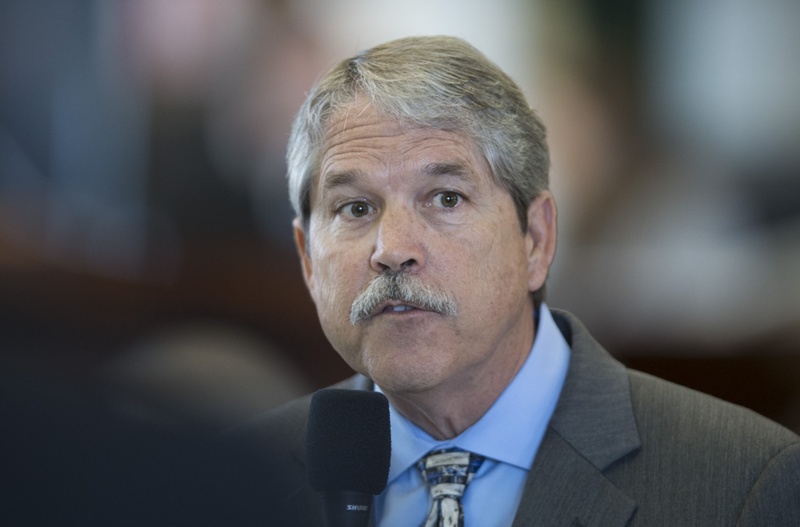
State Sen. Larry Taylor, R-Friendswood, discusses a bill amendment in the Senate on March 30, 2017. 
State Sen. Larry Taylor, R-Friendswood, discusses a bill amendment in the Senate on March 30, 2017.
Bob Daemmrich for The Texas Tribune

The Texas Senate on Sunday night approved a bill that would both simplify the formulas for funding public schools and allow parents of kids with disabilities to take state money to leave the public system for private schools or homeschooling.

Senators voted 21-10 to approve House Bill 21, which the House originally intended to reform a complicated system for allocating money to public schools and to provide a funding boost for most public schools.

Sen. Larry Taylor, R-Friendswood, changed the bill to include a provision the House hates and Lt. Gov. Dan Patrick very much wants: education savings accounts, which are state subsidies for parents who want to send their children with disabilities to private schools or need money for services to educate them at home.

"We're trying to fill a lot of different needs in the bill, and we're trying to keep our costs down," Taylor said while introducing the bill.

The bill now goes back to the House, where it will hit a major roadblock: Rep. Dan Huberty, R-Houston, the bill’s House author, has said he won’t accept a version that includes education savings accounts.

Patrick promised the House an extra $530 million for public schools if the education savings account program becomes law; he has been unsuccessfully advocating for similar voucher-like programs for the past decade. The House had originally budgeted a $1.5 billion boost for public schools, and with the promise of $530 million, the Senate went from offering little extra funding for public schools to meeting the House partway.

If the House doesn't approve HB 21 as amended by the Senate, public schools won’t get the extra $530 million, Taylor said. Under the Senate's version of the bill, about 93 percent of school districts would see more revenue by 2019, with 7 percent seeing no change in revenue, he said.

Taylor stripped the bill of several of the original tweaks from the House that were intended to either simplify the funding formulas or allocate money to specific student groups, saying they would cost too much money.

At the same time, he packed HB 21 with provisions from other bills in the House and Senate — including $100 million in first-time facilities funding for charter schools, $20 million in grants for schools running programs for kids with autism and a 15-member commission for long-term school finance reform.

Democrats challenged Taylor to explain why state money should be used to pay for private schools when they are not subject to state accountability, are not required to take all students and are not subject to federal law when it comes to offering services for students with disabilities.

“We don’t want someone to be forced to take a student they’re not set up to handle,” Taylor said. He argued private schools are subject to a higher level of accountability because parents can decide to leave a school that doesn’t fit them.

He said he didn’t understand why a small program that would affect just 5,000 students would stop legislators from approving half a billion dollars for public schools.

“This whole [education savings account] is a mouse, and this elephant is just freaking out,” he said. “The whole world is coming to an end over this little bitty thing.”

Sen. José Rodríguez, D-El Paso, unsuccessfully proposed an amendment to the school finance bill that simply crossed out the education savings account language.

Taylor succeeded in convincing rural conservative senators to vote for the Senate’s version of the bill despite the fact that they generally have fewer private schools in their legislative districts and serve constituents who are skeptical of “private school choice.”

Sen. Robert Nichols, R-Jacksonville, said the 101 public school superintendents in his district dislike the education savings accounts but like the provisions that would save small, rural schools money. Nichols ended up voting yes on the bill.

Public education advocates did an about-face on the bill once they saw it included education savings accounts, with about 40 organizations sending letters to all Senate offices asking them to vote against it.

“In the middle of the night, the Texas Senate voted for a voucher scheme that will rob taxpayer money from public schools and give it to private schools,” said Ann Beeson, executive director of the left-leaning policy group the Center for Public Policy Priorities. “What started as a good school finance bill in the Texas House turned into a voucher bill that does not help remodel our state’s school finance system.”

Patrick on Wednesday listed the bill as one of the priorities he wants the House to pass. In exchange for a vote on HB 21, he promised to concur with the part of the House's proposal for the school accountability system that would delay implementation of a controversial A-F grading system for schools and districts until 2019.

House Speaker Joe Straus shot back later that day, arguing that the Senate's budget proposal reduced the state's share of public education funding, leaving local property taxpayers with a heavier financial burden. "The House made a sincere effort to start fixing our school finance system, but the Senate is trying to derail that effort at the 11th hour," he said.

Read related Tribune coverage:
  • A Senate committee passed the House’s major school finance reform bill, after adding a controversial provision subsidizing private school tuition for special needs students — a move unlikely to go over well in the House.
  • The Senate Education Committee discussed a bill that would radically simplify the state's school finance formula, stripping it of some antiquated provisions. Parents and educators who testified wanted a few new provisions added in.