The temperature rose during a Tuesday House committee debate on a
bill to circumvent high-stakes testing when the chairman lost his temper
with the sole witness testifying in opposition.
Drew Scheberle, senior vice president of the Austin Chamber of
Commerce, told the House Public Education Committee that he did not
support allowing students who fail standardized tests, including those
with disabilities, to take an alternative route to graduation. That got
the panel's Chairman
Dan Huberty, R-Houston, angry — because his son is dyslexic.
"I'm not going to argue with you about this. You're completely wrong on this," Huberty told Scheberle.
Huberty sponsored Senate Bill 463, which would extend an existing
program letting high school students who fail required state tests and
end-of-course exams graduate as long as they go through a special
committee that agrees they are academically prepared. Huberty later
apologized for his outburst, explaining that the piece of legislation
has personal relevance for his son, who might need to use the
alternative route to graduate.
"I got a little heated there, and I apologize for that," he said.
"But this is very very personal to me. I'm a parent that has a
special-needs child. ... This is a lifeline."
The House versions of the legislation, House Bill 77 and House Bill
966, died without being heard. SB 463 was left pending in the House
committee Tuesday.
Committee members — the student's teachers, guardians and
administrators — use related classwork and projects to determine whether
that student is ready to graduate. About 70 percent of the students
eligible to use these committees as an alternate route in 2015-16
actually passed and graduated, according to state data released last
month.
Legislators established these committees in 2015, riding a wave of
fervor against high-stakes standardized testing. The 2015 law included a
clause causing it to expire in September.
Advocates wanted legislators to extend the use of the committees indefinitely. SB 463, authored by Sen.
Kel Seliger,
R-Amarillo, started off that way, passing unanimously in the Senate
Education Committee. But just before the full Senate vote, Seliger
changed the bill to cap the use of the committees to 2019, meaning
advocates will probably need to prepare for another fight next session.
Theresa Trevino, president of anti-testing group Texans Advocating
for Meaningful Student Assessment, asked legislators Tuesday to either
remove the new cap or extend it past 2019. "We need to have some sort of
safety net for our kids," she said.
Critics argue that making graduation requirements more flexible for some lowers the bar for all Texas students.
Scheberle, an outspoken critic of the graduation committees, said he
was happy that the bill now has more restrictions. He praised the
amendments to cap them to 2019, and to study how well students do when
they graduate without passing one or more required exams. But, he said,
he is still opposed to the bill, even for students with disabilities.
"Candidly, this pisses me off," Huberty said. "You know how personal
this is. The fact that you came up here to do this really irritates me."
Several parents and advocates testified in favor of the bill Tuesday.
J.W. Lively drove from Denton early in the morning to explain that
his daughter only graduated from high school because of the alternate
route offered by the graduation committees. Struggling with dyslexia,
she took a required English exam six times before she was able to pass
it — but was on the verge of succumbing to a failed history test, he
said. She only graduated by going before an individual graduation
committee, which determined she was ready to graduate, despite the
failed exam.
Lively said his three children are all succeeding despite being
dyslexic. "They struggle greatly, but they work their tails off," he
said.
Read related Tribune coverage here:
- The Senate passed a bill
extending the opportunity for students to graduate even if they haven't
passed their required exams by going before a graduation committee.
- The Texas Senate Education Committee heard Tuesday
from supporters, and a few critics, of a bill that would make permanent
a 2015 law that allows students to graduate even if they haven't passed
their required exams by going before a graduation committee.
Disclosure: The Austin Chamber of Commerce has been a financial
supporter of The Texas Tribune. A complete list of Tribune donors and
sponsors is available here.
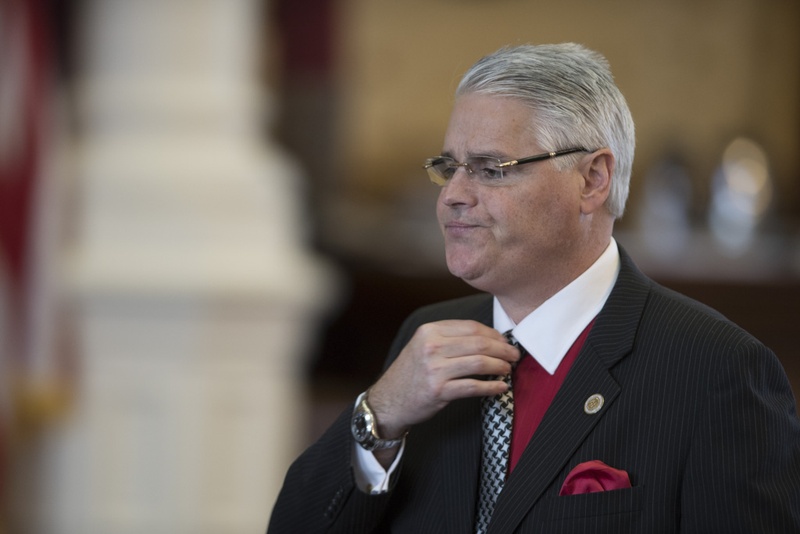
 Here at House Committee on Public Education committee hearing at the Texas State Capitol on special education and high-stakes testing, signed up to testify on testing and test-based accountability in E2.028, the annex of the Texas State Capitol.