Translate

Showing posts with label Indigenous Cultures Institute (ICI). Show all posts

Wednesday, September 18, 2024

Xinachtli Pedagogy, Thinking Outside of the Box, and Addressing the Water Crisis in Texas

Friends:

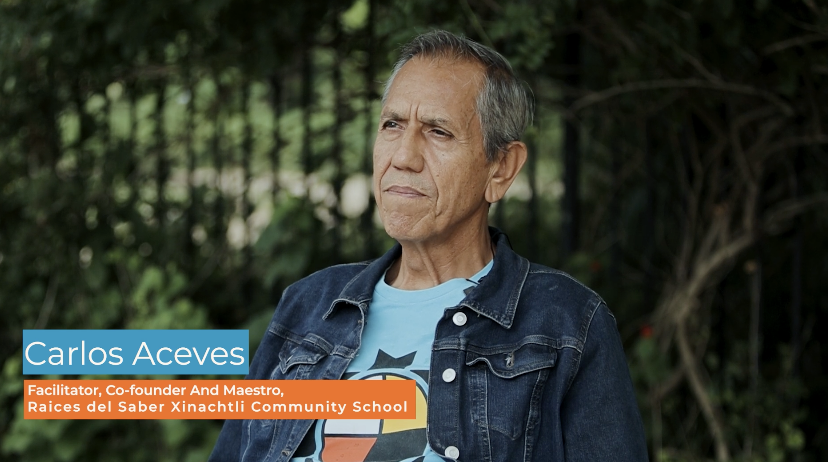
Xinachtli means "seed" in Nahuatl and as described in this wonderful video as
 a way of thinking "outside the box" of tradition, mainstream schooling in the U.S. Maestro Carlos Aceves shares, an Indigenous elementary school teacher his view that children do get a lot of information in schools, but they're objectified through processes and their corollary logics like high-stakes testing, tracking, drill and kill curriculum and the like, that reduce their sense of who they are and accordingly, their possibilities.
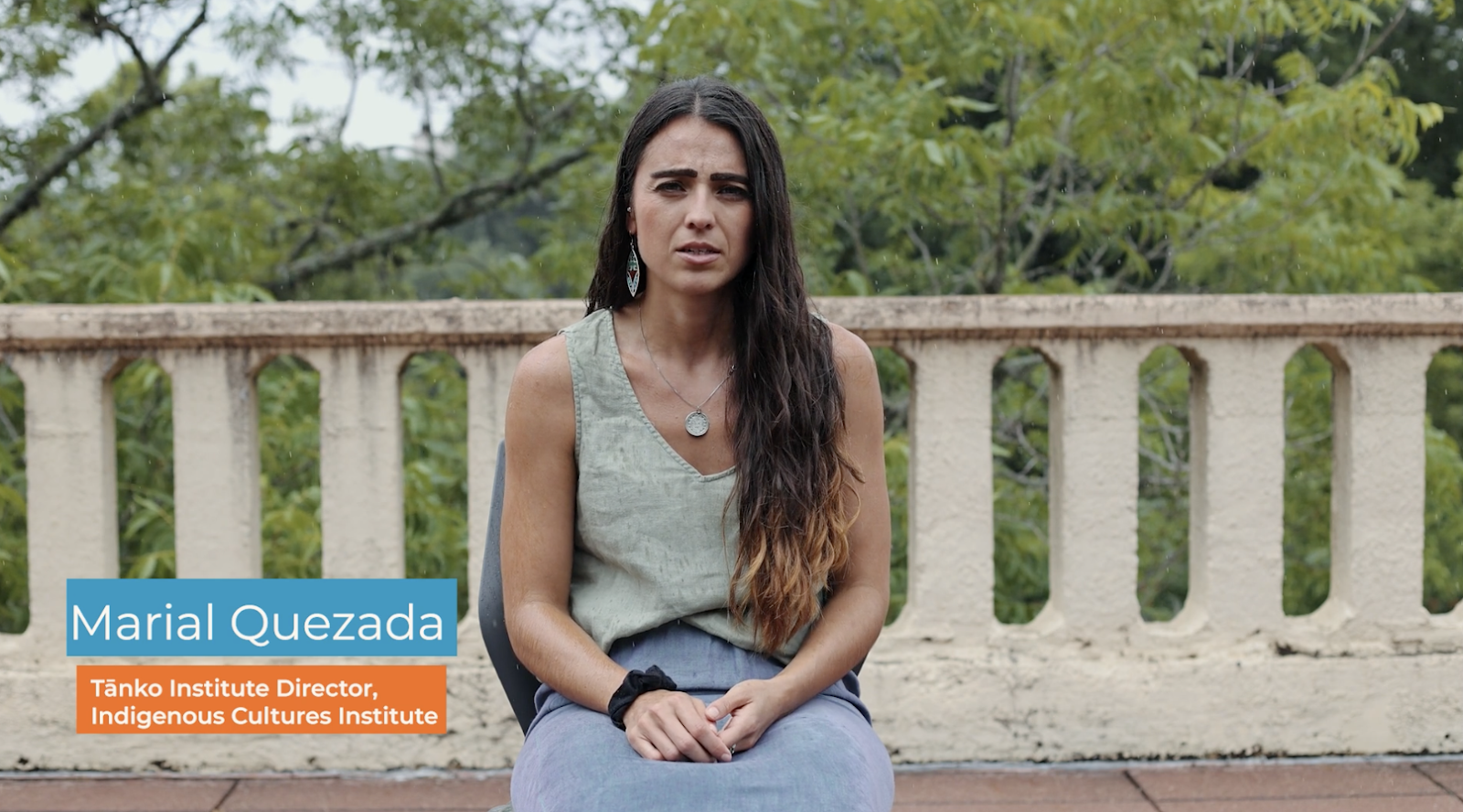
Indigenous Cultures Institute (ICI) Board of Elders Dr. Mario Garza and Maria Rocha and Director Marial Quezada, also a doctoral student in Cultural Studies at UT-Austin are featured in this film as the ICI regularly invites Maestro Aceves, who lives in El Paso, to provide instruction at the ICI's annual Tanko Institute both of which are in San Marcos, Texas. Our school, Academia Cuauhtli is partnered with the ICI with our teachers attending the Tanko Institute and a number engaged in Indigenous pedagogy. I see some of them in the video. 😊 Academia Cuauhtli students also annually attend the ICI's Sacred Springs powwow.

I recently corresponded with Maestro Aceves when I received one of his emails that expressed:

Restore the ceremonies, renew the covenants, return to the sacred places, and follow the story in the Sky.”

 As Natural Peoples we look to Creation for guidance. We were given ceremonies as textbooks, we made agreements with Natural Powers so that we can continue surviving as a people, we travel to special places of Creation on Earth to make offerings in appreciation of Life, and we learn the cycles above as patterns for our Natural Way of Life.

"Ceremonies as textbooks." These words touch me deeply. There is such beauty in his words that encourages us to think of the natural world differently. 

For Texans, this should be an urgent matter as according to a recent Instagram post by Progress Texas, our state is running out of water. Newsweek also has a recent story on this last week on September 11. It's shocking to learn from Agriculture Commissioner Sid Miller, "We lose about a farm a week in Texas, but it's 700 years before we run out of land, the limiting factor is water." Okay...  That's not a small "but" to me. In any case, you get the point.

What should also concern us is that recent statistics show that people from around the country are flocking to Texas because it's an affordable state. Long term, this places stress on our state's water supply that is additionally jeopardized by fracking. 

To combat all of this, we absolutely do need to address policy related to natural resources, but we also need a different kind of consciousness and permission structure where we are not estranged from the natural world but rather see ourselves as a part of it, even caught up with it as a form of destiny. If we change, the world changes. It's not either-or, but both-and. After all, it doesn't make sense to change policies when the thinking that got us to where we are remains in place.

This is what we are collectively about, Academia Cuauhtli, the ICI, the Tanko
Institute, and so many, if not all of us, in the Ethnic Studies Movement. Education is always about changing consciousness. Unfortunately, mainstream schooling with its colonial logics is often about reducing children to a number on a piece of paper—and not just the children, but their teachers and schools. This testing regime has been so terribly harmful. What is there not to love about spending time in nature and taking time to learn, not just from teachers, but from the natural world itself?  

For a paper I'm writing that is focused on our work at Academia Cuauhtli where I cite Maestro Aceves, I asked him how he identifies and this is what he shared,

Carlos Aceves Yolohuitzcalotl

Cihuacoatl for Kalpulli Tlalteca People of the Earth Community.

bilingual elementary school teacher

I have seen Maestro Aceves in action. He is the consummate Indigenous bilingual elementary school teacher. I would love to be in his elementary school classroom every single day, were it possible. 

Thank you, Maestro Aceves and thank you ICI for our partnership that from our own Xinachtli moment has grown and blossomed exquisitely over the years. 

-Angela Valenzuela


Tānko Institute || Xinachtli Pedagogy for Educators

Thursday, October 14, 2021

Quechua Children's Choir—Coro de niƱos de Espinar K'ana wawakunas: Ch'aska Ƒawi NiƱucha.


Such beautiful music sung by an Indigenous children's choir singing in the Quechua language. I wish I new what they were saying. I love their energy. This brought such happiness to me today. Our Indigenous communities in this hemisphere have so very much to offer the world.

Thanks to Dr. Tony Baez for sharing.

-Angela Valenzuela

Friday, September 25, 2020

Indigenous Tribe Sees Mission To Reclaim Remains From UT As A Spiritual Issue, Not A Legal One

I, along with so many others, hold the highest regard for Dr. Mario Garza and Maria Rocha from the Coauhiltecan, Miakan-Garza Band in San Marcos in their unflagging efforts to reclaim and re-bury the remains of three Native Americans at least a thousand years old that remain in the possession of the University of Texas at Austin. 

Based on a conversation with Maria Rocha, the article fails to mention that both the NAGPRA Review Committee at Texas State University and the Secretary of the Interior accepted the Miakan-Garza documentation, and were willing to give them the remains, making "strict law," as alleged by UT President Jay Hartzell, an interesting, if not questionable, claim. To be sure, our community is not at all satisfied.

It's disgusting to think of how our university, as part of its ongoing colonial project to "own" Native bodies in the name of "science" for "archaeological research," has dishonored these individuals that could have been one of our ancestors as peoples who are Indigenous not just to this continent, but specifically to this area that we now know as "Texas," itself a name of Indigenous origins.

-Angela Valenzuela

#WeAreAlwaysOnNativeLand

Indigenous Tribe Sees Mission To Reclaim Remains From UT As A Spiritual Issue, Not A Legal One

  SEP 14, 2020


Lee esta historia en espaƱol. 

Drumming and the rhythmic clinking of wooden seed pods drowned out the sound of cars rushing past the J.J. Pickle Research Campus on a Monday evening.

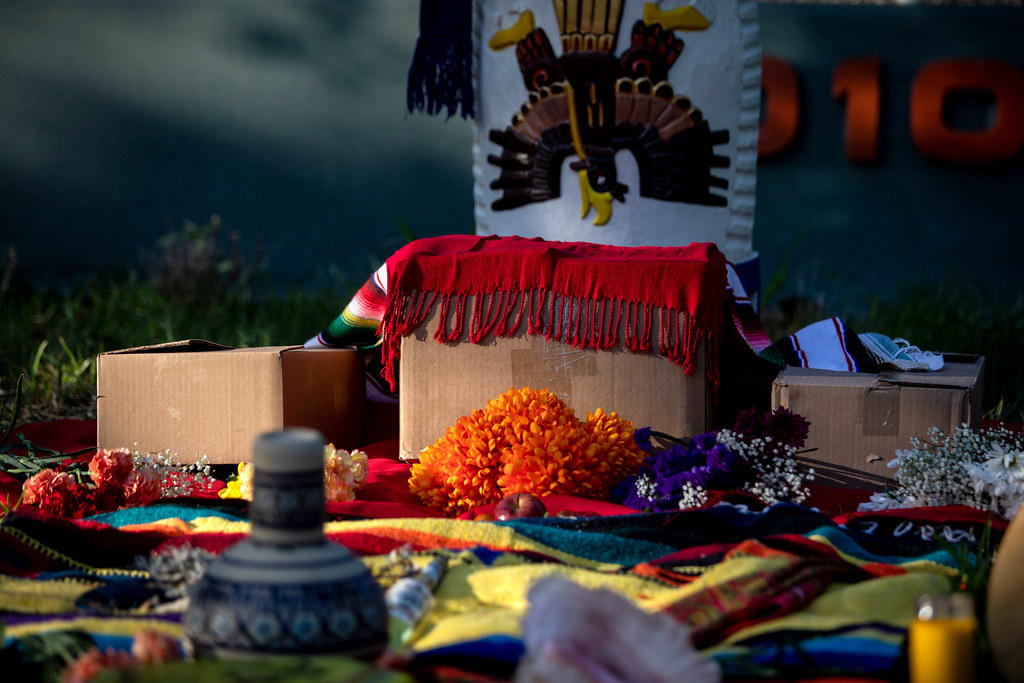
Dozens of people had gathered at the entrance of the campus to witness as members of UT Austin's student-led Aztec Dance group made an offering to their ancestors. They danced in front of an altar, where bouquets of flowers and bowls with traditional sacred medicines were carefully placed across two colorful blankets.

Three cardboard boxes sat at the altar’s head, representing the remains of three Native Americans who died thousands of years ago. The physical remains were stored nearby, at the school’s archeological research lab.

Members of UT Austin's Aztec Dance group made offerings of flowers and fruit at an altar that featured three cardboard boxes holding the symbolic remains of their ancestors.
CREDIT MICHAEL MINASI / KUT

For the past four years, members of the indigenous Miakan-Garza Band in San Marcos have been asking UT to return the remains to them for repatriation.

UT denied the tribe's request for the remains in June, largely because researchers classified them as “culturally unidentifiable,” meaning they couldn’t find a shared group identity between the remains and any living tribe, including the Miakan-Garza.

In a July letter to interim UT President Jay Hartzell, the Miakan-Garza said the denial “disregards an opportunity for a historic gesture towards indigenous people in Texas by returning stolen ancestral remains for final re-interment in their burial homeland.”

Coahuiltecan is a collective name for the small, autonomous bands of Native Americans who lived in Central and South Texas in the 16th century before the Spanish conquest. The Miakan-Garza, who founded the Indigenous Cultures Institute in San Marcos, identify as a Coahuiltecan tribe.

“Who has been in Texas where these culturally unidentifiable remains have been dug out? Who has been here for 14,000 years? The Coahuiltecan people,” Maria Rocha, executive director of the Indigenous Cultures Institute, said. 

Though they lack federal recognition, they were acknowledged as members of the Coahuiltecan people in a Texas House resolution in 2013.

“So just, logically – something was dug up here. We've been here 14,000 years,” Rocha said. “They're our ancestors.”

The Miakan-Garza believe that when someone dies, only their physical body dies; what begins after is a spiritual journey.

“When the remains are disturbed, it disturbs the spiritual journey of the spirit. And the spirit, it's out there in limbo, in agony, in pain,” said Mario Garza, principal founder of the institute. “So that's why we feel it's our obligation to repatriate, to rebury the physical remains of that individual.”

Mario Garza and Maria Rocha, seen here in 2014, say they feel it is their obligation to rebury the remains held by UT. CREDIT GABRIEL C. PƉREZ / KUT

For Rocha and Garza, this work is a religious obligation.

“Even if we don't win, what will UT benefit from beating indigenous people out of their ancestors' remains?” Rocha said.   

The Miakan-Garza have been doing repatriation work for decades. In 2016, they received culturally unidentifiable remains from Texas State University through the federal Native American Graves Protection and Repatriation Act despite not having federal recognition. They also worked with the City of San Marcos to establish a repatriation cemetery for unearthed Native American remains.  

But UT said it doesn't have enough evidence to link the remains to the band, so it legally can't turn them over.

“The law requires certain standards be met, and, in this case, the facts simply cannot justify the requested repatriation," Hartzell's office wrote in a response to Garza. "The law does not allow repatriation simply because a group is willing to bury the remains.”

Rocha said it feels as though the university has intentionally disregarded their request and is leaning on legal technicalities as justifications for its decisions.

“We believe and we've experienced in the past, time after time, when an institution doesn't want to help you, they put these obstacles in the way until you get discouraged and you go away,” she said. “And that has been our experience with UT Austin.”

At last week's demonstration, spectators left offerings at the base of the altar: small bouquets of flowers, a couple oranges, a dollar bill. Many said they felt the fight was just beginning. 


Mario Ramirez takes part in the ceremonial dance last week.

CREDIT MICHAEL MINASI / KUT

The issue should matter to people regardless of whether they are indigenous, said Jessica SĆ”nchez Flores, co-chair of the graduate Native American Student Association at UT, “because we are talking about ancestors. And these could be anyone's ancestors.”

Cheyenne Grubbs, who is on the board of the undergraduate Native American Student Association, said she hopes Hartzell has the conviction to “do what's right” and return the remains.

“There's people hurting," said Grubbs, who belongs to the Choctaw Nation of Oklahoma. "There's people feeling a lot of emotions. And I hope you know that there's answers to ease that pain. And it's just doing what's right.”

Got a tip? Email Riane Roldan at rroldan@kut.org. Follow her on Twitter @RianeRoldan

If you found the reporting above valuable, please consider making a donation to support it. Your gift pays for everything you find on KUT.org. Thanks for donating today.

Saturday, November 16, 2019

UT’s Texas Archaeological Research Laboratory must return ancestral remains

A hallmark of settler colonialism is its objectifying ways of knowing, meaning treating "the other" like objects—like a grade, a number, a test score—or as covered in this poignant story below, like an artifact.  How disgraceful to learn about the over 2,000 ancestral remains housed at UT's Texas Archaeological Research Laboratory (TARL).  

I hope that the TARL stops their foot dragging and honor the request by Dr. Mario Garza, Maria Rocha, and other Indigenous groups and return the ancestral remains to the communities and places to whom and where they belong.  

I would also hope that this become a teaching moment for an entire field with a sordid history of dehumanizing and objectifying native peoples under the guise of "science."  Indeed, this very 'ask' unmasks the field as not at all objective, but as ideologically caught up with the horrors of settler colonialism that continues forcefully into the present.

As the great American novelist, William Faulkner once said,

"The past is never dead. It's not even past."

-Angela Valenzuela

Photo Credit: Helen Brown | Daily Texan Staff


UT’s Texas Archaeological Research Laboratory must return ancestral remains

Published on October 22, 2019 at 9:18 pm

Imagine your great-grandparents’ graves are upturned, and their remains are unearthed to build a fence or maybe a ticket booth. Official law has validated requests for their reburial, but these requests are denied. Their bodies are collections in a museum. Their bones are artifacts of archaeological research.
It’s a horrific thought, which is why the Texas Penal Code prevents just this sort of an act.
However, consistent with Texas’ history of treating its indigenous groups as less than human, over 3,400 ancestors of original groups have been disturbed from what should have been their final resting place. Before, they lay carefully buried in customary tradition. Now, they sit in the aseptic cabinets of archaeological research labs.
Over 2,000 ancestral remains can be found at UT’s Texas Archaeological Research Laboratory (TARL), on the J.J. Pickle Research Campus. 
The lab should repatriate ancestral remains to their original groups so that they may receive the proper burial required by their sets of beliefs and traditions. This act could both contest the unequal treatment of indigenous groups and serve as a step in repairing a history of mistreatment, removal and extermination.
According to the TARL’s website, “The disposition of human remains and associated objects affiliated with particular Native American Tribes will be determined by each tribe.” 
This vague language seems to suggest that each original group determines the fate of their ancestors. While this should be the case according to the Native American Graves Protection and Repatriation Act (NAGPRA) of 1990, Mario Garza of the Miakan-Garza band of the Coahuiltecan people said that TARL has refused to return remains due to his group’s lack of federal recognition. 
This is despite NAGPRA’s statement on their website that “there are some cases in which nonfederally recognized tribes may be appropriate claimants for cultural items,” which includes human remains or artifacts. According to Garza, 11 nonfederally recognized tribes like his own have gotten remains through NAGPRA.
NAGPRA has placed responsibility on museums and federal institutions in returning cultural items of the original groups of the U.S. So why then does UT’s TARL continue to refuse the requests of Garza and other indigenous groups?
According to TARL, the institution has received conflicting claims for the same remains, and these disputes should be resolved between such groups. Garza responded that this policy has never been communicated to him or his organization and that he was unaware of any conflicting claims. TARL additionally did not offer details about the identity of the conflicting group.
Garza and his people, originally from the San Marcos area, know all too well how difficult this bureaucratic struggle can be. Along with his wife MarĆ­a Rocha, he founded the Indigenous Cultures Institute in 2006, an organization dedicated to preserving the culture of Texas’ original peoples while maintaining their covenant to sacred sites.
“We generally believe that when a person dies, only the physical body dies, but the spirit does not die. It continues on a spiritual journey,” Garza said. “When the remains are removed, it interrupts that spiritual journey of the individual, and the spirit is out there in some type of limbo. We believe the remains should not be bothered at all to start with. If it is removed, the remains need to be repatriated and hopefully as close as possible to the original site.”
TARL claims that they applaud and support efforts to resolve claim disputes between Texas’ originary groups. However, Garza said that talks have stopped.
Students and UT affiliates who want to stand in solidarity with the fight for the return of ancestral remains to original groups should contact TARL with their requests. 
“I think that if they would receive 1,000 letters from students, they would realize there are more than two people fighting for this,” Garza said. Additionally, students can become involved with the Indigenous Cultures Institute.
The individuals that first inhabited Texas deserve equal legal protection, and UT should do its part to ensure this. 
“I don’t see it as a Native American issue, I see it as a human issue — a human rights issue,” Garza said. “We need support from everybody.”
Burns Passafiume is a third-year Ph.D. student in the Department of Spanish and Portuguese.