Translate

Showing posts with label UTRGV. Show all posts

Thursday, October 22, 2026

What the 2027 Rankings Do—and Do Not—Tell Us about Texas Higher Education, by Angela Valenzuela, Ph.D.

What the 2027 Rankings Do—and Do Not—Tell Us about Texas Higher Education

by 

Angela Valenzuela, Ph.D.

October 22, 2026

The newly released U.S. News & World Report rankings deserve more scrutiny than the usual horse-race coverage of who moved up and who moved down. The headline is that six Texas universities remain among the nation's top 100. But underneath that relatively reassuring news is a striking pattern of decline among a number of the state's public universities—and particularly among institutions in the University of Texas System (Wilhelm, 2026).

UT Austin fell from No. 30 to No. 34 nationally. Texas A&M dropped eight places, from No. 51 to No. 59. Outside the top 100, UT Dallas fell 11 places, UT San Antonio and UT Arlington each fell 14, UT Rio Grande Valley fell 37, Texas State fell 31, UT Tyler fell 13, and the University of Houston–Clear Lake fell 35 (Wilhelm, 2026).

The UT System pattern in particular merits attention. Every UT System institution singled out in this article for year-to-year movement declined: Austin by four places, Dallas by 11, San Antonio by 14, Arlington by 14, Rio Grande Valley by 37, and Tyler by 13. That does not establish that something systemwide caused these declines. Texas Tech, Prairie View A&M, and Texas A&M–Kingsville, for example, moved upward, so there is no uniform “Texas effect” (Wilhelm, 2026). But when several institutions operating under the same system and state policy environment move downward simultaneously, it is reasonable to notice the pattern and watch whether it persists.

At the same time, we should be very careful about what these rankings actually measure. A university's ordinal position is not the equivalent of a report card. UT Austin did not suddenly become "four places worse" as a university. Rankings are relative: an institution can improve on important measures and still fall because other universities improve faster, because institutions enter or leave its comparison group, or because the ranking formula itself changes.

And the formula did change this year.

For the 2027 rankings, U.S. News replaced graduate indebtedness with a new "earnings by major" measure worth 5 percent of the score and began using the updated 2025 Carnegie classifications (Baity, 2026; U.S. News & World Report, L.P., 2026). More broadly, student outcomes account for about 52 percent of the U.S. News formula, while academic peer assessment alone accounts for another 20 percent; faculty and financial resources, standardized test scores, and research measures make up much of the remainder (Baity, 2026).

That context makes UT Austin’s decline especially interesting. The university itself reports that freshman applications reached a record 98,841 this year, its four-year graduation rate rose to a record 77.7 percent, and it awarded a record 16,801 degrees during 2025–26 (University of Texas at Austin, 2026). UT also remains the No. 1 public university in Texas and No. 8 among public universities nationally according to these same U.S. News rankings (University of Texas at Austin, 2026; Wilhelm, 2026). In other words, the four-place decline in the overall ranking coexists with several indicators of very strong institutional performance. That alone should caution us against interpreting No. 34 rather than No. 30 as evidence of a four-step deterioration in educational quality.

UTRGV offers an even more dramatic lesson about the limitations of composite rankings. Its overall national ranking fell an eye-catching 37 places to No. 250 (Wilhelm, 2026). Yet in the very same 2027 rankings, UTRGV climbed 30 places to No. 26 nationally for social mobility and tied for No. 1 among Texas public universities on that measure (University of Texas Rio Grande Valley, 2026). Which ranking tells us what UTRGV actually contributes to higher education? 

For an institution whose mission centrally involves expanding opportunity in one of the nation's most economically challenged regions, its performance in graduating Pell Grant students arguably tells us something that its position in a single national prestige hierarchy cannot. The U.S. News social mobility measure specifically assesses institutions’ success in enrolling and graduating students who receive Pell Grants (University of Texas Rio Grande Valley, 2026).

This is why rankings are never neutral descriptions of "quality." They embody decisions about what counts. Is a great university one whose graduates command high salaries? One with highly paid faculty and abundant financial resources? One highly regarded by other university presidents and provosts? One that produces research? One that enrolls economically disadvantaged students and actually gets them to graduation? 

U.S. News combines these different purposes into a single number using a weighted set of student-outcome, peer-assessment, faculty-resource, financial-resource, research, and other measures (Baity, 2026). The ranking then asks us to believe that No. 34 meaningfully distinguishes an institution from No. 30—or even from the seven universities tied with UT at No. 34. The ranking gives us a precise number, but not necessarily a precise measure of educational quality.

Still, I would not dismiss the Texas declines. Rankings matter precisely because people believe they matter. Prospective students see them. Parents see them. Legislators and governing boards cite them. Potential faculty recruits see them. University leaders use them in fundraising and institutional branding. And because 20 percent of the U.S. News score comes from peer assessment, reputation itself becomes part of the ranking calculation (Baity, 2026). A deterioration in how academic leaders elsewhere perceive an institution can therefore eventually become measurable even when its graduation rates and research productivity remain strong.

That point bears watching in Texas. A recent 2026 Faculty in the South survey drew responses from 1,023 Texas faculty members; about 35 percent said they planned to seek employment outside Texas in the coming hiring cycle, and roughly 70 percent said they would not encourage graduate students or faculty colleagues to seek employment in the state (Surjadi, 2026). Because this was a voluntary survey rather than a representative sample of all Texas professors, those figures should not be treated as population estimates. The survey was distributed through email and social media, with invitations sent to more than 85,000 addresses across participating states (Boedy, 2026). But the results are meaningful evidence of faculty sentiment and of potential recruitment and retention problems that universities should take seriously.

We should therefore resist a tempting but premature conclusion: the 2027 rankings do not prove that recent changes in Texas higher education caused UT Austin or other Texas universities to fall. Much of the information entering these rankings is necessarily retrospective. The new earnings measure, for example, looks at graduates’ earnings four years after graduation (U.S. News & World Report, L.P., 2026). Policies and institutional decisions made in 2025 or 2026 therefore cannot plausibly explain many of the outcome measures appearing in a ranking released in September 2026.

The more important question is prospective: What happens to these universities over the next five years?

If Texas universities become less successful at recruiting and retaining distinguished faculty; if institutional reputation among academic peers weakens; if research capacity deteriorates; if students increasingly choose institutions elsewhere; or if the academic breadth of universities is narrowed, those effects will eventually appear somewhere—in research productivity, faculty resources, graduate programs, peer assessments, student demand, or other measures of institutional quality.

That is why UT Austin’s movement from No. 30 to No. 34 should neither be sensationalized nor waved away. One year's ranking is a data point, not a verdict. But alongside substantial declines at a number of other Texas public institutions—and particularly the cluster of declines across UT System campuses—it is a data point worth remembering (Wilhelm, 2026).

The real test will not be where Texas universities stand in one magazine's rankings this September. It will be whether, five or ten years from now, they remain places where exceptional faculty want to work, talented students want to study, consequential research can flourish, and universities possess the intellectual breadth and institutional conditions necessary to fulfill their public mission.

References

Baity, C. (2026, September 22). ECU once again named among nation’s best colleges. East Carolina University. https://news.ecu.edu/2026/09/22/ecu-once-again-named-among-nations-best-colleges/

Boedy, M. (2026, September 10). Results from the 2026 Faculty in the South Survey. Academe Blog. https://academeblog.org/2026/09/10/results-from-the-2026-faculty-in-the-south-survey/

Surjadi, M. (2026, September 14). More professors want to leave Texas this year, citing political climate, censorship, survey says. The Dallas Morning News. https://www.yahoo.com/news/videos/more-professors-want-leave-texas-124335563.html

University of Texas at Austin. (2026, September 22). UT sets academic performance records, remains the No. 1 public university in Texas. UT News. https://news.utexas.edu/2026/09/22/ut-sets-academic-performance-records-remains-the-no-1-public-university-in-texas/

University of Texas Rio Grande Valley. (2026, September 23). UTRGV rises to No. 26 nationally for social mobility in U.S. News & World Report rankings. The Newsroom. https://www.utrgv.edu/newsroom/2026/09/23/2027-us-news-world-report-best-colleges.htm

U.S. News & World Report, L.P. (2026, September 22). MIT claims No. 1 spot in U.S. News 2027 Best Colleges rankings. PR Newswire. https://www.prnewswire.com/news-releases/mit-claims-no-1-spot-in-us-news-2027-best-colleges-rankings-302885278.html

Wilhelm, M. (2026, September 22). Six Texas schools crack U.S. News & World Report’s 2027 top 100. Chron. https://www.chron.com/texas/article/texas-us-news-2027-best-colleges-22436271.php


Six Texas schools crack U.S. News & World's 2027 top 100

Some Texas schools climbed while others took a tumble.
By Molly Wilhelm, Trending ReporterSep 22, 2026
19 FEB 2015: Campus Life photos taken at Sam Houston State University in Huntsville, TX.
Sam Houston ranked among U.S. News & World's 2027 Best Colleges regional list for the West. NCAA Photos/NCAA Photos via Getty Images

April 3, 2012. Sewall Hall in Rice University with a student walking in the hallway. Rice University was the top ranking Texas university among U.S. News & World's 2027 Best Colleges list. aimintang/Getty Images
U.S. News & World Report released its Best Colleges of 2027 ranking, and six Texas institutions cracked the top 100.

Houston's Rice University was the top-ranked for Texas, landing at No. 16 nationally—tied with Brown University in Rhode Island, Vanderbilt University in Tennessee and Washington University in St. Louis, Missouri.

The publication measured academic quality and student outcomes using graduation and retention rates, post-graduation earnings, faculty resources and research, financial resources, incoming students' SAT and ACT scores, and other factors, according to the methodology.

But how did other Texas institutions fare, and did any see a major shift?

Texas A&M main campus clock tower. Texas A&M ranked among U.S. News &
World's top 100 in its 2027 Best Colleges ranking, down eight spots from
last year.Riley Davidson/Getty Images

Texas schools in the top 100

No 16. Rice UniversityTied with Brown University, Vanderbilt University and Washington University in St. Louis.

Up one place from 2026 rankings.

No 34. The University of Texas-AustinTied with Boston University, University of California-Davis, University of California-Irvine, University of Florida, University of Illinois Urbana-Champaign, University of Wisconsin-Madison and Wake Forest University.

Dropped four places from 2026 rankings.

No 59. Texas A&M UniversityTied with Brandeis University, Florida State University, George Washington University, Stevens Institute of Technology, Stony Brook University-SUNY, Tulane University of Louisiana, University of Massachusetts-Amherst, University of Minnesota-Twin Cities and University of Pittsburgh.

Dropped eight places from 2026 rankings.

No 85. Southern Methodist UniversityTied with Fordham University, New Jersey Institute of Technology, University at Buffalo-SUNY and University of Delaware.

Rose three places from 2026 rankings.

No 90. Baylor University and Texas Christian UniversityTied with Gonzaga University, Marquette University and Yeshiva University

Baylor dropped two places from 2026 rankings, TCU rose seven places.

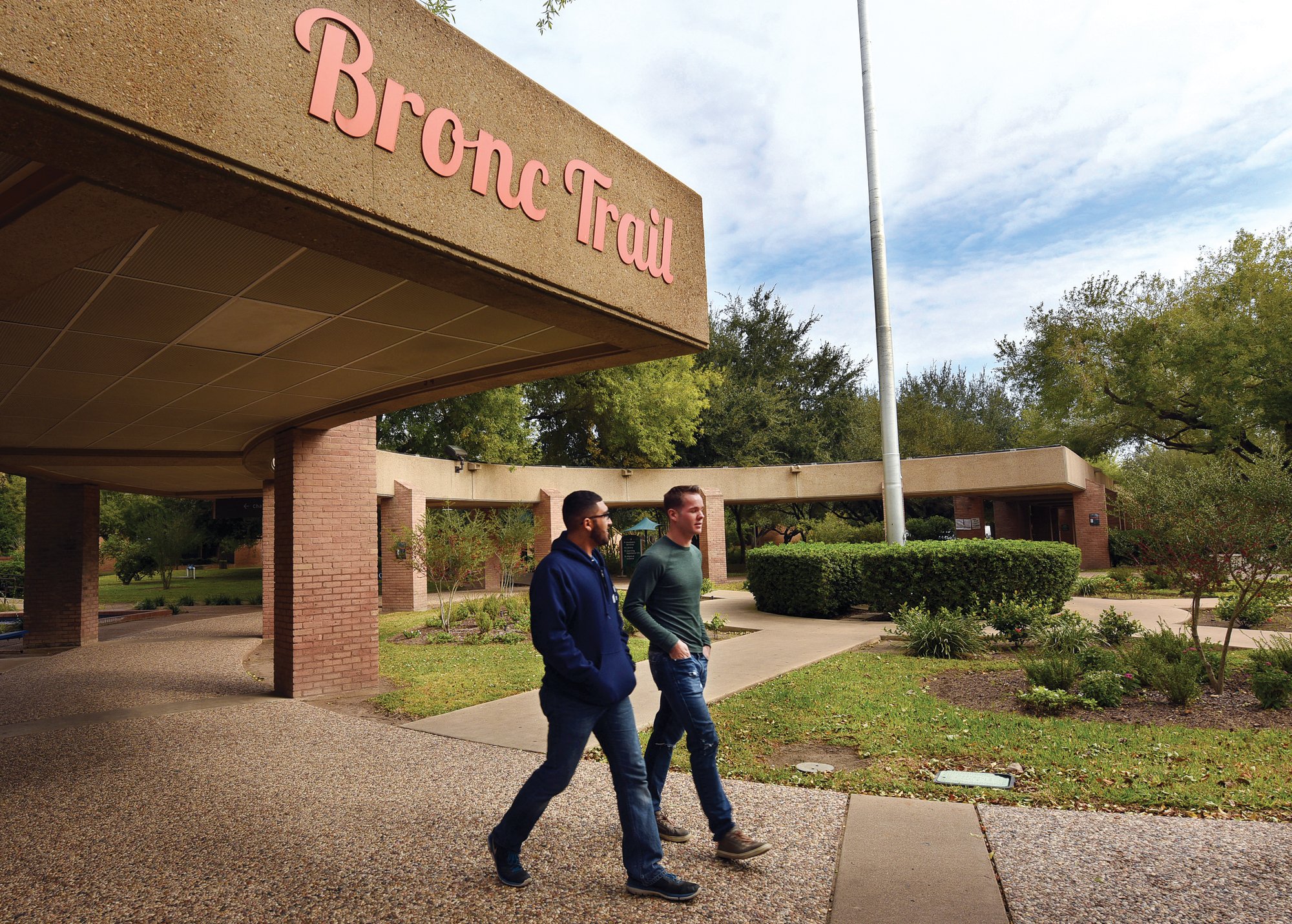
University of Texas Rio Grande Valley campus, Brownsville, Texas. The school
fell nearly 40 spots in U.S. News & World's 2027 Best Colleges list.Christine_Kohler/Getty Images

Outside of the top 100, some Texas institutions drop nearly 40 places

Outside the top 100, 12 Texas universities and colleges moved more than 10 spots from last year's national rankings, with some shifting by nearly 40 places:

No. 121. The University of Texas-Dallas (tied)Dropped 11 places from 2026 rankings.

No. 186. Texas Tech University (tied)Rose 12 places from 2026 rankings.

No. 227. University of Texas-San Antonio (tied)Dropped 14 places from 2026 rankings.

No. 236. University of Texas-Arlington (tied)Dropped 14 places from 2026 rankings.

No. 250. The University of Texas-Rio Grande Valley (tied) Dropped 37 places from 2026 rankings.

No. 288. Texas State University (tied) Dropped 31 places from 2026 rankings.

No. 308. Abilene Christian University (tied) Rose 21 places from 2026 rankings.

No. 308. University of the Incarnate World (tied) Dropped 15 places from the 2026 rankings.

No. 317. Prairie View A&M University (tied) Rose 26 places from 2026 rankings.

No. 332. Texas A&M University- Kingsville (tied) Rose 20 places from the 2026 rankings.

No. 342. The University of Texas at Tyler (tied) Dropped 13 places from the 2026 rankings.

No. 353. University of Houston-Clear Lake (tied) Dropped 35 places from 2026 rankings.
19 FEB 2015: Campus Life photos taken at Sam Houston State
University in Huntsville, TX. Sam Houston ranked among U.S.
News & World's 2027 Best Colleges regional list for the West.

NCAA Photos/NCAA Photos via Getty Images

The top 10 Texas regional universities and colleges

In addition to its national rankings, U.S. News & World Report ranked the top 50 regional universities and colleges. Texas schools were included in the "West" category.

The publication defines regional universities as institutions offering a wide range of undergraduate programs and some master's degrees, but few doctoral programs. Regional colleges focus on undergraduate education, with most degrees in professional fields.

Texas' top 10 regional universities

St. Edward's University (No. 6 overall)
University of Dallas (No. 10 overall, tied)
St. Mary's University of San Antonio (No. 12 overall, tied)
LeTourneau University (No. 29 overall, tied)
Stephen F. Austin State University (No. 29 overall, tied)
Texas A&M International University (No. 34 overall, tied)
West Texas A&M University (No. 37 overall)
Hardin-Simmons University (No. 38 overall, tied)
Sam Houston State University (No. 48 overall, tied)
University of Houston-Downtown (No. 48 overall, tied)

Texas' top 9 regional colleges
Southwestern Adventist University (No. 12 overall, tied)
Texas Lutheran University (No. 12 overall, tied)
Houston-Tillotson University (No. 22 overall)
McMurry University (No. 23 overall)
Howard Payne University (No. 27 overall, tied)
Wiley College (No. 42 overall)
Jarvis Christian University (No. 46-50 overall)
South Texas College (No. 46-50 overall)
Texas College (No. 46-50 overall)

While the University of Houston didn't crack the top 100 nationally, it ranked No. 67 when compared to public universities across the U.S., tied with seven other institutions. It ranked fourth when looking solely at public universities in Texas, according to a UH press release.

"The University earned Top 100 rankings in several other key categories, including Most Innovative Schools (No. 65), Best Value Schools (No. 78) and Best Colleges for Veterans (No. 96)," UH wrote on Tuesday.

Several other schools also ranked in the top 100 for public colleges: UT Austin at No. 8, Texas A&M University at No. 24, The University of Texas-Dallas at No. 58 and Texas Tech University at No. 96.

Thursday, January 12, 2023

Call for Papers: National Association for Chicana/Chicano Studies: Tejas Foco Conference March 23-25 UTRGV Brownsville

Call for Papers!!!


National Association for Chicana/Chicano Studies: Tejas Foco Conference


March 23-25, 2023

University of Texas-Rio Grande Valley

Brownsville, Texas


Conference Theme:

“Confronting/Resisting the Colonizer Within: A History of Violence, Discrimination/Oppression and Shame”


The NACCS-Tejas Foco Conference invites scholarly/creative submissions which address internalized colonialism/oppression/racism/colorism, as well as within our Chicanx/Latinx communities. We call for a confrontation/resistance to colonialist indoctrination, such as the legacy of racism, colorism and discrimination which are maintained by settler colonialism within our own Chicanx/Latinx communities. In order to truly decolonize our communities, we must face the enemy within and embrace our indigeneity. We must begin with deconstructing the historical structures such as the Spanish caste system which continues to marginalize/subjugate BIPOC. We encourage submissions that address the following topics, and welcome proposals that address the Tejanx experience in general.


History and legacy of the caste system in Latinx culture

Racism/Colorism within Latinx culture  

Anti-indigeneity, Anti-blackness, Anti-immigrant narratives within the Latinx community

Colonialism, Settler colonialism, Land/water/sacred sites, land theft/dispossession, Environmental racism/justice 

Internalized colonialism/racism, intergenerational trauma, abuse/violence within the Latinx community

Reclaiming/retracing our indigeneity and African roots, Nepantla

Identity/body politics, politics of labels, politics of language indoctrination

Indigenous erasure, detribalization, imperialist policies of blood quantums

Indigenous children and boarding schools/missions

Politics of Mestizaje, myth of the Raza Cosmica, “mejorar la raza” narratives 

Mestiza consciousness, double-consciousness, subjection/agency

“Vendidos”/sell-outs, complicity of BIPOC with white male heteropatriarchal narratives of supremacy

Catholicism and colonialism, criminalization of indigenous religions and spirituality

Religion and identity/gender roles/oppression, forced Christianization/indoctrination

History of resistance, Mexican Revolution, Adelitas

LGBTQ+ and colonialism/heteropatriarchal structures/settler colonialism

Lack of Indigenous and Black representation in Latinx media and Hollywood

Indigenous rights, Immigrant rights, Afro Latinos/Indigenous rights

Racial Justice, criminal justice and social control, criminalization of BIPOC, immigration policies & rhetoric

Latinx elites and anti-indigeneity/blackness, white Latinx, white Mexicans/Whitexicans, Fresa culture, MAGA Latinx

European beauty standards and their effects on BIPOC

Transformative pedagogies, decolonial pedagogies, anti-racist education  

Empowerment and activism, teaching/empowering the youth

Intersectionality/matrix of domination, gender roles and racism/colorism, colonialism and misogyny


Deadline for CFP: January 15, 2023

Please submit proposals for panels, roundtables, and/or individual presentations to the Tejas Foco Conference Organizers: Rosalva.resendiz@utrgv.edu or Miryam.espinosadulanto@utrgv.edu.  


In your email, please include the following: 

Name & Affiliation (Independent Scholar, College/University, Agency/Organization)

Individual submission – include a 200-300 word abstract, along with key terms

Panel proposal (3 to 4 participants) – include a brief description of the panel, list the Presenters, along with the Title of their paper and a 200-word abstract for each presenter  

Roundtable proposal (3 to 4 participants) – provide a 400-500 word proposal, include a Chair for the roundtable, and the Names and Affiliations of the each of the participants


Wednesday, April 19, 2017

Inside the Nation’s First Bilingual University

So inspiring and encouraging!  Finally, here we have a Texas university that realizes that it is in a state that shares a close to 2,000-mile border with Mexico.

It's fun to know all the people in this story.  There is no reason why more of our universities cannot move in this direction.  Long overdue.  Congratulations, felicidades, my friends!


UTRV Students
The Edinburg campus of UTRGV, where 90 percent of the student body is 
Hispanic.  
Brad Doherty

UT-Rio Grande Valley looks to become the first 'bilingual, bicultural, biliterate' campus in the country.

by Daniel Blue Tyx 

“The question of the day is: Are you smart?” professor José Saldívar announced at the start of class. “Don’t just give me a yes-or-no answer. Tell me why.” Seated in a sparkling new classroom at the University of Texas Rio Grande Valley’s Edinburg campus, with rolling chairs in the school colors — blue, green and burnt orange — students inched closer together to debate the value of innate ability versus hard work. Their conversations might have occurred in any first-year seminar, but for one key difference: They took place in both English and Spanish, often at the same time.

The bilingual course I visited is a pilot for an initiative known around campus as B3 — “bilingual, bicultural, biliterate” — that aims to transform the University of Texas Rio Grande Valley (UTRGV) into the United States’ first comprehensively bilingual public university. The project’s goals, proponents say, are far-reaching: to not only produce the bilingual professionals in high demand along the Texas-Mexico border, but also to begin to redress a historical legacy of what queer Chicana theorist Gloria Anzaldúa, a Valley native, calls “linguistic terrorism” against border Spanish speakers denied the legitimacy of their native tongue. As the initiative moves from rhetoric to reality, though, UTRGV finds itself grappling with questions of identity: What does it mean to be a bilingual and bicultural university?

“It’s about being much more aware of the language that is being spoken, and making sure that the space is safe for my students,” Saldívar told me after class in his office, which is decorated with an oversized pennant from Stanford, his alma mater. Saldívar, who in the fall of 2016 taught the first of what is expected to be dozens of bilingual or Spanish courses, has plenty of common ground with his students. Now in his late 30s, he grew up in the rural South Texas community of Edcouch-Elsa; his parents were punished in school for speaking Spanish and encouraged him to speak only English at home. Language could play a role in helping students feel a sense of comfort and belonging at the university, Saldívar said, but he wanted to impress on me that what the students were talking about was as noteworthy as how they chose to say it. “I think the American ethos is you pull yourself up by your bootstraps in order to be successful,” he said. “And that’s great. But I want my students to recognize the challenges and the disparities. And when faced with those challenges, ask: ‘What do we do?’ Because I want them to be able to handle that.”

For the class I visited at UTRGV’s Edinburg campus, students had read an article by Juan Carrillo called “I Always Knew I Was Gifted: Latino Males and the Mestiz@ Theory of Intelligences.” It led with an epigraph from Anzaldúa: “Theorists-of-color are in the process of trying to formulate ‘marginal’ theories that are partially outside and partially inside the Western frame of reference (if that’s possible), theories that overlap many ‘worlds.’”

The critical theory made for challenging reading for first-year students in what has often been taught as a remedial course. Before class, I’d heard several students grumbling bilingually about the article’s length. Still, as I listened in on their conversations, I observed that for several students in particular, the topic seemed to have struck a chord. “They would only pay attention to the smart ones, to the APs,” Julissa Lopez said of her high school teachers. “With the people who spoke Spanish, they were simple. They talk to you like you’re stupid. Like a baby.”

“¿En-ti-en-des lo que es-toy di-ci-en-do?” Sara Nuño interjected, mimicking a teacher’s condescending tone. Moving back and forth between Spanish and English, she explained that in high school, she and her mother would line up at 5 a.m. to walk across the international bridge from their home in Rio Bravo so she wouldn’t be late for class in Pharr. “Yo, todas las mañanas, I would cross the border, since sixth, seventh grade, till senior year. Todas las mañanas, 5 a.m. El sacrificio que haces por venir aquí.”


Professor UTRGV
Professor José Saldívar at the UTRGV campus in Edinburg.  Brad Doherty
After class, Saldívar said that Sara was a shy student at first, but that the bilingual aspect of the class helped her find her voice. “I remember the first time she spoke, she was really hesitant, and she tried speaking in English,” he said. “Then she said, ‘No, no, bueno, en español,’ and she just took off. Now, I can always count on Sara to talk in class.”

Another student, Ethan Treviño, said a scheduling glitch had randomly placed him in the bilingual pilot section, even though he doesn’t speak Spanish. While initially apprehensive, he’d come to see the placement as an opportunity. “Going through high school, there were a lot of people in my classes who mainly spoke Spanish,” he said. “I never got a chance to hang out with them because of the language barrier. This class is allowing me to learn what I couldn’t in high school. It wasn’t the type of Spanish that we talk here; they wanted us to learn ‘proper,’ like what they’re speaking in Spain. It didn’t allow me to lose that barrier here where I live.”

The bilingual initiative was born out of a messy divorce and a shotgun marriage. In 2011, Texas Southmost College, a community college, and the University of Texas at Brownsville (UTB) severed ties in a dispute over unpaid rent, precipitating a fiscal crisis. At the behest of the University of Texas System Board of Regents, then-UTB President Juliet Garcia convened a planning committee. The blueprint they created, known as UTB 2.0, included the bilingual program’s principles. “Universities are always trying to identify what they’re going to be uniquely good at,” Garcia told me. “We felt that we should embrace our geography, embrace our unique positioning with the issues of language and culture, and produce historians, teachers, physicians and engineers who could do this work in at least two languages.”

Then-UT System Chancellor Francisco Cigarroa, a Laredo native, was enthusiastic but skeptical of the economics. “I don’t care how optimistic we are — at the end of the day, a vision isn’t going to become reality without a realistic business plan,” he said. Cigarroa proposed merging UTB with the University of Texas-Pan American (UTPA), 70 miles west in Edinburg. The creation of a new university allowed both campuses to draw on the Permanent University Fund, a $17.5-billion fund historically built on oil and gas. Acting quickly, the regents adopted a set of guiding principles that drew heavily on UTB 2.0. The bilingual program was principle number five.

“I saw that, and I just about fell out of my seat,” said Francisco Guajardo, the executive director of the newly formed B3 Institute at UTRGV. “I said, ‘What, are you serious?’ You know the makeup of regents — they’re all appointed by very conservative governors. They were probably thinking folklórico and mariachis.” His booming laugh filled the dining room of the historic Echo Hotel, a few miles south of UTRGV’s Edinburg campus, where we discussed the origins of B3 over breakfast tacos.

Guajardo’s roots in the Valley run deep, and his interest in bilingual and bicultural education is as personal as it is academic. He was born in Reynosa, where — according to family lore — his grandfather, a bulega (bootlegger), fled after killing a rival who snitched on him to the Texas Rangers. In December 1968, when Guajardo was 4 years old, his family moved to Edcouch-Elsa. A month earlier, 140 Edcouch-Elsa High School students had walked out to protest discrimination against Mexican Americans. Three years later, as a first-grader, Guajardo became part of a pilot bilingual education class, the first of its kind in the Valley. “I’m from around here,” he said. “I’ve experienced a lot of these kinds of things around language and culture, and around the valuing or the devaluing of both.”

I met Guajardo after he gave a community talk at the Museum of South Texas History called “From Taming a Wild Tongue to Building a Bilingual University.” The title borrowed from a chapter in Gloria Anzaldúa’s Borderlands/La Frontera in which she remembers that as a student at Pan American University — now UTRGV’s Edinburg campus — she was required to take speech classes to “correct” her accent in English. She argues that “ethnic identity is twin skin to linguistic identity — I am my language. Until I can take pride in my language, I cannot take pride in myself.”

After the talk, a UTRGV professor stood up to inquire if B3 was a top-down initiative. “It is,” Guajardo allowed. Before he could elaborate, a Mexican-American man in his 60s came to his defense. “It may be top down,” the man said, “but this is the percolating of sentiment in the community to say, ‘We need to right the wrongs. We need to be about having permission, unfettered, to raise our children differently.’”

In 2015, Guajardo traveled with four faculty members to the University of Ottawa, the largest bilingual university in North America. “It’s a 150-year-old institution that is sitting on a bilingual zone as a matter of public policy,” Guajardo said. “We see that. We think to ourselves: ‘This is so inspiring. Could we do it in a place that tamed a wild tongue?’” In the spring, the university will expand the bilingual pilot from one to five sections. A few programs, including an MFA in creative writing and an MBA, are already offered in Spanish or bilingually. Soon, Guajardo hopes, UTRGV will be able to offer the entire core curriculum bilingually, with more complete degree plans to follow.
But becoming the nation’s first bilingual university will mean more than just offering classes in both languages. It will also require a dramatic shift in the way that the university, and the Valley as a whole, thinks about matters of history and identity, in a place where a century of systemic language and ethnic discrimination has too often gone unacknowledged, and where even today bilingual education is viewed primarily through a remedial lens.

In addition to directing the B3 Institute, Guajardo is at work on a book of oral histories documenting the history of bilingual education in the Valley. “Invariably, each of the elders will tell the story of how they were punished, spanked, chastised, for speaking Spanish in school,” he said. “It is no accident that this region is much more conservative in terms of bilingual education, because of a historical trauma that people experienced.

“This,” Guajardo said, “is a social change experiment.”


Professor UTRGV
Francisco Guajardo speaks with two UTRGV alumni at a meeting in Edinburg about the bilingual program.  Brad Dohorty
UTRGV’s newly drafted vision statement begins, “To be the nation’s premier Hispanic-serving institution and a highly engaged bilingual university.” The admissions page on the university’s website — soon to be fully bilingual — prominently features the program as a selling point. “It is a priority,” Provost Havidán Rodríguez told me when we met on the Brownsville campus, which, unlike Edinburg’s, is right on the border. (On my way to campus, I passed under a sign warning me not to take firearms into Mexico, before exiting onto University Boulevard.)

“This is not a marketing scheme. We’re putting in place the organizational structure, the staff, the funding and the faculty that we need to make this happen. I think that speaks louder than words, right?”

Overt opposition of the kind you might expect elsewhere — “English-only” rhetoric and the like — has been largely nonexistent in the Valley. All of the students I met, from freshmen to graduate students, from monolingual English speakers to recent immigrants from Mexico, expressed an interest in taking the bilingual classes. “Honestly, I’m not really concerned,” Rodríguez responded when I inquired about student interest. “Students know this is important.”

The most insistent criticism has come from students and faculty who think the university is not going far enough. As the university considers starting a football team and scrambles to deal with the fallout from a December decision by its accreditor to put the university on probation — UTRGV says the violations are related to the contentious separation from Texas Southmost College — skeptics worry that the university may lack sufficient commitment to follow through on its ambitious agenda.

Stephanie Alvarez, the founding director of the Center for Mexican American Studies at UTRGV, has been one of the most vocal critics. We spoke on a lime-green couch at the center, which Alvarez had a hand in designing, asking that the planned cubicles be eschewed in favor of an open lounge. Behind us, a group of students sat talking while they cut out materials for a Day of the Dead altar project the center was facilitating at area elementary schools.

For Alvarez, who in 2015 became the first faculty member in the history of the University of Texas System to receive a prestigious U.S. Professor of the Year Award from the Carnegie Foundation, the focus on bilingualism obscures a lack of commitment to programs such as Mexican-American studies that turn a critical eye on the history and culture of the borderlands. “It’s easy to sell bilingual in some ways,” Alvarez said. “Many, many people speak Spanish in the Valley. It’s not threatening. Whereas [with] Mexican-American studies, you have to have difficult conversations. You’re possibly producing new knowledge that disrupts the dominant narrative, which for some people makes them very uncomfortable.”

Growing up Cuban American in Miami during the Mariel boatlift, a time of heightened anti-Cuban sentiment, “I really had no appreciation for my culture,” Alvarez said. “I wanted to distance myself as much as possible.” In high school, she didn’t read books. “Ever. The worst thing you could ever tell me was that I would have to read.” She went to college to play basketball and ended up a Spanish major by default, since it required the fewest courses to graduate. Then, during her senior year, she was required to take a Latin-American literature course. The first entry in the anthology was a magical realist story by Puerto Rican writer Rosario Ferré. For Alvarez, it was a moment of academic awakening. “I realized that this was the first time I’d ever read anything that I connected to,” she said.
When Alvarez came to teach at UTPA in 2006, the only ethnic studies degree plan was called Mexican-American Heritage, and it had graduated just three students in 30 years. Eighteen credit hours were in Spanish grammar, “indicating much of what Anzaldúa says about ‘linguistic terrorism,’ but on the Spanish side, which was to ‘correct’ the students’ Spanish,” Alvarez said. She joined an informal group of Latina junior faculty members that began developing a revised curriculum that would become the basis for Mexican-American studies at UTRGV.

Alvarez is particularly outraged that no other degree plan at the university requires a Mexican-American studies course. “If you get a degree in English, you never have to take a class in Mexican-American literature,” Alvarez said. “It is an option. But it cannot be an option if we are going to be a bicultural university. If you are going to be an English teacher, 90-something percent of your students are going to be Mexican American. Those teachers have no access to the literature that represents their students.”


UTRGV professor
Stephanie Alvarez outside her office on the Edinburg campus.  Brad Dohorty
Hiring is another issue. Alvarez pointed out that the Mexican-American studies department has only two faculty members; previous efforts at joint hires with other departments have gone nowhere. “People always think there’s an urgency for, I don’t know, ‘I desperately need a medievalist.’ But at this moment, at this university, we desperately need someone who can do bilingual and bicultural. This is what will make UTRGV stand out from any other university.”

Guajardo is acutely sensitive to the critiques voiced by Alvarez and others. “Without the infusion of culturally appropriate, culturally relevant approaches, I think that we don’t touch the spirit of the region,” he said. At one point, he was interrupted by a phone call; someone from the MBA program was looking for a course taught in Spanish to fulfill a breadth requirement. He pitched a Mexican- American studies class. “Stephanie would be great for the MBA students,” he told the person on the other line. “She would turn [the business students] upside down with all kinds of Chicano studies stuff that they would do well to know.”

As for hiring and resources, Guajardo told me, “If I have an issue, and this is a personal critique, it’s that I hoped the investment would have been so much greater. It’s not because people don’t want it. In fairness to my immediate supervisors, they’re trying, they’re working it. But you know, it’s never enough. A lot of this is the faith that we have in certain people.”

On November 2, the Day of the Dead, I joined a group of 15 UTRGV students, faculty and community members at Gloria Anzaldúa’s gravesite in the Valle de la Paz Cemetery in Hargill, the one-conveniencestore- town north of Edinburg where she grew up in a family of migrant farmworkers. Organized by the Center for Mexican American Studies, the annual pilgrimage symbolically “returns” Anzaldúa to the Valley and her alma mater, where her work, in spite of widespread acclaim elsewhere, was largely unrecognized at the time of her death in 2004. Now in its 10th year, the event and others like it have catalyzed local interest, and Anzaldúa’s writing, which moves fluidly between English and Spanish and poetry and prose, is foundational to the bilingual program.

“If we don’t want to reproduce the ‘linguistic terrorism’ that Anzaldúa experienced at Pan American University, then we need to embrace initiatives like B3,” Lupe Flores, a graduate student in anthropology and Mexican-American studies, told me. Flores first encountered Anzaldúa in one of Stephanie Alvarez’s classes and organized the pilgrimage this year. “Outside the university, we have this national climate that is very ‘English-only,’ anti-Spanish, anti-immigrant — they kind of go hand in hand,” he said. “I think this initiative has a lot of potential to undo the racism and oppression that earlier generations had to experience, and that a lot of us are still experiencing.”

On the tombstone, emblazoned on either side by bilingual passages from Anzaldúa’s work, participants placed ofrendas of sugary pan de muerto and magenta bougainvillea leaves. One student had brought a bundle of cenizo (sage), which she lit and passed around with a conch shell underneath to catch the ashes. For 15 minutes or so, everyone stood in silence, except for the sounds of birdsong, dogs barking and a rooster crowing in the distance.

Then, one by one, those gathered began to offer testimonios describing how Anzaldúa’s work embracing the linguistic and cultural richness of the borderlands had shaped their own lives. Flores spoke about his grandmother, a Pentecostal Christian whose family has lived on the same riverfront rancho for almost two centuries. Estranged first by a language barrier and later because of his homosexuality, Flores said that reading Anzaldúa had helped him reconnect with his grandmother and the culture of the border more broadly. “Seeing my grandmother think through her positions, I could see that even though she’s this very religious, God-fearing woman, she has her own borderlands, her own ways of articulating and accepting things,” he said.

Toward the end of the ceremony, members of a student poetry collective offered a choral reading of an excerpt from Anzaldúa’s work. At the text’s instruction, they invited those gathered to turn their gaze to the east, south, west and north, then to the underworld, and lastly to the sky, as they read:

We are ready for change.
Let us link hands and hearts
together find a path through the dark woods
step through the doorways between worlds
leaving huellas for others to follow,
build bridges, cross them with grace,
and claim these puentes our

“home”
si se puede, que asi sea, so be it,
estamos listas, vámonos.

Now let us shift.

contigo,
gloria


This article appears in the February 2017 issue of the Texas Observer. Read more from the issue or subscribe now.

Daniel Blue Tyx lives in McAllen. His work has appeared in Best American Travel Writing, the Gettysburg Review, CutBank and elsewhere.


Thursday, October 06, 2016

LatinX Students in Public Education Symposium: Ethnic Studies & Academic Succss—UTRGV-Brownsville Campus


 #ethnicstudiesnow
#MASforTexas


Latinx Students in Public Education Symposium:
Ethnic Studies and Academic Success  

8:45am: Coffee & Pan Dulce

9:00am: Welcome
            Emmy Pérez,
Interim Director, Center for Mexican American Studies

9:15am: Introductions of Guest Speakers
            Dr. Martiza De La Trinidad, History Department & MAS Affiliate Faculty

Keynote Speaker, Dr. Angela Valenzuela, UT Austin
            “The Past, Present and Future of Ethnic Studies: Prospects for Texas and the           Nation”

10:30am: Workshop
Dr. Julio Cammarota, Iowa State University
“The Social Justice Education Project: A Case Example of Youth Participatory Action Research in Ethnic Studies”

12pm: Luncheon 

1:00pm: Roundtable Discussion 
“Reject this Text: A Discussion about the Proposed Textbook Mexican American Heritage”
Introduction
            Dr. Francisco Guajardo, Director, B3 Institute
Discussion Facilitators
            Dr. Emilio Zamora, UT Austin
            Dr. Christopher Carmona, UTRGV
2:15pm: Presentation & Discussion
“Mexican American Studies in the Rio Grande Valley”
            Dr. Stephanie Alvarez, MAS Program UTRGV
            Valerie Cerda, MA candidate in MAS UTRGV
            Tania Chávez, Special Projects Coordinator, La Unión del Pueblo Entero
            Alejandro Sanchez, BA candidate in MAS UTRGV

3:30pm: Student Testimonios and writing from Dr. Julio Cammarota’s workshop

4:15pm-5pm: Closing Circle, Dr. Francisco Guajardo

Hosted by: CMAS: Center for Mexican American Studies

Sponsored by: CMAS, College of Education & P-16 Integration, the Office for Student Involvement, and LUCHA student organization

CMAS Symposium Planning Committee: Monica Alvarez, Stephanie Alvarez, Christopher Carmona, Valerie Cerda, Maritza De La Trinidad, George Díaz, Francisco Guajardo, Emmy Pérez, Yajaira Rivera, Arnulfo Segovia, and Amanda Tovar.

Thank you Jennifer Berghom, Yaribel Caraveo, Daniel Cardenas, Elisa Flores, Raul Leal, Dr. Patricia McHatton, Cindy Mata-Vasquez, Patricia Montemayor, Dalyn Ruiz, Cheryl Taylor, Edna Zambrano, Emilio Zamora, and all the public school students, teachers, and administrators in attendance.

For More Information: CMAS Staff: Yajaira Rivera or Valerie Cerda @ (956) 665-3212 or Emmy Pérez emmy.perez@utrgv.edu