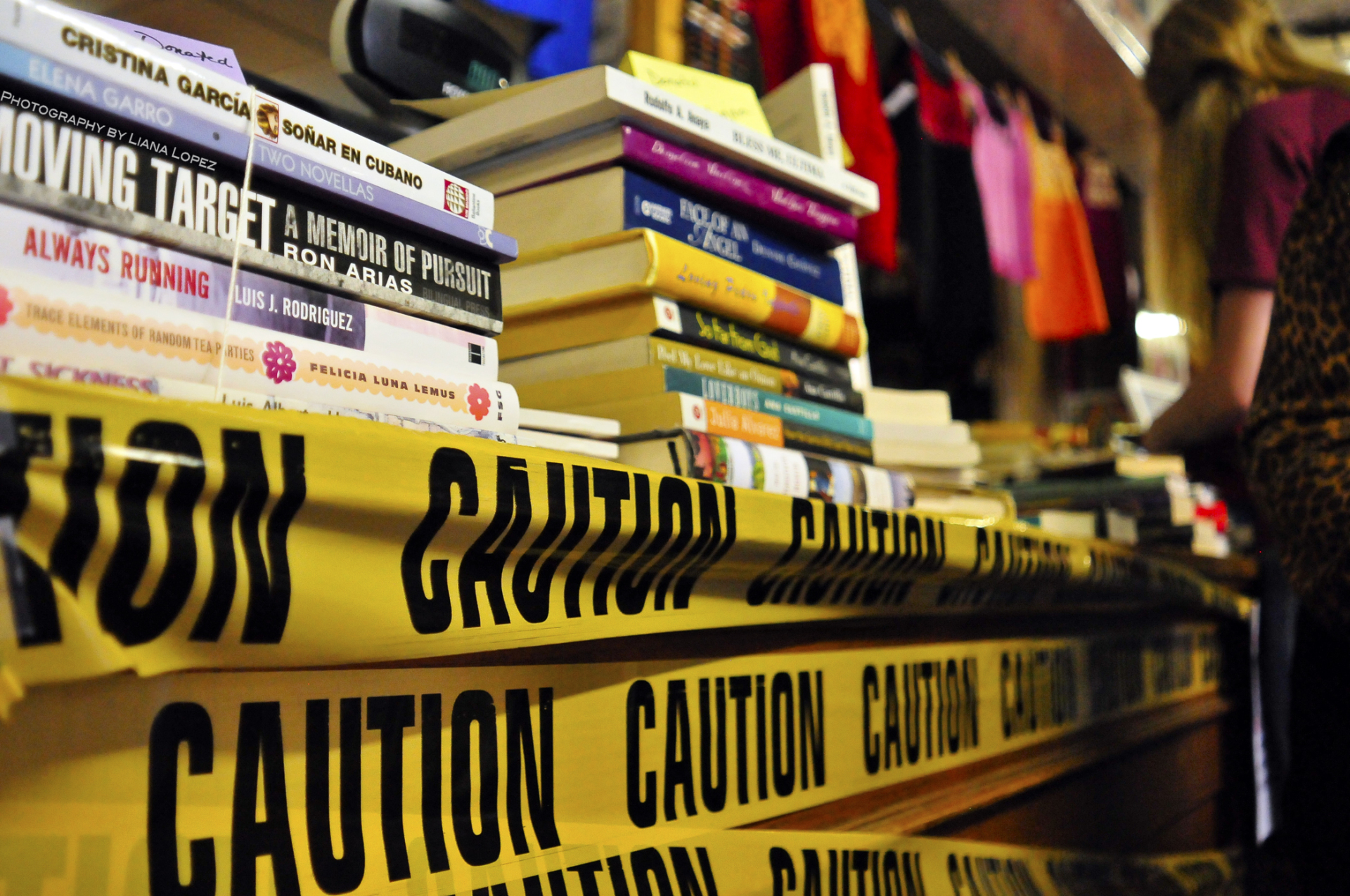
Wonderful essay on the power of poetry by Tony Diaz, The Cultural Accelerator who aptly quotes author, Dagoberto Gilb, to express now nonsensical it is to disrespect poetry:
All humans have the desire to relate their voices, their visions, their stories. All people want to. “Poetry Does Not Make Money” sentences the community to silence. Writer Dagoberto Gilb says it not accurate to call this “invisibility.”
Indeed, "contrived invisibility" might be a better way to express this social engineering of silence.
Poetry, slam poetry, spoken word, and storytelling are among the most beautiful and meaningful of inheritances that any of us could possibly receive in our lives. Life and living, after all, have poetic dimensions as the phrase, "poetic justice," suggests. "Aesthetics" readily aligns to this, pointing to that which makes us human.
No, poetry isn't necessarily directly related to the acquisition of money, but can, nevertheless, have multiple, positive spillover effects, not the least of which are personal, community, and ultimately, societal transformation.
And that's worth more than gold!
Great read. Enjoy!
-Angela Valenzuela

by Tony Diaz
Poetry doesn’t make money.
That sentence is intended to sentence our senses to cents. Yet, we
hear it all the time.
I aim to write about Cultural Capital to defy sentences like this.
Because here is the truth: poetry does not create direct capital,
but poetry creates a gold mine of Cultural Capital. And our community thrives
on it.
We will not be kept from it, but our community needs to profoundly
understand the power of Cultural Capital, and they must know that others
actively attempt to make us relinquish our voice.
At the most basic level, teachers, parents, and even editors tell
potential poets and writers that poetry doesn’t make money as if they are
repeating a universal truth.
Most folks might consider this a harmless statement. The harmful
part is that it’s a stereotype that has gained traction and is repeated more
often than poems are probably read.
Too Poor For Poetry
“Poetry Does Not Make Money” becomes a brilliant advertising
campaign. The result is that our community is sentenced to a reality where
poetry does not matter because, evidently, we don’t have enough money to enjoy
it.
At the very least repeating “Poetry
Does Not Make Money” might persuade a young person not to read poetry, a
college student to reject his or her dream of choosing to major in Literature
or Humanities, or an editor not to publish a collection of poems. Folks then
assume that our community does not care about poetry or literature.
All humans have the desire to relate
their voices, their visions, their stories. All people want to. “Poetry Does
Not Make Money” sentences the community to silence. Writer Dagoberto Gilb says
it not accurate to call this “invisibility”.
2 of Dagoberto Gilb’s books were in the Mexican American Studies curriculum
outlawed in Arizona. This is from the introduction to “Mexican American
Literature: A Portable Anthology”: “. . . historians and scholars are
inclined to attribute that unawareness to an “invisibility” of the community.
But the implication of this becomes that it must be something of a quaint,
natural character inside MexAm people, and not the effect of poverty or
consequence of a lack of political power. I’d suggest that it’s more of visual
degeneration in the center of the dominant culture’s eyes.”
Mind-Altering Prose
It is what Gloria Anzaldua calls facultad that transforms us and
inspires us to pierce through this manufactured “invisibility”. Endowed with
facultad we are on the road to becoming Cultural Accelerators.
Anzaldua’s book “Borderlands/La Frontera: The New Mestiza” was also
one of the books on the prohibited MAS curriculum at the Tucson Unified School
District. In it she writes, “La facultad is the capacity to see in surface
phenomena the meaning of deeper realities, to see the deep structure below the surface.”
“Seeing” “deep structures” “below the surface” is a potent way to
unleash an individual’s ability to quantify Cultural Capital, which makes it
easier to invest that power, and to protect that power.

Mind-altering poetry and prose reveal to us what is missing. And then we write
about what we see in our minds. And we dispel that myth that poetry does not
pay because we are proof that poetry creates Cultural Capital. If we invest
that Cultural Capital into our community, we are poised to accelerate it for
the good of not just our community but for humanity.
I have seen this happen before my very eyes.
In 1998, I founded Nuestra Palabra: Latino Writers Having Their Say
in the party hall of Chapultepec Restaurant in Houston’s Montrose neighborhood.
At the time, people did not quite say to me “Poetry Does Not Make Money”, but
instead they used a lot of synonyms and euphemisms.
The worst thing I would hear, even from other Latinos, was that our community
just was not interested in literature.
Let that sink in. Our own community deeply believed we did not possess the
basic humanity to want to tell our or hear our story. That is profound damage.
I would simply tell them they were welcome not to attend, but this train was
moving, and I kept looking for other Cultural Accelerators who were ready to
unleash Aztec muses.
From the outside world, I would hear that there were not enough
Hispanic writers in Houston to sustain a series.
I had just become the first Chicano to earn a Master of Fine Arts
in Creative Writing form the University of Houston. I moved here specifically
for that. This was shocking to me. I always wondered why Houston had to import
Mexican Americans from Chicago when, being occupied Mexico, it had plenty of
its own. Examining Cultural Capital peels the structural issues that explain
this.
MFA students are taught to flee to New York to starve as soon as
they graduate and try to get an obscure novel published by a small New York
press. I looked into that and ascertained that NYC already had enough writers,
actors and hit men. Instead, I decided to invest my Educational Capital into
Houston’s Cultural Capital.
In graduate school, you’re not supposed to leave the ivory tower
unless it’s for a reading of your novel in progress. I adhered to other habits.
My instinct has always been to stay connected to my community. At
first, I thought that meant only my family. However, I realized as early as
high school that if I was going to navigate the halls of education, I was going
to need my community’s support.
For that reason, I continued to make
history during graduate school. I was the first to teach Creative Writing
courses at places like the Chicano Family Center and Talento Bilingue de
Houston. I also helped organize press conferences for Central Americans
seeking, and being denied, political asylum.
For that reason, I knew that there was not just a need to share our
voices but a deep pool of talent.
Sitting in those workshops, I was
thrilled to hear people who resembled us tell their stories on their terms for
the first time. Everyone should experience an edifying moment like that. It is
thrilling to be part of. I wanted to give more people a stage for that. And
Houston wanted to be that stage.
So, when folks told me there were not enough Latino writers in
Houston to sustain a reading series, I would tell them they were wrong because
I knew that if we ran out of writers I could create more.
And I would convene with the founding members of Nuestra
Palabra such as Russell Contreras, Alvaro Saar Rios, and Carolina
Monsivais, and others like them who shared their time, energy, and genius with
our cause and who have gone on to publish nation-wide and earn advanced degrees
and inspire the next generation of writers, and on, and on, and on.

When I think of the 2.6 million Latinx students in Texas public
schools right now, I envision 2.6 million poets and writers.
But don’t be scared. Even when they
are all freed into their Cultural Capital, the number of poets and writers will
probably stay the same percentage-wise, but they will have an army of readers
who have become doctors, lawyers, professors, accountants, politicians, board
members, and so on, and so on, and so on.
If you don’t believe me, you simply need to refer to the research
by Chicanas and Chicanos submitted as evidence in court to overturn Arizona’s
un-American ban of Mexican American Studies. If you need more proof . . .
Sociologists take too long to explain the dagger at our throat.
Writers provide vivid renditions of the tip of the pyramid but must
write novels to explain the base.
The poets make us sharply feel the import.
I bring all three to this battle for Cultural Capital and have 10
more waiting in my car.
That's all for now, but you can do something to invest in Cultural Capital
today.
Here are 3 ways invest in Cultural Capital today.
Donate to an art nonprofit from the community. (Here’s a link to Macondo.)
Volunteer. (Here’s a link to volunteering for Nuestra Palabra: Latino Writers
Having Their Say.)
Read and write. Spending your time reading our work is a potent investment.
Others will see it and then be reminded to of our how powerful an act it is.
(Tune into to the Nuestra Palabra Radio Show to hear about more writers and
poets.)

Next Tuesday at 2 pm: Mind-Altering
Prose
Tony Diaz
TV, Prose, & Radio
TV, Prose, & Radio
Sun 7am
"What's Your Point" Fox 26 Houston
Tony Tuesdays at 2 PM
New essays
"The Cultural Accelerator" at www.TonyDiaz.net
Tues 6pm
NP Lit Radio 90.1 FM KPFT, Houston
"The Cultural Accelerator" at www.TonyDiaz.net
Tues 6pm
NP Lit Radio 90.1 FM KPFT, Houston
24/7