Educational Equity, Politics & Policy in Texas

This blog on Texas education contains posts on higher education, as well as preK-12 policy accountability, testing, bilingual education, immigration, school finance, race, class, and gender issues at both the state and national level. It also represents my digital footprint, of life and career, as a community-engaged scholar in Texas.

Translate

Tx Trib Schools Explorer

  • Texas Public Schools Explorer
Showing posts with label immigrant labor. Show all posts

Monday, May 19, 2025

Mexican Labor: The Invisible and Exploited Backbone of American Dairy

Friends:

Note: I don’t usually blog about farmers or milk—this is, after all, an education blog. But I do often write about immigration, people, justice, and the structures that exploit them. This story—about labor, invisibility, and systemic abuse—falls squarely within that frame. Hence, this post.

As we reckon here in the U.S. with the escalating attacks on undocumented Mexican and Latina/o/x immigrants, we must confront the broader societal consequences. We all enjoy milk, don’t we? Maybe in our morning coffee, or as a staple in our children’s diets—“for strong, healthy bones,” we like to say. But who makes that possible?

Consider the following: in Michigan, as in much of the country, the labor that keeps the dairy industry alive is overwhelmingly Mexican. 
Check out this related piece for further evidence.

It’s demanding, relentless work—milking cows in the cold, hauling feed, maintaining machinery, day in and day out. And it’s work that most U.S.-born laborers won’t touch.

Let’s be clear: without Mexican labor, Michigan’s dairy industry would collapse. The same is almost certainly true for Texas, a leading milk producer. These workers—skilled, dependable, and exploited—have become the invisible backbone of American dairy.
 These workers form the foundation of America’s milk supply, yet they do so with little protection, under the constant threat of deportation, and for wages that barely meet survival. 

This is serious, my friends.

WE DEPEND ON MEXICAN LABOR, not just in dairy farming, but also in agriculture. This isn’t just a milk supply issue—it’s a humanitarian crisis hiding in plain sight. Moreover, if immigration policy doesn’t shift with the threat and actualization of mass deportations, it won’t just be the milk supply that falters—it will be our basic sense of justice and humanity.

-Angela Valenzuela

Michigan dairy labor supply pressures

While labor-saving technology has increased productivity, people are still an integral part of cow care. In this article we’ll provide context and highlight strategies to help address labor challenges.

by Zachariah Rutledge, Michigan State University Department of Agricultural, Food, and Resource Economics; and Phil Durst, Michigan State University Extension - October 03, 2023

  • share this on facebookShare
  •  
  • share this on twitterTweet
  •  
  • save to PinterestSave
  •  
  • share this on linkedinShare
  •  
  • print this pagePrint
  •  
  • Email this pageEmail

In the heartland of Michigan’s agricultural economy, dairy farms are confronting a persistent and growing challenge: a labor shortage that threatens one of the state’s most critical industries. Increasingly, these farms are turning to a reliable workforce that has become the backbone of dairy production across the country—Mexican laborers.


Dairy farming is unlike seasonal agriculture. Cows don’t stop producing milk in the winter, and the work doesn’t pause for holidays or weekends. Milking, feeding, and equipment maintenance continue year-round, often under grueling conditions. “It’s cold, it’s wet, it’s dark—this is not the kind of work most Americans want to do,” says one Michigan dairy operator who requested anonymity due to the sensitive nature of immigration labor discussions.

That reluctance from the domestic workforce has left a vacuum—one that Mexican workers have stepped in to fill. Many arrive with agricultural experience, deep familiarity with animal husbandry, and a work ethic honed by necessity. For them, a job on a Michigan dairy farm—though demanding—offers a lifeline. Wages, while modest by U.S. standards, far exceed what’s available in many parts of rural Mexico.

But the labor these workers provide is not just about economics—it’s about continuity. Farmers describe Mexican workers as dependable and highly skilled, often learning to operate heavy machinery, manage herds, and take on supervisory roles over time. The relationships built through word-of-mouth recruitment have created informal labor pipelines between rural towns in Mexico and the milking parlors of the Midwest.

The federal H-2A visa program, designed to bring in temporary agricultural workers, doesn’t apply to the dairy sector because it’s classified as non-seasonal. As a result, many farmers find themselves navigating a legal gray area—employing undocumented workers or those whose visas have expired simply to keep their operations running.

For Michigan dairy producers, the question is not whether they prefer Mexican labor. It's that without it, the entire system might collapse.

“This isn’t just about convenience,” one farmer noted. “It’s about survival.”

As immigration policy debates continue in Washington, dairy producers across the country are watching closely. For many, the stability of the American milk supply depends on what happens next.

Oh, the labor pains! How often we hear from farm owners that they can’t find enough people willing to work on the farm. Dairy production is labor-intensive, with cows being milked, fed, moved and managed around the clock. Compounding these challenges, the labor market is increasingly tight for a number of reasons, including a declining interest in farming among younger generations, a declining pool of workers who are willing to do farm work, and few legal channels for immigrant labor. While labor-saving technology has increased productivity, people are still an integral part of cow care. In this article we’ll provide context and highlight strategies to help address labor challenges.

Background

Most hired farm employees in the United States were born in Mexico. Mexico’s close proximity to the US, and its relatively poor economic conditions, incentivized migration to the US during the 1900s and early 2000s. Many of these migrants entered the US without legal authorization and sought work on US farms. High levels of Mexico-US migration enabled US agricultural producers to maintain access to an abundant supply of relatively inexpensive labor and expand production to satisfy increased demand.

However, in recent years, US farm labor markets have undergone substantive structural changes that have increased the prevalence of labor shortages. Labor supply pressures drive farm wages up, stunt growth opportunities for American farmers, accelerate the adoption of labor-saving technologies, and force production to other countries that have lower production costs. These trends raise concerns about the economic viability of dairy farming in Michigan and the production capacity of Michigan’s dairy industry.
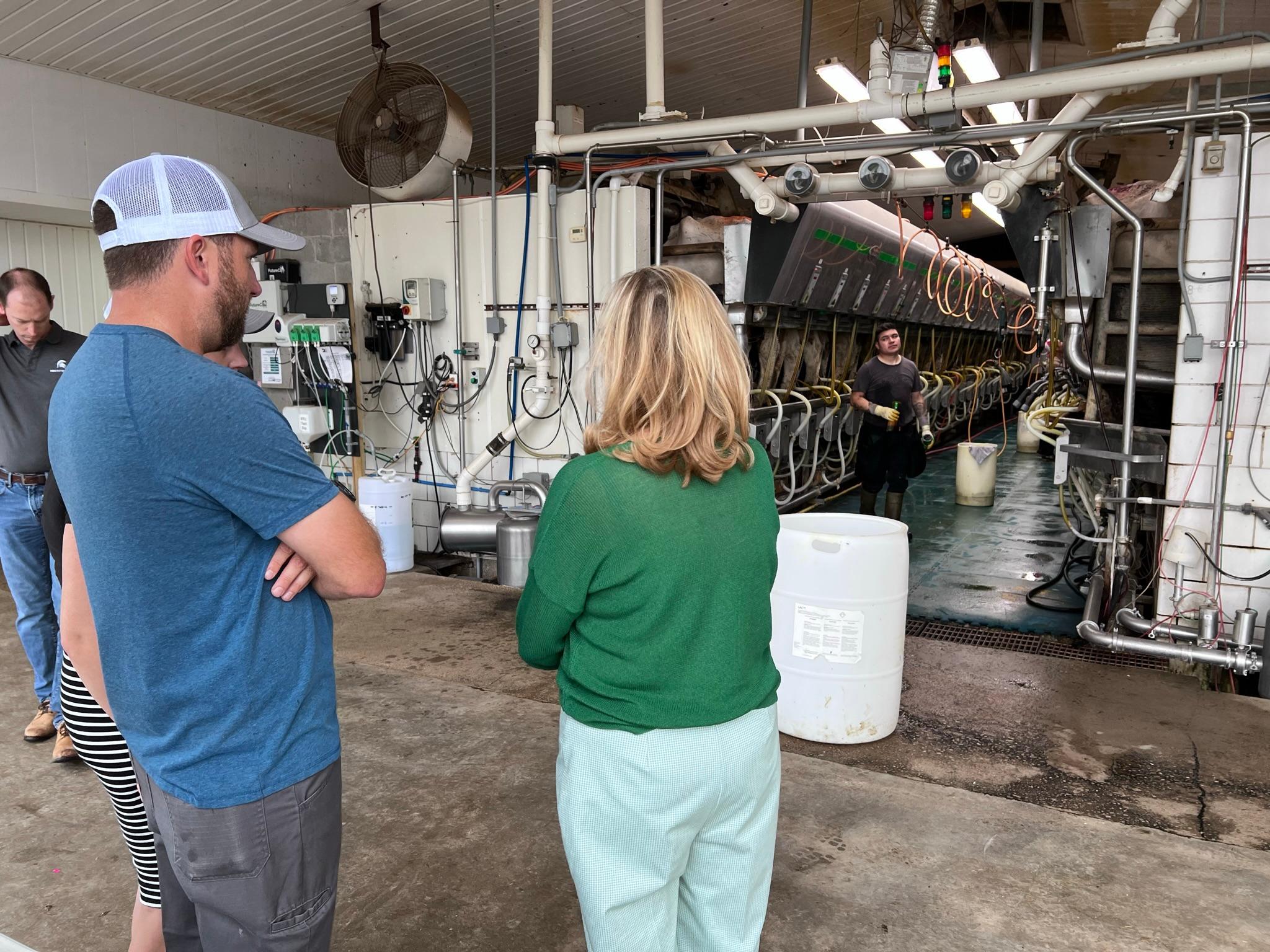
People standing in a milking parlor
MSU Interim President Teresa Woodruff visits with Kyle Jandernoa during a visit with Dutch Meadows Dairy in recognition of Farmworker Appreciation Day on August 6. Photo by Brandon Gross.

Dairy labor costs are rising and employment is declining

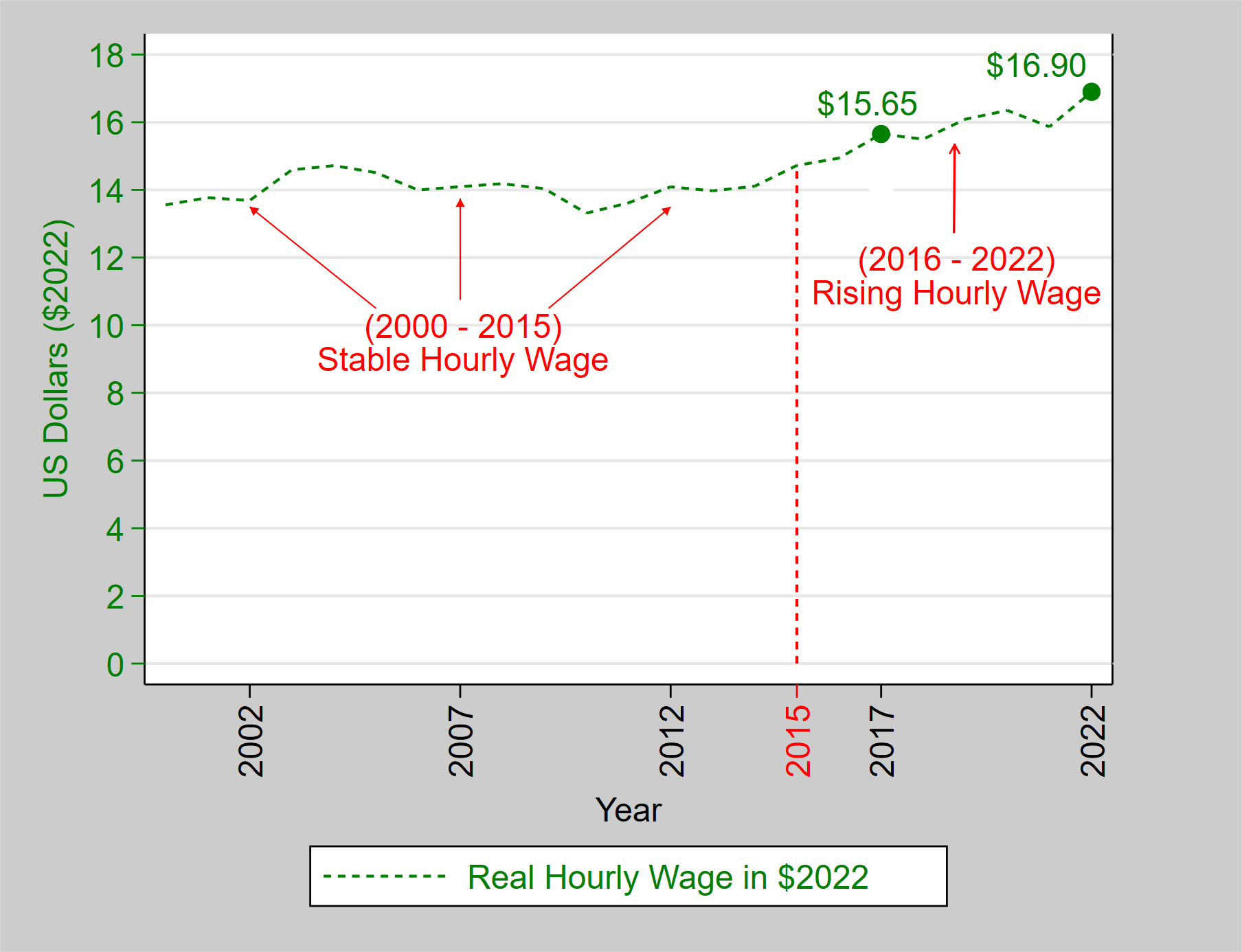
The year 2015 marked an inflection point in Michigan’s dairy labor market, when the growth of real labor costs (i.e., adjusted for inflation into 2022 dollar values) started rising and employment growth started tapering off. Figure 1 shows that between 2000 and 2015, the real average hourly wage (in $2022) of animal-related farm employees in the Lake Region was relatively stable in the $13.00 to $14.00 range. In 2017, the average real wage (in $2022) reached an all-time high of $15.65 and has continued to rise. In 2022, the average real wage was $16.90.
Hourly Wage Color V3.png
Figure 1. Real hourly wage ($2022) for Lake Region animal employees, 2000 – 2022.

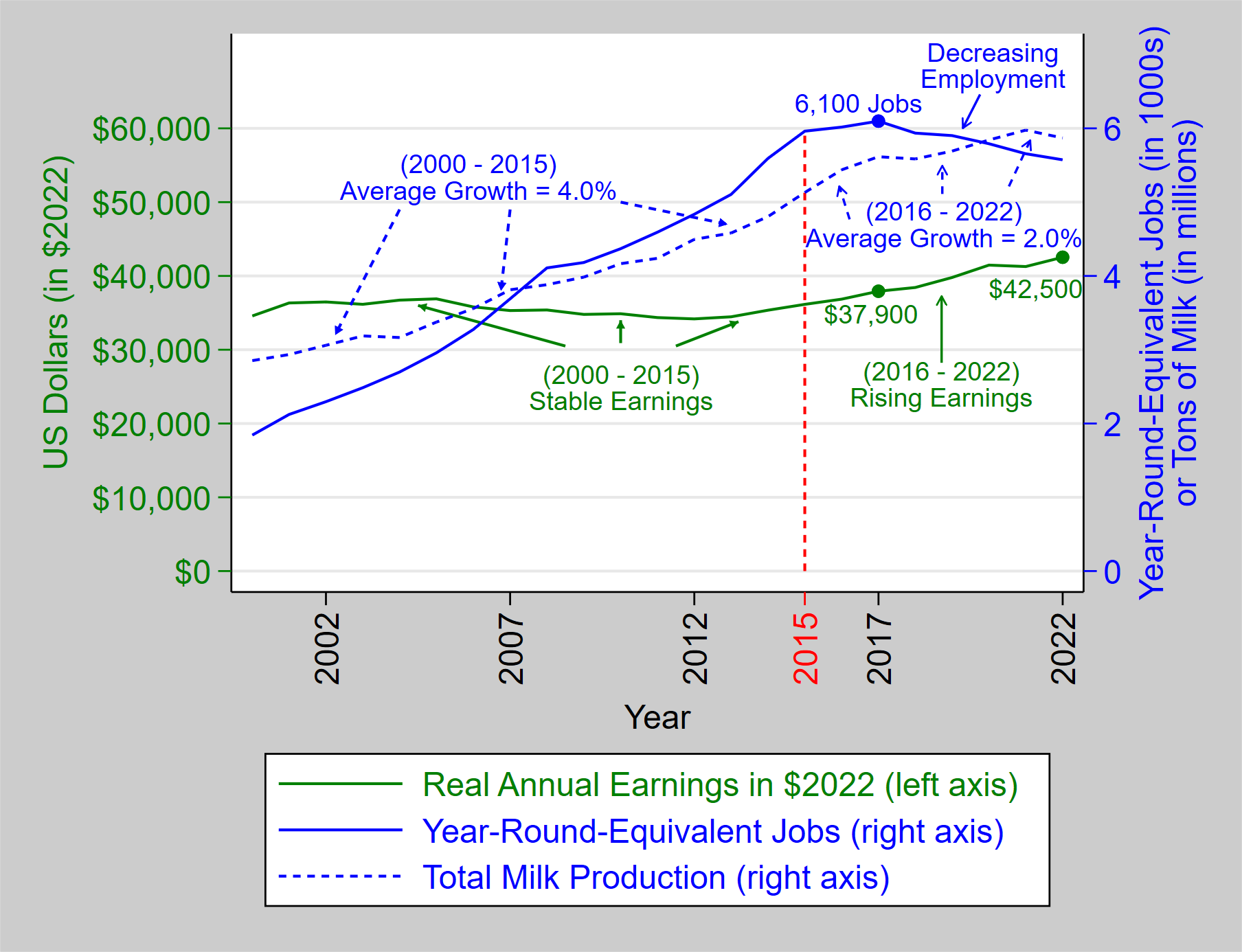
Dairy employment has dropped every year since the 2017 peak, and there were 500 fewer year-round-equivalent jobs on the books of Michigan dairy farmers in 2022 relative to 2017 (Figure 2). Economic theory suggests that when a labor market is experiencing a decline in the supply of labor, wages will rise, and employment will drop. These recent trends are consistent with a declining supply of dairy farm labor in Michigan.
Production Color V3.png
Figure 2. Michigan milk production, dairy employment, and annual employee earnings, 2000 – 2022.

Since 2015, the growth in total milk production declined to an average 2 percent per year. While there are many factors that can slow milk production growth (including increased building costs and processing capacity limits), a decrease in labor availability, as indicated by the reduction in farm employees, may also be a factor limiting growth.

Value for investment

Rising income for dairy employees is not the problem, as long as productivity increases faster than wages. Therefore, it is important to look at efficiency and consistency in work. Unfortunately, many farms report problems with their employees, including failure to show up for work, a lack of concern about the success of the farm, and employee turnover. These problems decrease efficiency and consistency and exacerbate the farm labor availability problem. Figure 2 shows that dairy production growth started declining in the wake of rising labor costs and reduced employee availability. In fact, in 2018 and 2022, Michigan experienced declines in milk production relative to the previous year.

Employee disengagement and turnover are costly, not only in terms of wages wasted, but also in terms of employee morale, quality of work and product, and safety for all. Many farmers recognize the importance of developing positive relationships with the people who work for them. Open and honest communication regarding expectations, farm goals, how the employee’s work contributes to those goals, and employee performance are key factors that can help employees develop a personal commitment to the success of the farm.

A study published by Moore et. al. (2019) concluded that “the importance of an employee’s relationship with their supervisor and other employees cannot be overstated. The relationship can have a positive or negative effect on (employee) satisfaction, longevity and recruitment.” Employees serve a critical role in job recruitment efforts because they are often the ones that refer other workers to the farm. Satisfied employees are more likely to recommend the farm as a place to work to individuals who share their commitment to work. As such, when farm owners and managers develop good relationships with their employees, they will improve the quality of the work environment and expand the pool of quality employees seeking to work on their farm. In a tight labor market, this factor can make the difference between a farm that is able to grow and one that cannot because it cannot attract or retain a high-quality workforce that is committed to the farm.

While the availability of immigrant farm employees is declining, foreign-born workers will continue to serve a critical role in the farm workforce. If farmers want to expand the pool of employees that are able and willing to work on their farms, they may want to consider participating in agricultural labor policy reform discussions that are being held at the local, regional, and national levels. Moreover, developing business management strategies that improve the work environment and help employees feel connected to the business can help retain and expand the pool of high-quality employees.

Employee leadership tips

  • Consistently build team mentality; teach and model an attitude of helping one another and being responsible to others.
  • Communicate regularly about business performance; provide individual feedback soon for both good and lacking performance.
  • Respect employees as people; listen to them and ask them to respect your decisions. Teach them why you set your methods and standards the way you do.
  • Provide regular opportunity for employee development; teach cattle evaluation practices, have visiting consultants talk with employees, and don’t underestimate their desire to learn.
  • Involve employees in making decisions; whether hiring or purchasing decisions, employees can provide valuable input that makes them vested in the results.

Conclusion

Labor is a critical component of any farming operation. Labor supply constraints can reduce the economic viability of farming and reduce production capacity. In some cases, automation may replace labor inputs and reduce labor costs, but these types of investments can be expensive. For many farming operations, investing in costly technology solutions is not economically feasible, and having access to employees who are qualified and willing to perform farm work is the only viable option. Based on the current trajectory of employment and production in Michigan’s dairy sector, the dairy industry in the state may be constrained by labor availability. If employment continues to decline and solutions are not found, milk production capacity could decline within the next few years. Farmers can take steps in their own businesses to foster positive relationships with their employees and enhance the work environment, which can help improve efficiency and reduce employee turnover.

Michigan State University is committed to understanding the labor challenges our state is facing, exploring potential solutions to the problem, and helping farmers improve their employee leadership skills.

Upcoming dairy labor availability survey

Michigan State University also understands that there is a lack of research documenting dairy producers’ preferences for labor and workforce development policies. This type of information is important to the current debate surrounding farm labor availability, and we are working to bring producers’ voices into that discussion. To address this information gap, we are developing a survey to give Michigan dairy farmers an opportunity to have their voices heard on this important issue. All survey participants will remain anonymous, and the findings will be disseminated to the public via outreach reports intended for Michigan dairy stakeholders and other interested parties, presentations at industry group meetings, extension workshops, research conferences, and a policy roundtable event that will be open to the public. Please keep an eye out for the survey from Michigan State University in the upcoming months.


Posted by Angela Valenzuela at 9:00 AM 1 comment:
Email ThisBlogThis!Share to XShare to FacebookShare to Pinterest
Labels: dairy cows, dairy industry, farm labor markets, immigrant labor, Mexico, Michigan, milk. Mexican labor

Thursday, July 23, 2020

The Day That ICE Came: How Worksite Raids Are Once Again Harming Children and Families

ICE continues to terrorize our community. This report by policy organization, CLASP, is harrowing.  You can download the entire report HERE. 

-Angela Valenzuela

The Day That ICE Came: How Worksite Raids Are Once Again Harming Children and Families


IMMIGRANT CHILDREN AND FAMILIES
Young Men and Women of Color
Report/Brief
July 13, 2020


By Wendy Cervantes, 
Rebecca Ullrich, & 
Vanessa Meraz

Introduction

As a nation, we value hard work and believe that all children deserve the opportunity to achieve their full potential. Immigrants have played a critical role in our workforce throughout history, and children of immigrants now comprise one in four of all children in the United States.[1] Yet, hardworking immigrants continue to be humiliated and punished due to an unjust system that relies on and often exploits their labor. Their children, the majority of whom are U.S. citizens, are forced to suffer the long-term harmful consequences of harsh immigration policy decisions that are often politically motivated.[2]
Recent efforts to ramp up immigration enforcement in the interior of the United States and drastic changes in enforcement policies—such as making parents of U.S. citizen children priorities for deportation—have made families across the country increasingly vulnerable to being separated. The reemergence of worksite raids is an example of the Trump Administration’s enforcement-heavy approach to immigration policy that harms not only the workers targeted, but also their families and communities. Previous research on worksite enforcement clearly documents the short- and long-term harms to children’s physical and mental health as well as the strain on local communities attempting to respond to families’ immediate and long-term needs.[3] Public outcry against massive worksite raids under the George W. Bush Administration led to the creation of “humanitarian guidelines” to better protect children and other individuals impacted by worksite actions. The practice of large-scale worksite enforcement largely came to an end under the Obama Administration.
Shortly after President Trump took office, officials in his administration ordered the reinstitution of worksite raids, which they have conducted more frequently and in larger scale over time.[4] In the summer of 2018, Immigration and Customs Enforcement (ICE) carried out multiple raids, including large-scale operations that each had more than 100 arrests. A series of raids on poultry processing plants in Mississippi in August 2019—resulting in the arrest of nearly 700 workers and affecting more than one thousand children—remains the largest singlestate worksite operation in U.S. history. The national scope of these raids, their unpredictable nature, and the excessive force with which they have been carried out has raised concerns once again about the high human cost of such operations.
Building on research conducted in 2017,5 the Center for Law and Social Policy (CLASP) conducted a series of site visits in 2019 to document the impact of recent worksite raids on children, families, and communities. It is important to note that the devastating impacts of the worksite raids covered in this study represent yet another insurmountable hurdle for children and families already affected by the stresses of poverty, increased anti-immigrant discrimination, and constantly changing immigration policies.
Across all the sites, a common theme was the excessive use of force and the highly dramatic nature of the operations. The workers arrested in the raids were often mothers and fathers—many of whom had lived in the community for decades, rarely missed a day of work, and had no criminal record. Workers and community members alike expressed difficulty understanding the logic behind the choice to arrest workers in such an aggressive, public manner. Many immigrants talked about the large number of agents, often at least one per worker, the use of helicopters, and such physical and verbal aggression as pushing and yelling while handcuffing and transporting workers. In Mississippi, several providers and community members likened the raid to a terrorist attack.
The findings in this report and in previous studies are clear on the serious implications for our country’s collective future: if we continue down a path of harsh enforcement-only immigration policies and disregard the safety and long-term wellbeing of millions of children in immigrant families across the country, we as a nation will ultimately pay the price. Rather than undermine the healthy development of children of immigrants through policies that separate them from their parents or prevent them from having their basic needs met, it is critical that policymakers reverse course to advance policies that address the significant harm already inflicted upon our nation’s children and help them thrive

Key Findings Include:

  • Family Separation: Families experienced separation ranging from several hours to months, including long-term separation due to the deportation of a parent.
  • Harm to Children’s Mental and Physical Health: Children experienced significant harm to their mental and physical health immediately after the raid and in the long term, including changes to their daily routines.
  • Harm to Parents’ Mental and Physical Health: Parents arrested in the raids and those left behind experienced adverse consequences to their mental and physical wellbeing, which were often exacerbated by related hardships and the need to provide emotional support for children.
  • Economic Hardship: Families faced additional economic hardships as a result of the raids stemming from the sudden loss of income and difficulty finding employment.
  • Stress on Providers and Community Leaders: Providers and community leaders working directly with immigrant families affected by the raids had to quickly organize and shift their priorities to meet the short- and long-term needs of families, often with consequences for their own mental and physical health.
Read more »
Posted by Angela Valenzuela at 11:52 AM No comments:
Email ThisBlogThis!Share to XShare to FacebookShare to Pinterest
Labels: #AbolishICE, anti-immigrant, Ice Raids, immigrant children, immigrant labor, immigrant rights

Thursday, May 14, 2020

Vulnerable to COVID-19 and in Frontline Jobs, Immigrants Are Mostly Shut Out of U.S. Relief

Vulnerable to COVID-19 and in Frontline Jobs, Immigrants Are Mostly Shut Out of U.S. Relief 

On the frontlines of responding to the COVID-19 pandemic yet also more disproportionately affected by the virus and with reduced health care access, immigrants in the United States have largely found themselves blocked from federal economic relief. As states and philanthropic groups seek to plug the gap, this article examines conditions and changing policies around immigration and the coronavirus response.


Even in a period of crisis and against our own self interests as a country, we continue to be exclusionary and exploitative:

"The Migration Policy Institute (MPI) has estimated that immigrants make up outsize shares both of essential workers in the fight against the pandemic and those in the industries hardest hit by its economic impact. Six million immigrants are working in frontline occupations, such as health care, food production, and transportation; they are overrepresented in certain critical occupations, such as doctors and home health aides, where they face heightened risk of exposure. Another 6 million immigrants work in industries such as food services and domestic household services that have been economically devastated, making up 20 percent of the total workers in those industries."
Posted by Angela Valenzuela at 9:32 PM No comments:
Email ThisBlogThis!Share to XShare to FacebookShare to Pinterest
Labels: #Covid, #Covid19, anti-immigrant, Covid19Update, immigrant labor, Mexican immigrants, scapegoating immigrants, unauthorized immigrant

Thursday, March 19, 2020

Declaración para la comunidad inmigrante sobre el coronavirus / Movimiento Cosecha Statement for the Immigrant Community About Coronavirus

Declaración para la comunidad inmigrante sobre el coronavirus

Haz clic para leer en español.


Dear Immigrant Community:

We are in a confusing, uncertain, and unprecedented moment with the global coronavirus (COVID-19) crisis. Every day there is news about new cases, business closings, curfews, and other restrictions that affect our lives.
We must not panic, hoard resources that others also need, or spread misinformation. However, it is essential that we take this situation seriously to protect ourselves and our community.

The reality is the immigrant community is extremely vulnerable during this pandemic.

Until now, many of us have not been able to stop going to work. We also face various barriers to taking the best health precautions right now, including lack of access to health insurance, lack of information in our languages, and the ongoing fear of being detained or deported.
We are also worried for our families in our home countries, who are also living this global crisis — the daily pain of distance and borders is becoming even greater.
A public health crisis like this one reveals and worsens the profound inequalities that harm the 11 million undocumented immigrants every day.
We are part of an economy that expects us to work despite imminent risk of exposure. That expects us to stay quiet about massive layoffs that are already happening. As Cosecheros, we know that this country depends on our labor during and after this national crisis.
They want us to risk our lives while denying us medical care, pay for lost hours, and continuing to threaten us with ICE every day. It is not the moment to put our heads down and just do what this country expects of us. In the face of this pandemic, we must continue demanding dignity and respect. We must empower ourselves with information and preventative actions that fight against the idea that we should put ourselves at risk, just because we are undocumented workers.
Just as we organize in Cosecha to fight for permanent protection for the community, now we will organize to protect our health and support the community during these times.

The most important thing right now is “social distancing” or quarantine.


The most important thing right now is “social distancing” or quarantine, which means that everyone says home and commits to only leaving the house for essential reasons (buying food or medicine, going to work if absolutely necessary). A concerning fact about COVID-19 is that a seemingly healthy person can still have the virus without showing any symptoms and pass it to other people without knowing or meaning to cause harm.

For this reason, practicing social distancing and quarantine is an act of love and solidarity for the community and reduces everyone’s risk of exposure. In many parts of the world this practice has successfully slowed the spread of the virus.
In countries with high numbers of deaths and infections, they have accepted that not taking these steps earlier was a mistake. By taking this situation seriously and staying home, we protect our families and we tell each other that the our undocumented community’s health matters, that we are human beings who deserve to be healthy and live.
For many of us, to be in quarantine and not go to work means not having an income to sustain our families — it will seem unthinkable, even though we know it is necessary for our wellbeing. But the reality is…

In the coming days and weeks there will be many rapid changes to our daily lives.

  • Many states are already closing all businesses, prohibiting people from gathering in groups, and implementing curfews.
  • It is possible that entire families in our community will lose essential sources of income and need help to be able to support themselves, take care of their children, and pay rent.
  • Many others will become exposed and sick from the virus and live with fear around whether they should go to the hospital since they do not have insurance and fear that ICE will find them.
The immigrant community and all workers in this country must work together to find new ways of supporting ourselves under ever-changing emergency conditions. We will have to fight to take care of each other, to demand the resources and protections that we need, and above all stay connected, not isolated, in these difficult times.
We commit 100% to this work.
With love, solidarity, and hope,
The leaders of Movimiento Cosecha


Cosecha is a national popular movement fighting for permanent protection, dignity, and respect for the undocumented community in this country. Follow us on Facebook and Twitter for more information.

Coronavirus, #Covid19, 
Posted by Angela Valenzuela at 4:10 PM No comments:
Email ThisBlogThis!Share to XShare to FacebookShare to Pinterest
Labels: #Covid19, Coronavirus, Cosecha, immigrant community, immigrant labor, immigrant rights

Thursday, August 08, 2019

680 mostly Latino workers arrested TODAY. Largest workplace sting in at least a decade.

Trump continues to say that he's not racist just to deflect and to try to trick people into believing in him.  And on this same day in what should be a National Day of Mourning for events in El Paso, Dayton, and Gilroy, he allows this horrific thing to happen to families in Mississippi.  

I sense that most of us can see right through him. And that's a good thing.


The response by El Pasoans is setting the standard.  Falta de respeto!  Such a horrific lack of respect is their collective takeaway.  Maria Hinojosa with Latino USA spoke about this this evening on MSNBC.  She says that El Pasoans feel like Trump is ridiculing them and that he's disrespectful and engaged in de-humanizing them.  Of the kind that led to the very violence that caused such carnage.

Let's get away from getting diverted by discourses that intend to dissolve in terms of a binary, either/or judgement on whether or not Trump is a racist, or as Tucker Carlson said this evening, that white supremacy is a hoax.

(Read this piece in Mother Jones,"White Supremacy is Taking Lives, But Tucker Carlson Calls It “a Hoax.” )

And then this terrible thing happens to 680, mostly Latino, workers in Mississippi today:


"680 mostly Latino workers arrested today. Largest workplace sting in at least a decade."

If this wasn't going to turn out to be a day of mourning, together with appropriate reverence and solemnity, THIS story should have received much greater coverage than it received today.  Instead, stupid Tweets and conversations of racism—a profound, much-theorized, and much-studied, concept—that Trump actually knows precious little about other than to use it as a deflecting tool.

As I posted earlier, I want off this Absurd Merry Go Round that Trump has us on.  

Plus, on top of all the other bad, evil stuff that he is, the guy is exhausting!  

Good night.


-Angela Valenzuela

Hundreds arrested in ICE raids at Mississippi food processing plants

Click on page here


Sarah Fowler, Mississippi Clarion LedgerPublished 9:33 a.m. CT Aug. 7, 2019 | Updated 6:39 p.m. CT Aug. 7, 2019
 

xMORTON — U.S. immigration officials raided numerous Mississippi food processing plants Wednesday, arresting 680 mostly Latino workers in what marked the largest workplace sting in at least a decade.
The raids, planned months ago, happened just hours before President Donald Trump was scheduled to visit El Paso, Texas, the majority-Latino city where a man linked to an online screed about a "Hispanic invasion" was charged in a shooting that left 22 people dead in the border city.
Workers filled three buses — two for men and one for women — at a Koch Foods Inc. plant in tiny Morton, 40 miles east of Jackson. They were taken to a military hangar to be processed for immigration violations. About 70 family, friends and residents waved goodbye and shouted, "Let them go! Let them go!" Later, two more buses arrived.
A tearful 13-year-old boy whose parents are from Guatemala waved goodbye to his mother, a Koch worker, as he stood beside his father. Some employees tried to flee on foot but were captured in the parking lot.
Workers who were confirmed to have legal status were allowed to leave the plant after having their trunks searched.
"It was a sad situation inside," said Domingo Candelaria, a legal resident and Koch worker who said authorities checked employees' identification documents.
The company did not immediately respond to an emailed request for comment.
About 600 agents fanned out across the plants involving several companies, surrounding the perimeters to prevent workers from fleeing. They occurred in small towns near Jackson with a workforce made up largely of Latino immigrants, including Bay Springs, Carthage, Canton, Morton, Pelahatchie and Sebastapol.
Matthew Albence, U.S. Immigration and Customs Enforcement's acting director, told The Associated Press that the raids could be the largest such operation thus far in any single state.
Asked to comment on the fact that the raid was happening on the same day as Trump's El Paso visit, Albence responded, "This is a long-term operation that's been going on. Our enforcement operations are being done on a racially neutral basis. Investigations are based on evidence."
The sting was another demonstration of Trump's signature domestic priority to crack down on illegal immigration. While planned months ago, it coincided with the day that Trump was to visit El Paso to offer his condolences to the majority-Latino city after a gunman linked with an anti-Hispanic post online fatally shot 22 people on Saturday.
Such large shows of force were common under President George W. Bush, most notably at a kosher meatpacking plant in tiny Postville, Iowa, in 2008. President Barack Obama avoided them, limiting his workplace immigration efforts to low-profile audits that were done outside of public view.
Trump resumed workplace raids, but the months of preparation and hefty resources they require make them rare. Last year, the administration hit a landscaping company near Toledo, Ohio, and a meatpacking plant in eastern Tennessee. The former owner of the Tennessee plant was sentenced to 18 months in prison last month.
A hangar at the Mississippi National Guard in Flowood, near Jackson, was set up with 2,000 meals to process employees for immigration violations on Wednesday. There were seven lines, one for each location that was hit. Buses had been lined up since early in the day to be dispatched to the plants.
"I've never done anything like this," Chris Heck, resident agent in charge of ICE's Homeland Security Investigations unit in Jackson, told The Associated Press inside the hangar. "This is a very large worksite operation."
Koch Foods, based in Park Ridge, Illinois, is one of the largest poultry producers in the U.S. and employs about 13,000 people, with operations in Mississippi, Alabama, Georgia, Illinois, Ohio and Tennessee.
Forbes ranks it as the 135th largest privately held company in the U.S., with an estimated $3.2 billion in annual revenue. The Morton plant produces more than 700,000 tons of poultry feed a year, company officials said in February. The company has no relation to prominent conservative political donors and activists Charles and David Koch.
Agents arrived at the Morton plant, passing a chain-link fence with barbed wire on top, with a sign that said the company was hiring. Mike Hurst, the U.S. attorney for Mississippi, was at the scene.
Workers had their wrists tied with plastic bands and were told to deposit personal belongings in clear plastic bags. Agents collected the bags before they boarded buses.
"This will affect the economy," Maria Isabel Ayala, a child care worker for plant employees, said as the buses left. "Without them here, how will you get your chicken?"
Immigration agents also hit a Peco Foods Inc. plant in Canton, about 35 miles north of Jackson. The company, based in Tuscaloosa, Alabama, says it is the eighth-largest poultry producer in the U.S. A company representative did not immediately respond to a telephone call or email seeking comment.
Danielle Vargas went into hiding after Immigration and Customs Enforcement agents cam to her home and took away her father and brother. Wochit
Elliot Spagat contributed reporting from San Diego.

DIG DEEPER
ICE raids in Mississippi

Hundreds arrested in ICE raids at Mississippi food processing plants

Where are Mom and Dad? School on standby to help children

'Dehumanizing': Jackson mayor calls on churches to become safe havens

El Paso shooting heightens fear of daily life for Latinos in Mississippi
Posted by Angela Valenzuela at 1:04 AM No comments:
Email ThisBlogThis!Share to XShare to FacebookShare to Pinterest
Labels: Donald Trump, immigrant labor, immigrant raids, Tucker Carlson, white supremacy
Older Posts Home
Subscribe to: Posts (Atom)

Top Education Reform Blog Nationally

Top Education Reform Blog Nationally

Featured Post

25th Anniversary of "Subtractive Schooling: U.S.-Mexican Youth and the Politics of Caring," by Angela Valenzuela, Ph.D.

Friends, Before the end of 2024, I want to highlight that this year marks the 25th anniversary of my award-winning book,  Subtractive School...

Most Popular Posts

  • We just made history: Unanimous vote AGAINST by the Texas State Board of Education Wed. Nov. 16, 2016
    We just made history. The Texas State Board of Education just voted AGAINST the racist textbook by Jaime Riddle & Valarie Angle. Th...
  • Election Week 2020: When and How Young People Voted
    Here is an excellent analysis together with data sources from the Center for Information & Research on Civil Learning and Engagement (CI...
  • The Inconvenient Truth about Charter Schools in Texas: Look at the Evidence
    This press release by former, two-term SBOE Member and Vice-Chair Thomas Ratliff (R-District 9 ) that came out, I believe, sometime...
  • Texas bill on ethnic studies would add Mexican American, African American history to curriculum. "Our history is not an elective."
    This is super wonderful news from Rep. Morales' Nov. 13th press release and press conference joined by Senator Carol Alvarado, Represent...
  • Starting From the Bottom: Why Mexicans are the Most Successful Immigrants in America
    I applaud this research as it provides an appropriate framing of success.  While so many groups begin at the proverbial ...
  • Karnes County Historical Society and the Texas Historical Commission memorialize the legendary Gregorio Cortez
    Great news regarding the dedication of an official Texas historical marker that honors the memory of Gregorio Cortez.  If you've never...

Popular Posts

  • Documentary: The History of Bilingual Education in Texas
    Thanks to Dr. Rudy Rodriguez who reminds us that 2019 is the 50th anniversary of the original Federal ESEA Title VII legislation.  Texas A...
  • “I Will Not Submit”: A Powerful Day at the Historic Texas People’s Hearing, by Angela Valenzuela, Ph.D., August 13, 2026
    “I Will Not Submit”: A Powerful Day at the Historic Texas People’s Hearing by Angela Valenzuela, Ph.D. August 13, 2026 Yesterday’s historic ...
  • REMINDER NOTICE: Historic People’s Hearing on Threats to Diversity and Academic Freedom in Higher Education is taking place on Wednesday, August 12, 9-11:45 AM, Texas Capitol
    August 10, 2026 Dear Friends: This is a reminder that the historic People’s Hearing on Threats to Diversity and Academic Freedom in Higher E...
  • Public Universities Belong to the Public: Join the August 12 People’s Hearing on Higher Education
    Friends, Texas higher education is being rapidly transformed—mostly without meaningful public consultation, transparent academic review, or ...
  • The Serpent Has Reached Its Tail: America Is Devouring Itself at Santa Elena Canyon, by Angela Valenzuela, August 16, 2026
    The Serpent Has Reached Its Tail: America Is Devouring Itself at Santa Elena Canyon by Angela Valenzuela, Ph.D. August 16, 2026 There are ac...
  • UT Austin’s Elimination of Mexican American and Latina/o Studies is a Betrayal of Texas, by Alfonso Ayala III
    Students, Friends, and Colleagues: Please read this Latinopia.com publication about what's playing out at UT right now. Alfonso is a do...
  • Election Week 2020: When and How Young People Voted
    Here is an excellent analysis together with data sources from the Center for Information & Research on Civil Learning and Engagement (CI...
  • Draining the Ogallala Aquifer for AI? Project Matador and the myth of limitless growth, by Angela Valenzuela, Ph.D. & Luke Metzger, Exec. Dir., Environment Texas Research & Policy Center
    Friends, I’m pleased to share a newly-published article co-authored with Luke Metzger, executive director of the Environment Texas Research ...
  • "Let Them Eat Tests," by Jason Stanford, July 11, 2012
    Let Them Eat Tests ...

Angela Valenzuela's 2018 Lecture at Teachers College Columbia

  • Gordon Lecture Teachers College Columbia

Followers

Angela Valenzuela's Links

  • Education Policy & Planning (EPP) at UT Official Website
  • UT Education Policy & Planning (EPP) Facebook Page
  • Angela Valenzuela, Ph.D. Portfolio
  • Angela's Google Scholar Profile
  • Angela's Twitter Account
  • Angela's Instagram Account

Keyword Search

Growing Critically Conscious Teachers

Growing Critically Conscious Teachers
A Social Justice Curriculum for Educators of Latino/a Youth

Total Pageviews

Select Publications by Angela Valenzuela

  • LEAD THE CHANGE SERIES: Q&A with Angela Valenzuela
  • Select Publications by Angela Valenzuela
  • Struggles For/With/Through Ethnic Studies in Texas: Third Spaces as Anchors for Collective Action
  • FACTSHEET – Nationwide Ethnic Studies Now
  • The Struggle to Decolonize Official Knowledge in Texas’ State Curriculum: Side-Stepping the Colonial Matrix of Power
  • Mexican American Studies and Scholar Activism in a Decolonial Enactment of Citizenship
  • Subtractive Schooling: U.S.-Mexican Youth and the Politics of Caring [Article]
  • Disrupting Colonial Logics: Transformational Resistance Against SB 17 and the Dismantling of DEI in Texas Higher Education

Blog Archive

  • ▼  2026 (158)
    • ▼  August (10)
      • The Serpent Has Reached Its Tail: America Is Devou...
      • Who Gets to Control the University Curriculum? Wha...
      • “I Will Not Submit”: A Powerful Day at the Histori...
      • How to Occupy a University, by Deena Varner, The H...
      • The Christian Nationalist Government Is Here, by E...
      • REMINDER NOTICE: Historic People’s Hearing on Thre...
      • After Colleges Reject ‘Compact,’ Trump Officials T...
      • New Restrictions Leave Some Texas Students Questio...
      • The Rot We Refuse to Name: Montgomery, Alabama, an...
      • Black Male Lives Are Not Disposable: Confronting G...
    • ►  July (23)
    • ►  June (26)
    • ►  May (21)
    • ►  April (20)
    • ►  March (24)
    • ►  February (16)
    • ►  January (18)
  • ►  2025 (251)
    • ►  December (18)
    • ►  November (11)
    • ►  October (29)
    • ►  September (28)
    • ►  August (19)
    • ►  July (36)
    • ►  June (25)
    • ►  May (32)
    • ►  April (19)
    • ►  March (16)
    • ►  February (11)
    • ►  January (7)
  • ►  2024 (154)
    • ►  December (7)
    • ►  November (10)
    • ►  October (15)
    • ►  September (10)
    • ►  August (20)
    • ►  July (10)
    • ►  June (15)
    • ►  May (18)
    • ►  April (9)
    • ►  March (10)
    • ►  February (13)
    • ►  January (17)
  • ►  2023 (217)
    • ►  December (11)
    • ►  November (17)
    • ►  October (11)
    • ►  September (11)
    • ►  August (17)
    • ►  July (22)
    • ►  June (14)
    • ►  May (27)
    • ►  April (21)
    • ►  March (21)
    • ►  February (19)
    • ►  January (26)
  • ►  2022 (231)
    • ►  December (14)
    • ►  November (22)
    • ►  October (21)
    • ►  September (29)
    • ►  August (26)
    • ►  July (10)
    • ►  June (25)
    • ►  May (17)
    • ►  April (10)
    • ►  March (11)
    • ►  February (20)
    • ►  January (26)
  • ►  2021 (279)
    • ►  December (14)
    • ►  November (18)
    • ►  October (20)
    • ►  September (35)
    • ►  August (24)
    • ►  July (30)
    • ►  June (29)
    • ►  May (34)
    • ►  April (22)
    • ►  March (22)
    • ►  February (15)
    • ►  January (16)
  • ►  2020 (423)
    • ►  December (16)
    • ►  November (24)
    • ►  October (38)
    • ►  September (40)
    • ►  August (49)
    • ►  July (45)
    • ►  June (44)
    • ►  May (48)
    • ►  April (47)
    • ►  March (42)
    • ►  February (13)
    • ►  January (17)
  • ►  2019 (220)
    • ►  December (26)
    • ►  November (28)
    • ►  October (15)
    • ►  September (20)
    • ►  August (22)
    • ►  July (21)
    • ►  May (16)
    • ►  April (13)
    • ►  March (18)
    • ►  February (19)
    • ►  January (22)
  • ►  2018 (406)
    • ►  December (24)
    • ►  November (24)
    • ►  October (19)
    • ►  September (31)
    • ►  August (19)
    • ►  July (66)
    • ►  June (54)
    • ►  May (27)
    • ►  April (29)
    • ►  March (48)
    • ►  February (32)
    • ►  January (33)
  • ►  2017 (378)
    • ►  December (34)
    • ►  November (33)
    • ►  October (31)
    • ►  September (27)
    • ►  August (27)
    • ►  July (24)
    • ►  June (25)
    • ►  May (39)
    • ►  April (30)
    • ►  March (34)
    • ►  February (33)
    • ►  January (41)
  • ►  2016 (248)
    • ►  December (31)
    • ►  November (38)
    • ►  October (21)
    • ►  September (28)
    • ►  August (19)
    • ►  July (20)
    • ►  June (15)
    • ►  May (21)
    • ►  April (8)
    • ►  March (17)
    • ►  February (10)
    • ►  January (20)
  • ►  2015 (233)
    • ►  December (22)
    • ►  November (21)
    • ►  October (27)
    • ►  September (20)
    • ►  August (16)
    • ►  July (10)
    • ►  June (23)
    • ►  May (16)
    • ►  April (9)
    • ►  March (20)
    • ►  February (23)
    • ►  January (26)
  • ►  2014 (220)
    • ►  December (34)
    • ►  November (19)
    • ►  October (27)
    • ►  September (25)
    • ►  August (20)
    • ►  July (29)
    • ►  June (11)
    • ►  May (14)
    • ►  April (14)
    • ►  March (10)
    • ►  February (9)
    • ►  January (8)
  • ►  2013 (124)
    • ►  December (5)
    • ►  November (8)
    • ►  October (6)
    • ►  September (6)
    • ►  August (6)
    • ►  July (13)
    • ►  June (7)
    • ►  May (10)
    • ►  April (7)
    • ►  March (22)
    • ►  February (16)
    • ►  January (18)
  • ►  2012 (229)
    • ►  December (15)
    • ►  November (27)
    • ►  October (14)
    • ►  September (21)
    • ►  August (29)
    • ►  July (24)
    • ►  June (10)
    • ►  May (6)
    • ►  April (18)
    • ►  March (20)
    • ►  February (20)
    • ►  January (25)
  • ►  2011 (431)
    • ►  December (17)
    • ►  November (34)
    • ►  October (51)
    • ►  September (12)
    • ►  August (39)
    • ►  July (24)
    • ►  June (15)
    • ►  May (65)
    • ►  April (25)
    • ►  March (42)
    • ►  February (55)
    • ►  January (52)
  • ►  2010 (627)
    • ►  December (47)
    • ►  November (24)
    • ►  October (19)
    • ►  September (15)
    • ►  August (21)
    • ►  July (92)
    • ►  June (68)
    • ►  May (82)
    • ►  April (80)
    • ►  March (50)
    • ►  February (41)
    • ►  January (88)
  • ►  2009 (682)
    • ►  December (73)
    • ►  November (96)
    • ►  October (63)
    • ►  September (56)
    • ►  August (39)
    • ►  July (60)
    • ►  June (93)
    • ►  May (15)
    • ►  April (38)
    • ►  March (40)
    • ►  February (54)
    • ►  January (55)
  • ►  2008 (494)
    • ►  December (22)
    • ►  November (21)
    • ►  October (29)
    • ►  September (18)
    • ►  August (71)
    • ►  July (49)
    • ►  June (56)
    • ►  May (54)
    • ►  April (54)
    • ►  March (49)
    • ►  February (33)
    • ►  January (38)
  • ►  2007 (474)
    • ►  December (41)
    • ►  November (46)
    • ►  October (64)
    • ►  September (62)
    • ►  August (60)
    • ►  July (46)
    • ►  June (31)
    • ►  May (18)
    • ►  April (15)
    • ►  March (31)
    • ►  February (31)
    • ►  January (29)
  • ►  2006 (349)
    • ►  December (32)
    • ►  November (27)
    • ►  October (26)
    • ►  September (26)
    • ►  August (44)
    • ►  July (40)
    • ►  June (25)
    • ►  May (36)
    • ►  April (30)
    • ►  March (29)
    • ►  February (18)
    • ►  January (16)
  • ►  2005 (704)
    • ►  December (26)
    • ►  November (19)
    • ►  October (31)
    • ►  September (42)
    • ►  August (72)
    • ►  July (78)
    • ►  June (91)
    • ►  May (71)
    • ►  April (57)
    • ►  March (73)
    • ►  February (77)
    • ►  January (67)
  • ►  2004 (11)
    • ►  December (10)
    • ►  October (1)

Subscribe to Texasedequity.blogspot.com

Posts
Atom
Posts
All Comments
Atom
All Comments

Contributors

  • Angela Valenzuela
  • Greg Pulte

University of Texas Links

  • Texas Center for Education Policy (TCEP)
  • UT Homepage
  • UT College of Education
  • Cultural Studies in Education Program
  • Department of Educational Leadership and Policy
  • Center for Mexican American Studies
  • Center for African and African American Studies
  • Center for Asian Studies
  • UT Law School
  • Center for Women's and Gender Studies
  • Human Rights Documentation Initiative (HRDI)
  • Center for Open Educational Resources and Language Learning

Policy Centers in Texas

  • Equity Center: Advocating School Finance Equity & Adequacy in Texas
  • Intercultural Development Research Association (IDRA)
  • Moak, Casey & Associates
  • Raise Your Hand Texas
  • Ray Marshall Center for the Study of Human Resources
  • Rice University Center for Education
  • Texas Appleseed
  • Texas Center for Education Research
  • Texas Criminal Justice Coalition (TCJC)
  • Texas Institute for Education Reform (TIER)
  • Texas Public Policy Foundation (TPPF)
  • Texas State Data Center & Office of the State Demographer
  • UT Dana Center
  • UT Division of Community & Campus Engagement

Statewide Organizations

  • Association of Texas Professional Educators (ATPE)
  • Southwest Voter
  • Texas Association for Bilingual Education (TABE)
  • Texas Association of School Administrators (TASA)
  • Texas Association of School Boards (TASB)
  • Texas Ethics Comission
  • Texas Federation of Teachers (TFT)
  • Texas Freedom Network (TFN)
  • Texas League of United Latin American Citizens (LULAC)
  • Texas State Teachers Association (TSTA)
  • University Leadership Initiative (ULI)

Statewide News Sources/Magazines

  • Austin Chronicle
  • El Paso Times
  • Houston Chronicle
  • Houston Press
  • Rio Grande Guradian
  • San Antonio Express News
  • Texas Monthly
  • Texas Tribune
  • Texas Watchdog
  • The Dallas Morning News
  • The Monitor
  • The Quorum Report
  • The Texas Observer
  • Waco Tribune

Texas Agencies, Statutes & Regulations

  • Texas Education Agency (TEA)
  • Texas Higher Education Coordinating Board (THECB)
  • State Board for Educator Certification (SBEC)
  • Texas State Board of Education (TSBOE)
  • Texas Education Code (TEC)
  • Texas Administrative Code (TAC)
  • Texas Higher Ed Rules and Laws
  • Texas Legislative Budget Board (LBB)
  • Texas Workforce Commission (TWC)

Texas State Legislature

  • Texas State Legislature Online
  • Bill Search
  • Bill Status
  • Texas House Committee Schedule
  • House Video/Audio Stream
  • Texas Senate Committee Schedule
  • Senate Video/Audio Stream
  • Who in Texas Represents Me
  • Austin Am-Statesman Virtual Capitol

National Policy Centers

  • Alliance for Excellent Education
  • Center for Latino Achievement and Success in Education (CLASE)
  • Center for Multilingual, Multicultural Research (CMMR)
  • Consortium for Policy Research in Education (CPRE)
  • Education and Public Interest Center (EPIC) / Education Policy Research Unit (EPRU)
  • Education Policy Analysis Archives
  • Education Policy Studies Laboratory (EPSL)
  • Education Policy Studies Laboratory (EPSL)
  • Education Review
  • Educational Policy Institute (EPI)
  • Higher Education Research Institute (HERI)
  • Institute for Democracy, Education, & Access (IDEA)
  • Institute for Higher Ed Policy (IHEP)
  • Institute for Language and Education Policy (ILEP)
  • Institute on Education Law and Policy
  • Migration Policy Institute (MPI)
  • National Center for the Study of Privatization in Education (NCSPE)
  • National Education Task Force (NETwork)
  • National Immigration Law Center (NILC)
  • Pew Hispanic Center
  • Policy Analysis for California Education (PACE)
  • Public Policy Institute of California (PPIC)
  • The Center for Research on Edu of Ss Placed at Risk (CRESPAR)
  • The Civil Rights Project / Proyecto Derechos Civiles
  • The Education Policy and Leadership Center (EPLC)
  • The Institute for Education and Social Policy (IESP)
  • The University of California Linguistic Minority Research Institute (UC LMRI)
  • The Utah Education Policy Center (UEPC)
  • Thomas B. Fordham Institute
  • Tomás Rivera Policy Institute (TRPI)
  • UC Accord

National Organizations

  • Center for American Progress (CAP)
  • Center for Applied Linguistics (CAL)
  • Disability Rights Education & Defense Fund
  • Ed Trust
  • Forum for Education and Democracy (FED)
  • Forum on Educational Accountability (FEA)
  • League of United Latin American Citizens (LULAC)
  • Master of Arts in Teaching (national resource)
  • Mexican American Legal Defense & Education Fund (MALDEF)
  • National Association for Bilingual Education (NABE)
  • National Association of Latino Elected and Appointed Officials (NALEO)
  • National Center for Learning Disabilities (NCLD)
  • National Education Association (NEA)
  • NCLB Updates from Civil Society Institute
  • Public Advocates
  • Southern Poverty Law Center
  • The Aspen Institute
  • The National Opportunity to Learn Campaign
  • U.S. Agency for International Development (U.S. AID)

National News Sources/Magazines

  • ASCD SmartBrief
  • Associated Press
  • DemocracyNOW
  • Diverse Issues in Higher Education
  • Education Week
  • Educationnews.org
  • Inside Higher Ed
  • Latino Political Avenue
  • National Public Radio
  • NEA Today
  • Teacher Magazine
  • The Answer Sheet
  • The Atlantic
  • The Chronicle of Higher Education
  • The Hispanic Outlook in Higher Education Magazine
  • The Nation

DREAM Act Resources

  • Analysis of Potential DREAM Act Beneficiaries
  • Background on the DREAM Ac
  • DREAM Act Editorials
  • DREAM Act Resources by State
  • DREAM Act Talking Points
  • DREAM Act Talking Points in Spanish
  • Let Us Serve
  • Spanish DREAM Act Editorials and Articles
  • The DREAM Act and the Economy
  • The Economic Potential of DREAM Act Beneficiaries

Resources for Federal Policy

  • Blueprint for ESEA (Reauthorization)
  • Current Elementary and Secondary Education Act (ESEA)
  • Immigration Policy Center: Responding to State Immigration Legislation (A Resource Page)
  • Library of Congress
  • Research Behind the Blueprint for ESEA
  • U.S. Department of Education
  • U.S. House of Representatives
  • U.S. Senate
  • White House Blog

Blog Archive

  • ▼  2026 (158)
    • ▼  August (10)
      • The Serpent Has Reached Its Tail: America Is Devou...
      • Who Gets to Control the University Curriculum? Wha...
      • “I Will Not Submit”: A Powerful Day at the Histori...
      • How to Occupy a University, by Deena Varner, The H...
      • The Christian Nationalist Government Is Here, by E...
      • REMINDER NOTICE: Historic People’s Hearing on Thre...
      • After Colleges Reject ‘Compact,’ Trump Officials T...
      • New Restrictions Leave Some Texas Students Questio...
      • The Rot We Refuse to Name: Montgomery, Alabama, an...
      • Black Male Lives Are Not Disposable: Confronting G...
    • ►  July (23)
    • ►  June (26)
    • ►  May (21)
    • ►  April (20)
    • ►  March (24)
    • ►  February (16)
    • ►  January (18)
  • ►  2025 (251)
    • ►  December (18)
    • ►  November (11)
    • ►  October (29)
    • ►  September (28)
    • ►  August (19)
    • ►  July (36)
    • ►  June (25)
    • ►  May (32)
    • ►  April (19)
    • ►  March (16)
    • ►  February (11)
    • ►  January (7)
  • ►  2024 (154)
    • ►  December (7)
    • ►  November (10)
    • ►  October (15)
    • ►  September (10)
    • ►  August (20)
    • ►  July (10)
    • ►  June (15)
    • ►  May (18)
    • ►  April (9)
    • ►  March (10)
    • ►  February (13)
    • ►  January (17)
  • ►  2023 (217)
    • ►  December (11)
    • ►  November (17)
    • ►  October (11)
    • ►  September (11)
    • ►  August (17)
    • ►  July (22)
    • ►  June (14)
    • ►  May (27)
    • ►  April (21)
    • ►  March (21)
    • ►  February (19)
    • ►  January (26)
  • ►  2022 (231)
    • ►  December (14)
    • ►  November (22)
    • ►  October (21)
    • ►  September (29)
    • ►  August (26)
    • ►  July (10)
    • ►  June (25)
    • ►  May (17)
    • ►  April (10)
    • ►  March (11)
    • ►  February (20)
    • ►  January (26)
  • ►  2021 (279)
    • ►  December (14)
    • ►  November (18)
    • ►  October (20)
    • ►  September (35)
    • ►  August (24)
    • ►  July (30)
    • ►  June (29)
    • ►  May (34)
    • ►  April (22)
    • ►  March (22)
    • ►  February (15)
    • ►  January (16)
  • ►  2020 (423)
    • ►  December (16)
    • ►  November (24)
    • ►  October (38)
    • ►  September (40)
    • ►  August (49)
    • ►  July (45)
    • ►  June (44)
    • ►  May (48)
    • ►  April (47)
    • ►  March (42)
    • ►  February (13)
    • ►  January (17)
  • ►  2019 (220)
    • ►  December (26)
    • ►  November (28)
    • ►  October (15)
    • ►  September (20)
    • ►  August (22)
    • ►  July (21)
    • ►  May (16)
    • ►  April (13)
    • ►  March (18)
    • ►  February (19)
    • ►  January (22)
  • ►  2018 (406)
    • ►  December (24)
    • ►  November (24)
    • ►  October (19)
    • ►  September (31)
    • ►  August (19)
    • ►  July (66)
    • ►  June (54)
    • ►  May (27)
    • ►  April (29)
    • ►  March (48)
    • ►  February (32)
    • ►  January (33)
  • ►  2017 (378)
    • ►  December (34)
    • ►  November (33)
    • ►  October (31)
    • ►  September (27)
    • ►  August (27)
    • ►  July (24)
    • ►  June (25)
    • ►  May (39)
    • ►  April (30)
    • ►  March (34)
    • ►  February (33)
    • ►  January (41)
  • ►  2016 (248)
    • ►  December (31)
    • ►  November (38)
    • ►  October (21)
    • ►  September (28)
    • ►  August (19)
    • ►  July (20)
    • ►  June (15)
    • ►  May (21)
    • ►  April (8)
    • ►  March (17)
    • ►  February (10)
    • ►  January (20)
  • ►  2015 (233)
    • ►  December (22)
    • ►  November (21)
    • ►  October (27)
    • ►  September (20)
    • ►  August (16)
    • ►  July (10)
    • ►  June (23)
    • ►  May (16)
    • ►  April (9)
    • ►  March (20)
    • ►  February (23)
    • ►  January (26)
  • ►  2014 (220)
    • ►  December (34)
    • ►  November (19)
    • ►  October (27)
    • ►  September (25)
    • ►  August (20)
    • ►  July (29)
    • ►  June (11)
    • ►  May (14)
    • ►  April (14)
    • ►  March (10)
    • ►  February (9)
    • ►  January (8)
  • ►  2013 (124)
    • ►  December (5)
    • ►  November (8)
    • ►  October (6)
    • ►  September (6)
    • ►  August (6)
    • ►  July (13)
    • ►  June (7)
    • ►  May (10)
    • ►  April (7)
    • ►  March (22)
    • ►  February (16)
    • ►  January (18)
  • ►  2012 (229)
    • ►  December (15)
    • ►  November (27)
    • ►  October (14)
    • ►  September (21)
    • ►  August (29)
    • ►  July (24)
    • ►  June (10)
    • ►  May (6)
    • ►  April (18)
    • ►  March (20)
    • ►  February (20)
    • ►  January (25)
  • ►  2011 (431)
    • ►  December (17)
    • ►  November (34)
    • ►  October (51)
    • ►  September (12)
    • ►  August (39)
    • ►  July (24)
    • ►  June (15)
    • ►  May (65)
    • ►  April (25)
    • ►  March (42)
    • ►  February (55)
    • ►  January (52)
  • ►  2010 (627)
    • ►  December (47)
    • ►  November (24)
    • ►  October (19)
    • ►  September (15)
    • ►  August (21)
    • ►  July (92)
    • ►  June (68)
    • ►  May (82)
    • ►  April (80)
    • ►  March (50)
    • ►  February (41)
    • ►  January (88)
  • ►  2009 (682)
    • ►  December (73)
    • ►  November (96)
    • ►  October (63)
    • ►  September (56)
    • ►  August (39)
    • ►  July (60)
    • ►  June (93)
    • ►  May (15)
    • ►  April (38)
    • ►  March (40)
    • ►  February (54)
    • ►  January (55)
  • ►  2008 (494)
    • ►  December (22)
    • ►  November (21)
    • ►  October (29)
    • ►  September (18)
    • ►  August (71)
    • ►  July (49)
    • ►  June (56)
    • ►  May (54)
    • ►  April (54)
    • ►  March (49)
    • ►  February (33)
    • ►  January (38)
  • ►  2007 (474)
    • ►  December (41)
    • ►  November (46)
    • ►  October (64)
    • ►  September (62)
    • ►  August (60)
    • ►  July (46)
    • ►  June (31)
    • ►  May (18)
    • ►  April (15)
    • ►  March (31)
    • ►  February (31)
    • ►  January (29)
  • ►  2006 (349)
    • ►  December (32)
    • ►  November (27)
    • ►  October (26)
    • ►  September (26)
    • ►  August (44)
    • ►  July (40)
    • ►  June (25)
    • ►  May (36)
    • ►  April (30)
    • ►  March (29)
    • ►  February (18)
    • ►  January (16)
  • ►  2005 (704)
    • ►  December (26)
    • ►  November (19)
    • ►  October (31)
    • ►  September (42)
    • ►  August (72)
    • ►  July (78)
    • ►  June (91)
    • ►  May (71)
    • ►  April (57)
    • ►  March (73)
    • ►  February (77)
    • ►  January (67)
  • ►  2004 (11)
    • ►  December (10)
    • ►  October (1)

Labels

California (169) Dropouts (60) English language learners (96) HB 1403 (13) HB 3 (43) NCLB (99) NCLB reauthorization (112) Parent Involvement (37) Performance-based Pay (11) Race to the Top fund (36) TAKS (32) Texas State Board of Education (34) accountability (85) bilingual education (71) college readiness (48) curriculum (61) demographics (50) dream act (33) dual enrollment (4) dual language education (34) failing schools (27) high-stakes testing (157) higher education (307) immigration (201) immigration and education (60) school finance (79) segregation (20) teachers (140) testing (48)

Wikipedia

Search results

Translate

Ethereal theme. Powered by Blogger.