This blog on Texas education contains posts on higher education, as well as preK-12 policy accountability, testing, bilingual education, immigration, school finance, race, class, and gender issues at both the state and national level. It also represents my digital footprint, of life and career, as a community-engaged scholar in Texas.
Inspired by the late Roberto Cintli Rodriguez, who was himself brutalized by the police, check out the work of demographer and statistician, Jesús Garcia and Ivette Xochiyotl Boyzo, on the the ongoing issue of police brutality through theRaza Database Project, with police violence against Black, Brown, and Indigenous peoples in the U.S.Dr. Cintli's work inspired the focus of this year's LEAD XII Summit at Cal State San Bernardino that recently took place on September 29, 2023. Congratulations to Dr. Enrique Murillo, Patricia Aguilera, and all the amazing members of his team for organizing a highly-successful, well-attended conference.
La Raza Database Project research manager and community activist, Ivette Xochiyotl Boyzo,pointed to how "when someone gets killed," the impacts of violence on families and communities are cumulative:
“Let me tell you, this is why impacted families must always be at the forefront and center of these conversations. Because when I see them, I see my brother, I see my mom, I see my son.”
It really is astounding to consider how 35,000 people have been killed by law enforcement in the U.S. since the year 2000. This 35K figure is double the amount reported. This careful, ongoing study that considers alternative sources of data—including independent journalists' archives—the number of Brown and Black people killed by police may be more than double the amount reported. Read the executive summary and published report here.
I encourage you to read the report and check out their methodology. Key findings:
The number of Raza killed by or who died in police custody increased by over 30 percent from 4,483
to nearly 6,460
The number of Asian and Pacific Islanders increased 75 percent from 497 to 2,010.
The number of Blacks increased 7.1 percent or nearly 600.
The Native American count grew by 11 percent from 332 to 373.
The remaining 4,749 were assigned white, increasing from 11,317 to a total of 16,066 or nearly 30
percent.
These numbers are still flawed and likely undercounted given that a significant amount of people have
non-ethnic surnames for various reasons, like intermarriage.
There is not enough awareness or transparency about the amount of people killed by or while in
custody of police
With respect to additional racial analyses the team conducted, they found the following:
African Americans, who constitute 12.1% amount of the population, constitute 24.2% (8,021) of the
killings/deaths at the hands of law enforcement, nearly one-quarter of all reported deaths
“Latinos” Raza peoples, who constitute 18.7% of the population, constitute 19.5% (6,460) of the
killings/deaths.
Native peoples, who constitute .7% amount of the population, constitute 1.1% (373) of the
killings/deaths
Asian-Pacific Islander peoples, who constitute 6.1% amount of the population, constitute 6.1% (2010)
of the killings/deaths.
White peoples, who constitute 57.8% of the population, constitute 48% (16,066) of the
killings/deaths, 10% lower than the rate of that population.
There is no data for Arab Americans or Middle Easterners who often are listed as White or other.
UFW Legendary activist, Dolores Huerta, LEAD Summit XIl, herself a victim of police violence, delivered the morning keynote address. The panel that I moderated consisted of National LULAC President Domingo Garcia, Drs. Emilio Zamora, Dean Manuel Zamarripa and local healer and educator Jessica Tazoltiani Zamarripa. Our focus was on the recent mass shootings in Uvalde and El Paso.
You can view the entire Summit on the LEAD CSUB 2023 Youtube Channel. Our panel begins at 3:58:50 on the meter. For ease, here are helpful links:
Final Raza Database Report:
Executive Summary, Analysis, Data Tables, AND Narrative Testimonials and Essays
The whole conference was bold, courageous, and extraordinary. The video extends beyond the summit with capsules on important work being done in California to target state violence. This gathering that remembered and honored the lives of loved ones lost to police violence was all so poignant and moving.
What was also impressive about the LEAD Summit was the attendance by the university's president and staff, both at the Thursday evening dinner and the daylong Friday event itself that was otherwise attended by 1200 people, not including the hundreds that viewed it online. Dr. Emilio Zamora and I are deeply honored to have been part of this year's summit.
-Angela Valenzuela
GIS Interactive Story Map: Geography of Deaths Pursued or in Police Custody 2000-2020
Our panel features myself (Angela Valenzuela), Drs. Emilio Zamora, Dr. Manuel Zamarripa, local healer and educator Jessica Tazoltiani Zamarripa, and National LULAC President Domingo Garcia. Our panel begins at 3:58:50 on the LEAD CSUB 2023 Youtube Channelmeter.
Great piece by award-winning writer and Seguin, Texas, native, Gabriel Daniel Solis, where elites are trying to erase a horrible history of white supremacist racial violence as embodied in the false, heroic myths of the Texas Rangers whose jobs were to "evaporate" Blacks, Mexicans, and Indigenous peoples. It illustrates how history that played out a hundred years ago is alive and meaningful today. It further raises the important question of monuments to a past of institutionalized racial violence that just shouldn't be.
In recent years, Seguin has honored the group with memorials. My father agreed to build one—but then started having second thoughts.
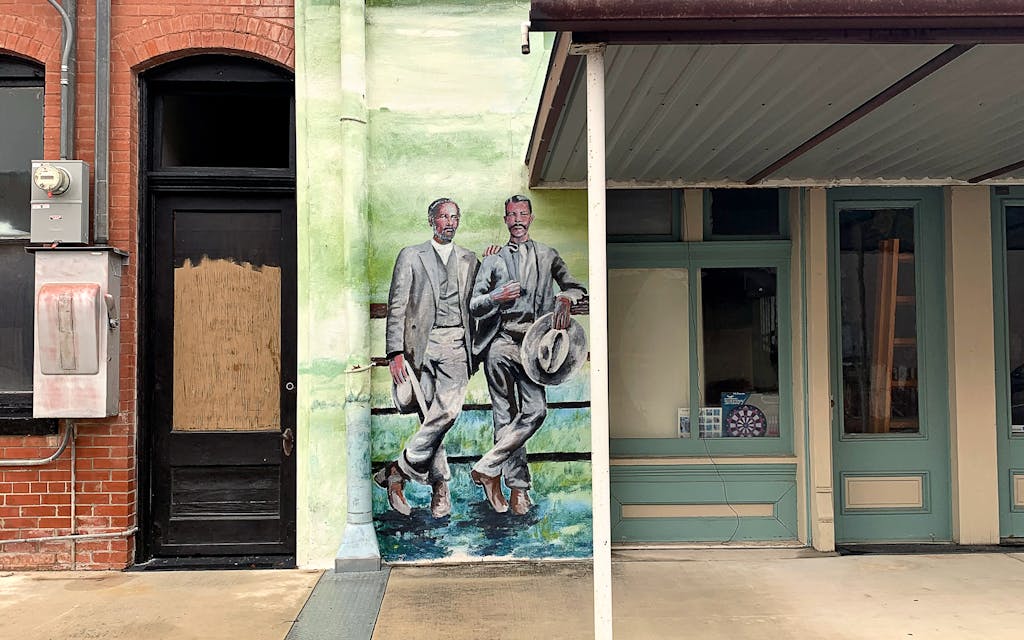
The Texas Ranger mural on the Aumont Building in Seguin. By Gabriel Daniel Solis | July 21, 2022 | TEXAS MONTHLY
Tejano to the bone, my father has never sat with elders who remembered seeing brown bodies sagging from trees or sunburned Texas Rangers flipping their cigarettes onto the shallow graves of their victims. That knowledge came to him only in recent years, in the pages of books I gave him. But even if he didn’t know about the Rangers’ long history of violence against people like us, he has certainly always known how these histories manifest today in our hometown, Seguin. It’s in the stories he tells.
Take the one about the time he went to bid on a construction job on a ranch outside of town. My dad, a general contractor, met the ranch owner at the gate and rode with him deep into the land, where an old white man in a cowboy hat appeared on the dirt road like a frail ghost. The man told the rancher the pump in the river was clogged with debris, then said, “Tell your Mexican to get in there and clear it.” When my dad shared the story with me, he told me he wanted to knock the man out on the spot. What he didn’t say, but what I still understood, was that he didn’t follow through because he was in the middle of nowhere. He knew he couldn’t escape.
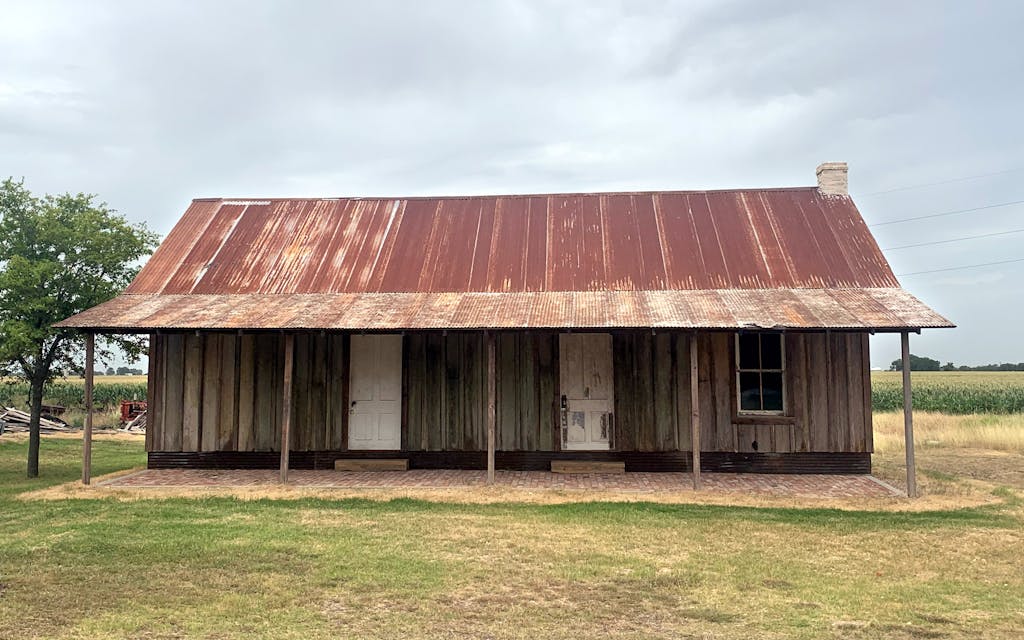
That’s why I was surprised when, in early 2020, my dad accepted a job with the town’s Agricultural Education and Heritage Center to rebuild a Texas Ranger station that was originally built around 1825 near Walnut Branch creek. My dad has restored historic buildings for the Seguin Guadalupe County Heritage Museum before, including the 1885 Navarro School that my grandmother attended as a girl in the 1930s. But his understanding of the Texas Rangers had shifted after I gave him Américo Paredes’s With His Pistol in His Hand for Christmas several years ago. The book tells the true story of Gregorio Cortez, a Tejano rancher who becomes a folk hero in the borderlands for resisting the Texas Rangers’ brutality. After my dad read it, he told me he hadn’t known about the Rangers’ legacy of violence against our people. “They never taught us that in school.”
If my dad rebuilt the Ranger station, it would add to the growing roster of sites in Seguin, 36 miles northeast of San Antonio, dedicated to honoring the Texas Rangers. Just a stone’s throw from his house, which was his grandmother’s house, sits the King Ranger Cemetery, where several early Rangers and their families are buried. Northwest of Seguin is the Hardscramble Ranger Station, the nineteenth-century dwelling of Henry and Benjamin McCulloch, both early Rangers and Confederate generals. In town, a large mural on the historic Aumont Building honors a group of early Rangers said to have founded the city in 1838. A Ranger lone-star badge adorns the entrance to the King Ranger movie theater, where I spent most Friday nights as a teenager, and photos of early Rangers line the walls near the snack bar.
But for me, the most disturbing monument is the cluster of old trees known as the Ranger Oaks. Located near the parking lot of the Chamber of Commerce, the historical marker there reads, in part: “Under Ranger Jack Hays and James Callahan, a group of renegades and Indians were captured, brought to town, and forced to dig a trench in the area of the Ranger Oaks. The captives were then lined up and shot so their bodies fell into the trench, thus saving some trouble of the burial.” If the story of the Ranger Oaks is true, and there’s no reason to believe it isn’t—Jack Hays, who is honored with a large mural and plaque elsewhere in town, was known for his ruthless killing of Native Americans, and the Texas Rangers were known to leave their victims in shallow graves—then the remains of the “renegades and Indians” are still there too, in a hole they were forced to dig themselves.
The Ranger mural and plans to rebuild the Walnut Branch Ranger Station are part of city leaders’ renewed embrace of narratives that portray the Texas Rangers as mythic, benevolent heroes. This recent push to honor the Rangers has come against a backdrop of growing nationwide demands for a public reckoning over legacies of white supremacist violence. As the Ranger mural was being painted on the Aumont, white supremacist monuments across the nation were being pulled down by protestors or quietly removed by city officials under pressure from communities of color.
The recent celebrations of the Texas Rangers also have come at a time when historians and archivists continue to reveal evidence of the group’s brutality against Black, Indigenous, and Tejano communities for two centuries. Among the most horrific episodes was La Matanza (“The Massacre”), a period between 1910 and 1920 when Texas Rangers hunted and murdered as many as five thousand Tejanos and Mexicans in the borderlands. Of this period of intense violence and killing, historian Benjamin Heber Johnson quotes an Anglo lawyer in Brownsville who, in 1919, said, “There have been lots who have evaporated in that country in the last 3 or 4 years. I am not in the attitude of inquiring into and was not when I heard of their evaporation but it would be talked around upon the street the next day.” José Tomás “J.T.” Canales, a Mexican American Texas legislator, led a 1919 legislative investigation of the “evaporations” carried out by the Texas Rangers, but as Johnson notes, “the Texas legislature deliberately suppressed evidence of the Texas Rangers’ brutality, refusing to publish copies of hearings into their conduct.”
Suppression of that evidence is an old story, one that continues today. If my dad had known the full truth of the Texas Rangers’ violence against our people and how that violence has widespread intergenerational impacts on our communities, I can’t imagine he would have agreed to rebuild the Ranger station in the first place.
The restored Texas Ranger outpost station in Seguin.Gabriel Solis
In 2016, Seguin’s city council approved $59,000 in public funds to hire a firm to create a new marketing strategy for the town. The task force that oversaw the campaign called itself the “Rebranding Rangers” and chose a new slogan for the town, “Seguin. It’s real,” replacing the old one, “There’s a story here.” That old slogan, of course, had been true. Seguin’s people, past and present, reflect a mosaic of stories in the town’s collective memory—they’re just not always the stories town leaders want to tell.
While I had a mostly good childhood in Seguin, even back then I recognized what Southern Methodist University historian Michael Phillips calls “amnesia by design,” a strategy of white elites to erase a place’s history of systemic racial violence and oppression. We’ve all been to these “laborator[ies] of forgetfulness,” as Phillips calls them, where shiny veneers hide what lies beneath. Towns and cities where many locals and visitors alike are only interested in cosplaying the past, co-opting the rugged aesthetic of Mexican vaqueros—boots, brimmed hats, worn jeans—or wearing bedazzled shirts with Native iconography while not actually knowing about the Native Americans who continue to live on this land. Seguin often feels like a giant film set where everything is a prop and everyone is an actor in the surreal tragedy of Anglo Texan heritage.
When I was growing up there, suspicion of Black and brown people was still thick in the air. Sometimes I could damn near taste it. It was my girlfriend’s father refusing to shake my hand. My friend’s dad singling me out of a tangle of sweaty boys to threaten when he’d had enough of our roughhousing. My friend’s mother bursting into the room yelling at me, “What did you do?! What did you do?!” when her son cried out after getting his own hands stuck in a Chinese finger trap.
What did I do? I got out of Seguin as soon as I could.
I returned again recently to visit the Texas Ranger monuments. First I headed to the original site of the Ranger station near Walnut Branch, where walking down the steps to the stream felt like descending into the past. Nestled between a sushi bar and a used-car lot, the glen is covered by southern live oaks and desert willows. When it rains, the water moves beneath the hill where the station once stood, glides across an old stone dam like glass, and swirls under the West Nolte Street bridge. In a nearby rose garden, a granite marker dedicated in 1976 to commemorate the United States bicentennial reminds that “earlier chapters were lived here by Indian tribes long before Columbus ‘discovered America.’ ”
In the afternoon I went to the Seguin Guadalupe County Heritage Museum, where my dad had served for several years on the board of directors. Visitors are greeted by a display about the Texas Rangers who founded the town. The display, near the museum’s collection of Indigenous artifacts, includes copies of photos of early Rangers, a replica of a Walker Colt revolver, and one of the original bricks from the Walnut Branch Ranger station. The museum also features the desk of John Ireland, a former mayor of Seguin who served as governor of Texas in the 1880s and believed slavery to be an “economic and political blessing.” Although the museum includes displays honoring notable Black, Indigenous, and Tejano residents, such as the pastor and educator William Baton Ball and Hall of Fame Negro League pitcher Smokey Joe Williams, there is no honest engagement with the town’s history of slavery or the generations of white supremacist violence against the town’s Black, Indigenous, and Tejano communities. While these silences were not surprising, they were still jarring.
But these histories of violence are known to many of us. They’re in our bones. While visiting my grandmother a few years ago, I noticed a large book on her shelf called Slave Transactions of Guadalupe County. I asked if I could borrow the book, assuring her that I’d return it next time I was in town. She put her hand on my shoulder. “Mijo,” she said, smiling. “I’m eighty-five years old. You don’t need to return the book.” Flipping through the pages, I recognized many familiar names. “People here don’t want to talk about this,” I said to my grandmother. “Yes,” she said. “That’s Seguin.”
After leaving the museum, I met my dad at a bar in the Aumont Building. Sitting just on the other side of Ranger mural, he told me he’d voted to approve it while on the town’s Main Street Advisory Board. “But now,” he said, “I think it needs to include more about what the Rangers really did.” I looked around the dark barroom, which reflected a town where over half the population is Latino. A table of stout Tejanos in Dallas Cowboys jerseys laughed and banged on the table. A young couple sat mesmerized by the TV glowing above the bar. Two Tejanas leaned in to each other in a corner, sipping pink martinis.
My dad introduced me to one of the owners of the Aumont Building, who served with him on the Main Street Advisory Board. He said he agreed to let the city use his wall for the mural because it needed to be repainted anyway. Then he said, “Look, I taught history for many years, so I understand why some people are upset by it, but in my view the mural honors a specific event at a specific moment in time. It isn’t about all the stuff the Texas Rangers did later.”
Before we left, my dad and I walked up to the terrace and looked out on the town. It was early evening, but the streets were already quiet. To the west, the Ranger Oaks rose above a row of drab buildings. I asked if he’d started work on the Ranger station. “Not yet,” he said, explaining that the heritage center insisted that he use as much of the original wood and bricks as possible, but very little was salvageable. “Besides,” he added, “I’m not sure I even want to rebuild the damn thing.”
When the Ranger mural on the Aumont was unveiled in 2019, the local council of the League of United Latin American Citizens (LULAC) presented a proclamation to city leaders opposing “the promotion of any mural or advertisement that highlights a dark chapter of our history.” For weeks, residents argued over the legacy of the Texas Rangers in the Seguin Gazette’s opinion pages. Shirley Hester, a former county commissioner, wrote, “The Texas Rangers did a wonderful job getting rid of the outlaws in our area. You people should stop nitpicking! Always trying to start something instead of being proud of our past history.”
Chris Aviles, a Latino Guadalupe County deputy constable and the only city council member to vote against using city funds for the Ranger mural, told me he did so because the story of Seguin is about more than the Texas Rangers. “I’m a police officer, and I have nothing but respect for the Texas Rangers as a law enforcement agency. But I was also a history major in college, so I’m aware of that history, and I would never suggest that we should forget our history.”
Mary Reiley, a local business owner who chaired the preservation board that approved the mural, told me that many town leaders don’t know about the Rangers’ atrocities. “If I’d known what I know now, and with everything going on in this country,” Reiley said, “I probably wouldn’t have voted for the mural, or at least would have suggested that we take more time to do research.” The director of Seguin’s Main Street district, Kyle Kramm, shared this sentiment. “We were aware of LULAC’s opposition to the mural,” he told me. “It was definitely an educational opportunity for us. A lot of us were unaware of what the Rangers did.”
Others initially had fewer qualms. Doug Parker, board president of the heritage museum and a descendant of the Comanche chief Quanah Parker, told me that he strongly disagreed with the removal of any Texas Ranger or Confederate monuments. “It makes me see red,” he said. “The past was a violent place. Our heroes sometimes had to do terrible things.” Parker told me he walks by the Ranger Oaks almost every day on his way to the Chamber of Commerce. When I mentioned that there may be remains of Native people there, he was quiet for a moment, then said, “You know, I’ve never made that connection before. I’m going to lose sleep about that.” When I asked him why the heritage museum is silent about the town’s history of slavery, he listed the ways the museum honors Black history, then said, “But it’s true, we’ve played down slavery. I guess you could say we’ve taken the easy way out, and we’ve taken the same approach with the Texas Rangers.”
Six months after the Ranger mural on the Aumont was unveiled, George Floyd’s murder by Minneapolis police officer Derek Chauvin sparked Black Lives Matter uprisings across the U.S. In Seguin, protesters gathered downtown to demand racial justice, and more than one thousand residents signed an online petition to remove a monument in the town square honoring John Ireland (it remains in place). Around the state, increased public scrutiny of the Texas Rangers’ violent legacy led to calls for the Texas Rangers baseball team to change its name, and in Dallas, a twelve-foot-tall bronze statue of Ranger captain E. J. “Jay” Banks that had been at Love Field since 1961 was removed because of Banks’s role enforcing barriers to the integration of Texas public schools.
That June, I wrote a letter to the editor of the Seguin Gazette titled “The Texas Rangers are not our heroes,” in which I called for town leaders to replace the Ranger mural on the Aumont with one that honors the contributions of Seguin’s Black, Indigenous, and Tejano communities. I also called for the city to replace the Ranger Oaks historical marker with one that tells the truth about the atrocities committed by the Texas Rangers in Seguin and surrounding areas. I ended the letter by saying that for many of us, our heroes are not the Rangers but our elders, mothers, teachers, and community leaders.
Two weeks later, Floyd McKee, a Seguin Gazette columnist, responded to my letter with a piece titled “Rangers are not the villains.” McKee, who notes at the end of his columns that he is a descendant of “eight of . . . the 33 Rangers that organized and developed Walnut Springs and Seguin,” defended the Ranger monuments while acknowledging that the Rangers had committed “injustices,” citing the 1918 Porvenir Massacre. He noted, correctly, that early Rangers included Tejanos in their ranks. McKee wrote, “Without the Rangers (mostly good men) the frontier would never have been safe for anyone. The murals and plaques honor those Rangers, Tejano and Anglo alike.” But what McKee didn’t mention is that the ranks of Tejano Rangers grew markedly only after the Civil War because federal Reconstruction legislation mandated the fair treatment of all men regardless of race. Nor did he mention that it didn’t last long. As historian Aminta Inelda Pérez writes in her dissertation on Tejano Rangers, “The end of Reconstruction and the return of the old guard to the dominant position in Texas politics brought about the almost complete removal of Tejano Rangers from the service of the state after 1874. . . . [Tejanos] were not counted as Texas Rangers again until the 1930s.” (McKee did not respond to requests for an interview.)
Arguments like these assume that Tejanos today must feel an automatic racial solidarity with all Tejanos in the past, no matter their proximity to protecting or advancing white supremacy. It doesn’t matter much to me that there were early Tejano Rangers or that the Ranger mission to protect Anglos and Tejanos from “Indian attacks and Mexican bandits” seemed like a righteous one at the time. What matters is the bolt of horror that shoots through me and others when we encounter monuments that gloat about the massacres of our ancestors. Many of us can’t help but see our own fathers, brothers, and cousins lying there on the ground, twisted and mangled, when we see the infamous 1915 photo of the Rangers and the dead “Mexican bandits” on the Norias Division of King Ranch. In Texas Ranger monuments, many of us only see an all-too-familiar message: This is not your town. This is not your land. And don’t you forget it.
Longtime efforts in Seguin to make the town’s origin story part of the master narrative of Anglo Texan heroism is a cunning maneuver of historical memory. Antony Cherian, a public historian who examined heritage narratives at historic sites in the state, notes that “by dating the origin of Texas to the revolution, those who trace their heritage to the Anglo-Texan revolutionaries take on the semblance of indigeneity. Adding insult to injury, this move also relegates American Indians who came before Anglo-Texans, the Mexicans who invited them, and enslaved African Americans they brought with them to the status of interlopers.” Texas Ranger monuments give believers of these narratives something real to point to, to touch, to bolster the fiction of white superiority and fortify their belief that this land belongs to them.
There’s a big difference between not knowing about histories of white supremacist violence in Seguin and not wanting to know, especially when that knowledge might threaten political, social, and economic power structures that have held strong since the town’s founding nearly two hundred years ago. In Seguin, like many towns and cities in Texas, Black, Indigenous, and Tejano communities are part of the “official” story, but only insofar as we don’t pose a threat to narratives of Anglo Texan heroism and indigeneity. Our histories and cultures exist here too, but never front and center, only way off to the side.
The far corner of the stagecoach mural in Seguin.Gabriel Solis
As the 200th anniversary of the Texas Rangers approaches next year, town leaders in Seguin have an opportunity to live up to the town’s new slogan, to be real. To do so, they’d work with Native tribes in the area to properly identify the lineal descendants of the Rangers’ victims under the Ranger Oaks and repatriate the remains of their ancestors. They’d follow the recommendations of local communities of color to remove or update the Texas Ranger monuments around town to include the truth about the atrocities the Rangers committed on this land. They’d support local efforts to create community archives to preserve our stories, memories, artworks, and other cultural ephemera. And they’d invite local artists to create additional sites of public memory to honor those who have fought for our communities over the years, including, for example, María Betancourt, Vickie De La Rosa, and Homer De La Rosa, who founded Teatro De Artes De Juan Seguin to honor Mexican American culture; Ana María González, who documented Tejano legacies in Seguin; and community leaders like Jesús Trinidad, Dalía Arambula, Alphonso Rincón, and my tío Carlos Tijerina.
But regardless of what actions town leaders decide to take (or not), Black, Indigenous, and Tejano communities will continue our long traditions of passing down our stories and sharing our knowledge—mothers to daughters, grandmothers to grandsons, sons to fathers. We refuse to forget the violence that maps the land’s memory and the histories and knowledges that have evaporated in the fire of white supremacist narratives of history. We do it for those who came before us, for the ones we love today, and for those still to come. Because with every falsehood we counter with evidence, every erasure we meet with revelation, and every silence we fill with truth, the sharp edges of our collective memory cut away at white supremacy’s fragile coalitionof myths and deceptions.
During a visit to Seguin, I sat with my dad in his garage on a cold, gray afternoon, trying to stay warm. Stagecoach, the 1986 made-for-TV western, played in the background without sound. I noticed Three Roads to the Alamo, William C. Davis’s book on James Bowie, Davy Crockett, and William B. Travis, on a workbench and asked him how he liked it. “It’s good,” he said, “but nothing like that other book you gave me.” (He was talking about Monica Muñoz Martinez’s The Injustice Never Leaves You.) We talked about how our people have persisted despite centuries of violence, killing, and erasure. “We weren’t meant to survive,” I said. “But we’re still here.” We lifted our beers. Salud.
I asked him if my letter in the Seguin Gazette had caused him any headaches around town. He shrugged. “No problems yet.” Then, after a moment, he added, “Besides, I’m not going to rebuild the Ranger station after all.” We sat silently for a moment, then I asked him how he felt about it. “Good,” he said. We sat there silently again, and the room began to feel a little warmer.
Gabriel Daniel Solis is the executive director of the Texas After Violence Project. His writings have appeared in the Oxford American, Scalawag, and the Texas Observer, and he is the recipient of the 2018 Pushcart Prize for nonfiction.
This is one of two pieces that I'm posting today on the ignominious Texas Rangers that Hollywood and popular culture have glorified despite a history of yawning atrocities. Learn here from this piece written by Tim Murphy in Mother Jones about a long history of violence to which Texas Mexicans and other people of color have been subjected. The story includes one of protest, beginning with the legendary J. T. Canales who at risk to his own personal safety, took the Rangers to trial back in 1919.
Violence against Mexican Americans by the Texas Rangers is not a distant part of history, but rather a fresh memory of horrific state violence as captured in the documentary, Porvenir, Texas," about which I previously blogged.
Glad to see that the Texas Rangers monument at Love Field Airport was taken down in the wake of George Floyd's killing. This action cannot be viewed in any other way than as a symbol of white supremacist "Anglo retrenchment" in support of state violence. My earlier New York Times post on the Texas Rangers takes a look at them in contemporary perspective. Not at all flattering. Quite the opposite.
I am so glad that major national news media like Mother Jones and the New York Times are helping to expose these truths of history. Long overdue, especially considering how such information tends not to be taken up by our local newspapers and his absent in state, public school curricula.
We must all continue to do the hard work to abolish such icons to state, racialized violence, together with the violence itself. As teachers, this can and should involve teaching the truth of Texas history—not to incite violence. Such is not teachers work, but rather, to keep this from happening over and over again.
-Angela Valenzuela
by Tim Murphy | July 22, 2020 | Mother Jones
When the wave of protests swept the United States this spring in the aftermath of the killing of George Floyd, one of the first monuments to come down was across from a Bruegger’s at the baggage claim at Dallas’ Love Field. It was a 12-foot bronze of a man with a pistol holstered on his hip and a cowboy hat on his head, lowering his left hand to appeal for calm. His name was E.J. Banks, and he was a Texas Ranger.
What precipitated the removal, in early June, was an excerpt, in D Magazine, from a new history of the Rangers called Cult of Glory, by former Dallas Morning News reporter Doug Swanson. In it, Swanson detailed Banks’ story: He was dispatched to North Texas in 1956 to prevent Black students from desegregating a high school. A photographer captured Banks, leaning against a tree, as an effigy of a Black student hanged above the school’s entrance. The statue, titled “One Riot, One Ranger,” was commissioned three years later.
Texas Ranger E.J. Banks was dispatched to prevent the desegregation of a high school in 1956. (Note the effigy hanging above the entrance.)United Press Photo/AFP/Getty
Domingo Garcia, president of the League of United Latin American Citizens, the nation’s oldest Hispanic civil rights organization, told me he was glad to see the Ranger come down—something he had first called for as a Dallas City Council member in 1992. But he and LULAC believed a more substantial change was in order. “The Rangers need to be disbanded,” he said. “They’re a national disgrace.”
It is not the first time the 197-year-old law enforcement division has faced a reckoning. Today the idea of abolishing police departments and other law enforcement agencies such as ICE sounds new and radical to the uninitiated, but in Texas, in 1919, the future of the Rangers was uncertain. Over the previous decade, the Rangers, who had evolved from a frontier guard into a state security force controlled by the governor, had swelled in response to fears of violence on the southern border. In reality, the Rangers instigated a reign of terror in which between 300 and several thousand Mexican nationals and Mexican Americans were killed.
You can also listen to Tim Murphy's story read aloud:
For almost two weeks in Austin, a single, courageous lawmaker, José Tomás Canales, put the Rangers on trial. A century later, the transcripts are essential for understanding our current moment—a remarkable document on race and the police, and the mechanisms of state violence and bureaucratic whitewashing.
The Rangers have been portrayed in popular culture as icons of law and order. To Garcia and others, the statue symbolized the myth underpinning their entire history—a lie laid bare by Canales a century ago.
J.T. Canales was a political insider who could never shake the prejudices that classified him as an outsider. Born on a ranch outside Corpus Christi, he studied law at the University of Michigan before returning to a South Texas that was rapidly changing. In the first decades of the 20th century, railroads and irrigation brought Anglos to the Rio Grande Valley in droves. The newcomers pushed people of Mexican descent from their land and took control of local levers of power. But the bilingual Canales—wealthy, charming, and well-connected—found unusual success in the local politics. When he was elected as a state representative in 1904, he was the only Mexican American in the chamber. When the legislature convened in January 1919 to consider the future of the state’s oldest law enforcement agency, he still was.
The Ranger investigation was overdue. As Swanson lays out in Cult of Glory, the Rangers had served since their creation as enforcers of white power. When a president of the Republic of Texas called for an “exterminating war” against American Indians, the Rangers were his muscle. After statehood, Rangers hunted fugitive slaves and committed atrocities against civilians during the Mexican–American War. In the 1910s, ostensibly for protection during the Mexican Revolution and World War I, the state doubled the size of the force and deputized a thousand more men. Governors appointed volunteer “special” Rangers—often as personal or political favors—who were still empowered to shoot to kill. Residents had a term for neighbors who vanished after encounters with Rangers: They “evaporated.”
Canales had raised his concerns about the force before, but the promised reforms never came. In early 1918, a company of Rangers executed 15 men in the West Texas village of Porvenir in retaliation for a raid from across the border. The unit responsible was disbanded, but most of its members remained on the force. Allegations of abuse continued. After Canales complained to one of the leaders of the force, another Ranger confronted him on the street. The Ranger—one of those hard men the force hangs its hat on, who later bragged he’d been shot 23 times—told Canales that if he didn’t back off, he was “going to get hurt.”
The stakes were set for a battle. Canales wrote a bill that would shrink the Rangers to prewar levels. Most importantly, they would be bonded so that victims could have legal recourse—similar to the idea of ending qualified immunity. His bill gained steam in Austin. But then the Rangers fired back. Accusing Canales of trying to abolish the Rangers, they demanded a public investigation. Their future, and his, would be settled in the hearing room.
A special committee of seven lawmakers—all Anglos, none from the border—was hastily assembled. The hearings started at the end of January. Canales had not expected to be thrust into the role of inquisitor. He struggled to line up witnesses willing to testify on the record. And he was working in a state of emotional distress, believing he was going to be murdered. “I do not expect to live six months…if this bill is killed,” he told colleagues. At one point, he took refuge in a local jail. The Rangers taunted him by offering to provide security.
Which makes it all the more remarkable that the hearings uncovered as much as they did. Day after day, Canales brought to light new abuses. Toribio Rodriguez was taken from his home and shot in the back by a deputy sheriff working with a Ranger captain, then left in a jail cell to die. A Ranger killed Lisandro Muñoz after mistaking him for another man. Florencio García was apprehended by three Rangers; his bones were later found in a pasture. A judge recalled discovering the decomposing bodies of 11 men off a country road. Canales displayed a photograph for sale around Brownsville: It showed three men on horseback—one a Ranger captain—mugging for the camera above four bound corpses.
And what kind of men were joining the Ranger force, anyway? One of them was hired after twice being convicted of murder (both convictions were overturned). Another received his badge after handing over a prisoner named Rodolpho Muñoz to a lynch mob. One night, while the hearings were ongoing, two Rangers engaged in a drunken shootout near Austin. Internal documents showed how the bureaucracy provided cover for the officers it was supposed to investigate.
The arguments that bad cops make to excuse abuses have not changed much over the last century. The Ranger who shot Lisandro Muñoz said the victim had grabbed his Winchester—the officer feared for his life. Others might have lived had they not tried to run. Then, as now, the evidence of guilt was never so clear as when the autopsy necessitated finding it. Rangers claimed to have found stolen property at Porvenir. Florencio García was a “notorious cow thief”—he was no angel.
Texas Rangers patrolling in South Texas in 1915. Canales charged that the Rangers committed more atrocities in Cameron County that year than the Germans did in all of Belgium.Bettmann/Getty