Translate

Tuesday, December 15, 2015

How Dual Language Learning Could Help Curb Education Inequality

The Colliers' research attests strongly to the achievement-gap-reducing the impact of dual language.
-Angela

 How Dual Language Learning Could Help Curb Education Inequality
• Nov 6, 2015

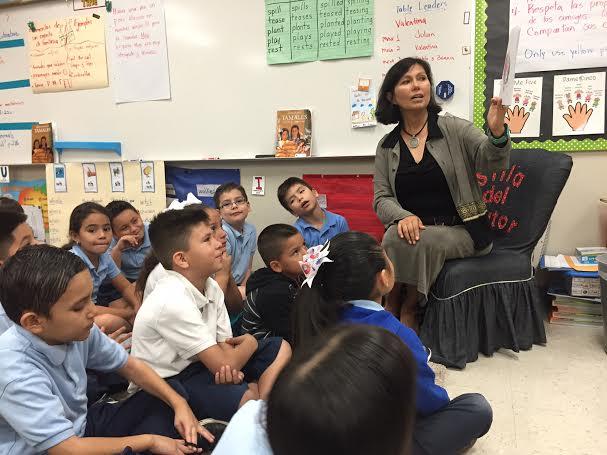
Rosa Jonasz leads her 2nd grade dual language class in a reading lesson.
Credit Virginia Alvino / Texas Public Radio News 
More than 17 percent of Texas’ public school students learned a language other than English first. There are a number of approaches to teaching these English language learners  - many researchers consider dual language learning to be one of the most effective. They say it allows students to learn English while simultaneously helping them advance literacy in their native language.
Texas Public Radio’s Virginia Alvino reports on the benefits and limitations of dual language learning, and why some educators see it as an issue of social justice.
At Passmore Elementary it’s time for a reading lesson in Rosa Jonasz’ 2nd- grade class.
Some of her students are native English speakers. Most are native Spanish speakers. This is a dual language class. The goal is to help all the students become bi-lingual and bi-literate, by learning from the teacher, and each other.
“Like today it will be Spanish reading, tomorrow it will be English reading," says Jonasz. "So we just continue, so if they didn’t catch it today they will catch it tomorrow, so that’s why we try to make the connections between the two days.”
They also use that pattern with math, and science. It’s not just learning both languages. It’s learning how to learn in both languages.
Many researchers agree – dual language programs are effective. Among them is Howard Smith, professor of bilingual studies at UTSA.
He says language education is a highly political issue - that many educated folks have always seen bilingualism as a sign of being well bred. So while public dual language programs are growing nationwide, Smith says that’s largely at the request of white, middle class families. The plus side is Hispanic students can benefit.
"Here in Texas we have some problems but we are recognizing the rights of children to have access to education," says Smith, "and the bilingual programs and dual language programs in specific are helping that to be achieved.”
While school districts are federally required to provide an option for English learners, they aren’t told which one. The advantage of dual language is that unlike other models, it also cultivates Spanish skills.
“And so when we see so many low economic families being denied bilingualism with the excuse that you have to learn English, English only, etcetera," says Smith. "But then you have these same students who are told forget Spanish, they reach high school, and the high school counselor says you know if you want to  get into college you have to have three years of a foreign language. Then you have kids named Gonzalez and Suarez who fail Spanish 1 in high school, because they are successful products of the system.”
That’s why Smith says there should be more dual language programs, and they should continue through High School - which only one San Antonio district does. But he says there’s a lack of infrastructure – for programs to grow, every district would need way more bilingual teachers, and language materials.
Noelia Benson is Northside ISD’s Director of Bilingual Education. She says  "we don’t have enough ELL’s for the dual language to grow it and have it across the district.”
Benson says NISD is majority Hisanic, but only 7 percent are English language learners. So, the district can’t meet the demand for the program - demand which she says, is coming from English speaking families.   For now  the district is still seeing the win-win benefit of this approach.
"Our dual language students usually outperform our mainstream English only,” says Benson.
Last year at Passmore  78 percent of fourth graders met state writing standards, while 100 percent of dual language ELL’s met the same standard.
In Passmore’s fifth grade dual language class, it’s hard to figure out which students are ELL’s while everyone’s speaking English. Anahi Reyes says she hardly spoke any English when she started. "Since pre-K I've been in dual language," she says.
As far as the Spanish language learners they aren’t fully carrying on conversations with each other in both languages, but they’re following along. At least in this class, a lot of the students seem to get that they’re lucky to be in the program. Plus, 5th grader Anahi Reyes says “people that know two languages get paid more.”
That's a favorite fact of many of the students who do get the opportunity to participate in dual language learning.

Saturday, December 12, 2015

‘Trump effect’ may fuel Latino voting

Presidential candidate Donald Trump has galvanized the Latino vote and we know that this vote makes a big difference in national elections.
"[M]ore than 2 million Latino voters — may head to the polls in November because of the “Trump effect.” Donald Trump’s disparaging remarks against unauthorized Latino immigrants have angered most Latinos because of their family immigrant histories — many of them are second- or third-generation Americans. And many Latinos may know someone dear to them who is or was an immigrant."
 It has gotten personal.

-Angela

‘Trump effect’ may fuel Latino voting

oliveramercedes@ymail.com  It’s a common refrain, heard repeatedly before elections: “Latinos don’t vote.”
Increasingly, however, it appears the reverse may be true, according to a new study released by the William C. Velasquez Institute in San Antonio last week. And local elected Latino officials are seeing the same trend.
In the 2014 midterm elections, more than 1 million Latinos turned out to vote in Texas. That translates into 48 percent of Latino registered voters — a considerable percentage when their numbers had gone down by 300,000 since the 2012 elections.
In addition, total voter turnout in Texas and around the country was anemic — 28 percent in Texas, and 36 percent nationwide.
“Never have we seen such a stunning turnout when a state loses so many voters but still performs in the turnout better than in the last two midterm elections,” said Lydia Camarillo, vice president for the Southwest Voter Registration Project in San Antonio.
“The narrative that Latinos don’t vote is just not true,” she said.
She cited other barriers to voting that still may play a role in depressing turnout, such as voter ID laws and a cumbersome electoral system that inhibits rather than encourages easy access to the polls the way same-day registration does in other states.
“You cannot blame Latino voters anymore,” she said. “If you want to change voting patterns for all groups, then you have to change the system.”
Nevertheless, the institute is projecting that a record number — more than 2 million Latino voters — may head to the polls in November because of the “Trump effect.”
Donald Trump’s disparaging remarks against unauthorized Latino immigrants have angered most Latinos because of their family immigrant histories — many of them are second- or third-generation Americans. And many Latinos may know someone dear to them who is or was an immigrant.
Fort Worth City Council member Salvador Espino said he has already seen it at work.
He said he has seen Latinos more engaged early in the presidential election cycle than in past years because of “frustration and concern” about comments by Trump.
He saw a similar situation when Ramon Romero ran for the District 90 legislative seat in 2014.
“There was a concern with Austin and the lack of diversity in the Tarrant County delegation,” Espino said.
Today, it is Trump who is lighting a fire under Latinos to become politically engaged.
“We take Donald Trump very seriously,” he said. “The more outrageous his statements, the more he rises in the polls. If he is not the nominee, no one is going to forget that many in the GOP did not call him out.”
Laura Barberena, president of the political consulting firm Viva Politics, echoed Espino’s sentiment.
“To what extent does his rhetoric define the Republican brand and is shaping it is the question,” said Barberena, who was present at the Velasquez Institute’s briefing last week.
“If they embrace Trump, then they’re embracing these politically charged positions that can be detrimental to the GOP brand in the long term with Latinos.”
The bigger question, though, is will Latinos still turn out if Trump is not the GOP presidential nominee.
Camarillo said that, either way, if Democrats want to win in Texas, “they can’t afford to sit on the sidelines and not invest in turning out the Latino electorate.”
Twitter: @molivera79

Wednesday, December 09, 2015

Diversity Makes You Brighter, By SHEEN S. LEVINE and DAVID STARK DEC. 9, 2015

Great piece in today's NYTimes on the Abigail Fisher, Affirmative Action case out of the University of Texas at Austin.  Summative quote:

Imagine how much students might be getting wrong, how much they are conforming to comfortable ideas and ultimately how much they could be underperforming because of this.

Ethnic diversity is like fresh air: It benefits everybody who experiences it. By disrupting conformity it produces a public good. To step back from the goal of diverse classrooms would deprive all students, regardless of their racial or ethnic background, of the opportunity to benefit from the improved cognitive performance that diversity promotes.
Research by Evan P. Apfelbaum and colleagues (2014) is brought to bear on the question of the importance of diversity in a market context with direct implications for higher education.

One can't help but wonder what influence the student movement nationwide that largely is calling for greater diversity in higher education will have (learn about their demands here), if any, on the court's decision today.  One would think that even if not directly addressed by the SCOTUS, the unfolding backstage story will nevertheless give them some pause.

Angela Valenzuela

c/s

The Opinion Pages | Op-Ed Contributors


Diversity Makes You Brighter


Photo

Credit Matt Chase

AFFIRMATIVE ACTION is back before the Supreme Court today. The court has agreed to hear, for the second time, the case of Abigail Fisher, a white applicant who claims that she was rejected by the University of Texas at Austin because of her race. Ms. Fisher invokes the promise of equal protection contained in the 14th Amendment, reminding us that judging people by their ancestry, rather than by their merits, risks demeaning their dignity.
Upholding affirmative action in 2003, in Grutter v. Bollinger, Justice Sandra Day O’Connor argued that it served the intellectual purpose of a university. Writing for the majority, she described how the University of Michigan aspired to enhance diversity not only to improve the prospects of certain groups of students, but also to enrich everyone’s education.
Ms. Fisher argues that diversity may be achieved in other ways, without considering race. Before resorting to the use of race or ethnicity in admissions, the University of Texas must offer “actual evidence, rather than overbroad generalizations about the value of favored or disfavored groups” to show that “the alleged interest was substantial enough to justify the use of race.”
Our research provides such evidence. Diversity improves the way people think. By disrupting conformity, racial and ethnic diversity prompts people to scrutinize facts, think more deeply and develop their own opinions. Our findings show that such diversity actually benefits everyone, minorities and majority alike.
To study the effects of ethnic and racial diversity, we conducted a series of experiments in which participants competed in groups to find accurate answers to problems. In a situation much like a classroom, we started by presenting each participant individually with information and a task: to calculate accurate prices for simulated stocks. First, we collected individual answers, and then (to see how committed participants were to their answers), we let them buy and sell those stocks to the others, using real money. Participants got to keep any profit they made.
When trading, participants could observe the behavior of their counterparts and decide what to make of it. Think of yourself in similar situations: Interacting with others can bring new ideas into view, but it can also cause you to adopt popular but wrong ones.
It depends how deeply you contemplate what you observe. So if you think that something is worth $100, but others are bidding $120 for it, you may defer to their judgment and up the ante (perhaps contributing to a price bubble) or you might dismiss them and stand your ground.
We assigned each participant to a group that was either homogeneous or diverse (meaning that it included at least one participant of another ethnicity or race). To ascertain that we were measuring the effects of diversity, not culture or history, we examined a variety of ethnic and racial groups. In Texas, we included the expected mix of whites, Latinos and African-Americans. In Singapore, we studied people who were Chinese, Indian and Malay. (The results were published with our co-authors, Evan P. Apfelbaum, Mark Bernard, Valerie L. Bartelt and Edward J. Zajac.)
The findings were striking. When participants were in diverse company, their answers were 58 percent more accurate. The prices they chose were much closer to the true values of the stocks. As they spent time interacting in diverse groups, their performance improved.
In homogeneous groups, whether in the United States or in Asia, the opposite happened. When surrounded by others of the same ethnicity or race, participants were more likely to copy others, in the wrong direction. Mistakes spread as participants seemingly put undue trust in others’ answers, mindlessly imitating them. In the diverse groups, across ethnicities and locales, participants were more likely to distinguish between wrong and accurate answers. Diversity brought cognitive friction that enhanced deliberation.
For our study, we intentionally chose a situation that required analytical thinking, seemingly unaffected by ethnicity or race. We wanted to understand whether the benefits of diversity stem, as the common thinking has it, from some special perspectives or skills of minorities.
What we actually found is that these benefits can arise merely from the very presence of minorities. In the initial responses, which were made before participants interacted, there were no statistically significant differences between participants in the homogeneous or diverse groups. Minority members did not bring some special knowledge.
The differences emerged only when participants began interacting with one another. When surrounded by people “like ourselves,” we are easily influenced, more likely to fall for wrong ideas. Diversity prompts better, critical thinking. It contributes to error detection. It keeps us from drifting toward miscalculation.
Our findings suggest that racial and ethnic diversity matter for learning, the core purpose of a university. Increasing diversity is not only a way to let the historically disadvantaged into college, but also to promote sharper thinking for everyone.
When it comes to diversity in the lecture halls themselves, universities can do much better. A commendable internal study by the University of Texas at Austin showed zero or just one African-American student in 90 percent of its typical undergraduate classrooms. Imagine how much students might be getting wrong, how much they are conforming to comfortable ideas and ultimately how much they could be underperforming because of this.
Ethnic diversity is like fresh air: It benefits everybody who experiences it. By disrupting conformity it produces a public good. To step back from the goal of diverse classrooms would deprive all students, regardless of their racial or ethnic background, of the opportunity to benefit from the improved cognitive performance that diversity promotes.

Sheen S. Levine is a professor at the Jindal School of Management at the University of Texas at Dallas; David Stark is a professor of sociology at Columbia.

Tuesday, December 08, 2015

What are some of the funding equity implications of the NCLB reauthorization bills?

I'm re-posting this from the Equity Alliance website.  Dr. Jimenez-Castellanos does excellent work!
-Angela

What are some of the funding equity implications of the NCLB reauthorization bills? by Oscar Jimenez-Castellanos


Oscar Jimenez-Castellanos is an associate professor in Education Policy and Evaluation in Mary Lou Fulton Teachers and Morrison Institute Faculty Fellow at Arizona State University. His primary area of research is school finance equity and adequacy in particular as it relates to traditionally marginalized communities. He has published in leading academic journals such as Review of Educational Research, Journal of Education Finance, The Urban Review and Journal of Latinos and Education. He is currently working as a school finance expert witness in the Martinez case and organizing an AERA 2016 presidential session entitled, Public Scholarship to Inform Public School Finance In a Culturally Pluralistic Democracy: A Town Hall Meeting.
Did you hear the news? The No Child Left Behind Act (NCLB) is going to be reauthorized! Or is it? In July of 2015, the Senate and House both passed separate bills to reauthorize the du jour version of the original Elementary and Secondary Education Act (ESEA) of 1965. A Senate version, the “Every Child Achieves Act” (ECAA), is believed to be the most plausible to pass into law given President Obama’s eagerness to veto the House version coined the “Student Success Act” (SSA). Currently, leaders in the two chambers are conferencing to work through some of these bills’ key differences in an attempt to create legislation that will pass Congress. This would be the first ESEA reauthorization since 2002.  Both Republicans and Democrats agree that NCLB needs revision but for vastly different reasons. Most recent newspaper reports and commentary focus on ECAAs reduced federal accountability, leaving accountability oversight to states. The federal government would still require annual standardized testing in grades 3-8  but would no longer use those test scores to punish “failing” schools that do not meet adequate yearly progress. States would be given latitude to decide how those asessment are used to measure school and teacher performance; somewhat of a political compromise. Less federal government for the Republicans and less punitive consequences for the Democrats, the language and tenor seem like a win-win. The ECAA has gained signficant support from mainstream liberal and conservative groups, viewed as an improvement over an outdated bill, long overdue for revision.
With the President, House, Senate, and mainstream populus all applauding this effort, it should be recognized that ECAA is in no way a game changer, requiring so much more in order to treat all students equitably.   We cannot forget that the ESEA was created in 1965 during the civil rights movement. Education is seen as the great equalizer to racial and economic diparities. It is imperative that any reauthorization of the ESEA safeguard and uphold the equal educational opportunity of all students without falling prey to deficit thinking that perceives these populations as unable to learn without remediation. In particular, those students in poverty, Native Americans, English Language Learners, and students with disabilities, have historically been touted as benefiting from the benevolence of supplemental funding, with no assurance of a high quality program of instruction, or the necessary resources required in order eliminate the opportunity gap that still exists in contemporary society.
There are a few school funding equity issues that I feel obligated to highlight related to any reauthorization of either the ECAA and SSA.
  1. Pervasive underfunding of public education
The percentage of federal revenue generated to fund K-12 public schools accounts for approximately 10% of local school budgets. Local public schools are now more dependent upon federal revenue and local bonds and overrides due to decreasing state and local revenue. One of the chronic issues with the NCLB Act was that it was never fully funded. Historically, we have tried to fund public education on the cheap. The Congressional Budget Office projects similar funding patterns to continue. With congress already setting limits, before discussing what is possible, the K-12 public school system will continue to be shortchanged. Congress needs to increase overall funding to effectively implement programs in a comprehensive manner to support state and local efforts.
  1. Diverting funds away from traditional public schools
Any proposed legislation or policies must ensure that public funding is limited to public schools, including Title I funding. Any reauthorization should prohibit diversion of public school funds to for-profit charter, private and religious schools. For instance, the Title I “student portability” caveat, if left unrestricted would allow public dollars to flow into private and/or religious schools with no accountability to the public.
Both bills would expand funding for charter schools (including for-profit) into one program through replication of any “high-quality” charters. On the surface, new changes to charter school funding are ideal, allowing parents to use their child’s funding in schools that are “successful,” but neither bill takes a stance on the depleting affects of funding diversion away from existing schools and districts. We need to make sure we fully fund public schools before we divert resources toward “innovative” charter schools. We should focus on innovation in our traditional public schools.
  1. Lack of accountability to serve traditionally marginalized populations
Any proposed legislation must ensure funds are used to provide services to the students they are intended to serve. The term “flexibility,” as applied to school funding, usually means “let me do whatever I need to do with this money,” without any accountability. Local administrators may find this flexibility liberating but in practice this could lead to significant unintended consequences for underserving populations most in need. In addition, the notion of collapsing Title I funding with other sections of ESEA (i.e., ELL, Native American), to gain more flexibility would lead to similar problems of potentially underserving and dually underfunding targeted students. We need funds to not only “supplement, not supplant” education, but should hold schools accountable to properly serve historically underserved populations.
The long overdue reform of NCLB would be a necessary but incomplete first step towards improving our K-12 educational system. Based on the ECAA and SSA bills, many equity issues would remain unresolved and many students would remain underserved. The question is how much longer can our children wait until we achieve a truly equitable system of education, bolstered by meaningful, transformative legislation?
Further readings
Duncan, A. (2015, February 12). It’s Past Time to Move Beyond No Child Left Behind: Addressing America’s Teachers and Principals. Retrieved from http://blog.ed.gov/2015/02/its-past-time-to-move-beyond-no-child-left-behind-addressing-americas-teachers-and-principals/
Jimenez-Castellanos, O. (2012). Revisiting the Coleman Report: Deficit Ideologies and Federal Compensatory Funding in Low-Income Latino School Communities. Association of Mexican-American Educators Journal, 6(2), 48-55.
Jimenez-Castellanos, O. (2010). Relationship Between Educational Resources and School Achievement: A Mixed Method Intra-District Analysis. The Urban Review, 42(4), 351-371.
Jimenez-Castellanos, O. & Okhremchouck, I. (2013). Entitlement Funding for English Language Learners in California: An Intra-District Case Study. Educational Considerations, 40(2), 27-33.
Jimenez-Castellanos, O., & Topper, A. (2012). The Cost of Providing an Adequate Education to English Language Learners: A Review of the Literature. Review of Educational Research, 82(2), 179-232.
Ravitch, D. (2015, November 15). Edweek: Deal Near to Revise NCLB. Retrieved from http://dianeravitch.net/2015/11/15/edweek-deal-near-to-revise-nclb/
U.S. Department of Education, For Each and Every Child—A Strategy for Education Equity and Excellence, Washington, D.C., 2013.  Retrieved from https://www2.ed.gov/about/bdscomm/list/eec/equity-excellence-commission-report.pdf
Walker, T. (2015, July 16). U.S. Senate Passes Every Child Achieves Act, End of NCLB Era Draws Closer. Retrieved from http://neatoday.org/2015/07/16/u-s-senate-passes-every-child-achieves-act-end-of-nclb-era-draws-closer/

A glimpse of how Supreme Court could reshape US elections

Important read. -Angela

The Supreme Court takes up a major Texas redistricting case Tuesday. But it's Yakima, Wash., that shows the stakes most starkly.  

Some folks said it would be impossible for a Latino candidate to win election to the city council in conservative Yakima, Wash.
Carmen Mendez proved them wrong.
So did Dulce Gutierrez. So did Avina Gutierrez.
Last month, all three women made history, becoming the first individuals of Hispanic heritage to win election to the seven-member city council traditionally dominated by white conservatives.
While their victories sparked celebrations in some parts of town, the achievement came after years of bitter litigation that prompted the redrafting of voting districts and required three Anglo council members to stand for reelection or leave office halfway through their four-year terms.
And the fight isn’t over. Council members filed an appeal raising a fundamental question: Does the constitutional principle of one person, one vote permit a federal judge to draw voting districts that enhance the power of individual voters in minority districts while diluting voters’ clout in predominantly Anglo districts?
The most recent Yakima election, for instance, saw only 549 voters cast ballots in a redrawn, Latino-majority district. In contrast, 3,593 voters turned out in a predominantly Anglo district.
For now, the Yakima appeal is on hold, but on Tuesday the United States Supreme Court will hear oral argument in a Texas case that raises the same basic question: If electoral maps are drawn according to total population, does that unconstitutionally dilute the clout of citizens who can actually vote?
Those challenging the Texas system argue that the large numbers of noncitizens in the state can dilute or enhance the power of individual voters from district to district. By their math, the fluctuation of noncitizen population from district to district means some voters cast ballots weighing 1-1/2 times more than those in other districts.
The case could reshape electoral maps nationwide by addressing the underlying question of whether those who can’t vote should continue to be included in the drawing of districts.
“Instances of extreme electoral imbalance are not confined to Texas,” writes Francis Floyd of the Seattle law firm Floyd, Pflueger & Ringer in a friend of the court brief filed on behalf of Yakima in the Texas case.
“This issue will occur with increasing regularity due to the combination of shifting demographic trends and the efforts of organizations like the ACLU using litigation to impose single-member districts on jurisdictions,” said Mr. Floyd.
The problem is a relatively new one, Floyd said. Decades ago, districts drawn to be equal according to total population did not create serious imbalances because the total population was a reliable proxy for the number of eligible voters.
Now with an estimated 11 million unauthorized immigrants in the US, total population in many jurisdictions no longer tracks citizen-voter demographics. Nonetheless, many lower court judges continue to enforce legal precedents from an earlier era.
Critics charge that such a system can’t possibly comply with one person, one vote. Supporters say the real goal is to ensure there is equal representation, not equality among voters.

A unique viewpoint

It is an issue that Ms. Mendez, an incoming Latina council member in Yakima, is well positioned to examine from both sides.
Although she joined her two colleagues as the first Hispanics to win a seat on the council, her path to victory was quite different. While her colleagues easily won in districts redrawn to increase Latino voting power, Mendez ran in a predominantly Anglo district.
In that way, her victory undermined the conclusion by the federal judge who mandated the new districts: without a judicial thumb on the scale, the judge held, it would be impossible for a Latino to win a council seat.
“I feel like some Latino community members aren’t completely happy with my victory,” Mendez says in an interview. “I think they appreciated the fact that I decided to run, but nobody expected me to win.”
She adds: “Once it happened, they said it proved the opposite of [the central allegation in] the lawsuit.”
Yakima is similar to many areas in the US that have witnessed rapid Hispanic growth. More than 41 percent of Yakima’s population of 91,000 is Latino, but Latinos make up only 23 percent of voting age citizens in the city.
But the fact that no Hispanic candidate had ever prevailed in a city council race was because of politics, not prejudice, some say. No moderate or conservative Latino candidates had ever run for office.
Virtually all of the elected officials that represent Yakima from Congress to the county to the city have been Republicans. In 2012, Republican Mitt Romney outpolled President Obama in Yakima County by 11 points, 54 percent to 43 percent.
“Yakima is a conservative place,” says Dave Ettl, a city council member slated to leave office at the end of the month after having his term cut short by the judge.
“I’ve been in Yakima for 35 years. It is a left-right issue, not a white-brown issue,” he says.
Others have offered a darker explanation: that the city’s Anglo residents were voting as a bloc to systematically deprive Latinos of political power.

How Yakima elections changed

The ACLU of Washington filed a lawsuit in 2012 on behalf of two Latino voters who charged that the city’s long-time method of using at-large voting for city council diluted Latino voting strength in violation of the Voting Rights Act.
US District Judge Thomas Rice, an appointee of President Obama, agreed and ordered the city to create seven city council districts, adopting in total the ACLU’s proposed districts.
The new districts were drawn to maximize Latino voting power in part by using the city’s large population of Latino noncitizens to fill out Districts 1 and 2.
Latinos totaled 55 percent of eligible voters in District 1. Some 46 percent of eligible voters in District 2 were identified as Latino.
Although the city’s seven voting districts were roughly equal in total population – ranging in size from 12,500 in District 1 to 13,300 in District 7 – no effort was made to try to equalize the number of voters in each district.
As part of his remedial action, the judge ordered all seven members of the council to stand for reelection last month. The order included three members who had served only half of their four-year terms.
Two of the three displaced council members decided not to run again. They include Councilman Ettl and Mayor Micah Cawley, who was reelected to a four-year-term in 2013, winning 11,605 votes – 95 percent of ballots cast under the old city-wide election system.
“To be thrown out of office two years early is kind of challenging,” Mayor Cawley says in an interview.
He said the judicial-ordered election system produced uneven results in last month’s election. “It is troublesome in a city of our size where you can get a few hundred votes and get elected to the city council,” he said.
The successful Latino candidate in District 1, Ms. Gutierrez, received 465 votes out of 549 votes cast in that district.
The winning candidate in predominantly Anglo District 6 received 2,095 votes out of 3,593 total votes cast in that district.
In terms of eligible voters, District 1 had a citizen voting age population of 4,800, compared with 9,800 eligible voters in District 7, also a predominantly Anglo district.

'Was it fair? No.'

Such discrepancies were not lost on Mendez, who won in District 3, where a quarter of eligible voters were Latino. She received 975 votes, 54 percent of votes cast.
“In my district in order to get the same [winning] percentage as District 1 and District 2, I had to get twice as many votes,” she said.
“It is frustrating for me to have to get twice as many votes to get 50 percent, and someone gets half as much as me and gets 80 percent of the vote,” Mendez said. “It is frustrating, but unfortunately this is the way it was designed.”
“Was it fair,” she says. “No.”
But Mendez says elections in Yakima are a work in progress. “What it used to be wasn’t working,” she says. Without the judge’s ruling and the resulting city-wide debate over voting rights, she believes she would never have won a seat on the council.
Asked what advice she would offer to other cities with a significant Latino population, Mendez says to make sure all residents receive fair representation. “I would say if [city officials] don’t want to be sued, they should look at their voting system and whether it is representative of their constituents,” she said.
Ettl offered a different response to the same question. “Hold your breath until June and see what happens” at the Supreme Court in the Texas case, he said.
In his friend of the court brief, Floyd urged the high court to provide a ruling with clear instructions for lower courts. He stressed that cities like Yakima need help right now.
Ettl says that cities must consciously reach out to minority residents and recruit quality minority candidates. “But I wouldn’t rig the deck and draw the district lines based on race.”
Democratic Individuality: Bill Tremblay: A Letter to Miguel Hernandez

Democratic Individuality: Bill Tremblay: A Letter to Miguel Hernandez:     Bill Tremblay unearths the viciousness of our moment, the shrinking space between a Spanish Republican prisoner of Franco thinking o...

Bilingual education: The cost of doing nothing

This is a a very important story.  Bilingual education isn't a frill or luxury.  It's essential for our children's academic achievement and acquiring biliteracy in the English language. Without it, far too many are doomed.  Such outcomes are a clear outcome of what I term, "subtractive schooling."

Glad to hear UCLA Professor Dr. Patricia Gandara speak to just how critical this is to these children and our nation.  I recommend reading her book with Rebecca Callahan titled, THE BILINGUAL ADVANTAGE.

-Angela

 
This story is a part of
Global Nation
Some of Unidos Dual Language Charter School teacher John Rendon's second-graders getting into a lesson.
Credit: Dan Carsen/WBHM
Imagine being in second grade and trying to learn math in a language that you’re also learning. That’s the situation for an increasing number of students in the US and the South. If you focus too much on learning English — maybe in special, isolated classes where you don’t hear your peers speaking the native language — you fall behind in math, among other things.

Listen to the story here.

Anti-Muslim bigots get masterfully schooled after linking Sikh basketball star to terrorism

I am so proud of UT Education Policy and Planning doctoral student Greg Worthington for setting the record straight on U.S.-born, turban-wearing basketball star, Darsh Singh, and in so doing, taking direct action against the divisive forces of bigotry and anti-Muslim sentiment in the wake of Donald Trump's incendiary call for banning the immigration of Muslims to the U.S.
His Facebook post went viral and I'm so happy about this. The forces of good are greater indeed than the forces of darkness and ill will that if left unchecked, can find their way into policy.
-Angela
c/s

Anti-Muslim bigots get masterfully schooled after linking Sikh basketball star to terrorism

Bethania Palma Markus

08 Dec 2015 at 14:20 ET                   
Darsh Singh (Facebook)

The joke features a picture of the man dribbling with the caption,
“No one wants to guard Muhammad, he’s too explosive.” But fellow Texan
and graduate student at the University of Texas at Austin, Greg
Worthington, posted to Facebook that he knows the player. He’s not Muslim or Arab, and his name is not Muhammad.

“His name is Darsh Singh and he’s a US citizen, born and bred. That
jersey he’s wearing in this pic, it currently sits in a Smithsonian
Museum in Washington, DC because he made US history as the NCAA’s first
turbaned Sikh American basketball player for Trinity University in my
hometown of San Antonio,” Worthington wrote.

Singh was co-captain of the university basketball team when the
picture was taken, he said. Since then he has worked in U.S.
intelligence and the National Security Agency, and currently manages
financial portfolios for “some of the most compassionate companies in
the US.”

Worthington pointed out that Sikhs have often been targeted for
violence because they are frequently mistaken for Muslim. In one of the
more high-profile cases, a white gunman stormed a Sikh temple in Wisconsin, killing six people.

But even if he was a Muslim or if he was Arab, this still doesn’t
make the joke okay and it still doesn’t give you reason to believe that
person is inherently evil or that they deserve harm,” Worthington wrote.

Worthington also linked to articles that show Singh’s accomplishments, from sports to business.

Most responses to Worthington’s post were positive.

“It’s incredibly touching to have friends and community members stand
for what is right, and it’s heartening to be reminded of what I truly
believe — that there is far more light and goodness in this world than
there is darkness,” wrote Simran Jeet Singh, Senior Religion Fellow at
The Sikh Coalition. “It also reminds me of something my parents always
taught me — relationships really matter.”

View Worthington’s post in its entirety, as posted, here:

Let me tell you why this shit isn't funny. I know this guy and his name's not 'Muhammad.' He's not Arab, he's Punjabi. He's not even Muslim, he's a Sikh. His name is Darsh Singh and he's a US citizen, born and bred. That jersey he's wearing in this pic, it currently sits in a Smithsonian Museum in Washington, DC because he made US history as the NCAA's first turbaned Sikh American basketball player for Trinity University in my hometown of San Antonio. He was co-captain of that team when he played there. He's worked in US Intelligence with the National Security Agency in the past and currently manages financial portfolios and hedge funds for some of the most compassionate companies in the US. Above all those things, he's a really nice guy, very funny, and he's a great friend of my younger brother whom I was more than happy to befriend myself.
People need to understand, this stuff hurts people. You might think it's funny but that's mainly because you don't know the guy. Perhaps if you did, then you would see this differently. But even if I didn't know Darsh, I still wouldn't think this was funny. Why? Because things like this pic teach people to be afraid of those who are different than you. What you might not know is that Sikhs have a history in the US and abroad of being mistaken for being Muslim and thus being accused of terrorism. This usually leads to them being attacked and even killed because someone stupid thought they deserved to be beaten, injured, or killed because of their religion. But even if he was a Muslim or if he was Arab, this still doesn't make the joke okay and it still doesn't give you reason to believe that person is inherently evil or that they deserve harm.
Do the world a favor and educate yourself. Get to know people who are different than you and learn about them as much as you can. Knowing one or two or even 15 people different than you is not enough. You need to be networked with groups of people who are not like you to begin to truly understand just how much this stuff hurts people like Darsh. And because I know almost everyone in my Facebook feed will never get to know him, I'll post some links so you can learn about him yourself.
http://m.huffpost.com/us/entry/4877106
http://www.cthedge.org/event/family-office-insight
http://www.bloomberg.com/…/a1f09176-d6a8-4227-b75f-61f222d2…
http://www.trinity.edu/…/pub…/trinity_people/darsh_singh.htm
https://www.google.com/search…


Public Education, Partnerships, and Community in a Violent World, by Angela Valenzuela

I just came across something that I didn't even remember having written—"300 Texans rally at state capitol against high stakes tests," by Angela Valenzuela.  I found it on the Internet. In Mexico, they call it "El Santo Internet," "The Holy Internet." That's what this find makes me think about. 

The article was published by legendary education activist and newspaper editor, George Schmidt, of Substance News. It captures a moment in our on-going battle against high-stakes tests and testing here in Texas published back in 2003. It was and is such a beautiful and powerful movement of wonderful people in pursuit of a better education for their children and now, like myself, their grandchildren.  We sought/and seek not to end public education, but to mend it.

The piece makes me reflect on how we have indeed made progress in this movement that now has gone nationwide (especially follow TAMSA, TexasKidsCan'tWait, FairTest, NEPC, Susan O'Hanion, Diane Ravitch, on this), but we still have a lot of work to do to eliminate harmful testing—and other educational—practices, even as we re-discover and rescue—if we can—the concepts of "assessment" and "accountability" from their reactionary underpinnings.

For starters, "assessment" is a much larger concept than "testing" and "accountability" is what we all still actually want—but not the way that they are currently articulated and understood in either state or federal NCLB policy.  We might ask then what is the next shift or articulation of these?  What are our alternatives?


We have a long tradition of grassroots democracy in our country that can serve us well today as an alternative to our calcified bureaucracies and ways of working in and with schools.  The idea here is that we as communities still use assessment tools, but become accountable to each other where large-scale testing assumes an important, but limited role as a metric, among others, of educational well-being.  

Here is a policy memorandum co-authored by myself, Wei-Ling Sun, Michael Barnes, and Emily Germain that presents this alternative, “High-Stakes Accountability in Texas Reconsidered [pdf].”  We've vetted it with audiences statewide and testified on this several times in the Texas State Legislature last session.  I encourage you to read it in its entirety.  As ambitious as it is, this alternative is still only a partial solution.  At best, it helps provide the infrastructure for a new educational framework that allows or helps create space for an alternative vision of education and society that we so desperately need. 

We as communities, need to come together to ask the big questions regarding our values, wishes, and desires for our children, youth, and ourselves as communities of conscience and as a society.  We need to define or redefine "educational success" for our times.  How, for instance, can we call ourselves successful if our children are not equipped with the tools of biliteracy, bilingualism, or multiculturalism?  How can we call ourselves successful if our children are not themselves equipped with the tools of democracy and civic engagement?  How can we call ourselves successful if all we've done is reproduce the vast inequalities that already exist in society?


Rather than experiencing schools from the vantage point of a diminished role as "clients" or "consumers" of education in a "market place of options," we need as communities to recommit to public education—not as it is, but as it can and should be—for our brave new world that we have inherited and that is otherwise on a collision course with itself.  This is a space where tolerance, respect, and inclusion express everyday ways of living and being in the world, and where a spirit of authenticity in relationships and good will abides. These are spaces not where children "achieve."  They "thrive," instead.  And their renewal is directly linked to our own, as well—to each one of us, individually and collectively.
 

We need as communities to come together and have courageous conversations and make decisions on how and where to anchor our resistance to the forces of violence, aggression, bigotry, narrow-mindedness and greed that capitalize on disaster at everybody's expense.  This is a world where real accountability means that we as communities collectively and democratically articulate and harness an alternative, socially just vision of education.  To wit, this is a spirit of educational renewal and freedom in our schools, local institutions, communities, and country.

Many of our churches are already doing this and that's a good thing, but because they are largely segregated, we also need for our children to occupy and inhabit through schools the interstices of multiple worlds in our society so that the social, cultural, and political tools of "civic engagement" and "democracy" together with notions of "communitarianism" and the "public good" are not abstractions, but rather, a way of life.  A great assessment and accountability system is complementary to just such an agenda.


Not only is this the best antidote to the fear-mongering and extremism that we are witnessing in our country right now, but if done well, it re-casts "educational accountability" in a fresh, life-giving way.  We as grassroots community members, need to get deeper into the grass and form committed partnerships with our cities, school districts, and universities in order to foster a fresh sense of engagement, one that breathes life, love, and peace into all of our relations and goings on. 


That's what we're doing here in Austin, Texas, with Cuauhtli Academy/Academia Cuauhtli, our Saturday Academy, and it is such a beautiful thing.  You may learn about us here where you can also view a two-minute video if you prefer.

Also consider reading this recent publication titled, “Academia Cuauhtli and the Eagle: Danza Mexica and the Epistemology of the Circle.”  Like us on Facebook.  


In short, rather than big, totalizing systems that convey an illusory peace and tranquility—I suggest herein that we need to reacquaint ourselves with the Deweyan ideal of schools as the bedrock of our democracy, albeit in ways that speak to the urgent realities that our current generation of children and youth face today.


Sí se puede!  Yes we can! And we're all the better for it.


Angela Valenzuela

c/s

Monday, December 07, 2015

Starting From the Bottom: Why Mexicans are the Most Successful Immigrants in America

I applaud this research as it provides an appropriate framing of success.  While so many groups begin at the proverbial "bottom," that bottom is demonstrably different across groups.  Not unlike other groups, it's clear that Mexicans immigrants aspire to higher education.

"Asian American exceptionalism" is also a myth that is harmful to all groups, Asian Americans, included.  "Stereotype promise" can indeed help some students achieve in schools; the downside though is becoming an "outlier" within one's own group, creating stressful environments for others. 

Along with this re-framing of the achievement debate—oftentimes cast psychologically in terms of "grit" and "impulse control," this research will help dispel the myth that "Mexican American parents don't care" about their children's education. 

My own research in Subtractive Schooling concurs with these findings and further illuminates why generational differences in student achievement and attitudes toward schools exist.

Angela Valenzuela

Starting From the Bottom: Why Mexicans are the Most Successful Immigrants in America 

A new study from UC Irvine and UCLA challenges our definition of success

immigrants_main_photo
Photo by Gareth Davies
Who’s more successful: The child of Chinese immigrants who is now a prominent attorney, or a second-generation Mexican who completed high school and now holds a stable, blue collar job?
The answer depends on how you define success.
In fact, according to a study by University of California, Irvine, Sociology Professor Jennifer Lee and UCLA Sociology Professor Min Zhou, contrary to stereotypes, Mexican-Americans are the most successful second-generation group in the country. The reason is simple: The study considered not just where people finished, but from where they started.
The report serves as counter-point to arguments raised by Amy Chua, a Yale Law School professor better known as the Tiger Mom. In a new book, The Triple Package, Chua and her husband, Jed Rubenfeld, argue that some groups—namely Chinese, Jews, Cubans, and Nigerians—are more successful than others because they possess certain cultural traits that enable them to be.
In a nutshell, Chua’s “Triple Package” includes: a cultural superiority complex, impulse control, and insecurity. Combined, the authors assert, these traits drive the groups to succeed within a broader American culture that is comparatively lackadaisical. They base their argument on an analysis of test scores, educational achievement, median household income, and other factors.
The UC study, however, argues that it’s not any specific cultural trait that makes groups like Chinese-Americans more successful than others. Lee and Zhou say both Chinese-American and Mexican-American parents highly value education. Most parents do. But the reason Chinese-Americans get ahead is because they start ahead. Way ahead, in many cases.
The study, called “The Success Frame and Achievement Paradox: The Cost and Consequences for Asian-Americans,” looked at Chinese-, Vietnamese-, and Mexican-Americans in Los Angeles whose parents immigrated to the U.S. At first glance, the study’s findings seem to reinforce claims made by Chua and her supporters: Children of Chinese immigrants far exceeded other groups when it came to educational outcomes. Sixty-four percent of Chinese immigrants’ children graduated from college, compared to 46 percent of native-born whites in L.A. Of the Chinese-American college graduates, 22 percent went on to attain graduate degrees.
Asian-American kids, the study found, have good role models and extra help from family and community when it comes to schooling. They also benefit from well-educated parents who put them in good schools and push them into high-income, high-status professions, including medicine, pharmacy, engineering, and law.
Mexican-Americans had the lowest level of educational attainment in the study. Eighty-six percent had graduated from high school, compared to 100 percent of the Chinese-Americans, and just 17 percent had graduated from college.
Fundamental to Chinese-Americans’ overall level of success is that their parents are already highly educated. Chinese immigrant parents were by far the most highly educated in the study—in L.A., 60 percent of Chinese immigrant fathers and 40 percent of Chinese immigrant mothers had a bachelor’s degree or higher. According to a separate study by Pew Research Center, 61 percent of recent Asian immigrants between the ages of 25 and 64 had a bachelor’s degree, which is more than double the U.S. average.
Meanwhile, Mexican-Americans’ high school graduation rate was more than double that of their parents, and their college graduation rate more than doubled that of their fathers and tripled that of their mothers. According to Lee, the results are clear: When success is measured as progress from generation to generation, Mexican-Americans come out on top.
The study found that Mexican parents strongly value education, but that their frame of academic achievement is less exacting than Chinese-American parents. They emphasize finishing high school, possibly going to college—though not necessarily an elite one—and having some kind of career. Mexicans aspiring to higher education, the study found, look toward good colleges in the L.A. area, and often settle on community colleges in their neighborhoods. Because many Mexican parents have a relatively low level of education, they were not as well-equipped to help their children succeed as Chinese-American parents.
“My mom never said to me to, ‘Get an A.’ She said, ‘Do your best,’” Nadia, a 28-year-old second-generation Mexican-American who is working toward her master’s in education, told the researchers. Nadia was the first in her family to go to college and pursued a graduate degree even though her parents didn’t understand the point of staying in school beyond a bachelor’s degree.
Lee found that second-generation Mexican-Americans who attained the highest education outcomes had access to public resources at their schools such as zero periods, College Bound programs, and AP classes, in which students learned how to apply for colleges. Many also had a teacher, guidance counselor, or coach who encouraged them along the way and guided them through the college application process.
Consider Camille, one of the study’s subjects. A 27-year-old second-generation Mexican woman who earned a bachelor’s and master’s degree from the University of Southern California, Camille’s parents arrived in the U.S. as unauthorized immigrants and worked in garment factories. Her parents wanted her and her twin sister to attend college but had no way to help them.
After high school, the twins attended a local community college, where Camille met a guidance counselor who guided her through the admissions process to a four-year college. After Camille was accepted by USC, the counselor visited her parents to persuade them of the merits of allowing their daughter to leave home for school. “She really went above and beyond,” Camille said.
The point of the study, Lee says, was to reframe the debate about what success means.
“We wanted to understand how parents’ position and parents’ immigration status, how their level of education, how all of these factors then shape how the second generation frames success,” she says. “We really wanted to reframe the debate about success.”
jennifer_lee_photo
Professor Jennifer Lee of University of California, Irvine.
Photo by Zócalo Public Square
Lee says that in the U.S., Asian-Americans benefit from a broad cultural belief in “Asian-American exceptionalism”—that Asians are inherently brighter and more hard-working than others—while other groups, such as Mexican-Americans and African-Americans, are subjected to negative stereotypes.
In elite U.S. universities, Asian-Americans make up a disproportionate percentage of the student population. Although they comprise just 5.5 percent of the American population, Asian-Americans account for just under one-fifth of the entering class at schools such as Harvard, Yale, and Princeton. At University of California, Berkeley, they make up 43 percent of the student body, but they are just 13 percent of the state’s population. Chinese parents also define success narrowly and invest their resources in their sons and daughters achieving it. (This is also, Lee says, why you don’t see many Chinese-Americans in careers such as writing, acting, fashion, and art.)
Lee argues that Asian-American students gain from this “stereotype promise”—the idea that being viewed through the lens of positive stereotypes can serve as a performance booster. In her research, she has found that positive stereotypes about Asian-Americans are reinforced in schools by teachers, guidance counselors, and administrators. In some cases, Asian students with mediocre grades in junior high were placed in advanced classes in high school regardless. (Stereotype promise can have a negative effect as well; Asian-Americans who are not high achieving reported feeling like outliers.)
Comparing different ethnic groups and their places in society, Lee often uses a baseball analogy. Asian-Americans, she says, tend to end up on the third base of life. But “their parents are so highly-educated, they almost start the race to get ahead on third base,” Lee says. “But all we see is that they’ve made it to third base. That’s not to say they don’t work hard to get there. They do. But they have certain advantages that other groups don’t have.”
Mexican-Americans, Lee says, are starting from behind home plate. “In the sense that they come [to the U.S.] much more poorly educated than the average American, they have a lot more catching up to do just to get to where the average American is. For Mexican-Americans, the fact that their children make it to first or second base is enormous progress.”

Mitch Moxley has written for publications including GQ, the Atlantic, and Grantland, and he is the features editor at Roads & Kingdoms. Follow him on Twitter.