This blog on Texas education contains posts on higher education, as well as preK-12 policy accountability, testing, bilingual education, immigration, school finance, race, class, and gender issues at both the state and national level. It also represents my digital footprint, of life and career, as a community-engaged scholar in Texas.
Thinking about the environment right now and how oil production contributes to environmental devastation. Accordingly, check out this not-so-spoiler alert: Texas is the top oil producer and among the worst polluters, as well, as per this 2014 piece in the Texas Tribune: Texas Among Nation's Worst Water Polluters.
With gasoline prices reaching their highest levels since 2014 this fall, consumers, policymakers, and economic experts have lately turned their attention to the state of oil production in the U.S. and worldwide. The COVID-19 pandemic has been an uneasy time for oil, as with many other products and sectors of the economy. The price of oil futures briefly turned negative in the first months of the pandemic and remained at relatively low levels through most of 2020 and the first part of 2021. This trend is partially a product of reduced demand for fuel and a price war between Russia and Saudi Arabia. While demand has recovered as the pandemic has gone on longer, oil production has been affected by the global supply chain struggles that many other industries are also experiencing. As a result, oil prices have rebounded to their highest levels in more than half a decade. The volatility of the oil markets during the COVID-19 pandemic highlights the challenges of having a critical product like oil be part of a complex globalized economy. Even before the pandemic, many political and economic leaders sought to lessen U.S. dependence on foreign sources of oil to make the country more self-reliant in its energy mix. The U.S. has had success on this front in recent years. The U.S. saw a steady decline in oil production from the late 1980s to the mid-2000s, a product of a range of factors including decreased demand, the growth of the environmental conservation movement, and increased involvement in the Middle East. Oil production in the U.S. bottomed out at 5 million barrels per day in 2008. Since then, policymakers have prioritized domestic production and the rise of techniques like fracking has reduced the cost of extracting petroleum, and U.S. production has boomed as a result. In 2018, the U.S. surpassed Russia and Saudi Arabia to become the world’s leading producer of crude oil.
The result of this growth in domestic production has been a sharp decline in petroleum imports. Imports have fallen since their peak of 13.7 million barrels per day in 2005 to only 7.85 million in 2020. After taking exports of 8.5 million into account, the U.S. actually became a net exporter of oil for the first time last year.
RELATED With CFDs, a trader is making a wager about whether the price of crude oil (or another underlying asset) will increase or decrease over an agreed-upon period of time. Learn more about CFDs in our CFD brokers guide.
In the U.S., as is the case globally, oil reserves are unevenly distributed. Some states produce significantly more than others. Texas is by far the leading oil producer in the U.S. at nearly 1.8 billion barrels annually — that’s more than four times the total of runner-up state, North Dakota. States in the Plains and Mountain West fare best, along with Alaska and Gulf Coast states like Louisiana and Mississippi. The data used in this analysis is from the U.S. Energy Information Administration. To determine the states producing the most oil, researchers at Commodity.com calculated the total annual crude oil production in 2020. In the event of a tie, the state with the higher 10-year change in annual crude oil production was ranked higher. Researchers also included the latest statistics on proven oil reserves, the number of operable petroleum refineries, and per capita oil consumption. Here are the states producing the most oil.
Yesterday, I showed my students the video, "Our Spirits Don't Speak English," which documents the inhumanity against children subjected to the American Indian Boarding school experience in our country. In the process of learning about this poignant documentary, I came across this piece by Shawnee Tribe member and Arizona State University Professor Robert J. Miller.
In the context of providing commentary on James Q. Whitman's well-researched and documented text titled, Hitler’s American Model:The United States and the Making of Nazi Race Law, Miller underscores a key finding on howNazis made use of U.S. laws, including American Indian law, in the formulation of anti-Jewish policy. I've read and was repulsed by Whitman's book—and have posted on it to this blog previously.
This should serve as a sobering reminder of the politics of knowledge—about which we continue to struggle—and how this has historically been policed by policies, textbook adoption processes, conservative school boards and state boards of education, and white supremacist ideology, in general. It's shameful to consider that we are only now learning about this specific connection between U.S. and Nazi jurisprudence, but can also see why those in power, presumably in both the U.S. and Germany, have been reluctant to expose these horrific chapters of history.
It is intriguing, yet profoundly disturbing, that American Indian law played a role in the Nazi formulation of Jewish policies and laws says Robert J. Miller
Photo: robERT J. MILLER
Most Americans would probably be shocked to learn that in the early 1930s Nazi scholars, lawyers, and officials were heavily influenced by United States law when they were developing policies and laws concerning Jewish people. Most Americans would also no doubt be surprised to discover that when Nazis were turning their racist ideas into legislative proposals and laws they were carefully studying federal Indian laws and American state laws that discriminated against American Indians.
A 2017 book by a Yale law professor, James Q. Whitman, Hitler’s American Model: The United States and the Making of Nazi Race Law lays out a convincing argument that Nazis studied in minute detail American federal and state laws that discriminated against African-American, Chinese, Japanese, Filipino, Puerto Rican, and other racial groups in the United States. Whitman, however, only mentions Native Americans on eleven pages in his book according to the book’s index.
In this article, I am undertaking the first step of what I anticipate will be a much larger study on how, and how extensively, federal and state laws and policies regarding American Indians influenced Nazi scholars, lawyers, and officials in formulating and enacting Nazi laws.
According to Professor Whitman, the Nazi laws that best exemplify its racist goals and tactics versus Jews were the Nuremberg Laws that were enacted and announced in September 1935. These laws established two important principles. First, the Reich Citizenship Law created a distinction between Reich citizens and mere German nationals. Under this law, Jewish people became nationals with restricted political rights and were not German citizens. Second, the Blood Law criminalized marriage and sexual relations between Jews and Germans.
Whitman proves that for years building up to the 1935 Nuremberg Laws that Nazi lawyers, jurists, scholars, and officials were studying and writing research materials, articles, and books on United States immigration laws from the very first one in 1790, through the 1870s, 1880s, 1917, 1921, and 1924. Nazis also studied U.S. state and federal laws that allowed racial discrimination and limits on the citizenship rights of minorities. The Nazis were especially interested in American anti-miscegenation laws (bans on inter-racial marriage). Such bans existed in North America as early as 1664 in Maryland, in 1691 in Virginia, and right up to the early 1930s when the Nazis were studying them. In fact, Nazi scholars expressly cited the statutes of thirty American states that banned inter-racial marriages in the early 1930s, as well as many other aspects of U.S. race law: Heinrich Krieger, Das Rassenrecht in den Vereigten Staaten, in Verwaltungsarchiv (1934); Heinrich Krieger, Das Rassenrecht in den Vereigten Staaten (Race Law in the United States) (1936); Johann von Leers, Blut und Rasse in der Gesetzgebung. Ein Gang durch die Volkergeschichte (Blood and Race: A Tour through the History of Peoples) (1936); and Herbert Kier, Volk, Rasse und Staat, in Nationalsozialistisches Handbuch fur Recht und Gesetzgebung (1935).
Nazis and Indians
The Nazis’ interest in the United States policies and laws regarding American Indians originated with Adolf Hitler himself. In his book Mein Kampf, Hitler discussed U.S. laws and policies and noted that the United States was a racial model for Europe and that it was “the one state” in the world that was creating the kind of racist society that the Nazi regime wanted to establish. In a 1928 speech, Hitler stated that Americans had “gunned down the millions of Redskins to a few hundred thousand, and now keep the modest remnant under observation in a cage ...” Other scholars agree that for “generations of German imperialists, and for Hitler himself, the exemplary land empire was the United States of America.”
Interestingly, the German word lebensraum (living space) became a Nazi rallying cry that demanded more land in Eastern Europe for German expansion and Germany’s growing population. This Nazi policy clearly evokes the American motto of Manifest Destiny that led to military actions, massacres, and official federal policies and laws to remove Indians from the path of American expansion. American Manifest Destiny led to attempted extermination of Indians, to Indian nations and Indians being confined to reservations, and to federal policies to allot and confiscate many of those reservations, and to terminate Indian nations political status.
Following Hitler’s lead, Nazi scholars, officials, jurists, and lawyers also delved deeply into United States Indian law when developing the 1935 Nuremberg Laws. The most important meeting in the process of drafting and enacting those Laws was held on June 5, 1934. At this meeting, the seventeen attendees reviewed extensive research materials that analyzed United States law and American states’ laws. Along with other Nazi scholarship, the materials presented at this meeting specifically highlighted and cited the laws of thirty U.S. states that criminalized or civilly nullified inter-racial marriages. Significantly, seven of those thirty state statutes also expressly outlawed white Americans from marrying Indians.
Other Nazi scholarly research also highlighted U.S. and state laws that treated Indians differently than other American citizens. The Nazis were very interested in how the United States had gotten away with discriminating against Indians for several centuries based on race and bloodlines. Consequently, it appears irrefutable that Nazi officials, jurists, and lawyers were influenced when developing the Nuremberg Laws, at least partially, by American Indian laws and policies.
A review of Heinrich Krieger’s career adds significantly to the thesis that Nazi scholars and officials were heavily influenced by United States Indian law.
Krieger was a crucial actor in the process of Nazis studying and adopting American racial policies and Indian laws. Krieger researched and drafted the most important materials that German officials, jurists, attorneys, and scholars used to debate and formalize the legislative proposals and strategies for the Nuremberg Laws. For example, Krieger’s research, written materials, and conclusions were no doubt incorporated into the conference materials distributed to the seventeen attendees, and discussed at length, at the crucial June 5, 1934 meeting. The attendees of this meeting were provided with Krieger’s and other scholars research on American laws that discriminated against minorities and Indians. In fact, Krieger published his research and findings on American racial laws contemporaneously with the June 1934 Nuremberg Laws meeting in his 1934 article, Race Law in the United States. He later developed and expanded his arguments further in his 1936 book of the same name.
Most importantly for my argument, Krieger was intimately familiar with American Indian Law. He published a twenty-nine pagelaw review article on Indian law in March 1935, Principles of Indian Law and the Act of June 18, 1934. He researched and wrote this article during 1933–34 when he was an exchange student at the University of Arkansas Law School and while he was also conducting research at the Library of Congress to publish his dissertation on “American Racial Law.” It is beyond belief that he would not have included his findings on Indian law in the materials he provided to Nazi officials for the June 1934 meeting when they discussed and planned what became the Nuremberg Laws.
In his law review article, Krieger discussed a wide array of issues regarding American Indians’ U.S. citizenship and their rights, the discriminatory treatment of Indians and Indian nations by the United States, and myriad federal Indian laws and policies. After all this research and analysis, he concluded that United States Indian law was racial law, and that the United States discriminated against and treated Indians and Indian nations differently from other American citizens based on their alleged racial differences from white Americans. (“the Indian law is exactly what its name indicates: a racial law; and there is no way out of the extra-constitutional situation …” Emphasis in original.) Krieger also concluded: “The proper nature of the tribal Indians’ status is that of a racial group placed under a special police power of the United States.” It appears certain that what Krieger learned from his intensive study of federal Indian law and the state laws that discriminated against Indians, and what he emphasized to Nazi officials, was that the United States discriminated against its Indian citizens because of their race and had always done so. Thus, he concluded that Nazi Germany should be justified in doing the same against German Jews.
How intriguing, yet at the same time how profoundly disturbing, that American Indian law played a role in the Nazi formulation of Jewish policies and laws. Further research will hopefully reveal just how large a role United States Indian laws and policies played in that disturbing chapter of world history.
Robert J. Miller, Eastern Shawnee Tribe of Oklahoma, is Professor Sandra Day O’Connor College of Law at Arizona State University.
Great op-ed by Michael Gerson on just how extreme Texas' Senate Bill 3 is, particularly in light of the inherent and inescapable discomforts that come with the teaching and learning of U.S. history, a discipline that is not easily "tamed."
My only amendment to this piece by Gerson is that it's incorrect to refer to our entire state as the "laboratory of idiocracy" when actually, Senate Bill 3 is in great part a reaction to the positive success that we have had within the Ethnic Studies Movement in our state and about which I have blogged continuously. [Note: Senate Bill 3—passed during the second-called special session of the legislature—supersedes House Bill 3979 that was similarly anti-CRT, but limited to the social studies curriculum. SB 3 applies to the entirety of the K-12 curriculum.]
As evidence of racial animus against Ethnic Studies I point to the fact that during the regular legislative session , anti-CRT House Bill 3979 was scheduled side-by-side with HB 1504, Rep. Cristina Morales' Ethnic Studies bill. If passed, the bill would have created a pathway to high school graduation via the taking of Ethnic Studies high school courses. Though shy of the governor's desk, HB 3979 got heard while HB 1504 was left to die quietly in the night despite many pleas to the Senate by members of our anti-HB 3979 coalition that had formed in response.
That said, by denying Texas students a quality education that prepares them for an ethnically and racially diverse world, we are certainly at risk of becoming a laboratory of idiocracy. Simultaneously, our coalition is a strong and worthy opponent to these forces of extremism.
America’s cresting conflict over how to deal with racism in the teaching of history makes sense as a matter of ideology, but not as a matter of pedagogy.
As a matter of ideology, conservative parents’ fear that their children are being indoctrinated by progressive textbooks and teachers is an endemic feature of education in America. What is different this time around is the speed and vigor of Republicans at the state level in turning their hyperventilation into legislation. Over the summer, at least 12 states restricted how teachers can discuss race or racism in the classroom.
The state of Texas — confirming its status as the laboratory of idiocracy — did the most damage. It has forbidden the teaching of any “concept” that causes an individual to “feel discomfort, guilt, anguish, or any other form of psychological distress on account of the individual’s race or sex.”
The consequences for violating this law are unspecified. But the vagueness is the point. White children — really the White parents of White children — have been given an open invitation to protest any teaching on U.S. racial history that triggers their “discomfort.” Which for some parents will mean any teaching on racism at all. This will inevitably lead to self-censorship by teachers who want to avoid trouble.
A history curriculum designed to ensure the comfort of White people would have more than a few gaps. And teaching down to such a standard undermines one of the main purposes of historical education, which is to foster a useful discomfort with injustice.
The attempted declawing of historical studies may be politically useful for Republicans in some places. But it bears little relationship to the way history is actually learned. All good history teaching involves layering the perspectives of a period’s participants. For this reason, the great debates of U.S. history cannot be held within polite, nonoffensive boundaries.
Consider the case of David Walker’s “Appeal, to the Coloured Citizens of the World,” written in the late 1820s. Walker, a Black anti-slavery activist, argued that American slavery was far worse than the servitude the Egyptians imposed on the children of Israel. By depicting America as a place of exile and cruelty, Walker was completely subverting the Puritan self-conception of America as the “promised land.”
Walker argued that the list of grievances against the British contained in the Declaration of Independence was trivial compared with the “catalogue of cruelties” committed by White Americans against Black people. And he drew the logical conclusion that, if violent rebellion was justified against England, it was also justified against slaveholders and their enablers. “See your Declaration Americans!!! Do you understand your own language?”
Walker was clear about who had imposed slavery on his people. “The whites,” he said, “have always been an unjust, jealous, unmerciful, avaricious and blood-thirsty set of beings, always seeking after power and authority.” He argued that slavery had structural roots in an economy based on stolen labor. “The greatest riches in all America,” he wrote, “have arisen from our blood and tears.” And he diagnosed, not only the abject failure of America, but of American Christianity. “Can any thing be a greater mockery of religion than the way in which it is conducted by the Americans?”
Walker thought that Whites’ repentance might be possible, and that America could exist as a multiracial democracy. But still he warned: “The whites want slaves, and want us for their slaves, but some of them will curse the day they ever saw us. As true as the sun ever shone in its meridian splendor, my colour will root some of them out of the very face of the earth.”
This makes for bracing reading, even at a historical distance. And it demonstrates that history is not an easily tamed discipline. Walker’s voice in the classroom may trigger some parents in Texas. Who the hell cares. Walker made a Christian critique of an oppressive country headed toward self-destruction. And he was correct in just about every detail.
Because Walker’s perspective was justified does not make it comprehensive. Frederick Douglass looked at the same crimes, expressed the same anger, but eventually took the position that slavery could be ended through activism and political engagement. For all the U.S. Constitution’s flaws, Douglass saw it as a “glorious liberty document” that could be employed on behalf of abolition. Still other Black leaders of the era felt the American experiment beyond redemption and recommended a return to Africa.
Struggling to understand these layered perspectives is practice in critical thinking and mature citizenship. The discipline of history teaches us to engage with discomforting, distressing ideas without fearing them. This is something Texas (and just about everywhere else) could use more of.
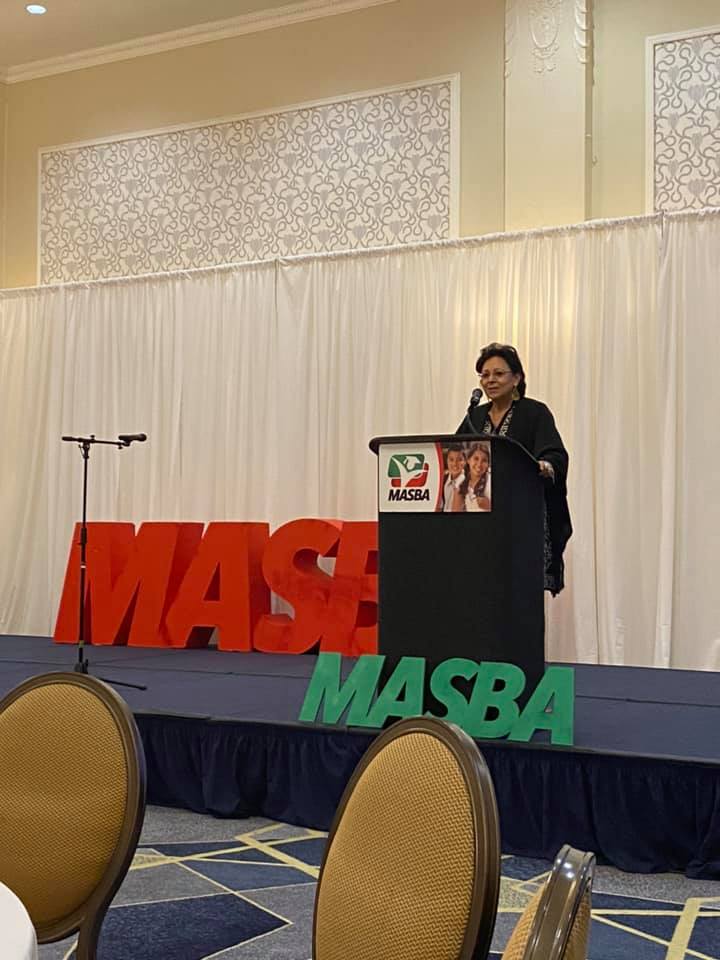
I invite you to read this beautiful recounting of an exquisite summit that took place last September of the Mexican American School Board Association (MASBA) by Dr. Emilio Zamora. I am so incredibly honored to have received their "La Campana" award and recognition with a mariachi serenade directed by Dr. Richard Carranza together with a beautiful, loud-ringing bell that—like Father Miguel Hidalgo y Costilla—positions me to toll the bell of the revolution! A revolution of the heart, no less. 💗 I could not be more honored.
Hats off to Immediate Past President Jacinto "Cinto" Ramos Jr., Interim Executive Director, Dr. Abeladro Saavedra, and Associate Executive Director Vincent Tovar for organizing a powerful summit. And congrats to current President Ana Cortez who was sworn in at the conference, successfully earning her place at the table as one of very few women ever to lead this organization.
Thanks, as well as to Dr. Zamora, who was so inspired by what he observed that he decided to write this informative piece that celebrates and honors MASBA's social justice agenda and exemplary leadership.
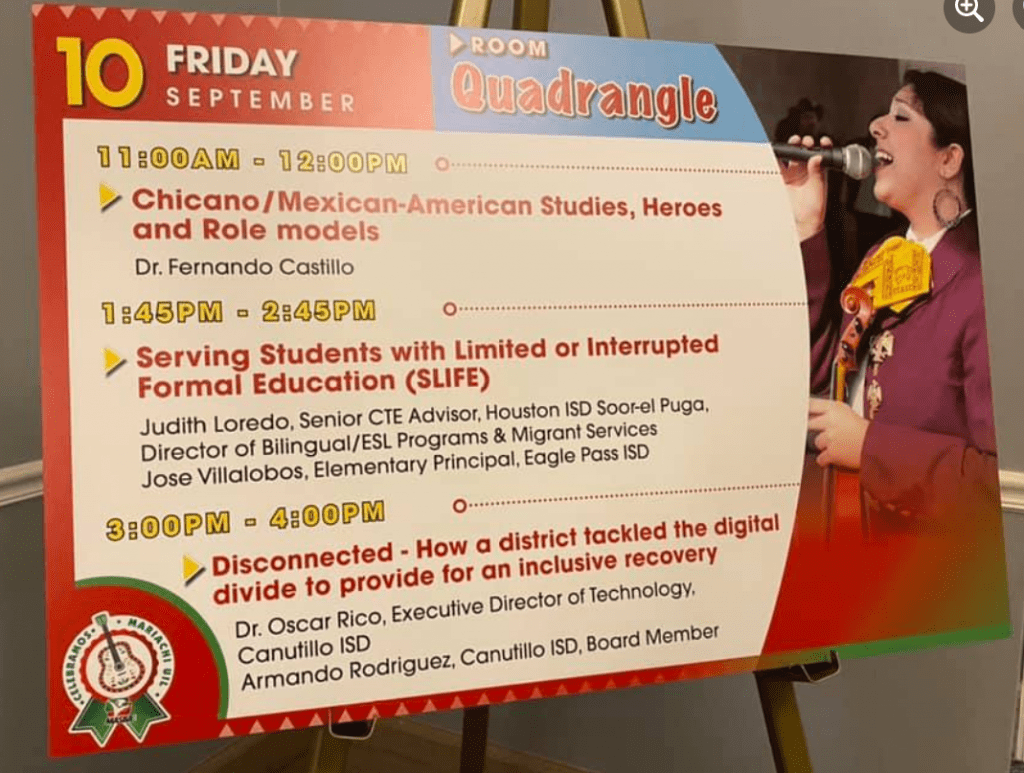
Encouraged by the conference theme, “We Shall March Forward Together,” over 100 affiliated Texas school districts and four-hundred people registered for the 23rd annual meeting of the Mexican American School Boards Association (MASBA) in San Antonio that took place on September 9-12, 2021. Hundreds more enjoyed the collegial fellowship and a robust program of vendor exhibitions, a Board of Directors meeting, school visits, keynote presentations, panel speakers, and discussions, a Mariachi demonstration and performances, 9-11 observances, a dance, scholarship announcement, recognitions and awards ceremonies. Coming out in bold, yet cautious, defiance of COVID-inspired fears that inhibit gatherings in the midst of a pandemic, MASBA has travelled a long and often challenging road since 1970 when Dr. José Cárdenas, the intrepid educator, school administrator, and founder of the Intercultural Development Research Association (IDRA), proposed the idea of such an organization and became a founding member of MASBA, along with Blandina “Bambi” Cardenas (Austin), José Angel Gutiérrez (Dallas), Rubén Hinojosa (McAllen), Gus García (Austin), Chris Escamilla (San Antonio), Amancio Chapa (La Joya), and Ciro Rodriguez (San Antonio).
At the time of its founding, Mexican American youth attended some of the poorest and most segregated schools in the state and, partly as a consequence, registered strikingly low attainment levels, high retention and dropout rates and few prospects for advancement into colleges and universities. They also had few adults in positions of influence that could speak on their behalf. Around 400, or 4 percent of school board members in the 1,400 Texas school districts, were Mexican Americans. Encouraged by the Mexican American social movement for dignity and equal rights, including numerous student walkouts demanding an end to discrimination and a more relevant and effective learning environment, a growing number of Mexican Americans began to vie for positions in local school boards. Successful redistricting and school desegregation suits by the Mexican American Legal Defense and Educational Fund, also encouraged Mexican American participation in improving the educational experience of their youth. The Justice Department also entered the picture by filing a suit against Texas that generated several desegregation cases involving Mexican Americans as an ethnic group and language minority.
Annual Conference of the Mexican American School Boards Association, 2021, San Antonio, Texas. Source: MASBA
More than fifty-five years after the founding of MASBA, Mexican American youth have made significant improvements in their educational standing. Their educational position relative to other groups, however, remains relatively unchanged in 2020. This includes the persistent problems of attending some of the most poorly funded schools and registering some of the highest dropout rates and lower graduation percentages, as well as relatively lower college enrollment figures and college completion rates. These problems are magnified by the high growth rate of the Mexican American school age population and their inability to close the educational attainment gap with their higher achieving peers from other groups. Although they constitute more than 50% of the public school population, they only make up less than 37% of students enrolled in higher education institutions. The attainment deficit, relative to other groups, has mostly remained unchanged in the last ten years and may continue into the foreseeable future.
The current state of Mexican American education—improved group standing alongside a poorer record of achievement relative to Anglo youth—speaks to the continued need for an active and effective MASBA and explains the resolve of its membership and leadership to continue advocating for much needed change. Judging from the stirring keynote speeches, inspirational performances, engaging presentations and the animated response from the membership in attendance, the generational hope that an educated and self-conscious youth can lead Mexican American communities into a better future endures as a historical motivation in MASBA. My observations on the conference activities focus on the events that I attended and observed.
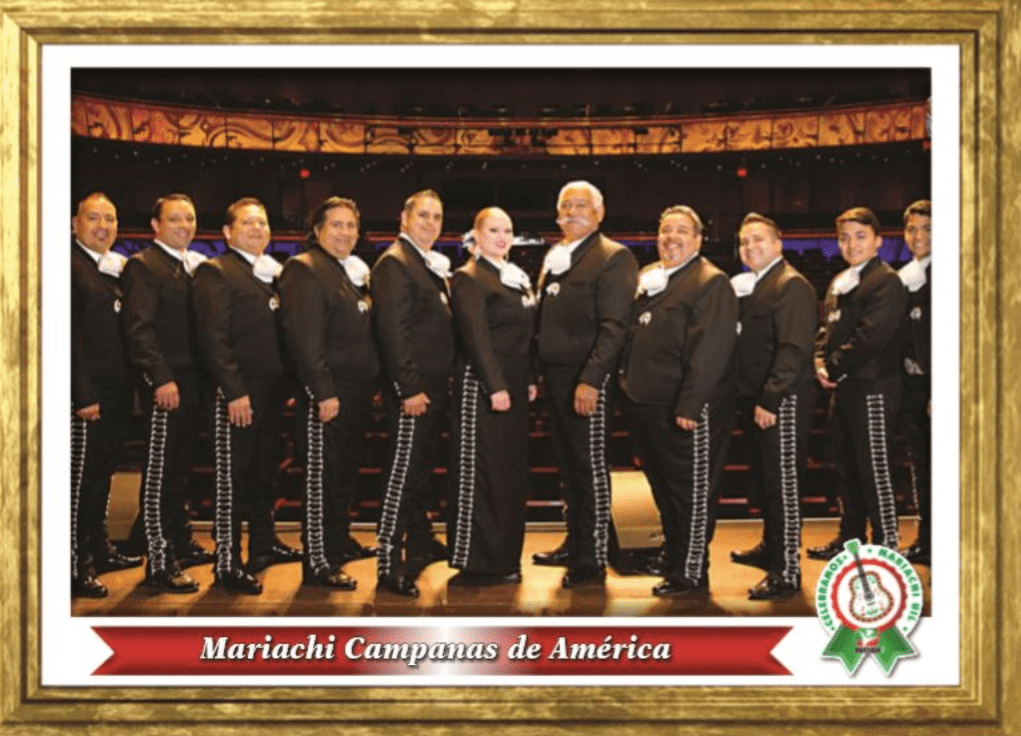
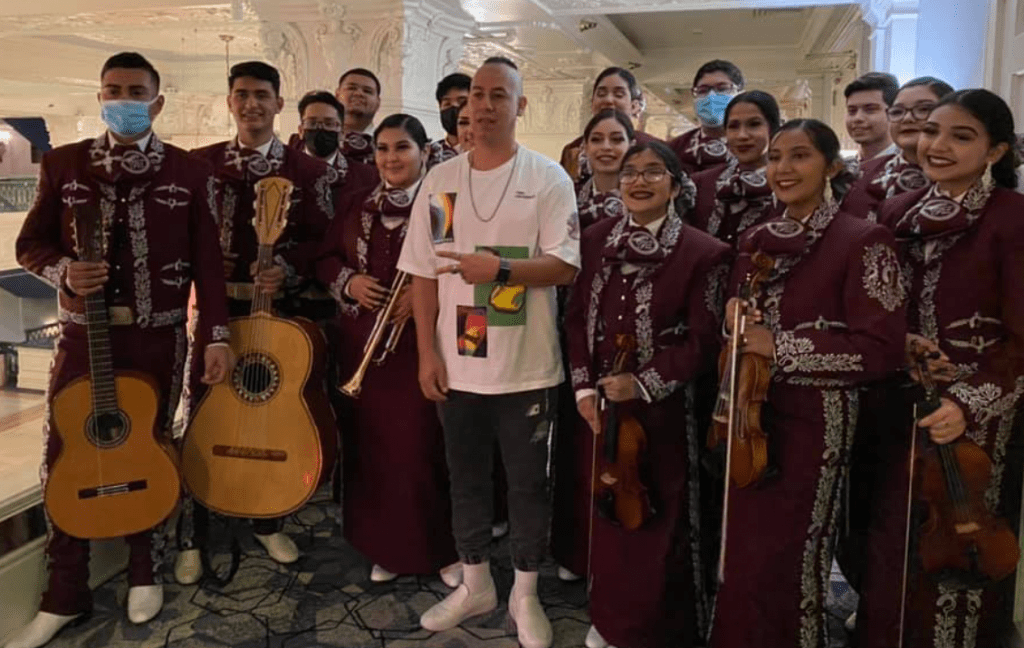
Mariachi performances were a highlight of the conference. This should not surprise anyone who knows that MASBA was instrumental in convincing the University Interscholastic League to incorporate the Mexican musical form and ensemble of the Mariachi into its statewide program of student recognition. High school mariachi groups—the Mariachi Espuelas de Plata from North Side, Fort Worth ISD, and the Mariachi Diamantes Estelares of Judson ISD—regaled the audience during the Friday and Saturday morning breakfasts. Dr. Richard A. Carranza, the former superintendent of Houston ISD and the New York City Schools Chancellor—as well as a Mariachi music performer himself—later led a performance and demonstration of mariachi music with the accompaniment of the famous Mariachi Campanas de America, the pride of San Antonio. They featured the various instruments in the ensemble and the different kinds of music that Mariachis perform during the Saturday lunch. Dr. Carranza and the Mariachi concluded their special event with a presentation and serenading of Dr. Angela Valenzuela, upon her recipient of the coveted Campana Award for public service.
Source: MASBA
Louis Q. Reyes, a past President, former Executive Director, and now Ambassador of MASBA received the grand Golden Molcajete Award, a recognition of exemplary service to the organization. Though not accorded the fanfare given to the Campana Award recipient, his acknowledgment was equally significant.
The heart of the conference, twenty-three panels—provided conference participants with opportunities to hear presentations and participate in conversations on current issues of importance. The themes and topics were as follows with the number of panels listed in brackets: Ethnic Studies (6), Educational Programs (4), Professional Development for Teachers and Board Members (4), Advocacy (1), Critical Race Theory (1), Energy Conservation in the Schools (1), Equity (1), Health Concerns (1), Legislation (1), School Taxes (1), School Infrastructure Issues (1), and The Digital Divide (1).
Conference Workshops. Source: MASBA
MASBA conference planners most probably gave preference to Ethnic Studies because the organization has long supported expanding the state’s curriculum to include the history and culture of under-represented groups, particularly Mexican Americans. The large number of groups involved in sponsoring teacher development workshops, curriculum writing projects, and Ethnic Studies advocacy efforts before the State Board of Education and the Texas Legislature may have also submitted the largest number of panel proposals. The recent attention that the Texas Legislature gave to a failed Ethnic Studies bill (House Bill 1504), as well as to the controversial Senate Bill 3 passed during the second special session of the Texas State Legislature that discourages the teaching of race and that the governor signed into law, may also explain the focus on Ethnic Studies.
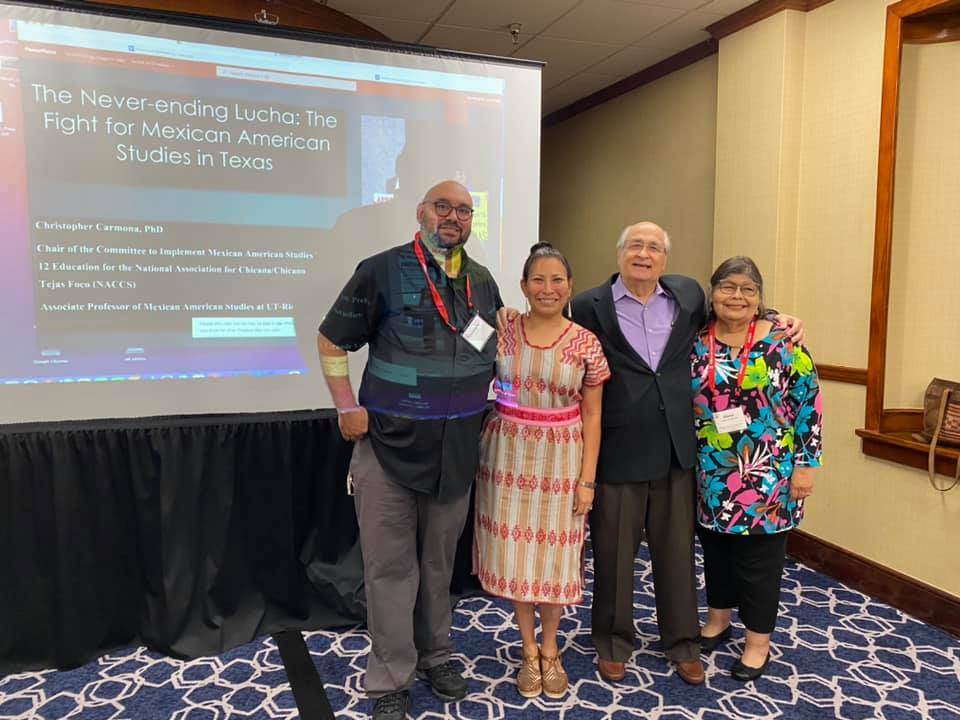
One session on Ethnic Studies stood out in particular. Representatives of the IDRA, the Teachers’ Academy from the University of Texas at San Antonio and an officer of the Pre K-12 Committee of the NACCS Tejas Foco (or chapter affiliate of the National Association for Chicana and Chicano Studies) described their work in a statewide campaign of well over 30 collaborating organizations and institutions. Their purpose is to expand the curriculum and prepare teachers to teach Ethnic Studies, including Mexican American Studies, and to justify these research-based initiatives as successful models for academic success for youth of all racial and ethnic groups, albeit especially for Mexican American public school students in Texas whose numbers represent over half of the state’s K-12 demographic.
Panelists Dr. Christopher Carmona, UTRGV, Dr. Liliana P. Saldaña, UTSA, Aurelio Mondemayor, Intercultural Development Research Associates, and Dr. Gloria Gonzales, UTSA, Panel: Creating MAS Solidarities in the Movement for Mexican American Studies in Texas K-12 Public Schools. Source: Emilio Zamora
One of the best-attended sessions addressed the difficulties that school districts are facing amid accusations that their teachers are advancing a pernicious form of teaching that blames Anglos for racial inequality and singles out Anglo children for something akin to the racial sins of their fathers. According to the presenters, conspiracy theorists as well as the publicity surrounding Senate Bill 3 have reportedly influenced parents and other members of the community to disrupt school board meetings with unfounded accusations of teaching Critical Race Theory. Teachers, administrators and staff have also reportedly received death threats.
The session, titled “CRT Defined,” included representatives of the Fort Worth, Crowley, and Ysleta school districts. They described their difficulties, explained their origins, and offered a novel way for school officials to respond. Adhering to the debating principle that whomever controls the rules of engagement wins the dispute, they proposed that the discourse over race (e.g., Critical Race Theory) should incorporate the notion of equity in the entire school environment, including the notion of equitable learning opportunities for all students, not just Anglos. Specifically, they turned the issue of discriminating against white children in the curriculum on its head and maintained that this, too, is an equity issue about which all should be concerned. Attending sessions like these illuminate the kind of wisdom and knowledge that comes from our leadership, underscoring the importance of organizations like MASBA to create spaces where grassroots struggles may acquire strength and visibility while reinforcing values and motivating civic action.
The conference participants heard four major keynote addresses. The talented David “Olmeca” Barragán, a Hip-Hop performer and Instructor with the Interdisciplinary Gender and Ethnic Studies Department at the University of Nevada, Las Vegas, gave the opening keynote talk titled, “Browning of America.” His uplifting message called on Latino people to assume confidence and pride in themselves and in a bright future that awaits us. We should be able to speak openly and with the knowledge that we have much to offer the world. His self-affirming statement in the poetic form of Spoken Word invoked and modelled the confident voice with which we should always speak.
Mariachi Espuelas de Plata, Fort Worth ISD, with David “Olmeca” Barragán, a Hip-Hop performer and Instructor with the Interdisciplinary Gender and Ethnic Studies Department at the University of Nevada, Las Vegas, Keynote Speaker. Source: MASBA
The second keynote presentation was delivered by Dr. José Angel Gutiérrez, a founder of the Mexican American Youth Organization and the Raza Unida Party and Professor Emeritus from the University of Texas at Arlington. In the first part of his talk, he examined Mexican American history with the use of key publications. His message was that we have a vast historical and literary tradition and that we should strive to become sufficiently literate to advance our social movement for dignity and equal rights. Dr. Gutiérrez followed by exhorting us to action, frequently asking what are you going to do in light of continuing problems that Mexican Americans are facing. He pointed to the dismal education gap that the Texas Higher Education Coordinating Board promised to fill but failed. They have now devised a new plan that will most probably also fail. We cannot depend on conventional institutions to solve our problems, he suggested, we need to take action on our own behalves.
Dr. Angela Valenzuela, Professor in the Department of Educational Leadership and Policy at the University of Texas at Austin titled her keynote address “Unmasking the Attack on Critical Race Theory as an Agenda to Deprive Our Access to the Inconvenient Truths of History.” Her principal argument was that the opposition to Ethnic Studies, Mexican American Studies in particular, does not have the moral or the philosophical wherewithal to deny us our historical destiny as an emancipated people. They depend on false conspiratorial arguments and outright misinterpretations of classroom learning to argue that we cannot be trusted to teach the youth, that we use race as a weapon to promote disdain against Anglos and blame their children for racial inequality. Fortunately, she expressed, we have both the First and the Fourteenth amendments to the Constitution and have learned from history the values of mutual respect, understanding and fairness towards all people. Through song and speech, her lyrical narration braided several strands of the political, intellectual, and spiritual in the context of a solemn Saturday-morning acknowledgement of lives lost on the morning of September 11, 2001.
Dr. Angela Valenzuela, UT Austin, Recipient of the Campana Award and Conference Keynote Speaker, “Unmasking the Attack on “Critical Race Theory as an Agenda to Deprive Our Access to the Inconvenient Truths of History.” Source: Emilio Zamora
April Hernández Castillo, an actress, writer and motivational speaker, shared the difficult experiences she encountered her life in a talk entitled “Your Voice, Your Choice.” She persevered despite self-destructive influences, an abusive relationship and thoughts of suicide, as if to say that we can and must persevere in life and that we must discover from within ourselves the resilient and self-protective spirit that can help us do this. Her life of near-tragic proportions invoked the idea that minoritized groups like us also face difficulties but we too can discover the resilient force within ourselves. Hernández Castillo was believable with her lovely persona of confident grace and honesty.
MASBA’s advocacy declaration, which appears prominently in conference materials as its self-defining statement, may be the most appropriate way to close as it best reflects the organization’s compassion and care for the education and general well-being of youth, especially Mexican American students:
Closing the Gaps
MASBA advocates for programs and practices that more quickly close the achievement gap for all Texas students, especially for the Hispanic students and English Language learners in our Texas public schools.
MASBA stands against all programs and practices that perpetuate and/or widen gaps in student performance.
Ensuring High-Quality Curriculum
MASBA advocates for high-quality curriculum for Texas public school students, particularly with respect to issues of equity, diversity and inclusion. MASBA supports ethnic studies for all students and high quality dual-language programs that promote bilingualism and biliteracy
MASBA stands against all curricula that do not reflect equity, diversity and inclusion, or that negatively portray the history or contributions of the diverse cultures represented by our students.
Solidarity
MASBA stands in solidarity with the students of our Texas public schools—particularly with our Hispanic students and English Language Learners—with their families, and with all persons who support them in achieving their dreams.
MASBA advocates for comprehensive immigration reform, for equitable treatment of all students irrespective of their immigration status and for all students who were brought to the United States as children and who have been educated in our public schools.
MASBA stands against racial profiling, discrimination based on immigration status, and all attempts to unfairly target persons based on race or appearance, and against all actions that instill fear and create instability in the lives of our students.
Diversity and Inclusion
MASBA advocates for racial justice and for policies and practices that help to ensure that the faculty, staff members, administrators and trustees of our public schools reflect the diversity and demographics of the students in our public schools.
MASBA stands against all attempts to inhibit equity, diversity or inclusion, and against all attempts that hinder a person from realizing his/her highest potential
Compliments of the Voice of the Mainland blog, here is specific detail on the specific request by Ft. Worth Rep. Matt Krause who is running for attorney general for texts purchased by school districts, including award winners, that address issues of race and sexuality [also read: Analysis: Matt Krause’s campaign for attorney general comes with a reading list]. This amounts to a new level of scrutiny of Texas public schools that falls on the heels of anti-CRT bill, Senate Bill 3, that promises to earn him a measure of notoriety.
Requests like these that are designed to bolster the political aims of lawmakers are not only a cost to taxpayers, but involve an inordinate amount of time—and for what purpose other than to polarize society even more? The Rs have reached the limits of their political leadership if this is all they have, pestering superintendents and local school boards for narrow, political ends.
-Angela Valenzuela
***
Editor: Texas State Representative Matt Krause is asking several Texas schools to conduct an assessment of books in their library and see if any of these books are in their library system, how many copies and the amount of dollars expended by the school district to purchase those books. The public has no knowledge what Rep Krause intends to do with the outcome of his investigation. Maybe noting. Maybe burn the books. Maybe deduct the amount spend on the books from the school district's budget. We do not know. Anyway, book burning seems to be making it's way into Texas education, maybe not as an act, but as a threat.
The text of his message is below. The full letter can be linked to here.
1. Please identify how many copies of each book in the attached Addendum your
District possesses and at what campus locations including school library and
classroom collections. Please identify the amount of funds spent by your District to
acquire the books identified in request No. 1 above.
3. Please identify any other books or content in your District, specifying the campus
location and funds spent on acquisition, that address or contain the following topics:
human sexuality, sexually transmitted diseases, or human immunodeficiency virus
(HIV) or acquired immune deficiency syndrome (AIDS), sexually explicit images,
graphic presentations of sexual behavior that is in violation of the law, or contain
material that might make students feel discomfort, guilt, anguish, or any other form of
psychological distress because of their race or sex or convey that a student, by virtue
of their race or sex, is inherently racist, sexist, or oppressive, whether consciously or
unconsciously.
Your prompt attention to this request is appreciated, and I request a written response via
email by November 12, 2021. If you have any questions, please contact me or the