Translate

Sunday, March 05, 2023

‘Just the tip of the iceberg’: Kimberlé Crenshaw warns against rightwing battle over critical race theory

Important read and interview in The Guardian of Dr. Kimberlé Crenshaw, founder of the African American Policy Forum and CRT pioneer. For me, this is the best quote in the whole piece.

“Wokeness has become the oppression, not the centuries of enslavement and genocide, and imperialism that has shaped the lives of people of color, in ways that continue into the present,” said Crenshaw.

Authoritarianism is definitely what is on the table here. We must stand against "racial tyranny," as Crenshaw aptly notes. Please have your voice heard and stand with us in solidarity.

Black Brown Dialogues on Policy hosts Virtual Town Hall next Sat. March 11, 2023 from 10:00 AM—4:30PM CST


We must not let democracy die in silence.

-Angela Valenzuela

#TeamBlackBrown #DontLetDEIDie

Exclusive: Author and academic cautions pushback against racial justice education feeds revival of segregationist policies

T

he professor who is a leading voice on critical race theory has warned that the rightwing battle against racial justice education not only threatens US democracy, but encourages a revival of segregationist values and policies. Kimberlé Crenshaw is among top American academics and authors recently stripped from the latest draft of the advanced placement (AP) African American studies course being piloted in US high schools, after Florida’s rightwing governor, Ron DeSantis, led an aggressive backlash against it.

The Columbia University and UCLA law professor and co-founder of the African American Policy Forum thinktank, believes that the escalations against racial history teaching, in Florida and elsewhere represent “the tip of the iceberg” of rightwing efforts to retract the progress since the civil rights era and push America towards authoritarianism.

“Are [schools] on the side of the neo-segregationist faction? Or are [they] going to stick with the commitments that we’ve all celebrated for the last 50, 60 years?” Crenshaw asked, referring to headway made on equal opportunities since the 1960s.

“The College Board fiasco, I think, is just the tip of the iceberg. There are a lot of interests that have to make this decision,” she said.

The College Board, the organization that administers college readiness exams and AP courses for high schoolers to earn college credits, denied bending to political pressure amid accusations that the curriculum has been watered down.

But in what many viewed as a response to DeSantis’s ban, the work of Crenshaw and other high-profile progressive Black figures, such as Ta-Nehisi Coates, were relegated from required reading to “optional” within the course.


People hold signs during a gathering outside a bookstore where the Florida governor was expected to be signing copies of his book. Photograph: Marco Bello/Reuters

Crenshaw said that the “frightening” choice in the new AP course to make contemporary lessons optional follows a similar logic to how corporations navigated Jim Crow segregation.

Crenshaw noted that Donald Trump and the right’s Make America Great Again (Maga) extremism is directly linked to the College Board’s decision – and further back to strategies used during decades of racial segregation laws that prevailed from post-Reconstruction to the 1960s.

“One of the truly, bone-chillingly frightening things about the aspiration to ‘make America great again’ that’s amplified by what’s happening with the College Board is that one of the most sustained features of segregation in the past was the fact that businesses were not only enablers, they facilitated segregation,” she said, driven by the profit motive and the white supremacy movement.

“So when businesses and segregation were aligned, it was a chokehold on Black freedom aspirations,” she said.

Crenshaw spoke to the Guardian from the sunlit living room of her New York home. A nearby desk that Crenshaw calls the “graveyard” is stacked with commonly banned books – books that Crenshaw herself hands out as part of her Books Unbanned tour, such as Toni Morrison’s The Bluest Eye.

It’s called ‘make America great again’. So what is it about this America now that this faction finds wanting?

She urges a stronger, concerted pushback to this latest manifestation of racist history. “What was brilliant about the civil rights movement is that they really pressured national interests, corporate interests, to break with their policies of simply facilitating segregation in the south,” she said.

Crenshaw believes that the College Board development reflects just one part of a continuous strategy from the right to target and disenfranchise minority groups.

“It’s called ‘make America great again’. So what is it about this America now that this faction finds wanting?” she asked.

“The energy and power structure of the Maga [movement] is really this desire for a time where there isn’t a sense of ‘I have to share this country with people who don’t look like me, [and] what we are born into was never an even playing field,’” she said.

So when the “idea of greatness” harks back to the time of racial tyranny, she noted, far-right forces attempt to forgo the teaching of said history, so that “future generations have no tools, no exposure, no ability to critique the present as a reflection of the past”.

Today’s most influential Republicans have made inclusive education a target and taken the supreme court further to the right, undermining other democratic institutions, as well as playing down the 6 January 2021 insurrection where extremist Trump supporters tried to stop the certification of Joe Biden’s victory over Trump and some carried Confederate flags inside the US Capitol after breaking in.

In Crenshaw’s view, this is all with the goal of transforming the “decades-long journey towards greater social justice” into what the right admonishes as “wokeness” – which is in fact the encouraging of racial justice and equity.

If parents can be convinced that there is a wrong happening in public schools, they might be convinced to agree to the dismantling of public education across the board

“Wokeness has become the oppression, not the centuries of enslavement and genocide, and imperialism that has shaped the lives of people of color, in ways that continue into the present,” said Crenshaw.

Crenshaw traces the aggressive disinformation campaigns about critical race theory to a September 2020 executive order passed by then president Donald Trump that restricted federal agencies and contractors from providing diversity and equity training.

“When that happened it was a five star alarm for me. Because if this can happen with the stroke of a pen, it means that our entire infrastructure that we’ve built since Brown [v Board] is weakened,” said Crenshaw, noting the landmark supreme court case that prohibited segregation in US public schools, adding that several elite universities rushed to comply with Trump’s mandate.

Soon after, she became acutely aware that Trump and activist Republicans were twisting the term critical race theory and critiquing Black history taught in schools, or slamming research such as the New York Times’ 1619 project in order to spread moral panic.

“The ban on anti-racism is so profound, that even the story of a kindergarten or first grade integrating an all-white school runs counter to [the new laws],” said Crenshaw, referring to the memoir of activist Ruby Bridges, the first Black child to integrate an elementary school in the American south in 1960.
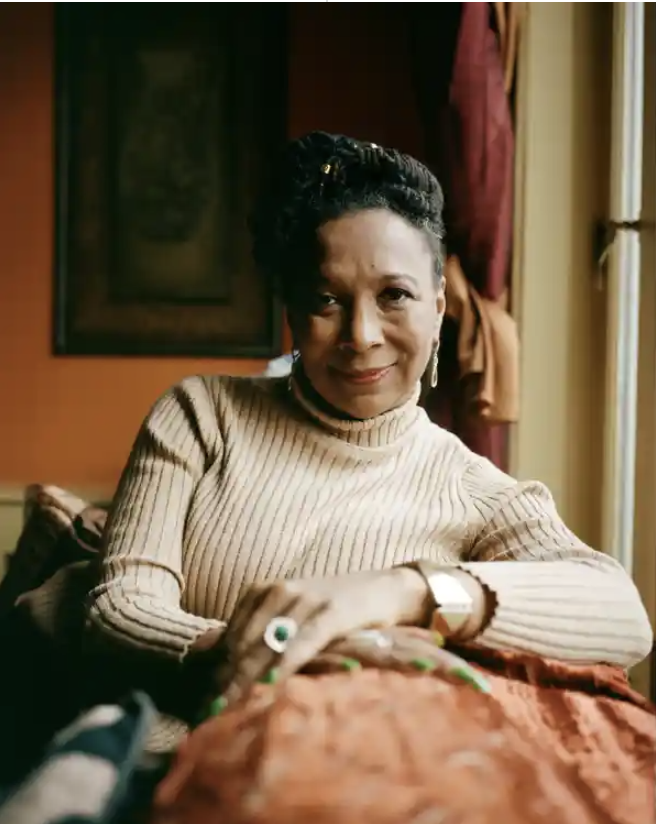
‘This court stands poised to really gut the entire civil rights infrastructure that was built by blood, sweat and tears,’ says Crenshaw. Photograph: Jasmine Clarke/The Guardian

“So, white kids’ feelings are more important than black kids’ reality.”

She continued: “They got their marching orders and into the school boards they went, and into the legislatures they went.”

She warned: “If parents can be convinced that there is a wrong happening in public schools, they might be convinced to agree to the dismantling of public education across the board.”

Colleges and universities have faced similar assault, Crenshaw noted, as professors are targeted under state laws.

Crenshaw further laments the risks of conservatives’ steady takeover of the supreme court and the dismantling of federal voting rights protection and threat to affirmative action in higher education.

“This court stands poised to really gut the entire civil rights infrastructure that was built by blood, sweat and tears,” said Crenshaw.

Overall, Crenshaw exhorts Democrats and the media to employ much more vigor and urgency in addressing escalating attacks on US institutions, noting that many news outlets frame “the push towards authoritarianism as a [mere] rebrand”.

“It was wishful thinking to believe that once the campaign was over, this was going to go away,” said Crenshaw, referring to the Biden-Harris victory in the 2020 election.

But Crenshaw remains buoyed by hope that the next generation can overcome attempts at retrenchment from the far right: “This is the next generation’s lap to run. And we’ve got to hand them a baton that they can carry.”

In the meantime, Crenshaw says there must be more acknowledgment of what’s at stake.

“At some point, there has to be a recognition that we’re fighting for the soul of the country,” she said.




Saturday, March 04, 2023

Exclusive: Gov. Greg Abbott explains his fight against diversity hiring programs on college campuses

Everybody needs to read every word of this U.S. Department of Education Office of Civil Rights Fact Sheet: Diversity & Inclusion Activities Under Title VI two-pager. DEI is not only legal but exists because of structural racism in higher education at its root. 

As indicated by David Hinojosa, who directs the Educational Opportunities Project at the Lawyers’ Committee for Civil Rights Under Law in Washington, D.C., this means that without diversity-focused programs and initiatives of the kind outlined in the Fact Sheet above, a lot of preferential hiring on the basis of "fit," as opposed to merit, is more likely to occur.

Regarding the alleged idea of “purg[ing] conservative thought," I've come across some interesting research by Dr. Jeffrey Sachs at Columbia University that suggests that universities may not be liberalizing communities, so much as communities liberalizing universities. 

With that as the hypothesis or premise in mind, it does seem compelling that universities are located—so many of them—in liberal towns within each state. To be sure, liberalism is a continuum unto itself. Austin, Madison, UCLA, Berkeley, Cambridge, Denver, Ann Arbor and so on, come easily to mind. 

Supposing that this hypothesis is actually true—and Sachs leans in that direction—the policy solution is perhaps rural universities—although that would re-segregate higher education. Not that this would concern some policymakers, but rather that prospective students—an increasingly black and brown demographic—would not be attracted to such institutions when there are great options and alternatives.

Expressed differently, the research suggests that they're not going to ever find all these cadres and cadres of conservative faculty that they seem to think are out there.

Policymakers need to stop churning up moral panics and fear and decide, instead, to adjust to the times that always bring new realities. As Heraclitus once said, "change is the only constant in life." 

Angela Valenzuela

Exclusive: Gov. Greg Abbott explains his fight against diversity hiring programs on college campuses


Photo of Jeremy Wallace

Even as Gov. Greg Abbott successfully pressures Texas universities to retreat from using diversity, equity and inclusion programs, he is adamant that doesn’t mean he’s against diversity on college campuses and in the government.

“Diversity is something that we support,” Abbott said in an exclusive interview with Hearst Newspapers.

THE ISSUE: As Gov. Abbott attacks diversity hiring, Biden launches all-out defense of the programs

The Republican governor said everyone is for equality and anti-discrimination policies. But he contends that diversity, equity and inclusion programs proliferating on college campuses have drifted far from advancing equal opportunity and are instead leading to hiring decisions based on the race of applicants. Further, he says they are part of a larger effort to “purge conservative thought.”

“What we’ve seen in our universities is DEI practices that are there for political purposes, advancing political agendas, blanketed with the perception that they are trying to protect diversity,” he said.

Advocates of diversity and equity programs say Abbott has it wrong. They say the goal is to increase pools of applicants for positions and address systemic barriers that have kept people from underrepresented backgrounds from advancement opportunities in the past.

In the past, many institutions thought they were hiring people based on merit when they were really hiring and promoting people based on how “they fit” with the organization, said David Hinojosa, the director of the Educational Opportunities Project at the Lawyers’ Committee for Civil Rights Under Law in Washington, D.C. That often meant decisions reflected the biases of the people doing the hiring, he said.

“The bottom line is these diversity, equity and inclusion programs are mostly set up because of these institutional biases against people of color,” said Hinojosa, a graduate of Edgewood High School in San Antonio who has argued affirmative action cases before the U.S. Supreme Court.

Abbott said his fight over DEI is bigger than just one program. He said he’s concerned about the atmosphere of college campuses where conservative ideas are not allowed to be expressed.

“They are purging any conservatives from the faculty and allowing the faculty to be led only by liberal leftists,” he said. 

Universities move to comply

Abbott is already seeing results since his office sent stern warning letters to all public Texas colleges and universities about DEI in January.

First, Texas Tech University officially removed DEI statements from faculty hiring requirements.

Then, the University of Texas last week announced that it had paused all new DEI initiatives and launched a review of existing programs.

On Thursday, the Texas A&M University system ordered all its schools and agencies to remove requirements that job applicants provide personal statements about their commitment to DEI efforts. Some units of the A&M system had such requirements, but others did not.

Those moves all come as the Republican-dominated Legislature has threatened funding for universities that espouse DEI. 

“Unfortunately, we’re paying for these things that we know are bad,” state Sen. Mayes Middleton, R-Galveston, said during a panel discussion of the matter put on Thursday by the conservative Texas Public Policy Foundation in Austin. “The state of Texas shouldn’t be paying for that.”

DEI has been around for decades, but after the murder of George Floyd by a Minnesota police officer in 2020, those programs got a boost as colleges addressed demands that they foster more diverse leadership on campuses. 

“Some university trustees didn’t know what hit them,” anti-DEI advocate John D. Sailer said at the Thursday panel discussion.

Sailer said that nationally, schools are imposing DEI priorities in all facets of university life, including making it a litmus test for promotions, tenure and hiring. The result, he said, is applicants know that if they don’t subscribe fully to DEI efforts, that can be used against them.

“Universities exist for the pursuit of truth,” said Sailer, who is a fellow with the New York-based National Association of Scholars. “But DEI represents a distortion of that mission to pursue social justice and a specific political goal.”

In January, Sailer issued a report on DEI programs at UT-Austin. He said DEI has “invaded every aspect” of the school.

“These policies espouse a specific set of contentious political views, dictate a new curriculum and embed the principles of DEI into the fabric of the university,” his report said.

Less than two weeks after the report, Abbott's staff sent a letter to all Texas public colleges, including UT, the governor's alma mater, warning them about DEI and repeating Sailer's concerns.

“Rebranding this employment discrimination as 'DEI' does not make the practice any less illegal,” wrote Gardner Pate, Abbott's chief of staff.

'Enormous harm'

On the other side, Texas NAACP President Gary Bledsoe has called the effort to dismantle DEI an attempt to return to Jim Crow-era laws and set back progress that communities of color have made.

“The governor's initiative will do enormous harm and take the state backwards,” Bledsoe said at a news conference last month blasting the effort.

Bledsoe says it is absurd for Abbott to claim he supports diversity when he’s going after the very programs that are helping to diversify institutions.

“You cannot support diversity and kill DEI,” Bledsoe said.

jeremy.wallace@houstonchronicle.com

"School Voucher Program is Not Right for Texas Education," by David DeMatthews & David S. Knight

Republicans are pushing hard for vouchers (again) this legislative session. Unfortunately, as per this piece titled, "Texas education board flip-flops on private school vouchers as new members take office," even the  Texas State Board of Education has opted to “hold back an opinion on this issue to be in lockstep with the state Legislature." 

Shame on the Texas SBOE for not standing strong behind public education! In so doing, they have betrayed the public trust.

Here are a couple of resources on the matter. 

First, a piece by Josh Cowen: School Vouchers: There Is No Upside (synopsis): Education scholar and researcher Josh Cowen has studied school vouchers for decades. For the Albert Shanker Institute blog, he spells out why vouchers are bad education policy. What if I told you there is a policy idea in education that, when implemented to its full extent, caused some of the largest academic drops ever measured in the research record? What if I told you that 40 percent of schools funded under that policy closed their doors afterward, and that kids in those schools fled them at about a rate of 20 percent per year? What if I told you that some the largest financial backers of that idea also put their money behind election denial and voter suppression—groups still claiming Donald Trump won the 2020 election. Would you believe what those groups told you about their ideas for improving schools?

Do read, as well, this widely-read piece by my colleague, David DeMatthews, and his co-author, David S. Knight. 


-Angela Valenzuela

School Voucher Program is Not Right for Texas Education

Columns appearing on the service and this webpage represent the views of the authors, not of The University of Texas at Austin.


ov. Greg Abbott is advocating for a vouchers program in the name of parental choice, but every Texan should question this because of the potential negative impact vouchers have on students and the state’s public school system.

School vouchers are relatively simple – they are taxpayer-funded government subsidies that parents use to pay private school tuition although tuition and transportation at many private schools exceeds the voucher. Families must pay the difference.

When a family uses a voucher, public school districts lose funding. Education savings accounts and tax credit scholarships are less traditional approaches to vouchers, but they still take away money from public schools.

With less money, districts are forced to cut popular programs such as dual language education, STEM initiatives and vocational training. Such cuts narrow curricular and programmatic offerings and disproportionately impact low-income communities that may not be able to afford private school tuition and transportation costs even with a voucher.

Private schools are also not held to the same standard of accountability as public schools. And they are not legally required to provide fair access and quality services to students with disabilities. These simple facts are concerning, but it gets worse.

School vouchers have been studied for decades in cities such as Milwaukee, New York and Toledo. Most studies find little or no statistical impact on achievement for students receiving vouchers. In fact, four recent studies in Louisiana, Indiana, Ohio and the District of Columbia found that on average, students attending private schools with vouchers did less well on tests relative to their similar peers in public schools.

In Arizona, a vouchers program was sold as a policy to help low-income families. In practice, vouchers were primarily used in high-performing districts by wealthy parents. Arizona House Minority Leader Eric Meyer said the state’s voucher program “essentially gives the wealthy a discount at a private school.” He added that the lack of money to cover transportation and additional tuition costs makes it difficult for families with fewer resources to use the vouchers program.

Texans should keep this in mind.

Texans should also keep in mind that our state already ranks among the worst for public school funding and has been cited by the U.S. Department of Education for illegally cutting special education funding. When vouchers are implemented, more money will come out of the public education system.

Consider Cleveland ISD in Liberty County outside of Houston, which enrolls approximately 9,000 students in 11 schools. The district’s total budget was about $130 million for the 2021-22 school year, with nearly $100 million going to cover staff salaries, busing and transportation costs, and facilities maintenance and operations.

If some families currently attending Cleveland ISD were to use a voucher to attend private schools, the most likely outcome is that their children would experience a lower-quality education. Meanwhile, the loss of 10 or 20 students would force Cleveland ISD to cut one to two staff members, such as a teacher or school nurse.

Schools in rural Texas like those in Cleveland ISD are not just places where children go to school. They also serve as community hubs, host important events and gatherings, and provide access to health care providers and counseling given the state’s long-term failure to ensure rural communities have access to hospitals and mental health services.

Policymakers should not disrupt the public education system given the state’s constitutional obligation to “make suitable provision for the support and maintenance of an efficient system of public free schools.” Taking money out of the public school system amid a global pandemic that disrupted learning and triggered a massive teacher shortage is even more illogical. Let’s also not forget the significant school safety concerns and security infrastructure problems brought to light by the recent school shooting in Uvalde.

Vouchers in Texas are a terrible idea. We should be investing in our public schools and focused on ensuring every school is well resourced, staffed with high-quality teachers, and offering innovative educational programs that prepare the next generation of Texans for postsecondary success. We should not have a program that does the opposite.

David DeMatthews is an associate professor in the Department of Educational Leadership and Policy at The University of Texas at Austin.

David S. Knight is an assistant professor of education finance and policy at the University of Washington.

A version of this op-ed appeared in the Austin American-StatesmanSan Antonio Express NewsAbilene Reporter News, and the Waco Tribune Herald.


MEDIA CONTACT

University Communications
Email: UTMedia@utexas.edu
Phone: (512) 471-3151

Friday, March 03, 2023

MEDIA ADVISORY: Black Brown Dialogues on Policy hosts Virtual Town Hall—Sat. March 11, 2023 from 10:00 AM—4:30PM CST


FOR IMMEDIATE RELEASE

March 3, 2023 Contact: Angela Valenzuela, Ph.D.

512-956-6722 (cell)

blackbrownpolicy@gmail.com


**Media Advisory**


AUSTIN, TX Saturday, March, 11 2023 at 10:00 a.m., Black Brown Dialogues on Policy is proud to announce its first Virtual Town Hall in partnership with Texas LULAC, the Texas NAACP, the Texas Legislative Black Caucus and the Mexican American Legislative Caucus to discuss both the importance of Diversity, Equity, and Inclusion (DEI) initiatives in Texas colleges and universities, along with workforce diversity, and Ethnic Studies policy in K-12 education in Texas.

BBDP’s Virtual Town Hall takes place online at www.facebook.com/TeamBlackBrown. 

It will feature a panel of experts, as well as students who will discuss the benefits of DEI programs and how they help build more diverse, inclusive and welcoming spaces for youth and faculty in higher education. The panel will include:

    • The Honorable Texas Senator Royce West
    • Julia Brookins, Special Projects Administrator, American Historical Association

DEI programs are essential for creating a more equitable society and helping marginalized groups overcome systemic barriers. However, some lawmakers in Texas have recently proposed bills that, if passed, would restrict or eliminate these programs. BBDP’s Virtual Town Hall meeting will provide an opportunity for community members, employers, and legislators to learn more about DEI programs and voice their support for them.


"Consistent with Title VI of the Civil Rights Act of 1964, we believe that DEI programs are critical for building a more just and inclusive society,” says Angela Valenzuela, Ph.D. and BBDP co-convener about the vital need for these programs and hiring practices. “We also encourage lawmakers to support Ethnic Studies in the K-12 curriculum,” she adds.


"As things stand in Texas because of decades of discrimination, there is a need for DEI policies to help ensure that African Americans and Latinos have fair representation and opportunities in recruitment, hiring and admission to tax-funding institutions and agencies,” said Gary Bledsoe, President of the Texas NAACP and a founder of the Black Brown Dialogues on Policy. "While DEI policies aren’t a magic wand, they have helped the state make progress in diversifying its workforce and its public colleges and universities."


The virtual town hall meeting is free and open to the public. We encourage community members, university faculty, students, advocates, and lawmakers to attend.


For more information about the town hall meeting, please contact Angela Valenzuela, Ph.D. at blackbrownpolicy@gmail.com.


WHEN: Saturday, March 11, 2023 at 10:00a.m. CST


WHERE:

www.facebook.com/TeamBlackBrown

INTERVIEW OPPORTUNITY: Angela Valenzuela, Ph.D.

Gary Bledsoe, Esq.


# # #


Follow us on Twitter: https://twitter.com/TeamBlackBrown


Follow us on Instagram: https://www.instagram.com/teamblackbrown/


#DEI #EthnicStudiesNow #DontLetDEIdie #GenZ #BBDPNextGen