This blog on Texas education contains posts on higher education, as well as preK-12 policy accountability, testing, bilingual education, immigration, school finance, race, class, and gender issues at both the state and national level. It also represents my digital footprint, of life and career, as a community-engaged scholar in Texas.
From Tony Diaz, the Cultural Accelerator. Still savoring our June 12, 2018 victory before the State Board of Education. I does feel like a renaissance. So much more work lays ahead though, including possibly establishing certification requirements, setting up pathways for young people to become an Ethnic Studies teacher, and even at some future point, making it a statewide requirement for graduation like Oregon did. In the meantime, we need to push for additional curriculum writing and preparing more teachers to teach it. My thoughts...
I want America to profoundly understand that we as Chicanos were on the brink of being erased.
I want America to remember that in our lifetime, just over 1 year ago as I write this, Mexican American Studies was banned in Arizona.
Additionally, I want our community to know what a powerful feat it was to defy and overturn that ban.
Arizona’s prohibition of our history and culture revealed many things.
First, we are not making up stories about oppression. We now have the proof-with a paper trail.
Secondly, we are powerful.
I want to break down what transpired, not just for posterity, but also as a guide for our community to understand its power in order to quantify, cultivate, and accelerate it.
We are the generation of Cultural Accelerators, and everything we once did to merely survive, will now help us thrive.
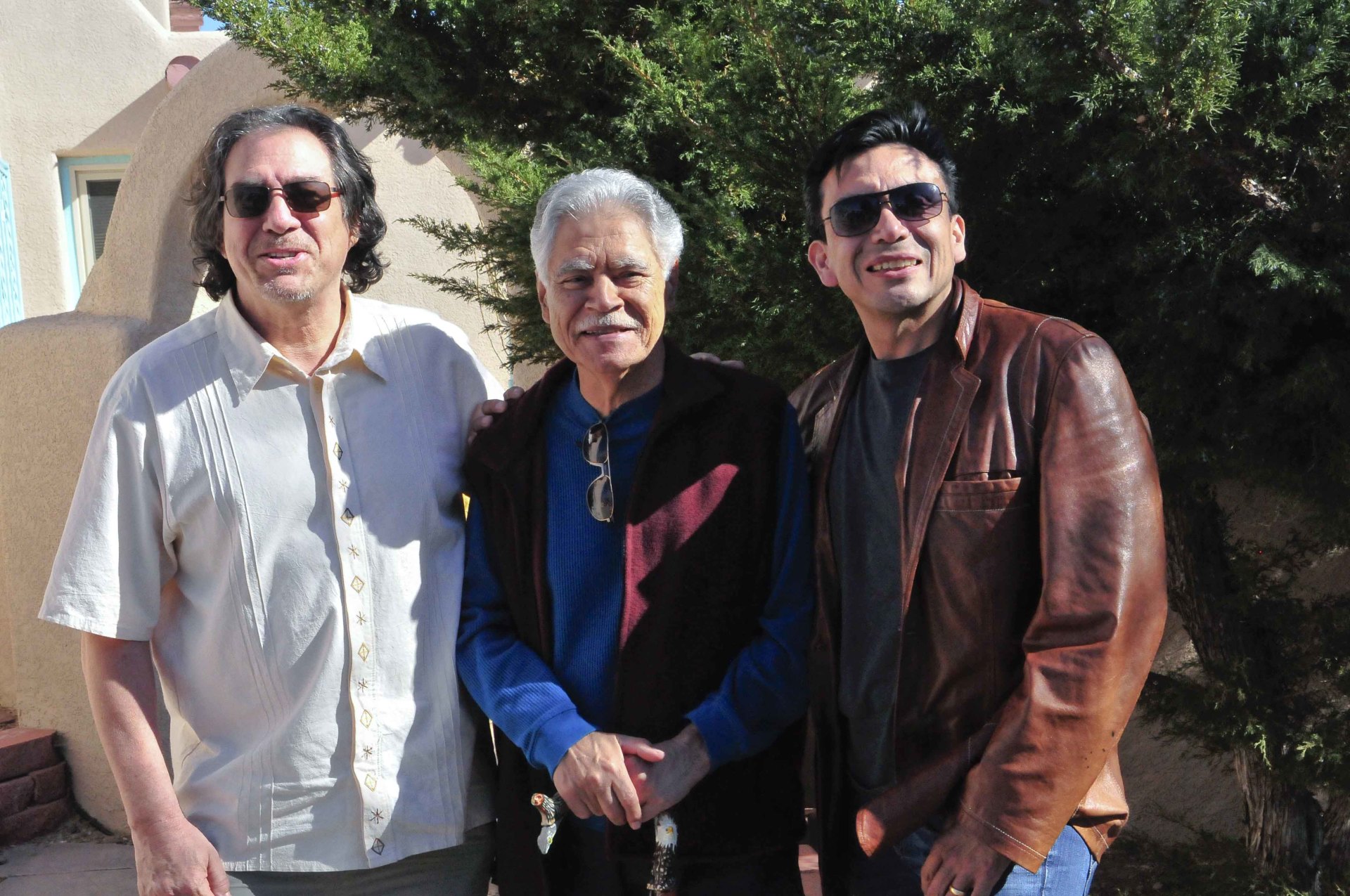
Banned Chicano authors Dagoberto Gilb & Rudolfo Anaya with Tony Diaz, El LIbrotraficante Photo Credit Liana Lopez
The Tip of the Pyramid
Policy change is the tip of the pyramid, and our community’s cultural capital is the base.
Mexican Americans have directly experienced the power of cultural capital through two potent examples.
In 2017, the Chicana/Chicano community overturned the banning of Mexican American Studies in Arizona.
In 2018, Chicanas and Chicanos advocated and succeeded in getting Mexican American Studies endorsed statewide by the Texas State Board of Education.
Texas is the first state of the union to do so.
Other states through other means have supported Ethnic Studies, and some school districts across the country have gone as far as making an ethnic studies course a requirement for graduation, but Texas is the only state in the nation to specifically endorse Mexican American Studies (MAS).
Of course, MAS is inclusive. At each step of this advocacy, we have gone out of our way to also include a path for African American Studies, Asian American Studies, and Native American Studies. We paved the way because we were inspired to invest our Cultural Capital in defying, containing, and overturning the direct banning of MAS in Arizona. Now that we have quantified our community’s Cultural Capital, we have simply continued to accelerate it.
Photo Credit Liana Lopez
The Arizona Ban of Mexican American Studies was Intended to Destroy Our Community.
If Arizona’s ban of Mexican American Studies had been implemented a generation or two earlier, it would have decimated our community for generations to come.
In fact, you need only study some of the earlier practices imposed upon our community for the full effects of this structural oppression to register.
From the lynching of Mexicans and Mexican Americans, to Operation Wetback, to Mexican Only Schools you can trace the deep psychological and societal impact of these practices for generations. The ban still left lasting scars. Our familia in Tucson suffered the brunt of this. The MAS K-12 curriculum in Tucson was the gold standard for culturally relevant curriculum. It should have been extolled. The dropout rate for our community was in the double digits. The Cabrera Report and Cambium Report, among other research, proved that the MAS curriculum raised the graduation rate to 98%.
Instead of being praised, MAS was banned, and MAS teachers were fired, maligned, and sued.
It was the brilliance, tenacity, and vision of the Tucson gente who were able to withstand this attack and gather the cultural capital to overturn this terrible law.
We in Houston were honored to lend our granito de arena to draw attention to this cause and to contain it. We were concerned that Arizona’s Anti-Ethnic Studies Law would spread the way Arizona’s Anti-Immigrant laws spread.
It was clear to we Tejanos that all of our communities were put at risk by the Arizona far right Republican legislators attacking our History and Culture.
In 2012, I and 4 other veteran members of the Nuestra Palabra: Latino Writers Having Their Say quantified our cultural capital and decided to invest it in defying this attack on intellectual freedom and freedom of speech.
In March of 2012, in 8 weeks, we organized the Librotraficante Caravan to smuggle back into Tucson the books that were part of the outlawed curriculum, especially since it included several Tejanas and Tejanos. We rented a bus and travelled the 1,100 miles from Houston to Tucson, stopping in 6-cities, opening 4 under ground libraries, and joining a national movement to oppose this racist, un-American law.
Again, it was the people of Tucson who directly took on the Arizona law, and the Librotraficantes learned a lot from them in the ensuing and victorious struggle.
Our Tucson familia taught us to be brave and bold.
It was also clear that our intellectual advancement was a threat to some-since they tried to ban it for good.
Wonderful story about what students from Roma, Texas, are doing themselves to help each other navigate the first-generation, college experience. My colleague, Dr. Victor Saenz, who studies mentoring is quoted within. I see a familiar face in the photo below, my masters student, Arinda Rodriguez, who is phenomenal. These young people are as capable as anyone else. They just need the opportunity. Hats off to the students themselves for assuming responsibility for their education. These young people inspire so much hope and pride. I'm excited at the thought of what all of this means for their futures and ours as a state. P'alante! Sí se puede! Yes we can! -Angela Valenzuela
Most of the people who grow up in Roma, Texas — a small ranching town on the Mexican border — don’t go to an elite four-year college. The ones who do must move at least six hours from everything they know. They are usually the first in their families to attend such schools. They arrive knowing almost nothing about life in a big city or at a major state university.
“It was overwhelming,” Jesús “Nacho” Aguilar, 23, told me as we sat at a table in the basement of the University of Texas-Austin with a group of Roma High School graduates who now live in Austin and San Antonio. “It was also liberating.”
I first met Jesús when he was a seventh grader at Roma Middle School, in a town where nearly every family was Mexican-American and where I taught English for two years as a Teach For America Corps member. When I attended the high school graduation for Jesús’ class, 88 of my 131 former students picked up a diploma. Of those, many have earned two-year degrees or are working on vocational certifications. Facebook tells me another is a pilot. There is more than one definition of success.
But, against the odds, Jesús and a small number of his classmates pursued and earned degrees at world-class universities. I wanted to know how they did it.
Jesús met up with me at his alma mater sporting running shorts and an acid wit. His friend, and fellow UT graduate, Tomás González, 23, is tall, thin and thoughtful. He’s now in medical school. Perla de la O, 22, the only one of the four who is my former student, loves Harry Potter, musicals and any sort of free festival she can find in Austin. She teaches at a Montessori preschool. And Eduardo Rios, 20, is still in school, studying business. He has a way of catching you off guard with thoughtful ideas you wouldn’t have given such a young man credit for understanding.
“It was
a huge culture shock,” said Tomás of moving from Roma to Austin, where Latinos
“are 20 percent at most. That’s the first thing I noticed.”
Statistically,
there was a depressingly small chance that any of these kids, English language
learners from low-income families living in a rural town, would make it to and
through college, let alone a college as prestigious as UT-Austin. Only 51
percent of low-income high school graduates even enrolled in a two- or
four-year-college in 2012, according to the Pew Research
Center. There’s an ongoing discussion as to how many low-income
students graduate, since the government’s
first crack at calculating that number last year was way off, but
the figure is estimated at between 24 and
68 percent, depending on the institution and whether students take
four, five or six years to complete their programs.
When
you ask the young people from Roma what got them through, their answer is
unequivocal: friends.
And
these friends are very serious about being friends. They even named their group
“La Raza.” Literally, “La Raza” translates to “the race,” but for most Latinos,
the meaning is deeper.
51
percent — Proportion of low-income high school graduates who enroll in college
“It’s
like, ‘our people,’” Tomás said.
“Our
gang,” added Perla. Though not a criminal gang, they hastened to explain,
giggling a little.
“We
just call it ‘the group,’” said Eduardo.
The
group holds potlucks featuring food from home. They get each other jobs. They
help the newest Roma-grads-cum-UT-freshmen find housing, the laundromat, and
free food on campus. They share textbooks and help each other with homework.
They carpool home for the holidays. They ask each other: How do you sign up for
health insurance? Can you explain this financial aid form? Where is the
registrar’s office? When someone is sick, they cook him dinner. When someone is
lonely, they talk. When someone is struggling, they encourage her to reach out
to resources on campus they know can help. When they join other groups —
fraternities, the Hispanic Business Association — they go to the first meetings
with another La Raza.
Members
of La Raza kayak on Barton Springs in Austin with visiting friends from home
during Spring Break 2014. From left to right: Perla de la O (foreground),
Zarina Moreno, Xenia Garcia, Bianca de la O, Jose R. Peña. Photo: Courtesy of Perla de la O.)
“We
help each other with anything,” Perla
said.
“You
think you’re the only one struggling,” Jesús said. “But no. Everyone is in the
same boat.”
Seeing
each other struggle, knowing you’re not the only one crying in the shower that
first desperately hard semester — that’s what gets you through, Tomás said.
“We are
missing a really important power,” Tomás said of arriving on campus as
first-generation students from a small town no one’s ever heard of.
“Networking.”
Eduardo,
the business student, nods. “We have to start our own networks from scratch.
That’s what La Raza is.”
At The Hechinger Report, we’ve written about dozens of
attempts to get kids like my former students to and through college: microgrants, college
counselors, programs to help students graduate in four
years, community
college guaranteed transferprograms, pushy moms,
and investing in
individual students like they’re a promising stock option, to
name a few. But one of the biggest factors in whether or not a student
graduates from college is almost entirely out of college leaders’ and nonprofit
do-gooders’ control: the students’ peer group.
“We know peer groups are either a key positive
motivating force or a key negative force,” said Victor Saenz, an education
professor at the University of Texas at Austin who studies the effect of peer
groups on male students of color. (Saenz, incidentally, grew up in Starr
County, Texas, a few towns over from Roma.)
And
yet, getting young people to decide to hang out with “the right crowd” is a
feat of social engineering few adults have mastered. Campus clubs, intramural
sports and theme-based residence halls are long-standing collegiate traditions,
all aimed at helping college freshmen find “their people.” And programs meant
to bring students from similarly disadvantaged backgrounds together aren’t new
either, though the urgency around them is growing.
“For first-generation
students, it’s difficult to know what they don’t know,” Saenz said. “We need to
do a better job demystifying the process.”
It can seem to adults immersed in the system — professors and administrators — that basic good habits like attending professors’ office hours when students have concerns about class should be obvious. Middle class students, though they may be in the know, are no better as potential mentors than these adults. It certainly would never have occurred to me at 19 that a classmate didn’t have health insurance or know how to sign up for it. Frankly, it wouldn’t have occurred to me that her parents weren’t handling that for her, as mine were.
Moreover, first-generation students, used to being top students back home, can be afraid to ask questions that make them feel dumb. They’re already well aware they don’t fit in and many are struggling to keep up. Asking for help can feel like an admission of failure.
And there’s enough of that in the first year already. The members of La Raza told me that upon starting college classes they’d quickly realized most of their high school teachers hadn’t been fully prepared to teach courses like AP Calculus, even though many AP courses were offered at Roma High School. On his first college test, Jesús, a star student at home, earned a 50 percent.
The night before their first day at UT in 2011, members of La Raza (before they had a name) gathered for dinner at the home of their former Teach For America teachers, Michael and Emily Franco. Photo: Courtesy of Perla de la O.)
“It was a slap in the face,” he said. “We just don’t want to let anyone down. When I experienced failure, it wasn’t just my own failure.”
The pressure to succeed that kids like Jesús bring to college can be immense. They are blazing the way into the middle class for their families; families who care deeply, but who are not familiar with the higher education system. Tomás’ parents, for instance, aren’t sure why he has to spend another four years in school to become a doctor when he just spent four years in school to earn his bachelor’s. That’s not how things worked in their native Mexico. At the same time, Tomás credits his parents and their support for his drive to push harder and higher.
“When you factor in the family piece, the pressures and the guilt, that’s a whole other level than a typical college student deals with,” said Saenz.
When I went away to college and left my Massachusetts suburb behind, I felt no guilt. But leaving Roma is harder.
Seeing friends who have stayed in the area, gone to the local community college and who live with family doesn’t make Eduardo feel superior. “It makes me kind of jealous,” he said.
“It’s not like we don’t want to be back home,” Perla said.
“We have everyone complaining that ‘We have brains leaving Roma and not coming back,’” said Tomás. “But we can’t come back.”
When I lived in Roma, I imagined the solution to the town’s woes would be for the best and the brightest kids to return and fill the teaching positions held by out-of-towners like me. If only the students here had more teachers from the area, teachers they could look up to, teachers who understood the culture, I thought, they’d be better off. The young local teachers were by far the most popular ones on campus.
But here in the student union, 300 miles north of Roma, the students say the best jobs in their home town are hard to get if you aren’t chummy with the right people. None of the current teachers are likely to leave what are considered plum jobs and besides, none of the group members have chosen to become teachers through Teach For America or another alternative certification program. And, they remind me, there are very few other legitimate jobs in Roma for people like them: people with college degrees.
I have
written about the complex role
of Teach For America in towns like Roma; there are benefits and
downsides. But these students, the ones who wanted to go that next mile, to
tread the path less taken, say they enjoyed having Teach For America teachers,
or “TFAs,” as they called us. We were interesting because we were from
elsewhere. We’d left our normal lives for a broader experience of the world,
just as they yearned to do. We’d also majored in the subjects we were teaching,
so we could better satiate their intellectual curiosity. And they were generous
enough to appreciate our fumbling efforts to help. They appreciate the help
they’ve had at UT-Austin as well.
“We are missing a really important power: Networking.”
Tomás
Gonzalez, University of Texas-Austin graduate, medical student
The
group ran through every helpful program they’ve found here: Freshman Interest
Groups, which are now mandatory; Summer Bridge, a program that helps low-income
students to get used to campus before the first day of school; the Valley
Longhorns, a student association for kids from their region; TIP Scholars, a
program of the College of Natural Sciences, and so on. They keep going. There
are special scholarships, offices full of mentors, friendly professors and
former Roma TFAs who live in Austin and host welcome dinners for freshmen.
“Don’t
be afraid to reach out to your college,” Tomás said he tells younger students
now. “There are resources, though they may not do a good job of putting their
name out there.”
“Don’t
be afraid to join organizations,” Perla added. “Freshman year, everyone needs
help.”
“There
are people looking out for people like us,” Eduardo said. “But we have to find
them.”
“There are people looking out for people like us, but we have to
find them.”
Eduardo
Rios, University of Texas, Austin, student
Saenz
hopes that schools and professors can start doing a better job of reaching out
to students like Eduardo and his friends, so they aren’t left to find
everything themselves. “We have to step up,” Saenz said. “We have jobs because
they’re here.”
But the
young people I spoke with don’t expect others to step up for them. In fact,
their big idea for what could be done better for kids like them is that they — the members of La Raza — should establish a more formal mentoring
program for high school kids in Roma who want to go away to college.
And
though the group is happy to share credit for their success with everyone who
ever lent them a hand, it seems clear to me that they did the hardest work
themselves. It’s incredible, I told them, that they had independently formed
the best possible organization to get them through college.
They
smile, shrug.
“I
thought we were unique,” Eduardo said, “but then I met a lot of people from El
Paso.”
Turns
out, there are El Paso parties, El Paso potlucks and an El Paso Facebook group.
There are more students from the much bigger border town and they have
different accents, but as far as looking out for each other, Eduardo said:
“They are just like us.”
This
story was produced by The Hechinger
Report, a nonprofit, independent news organization
focused on inequality and innovation in education. Read more about higher education.