Translate

Monday, April 06, 2026

Rationing Opportunity: The War on Children and the Dismantling of Plyler v. Doe, by Angela Valenzuela, Ph.D.

Rationing Opportunity: The War on Children and the Dismantling of Plyler v. Doe

by

Angela Valenzuela, Ph.D.
April 6, 2026

Visit MALDEF.org that played a central role litigating Plyler v. Doe


As you can read for yourselves in this article published by thehill.com titled GOP calls to get undocumented children out of public schools grow authored by Lonas Cochran (2026), there are moments when the law does more than interpret policy—it draws a line around who counts. In 1982, the U.S. Supreme Court did exactly that in Plyler v. Doe, holding that undocumented children are entitled to a free public K–12 education under the Equal Protection Clause of the Fourteenth Amendment.

That line is now under direct attack.

Recent reporting details a coordinated push—stretching from state legislatures to federal actors—to dismantle Plyler. Texas Congressman Chip Roy has called for overturning the decision, framing it as a “burden” on taxpayers. At the same time, Stephen Miller has reportedly encouraged Texas lawmakers to consider cutting funding for undocumented students. Tennessee is advancing legislation that would require proof of immigration status at school enrollment, a move widely understood as a precursor to legal challenge.

Let’s be clear: this is not random. It is a strategy.

The most likely pathway to overturning Plyler is not legislative repeal—it is engineered litigation. A state passes a law that restricts access to education, gets sued, and uses the case to invite a newly configured Supreme Court to revisit precedent. We have seen this playbook before. It is deliberate, incremental, and designed to normalize what once seemed unthinkable.

But much of the rhetoric surrounding this effort depends on misdirection.

First, the claim that Plyler represents “judicial overreach.” It does not. The Court did what it has long done: interpret the Constitution. The Fourteenth Amendment’s Equal Protection Clause applies to “persons,” not just citizens. This principle is not new. It dates back to cases like Yick Wo v. Hopkins (1886), which affirmed that noncitizens are entitled to constitutional protections.

Second, the assertion that Congress holds plenary power over immigration. True—but irrelevant here. Plyler is not about immigration enforcement. It is about whether a state can deny children access to education. That question falls squarely within constitutional limits on state power.

Third, the fiscal argument—that undocumented students strain public resources. This is not a constitutional argument; it is a political one. And it collapses under scrutiny. Public schools are funded through formulas tied to attendance. In an era of declining birth rates, many districts depend on stable or increasing enrollment to remain viable. Excluding students does not save systems—it destabilizes them. More importantly, denying education produces far greater long-term social costs: poverty, unemployment, and diminished civic participation.

What is unfolding, then, is not a good-faith debate about policy. It is a reframing of rights as liabilities.

And that reframing has consequences.

The article also points to a troubling operational shift: the erosion of long-standing norms that treated schools as protected spaces. With changes to federal enforcement posture, U.S. Immigration and Customs Enforcement (ICE) activity near or on school grounds is no longer off-limits. Reports of arrests involving parents and community members in proximity to schools are already emerging.

We need to name this for what it is: the transformation of schools from sites of learning into sites of surveillance.

When families fear school, they do not send their children. Attendance drops—not just among undocumented students, but across entire communities. Teachers become frontline responders to trauma. Classrooms become quieter, emptier, more precarious. And the damage extends far beyond immigration status.

There is also a deeper legal horizon to consider. Some observers have speculated that challenges to Plyler could intersect with broader efforts to reinterpret the Fourteenth Amendment, including debates over birthright citizenship. While the connection is not guaranteed, the logic is clear: narrow the definition of who counts as a constitutional “person,” and a cascade of exclusions becomes possible.

This is how rights erode—not all at once, but through strategic pressure points.

In my own work, I have described this as "discursive inversion": the process by which inclusion is reframed as excess, and rights are recast as threats. Under this logic, providing children with an education becomes an unfair advantage. Equal protection becomes preferential treatment. The moral universe flips, and exclusion begins to appear reasonable—even necessary.

We have seen this before. Historically, arguments about “limited resources” and “taxpayer burden” have been used to justify segregation, exclusion, and the rationing of opportunity. What changes are the targets, not the logic.

And here, the target is children.

Let us pause on that.

Plyler v. Doe did not create a broad new right. It prevented the state from imposing a devastating harm. The Court recognized that denying education to children—who have no control over their immigration status—would impose a “lifetime hardship,” effectively foreclosing their ability to participate meaningfully in society. Education, the Court reasoned, is foundational to individual dignity and democratic life.

To undo Plyler is to accept that some children can be rendered permanently disposable.

That is not a budgetary decision. It is a moral one.

It is also a profound shift in how we understand public education. For generations, public schooling in the United States has been grounded—however imperfectly—in the idea of universality. Not equality achieved, but equality aspired to. The notion that schools belong to the public, and that the public includes all who reside within it.

Overturning Plyler would mark a departure from that principle. Education would become conditional—granted not on the basis of presence or personhood, but on legal status. The classroom would no longer be a shared civic space, but a filtered one.

And once that line is drawn, it will not hold.

Because the question will not stop at undocumented children. It will expand—quietly at first—into other domains, other populations, other forms of conditional belonging.

This is how institutional unraveling begins. Not with a single decision, but with a redefinition of who is entitled to protection.

The Court answered that question in 1982. It affirmed that children, regardless of status, are persons under the Constitution and deserving of access to education.

The fact that we are now poised to revisit that decision should give us pause.

Not because precedent is sacred—it is not—but because the direction of change matters.

We are being asked, once again, to decide whether schools are instruments of democracy or tools of exclusion.

And this time, the answer will not be abstract.

It will be lived—in classrooms, in communities, and in the futures of millions of children watching closely to see whether this country believes they belong.

References

Lonas Cochran, L. (2026, March 30). GOP calls to get undocumented children out of public schools grow. The Hillhttps://thehill.com/homenews/education/5804304-undocumented-kids-public-schools-plyler/

Plyler v. Doe, 457 U.S. 202 (1982).

Yick Wo v. Hopkins, 118 U.S. 356 (1886).

“Affirmative Action for Conservatives”: The New Architecture of Academic Capture, by Angela Valenzuela, Ph.D. April 6, 2026

“Affirmative Action for Conservatives”: The New Architecture of Academic Capture

by

Angela Valenzuela, Ph.D.

April 6, 2026

I’ve been watching this unfold with a mix of disbelief and recognition—not because it is new, but because it is becoming normalized. At University of North Carolina at Chapel Hill, a newly created School of Civic Life and Leadership promises “civil discourse” and “ideological diversity.” On its face, that sounds like the very essence of higher education. Who could object to a project that claims to broaden debate, to welcome disagreement, to cultivate thoughtful citizenship?

But as is increasingly the case in this moment, the language obscures more than it reveals. What is taking shape is not a neutral expansion of perspectives, but a re-engineering of the university—one that substitutes one form of ideological gatekeeping for another while insisting it is restoring balance.

The most telling evidence comes not from critics on the outside, but from participants within. Even some of the program’s early conservative supporters have begun to raise alarms. One faculty member described the hiring practices as “affirmative action for conservatives.” The phrase is striking, not simply for its irony, but for its clarity. 

For years, affirmative action has been cast by the right as the ultimate symbol of unfairness—evidence of ideological distortion in higher education. And yet here we have a parallel structure, by their own account, designed to privilege a particular political orientation in hiring. This is not intellectual diversity. It is ideological substitution.

What we are witnessing is not simply hypocrisy. It is a pattern—one that can be understood as discursive inversion. Efforts toward equity and inclusion are first reframed as coercive, exclusionary, even dangerous. Then, under the banner of restoring neutrality, new systems of control are introduced—systems that are themselves deeply ideological, but now shielded by the language of “freedom,” “balance,” and “viewpoint diversity.” 

In this case, reports indicate that hiring decisions have sidelined candidates for perceived ideological deviations, including something as basic as a land acknowledgment in a syllabus. So much for open inquiry. The issue is not the removal of litmus tests, but their reconfiguration.

If this were an isolated case, it would still be troubling. But it is not. Across the country, similar centers are being established, often through direct legislative mandate or donor pressure, or both. They are framed as correctives to so-called “leftist capture,” yet they arrive with substantial financial backing, preferential hiring pipelines, and built-in student recruitment incentives. At UNC, students are offered thousands of dollars in scholarships and residential perks to participate. Faculty critics have called it inducement. Others might call it strategic recruitment. Either way, it signals something deeper: this is not incidental. This is infrastructure.

And that distinction matters. Because policy today does not operate only through prohibition—through what is banned or dismantled. It operates just as powerfully through construction—through what is funded, incentivized, and scaled. At the very moment when programs in ethnic studies, gender studies, and related fields are being defunded, merged, or eliminated across states like Texas and Florida, these new centers are experiencing a windfall. State appropriations, private philanthropy, and even federal funding streams are being mobilized to build them out quickly. This is not a coincidence. It is a reordering.

If you are in Texas, none of this should feel distant. We have already seen how legislative interventions—SB 17, SB 37, and related measures—reshape the terrain of higher education by dismantling DEI infrastructures, weakening faculty governance, and narrowing the scope of permissible inquiry. What follows is not a vacuum, but a replacement. North Carolina offers a glimpse of that replacement in action. 

The pattern is strikingly consistent: universities are declared ideologically “captured,” programs associated with equity and critical inquiry are dismantled, new centers framed around “civics” and “free speech” are installed, resourced heavily, staffed selectively, and used to attract students through targeted incentives. All the while, the project is framed as a restoration of neutrality.

But neutrality does not require ideological engineering.

Perhaps the most consequential effects are not the most visible ones. They show up in the subtle recalibrations of academic life: faculty second-guessing their syllabi, departments narrowing course offerings, scholars avoiding topics that may trigger scrutiny, students navigating an increasingly politicized curriculum landscape. This is governance through anticipation. 

No formal ban is needed when the conditions for self-censorship are firmly in place. And when hiring itself becomes ideologically inflected, the long-term consequences deepen. Academic fields do not disappear overnight. They are slowly starved, restructured, and repopulated.

This is why the phrase “affirmative action for conservatives” matters so much. It is not just a critique; it is a diagnostic. It reveals that the project is not merely about opening space for conservative ideas—something that a genuinely pluralistic university should welcome—but about constructing an institutional apparatus that ensures those ideas are privileged, protected, and reproduced. In other words, it is about power. And like all durable forms of power, it is being built not only through rhetoric, but through policy, funding, hiring, and governance.

The stakes are not abstract. They are visible in who gets hired and who does not, in what gets taught and what quietly disappears, in which students are drawn into particular intellectual pathways and why, and in how universities define their public mission. At issue is whether higher education remains a site of genuine inquiry or becomes an arena of managed discourse.

We are often told that these interventions are necessary to save the university. But we should ask: save it from what—and for whom? When efforts to expand inclusion are recast as ideological capture, and when that framing is used to justify new forms of institutional control, we are no longer in the realm of reform. We are in the realm of reconstruction.

The irony is hard to miss. In seeking to dismantle what is described as politicized education, these initiatives risk entrenching a new form of it—one that is no less ideological, but far less willing to name itself as such. The question is not whether universities should host disagreement. They must. The question is whether that disagreement will remain genuinely open—or whether it will be curated, incentivized, and quietly constrained under the banner of “freedom.”

Because when “diversity” becomes selective, when “balance” becomes engineered, and when “freedom” becomes a governing script rather than a lived practice, we should recognize the shift for what it is.

Not a correction.

A capture.


A University of North Carolina program was intended to promote civil discourse and ideological diversity. Some of its early conservative supporters say it is doing the opposite.

The University of North Carolina at Chapel Hill opened a new school focused on civics two years ago.
It has drawn controversy almost since the beginning.Credit...Cornell Watson for The New York Times

By Stephanie Saul Photographs by Cornell Watson

Stephanie Saul reported from the campus of the University of North Carolina at Chapel Hill.
March 30, 2026

The syllabus for SCLL 230-001, also known as “Men and Women,” describes requirements different from the typical college course. Students in the class, at the University of North Carolina at Chapel Hill, must go on a date, plan their own weddings and organize a ball (a group project).

Guest speakers last fall included Chloe Cole, an activist against gender treatment for minors; Dr. William B. Hurlbut, a former White House bioethics adviser who warned about the dangers of premarital sex; and several married couples, one with a baby who was passed around to students.

The class reading list includes ideas from both the right and left, and the course is billed as a chance to openly debate issues affecting the genders in the age of a “masculinity crisis in the modern West.” But some students who took the class said it tilted toward promoting traditional gender roles in dating, marriage and family life.

The class is among the offerings at the U.N.C. School of Civic Life and Leadership, one of more than 40 academic programs that have sprung up across the country as part of a movement among conservatives to combat what they see as excessive leftism on college campuses. While the centers vary in curriculum, they emphasize Western thought, America’s founders and civil discourse.

The centers have built excitement — and drawn big-ticket donors — among those looking for a counterweight to classes on feminism, social justice and systemic oppression. Nine state legislatures in red-leaning states have passed laws requiring the opening of similar programs. In announcing the creation of a center at Ohio State University, lawmakers attacked “a monopoly of left-wing ideology” on campuses.

But the centers have also drawn controversy and criticism, including from some initial supporters. Shiri Spitz Siddiqi, chief researcher for the nonprofit group Heterodox Academy, which released a report on the programs last year, said the centers had generated “a lot of distrust among mainstream academics.”


The School of Civic Life and Leadership building at U.N.C. In several Republican-led states, legislatures have required universities to open similar programs.

At U.N.C., some conservative faculty members say the program has been hypocritical. The school, they argue, is mimicking the same problems that conservatives have said are endemic to left-leaning campuses, such as applying ideological litmus tests in hiring to keep out professors who don’t fit a certain political profile.

Jonathan Williams, a U.N.C. professor of economics who was appointed chief economist for the Trump administration’s Federal Communications Commission in January, supported the school at first. He noted that he had worked for a decade to fight “wokeness” on campus.

But last year, he called the school an “unmitigated disaster” in an email resigning from its advisory board, accusing the school of ignoring hiring protocols that are important to professors. The board did not respond to a request for comment.

Jed Atkins, the school’s dean, declined to be interviewed for this article. But in a written statement, he said that the school did not apply “political or religious litmus tests” to hiring.
‘Affirmative Action’ for Conservatives

The idea for the U.N.C. program predated the start of President Trump’s second term, which supercharged a movement to overhaul college campuses. In 2023, the state legislature pledged $4 million over two years and ordered the hiring of up to 20 faculty members for the new school.

But it faced controversy almost from its start. Dr. Atkins, a Greek and Roman scholar who came from Duke University, has clashed with faculty and advisers over how professors have been hired and what some believe is a set of courses too narrowly focused on the American story and religion.

Several of his hires are theology experts, including the professor who teaches “Men and Women,” John Rose, who has a Ph.D. in theology and who also came from Duke. He also teaches a course called “The Christian Story,” which examines the life of Jesus and what it means to be human, among other things, according to the syllabus.

Other professors teach classes with Christian themes, including a course about C.S. Lewis, the Christian author, and another called “Pursuing the Good Life,” in which readings include the Bible. The course ponders questions such as, “How should I live?” and “Whom and how should I love?”


Jed Atkins, dean of the School of Civic Life and Leadership, clashed with professors over hiring.

Faculty expertise includes Greek and Roman political theory; Jewish, Christian and Muslim scriptures and thought; and American history and literature, Dr. Atkins said in a statement.

The school “educates citizens and leaders for constitutional self-government through free inquiry and civil discourse,” he added, “equipping students with the knowledge, judgment and habits to lead wisely, deliberate across differences and live with purpose in a pluralistic American democracy.”

Among the school’s first hires was David Decosimo, an opponent of diversity, equity and inclusion programs who had been recruited from Boston University. Within a year, though, he clashed with Dr. Atkins over hiring decisions, suggesting the school was applying “affirmative action” for conservatives.

“Schools devoted to civil discourse must exemplify it, starting at the top,” he posted in a long thread online. “They must welcome disagreement, not punish it.”

He remains a professor at U.N.C. but has been fired as associate dean.

One contentious point, several professors said, involved an Ohio State University historian, Sean Anthony, who had been recruited to apply. He complained that he’d been eliminated because his syllabus included a “land acknowledgment” recognizing that O.S.U. occupied the former home of Native Americans.

“I was rejected because of an ideological litmus test,” Dr. Anthony, a professor of Near Eastern and South Asian cultures, wrote in a letter of complaint to U.N.C. officials obtained by The New York Times.

Several administrators criticized the hiring process, including the university’s provost, Christopher Clemens, an avowed conservative who helped set up the program. He was forced out as provost after ordering a pause in hiring at the school, a decision that was ultimately overturned.

“A hiring process that relies on ideology would provide an excuse and even an incentive for the rest of the faculty to isolate, neglect, or even actively undermine the center’s efforts,” Dr. Clemens, an astrophysicist, wrote in a soon-to-be-published book chapter.

Tension over hiring came to a head during a vitriolic meeting in February 2025, when faculty members complained that the hiring committee’s recommendations were being overruled, according to meeting records obtained by The New York Times.

“I was supportive of the school,” Dr. Williams, who was on an advisory panel, told Dr. Atkins during the meeting. “I was openly mocked for supporting it. And if this process is not squeaky clean, our reputations are ruined on campus.”

The university ordered an outside investigation into the school. This month, the university said the findings of the 400-page report, which cost more than $1 million, would not be disclosed.

In a statement, the university’s chancellor, Lee H. Roberts, issued a vote of confidence in Dr. Atkins, noting his resolve and the fact that he had secured a major donation.
A Deal for Students

Some of the centers have had difficulty recruiting students. But the U.N.C. school says it has grown, from 84 students in the fall of 2024 to 487 this semester.

The curriculum attracted Devin Duncan, the student body president-elect, who said he decided to minor in the school after taking a course on the Federalist Papers. He said it posed “really large questions” such as: “What is the American experiment? What makes a good leader and what makes for a bad one?”

Other students have been skeptical. A progressive U.N.C. group called TransparUNCy called for a boycott of the school. One of the group’s leaders, Toby Posel, called it a “key element of Donald Trump’s MAGA agenda.”

Some of the classes are nearly at capacity, according to enrollment information obtained by The New York Times. But classes like “Seeking a Just Society” and “Classics of Civic Thought” filled fewer than half their seats. (The school did not respond to questions about enrollment for specific classes.)

Some students have been drawn to the school because of special financial offers. Students who pursue minors are eligible for the Libertas Scholarship, valued at $12,000 over four years. Tuition at U.N.C. is about $7,000 a year for in-state students and about $43,000 for out-of-state students.

Before freshmen arrived on campus last fall, the school had offered another deal for them, even if they hadn’t signed up for the minor.

“Students: we offer a $3,000 scholarship, transformational programming (including a tech-free retreat in the NC mountains), and superb faculty leadership,” the promotion read. To receive the money, students had to live in a residential “civil discourse” community — called Civ-Comm — connected to the school.


Clockwise from top left, Toby Posel, Noa Roxborough, Emma Serrano, Christina Huang and Pragya Upreti are members of TransparUNCy, a progressive U.N.C. group that called for a boycott of the civics school.Credit...Cornell Watson for The New York Times


Erik Gellman, a history professor, calls the offers bribery. “If you join us in this school, we will throw money at you,” said Dr. Gellman, a leader of the American Association of University Professors chapter on campus.

A spokesman for U.N.C. said similar scholarships had been offered at other schools.

Kirstin Crump lives in the residential community, has taken two courses and also applied for the scholarship for those declaring minors. “I’ve had a really positive experience with the courses themselves,” she said. But she said she was concerned by allegations circulated on campus that the school was created to push specific ideologies.

“It’s probably just going to come down to financial considerations,” she said. “It’s a lot of money.”

The offers come during a period when U.N.C., one of the nation’s most prestigious public universities, is facing millions of dollars in cutbacks.

The School of Civic Life and Leadership has seen a windfall, however, with funding from the state, private donations, an Education Department grant of nearly $1 million, and more than $10 million from the National Endowment for the Humanities to fund “a world-class civics faculty.”

Dr. Hurlbut, a Stanford medical doctor who spoke to Dr. Rose’s class last semester about the dangers of sexually transmitted diseases, said the school’s professors were steering their students through important debates.

“I think John Rose is trying to get students to really talk to one another so they can find common ground,” said Dr. Hurlbut, who served on President George W. Bush’s Council on Bioethics.


The U.N.C. civics school has grown quickly. Some students were drawn to enroll by financial incentives.

Dr. Rose said in a statement that he was introducing diverse perspectives to encourage healthy discourse. During one class, students heard both from Simone and Malcolm Collins, an activist couple who promote having more babies, and from Amy Glaser, a North Carolina State University professor who founded an L.G.B.T.Q. organization.

Outside the Civ-Comm residential community, Sasha Widman, an aspiring nurse, said she had accepted the $3,000 residence scholarship, enticed by what she believed would be vibrant, organized discussions.

Still, she does not plan to declare a minor.

“I don’t think that’s necessarily where I want our society to go, or where I want my education to go,” Ms. Widman said.


Stephanie Saul reports on colleges and universities, with a recent focus on the dramatic changes in college admissions and the debate around diversity, equity and inclusion in higher education.

Sunday, April 05, 2026

Resurrection or Ruin? Christian Nationalism and Reactionary Nihilism in America and Beyond, by Angela Valenzuela, Ph.D.

Resurrection or Ruin? Christian Nationalism and Reactionary Nihilism in America and Beyond

by 

Angela Valenzuela, Ph.D.
April 5, 2026

Here’s wishing everybody an awesome Easter—one grounded not only in celebration, but in reflection. A day of resurrection should call forth not just renewal of spirit, but a heightened consciousness about the political moment we are living through.

Let’s be clear: what we are witnessing is not simply a religious revival. It is the rise of Christian nationalism—not a faith, but a mindset. 

As Katherine Stewart argues in Money, Lies, and God: Inside the Movement to Destroy American Democracy, this movement is driven by what she terms “reactionary nihilists”—actors less interested in preserving democratic institutions than in dismantling them when those institutions no longer serve their ends.

And let’s be equally clear: this is so not Jesus.

What we are seeing instead is a coordinated effort to hollow out public institutions—schools, universities, courts—while cloaking that effort in the language of “freedom,” “faith,” and “parental rights.” In Texas and beyond, public higher education is increasingly a target, with governance structures reworked, curricula policed, and entire fields of study destabilized.

If we are to understand this moment, we need to study it—historically, structurally, and unapologetically. Below is a powerful reading pathway (originally shared in a Reddit  thread with book images that I added) that traces how we got here. Many of these texts, including Money, Lies, and God, are available as audiobooks.

-Angela Valenzuela, Ph.D.

Reddit Post by Unknown

Start with Dollarocracy: How the Money and Media Election Complex is Destroying America. It gives a good generalized overview of what's been going on since the 60s.

From there move onto Birchers: How the John Birch Society Radicalized the American Right. It goes into detail on how it was formed, what its goals are, who it influenced, and what groups grew out of it. 
Next, The Blue Book. This was written by Robert Welch Jr, and it shows just what the John Birch Society stood for.


From there, move onto Dark Money: The Hidden History of the Billionaires Behind the Rise of the Radical Right. This one goes into detail on the various multimillionaires and billionaires in action today, the groups they influence, the politicians they influence, and how they spend their money.


After that, check out Democracy in Chains: The Deep History of the Radical Right's
Stealth Plan for America. This one looks at the plans of these groups, how they were test ran in other countries, how they were refined, and how they were implemented (and still being carried out), in the United States.

From there, move on to The Scheme: How the Right Wing Used Dark Money to Capture the Supreme Court. It goes into detail on how the Supreme Court was brought into these plans, and how their various rulings have helped to further things along.

Next pick up Ratf**ked: The True Story Behind The Secret Plan To Steal America's Democracy. It's a detailed analysis of Project Redmap, which was funded by dark money, to gerrymander as many states as possible in order to further the plans of the rich.


As a companion to the above book, you'll want One Person, No Vote: How Voter Suppression Is Destroying Our Democracy, which goes into detailed examination of the various things laid out in Give Us the Ballot.


As another companion to both of these books, you'll want to read The Court v. The Voters: The Troubling Story of How the Supreme Court Has Undermined Voting Rights. A lot of the names and cases found in The Scheme show up in this book as well. This one goes into detailed examinations of the various court cases used by these groups to suppress voter rights.

You'll want to pick up Give Us the Ballot: The Modern Struggle for Voting Rights in America. It goes into detail on how these groups, through politicians & the court system, have fought tooth and nail to limit who can vote and where.

From there, hop into Attack from Within: How Disinformation Is Sabotaging America, which goes into detail on how these groups use misinformation and disinformation to distract people from what they're doing and how they're doing it.

And finally, to see where all of this is leading, read Fascism: A Warning

Tuesday, March 31, 2026

Scholarship in Action: What Dr. Álvaro Huerta Teaches Us About Organizing for Justice

Scholarship in Action: What Dr. Álvaro Huerta Teaches Us About Organizing for Justice

by 

Angela Valenzuela

March 31, 2026

What does it mean to be both a scholar and an organizer in this moment of backlash? In his manifesto posted below together with helpful videos, Dr. Álvaro Huerta offers a powerful answer: theory without practice is hollow, and practice without theory is directionless. Drawing on the concept of praxis from Paulo Freire, Huerta insists that transformative change requires both reflection and action—grounded in lived struggle.

Across decades of activism—from student-led hunger strikes at University of California, Los Angeles to organizing Latino gardeners against criminalization in Los Angeles and leading environmental justice campaigns—Huerta distills key lessons for organizers. First, learn from history. Social movements are not spontaneous; they are built on knowledge, strategy, and study. Second, organize with communities, not for them. This means humility, deep listening, and rejecting top-down approaches that impose outside agendas.

Huerta is equally clear about what not to do: don’t romanticize poverty or confuse marginalization with virtue. Communities deserve material improvements—but without displacement. Effective organizing builds from existing social networks, honoring the dense webs of relationships that sustain working-class life. At the center of this work is confianza—trust—which cannot be rushed, manufactured, or substituted with flyers and speeches.

Perhaps most striking is Huerta’s insistence that organizing is relational. It happens in homes, at kitchen tables, in churches, and yes—even over tacos and beer. These everyday spaces are not peripheral; they are foundational to building the relationships that make collective action possible.

Finally, Huerta reminds us that organizing requires total commitment. Movements demand focus, sacrifice, and an unwavering belief in the possibility of a better world. In this sense, the scholar-activist is not simply an observer of injustice, but an active participant in its undoing.

At a time when higher education itself is under siege, Huerta’s lessons are instructive: real change does not emerge from policy texts alone, but from organized people, grounded in community, moving together with clarity, strategy, and purpose.

A Chicana/o Manifesto on Community Organizing: Reflections of a Scholar-Activist (OPINION)

As an urban planning and ethnic studies scholar with an extensive background in community activism—over the past three decades— I’ve become an expert in community organizing. While some individuals are experts in the theory of community organizing, they lack the practice. Similarly, while other individuals are experts in the practice of community organizing, they lack the theory. In what I call the “dialectic of community organizing,” I possess both the theory and practice. Throughout my lifelong efforts to transform the world for the better, among other influential thinkers throughout history, I’ve coined this concept from the brilliant educator and philosopher Paulo Freire. In his classic book, Pedagogy of the Oppressed, for instance, Freire advances the notion of praxis as “…reflection and action upon the world in order to transform it.”

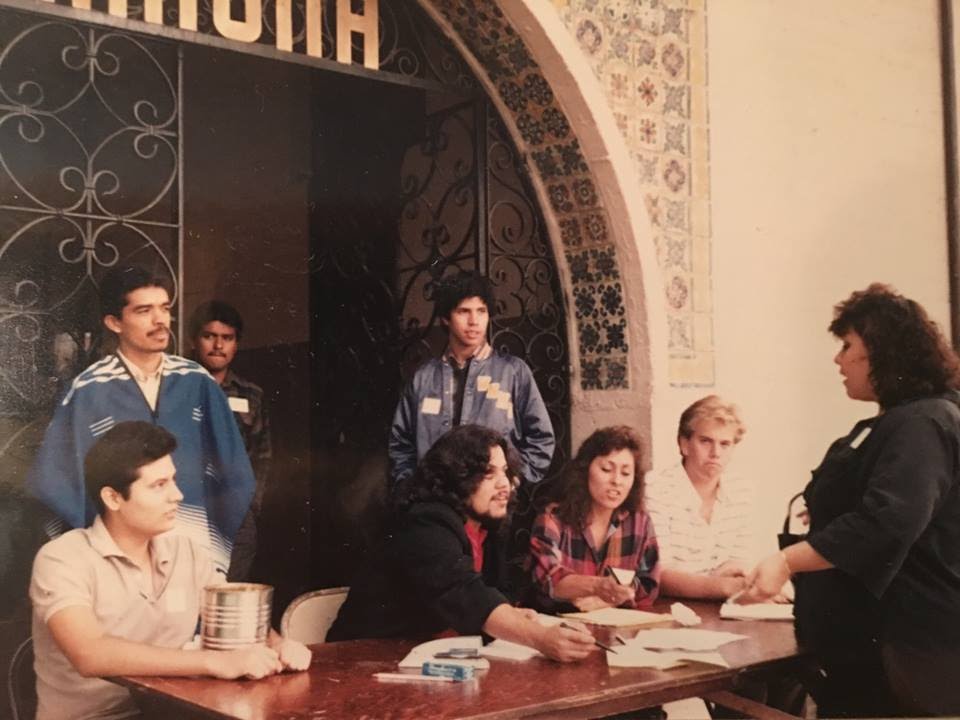
Since 1985, starting as a freshman at UCLA, I’ve studied social movements and revolutions—both domestically and internationally. This includes the theoretical foundations and leaders behind major societal transformations. Complementing my university studies, during the mid-1980s, I also engaged in student activism (as a MEChista). This included lobbying for U.S. divestment in South Africa’s then-apartheid regime, advocating for racial/economic diversity in higher education and defending the rights of undocumented students (e.g., eight-day hunger strike). While not one of the five hunger strikers, I played a leadership role in a groundbreaking protest at UCLA (November 11-19, 1987), preserving/securing university funding sources (and other services) for undocumented students. Our successful efforts provided an organizing model for other Chicana/o student activists to stage similar hunger strikes at UCLA (May 24-June 7, 1993), UCSB (April 27-May 5, 1994) and other colleges/universities.


Alvaro Huerta. standing second to left in blue sarape, around 1986 (Photo provided by Alvaro Huerta)

At the community level, I—along with fellow activists—co-founded the Association of Latin American Gardeners of Los Angeles (ALAGLA) to successfully challenge the City of Los Angeles’ leaf blower ban (1996). This draconian ban included a misdemeanor charge, $1,000 fine and up to six months in jail for cited Latino gardeners. Learning from UCLA’s hunger strike, during the pivotal period of this movement, 11 ALAGLA organizers/members staged a six-day hunger strike in front of City Hall (January 3-9, 1998) to demand justice for honest, hard-working Latino gardeners. (To learn more about this social/economic justice campaign, click here for journal article and here for video.)


Following this dynamic grassroots campaign, as the lead organizer at Communities for Better Environment (CBE) —during the late 1990s and early 2000s— I successfully led an organizing campaign to defeat a proposed power plant in Southeast Los Angeles, specifically, the City of South Gate. If built, the proposed power plant (size of
Dodger Stadium) would have emitted over 150 tons of 
pollution per year, such as particulate matter (PM10). PM10 (or fine particles
of soot) has been linked to premature death, including heart failure and
respiratory ailments, such as asthma and bronchitis. (To learn more about this environmental justice (EJ) campaign, click here for journal article and here for video.)


For the record, all successful community-based campaigns represent collective efforts, where all participants (e.g., leadership, membership, volunteers, sympathizers) deserve credit.

That said, given my positionality as a scholar-activist and public policy advocate (e.g., immigration advocacy) on behalf of los de abajo (or those on the bottom), I offer my dos centavos (or two cents) in a non-ranked order for current and future community organizers to benefit from. (While I have more to say on this important question, I’ll do so in future essays.)
Learning from causes for social, racial and economic justice.

Since the turbulent 1960s to the present, college and university students have played a key role in protesting unjust wars (e.g., Vietnam, Iraq), eradicating racism, defending free speech and fighting for a more just society, among other noble causes. Given their privileged status, college/university students have the luxury of time and access to resources to study contemporary and historical social movements and revolutions. This allows this class or group to learn from influential thinkers and leaders responsible for creating transformative change throughout history. While not limited to college/university students, the idea here is for community organizers to study influential causes and their leaders to be better prepared—theoretically and strategically—for emerging causes or struggles.
Demonstrate humility and don’t impose moral values.

When organizing marginalized community members or vulnerable groups, like Kendrick Lamar—greatest rapper alive—says, “be humble.” Need I say more on this point?

In terms of moral values, it’s imperative that community organizers don’t impose their own values or belief systems on the community members they’re “trying to help.” Organizers should not judge or try to change the behavior of community members or presuppose that they know “what’s good for the community.” Be open, listen and engage in dialogue with community members or group members to better understand why individuals or (sub)groups adopt particular conduct, speech, attire, etc.

Overall, instead of operating from a hierarchal or top-down approach (like some non-profits and unions that I worked for), engage with community members on a horizontal or equal level. In other words, don’t organize “for” community members; organize “with” them.
Don’t romanticize poverty.

There’s nothing good about being poor or the objective conditions of the working poor. I should know since I grew up in abject poverty—both in Tijuana (Baja California, Mexico) and East Los Angeles, as I discussed in my TEDxCPP talk (April 27, 2017). Thus, community organizers shouldn’t shy away from improving the living conditions or neighborhoods of historically disenfranchised groups.


The balance, however, is to improve or invest in these communities without the perils of gentrification or displacement of the same people you’re “trying to help.” For instance, the federal urban renewal program of 20th Century—supposedly aimed at “improving” and “transforming cities”—caused havoc for racialized and working-class communities in America’s barrios and ghettos.
Access existing social networks and build from them.

While racialized and working-class communities may be “poor” in terms of financial capital, they are often “rich” in terms of social networks and other forms of social capital. Social networks constitute interpersonal connections among family members, friends, acquaintances, neighbors, co-workers and other relationships, like those via the church (e.g., padrinos/madrinas, compadres/comadres). For instance, in the case of many Chicana/o-Latina/o households, we can clearly see how they effectively organize themselves (and maintain their cultures/identities) around important family events and celebrations, like weddings, quinceañeras, funerals, baptisms and so on.

To effectively organize and mobilize these communities or members around particular campaigns or issues (e.g., legalize street vending, halt deportations, defeat gentrification), it’s key for community organizers to access these pre-existing networks. For instance, when we—Adrian Alvarez, Pedro Perez and myself—first ventured into the streets of Los Angeles to organize Latino gardeners (an informal labor niche which had never been organized before), we did so by accessing the social networks of a Jaime Aleman—a veteran gardener from Zacatecas, Mexico.

I will never forget that cold Saturday night in the summer of 1996, where we first met with some of Jaime’s paisanos and fellow gardeners behind an apartment building. By accessing and expanding upon Jaime’s social networks, a small group of Chicana/o organizers and gardeners successfully organized Latino gardeners—independent and dispersed workers/petty-entrepreneurs throughout the city—to fight City Hall. By chance, like qualitative researchers, we used this opportunity or insider access to initiate a snowball sampling strategy to obtain referrals or contacts with other gardeners throughout the city.
Building confianza or trust.

Without establishing or building confianza (or trust) between the community organizers and community members/impacted members, the organizers will fail miserably. Confianza isn’t something you can establish overnight. It takes time to establish and build. It also takes patience, honest, transparency, consistency and good deeds on behalf of the organizers. Too often, marginalized community members have been taken advantage of by opportunists, politicians, hustlers, hucksters, etc., in this country and, for some, their home countries. This is one reason why marginalized community members are suspicious of outsiders, despite their good intentions to help improve their plight.

Thus, before any organizer arrives into a community/neighborhood that they’re not embedded in and demand action or participation by the community members, they must first get to know the people, especially on a social or personal level. This includes attending events or places where community members congregate, like schools, churches, parks, etc. It helps to start with one person or a family and build confianza from there. It’s impossible to deliver a political speech at a local school or church, expecting community members to trust you or your good intentions. On a similar note, it’s a waste of money and energy to distribute flyers and expect for community members to join your cause without serious reservations.
Eat the tacos de carnitas.

Should an organizer (or organizers) be fortunate enough to be invited into the home of a Latina/o community member or to attend a special occasion, like a quinceañera, don’t offend the host(s) by rejecting their food. In many Mexican households —both in this country and abroad— the host(s) will often serve their guests food without asking. This applies to the poorest barrios of California to the poorest villages of Chiapas, Mexico. Thus, should the guest(s) refuse to eat the served food, the host(s) will be offended.

When organizing against the power plant proposal in South Gate, for example, I noticed some of my fellow organizers commit this crime or insult. I tried to compensate by ordering some extra tacos de carnitas to go, but the damage had already been done.
Organizing at cantinas and Mexican restaurants.

Community organizing shouldn’t be limited to distributing flyers, holding press conferences and organizing protests. Community organizing should also include gatherings informally or socializing at bars, restaurants, coffee shops and back-yard carne asada cookouts with community members. For instance, when organizing gardeners, we (as Chicana/o activists) established strong personal relationships with the Latino gardeners—mostly from rural Mexico—over some Pacifico and Dos Equis beers. (Actually, “some” is an understatement.) This is an insightful point that Adrian Alvarez, president of ALAGLA, discussed at a symposium (on May 13, 2015) at UCLA’s Chicano Studies Research Center (CSRC): “Organizing Latino Immigrants in the Informal Economy: The Successful Case of the Association of Latin American Gardeners of Los Angeles.”


Immerse yourself into organizing campaign.

When organizing a grassroots campaign, you must immerse yourself and focus on the campaign or larger movement. Too often, organizers spread themselves too thin by taking on too many campaigns at once. This is a recipe for failure. When I co-organized the gardeners or led the campaign against the power plant, I immersed or committed myself without external distractions. This allowed me to focus on my particular role within the given organizing campaign and collective objectives.

While there are psychological and physical costs to being fully immersed or committed to a challenging organizing campaign or cause, where you’re constantly thinking about the opponents (e.g., corporation, City Hall, federal government) and major obstacles, etc., this is the price one pays for fighting/dreaming for a better world!

To conclude, I end with the brilliant words of Ricardo Flores Magón (1921)—the precursor of the Mexican Revolution: “The dreamer is the designer of tomorrow… Suppress the dreamer, and the world will deteriorate towards barbarism.”

***

Alvaro Huerta, Ph.D., is an Assistant Professor of Urban & Regional Planning and Ethnic & Women’s Studies (EWS) California State Polytechnic University, Pomona.

Sunday, March 29, 2026

A Thoughtful Introduction to my book, Subtractive Schooling—Through Becky Morales’ Lens, by Angela Valenzuela, Ph.D.

A Thoughtful Introduction to my book, Subtractive Schooling—Through Becky Morales’ Lens, by Angela Valenzuela, Ph.D.

Every now and then, someone comes along who is able to take a body of work and make it newly accessible—clear, grounded, and meaningful in ways that reach beyond the academy. I want to share one such example with you. In this YouTube video, educator and global learning advocate Becky Morales offers a thoughtful and generous reading of my book, Subtractive Schooling: U.S.-Mexican Youth and the Politics of Caring. What I appreciate most about her interpretation is not simply that she engages the core ideas, but that she does so with care, clarity, and a deep respect for the lived experiences at the heart of the work.

Becky brings into focus what “subtractive schooling” really means—not as an abstract concept, but as something that shapes students’ identities, language, and sense of belonging. As she notes, the book examines how schooling processes can strip away students’ cultural and linguistic resources even as they claim to educate them . At the same time, she highlights the importance of what I have called “authentic caring”—a form of relational, humanizing practice that stands in contrast to these subtractive forces.

What is especially meaningful to me is how Becky translates these ideas for educators, parents, and community members. She reminds us that this work is not only about critique, but about possibility—about how we might do schooling differently, in ways that affirm rather than erase who students are.

I share this not to revisit my own work, but to lift up hers. In a moment when conversations about education are often flattened into soundbites or politicized narratives, Becky Morales offers something else: a careful, accessible, and deeply humane engagement with what is at stake for young people in our schools.

I hope you’ll take a few minutes to watch. It’s a beautiful example of what it means to read with care—and to teach with purpose. You may follow her YouTube @BeckyMorales


Becky Morales, creator of KidWorldCitizen.org and author of GlobalEdToolkit.com, shares activities to enhance global learning. Topics include: geography, world culture, empathy, service learning, cultural exchange, family travel, world recipes/music/films for kids, multicultural crafts, multicultural children's literature, educational technology, adoption, and multicultural families.

Saturday, March 28, 2026

Civil Rights, Reversed: When “Equality” Masks Inequality, by Angela Valenzuela, Ph.D.

 Civil Rights, Reversed: When “Equality” Masks Inequality

by

Angela Valenzuela, Ph.D.
March 28, 2026

There is a through line connecting two arguments that, at first glance, may appear distinct but are in fact deeply aligned. One, advanced by Christopher Rufo, calls for a “colorblind” reinterpretation of civil rights law—one that would prohibit any consideration of race, even for remedial purposes. The other, emerging from more radical libertarian circles, goes further: it claims that the Civil Rights Act of 1964 itself is an illegitimate infringement on freedom of association and suggests it should be dismantled altogether. 

What links these positions is not merely their skepticism of race-conscious policy, but a shared project of narrowing—if not undoing—the legal architecture of civil rights itself. For a revealing articulation of this trajectory, see Ross Douthat’s interview with Rufo in The New York Times (Douthat, 2025).

Taken together, these positions mark not a debate over policy nuance, but a coordinated redefinition of civil rights. One narrows its meaning to the point of inversion. The other seeks its outright elimination. Both rest on the same premise: that efforts to address inequality are themselves the problem.

Let us begin with the “colorblind” argument. Its appeal lies in its simplicity: no advantages or disadvantages based on ancestry; no consideration of race in admissions, hiring, or public policy. Equality, in this view, is achieved by ignoring history and the politics of difference altogether.

Digital graphic by Angela Valenzuela

But this formulation depends on a false premise—that we are operating on a level playing field. We are not. 

What this argument ultimately masks is not neutrality, but grievance politics reframed as principle. Under the banner of “colorblind equality,” what is being advanced is a narrative of injury—that white Americans, and particularly those aligned with dominant institutional power, are now the true victims of discrimination. This is not a legal argument so much as a political one. It converts historically grounded efforts at remedy into perceived acts of injustice, recasting inclusion as exclusion and equity as unfairness. 

Digital graphic by Angela Valenzuela

In doing so, it mobilizes resentment while disavowing it, presenting grievance as constitutional fidelity. But grievance politics, however carefully dressed in the language of rights, does not resolve inequality—it obscures it. And in the current Texas context, it provides the affective fuel for policies like anti-DEI Senate Bill 17 and Senate Bill 37 where the rhetoric of neutrality legitimates the restructuring of institutions in ways that ultimately consolidate, rather than challenge, existing hierarchies.

The United States did not arrive at inequality by accident. It was produced through centuries of law and policy: enslavement, segregation, exclusion from housing and employment, and systematic disinvestment. The Jim Crow laws were not merely social customs; they were legal regimes that structured access to opportunity. The Civil Rights Act was enacted precisely to dismantle those regimes and, crucially, to enable remedies where their effects persisted.

To collapse race-conscious remedies into “racial favoritism,” as Rufo does, is to erase this history. It is to treat corrective measures as equivalent to the harms they were designed to address. This is not legal reasoning; it is what I would call policy theater—a reframing of institutional retrenchment as moral clarity.

We see the consequences of this reframing most clearly in Texas.

With SB 17, the state has effectively banned DEI initiatives across public universities, invoking the language of neutrality while triggering widespread anticipatory compliance. Programs have been dismantled, trainings canceled, and academic units reorganized in ways that extend well beyond the statute’s text. At the University of Texas at Austin, the consolidation of departments focused on race, ethnicity, and gender signals not simply administrative efficiency, but a reorientation of institutional priorities.

SB 37 builds on this foundation by weakening faculty governance and centralizing authority, reducing the capacity of academic communities to respond collectively to these changes. The result is not a neutral landscape, but a managed one—where the boundaries of permissible knowledge are increasingly shaped by political directives.

This is the paradox of the “colorblind” project: in the name of limiting the role of the state, it invites a different kind of state intervention—one that withdraws protections while actively restructuring institutions.

Digital graphic by Angela Valenzuela

The libertarian argument takes this logic to its endpoint. If any government mandate for nondiscrimination is an infringement on liberty, then civil rights law itself must be dismantled. Businesses, employers, and institutions should be free to associate—or refuse to associate—on any basis, including race.

At first glance, this may appear as a principled defense of freedom. In reality, it rests on a deeply flawed understanding of both freedom and history.

Freedom of association has never been absolute, particularly in the public sphere. Once an entity opens itself to the public—whether a restaurant, a university, or an employer—it becomes part of a broader civic infrastructure. The rules that govern that space are not arbitrary constraints; they are conditions that make participation possible.

Without such protections, “freedom” becomes asymmetrical. Those with power retain the freedom to exclude, while those without it bear the consequences.

This is not a hypothetical concern. It is a historical fact.

Prior to the Civil Rights Act, discrimination in public accommodations, employment, and education was not episodic—it was systemic. Entire populations were excluded from the basic institutions of public life. To suggest that market forces alone would have corrected these injustices is to ignore the depth and durability of structural inequality.

Here, the libertarian argument converges with the “colorblind” one. Both assume that inequality is either no longer significant or irrelevant to the question of justice. Both prioritize formal neutrality over substantive fairness. And both, in doing so, risk entrenching the very inequalities they claim to transcend.

As Eduardo Bonilla-Silva has argued, colorblind ideology functions by masking structural inequality, allowing it to persist under the guise of neutrality (Bonilla-Silva, 2018). And as Kimberlé Crenshaw reminds us, civil rights law has always been contested terrain—expanded through struggle, and vulnerable to retrenchment (Crenshaw, 1988).

What we are witnessing now is a moment of such retrenchment.

The language of civil rights is being repurposed to constrain remedy. The concept of freedom is being narrowed to exclude considerations of equity. And the institutions tasked with fostering knowledge and opportunity are being reshaped accordingly.

The stakes are not abstract.

They are visible in classrooms where faculty hesitate to engage certain topics. In departments that are merged or dissolved. In students who find fewer spaces where their histories and experiences are taken seriously as objects of study. In a broader climate where the line between policy and politics grows increasingly difficult to discern.

The question before us is not whether we believe in equality. It is what kind of equality we are willing to defend.

Digital graphic by Angela Valenzuela

Is it an equality that ignores history, overlooks power, and quietly reproduces existing hierarchies? It is an equality that recognizes the unfinished work of democracy—one that understands that justice requires more than neutrality—one that requires attending to the conditions that make inequality endure?

In Texas, this question is no longer theoretical. It is legislative. It is institutional. And it is unfolding in real time.

The answer we choose will determine not only the future of civil rights law, but the meaning of freedom itself.

References

Bonilla-Silva, E. (2018). Racism without racists: Color-blind racism and the persistence of racial inequality in the United States (5th ed.). Rowman & Littlefield.

Crenshaw, K. (1988). Race, reform, and retrenchment: Transformation and legitimation in antidiscrimination law. Harvard Law Review, 101(7), 1331–1387.

Douthat, R. (2025, March 7). The anti-D.E.I. crusader who wants to dismantle the Department of Education. The New York Times.