Translate

Showing posts with label U.S. Constitution. Show all posts

Monday, April 06, 2026

Rationing Opportunity: The War on Children and the Dismantling of Plyler v. Doe, by Angela Valenzuela, Ph.D.

Rationing Opportunity: The War on Children and the Dismantling of Plyler v. Doe

by

Angela Valenzuela, Ph.D.
April 6, 2026

Visit MALDEF.org that played a central role litigating Plyler v. Doe


As you can read for yourselves in this article published by thehill.com titled GOP calls to get undocumented children out of public schools grow authored by Lonas Cochran (2026), there are moments when the law does more than interpret policy—it draws a line around who counts. In 1982, the U.S. Supreme Court did exactly that in Plyler v. Doe, holding that undocumented children are entitled to a free public K–12 education under the Equal Protection Clause of the Fourteenth Amendment.

That line is now under direct attack.

Recent reporting details a coordinated push—stretching from state legislatures to federal actors—to dismantle Plyler. Texas Congressman Chip Roy has called for overturning the decision, framing it as a “burden” on taxpayers. At the same time, Stephen Miller has reportedly encouraged Texas lawmakers to consider cutting funding for undocumented students. Tennessee is advancing legislation that would require proof of immigration status at school enrollment, a move widely understood as a precursor to legal challenge.

Let’s be clear: this is not random. It is a strategy.

The most likely pathway to overturning Plyler is not legislative repeal—it is engineered litigation. A state passes a law that restricts access to education, gets sued, and uses the case to invite a newly configured Supreme Court to revisit precedent. We have seen this playbook before. It is deliberate, incremental, and designed to normalize what once seemed unthinkable.

But much of the rhetoric surrounding this effort depends on misdirection.

First, the claim that Plyler represents “judicial overreach.” It does not. The Court did what it has long done: interpret the Constitution. The Fourteenth Amendment’s Equal Protection Clause applies to “persons,” not just citizens. This principle is not new. It dates back to cases like Yick Wo v. Hopkins (1886), which affirmed that noncitizens are entitled to constitutional protections.

Second, the assertion that Congress holds plenary power over immigration. True—but irrelevant here. Plyler is not about immigration enforcement. It is about whether a state can deny children access to education. That question falls squarely within constitutional limits on state power.

Third, the fiscal argument—that undocumented students strain public resources. This is not a constitutional argument; it is a political one. And it collapses under scrutiny. Public schools are funded through formulas tied to attendance. In an era of declining birth rates, many districts depend on stable or increasing enrollment to remain viable. Excluding students does not save systems—it destabilizes them. More importantly, denying education produces far greater long-term social costs: poverty, unemployment, and diminished civic participation.

What is unfolding, then, is not a good-faith debate about policy. It is a reframing of rights as liabilities.

And that reframing has consequences.

The article also points to a troubling operational shift: the erosion of long-standing norms that treated schools as protected spaces. With changes to federal enforcement posture, U.S. Immigration and Customs Enforcement (ICE) activity near or on school grounds is no longer off-limits. Reports of arrests involving parents and community members in proximity to schools are already emerging.

We need to name this for what it is: the transformation of schools from sites of learning into sites of surveillance.

When families fear school, they do not send their children. Attendance drops—not just among undocumented students, but across entire communities. Teachers become frontline responders to trauma. Classrooms become quieter, emptier, more precarious. And the damage extends far beyond immigration status.

There is also a deeper legal horizon to consider. Some observers have speculated that challenges to Plyler could intersect with broader efforts to reinterpret the Fourteenth Amendment, including debates over birthright citizenship. While the connection is not guaranteed, the logic is clear: narrow the definition of who counts as a constitutional “person,” and a cascade of exclusions becomes possible.

This is how rights erode—not all at once, but through strategic pressure points.

In my own work, I have described this as "discursive inversion": the process by which inclusion is reframed as excess, and rights are recast as threats. Under this logic, providing children with an education becomes an unfair advantage. Equal protection becomes preferential treatment. The moral universe flips, and exclusion begins to appear reasonable—even necessary.

We have seen this before. Historically, arguments about “limited resources” and “taxpayer burden” have been used to justify segregation, exclusion, and the rationing of opportunity. What changes are the targets, not the logic.

And here, the target is children.

Let us pause on that.

Plyler v. Doe did not create a broad new right. It prevented the state from imposing a devastating harm. The Court recognized that denying education to children—who have no control over their immigration status—would impose a “lifetime hardship,” effectively foreclosing their ability to participate meaningfully in society. Education, the Court reasoned, is foundational to individual dignity and democratic life.

To undo Plyler is to accept that some children can be rendered permanently disposable.

That is not a budgetary decision. It is a moral one.

It is also a profound shift in how we understand public education. For generations, public schooling in the United States has been grounded—however imperfectly—in the idea of universality. Not equality achieved, but equality aspired to. The notion that schools belong to the public, and that the public includes all who reside within it.

Overturning Plyler would mark a departure from that principle. Education would become conditional—granted not on the basis of presence or personhood, but on legal status. The classroom would no longer be a shared civic space, but a filtered one.

And once that line is drawn, it will not hold.

Because the question will not stop at undocumented children. It will expand—quietly at first—into other domains, other populations, other forms of conditional belonging.

This is how institutional unraveling begins. Not with a single decision, but with a redefinition of who is entitled to protection.

The Court answered that question in 1982. It affirmed that children, regardless of status, are persons under the Constitution and deserving of access to education.

The fact that we are now poised to revisit that decision should give us pause.

Not because precedent is sacred—it is not—but because the direction of change matters.

We are being asked, once again, to decide whether schools are instruments of democracy or tools of exclusion.

And this time, the answer will not be abstract.

It will be lived—in classrooms, in communities, and in the futures of millions of children watching closely to see whether this country believes they belong.

References

Lonas Cochran, L. (2026, March 30). GOP calls to get undocumented children out of public schools grow. The Hill. https://thehill.com/homenews/education/5804304-undocumented-kids-public-schools-plyler/

Plyler v. Doe, 457 U.S. 202 (1982).

Yick Wo v. Hopkins, 118 U.S. 356 (1886).

Tuesday, September 23, 2025

Third lawsuit filed against display of Ten Commandments in schools

Friends:

Attorney General Paxton’s claim distorts both history and constitutional principle. While the Ten Commandments in the Bible are part of the religious heritage of many, America’s legal and civic foundation rests not on a single faith tradition but on Enlightenment ideas, English common law, and a deliberate commitment to religious liberty.

Many of the framers themselves descended from those who fled religious persecution in Europe. From this history, they understood that a republic could only survive if it safeguarded freedom of conscience against state-imposed faith—an understanding that was ultimately enshrined in the First Amendment’s guarantee that “Congress shall make no law respecting an establishment of religion, or prohibiting the free exercise thereof.”

In drafting the Constitution, the framers explicitly rejected the establishment of any religion as the basis for government, ensuring that all faiths—and those with none—could belong equally. To insist, as Paxton does, that the Ten Commandments are the cornerstone of American law is to erase the pluralism that has defined this country from the start and to undermine the very protections of the First Amendment. 
It is, in effect, a rewriting of history that asks the public to ignore the evidence before their very eyes.

This is why the third lawsuit filed against the Ten Commandments classroom display law is so significant. As Austin American-Statesman education reporter Keri Heath documents, fifteen families representing a variety of faith backgrounds—including Christian, Jewish, Lutheran, and nonreligious—have joined together to challenge Senate Bill 10 in federal court. Their action underscores that Paxton’s directive is not only constitutionally dubious but also deeply out of step with the diverse religious and civic traditions that make up Texas and the nation.

-Angela Valenzuela

By , Staff Writer


A third lawsuit has been filed against school districts over a new state law requiring the placement of the Ten Commandments in school classrooms. / Jay Janner/Austin American-Statesman


A group of families on Monday filed a third lawsuit against a batch of school districts over a law requiring the placement of the Ten Commandments in Texas classrooms. The 14 school districts, which include Georgetown and Comal, are among several dozen that have been sued over the law since Gov. Greg Abbott signed it in June.


The lawsuit also comes about a month after Attorney General Ken Paxton sent a memo to superintendents reinforcing that districts should display posters depicting the 10 Commandments, despite a federal judge temporarily blocking the law for a handful of districts.


The lawsuit also includes the Conroe, Flour Bluff, Fort Worth, Arlington, McKinney, Frisco, Northwest, Azle, Rockwall, Lovejoy, Mansfield and McAllen school districts. All of the districts listed in the lawsuit either received or already posted donated posters depicting the Ten Commandments, according to the lawsuit. 


The new lawsuit was filed in the U.S. Western District Court of Texas by 15 families of students in the named districts. The families are of a variety of faith backgrounds, including Christian, Jewish, Lutheran and nonreligious, according to the lawsuit.


“I address questions about God and faith with great care, and I emphatically reject the notion that the state would do this for me,” said Rev. Kristin Klade, a Lutheran pastor who lives in Fort Worth.


Authored by Sen. Phil King, R-Weatherford, Senate Bill 10 requires that school districts post any donated copies of a specific version of the Ten Commandments in public school classrooms.


The lawsuit filed Monday is the third sparked by SB 10. In June, parents brought a lawsuit against three districts and the Texas Education Agency. In July, additional families brought a lawsuit against 11 other districts. 


A federal judge temporarily blocked the law for the 11 districts last month, prompting Paxton to issue instructions directing every other district in the state to abide by SB 10.


“From the beginning, the Ten Commandments have been irrevocably intertwined with America’s legal, moral, and historical heritage,” Paxton said in a statement when he issued the directive.


That July lawsuit included the Lake Travis and Dripping Springs districts. The Austin school district was eventually dismissed from the case as long as it adhered to any injunction the court placed.


K-12 EDUCATION REPORTER

Friday, September 19, 2025

Texas A&M president resigns after instructor’s firing over gender teachings, Molly Hennessy-Fiske, Washington Post

Friends:

Texas A&M University President Mark A. Welsh III has announced his resignation barely a week after a viral video set off a storm of political outrage that ended with the firing of senior lecturer Melissa McCoul and the removal of both a dean and department head.

The controversy began in Professor McCoul’s children’s literature course when a student objected to her teaching of Jude Saves the World, a novel whose main character is nonbinary. The student insisted the lesson was “illegal” and against religious belief. McCoul, who had successfully taught the text in previous semesters, maintained that her teaching was both lawful and academically appropriate. 

For the record, it's not illegal since anti-DEI, Senate Bill 17 allows us as faculty to continue to teach and conduct research. The moment was nevertheless secretly recorded, uploaded to social media, and swiftly seized upon by political figures eager to weaponize it.

Welsh—a retired four-star general and former member of the Joint Chiefs of Staff—soon found himself under heavy fire from state leaders including Lt. Gov. Dan Patrick and Rep. Brian Harrison, who demanded his ouster and the dismantling of all so-called “DEI and LGBTQ indoctrination” in Texas universities. His attempt to appease critics by firing McCoul and demoting administrators did not silence the uproar. In the end, he stepped aside.

Now, faculty and students at Texas A&M face an unsettling reality: a campus climate increasingly shaped by political dictates rather than academic judgment. McCoul, by all accounts a respected instructor with more than a decade of teaching experience, is fighting her termination through an appeal.

From what I have gathered about Welsh’s own defense of academic freedom—including a thoughtful LinkedIn post shared by Dr. Leonard Bright—I cannot help but wonder if his willingness to stand by this principle hastened his exit. It is sobering to realize that one of our state’s largest and most prestigious public university could not shield its president from partisan attack when he appeared to affirm what is, after all, a constitutional right.

As assaults on higher education escalate across the nation, Welsh’s resignation is a stark warning. It signals not only the erosion of academic freedom but also the weakening of democratic norms. The question we face is urgent: Will Texas universities defend the right of professors to teach and students to learn without fear, or will they surrender to political interference? The future of higher education in this state—and the public it serves—depends on the answer.

—Angela Valenzuela

Texas A&M president resigns after instructor’s firing over gender teachings


President Mark A. Welsh III is stepping down after a video of a student accusing an instructor of illegally teaching “gender ideology” led to the instructor’s firing.


Texas A&M University President Mark A. Welsh III (Mark Felix/For The 
Washington Post)


HOUSTON — The president of Texas A&M University’s flagship campus is stepping down a little over a week after a viral video of a student accusing an instructor of illegally teaching “gender ideology” led to the instructor’s firing, the removal of a dean and department head, as well as calls for investigations — including by the Justice Department.

President Mark A. Welsh III is a retired four-star general who trained as a fighter pilot and later served as a member of the Joint Chiefs of Staff. He has also held roles including associate director for military affairs at the CIA, commandant of cadets at the U.S. Air Force Academy and dean of the Bush School of Government and Public Service at A&M.

Welsh took over at Texas A&M two years ago after M. Katherine Banks retired as university president in the wake of a scandal involving the botched hiring of journalism professor Kathleen McElroy. That job offer provoked backlash from the Texas GOP because of McElroy’s work on diversity, equity and inclusion programs, which Texas has since banned.

Welsh will step down Friday, according to a statement released by Texas A&M late Thursday.

“Today, President Welsh has submitted his resignation, and both the Board of Regents and I agree that this is the right moment for change,” Texas A&M Chancellor Glenn Hegar said in a separate statement posted on X.

Hegar, a former GOP state lawmaker, thanked Welsh for his service and contributions to the university. He said the nine-member Board of Regents — appointed by Texas Gov. Greg Abbott (R) — will conduct a nationwide search for Welsh’s successor and appoint an interim president “to guide the university during this transition.”

On Friday, Welsh posted a statement that shed little light on why he decided to resign, apart from the recent controversy.

“When I was first appointed as President of Texas A&M University, I told then Chancellor John Sharp and our Board of Regents that I would serve as well as I possibly could until it was time for someone else to take over. Over the past few days, it’s become clear that now is that time,” Welsh wrote.

“It was the right decision for him to do for himself, the university, students, and faculty,” said Leonard Bright, a professor at Texas A&M’s Bush School of Government and Public Service, in a text message. “Now, we look to the university and (board of regents) to conduct an earnest search for a replacement who will fully support the values of academic freedom and protect the university from political interference in our classrooms.”

State Rep. Brian Harrison (R), who posted the viral video and audio recordings of Welsh while repeatedly demanding his ouster, celebrated his resignation Thursday on X.

“As the first elected official to call for him to be fired, this news is welcome, although overdue,” Harrison wrote. “Now … END ALL DEI AND LGBTQ INDOCTRINATION IN TEXAS!!”

The video excerpt that contributed to Welsh stepping down was shared by Harrison on Sept. 8. It was filmed on July 29 during a children’s literature class, but neither the student — whom Harrison declined to identify because they had requested anonymity — nor instructor Melissa McCoul appear on camera.

In a statement emailed to The Washington Post by her attorney this week, McCoul said the class was on the second of three days reading a middle-grade contemporary fiction novel called “Jude Saves the World” that she had taught in “several previous iterations” of the class.

“The main character, Jude, is nonbinary. The plot largely deals with Jude’s difficulties with ADHD in school, their relationship with their friends, mother, and grandparents, and their friend group’s attempt to build an LGBTQ-accepting social club in their town,” she said.

McCoul said that on the first day, she had provided “contextual background information on sex, sexuality and gender as they applied to children’s literature, as well as the ways things like toys and clothing are often gendered,” and was recapping those points when the video was filmed.

The footage begins as the student interrupts to insist the lesson is “not legal, and I don’t want to promote something that is against our president’s laws.”

“According to our president, there’s only two genders,” the student says, alleging that the instruction “very much goes against, not only myself, but a lot of people’s religious beliefs.”

In response, McCoul can be heard telling the student that “if you are uncomfortable in this class, you do have the right to leave. What we are doing is not illegal.”

She then referred the student to a department head, noting that officials were aware of the concerns. “I’m not convinced that your proposal will be effective in stopping me from teaching things that are biologically true, because I do have the legal and ethical authority, professional expertise in this classroom,” McCoul said, before telling the student to leave.

A day later, McCoul was fired. Her attorney Amanda Reichek, a Democratic former Texas judge, has released a statement calling McCoul “a highly regarded senior lecturer,” noting that she had “over a decade of teaching experience under her belt when she was summarily terminated” and is appealing her firing.

After the video went viral, Welsh also removed McCoul’s dean and department head, but that did not satisfy Harrison or Texas Lt. Gov. Dan Patrick (R), a staunch ally of President Donald Trump.

“His ambivalence on the issue and his dismissal of the student’s concerns by immediately taking the side of the professor is unacceptable,” Patrick posted on X last week.

Abbott had already threatened to fire Welsh in January after the university’s business school invited doctoral students and faculty to a conference designed to promote classroom diversity. Welsh responded by pulling the university out of the conference.

Several other presidents of major U.S. universities have also been forced out or resigned under pressure in recent years, as elected officials and conservative activists — including in the Trump administration — increasingly scrutinize campus culture and decisions.

Trump and his administration have this year attacked Columbia, Harvard, Northwestern, the University of Pennsylvania and the University of Virginia. Texas A&M, with an enrollment of more than 79,000, is the largest state school to face such backlash and is among the largest universities in the country.

Texas GOP leaders have passed laws this year strengthening their control over university curriculums, hiring and protests.


Susan Svrluga contributed to this report from Washington.


Friday, June 27, 2025

Immigrants' Rights: Know your rights, compliments of the American Civil Liberties Union (ACLU)

Friends, 

Tragically, we are hearing of a lot of people getting picked up by ICE in our communities. It's important theat people know their rights. 

Here is great information on what your rights are from the American Civil Liberties Union (ACLU) that has been carefully developed to help you navigate encounters with law enforcement and immigration officials safely and confidently.

If you’re ever questioned about your immigration status, it’s critical to know your rights—you do not have to answer questions about your citizenship or status, and you absolutely have the right to remain silent. Never lie or present false documents. Remember that you can refuse a search unless there’s probable cause. 

Please take a moment to review this important guidance so you can protect yourself and your loved ones. 

My best suggestion is to go directly to the ACLU website for detailed explanations and various scenarios. 

May our Creator—who sees no borders and draws no distinctions among us—bless and protect you always. These are the hard times.

-Angela Valenzuela


Know your rights

Immigrants' Rights

Regardless of your immigration status, you have guaranteed rights under the Constitution. Learn more here about your rights as an immigrant, and how to express them.

Law enforcement asks about my immigration status

Wednesday, August 09, 2023

Texas' book ban law isn't just bad. It's bad business. (Opinion), by Ed Nawotka, Houston Chronicle, Aug. 4, 2023

Here's a recent piece on Texas'  medieval “book ban law," or House Bill 900, that passed in the regular 88th (2023)Texas Legislative Session. The short of it is that banning books violates the First and Fourteenth Amendments to the U.S. Constitution and is just plain bad for business—or as Molly Ivins used to say—"bid-ness," in Texas. This specific piece addresses the converting of some Houston Schools' libraries into detention centers referenced in the piece I just posted to this blog.

What distinguishes us as a democracy is freedom of speech, thought, and equal protection under the law. I wish those filing suit a successful day in court, beginning with a preliminary injunction hearing in Federal Court on August 18th here in Austin, Texas. If we can't win these battles in the legislature, we must turn to the courts.

-Angela Valenzuela

Texas' book ban law isn't just bad. It's bad business. (Opinion)

Valerie Koehler, owner of Blue Willow Bookshop, is part of a lawsuit aimed at stopping a law that would require bookstores to label books with sexual content.

Brett Coomer/Staff photographer

It is only fitting that the battle over House Bill 900, Texas’ new “book ban law," would start at the Alamo — or, to be more specific, across the street at the historic Menger Hotel. In April, more than 75 booksellers had gathered there to preview and celebrate the year’s forthcoming books. The star writer in the room that day was Houston’s Bryan Washington. Among those on hand to take it all in were more than a dozen new booksellers who have opened stores in the state in recent years, including David and Dara Landry, owners of CLASS bookstore.

The booksellers were concerned. The Texas Legislature was about to vote on and pass the new law that demands, in part, that “library material vendors,” including booksellers and publishers, create and implement a rating system for books sold to Texas schools and school libraries based on the book's “sexual” content. The intent, said lawmakers, was to protect children and keep pornography out of schools. (A cause that would be better served by taking away their phones and shutting off the school Wi-Fi.) The consequence of not doing so or getting the rating wrong, according to the state, is to be blacklisted from selling books to any Texas schools.

What’s ironic is that for all of Texas’ flag-waving talk about personal freedom, independence and freedom of speech, this law is akin to those in China, Cuba, Saudi Arabia, Turkey or Russia — all countries where the government controls what books can be published and put on sale.

That’s some nefarious company.

Something had to be done about this intimidation, the booksellers agreed. And the fight was on.Last week, Houston bookseller Valerie Koehler, owner of Blue Willow Bookshop joined Charley Rejsek, CEO of BookPeople bookstore in Austin, in filing a lawsuit in federal court to try and get the law struck down. The pair were joined in their case by the American Booksellers Association, the Association of American Publishers, the Authors Guild and the Comic Book Legal Defense Fund — a group that represents pretty much anyone and everyone who writes or sells you a book.

Their argument is that not only does the law violate the First and Fourteenth Amendments, but that it is vague, sweeping and, frankly, untenable. As Koehler put it to me for an article about the lawsuit in Publishers Weekly, “The hours, the payroll that it would require for us to check and rate every book we sell, and then do it retroactively for the all the books we’ve ever sold, as the law implies we must do, is just absurd. Our job is to sell, not rate, books.”

If you’re not familiar, Koehler’s store, Blue Willow, is nationally known and considered one of the best in the country. It runs hundreds of events a year, including numerous author visits to schools and three book festivals for children and teens, including Bookworm Festival, Tweens Read, and Teen BookCon. She estimates sales to schools account for 20 percent of her annual revenue. For bookstores that operate on extremely thin margins — 3 percent profit is considered good — this lost revenue could be catastrophic.

To call this law foolhardy is to be kind to it. It’s simply ignorant. Rejsek told me that in the debate on the floor of the Legislature the lawmakers presumed this would only impact a handful of vendors, 50 or so at most. Instead, it impacts hundreds. No company, not even Amazon, could comply with this law. It’s an exercise in existential bullying, simply put. Or maybe the lawmakers are hoping AI can step in and take over the job. 

The chilling effect of the law is already being felt. The Katy ISD school board has said that it will not put any new books in circulation until the books are reviewed for content. Expect this to be the case more and more often in other Texas counties. And sometimes, the educators themselves take the lead on curtailing access to books, such as new HISD superintendent Mike Miles who is converting the libraries of some challenged schools into centers where disciplined kids will be sent. That’s the way to promote a lifelong love of reading and literature: Equate being among books as punishment.One cannot help but think that the passage of HB 900 reeks of grandstanding and currying favor. Why go after booksellers and librarians, and not, for example, the large media and telecom companies that pump the internet and its trillions of sexually explicit (and worse, much, much worse) images and content directly onto our phones, iPads and computers? Could it be that this would, by extension, implicate every parent who ever bought their child a mobile phone? Or more likely lawmakers probably thought the bookish people were soft targets; after all, the tech companies have deep pockets and, let’s be frank, are pumping billions of dollars through the Texas economy. The booksellers? They don’t account for nearly as much.

What’s more, I suspect there’s a certain amount of self-congratulation among the politicians that they outsmarted the smarty-pants people. Readers are to be viewed as suspicious; after all, they might learn to think for themselves. This isn’t new: look up the late Houston comedian’s Bill Hick’s routine from the 1990s, “What are you reading for?” on YouTube.

Koehler and her colleagues in bookselling and publishing are fighting uphill. They also know that the only argument that politicians will listen to is one that concerns money. “To be honest, I never thought this law would pass. No one in their right mind did,” Koehler told me. “Clearly no one thought this through. In one of the most business-friendly states in America, this is one of the most business-unfriendly laws ever passed.”

A preliminary injunction hearing is being held in Austin on Aug. 18. What can you do to help in the fight? In the past, I might have told you to “write to your legislator.” But it appears our legislators don’t like to read and at this point, that option is passed.

Ideally, I’d urge you to go to Austin and show your support for our freedom to read in person. I know I’ll be there. But if that is not an option for you, how about this: Go to a bookstore. Talk to a bookseller. Ask for a recommendation. Buy the book. Read it. And repeat. You get extra points if you share it with your children, their teachers, friends and family.

It’s easy. That’s it. Buy books. Read. Repeat. Vote with your dollars. Then, when the time comes, vote the knuckleheads responsible for this out of office.

Ed Nawotka is a Houston-based writer and the international editor at Publishers Weekly.

Monday, March 27, 2023

"Statue of Liberty Wears Chains and Shackles Honoring Freed Slaves" by Sharon Kyle | The LA Progressive

This is a largely unknown story about Lady Liberty's shackles and the cover up that's ensued since 1865. This is the first that I learn that the Statue of Liberty was, I quote:  "given to the U.S. as a monument to acknowledge the end of one of its biggest mistakes  — slavery."  It's really interesting that the original depiction of Lady Liberty had her "holding broken chains in her left hand, with more broken chains and broken shackles at her feet."

But, what most people don’t know, even today, is that Bartholdi left the broken shackles and chains that were at her feet (my emphasis).  These symbols of state-sponsored bondage, human chattel and the hypocrisy of American exceptionalism remain there on the Statue of Liberty as a permanent reminder of the slaves that contributed to the building of the United States.

This project was the brainchild of Edouard de Laboulaye, a French person behind on of our nation's most important icons.  Laboulaye was an abolitionist from France and co-founder of the French Anti-Slavery Society.  The sculptor, also French, was named Frederic Bartholdi.  The two planned all of this in 1865, the very year the U.S. passed the 13th amendment to the U.S. Constitution officially abolishing slavery.  However, due primarily to financing issues, and possibly, ideological ones, as well, as this story intimates, the actual installation on Liberty Island occurred 21 years later in 1886. Bartholdi ultimately had to compromise on this or jeopardize the financing of the project.

As the author muses, perhaps the financiers of this project themselves profited from slavery and were thus resistant to this representation.  Or maybe they were just exercising their privilege—and thusly, their power over representation and—much like many folks do today to appear as less racist than they really are, thinking, I suppose, that this detail would get lost over the generations.  Only more research can tell.  

In any case, a new book by Yasmin Sabina Kahn titled, Enlightening the World: The Creation of the Statue of Liberty, delves into this story which is deserving of our attention. Kahn refers to
Bartholdi's original depiction where she held broken chains on her left hand, and broken shackles at her feet, symbolizing the end of slavery in the U.S.

This history is totally buried in American lore about Lady Liberty. Geez, what we are not taught or ever told and that our legislatures want to keep us from learning.

-Angela Valenzuela

#TeachTheTruth

Reference

Khan, Y. S. (2010). Enlightening the world: the creation of the Statue of Liberty. Ithaca, NY: Cornell University Press.

Statue of Liberty Wears Chains and Shackles Honoring Freed Slaves


The LA Progressive ran a story in the spring of 2011 that began with a
video of Sarah Palin being interviewed at Liberty Island. In it she is
asked about the symbolism of the Statue of Liberty, she responded:

https://youtu.be/AM2CmpFMnSY

“It is, of course, the symbol for
Americans to be reminded of other countries because this was gifted us,
of course by the French—other countries warning us to never make the
mistakes that some of them had made.”

Paraphrased, Palin was saying that France gave the United States the
statue to warn the U.S. not to commit the mistakes other countries 
committed.

The problem with her response –American exceptionalism and word salad aside
— is that it has no basis in fact. In other words, it is WRONG.

Historians tell us that the Statue of Liberty represents the OPPOSITE of
what Palin suggests. Instead of reminding the United States not to make
mistakes made by other countries, the Statue of Liberty was given to
the U.S. as a monument to acknowledge the end of one of its biggest
mistakes  — slavery.


When we ran the story in 2011, we got lots of feedback from readers
who were surprised to learn that our Statue of Liberty was in any way
connected to American slavery. However, several of our readers did some
checking on their own and commented that they couldn’t find information
corroborating our story. Some mentioned that the U.S. National Park
Service (the federal agency responsible for the Statue of Liberty)
offered information on their site that did not line up with what we were
reporting.


In 2011, the U.S. Park Service made no mention of the chains or the
connection between the emancipation of the American slaves and the gift
from France — the Statue of Liberty.  Even though the U.S. Parks Service
was fully aware of the story, they did not mention it on their website
or any of the pamphlets given to tourists when visiting Lady Liberty.
But sometime between 2011 and 2014 the U.S. Parks Service made a
dramatic change. Today, the National Park Service website tells
the story of how the Statue of Liberty came to be in New York’s harbor
and its relationship to slavery. Following is an abbreviated version.

Statue of Liberty Wears Chains and Shackles

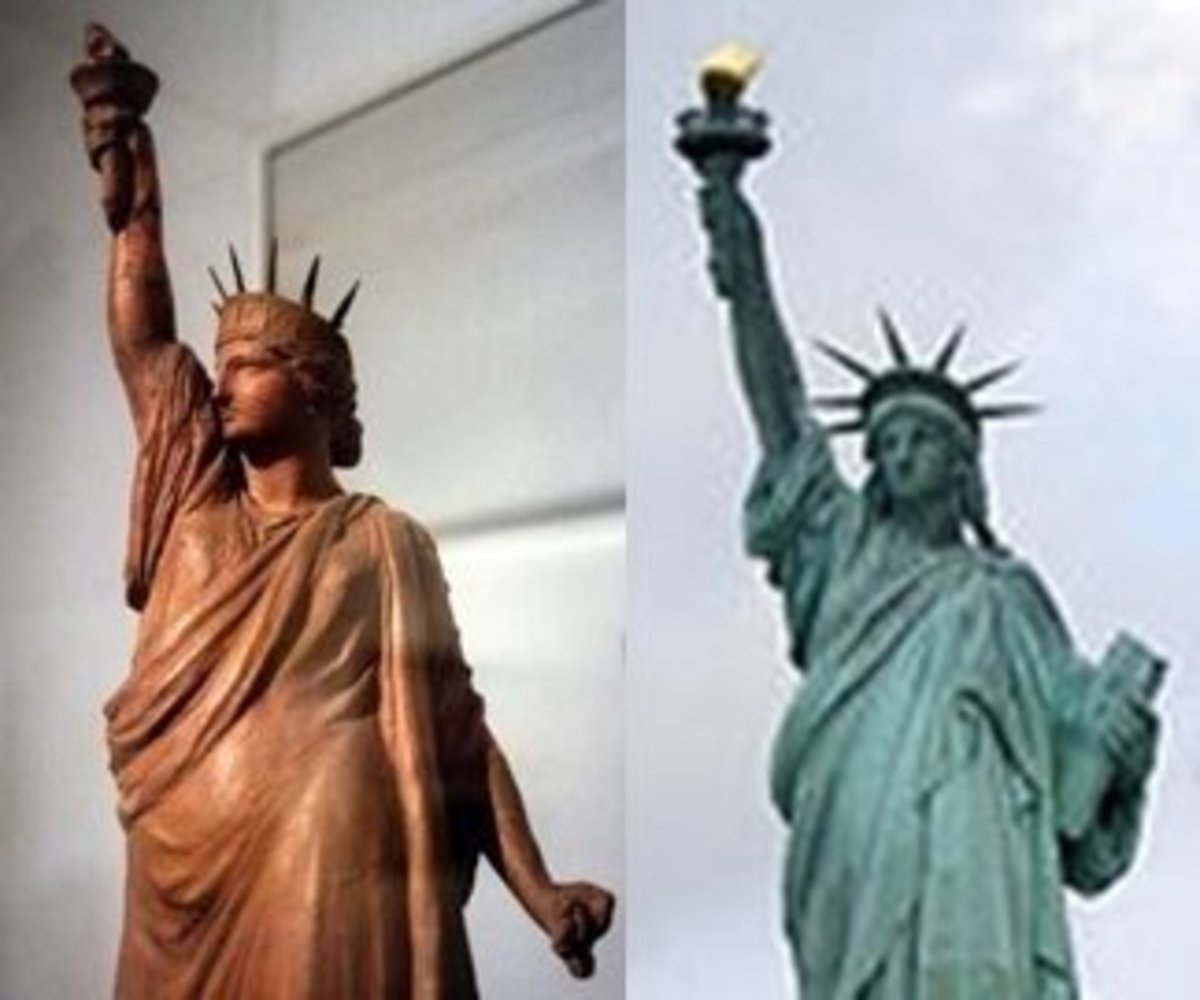
The statue on the left is a copy of an early version of the statue with chains in hand. The one on the right is the way she appears today. The Statue of Liberty that today sits on Liberty Island in New York harbor is known to have been the brainchild of noted Frenchmen and abolitionist Edouard de Laboulaye, a man so dedicated to the eradication of slavery that he co-founded the French Anti-Slavery Society. The idea for establishing a monument
specifically to honor the emancipation of slaves in America was
discussed between Laboulaye and Frederic Bartholdi, a French sculptor in 1865, the year the U.S. abolished slavery.

In addition to his abolition work, Laboulaye was also a U.S.
Constitution expert. Although we cannot know this for sure, one can only
imagine that the 1865 signing of the 13th amendment to the U.S.
Constitution would be very important to an abolitionist and likely
fueled Laboulaye’s desire to have the monument built. So, in 1865 he
shared this idea with Bartholdi, who later became the designer of the
statue, working closely with Laboulaye to make Laboulaye’s vision a
reality.

The connection between the Statue of Liberty and the abolition of
slavery is one that has been denied for 125 years. Almost from the start
of the project, the American financiers wanted no mention of slavery
and for 125 yrs they got their wish.

Although Laboulaye and Batholdi had envisioned a statue holding
broken chains and shackles (as shown in the image above on the left),
the early financiers that funded the project did not want chains on the
monument. It was the American backers who were most opposed to the
notion that the statue should in anyway acknowledge slavery. Because the
French, who were paying for the statue, were facing difficult economic
times, Laboulaye and Bartholdi relied on Americans to pay for and build
the pedestal where the statue would stand. This was an essential part of
the monument. Without American financial backing, the project could not
be completed, but the American financiers were adamant that Laboulaye
lose the chains and shackles. One can only surmise that some of the
backers may have made their fortunes directly or indirectly
through slavery.

In her book, Enlightening the World: The Creation of the Statue of Liberty,
Yasmin Sabina Kahn explained that although Laboulaye came upon the idea
and communicated it to Bartholdi in 1865, the political climate in
France at the time and a lack of funding made it impossible to raise
enough money to get the project off the ground for several years.
Indeed, it took the sculptor years to raise the funds. According to
Kahn, “Bartholdi’s original depiction of Lady Liberty had her holding
broken chains in her left hand, with more broken chains and broken
shackles at her feet. The chains were symbolic of the end of slavery in
the United States.”

Feet of the Statue of Liberty with chains
In lectures and on speaking tours, noted professor Dr. Joy DeGruy,
frequently talks about the chains that were part of the original
renderings of the Statue of Liberty. DeGruy explains that Bartholdi
intended the statue to represent democracy and to symbolize the end of
all types of oppression. However, according to DeGruy, the American
decision-makers of the day rebuffed Bartholdi for including the chains
and shackles and insisted that he remove them. Bartholdi was adamant
that they remain, although he eventually was forced to compromise
because he didn’t want to risk losing the financial support that was
making the project possible. Finally, he removed the chains from Lady
Liberty’s hand, replacing them with a book.

But, what most people don’t know, even today, is that Bartholdi left
the broken shackles and chains that were at her feet. These symbols of
state-sponsored bondage, human chattel and the hypocrisy of American
exceptionalism remain there on the Statue of Liberty as a permanent
reminder of the slaves that contributed to the building of the United
States.


Because the height of the pedestal built to support the statue makes
it impossible to see the chains and shackles from the ground, most
people visiting Liberty Island remain unaware of them. This is where the
U. S. Parks Service plays a pivotal role.

While it is not surprising that Sarah Palin got it wrong, it should be noted
that if asked, most of us would likely get it wrong too.


Clearly, the chains were obvious when the statue was delivered and installed 125 years ago but that knowledge quickly faded from memory. Aided by the fact that the height of the
pedestal made the chains and shackles impossible to see unless one were
viewing the statue from a helicopter, the wishes of the original funders
were fulfilled. No one need know the true meaning of the Statue of
Liberty. For most of the years since the statue’s installation at
Liberty Island, its true meaning has been kept in the dark. Even the
U.S. agency tasked with the responsibility of caring for and educating
the public about the statue had a hand in keeping the true meaning
hidden.

One contention of those in opposition to the idea that the statue
celebrated the end of slavery was the date the statue was proposed. Due
to lack of funding, more than 20 years passed between the time the
statue was first proposed in 1865 and the actual installation on Liberty
Island in 1886. Those who wanted to downplay the connection between the
statue and slavery insist that the year 1865 played no role in the idea
to build the monument.  In a report released by the U.S. Park Service
in 2000, the Park Service claimed that noted abolitionist Edouard de
Laboulaye did not propose the idea of constructing a monument in 1865.
Their report states:

sharon-kyle-moreThis story is a legend. All available evidence points to its conception in 1870 or 1871. The dinner party legend is traceable to a single source —
an 1885 fund-raising pamphlet written by the statue’s sculptor, Auguste
Bartholdi, after the death of Laboulaye.


But somewhere along the way, the U.S. Parks Service changed its position. They now admit that

  • the year 1865 was a key element of the story;
  • Laboulaye is the father of the idea for the monument; and
  • he was an abolitionist who wanted to honor the emancipation of the slaves.
Perhaps pressure was brought to bear on the agency forcing them to
change their literature and their website but today they devote pages to
the history of the statue and prominently state that the statue was a
gift to the United States from the people of France to celebrate “the
Union’s victory in the American Civil War and the abolition of slavery.”
You can find this and more at The National Parks Service website.

sharon kyleI started this piece with the video of Sarah Palin partly because any mention of Sarah somehow catches people’s attention but mostly because Sarah Palin’s understanding of the symbolism of the Statue of Liberty is probably not very different from most Americans. So while it is not surprising that Sarah Palin got it wrong, it should be noted that if
asked, most of us would likely get it wrong too.

As an American who is a decendent of slaves, I find it all the more shameful that this country continues to have countless monuments honoring men known to have been slaveholders but nothing honoring the millions whose blood, sweat and tears built this country. 

From that perspective, the story of the Statue of Liberty and how it came to be a part of our national landscape is as important as the story of Paul Revere’s Midnight Ride and should be as widely known. The National Park Service took an important step towards that end when it changed its position. And people like Dr. Joy DeGruy and others likely had a hand in making that happen.

To all who made that happen, I say thank you.

Sharon Kyle

Publisher, LA Progressive


(Dr. Joy DeGruy can be seen in the video below. She talks about the
statue at about 43 seconds into the video. She’s a great storyteller.
Watch it – you won’t be disappointed.)

https://youtu.be/gMYwsxVkc6s