Translate

Showing posts with label Presidential Election 2016. Show all posts

Saturday, February 11, 2017

Texas Democrats Demystify the Political Status Quo

Very interesting and important read.  Now this, is getting back to your roots.  It's reading history, one's history, and gleaning important lessons from it.
“It’s never going to be about what a small group of people said or do in a room," she said. "It’s about what the people of Texas tell us what they need. Many of us have committed to going out and having those conversations.”
I appreciate this long view of history.  It helps one to demystify what today might feel like an intractable set of circumstances while availing oneself of guideposts to a better future and to find direction in the people of Texas themselves.  Democracy at work.

I'm hopeful.  Very hopeful.

Angela Valenzuela
c/s


Texas Democrats begin to plot out strategy for 2018 midterms

A recent private meeting of some of the Democratic Party's most well-known Texas figures suggests party leaders see glimmers of hope for the midterm elections thanks to President Donald Trump.
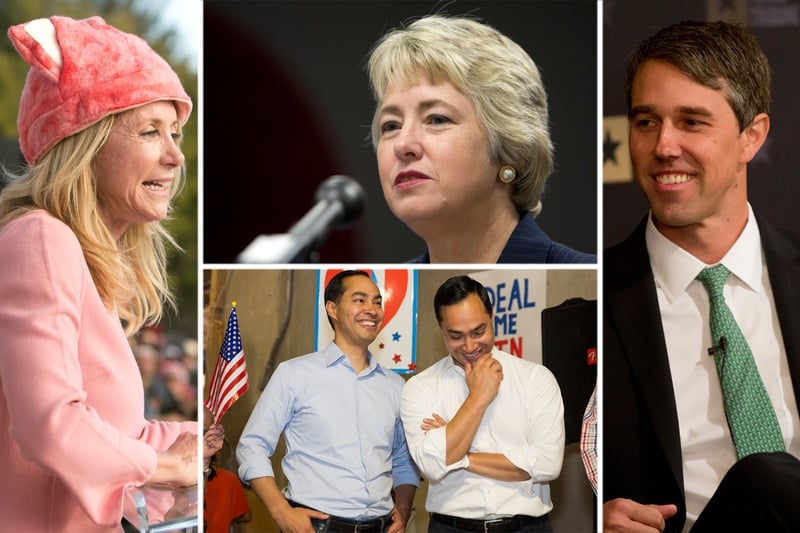
Clockwise from left: former state Sen. and gubernatorial candidate Wendy Davis, former Houston Mayor Annise Parker, U.S. Rep. Beto O'Rourke, D-El Paso, U.S. Rep. Joaquin Castro, D-San Antonio, (r.) and his twin brother, former Housing and Urban Development Secretary Julián Castro.
Clockwise from left: former state Sen. and gubernatorial candidate Wendy Davis, former Houston Mayor Annise Parker, U.S. Rep. Beto O'Rourke, D-El Paso, U.S. Rep. Joaquin Castro, D-San Antonio, (r.) and his twin brother, former Housing and Urban Development Secretary Julián Castro. All photos: Marjorie Kamys Cotera for The Texas Tribune
Correction appended.
In late January, a high-profile forum for candidates vying to be the next Democratic National Committee chair brought hordes of Democrats to Houston ready to plot the party’s national future. But for Texans in the party, the more consequential meeting may have occurred the day before in Austin.
A tight-knit group of Texas Democratic leaders traveled to the state capital that day to begin preliminary conversations about the 2018 midterm races.
According to over a dozen interviews with Texas Democratic insiders and national Democrats with ties to the state, the meeting included some of the party's most well-known figures from Texas including former Secretary of Housing and Urban Development Julián Castro, his twin brother, U.S. Rep. Joaquin Castro of San Antonio, Texas Democratic Party Finance Chairman Mike Collier, former state Sen. Wendy Davis, state Democratic Chairman Gilberto Hinojosa, U.S. Rep. Beto O'Rourke of El Paso, former Houston Mayor Annise Parker and state Reps. Rafael Anchia of Dallas and Chris Turner of Grand Prairie.
The Texas Tribune thanks its sponsors. Become one.
Their main agenda: mapping out a strategy for the 2018 midterm elections.
The expectations in the room were not soaring but were cautiously hopeful. That optimism was mostly rooted around one person: President Donald Trump. 
"I think 2018 will be the most favorable environment Texas Democrats have had in a midterm election in well over a decade," said Turner, who declined to comment on the meeting. "I think when you look at the actions of the Trump administration just three weeks in, you’re seeing a president with historically low approval ratings in what should be a honeymoon period, and no indication that’s going to change given his divisive actions."
Trump's presidency brings together a confluence of several factors that Democrats hope will get candidates over the line: a stronger-than-past Texas Democratic performance last November in urban centers, the traditional backlash against a sitting president in the midterms and an increasingly expected added drag that Trump will create for Republicans. 
The Democratic calculation is that in this unpredictable and angry climate, a full 2018 slate could produce a surprising win or two statewide or down-ballot. 
At the Jan. 27 gathering in Austin, attendees strategized how to make inroads in the state at any level, from municipal races up to the ultimate prize, taking down U.S. Sen. Ted Cruz, who will be up for re-election for the first time next year. 
The Texas Tribune thanks its sponsors. Become one.
That meeting roster largely reflects a new generation of Texas Democrats who only know life as part of a minority party that often functions as an afterthought in state politics. A Democrat has not won statewide office in Texas since 1994.
Despite attendees' omerta-esque unwillingness to comment on the meeting, what can be gleaned is that the powwow pulled together politicians from disparate regions who, in at least one case, only a few months ago had not even heard of some of the people in the room. 
Sources say no decisions were made on whom should run in which slot, nor was that widely discussed. Instead, the emphasis was on ensuring that state leaders would work together to present the strongest slate possible. 
And also unlike past cycles, the Democratic planning this term centers on the political climate, rather than on a singularly compelling personality running for governor. 
That the meeting happened at the outset of the state's legislative session was also no coincidence. Democrats sense an opportunity to win over some of the business community, particularly as the "bathroom bill" touted by Republican Lt. Gov. Dan Patrick continues to percolate at the state Capitol and as immigration, and particularly Trump's proposals for a border wall and Mexican tariffs, roil national politics. 
Parker did emphasize to the Tribune that the conversations about 2018 are happening throughout the state. 
“It’s never going to be about what a small group of people said or do in a room," she said. "It’s about what the people of Texas tell us what they need. Many of us have committed to going out and having those conversations.”
The nascent battle plan is to charge the hill.  

The assumption is that only a few candidates will break through and lay the foundation for the future. But candidates need to be in place to help the collective whole, the thinking goes. 
Some Democratic insiders pointed to the 1990 election, which, at first blush, was just another year of Texas Democrats continuing their ancestral dominance of the state's politics. 
But two relatively unknown GOP candidates, Rick Perry and Kay Bailey Hutchison, won lower-level statewide races: agriculture commissioner and treasurer, respectively. Those two Republicans helped usher in the full GOP sweep that was to come later in the decade. 
In that vein, the gubernatorial race is unlikely to take center stage.  
Since the Jan. 27 meeting, Julian Castro, the most-speculated Democratic contender to take on Gov. Greg Abbotthas made clear he is unlikely to run statewide in 2018. He all but closed the door on that possibility in an early morning tweet Thursday

Instead, the most frequently floated gubernatorial candidate is Collier, a 2014 state comptroller candidate. Collier is relatively unknown statewide but impressed several Democrats in that previous run. He has also been suggested as a possible contender to run for lieutenant governor.
It's the U.S. Senate race that is quickly becoming the center of the Democratic world, in part because of the incumbent, Cruz, and because of the two Democratic up-and-comers mulling runs: O'Rourke and Joaquin Castro. 
Both men are in the same 2012 congressional class and are considered friendly with each other. 
Democrats in the state and in Congress are closely watching how the two men maneuver around a possible primary race against each other, but the betting money is that O'Rourke is more likely to follow through with a run.
The possible independent candidacy of Texas-based political operative Matthew Dowd only increases the intrigue surrounding the Senate seat. 
Party insiders are also coveting two other statewide offices: attorney general and agriculture commissioner. The two Republican incumbents, Ken Paxton and Sid Miller, respectively, have faced a series of political struggles that could complicate their re-election campaigns. 
”I think you’ll see with a lot of the troubles that Ken Paxton and Sid Miller have found themselves in over the last couple years, I think you’re going to see considerable interest in those seats as well," Turner said. 
But no Democratic challengers emerged among these interviews. 
Todd Smith, Miller's political consultant, told the Tribune that the Miller campaign "had no concern about a Democratic opponent in the general election." 
"We feel very confident about where we are in a re-election planning and our position in strength in the race, and we welcome all comers: Republican, Democratic and independent, and we have a great story to tell and look forward to telling the people of Texas that story," Smith said. 
The House Democratic campaign arm recently announced it was eyeing three GOP-held congressional districts: U.S. Rep. John Culberson's 7th District, U.S. Rep. Will Hurd's 23rd District and U.S. Rep. Pete Sessions' 32nd District. Only the appearance of Hurd's district on the list was unexpected.
Democrats did not spend money in either Culberson's or Sessions' districts in recent cycles, but presidential nominee Hillary Clinton's performance there in 2016 encouraged the party to take a second look. Dallas school board member Miguel Solis recently told the Tribune he was considering a challenge to Sessions.
One prominent Texas Democrat who is not outwardly entertaining a 2018 run is Davis, as observers detect little interest from her. However, she is very much in the strategic mix, with sources saying she is positioning herself as a font of advice after her brutal 2014 gubernatorial run. 
To be sure, there is nothing new about this planning. 
Back in July, when most Democrats assumed Hillary Clinton would win the presidency, Texans at the Democratic National Convention in Philadelphia offhandedly floated the notion that a Trump presidency would present a morbid opportunity for Texas Democrats to do well amid a 2018 backlash. 
But now a Trump administration is a reality and thousands of Democrats are marching in the streets across the state. And more than once, in conversations with the Tribune, Democrats noted that the Trump-Clinton margin in Texas in November – 9 percentage points – was nearly as narrow as that of perennial battleground Ohio. 
And yet, there's a clear-eyed understanding of just how difficult any of this will be. 
Any Democratic candidate is likely to begin a statewide race with a double-digit deficit to a Republican incumbent. The Congressional and state legislative maps were drawn years ago stacked in favor of the GOP with few competitive seats. 
The way to narrow those gaps is typically to swamp voters with television advertising, which in Texas is prohibitively expensive. 
Fundraising remains a constant struggle for state Democrats, and there will be no shortage of Republican money. Abbott alone recently reported a $34.4 million war chest. And while Cruz had an unsteady landing after his presidential campaign, he was a money magnet as a candidate. 
And there is little optimism that the national Democratic campaign arms for gubernatorial and U.S. Senate races will be inclined to invest in the state. 
In effect, these Texas Democrats assume they are on their own.
Republican pollster Chris Perkins said there is some semblance of logic to the Democratic mindset but remains dubious that the opposition will make an effective case to voters. 
"I can see the Democrats' argument for optimism, based on national historical trends — but this is Texas," he said. "We're a conservative state and the Democrats' most recent rhetoric suggests that they will once again run hard to the left and alienate independent-leaning voters." 
Still, Parker, the former Houston mayor, told the Tribune she sees more value to this cycle than just wins and losses. 
"I'm really excited as I interact with Democrats around the state, how many young electeds are ready to move up in the leadership," she said. "There's a lot of young Turks out there who are planning their future." 
Read more: 
An earlier version of this story misidentified U.S. Rep. Pete Sessions' congressional district.

Friday, December 30, 2016

Holidays with a Storm on the Horizon by Dr. Roberto Cintli Rodriguez

I agree with U of Arizona Professor Roberto Cintli Rodriguez who lays out why this election and presidency are distinctive even relative toward others to which they can be reasonably compared, namely,  Richard Nixon, Ronald Reagan, CIA man George H.W. Bush, and later his son, George W. Bush.  Even as we face the storm, our great work continues regardless. Happy New Year, everybody!

-Angela

Rodriguez: Holidays with a Storm on the Horizon

We are in the midst of the holidays and I ask myself, what compels me to write when I should instead simply be enjoying the holidays?

The answer: because the proverbial calm before the storm is upon us and it seems a bit too eerie for me. This past week, I filled out that professor watchlist petition because the times remind me of that Tagalog expression, Isang Balsak — when one falls, we all fall, and conversely, when one rises, we all rise. There appears to be a consensus that the incoming administration will be anti-education in general, anti-academic freedom specifically, and even more so, that it will be hostile to undocumented students.
President-elect Donald Trump

In these past few days I have read and heard an inordinate amount of pleas to keep at least a few days free from politics, if not the entire holiday season. This is no different than every year, except this year feels different. They appear to be nervous pleas.

Without question, there is definitely something ominous in the air. When actor Ronald Reagan, and CIA man George H.W. Bush, were elected president, in 1980, 1984 and 1988, respectively, a similar feeling gripped the nation. The same goes for George W. Bush, in 2000, when half the country viewed his victory as part of a coup, and again in 2004 when his nightmarish ways of worldwide war continued. The same could be said before the days before Richard Nixon took office in 1968 and 1972.

The apprehension turned out to be justified as they all turned out to be warmongers in the tradition of U.S. imperialist leaders partaking in a modern version of manifest destiny, which has resulted in millions of casualties in Asia, Africa and the Americas. And yet there seems to be something radically different about this incoming president.

 So why is this president-in-waiting being perceived as even more dangerous? The short answer: he seems to be the embodiment of the Ugly American. He is nasty, rude and offensive, the antithesis of, as he invokes, “politically correct.” While the other presidents listed here have advanced similar policies, they have arguably been civil, whereas the incoming president is actually pompous about being the Ugly American. But it is beyond that.

Some of those policies include waging wars against weaker nations, never against nuclear-armed nations. And on the homefront, it includes carrying out the same anti-people of color, anti-worker, anti-woman, anti-LGBTQ, anti-science and anti-education policies that the incoming president has espoused.

That being the case, why is there more apprehension today? One could argue that the only difference perhaps is that these previous presidents have hidden their biases and bigotry and were predictable, whereas the incoming one flaunts them and also appears to be unpredictable, unstable and narcissistic.

It is uncontested that he lost by some 3 million votes, so it is not that the majority of Americans voters support him; it is that his supporters are easily moved and incited by his hate, rhetoric and beliefs. Just since the election alone, the Southern Poverty Law Center has documented more than 1,000 bias-related incidents. Feeling unconstrained, we are likely to see a rise in right-wing hate, violence and vigilantism.

At the same time, there may even be no need for vigilantes as the government itself and its official forces may be those that will enforce his proposed unconstitutional or amoral policies, particularly against those peoples he has already been belligerent with, including against his perceived enemies. Dissent and mass protests may perhaps no longer be tolerated.


Again, those presidents mentioned above did as much, thus, why the extra apprehension?
Perhaps that is the point. Still fresh on many peoples’ minds are the illegal wars, invasions and military coups this country has carried out and supported, just since Vietnam. Still fresh on peoples’ minds are the wars at home that targeted activists of color and the progressive movement. And still fresh on peoples’ minds is the War on Drugs that has resulted in the tenfold increase in the U.S. penal system since 1970, an institution that has become virtually a warehouse for people of color.

Perhaps that is the reason for the trepidation. There has been a general perception that, as a nation, we were moving in a positive direction in which there would be less war, more human rights, less brutality, and less incarceration. With the incoming president, it appears that instead there will be a radical acceleration. Perhaps people should be celebrating during this holiday season, though truly, people should also be preparing for what is to come, as opposed to simply withdrawing.

On Inauguration Day, on colleges and universities across the nation, there will be walkouts, cancelled classes, teach-ins, rallies, and marches. The question is, what will be the “new normal” thereafter?

Dr. Roberto Rodriguez is an associate professor in Mexican American Studies at the University of Arizona.

Wednesday, December 21, 2016

Sorry, sexists. The genie's out of the bottle and your own families are the better for it.

For his ultimate victory, it wasn't the case that Trump tapped into a benign, chivalrous kind of sexism that may be characterized as in the realm of "traditional values" with respect to women's roles in society, rather according to research cited below, "[he's] getting support from people who are hostile toward women’s economic and legal equality and who think feminism is making America worse."

Though the pertinent research referenced below doesn't break this down, this obviously also captures the sentiments of some women themselves who have patriarchal views.  What's interesting is that we in the U.S. are often quick to thumb our noses in arrogance against other, frequently Islamist, countries for their systems of government and society where men hold the social, economic, political, and cultural power from which women are largely excluded, yet fail to see this happening within the context of our own country and society.

Clearly, men's loss of centrality is what is at stake here.  While we clearly need a revived women's movement that keeps pushing forward for women's rights and equity-based policies and practices, the election itself is in part a reaction against what I think to be an inexorable progression of women's call for equality in U.S. society. 

Sorry, sexists.  The genie's out of the bottle and your own families are the better for it.

Angela Valenzuela
c/s

Hostility toward women is one of the strongest predictors of Trump support

Updated by

Since the start of the Republican primaries, hundreds of thousands of words and hours of television airtime have been devoted to one question: What do Donald Trump’s supporters want? The 42 percent of Americans supporting Trump have been studied and caricatured and psychoanalyzed.
Explanations abound: They’re stricken with economic anxiety. They’re anxious about their social status. They feel left behind by the federal government. They’re authoritarians who want a forceful leader. They’re racists who oppose the changing demographics and norms of the US.
But there’s another important factor that these analyses have largely left out: sexism. Three political scientists who studied the connection between sexism, emotions, and support for Trump found that the more hostile voters were toward women, the more likely they were to support Trump.
Researchers Carly Wayne, Nicholas Valentino and Marzia Oceno, who wrote about their work for the Washington Post’s Monkey Cage, conducted their research before the revelation of the secret recording that captured Trump bragging about kissing and groping women without their permission, and before more than a dozen women came forward to accuse Trump of sexual assault in the aftermath of its release.
While it might not seem surprising now that Trump has galvanized sexists, their findings suggest that sexism played a much bigger role in his rise than most people realized or wanted to imagine.

How “hostile sexism” predicts support for Trump

Sexism has largely been overlooked as a major factor in voters’ decisions to support Donald Trump. That would be understandable if it were simply one factor among many — one prejudice among the many that Hillary Clinton called the “basket of deplorables … racist, sexist, homophobic, xenophobic, Islamophobic, you name it.”
But Wayne, Valentino, and Oceno’s research, conducted in June, found hostility toward women was a major factor, predicting support for Trump more strongly than authoritarian attitudes and about as well as racial prejudice. The political scientists used a four-question survey to determine sexist attitudes, asking if people agreed with the following statements:
  1. Most women interpret innocent remarks or acts as being sexist.
  2. Many women are actually seeking special favors, such as hiring policies that favor women over men, under the guise of asking for equality.
  3. Feminists are not actually seeking for women to have more power than men.
  4. Feminists are making entirely reasonable demands of men.
The survey also asked how strongly respondents supported Clinton or Trump. The higher they were on the sexism scale, the more likely they were to support Trump and the less likely they were to support Clinton. Hostile sexism was nearly as good at predicting support for Trump as party identification was.
Sexism — and particularly anti-feminism — isn’t politically neutral. Many conservative women have come forward to say they’re horrified by Donald Trump, but sexism has been correlated with support for other Republican candidates as well. In studies of voters in 2008 and 2012, traditional beliefs about gender and hostility toward feminism were also linked to much lower support for Hillary Clinton.
“It’s the kind of sorting that people do to go into one party or the other,” said Wayne, a PhD candidate in political science at the University of Michigan. Republicans “tend to have attitudes that are more traditionalist, more old-fashioned, less likely to want the kinds of changes that feminism, for example, is pushing.”
Wayne said she couldn’t compare how sexist attitudes nationally had correlated with support for Republicans in previous elections, so she couldn’t say if Trump made the situation better or worse. But Brian Schaffner, a political scientist at the University of Massachusetts Amherst, used the same survey as part of a poll in New Hampshire, and found that sexism was a much bigger factor in the 2016 election than it was in 2012:
Clinton’s candidacy is another piece of important context — it’s possible that strong support for Trump among sexists is in part a reaction to the first woman who could plausibly be elected president — but Schaffner’s findings back up the idea that Trump’s core supporters are unusually hostile toward women and feminism.

Trump isn’t just tapping into “traditional values”

Trump’s support among sexists doesn’t seem to be a function of the traditional, old-fashioned “family values” usually associated with the Republican Party.
In a survey in August, Wayne and her co-authors measured the impact of a different kind of “old-fashioned” view about women’s roles: the belief that women are different from men because they’re physically weaker and more morally pure. They asked survey respondents if they agreed with the following statements:
  1. In a disaster, women should be rescued before men.
  2. Women have a quality of purity that few men possess.
  3. Men should be willing to sacrifice their own well-being in order to provide for the women in their lives.
  4. Every man ought to have a woman whom he adores.
The questions measure “benevolent sexism” — a traditional, chivalrous view of men and women’s proper roles. Benevolent sexism can still undermine women’s equality because it paints women as weaker and more in need of male protection. Unlike its more hostile counterpart, though, benevolent sexism didn’t correlate much at all with support for Trump, at least before the leaked Access Hollywood tape. (Unlike the study on hostile sexism, the researchers didn’t use a representative national sample but rather an online survey. But the results were weighted for partisan identity, and Wayne says it was a high-quality sample.)
“The hostile sexism is highly correlated, but the benevolent sexism really is not,” Wayne said. “I found this result particularly interesting in the aftermath of some of the fallout from Trump’s tape. … There were a lot of Republicans saying they were against Trump’s statements because of their daughters and wives.”
Trump, in other words, isn’t just drawing from a base of people who have traditional views about women’s roles. He’s getting support from people who are hostile toward women’s economic and legal equality and who think feminism is making America worse.

Trump’s sexism was hidden in plain sight

It shouldn’t be surprising that Trump is the candidate of choice for people who believe that allegations of sexism are mostly made up and that feminism is really a ploy to get men on the losing side of a zero-sum status competition between the sexes. Trump’s misogyny has been a core part of his public persona for a long time.
Long before many of the sexual assault allegations emerged, Trump made clear, in public and private, that women matter to him not as people but as sex objects. Even with women whom he supposedly likes and admires, he’s made clear that he values their looks above all else. He turned his attitudes into discriminatory policies in his offices, at his resorts, and on his TV show, harassing women he found attractive and urging his employees to fire those he did not.
The fact that Trump was virulently sexist used to be widely recognized. "His brand of self-aggrandizing, bewigged machismo was kind of de rigeur in the 80's and charmingly old-timey in the 90's, but now it's just passé and exhausting and increasingly offensive," Richard Lawson wrote in a post headlined "Donald Trump: A Sexist Dinosaur" for Gawker in 2008. "And he never stops!"
In the vast American soul-searching over why people might want to vote for Trump, sexism has gotten short shrift. That might be because Trump’s blatantly sexist remarks were generally not a part of his political campaign or preferred policies, unlike his hostility toward immigrants and Muslims and his constant reiteration that African Americans live in a wasteland of crime and violence.
But even if his misogyny was more muted in the early days of the campaign, it appears to have found a receptive audience.
Since the start of the Republican primaries, hundreds of thousands of words and hours of television airtime have been devoted to one question: What do Donald Trump’s supporters want? The 42 percent of Americans supporting Trump have been studied and caricatured and psychoanalyzed.
Explanations abound: They’re stricken with economic anxiety. They’re anxious about their social status. They feel left behind by the federal government. They’re authoritarians who want a forceful leader. They’re racists who oppose the changing demographics and norms of the US.
But there’s another important factor that these analyses have largely left out: sexism. Three political scientists who studied the connection between sexism, emotions, and support for Trump found that the more hostile voters were toward women, the more likely they were to support Trump.
Researchers Carly Wayne, Nicholas Valentino and Marzia Oceno, who wrote about their work for the Washington Post’s Monkey Cage, conducted their research before the revelation of the secret recording that captured Trump bragging about kissing and groping women without their permission, and before more than a dozen women came forward to accuse Trump of sexual assault in the aftermath of its release.
While it might not seem surprising now that Trump has galvanized sexists, their findings suggest that sexism played a much bigger role in his rise than most people realized or wanted to imagine.

How “hostile sexism” predicts support for Trump

Sexism has largely been overlooked as a major factor in voters’ decisions to support Donald Trump. That would be understandable if it were simply one factor among many — one prejudice among the many that Hillary Clinton called the “basket of deplorables … racist, sexist, homophobic, xenophobic, Islamophobic, you name it.”
But Wayne, Valentino, and Oceno’s research, conducted in June, found hostility toward women was a major factor, predicting support for Trump more strongly than authoritarian attitudes and about as well as racial prejudice. The political scientists used a four-question survey to determine sexist attitudes, asking if people agreed with the following statements:
  1. Most women interpret innocent remarks or acts as being sexist.
  2. Many women are actually seeking special favors, such as hiring policies that favor women over men, under the guise of asking for equality.
  3. Feminists are not actually seeking for women to have more power than men.
  4. Feminists are making entirely reasonable demands of men.
The survey also asked how strongly respondents supported Clinton or Trump. The higher they were on the sexism scale, the more likely they were to support Trump and the less likely they were to support Clinton. Hostile sexism was nearly as good at predicting support for Trump as party identification was.
Sexism — and particularly anti-feminism — isn’t politically neutral. Many conservative women have come forward to say they’re horrified by Donald Trump, but sexism has been correlated with support for other Republican candidates as well. In studies of voters in 2008 and 2012, traditional beliefs about gender and hostility toward feminism were also linked to much lower support for Hillary Clinton.
“It’s the kind of sorting that people do to go into one party or the other,” said Wayne, a PhD candidate in political science at the University of Michigan. Republicans “tend to have attitudes that are more traditionalist, more old-fashioned, less likely to want the kinds of changes that feminism, for example, is pushing.”
Wayne said she couldn’t compare how sexist attitudes nationally had correlated with support for Republicans in previous elections, so she couldn’t say if Trump made the situation better or worse. But Brian Schaffner, a political scientist at the University of Massachusetts Amherst, used the same survey as part of a poll in New Hampshire, and found that sexism was a much bigger factor in the 2016 election than it was in 2012:
Clinton’s candidacy is another piece of important context — it’s possible that strong support for Trump among sexists is in part a reaction to the first woman who could plausibly be elected president — but Schaffner’s findings back up the idea that Trump’s core supporters are unusually hostile toward women and feminism.

Trump isn’t just tapping into “traditional values”

Trump’s support among sexists doesn’t seem to be a function of the traditional, old-fashioned “family values” usually associated with the Republican Party.
In a survey in August, Wayne and her co-authors measured the impact of a different kind of “old-fashioned” view about women’s roles: the belief that women are different from men because they’re physically weaker and more morally pure. They asked survey respondents if they agreed with the following statements:
  1. In a disaster, women should be rescued before men.
  2. Women have a quality of purity that few men possess.
  3. Men should be willing to sacrifice their own well-being in order to provide for the women in their lives.
  4. Every man ought to have a woman whom he adores.
The questions measure “benevolent sexism” — a traditional, chivalrous view of men and women’s proper roles. Benevolent sexism can still undermine women’s equality because it paints women as weaker and more in need of male protection. Unlike its more hostile counterpart, though, benevolent sexism didn’t correlate much at all with support for Trump, at least before the leaked Access Hollywood tape. (Unlike the study on hostile sexism, the researchers didn’t use a representative national sample but rather an online survey. But the results were weighted for partisan identity, and Wayne says it was a high-quality sample.)
“The hostile sexism is highly correlated, but the benevolent sexism really is not,” Wayne said. “I found this result particularly interesting in the aftermath of some of the fallout from Trump’s tape. … There were a lot of Republicans saying they were against Trump’s statements because of their daughters and wives.”
Trump, in other words, isn’t just drawing from a base of people who have traditional views about women’s roles. He’s getting support from people who are hostile toward women’s economic and legal equality and who think feminism is making America worse.

Trump’s sexism was hidden in plain sight

It shouldn’t be surprising that Trump is the candidate of choice for people who believe that allegations of sexism are mostly made up and that feminism is really a ploy to get men on the losing side of a zero-sum status competition between the sexes. Trump’s misogyny has been a core part of his public persona for a long time.
Long before many of the sexual assault allegations emerged, Trump made clear, in public and private, that women matter to him not as people but as sex objects. Even with women whom he supposedly likes and admires, he’s made clear that he values their looks above all else. He turned his attitudes into discriminatory policies in his offices, at his resorts, and on his TV show, harassing women he found attractive and urging his employees to fire those he did not.
The fact that Trump was virulently sexist used to be widely recognized. "His brand of self-aggrandizing, bewigged machismo was kind of de rigeur in the 80's and charmingly old-timey in the 90's, but now it's just passé and exhausting and increasingly offensive," Richard Lawson wrote in a post headlined "Donald Trump: A Sexist Dinosaur" for Gawker in 2008. "And he never stops!"
In the vast American soul-searching over why people might want to vote for Trump, sexism has gotten short shrift. That might be because Trump’s blatantly sexist remarks were generally not a part of his political campaign or preferred policies, unlike his hostility toward immigrants and Muslims and his constant reiteration that African Americans live in a wasteland of crime and violence.
But even if his misogyny was more muted in the early days of the campaign, it appears to have found a receptive audience.

Monday, November 28, 2016

Rodriguez: Nation Not Treading Lightly in Unchartered Territory

Roberto Cintli Rodriguez​, publishing in Diverse Issues in Higher Education, among other things that seem and feel perilous, notes that Kris Kobach, who will likely be a member of Donald Trump’s cabinet, is also the architect of Arizona’s racist, anti-immigrant, and discredited,  SB 1070 legislation that racially profiled Latin@s, as well as the National Security exit-entry registration system (NSEERS), 

“which during the President George W. Bush Administration, was used to track Arabs and Muslims in this country, yet resulted in zero terrorism convictions.”  

Albeit imperfect, this is not the multiracial, multinational democracy into which I was born, but rather the opposite, namely, one that is extremist, right wing, xenophobic, and fascist. 
 

We must all keep up the pressure as yes, we are absolutely on “unchartered territory.”

Angela Valenzuela 
c/s

Rodriguez: Nation Not Treading Lightly in Unchartered Territory

by Roberto Rodriguez/ Diverse Issues in Higher Education
Without question, this country is in unchartered territory. People across the country continue to express themselves in despair. Others in fear. Some panic, while still others prepare. Of course, many have staged numerous protests from coast to coast.

Election Protests WashingtonIn response to the aftermath of the elections, some 150 college and university presidents have banded together to express their concern regarding the rise in hate crimes across the country. The unexpected presidential results have emboldened racial supremacists and misogynists across the country, including on the campuses of colleges and universities nationwide.

At the same time, professors from coast to coast are also speaking out, including via the American Association of University Professors (AAUP), who have denounced the racial incidents and hate crimes which are happening not just at colleges and universities, but also at K-12 schools. They have also come out in support of the idea of sanctuary campuses for undocumented students.

While a colleague, Angela Valenzuela at the University of Texas at Austin, speaks of watching a documentary on the rise of Hitler and its striking similarities with today’s political situation, hundreds of Jewish scholars of Holocaust history call on Americans to mobilize in global solidarity against the president-elect.

This also includes a call by some 200 national human rights organizations that are calling upon President Obama to dismantle whatever is left of the National Security exit-entry registration system (NSEERS), which during the President George W. Bush Administration, was used to track Arabs and Muslims in this country, yet resulted in zero terrorism convictions. The denunciation of this program  has also come from the Council on Arab Islamic Relations (CAIR). The architect of NSEERS, Kris Kobach, appears to also be on track to have a prominent role in the president-elect’s cabinet. He purportedly is proposing something similar, though not limited to Arabs or Muslims, thus prompting that joint call. Kobach, not coincidentally, was the architect of Arizona’s anti-immigrant SB 1070 legislation, a state measure that was copied by many states across the country.

This is but two weeks after the elections and yet all the signs are ominous, beginning with the selection of Steve Bannon, a racial extremist who previously led Breitbart News, as chief strategist and senior counselor to the president-elect. As he continues to choose the rest of his cabinet, all the signs point towards extreme right-wing consolidation, including the likes of Maricopa County Sheriff Joe Arpaio and ex-Arizona governor, Jan Brewer.

All this has been taking place while the inhumane, brutal and unprecedented assaults against the water protectors at Standing Rock continue to shock the world’s conscience. Despite the president ordering the halting of the construction of the Dakota Access Pipeline, which is slated to traverse through four states, he has done little in the past several months to both stop its building, nor has he stopped the violence against the water protectors. And prospects do not look good regarding this issue, as the president-elect is a strong supporter of oil drilling and energy deregulation.

Amid this chaos, those from communities most at risk, the undocumented, including DREAMERS, continue to prepare for the worst, yet their leadership remains undaunted. In fact they continue unafraid. This includes a Caravan of Courage and march from New York to Washington DC (Nov 22-24), led by the national Dream Action Coalition. Throughout the country, walkouts, in support of K-12 DREAMERS have also taken place, especially in cities such as Los Angeles.

Come Inauguration Day, January 20, 2017, when we can expect not simply massive protests in Washington, D.C., but nationwide, also to be expected will be more student walkouts at colleges and universities and K-12 schools throughout the country. The question of course will be, what will happen the next day? Actually, a nationwide protest by women will also converge on the capitol on Jan 21.

Without question January 20-21 will most likely amount to an unprecedented national general strike. But again, what will happen the following day? Not being a soothsayer, it is not certain anyone can predict what happens thereafter. However, what can be predicted is that some sectors of society will withhold recognition of the incoming administration.

Many will express the sentiment that if the administration treats certain sectors of society as less than human, then this administration will forever be seen as immoral and illegitimate. It appears that the only certainty that we can count on is uncertainty, and that is not necessarily in regards to the incoming administration because the president-elect appears to be doing precisely what he promised. The uncertainty is how those that have been targeted will continue to react.

Not to be forgotten is that the president’s challenger has reportedly won the popular vote by 1.7 million thus far and the gap may reach 2 million.

Governance in this environment is again, uncharted territory.

Dr. Roberto Rodriguez is an associate professor in Mexican American Studies at the University of Arizona.

Tuesday, November 22, 2016

The Election was Stolen – Here’s How… by Greg Palast

My sources are telling me that the election was indeed stolen, but not by the Russians and that that's a distraction and that you can read for yourselves about it here in this piece by investigative reporter, Greg Palast.

Good enough.  It speaks to what he not only found, but had said months earlier was happening even before the election occurred.  Essentially, it involved voter suppression through what came to be called the “Crosscheck" that purged minority voters with similar names from the polls, regardless of middle names, addresses, and social security numbers and shunting them to provisional ballots that didn't get counted.  Quote from within:
This country is violently divided, but in the end, there simply aren’t enough white guys to elect Trump nor a Republican Senate.  The only way they could win was to eliminate the votes of non-white guys—and they did so by tossing Black provisional ballots into the dumpster, ID laws that turn away students—the list goes on.  It’s a web of complex obstacles to voting by citizens of color topped by that lying spider, Crosscheck.

Glad to see that Palast's investigative reporting has brought this to light.  Here is a link to his movie titled, The Best Democracy Money Can Buy. Donate to the Palast Investigative Fund and get the signed DVD.

This is a sad day for our fragile democracy.

Angela Valenzuela
c/s

 
The Election was Stolen – Here’s How…

by Greg Palast,  author of The New York Times bestsellers, The Best Democracy Money Can Buy and Billionaires & Ballot Bandits,
 
Friday, November 11, 2016 
 
Before a single vote was cast, the election was fixed by GOP and Trump operatives.
Starting in 2013 – just as the Supreme Court gutted the Voting Rights Act – a coterie of Trump operatives, under the direction of Kris Kobach, Kansas Secretary of State, created a system to purge 1.1 million Americans of color from the voter rolls of GOP–controlled states.
The system, called Crosscheck, is detailed in my Rolling Stone report,
The GOP’s Stealth War on Voters,” 8/24/2016.
Crosscheck in action:  
Trump victory margin in Michigan:                    13,107
Michigan Crosscheck purge list:                       449,922
Trump victory margin in Arizona:                       85,257
Arizona Crosscheck purge list:                           270,824
Trump victory margin in North Carolina:        177,008
North Carolina Crosscheck purge list:              589,393
On Tuesday, we saw Crosscheck elect a Republican Senate and as President, Donald Trump.  The electoral putsch was aided by nine other methods of attacking the right to vote of Black, Latino and Asian-American voters, methods detailed in my book and film, including “Caging,” “purging,” blocking legitimate registrations, and wrongly shunting millions to “provisional” ballots that will never be counted.
Trump signaled the use of “Crosscheck” when he claimed the election is “rigged” because “people are voting many, many times.”  His operative Kobach, who also advised Trump on building a wall on the southern border, devised a list of 7.2 million “potential” double voters—1.1 million of which were removed from the voter rolls by Tuesday. The list is loaded overwhelmingly with voters of color and the poor. Here's a sample of the list

Those accused of criminal double voting include, for example, Donald Alexander Webster Jr. of Ohio who is accused of voting a second time in Virginia as Donald EUGENE Webster SR.

Note: Watch the four-minute video summary of Crosscheck. The investigation and explanation of these methods of fixing the vote can be found in my book and film, The Best Democracy Money Can Buy: a Tale of Billionaires & Ballot Bandits (2016).

No, not everyone on the list loses their vote.  But this was not the only racially poisonous tactic that accounted for this purloined victory by Trump and GOP candidates.
For example, in the swing state of North Carolina, it was reported that 6,700 Black folk lost their registrations because their registrations had been challenged by a group called Voter Integrity Project (VIP). VIP sent letters to households in Black communities “do not forward.”  If the voter had moved within the same building, or somehow did not get their mail (e.g. if their name was not on a mail box), they were challenged as “ghost” voters.  GOP voting officials happily complied with VIP with instant cancellation of registrations.
The 6,700 identified in two counties were returned to the rolls through a lawsuit.  However, there was not one mention in the press that VIP was also behind Crosscheck in North Carolina; nor that its leader, Col. Jay Delancy, whom I’ve tracked for years has previously used this vote thievery, known as “caging,” for years.  Doubtless the caging game was wider and deeper than reported.  And by the way, caging, as my Rolling Stone co-author, attorney Robert F. Kennedy Jr., tells me, is “a felony, it’s illegal, and punishable by high fines and even jail time.”
There is still much investigation to do.  For example, there are millions of “provisional” ballots, “spoiled” (invalidated) ballots and ballots rejected from the approximately 30 million mailed in.  Unlike reporting in Britain, US media does not report the ballots that are rejected and tossed out—because, after all, as Joe Biden says, “Our elections are the envy of the world.”  Only in Kazakhstan, Joe.
While there is a great deal of work to do, much documentation still to analyze, we’ll have to pry it from partisan voting chiefs who stamp the scrub lists, Crosscheck lists and ballot records, “confidential.”
But, the evidence already in our hands makes me sadly confident in saying, Jim Crow, not the voters, elected Mr. Trump.
What about those exit polls?
Exit polls are the standard by which the US State Department measures the honesty of foreign elections.  Exit polling is, historically, deadly accurate. The bane of pre-election polling is that pollsters must adjust for the likelihood of a person voting.  Exit polls solve the problem.
But three times in US history, pollsters have had to publicly flagellate themselves for their “errors.”  In 2000, exit polls gave Al Gore the win in Florida; in 2004, exit polls gave Kerry the win in Ohio, and now, in swing states, exit polls gave the presidency to Hillary Clinton.
So how could these multi-million-dollar Ph.d-directed statisticians with decades of experience get exit polls so wrong?
Answer:  they didn’t.  The polls in Florida in 2000 were accurate.  That’s because exit pollsters can only ask, “How did you vote?”  What they don’t ask, and can’t, is, “Was your vote counted.”
In 2000, in Florida, GOP Secretary of State Katherine Harris officially rejected 181,173 ballots, as “spoiled” because their chads were hung and other nonsense excuses.  Those ballots overwhelmingly were marked for Al Gore.  The exit polls included those 181,173 people who thought they had voted – but their vote didn’t count.  In other words, the exit polls accurately reflected whom the voters chose, not what Katherine Harris chose.
In 2004, a similar number of votes were invalidated (including an enormous pile of “provisional” ballots) by Ohio’s GOP Secretary of State Kenneth Blackwell.  Again, the polls reflected that Kerry was the choice of 51% of the voters.  But the exit polls were “wrong” because they didn’t reflect the ballots invalidated by Blackwell.
Notably, two weeks after the 2004 US election, the US State Department refused the recognize the Ukraine election results because the official polls contradicted the exit polls.
And here we go again. 2016: Hillary wins among those queried as they exit the polling station—yet Trump is declared winner in GOP-controlled swings states. And, once again, the expert pollsters are forced to apologize—when they should be screaming, “Fraud!  Here’s the evidence the vote was fixed!”
Now there’s a new trope to explain away the exit polls that gave Clinton the win.  Supposedly, Trump voters were ashamed to say they voted for Trump.  Really?  ON WHAT PLANET?  For Democracy Now! and Rolling Stone I was out in several swing states.  In Ohio, yes, a Black voter may have been reluctant to state support for Trump. But a white voter in the exurbs of Dayton, where the Trump signs grew on lawns like weeds, and the pews of the evangelical mega churches were slathered with Trump and GOP brochures, risked getting spat on if they even whispered, “Hillary.”
This country is violently divided, but in the end, there simply aren’t enough white guys to elect Trump nor a Republican Senate.  The only way they could win was to eliminate the votes of non-white guys—and they did so by tossing Black provisional ballots into the dumpster, ID laws that turn away students—the list goes on.  It’s a web of complex obstacles to voting by citizens of color topped by that lying spider, Crosscheck.
*****
Rent it or buy Greg Palast's movie from Amazon or Vimeo.
Greg Palast (Rolling Stone, Guardian, BBC) is the author of The New York Times bestsellers, The Best Democracy Money Can Buy and Billionaires & Ballot Bandits, now out as major motion non-fiction movie.
Donate to the Palast Investigative Fund and get the signed DVD.
Download the FREE Movie Comic Book.
Rent or buy the film from Amazon or Vimeo.
Visit the Palast Investigative Fund store or simply make a tax-deductible contribution to keep our work alive! 
Or support the The Palast Investigative Fund (a project of The Sustainable Markets Foundation) by shopping with Amazon Smile. AmazonSmile will donate 0.5% of your purchases to the Palast Fund and you get a tax-deduction! More info.
GregPalast.com

Sunday, November 20, 2016

The NSA Chief Says Russia Hacked the 2016 Election. Congress Must Investigate

Important read.  I think that we should all join Sen. Lindsey Graham (R-S.C.) and reach out to our leadership and call for an "a full-fledged congressional investigation that holds public hearings and releases its findings to the citizenry."
In his recent book, The Plot to Hack America [6], national security expert Malcolm Nance wrote, "Russia has perfected political warfare by using cyber assets to personally attack and neutralize political opponents…At some point Russia apparently decided to apply these tactics against the United States and so American democracy itself was hacked."

Angela Valenzuela
c/s


It's up to Capitol Hill to protect American democracy.


Links:
[1] https://twitter.com/i/web/status/798647324687929344
[2] https://www.washingtonpost.com/world/national-security/fbi-is-investigating-foreign-hacks-of-state-election-systems/2016/08/29/6e758ff4-6e00-11e6-8365-b19e428a975e_story.html
[3] https://www.washingtonpost.com/world/moscow-had-contacts-with-trump-team-during-campaign-russian-diplomat-says/2016/11/10/28fb82fa-a73d-11e6-9bd6-184ab22d218e_story.html
[4] http://www.motherjones.com/politics/2016/10/veteran-spy-gave-fbi-info-alleging-russian-operation-cultivate-donald-trump
[5] http://www.motherjones.com/politics/2016/11/dnc-told-fbi-it-may-have-been-bugged
[6] https://www.amazon.com/Plot-Hack-America-Cyberspies-WikiLeaks/dp/1510723323
[7] http://www.nbcnews.com/politics/2016-election/top-democrats-call-fbi-investigate-trump-ties-russia-over-hacking-n666696
[8] http://www.salon.com/2016/10/31/harry-reid-calls-on-james-comey-to-investigate-explosive-information-about-donald-trumps-ties-to-russia/
[9] https://www.yahoo.com/news/u-s-intel-officials-probe-ties-between-trump-adviser-and-kremlin-175046002.html
[10] http://www.nbcnews.com/news/us-news/fbi-making-inquiry-ex-trump-campaign-manager-s-foreign-ties-n675881
[11] http://www.latimes.com/nation/politics/trailguide/la-na-trailguide-updates-gop-sen-lindsey-graham-wants-congress-1479254194-htmlstory.html