Translate

Showing posts with label sexism. Show all posts

Monday, January 01, 2018

2017 Was the Year I Learned About My White Privilege, by Max Boot

These kinds of testimonies are always helpful since the truth of privilege for the privileged is often more easily heard from a peer, if you will. I discovered this piece titled, "2017 Was the Year I Learned About My White Privilege" from Kenneth Bernstein's blog (aka teacherken).  
It is very encouraging to read this piece in the new year as it may signify a social awakening of a kind and to a degree. Indeed, recently, Christian Bale made just such a statement:  "We’d Be Better Off If ‘White Dudes’ Weren’t Running Everything.
Hopefully, this awareness spreads to all corners of our society and the world.  After all, it's a global issue and not just a North American one.
Angela Valenzuela
c/s

A terrific piece about white male privilege
written by Max Boot and appearing yesterday in Foreign Policy.  It is titled 2017 Was the Year I Learned About My White Privilege and has the subtitle “I used to be a smart-alecky conservative who scoffed at “political correctness.” The Trump era has opened my eyes.”

Boot is an immigrant of Jewish background from Russia, or to be more accurate, from what was then the Soviet Union. He was born in Moscow in 1969, and has been an adviser on foreign policy and similar topics to the likes of John McCain, Mitt Romney, and Marco Rubio.  Unlike a lot of those on the Conservative side of our politics, he holds a number of views that might make him comfortable on the liberal side — pro-gay rights, pro-environment, pro-abortion and pro-immigration.   He is fiscally conservative and very much for an active role for the US militarily around the world.

He has been a significant voice as an author and adviser, and has increasingly appeared on MS-NBC as one of the more notable Never Trump conservative voices.

The new Foreign Policy piece is quite open in acknowledging things to which he has previously been oblivious, on matters of race and of gender.
As he write:
A quarter century is enough time to examine deeply held shibboleths and to see if they comport with reality. In my case, I have concluded that my beliefs were based more on faith than on a critical examination of the evidence. In the last few years, in particular, it has become impossible for me to deny the reality of discrimination, harassment, even violence that people of color and women continue to experience in modern-day America from a power structure that remains for the most part in the hands of straight, white males. People like me, in other words. Whether I realize it or not, I have benefitted from my skin color and my gender — and those of a different gender or sexuality or skin color have suffered because of it.
This sounds obvious, but it wasn’t clear to me until recently. I have had my consciousness raised. Seriously.
Boot provides many examples of how his consciousness has been raised. Let me offer a few of his very pointed comments.
We are seeing pushback by some Trumpistas on how white men are the real victims, to which Boot responds
It is even more pernicious to cling to the conceit, so popular among Donald Trump’s supporters, that straight white men are the “true” victims because their unquestioned position of privilege is now being challenged by uppity women, gay people, and people of color.
On how Police actions that are inappropriate and totally out of control disproportionally affect minorities he writes
I am ashamed to admit I did not realize what a serious and common problem this was until the videotaped evidence emerged. The iPhone may well have done more to expose racism in modern-day America than the NAACP.
He makes clear that the problems of racism are not limited to police, telling us of a friend, “a well-educated, well-paid, well-dressed woman”  who was unwilling to be carrying a pair of jeans she was planning to give to another friend late in the day in her purse when she went into a department store:
Why not? Because she was afraid that she would be accused of shoplifting! This is not something that would occur to me, simply because the same suspicion would not attach to a middle-aged, middle-class white man.
As to the impact of Trump’s election, including on how the police act, Boot offers the following parenthetical remark:
(Far from being concerned about police misconduct, which disproportionately targets people of color, Trump actively encourages it.)
He references the terrific piece in Atlantic by Adam Serwer on Trumpism (about which I wrote in this Daily Kos post) that examines the nature of Trump’s base, then tells us
That doesn’t mean that every Trump supporter is a racist; it does mean that Trump’s victory has revealed that racism and xenophobia are more widespread than I had previously realized.
As to his advantage to being male, he tells us that
As with the revelations of police brutality, so too with sexual harassment: I am embarrassed and ashamed that I did not understand how bad the problem is.
and admits
I now realize something I should have learned long ago: that feminist activists had a fair point when they denounced the “patriarchy” for oppressing women. Sadly, this oppression, while less severe than it used to be, remains a major problem in spite of the impressive strides the U.S. has taken toward greater gender equality.
He brings it home in a concluding paragraph, of which I will only offer the second half:
But I no longer think, as I once did, that “political correctness” is a bigger threat than the underlying racism and sexism that continue to disfigure our society decades after the civil rights and women’s rights movements. If the Trump era teaches us anything, it is how far we still have to go to realize the “unalienable Rights” of all Americans to enjoy “Life, Liberty and the pursuit of Happiness,” regardless of gender, sexuality, religion, or skin color.
I think this is a very thoughtful, very honest, and very powerful piece by Boot.
I urge people to read the entire piece.

Friday, May 12, 2017

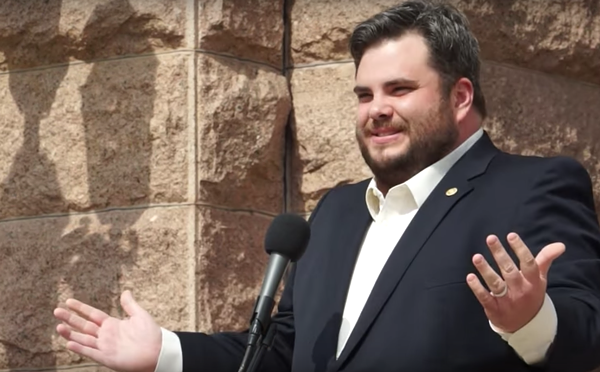
Lawmaker Tells Woman Staffer to "Smile for Us" on the Texas House Floor

This is disgusting.  We must teach our sons and daughters about the inappropriateness and offensiveness of sexism.  Plus, it connects directly to views on women's rights that when deployed by men in power, such as in the Texas State Legislature, has potentially significant consequences for all women.  

We should also encourage our daughters and those that we mentor to consider running for political office given that sexism also thrives where imbalances occur.

And we should also raise not just our daughters, nieces, and grand daughters, but also our sons, nephews and grandsons to be equitable, and committed to feminism as a political project to end the imbalances that pervade the power structure of society, as a whole.

Angela

Wednesday, May 10, 2017

Lawmaker Tells Woman Staffer to "Smile for Us" on the Texas House Floor

Posted By on Wed, May 10, 2017 at 1:43 PM

YOUTUBE VIA AGENDAWISE
  • YouTube via AgendaWise
Minutes into his Wednesday morning inquiry on the Texas House floor, Rep. Jonathan Stickland interrupted himself.

"Can we get the parliamentarian to smile for us today?" he asked, with a grin.

His question was directed at Assistant Parliamentarian Shalla Sluyter, who's spent the session working double-time to provide nonpartisan guidance on parliamentary rules and procedures to the House (and with the kind of bills we've seen pass through the House so far, lawmakers haven't made her job easy).

Stickland commented on how Sluyter hasn't been smiling enough lately, and chuckled with fellow far-right Rep. Tony Tinderholt, who was standing behind him. Sluyter, who was selected for the job after clerking for the both the Texas Supreme Court and Third Court of Appeals, did not smile.

Of course, this is nothing new. Men have been asking women to smile for them for decades — it's one of the more classic lines flung at women walking down a street, teaching a class, commanding a meeting, or even running for political office.

But patronizing women with sexist comments also appears to be one of Stickland's favorite tools. Last year, Stickland was forced to apologize for once pronouncing "rape is non-existent in marriage," and that husbands can "take what they want." The Bedford Republican has also supported a handful of laws that specifically limit women's rights.

Like his attempt last session to ban abortions after 20 weeks or a deal he tried to make with the Senate to expedite a bill to prohibit elective abortion coverage in Texas health care plans.

His male GOP colleagues aren't any better. Rep. Tinderholt even tried to turn his misogyny into a law this session with a bill that would stick women with murder charges for having an abortion because, he says, women need to be taught how to be more responsible with their bodies. Stickland happily helped Tinderholdt rally support for the bill. And remember when Sen. Charles Schwertner shattered a glass table with a gavel while trying to silence a woman testifying against an anti-abortion bill he supported?

Stickland's comment comes during a particularly trying week for women's rights in the Texas House — at least five different bills aimed at restricting the right to a legal abortion have been placed on the calendar. On Tuesday, a dozen women gathered in the capitol building dressed up like characters from The Handmaid's Tale (a dystopian novel where women are simply used as reproduction tools) to symbolize how the state's limited abortion access is nearing dystopian-levels.

I guess we shouldn't be surprised that this is how Stickland, a lawmaker who's spent his career writing bills telling women what they can or cannot do with their bodies, treats his female colleagues.

Wednesday, December 21, 2016

Sorry, sexists. The genie's out of the bottle and your own families are the better for it.

For his ultimate victory, it wasn't the case that Trump tapped into a benign, chivalrous kind of sexism that may be characterized as in the realm of "traditional values" with respect to women's roles in society, rather according to research cited below, "[he's] getting support from people who are hostile toward women’s economic and legal equality and who think feminism is making America worse."

Though the pertinent research referenced below doesn't break this down, this obviously also captures the sentiments of some women themselves who have patriarchal views.  What's interesting is that we in the U.S. are often quick to thumb our noses in arrogance against other, frequently Islamist, countries for their systems of government and society where men hold the social, economic, political, and cultural power from which women are largely excluded, yet fail to see this happening within the context of our own country and society.

Clearly, men's loss of centrality is what is at stake here.  While we clearly need a revived women's movement that keeps pushing forward for women's rights and equity-based policies and practices, the election itself is in part a reaction against what I think to be an inexorable progression of women's call for equality in U.S. society. 

Sorry, sexists.  The genie's out of the bottle and your own families are the better for it.

Angela Valenzuela
c/s

Hostility toward women is one of the strongest predictors of Trump support

Updated by

Since the start of the Republican primaries, hundreds of thousands of words and hours of television airtime have been devoted to one question: What do Donald Trump’s supporters want? The 42 percent of Americans supporting Trump have been studied and caricatured and psychoanalyzed.
Explanations abound: They’re stricken with economic anxiety. They’re anxious about their social status. They feel left behind by the federal government. They’re authoritarians who want a forceful leader. They’re racists who oppose the changing demographics and norms of the US.
But there’s another important factor that these analyses have largely left out: sexism. Three political scientists who studied the connection between sexism, emotions, and support for Trump found that the more hostile voters were toward women, the more likely they were to support Trump.
Researchers Carly Wayne, Nicholas Valentino and Marzia Oceno, who wrote about their work for the Washington Post’s Monkey Cage, conducted their research before the revelation of the secret recording that captured Trump bragging about kissing and groping women without their permission, and before more than a dozen women came forward to accuse Trump of sexual assault in the aftermath of its release.
While it might not seem surprising now that Trump has galvanized sexists, their findings suggest that sexism played a much bigger role in his rise than most people realized or wanted to imagine.

How “hostile sexism” predicts support for Trump

Sexism has largely been overlooked as a major factor in voters’ decisions to support Donald Trump. That would be understandable if it were simply one factor among many — one prejudice among the many that Hillary Clinton called the “basket of deplorables … racist, sexist, homophobic, xenophobic, Islamophobic, you name it.”
But Wayne, Valentino, and Oceno’s research, conducted in June, found hostility toward women was a major factor, predicting support for Trump more strongly than authoritarian attitudes and about as well as racial prejudice. The political scientists used a four-question survey to determine sexist attitudes, asking if people agreed with the following statements:
  1. Most women interpret innocent remarks or acts as being sexist.
  2. Many women are actually seeking special favors, such as hiring policies that favor women over men, under the guise of asking for equality.
  3. Feminists are not actually seeking for women to have more power than men.
  4. Feminists are making entirely reasonable demands of men.
The survey also asked how strongly respondents supported Clinton or Trump. The higher they were on the sexism scale, the more likely they were to support Trump and the less likely they were to support Clinton. Hostile sexism was nearly as good at predicting support for Trump as party identification was.
Sexism — and particularly anti-feminism — isn’t politically neutral. Many conservative women have come forward to say they’re horrified by Donald Trump, but sexism has been correlated with support for other Republican candidates as well. In studies of voters in 2008 and 2012, traditional beliefs about gender and hostility toward feminism were also linked to much lower support for Hillary Clinton.
“It’s the kind of sorting that people do to go into one party or the other,” said Wayne, a PhD candidate in political science at the University of Michigan. Republicans “tend to have attitudes that are more traditionalist, more old-fashioned, less likely to want the kinds of changes that feminism, for example, is pushing.”
Wayne said she couldn’t compare how sexist attitudes nationally had correlated with support for Republicans in previous elections, so she couldn’t say if Trump made the situation better or worse. But Brian Schaffner, a political scientist at the University of Massachusetts Amherst, used the same survey as part of a poll in New Hampshire, and found that sexism was a much bigger factor in the 2016 election than it was in 2012:
Clinton’s candidacy is another piece of important context — it’s possible that strong support for Trump among sexists is in part a reaction to the first woman who could plausibly be elected president — but Schaffner’s findings back up the idea that Trump’s core supporters are unusually hostile toward women and feminism.

Trump isn’t just tapping into “traditional values”

Trump’s support among sexists doesn’t seem to be a function of the traditional, old-fashioned “family values” usually associated with the Republican Party.
In a survey in August, Wayne and her co-authors measured the impact of a different kind of “old-fashioned” view about women’s roles: the belief that women are different from men because they’re physically weaker and more morally pure. They asked survey respondents if they agreed with the following statements:
  1. In a disaster, women should be rescued before men.
  2. Women have a quality of purity that few men possess.
  3. Men should be willing to sacrifice their own well-being in order to provide for the women in their lives.
  4. Every man ought to have a woman whom he adores.
The questions measure “benevolent sexism” — a traditional, chivalrous view of men and women’s proper roles. Benevolent sexism can still undermine women’s equality because it paints women as weaker and more in need of male protection. Unlike its more hostile counterpart, though, benevolent sexism didn’t correlate much at all with support for Trump, at least before the leaked Access Hollywood tape. (Unlike the study on hostile sexism, the researchers didn’t use a representative national sample but rather an online survey. But the results were weighted for partisan identity, and Wayne says it was a high-quality sample.)
“The hostile sexism is highly correlated, but the benevolent sexism really is not,” Wayne said. “I found this result particularly interesting in the aftermath of some of the fallout from Trump’s tape. … There were a lot of Republicans saying they were against Trump’s statements because of their daughters and wives.”
Trump, in other words, isn’t just drawing from a base of people who have traditional views about women’s roles. He’s getting support from people who are hostile toward women’s economic and legal equality and who think feminism is making America worse.

Trump’s sexism was hidden in plain sight

It shouldn’t be surprising that Trump is the candidate of choice for people who believe that allegations of sexism are mostly made up and that feminism is really a ploy to get men on the losing side of a zero-sum status competition between the sexes. Trump’s misogyny has been a core part of his public persona for a long time.
Long before many of the sexual assault allegations emerged, Trump made clear, in public and private, that women matter to him not as people but as sex objects. Even with women whom he supposedly likes and admires, he’s made clear that he values their looks above all else. He turned his attitudes into discriminatory policies in his offices, at his resorts, and on his TV show, harassing women he found attractive and urging his employees to fire those he did not.
The fact that Trump was virulently sexist used to be widely recognized. "His brand of self-aggrandizing, bewigged machismo was kind of de rigeur in the 80's and charmingly old-timey in the 90's, but now it's just passé and exhausting and increasingly offensive," Richard Lawson wrote in a post headlined "Donald Trump: A Sexist Dinosaur" for Gawker in 2008. "And he never stops!"
In the vast American soul-searching over why people might want to vote for Trump, sexism has gotten short shrift. That might be because Trump’s blatantly sexist remarks were generally not a part of his political campaign or preferred policies, unlike his hostility toward immigrants and Muslims and his constant reiteration that African Americans live in a wasteland of crime and violence.
But even if his misogyny was more muted in the early days of the campaign, it appears to have found a receptive audience.
Since the start of the Republican primaries, hundreds of thousands of words and hours of television airtime have been devoted to one question: What do Donald Trump’s supporters want? The 42 percent of Americans supporting Trump have been studied and caricatured and psychoanalyzed.
Explanations abound: They’re stricken with economic anxiety. They’re anxious about their social status. They feel left behind by the federal government. They’re authoritarians who want a forceful leader. They’re racists who oppose the changing demographics and norms of the US.
But there’s another important factor that these analyses have largely left out: sexism. Three political scientists who studied the connection between sexism, emotions, and support for Trump found that the more hostile voters were toward women, the more likely they were to support Trump.
Researchers Carly Wayne, Nicholas Valentino and Marzia Oceno, who wrote about their work for the Washington Post’s Monkey Cage, conducted their research before the revelation of the secret recording that captured Trump bragging about kissing and groping women without their permission, and before more than a dozen women came forward to accuse Trump of sexual assault in the aftermath of its release.
While it might not seem surprising now that Trump has galvanized sexists, their findings suggest that sexism played a much bigger role in his rise than most people realized or wanted to imagine.

How “hostile sexism” predicts support for Trump

Sexism has largely been overlooked as a major factor in voters’ decisions to support Donald Trump. That would be understandable if it were simply one factor among many — one prejudice among the many that Hillary Clinton called the “basket of deplorables … racist, sexist, homophobic, xenophobic, Islamophobic, you name it.”
But Wayne, Valentino, and Oceno’s research, conducted in June, found hostility toward women was a major factor, predicting support for Trump more strongly than authoritarian attitudes and about as well as racial prejudice. The political scientists used a four-question survey to determine sexist attitudes, asking if people agreed with the following statements:
  1. Most women interpret innocent remarks or acts as being sexist.
  2. Many women are actually seeking special favors, such as hiring policies that favor women over men, under the guise of asking for equality.
  3. Feminists are not actually seeking for women to have more power than men.
  4. Feminists are making entirely reasonable demands of men.
The survey also asked how strongly respondents supported Clinton or Trump. The higher they were on the sexism scale, the more likely they were to support Trump and the less likely they were to support Clinton. Hostile sexism was nearly as good at predicting support for Trump as party identification was.
Sexism — and particularly anti-feminism — isn’t politically neutral. Many conservative women have come forward to say they’re horrified by Donald Trump, but sexism has been correlated with support for other Republican candidates as well. In studies of voters in 2008 and 2012, traditional beliefs about gender and hostility toward feminism were also linked to much lower support for Hillary Clinton.
“It’s the kind of sorting that people do to go into one party or the other,” said Wayne, a PhD candidate in political science at the University of Michigan. Republicans “tend to have attitudes that are more traditionalist, more old-fashioned, less likely to want the kinds of changes that feminism, for example, is pushing.”
Wayne said she couldn’t compare how sexist attitudes nationally had correlated with support for Republicans in previous elections, so she couldn’t say if Trump made the situation better or worse. But Brian Schaffner, a political scientist at the University of Massachusetts Amherst, used the same survey as part of a poll in New Hampshire, and found that sexism was a much bigger factor in the 2016 election than it was in 2012:
Clinton’s candidacy is another piece of important context — it’s possible that strong support for Trump among sexists is in part a reaction to the first woman who could plausibly be elected president — but Schaffner’s findings back up the idea that Trump’s core supporters are unusually hostile toward women and feminism.

Trump isn’t just tapping into “traditional values”

Trump’s support among sexists doesn’t seem to be a function of the traditional, old-fashioned “family values” usually associated with the Republican Party.
In a survey in August, Wayne and her co-authors measured the impact of a different kind of “old-fashioned” view about women’s roles: the belief that women are different from men because they’re physically weaker and more morally pure. They asked survey respondents if they agreed with the following statements:
  1. In a disaster, women should be rescued before men.
  2. Women have a quality of purity that few men possess.
  3. Men should be willing to sacrifice their own well-being in order to provide for the women in their lives.
  4. Every man ought to have a woman whom he adores.
The questions measure “benevolent sexism” — a traditional, chivalrous view of men and women’s proper roles. Benevolent sexism can still undermine women’s equality because it paints women as weaker and more in need of male protection. Unlike its more hostile counterpart, though, benevolent sexism didn’t correlate much at all with support for Trump, at least before the leaked Access Hollywood tape. (Unlike the study on hostile sexism, the researchers didn’t use a representative national sample but rather an online survey. But the results were weighted for partisan identity, and Wayne says it was a high-quality sample.)
“The hostile sexism is highly correlated, but the benevolent sexism really is not,” Wayne said. “I found this result particularly interesting in the aftermath of some of the fallout from Trump’s tape. … There were a lot of Republicans saying they were against Trump’s statements because of their daughters and wives.”
Trump, in other words, isn’t just drawing from a base of people who have traditional views about women’s roles. He’s getting support from people who are hostile toward women’s economic and legal equality and who think feminism is making America worse.

Trump’s sexism was hidden in plain sight

It shouldn’t be surprising that Trump is the candidate of choice for people who believe that allegations of sexism are mostly made up and that feminism is really a ploy to get men on the losing side of a zero-sum status competition between the sexes. Trump’s misogyny has been a core part of his public persona for a long time.
Long before many of the sexual assault allegations emerged, Trump made clear, in public and private, that women matter to him not as people but as sex objects. Even with women whom he supposedly likes and admires, he’s made clear that he values their looks above all else. He turned his attitudes into discriminatory policies in his offices, at his resorts, and on his TV show, harassing women he found attractive and urging his employees to fire those he did not.
The fact that Trump was virulently sexist used to be widely recognized. "His brand of self-aggrandizing, bewigged machismo was kind of de rigeur in the 80's and charmingly old-timey in the 90's, but now it's just passé and exhausting and increasingly offensive," Richard Lawson wrote in a post headlined "Donald Trump: A Sexist Dinosaur" for Gawker in 2008. "And he never stops!"
In the vast American soul-searching over why people might want to vote for Trump, sexism has gotten short shrift. That might be because Trump’s blatantly sexist remarks were generally not a part of his political campaign or preferred policies, unlike his hostility toward immigrants and Muslims and his constant reiteration that African Americans live in a wasteland of crime and violence.
But even if his misogyny was more muted in the early days of the campaign, it appears to have found a receptive audience.