Translate

Showing posts with label neo-confederate agenda. Show all posts

Sunday, September 10, 2023

My Great Grandfather was a Racist: Once we take down Confederate statues, Texans must still grapple with monsters in the past.

Gabriel Arana speaks candidly about discoveries he has made from researching his own family's history. I think everyone should do this so that we can learn about what has made us individually—as well as us, collectively—into who we are today. He speaks of the cringe-worthy, "Lost Cause" icons on the grounds of the Texas State Capitol in the form of flags, statues, and street signs that honor Confederate figures who, by definition, upheld racist policies.

Most telling is how their prevalence today on Texas Capitol grounds indeed aligns to the current cultural war with politics, policies, shrill rhetoric and propaganda that seek to whitewash Texas history that is further playing out at the highest levels of the Texas State Historical Association (TSHA). The organization has been roiled by conflict over how Texas history is to get interpreted. Accordingly, read the following:

D'Amico, R. (2023, July). Traditionalists Protest What Some Consider a “Woke” Takeover of the Texas State Historical Association, Inside the arguments, lawsuit, and angry outbursts that are dividing a key authority on historical matters, Texas Monthly. Retrieved: https://www.texasmonthly.com/news-politics/texas-state-historical-association-drama/ 

deGrood, M. (2023, July 18). Galveston billionaire, board to face off in mediation in case over how Texas history is taught, Houston Chronicle.Retrieved: https://www.houstonchronicle.com/news/houston-texas/trending/article/mediation-in-case-over-how-texas-history-is-taught-18205227.php

Dey, S. (2023, June 22).  A battle over who gets to tell Texas history is brewing into a war over the state historical association’s future, Texas Tribune. Retrieved: https://www.texastribune.org/2023/06/22/texas-state-historical-association-lawsuit/

I like how a personal narrative like this illustrates well the feminist notion that the personal is political. And boy is it, as you can see from the historic battle taking place within the TSHA.

What we can easily infer from these struggles is how for the dominant group, it's not sufficient to be politically and economically dominant. Rather, the intellectual, cultural, and what is construed as the moral sphere of our (in)glorious tradition must be so, as well, even if by force.

That said, history teaches us that grassroots struggles from below that challenge these symbolic orders matter enormously for the kinds of change those of us involved in such struggles seek, not the least of which is a truthful teaching of our state's and nation's history.

-Angela Valenzuela

My Great Grandfather was a Racist: Once we take down Confederate statues, Texans must still grapple with monsters in the past. by GABRIEL ARANA | Texas Observer 
SEPTEMBER 4, 2023, 11:47 AM, CDT A version of this story ran in the September / October 2023 issue.

My great-grandfather, José-María Arana, was a racist. 

After the United States barred Chinese men from immigrating under the Chinese Exclusion Act of 1882, tens of thousands sought a new life in Mexico, where they faced no warmer a welcome as they established themselves. A former schoolteacher and businessman, José-María led a vicious campaign against the Chinese in the Mexican states of Sonora, Sinaloa, and Baja California in the early 1900s.  

Seeking “all legal means to eliminate the Asian merchant,” whose growing prosperity he viewed as a threat to the working class and Mexican national identity, José-María formed a junta of local businessmen in 1912 to address what he called “the tremendous calamity of the Chinese jaundice.” He launched a newspaper, Pro-Patria, whose masthead boldly proclaimed, “Mexico for the Mexicans and China for the Chinese.” Featuring racist jokes and caricatures, the broadsheet portrayed Chinese immigrants as carriers of disease and a threat to Mexican women. 


JOSÉ-MARÍA ARANA ORGANIZED TO EXCLUDE CHINESE IMMIGRANTS FROM MEXICAN LIFE AND PROSPERITY. JOSÉ-MARIA ARANA/SPECIAL COLLECTIONS AT THE UNIVERSITY OF ARIZONA LIBRARY

“We cannot live together because there exists an absolute incompatibility in race, social customs, and economy,” José-María wrote in its pages. 

My great-grandfather carried his message throughout Northern Mexico, making speeches in working-class towns like Cananea—whose poor copper miners he thought ripe for radicalization—and urging city and state leaders to restrict the types of businesses that Chinese immigrants could run, relegate them to ghettos, and expel them de manera definitiva [in a definitive way]. 

I’ve thought increasingly about my great-grandfather and his ignoble legacy as I’ve settled into life in Texas, where the Confederate cause is memorialized on statues, flags, and street signs. Growing up on the U.S.-Mexico border in Nogales, Arizona—where José-María’s widow, my great-grandmother, settled after his death in 1921—I knew little about my family tree’s racist roots. Like a lot of gay kids who come from a small town, I left to find people like me in bigger cities and only much later started to contemplate my origins.


CHINESE IMMIGRANTS SENT JOSÉ-MARÍA POSTCARDS WITH DERISIVE POEMS IN SPANISH. TRANSLATION: OF YOUR ATTACKS I LAUGH / AND YOU EVEN GIVE ME COMPASSION / AND IT MAKES ME NEITHER HOT NOR COLD / YOUR RIDICULOUS ORATION. / AND THEY SAY FROM GRAND CHINA / THAT YOU’RE GOTTEN INVOLVED WITH THE DANCE / WITH YOUR GROSS PROPAGANDA / TO FILL YOUR BELLY. —JU KUN LEEJOSÉ-MARÍA ARANA, SPECIAL COLLECTION AT THE UNIVERSITY OF ARIZONA

Afew months after moving here in the summer of 2022, I visited the Capitol grounds with my in-laws from London. The Texas State Capitol is an imposing Renaissance revival structure made of pink granite with a dome that, Texans remind you, is taller than the U.S. Capitol. But what impressed us all the most on that first visit was the enormous Confederate Soldiers Monument on the right as one walks up to the entrance from 11th Street. 

bronze statue of Confederate President Jefferson Davis stands atop one of five pillars, the other four support figures representing the branches of the Confederate military. The inscription on the pedestal below commemorates the 437,000 soldiers who “died for states [sic] rights guaranteed under the Constitution” and asserts that “the People of the South, animated by the spirit of 1776, to preserve their rights, withdrew from the federal compact.” 

“It’s Texas,” I said preemptively, feeling defensive and embarrassed at the same time as my in-laws looked on in horror. It’s the same way I feel when an outsider mentions the state’s abortion ban or attacks on LGBTQ+ people. 

The Confederate Soldiers Monument is one of 12 memorials on the grounds that perpetuate the “lost cause”—the historical myth that the Confederate cause was heroic and not about slavery. 


It is a lie easily debunked by looking at Texas’ Ordinance of Succession, which laid out the state’s own reasoning for withdrawing from the union. The document declares that Blacks were “rightfully held and regarded as an inferior and dependent race” and that “the servitude of the African race … is mutually beneficial to both bond and free” as well as ordained by God. Even the monument’s Confederate death count, scholars have pointed out, is inflated. 

The endurance of the Confederate cult here does not, of course, reflect the prejudices of most Texans, which is what makes these symbols so corrosive to a shared sense of state identity. An implicit endorsement of white supremacy, they most directly exclude Black Texans, whose struggle for freedom offers a far more edifying narrative to rally around—one that embodies our national values and unity rather than doubling down on a lost war. But they set up an identity conflict for anyone of good conscience who wants to claim Texas as their own: Every assertion of Texas identity must come with a “but.” 

Reminders of the Confederacy abound here in Austin, considered the state’s bluest city: In the Texas State Cemetery, civil rights hero and Congresswoman Barbara Jordan and former Governor Ann Richards lie yards away from Albert Sidney Johnston, a slave owner and Confederate general whose Gothic tomb looks out on the Confederate Fields on the cemetery’s southeast side, where 2,200 Confederate veterans are interred, each plot marked by a white cross. 

Some of my Southern friends have said that when you grow up in the South, the paraphernalia is so commonplace, it can blur into the background. But if you’re new to it, it’s striking to see the resentments of the 1800s enshrined in what are supposed to be shared expressions of our civic ideals. 

It was perhaps easier to dismiss them before the Obama and Trump presidencies brought the Nazis and white, Christian nationalists out of the woodwork, when it was at least a bit more plausible to reassure oneself that “America is getting better.” It’s become harder to think of racism as a healing wound on the body politic when white nationalists demonstrate openly in public and Republicans in the Legislature try to ensure K-12 students only get taught a sanitized fairy tale about Texas history. 

“Most Texans do not support erasing our history … out of political correctness,” ​​Lieutenant Governor Dan Patrick wrote in an August 2022 letter to Senate Democrats who had urged the Legislature to remove Confederate monuments on the Capitol grounds. 

The irony is that whitewashing Texas history is the very purpose of Confederate propaganda—and the impetus behind state Republicans’ attacks on education. Last year, Governor Greg Abbott signed a law that limits how K-12 teachers can talk about racism and slavery; it bans educators from discussing the New York Times’ 1619 Project, which reframes the nation’s founding as inextricably linked to the arrival of slaves on American shores in 1619. 


Since the “Unite the Right” rally in Charlottesville, Virginia, in 2017, and the George Floyd protests in 2020, some Texans have begun to change their minds about memorializing the Confederacy. While a bare majority once opposed their removal, now 52 percent say they should be taken out of public view or relocated to museums where they can teach us about the past rather than help keep its prejudices alive. 

Amid our national reckoning about race, reminders of the Confederacy have started to come down in Texas. In 2017, the Texas State Preservation Board voted to remove the Children of the Confederacy plaque, which proclaimed that “the War Between the States was not a rebellion, nor was its underlying cause to sustain slavery,” from the Capitol. The University of Texas at Austin relocated four Confederate statues on its campus in 2015 and 2017. But this only scratches the surface: Statewide, only 34 of 240 Confederate symbols have been removed, including nine monuments, according to the Southern Poverty Law Center. 


My great-grandfather has no monuments dedicated to him, nor do I think he deserves any. What he represents is too corrosive to memorialize. 

I don’t have trouble condemning José-María as racist and acknowledging the harm he caused the Chinese community in Northern Mexico. I have come to take a qualified pride in my Mexican heritage, but to the extent it is synonymous with the racism José-María espoused, I must condemn it. Being members of a pluralistic society requires us to put our civic ideals, like the belief in human equality, above allegiance to our ancestry. 

I never heard about José-María as a kid. My grandparents died when I was young, and my father never spoke of him. One Christmas when I was home, I happened upon a collection of my grandfather’s writing about our family history. His father, he wrote, had been mayor of Magdalena, Sonora, and his papers were preserved in a collection at the University of Arizona. 
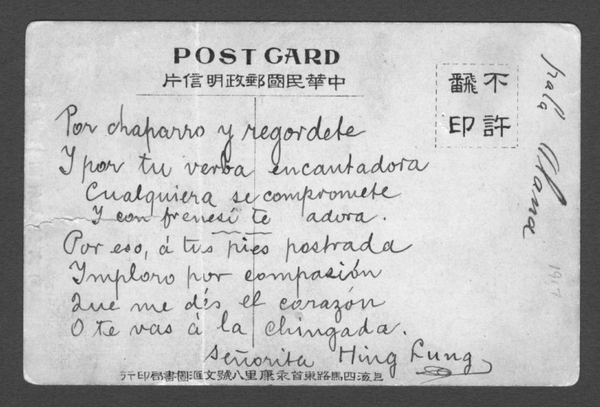
CHINESE IMMIGRANTS SENT JOSÉ-MARÍA POSTCARDS WITH DERISIVE POEMS IN SPANISH. TRANSLATION: FOR [BEING] SHORT AND FAT / AND YOUR ENCHANTING ORATION / WHOEVER HEARS IT / AND WITH FERVOR ADORES YOU / BECAUSE OF THAT, AT YOUR FEET PROSTRATED / I IMPLORE YOUR COMPASSION / OR YOU GO FUCK YOURSELF. —SEÑORITA HING LUNGJOSÉ-MARÍA ARANA, SPECIAL COLLECTION AT THE UNIVERSITY OF ARIZONA

I looked up the collection online, which featured speeches, newspaper clippings, and correspondence, including hate mail from Chinese Sonorans. A quick trip to Google Scholar filled in his biography. 

José-María was indeed elected mayor of Magdalena in 1919 after running twice, his first campaign derailed by a stint in prison for inciting violence against Chinese immigrants. As mayor, he was only able to pass laws taxing Chinese businesses, but his advocacy helped inspire the Sonoran legislature to relegate Chinese immigrants to ghettos and expel them in 1919—a move later overruled by the federal government. He died in 1921, supposedly from being poisoned, after which his widow moved to Arizona with my grandfather, where the family was reduced to poverty. 

Though I think it is good to have learned about the monster in my bloodline, I’m glad that ultimately, his name will only exist only for those who want to discover it. That’s where I think my great-grandfather’s shameful legacy belongs—in the historical record, the subject of debate and reflection about the mistakes of our ancestors, as a warning of what happens when one is too proud of one’s identity.
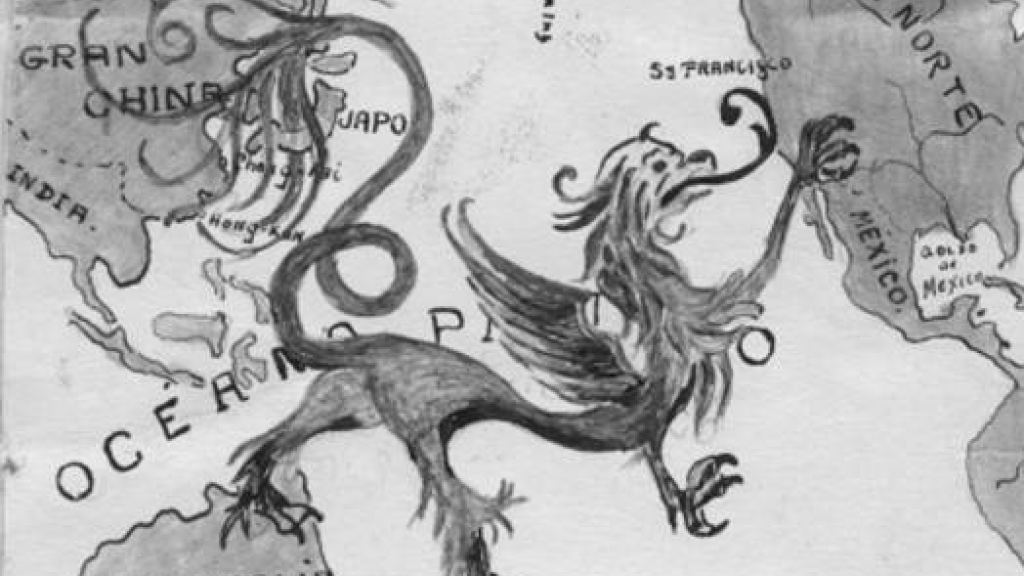
An old-fashioned black and white cartoon of an early 20th-century map of China and the West Coast of North and Central America. In between is a depiction of a cartoon dragon, poised with its claw upraised as if it is about to attack Mexico.
A CARTOON DEPICTION OF THE SUPPOSED “THREAT” JOSÉ-MARÍA AND OTHERS BELIEVED CHINESE IMMIGRANTS POSEDJOSÉ-MARIA ARANA/SPECIAL COLLECTIONS AT THE UNIVERSITY OF ARIZONA LIBRARY

Thursday, January 21, 2021

‘A hack job,’ ‘outright lies’: Trump commission’s ‘1776 Report’ outrages historians

This 1776 Report equates to outright lies and propaganda, not unlike what we saw here in Texas with our famous textbook battle in 2016 and 2017 before the Texas State Board Education with the proposed adoption of a racist, error-riddled textbook offensively titled, "Mexican American Heritage," written by two non-historians named Jaime Riddle and Valarie Angle that would have done enormous damage to our children had it been adopted. You can read all about this in Dr. Emilio Zamora's scathing critique here on this blog.

This book surfaced while many of us were advocating for a high school Mexican American Studies course and texts, with Zamora outlining the following:

The story began last summer when we heard that Momentum Books had proposed to the Texas State Board of Education a textbook for adoption to teach Mexican American Studies in the state’s public schools.  We suspected a problem when we discovered that the owner of the publishing house was Ms. Cynthia Dunbar, a former conservative member of the State Board, an Assistant Law Professor at Jerry Falwell’s Liberty University, a recent Trump delegate to the Republican Party Convention, and a co-chair of Senator Ted Cruz’s presidential campaign.  The selection of the book’s authors, Jaime Riddle and Valarie Angle, also raised concerns.

Relatedly, read "Texas' New Public School Textbooks Promote Climate Change Denial and Downplay SegregationAnd they could end up in your kid's classroom too." 

A major difference is that whereas the Riddle and Angle text at least pretended to be factual--even as the meticulous work of the review team of historians spearheaded by Dr. Zamora identified and reported 407 errors to the SBOE--the 1776 Report, according to public historian Alexis Coe, "[L]acks citations or any indication books were consulted, which explains why it’s riddled in errors, distortions, and outright lies.” 

So pathetic.

I am so happy that President Biden and Vice-President Harris are now in charge, meaning that our nation's highest office will not implicate itself in lies and gaslighting the American public with a false historical, racist narrative that masquerades as truth.

In the meantime, we must always call out such racist texts like these wherever and whenever they surface.

Forewarned is forearmed. 

-Angela Valenzuela

‘A hack job,’ ‘outright lies’: Trump commission’s ‘1776 Report’ outrages historians

President Trump speaks to the White House Conference on American History at the National Archives Museum on Sept. 17 in Washington. (Alex Brandon/AP)

By 

Gillian Brockell

Jan. 20, 2021 at 7:42 a.m. CST

Two days after historians responded with dismay and anger to the White House’s “1776 Commission” report, the Biden transition team announced President-elect Joe Biden would rescind the commission with an executive order on his first day in office.

The report was intended to a version of U.S. history that would “restor[e] patriotic education” in schools. Historians largely condemned it, saying it was filled with errors and partisan politics.

“It’s a hack job. It’s not a work of history,” American Historical Association executive director James Grossman told The Washington Post. “It’s a work of contentious politics designed to stoke culture wars.”

The commission was created in September with a confusing news conference featuring Housing and Urban Development Secretary Ben Carson. The 45-page report is largely an attack on decades of historical scholarship, particularly when it comes to the nation’s 400-year-old legacy of slavery, and most of those listed as authors lack any credentials as historians. While claiming to present a nonpartisan history, it compares progressivism to fascism and claims the civil rights movement devolved into “preferential” identity politics “not unlike those advanced by [slavery defender John C.] Calhoun and his followers.”

“I don’t know where to begin,” said public historian Alexis Coe. “This ‘report’ lacks citations or any indication books were consulted, which explains why it’s riddled in errors, distortions, and outright lies.”

Kali Nicole Gross, a history professor at Rutgers and Emory universities and the co-author of “A Black Women’s History of the United States,” said it was “dusty, dated” and “the usual dodge on the long-lasting, harmful impacts of settler-colonialism, enslavement, Jim Crow, the oppression of women, the plight of queer people … as the true threat to democracy.”

Boston University historian Ibram X. Kendi tweeted: “This report makes it seems as if slaveholding founding fathers were abolitionists; that Americans were the early beacon of the global abolitionist movement; that the demise of slavery in the United States was inevitable.”

“It’s very hard to find anything in here that stands as a historical claim, or as the work of a historian. Almost everything in it is wrong, just as a matter of fact,” said Eric Rauchway, a history professor at the University of California at Davis. “I may sound a little incoherent when trying to speak of this, because the report itself is not coherent. It’s like historical wackamole.”

He pointed to sections misinterpreting Puritan John Winthrop’s “city on a hill” speech, and to a section claiming the civil rights movement “came to abandon the nondiscrimination and equal opportunity of colorblind civil rights in favor of ‘group rights.’ ”

“Group rights is not anathema to American principles,” he said, recalling the formation of the Senate. “Why do Wyomingers have 80 times the representation that Californians have if not for group rights?”

Coe, who published a biography of George Washington last year, pointed to a section of the report that claims the first president had “freed all the slaves in his family estate” by the end of his life. In fact, he freed only one enslaved person upon his death; the 254 other enslaved people at Mount Vernon had a much more complicated fate.

George Washington owned slaves and ordered Indians killed. Will a mural of that history be hidden?

Hilary Green, a history professor at the University of Alabama, tweeted a list of books on American history people could read “instead of a certain report.”

Several historians said it was particularly offensive that the report was released on Martin Luther King Jr. Day and included several photos King and quotes they said were taken out of context.

“The suggestion that affirmative action programs are somehow antithetical to the vision of Martin Luther King Jr. is simply ludicrous,” said Princeton historian Kevin M. Kruse. “King was alive when the Johnson administration launched its affirmative action programs and publicly declared his support, specifically noting that it was a logical extension of the struggle for black equality. The document ignores King’s record of support for affirmative action, lamely pointing to the one line conservatives know from his ‘I Have a Dream’ speech and ignoring the rest of his radical record. The fact that this historical distortion of King’s life and work was released on MLK Day makes it even worse.”

Martin Luther King Jr.’s scorn for ‘white moderates’ in his Birmingham jail letter

“It is fitting that this president, who was impeached again, this time for inciting an insurrection in the nation’s capital, would mark his last Martin Luther King Jr. Day in office by attacking the very movement Martin Luther King Jr. was a leader of,” Coe said.

“To say that the racial divisions that have existed for the last half century are due to insistence by African Americans on ‘group rights’ rather than to the depth and breadth of racism, to say that on a page where you have a photograph of Dr. King is offensive to Dr. King’s legacy,” Grossman said.

The commission began in part as a response to the New York Times’s 1619 Project, a group of essays by historians and journalists about the way slavery has shaped the nation.

At the National Archives Museum on Sept. 17, President Trump criticized a New York Times project focused on the first arrival of enslaved Africans in Virginia. (The Washington Post)

Five professors say the 1619 Project should be amended. ‘We disagree,’ says the New York Times.

Even historians who have been critical of the 1619 Project, including Princeton’s Sean Wilentz, dismissed the 1776 report.

“It reduces history to hero worship,” Wilentz wrote in an email. “It's the flip side of those polemics, presented as history, that charge the nation was founded as a slavocracy, and that slavery and white supremacy are the essential themes of American history. It's basically a political document, not history.”

Historian Kevin M. Levin, author of several books about the Civil War, said: “The 1776 report views students as sponges who are expected to absorb a narrative of the American past without question. It views history as set in stone rather than something that needs to be analyzed and interpreted by students.”

The White House also released Monday a long list of historical figures to be featured at Trump’s proposed “National Garden of American Heroes.” Georgetown history professor Adam Rothman compared the report to the list, saying it was “nothing but the National Garden of Heroes in prose form, a stiff and lifeless history of America on a pedestal.”

Grossman, the AHA executive director, said: “This is written as if no historical scholarship has been produced in nearly 70 years, so it’s bereft of any professional historical sensibility at all. There are no historians on this commission. Would you take your car to a garage where there’s no mechanic?”

Teo Armus contributed to this report.


Wednesday, June 17, 2020

Trump might go down in history as the last president of the Confederacy by Eugene Robinson

I certainly hope that Eugene Robinson is correct when he suggests that Trump's "appeals to racial animus" are no longer working for him.  He has done so much damage.

We can only hope that Trump is not only the last president of the Confederacy, by that his job comes to a screeching halt in November.

-Angela Valenzuela


Trump might go down in history as the last president of the Confederacy

June 11, 2020 at 3:27 p.m. CDT
It should have happened 155 years ago, when Robert E. Lee surrendered to Ulysses S. Grant at Appomattox, but maybe — just maybe — the Civil War is finally coming to an end. And perhaps Donald Trump, not Jefferson Davis, will go down in history as the last president of the Confederacy.
Symbols like flags and monuments matter, because what they symbolize is our vision of ourselves as a nation: the heroes, battles, movements, sacrifices and ideals we honor. So when I see multiracial crowds toppling the statues of Confederate soldiers and politicians, when I see respected military leaders arguing that Army posts should no longer bear the names of Confederate generals, when I see NASCAR banning displays of the Confederate battle flag at its races — witnessing all of this, I let hope triumph over experience and allow myself to imagine that this may indeed be a transformational moment.
Like the Civil War itself, “Lost Cause” symbology is simply and entirely about white supremacy. It has nothing to do with “heritage” or “tradition” or any such gauzy nonsense. The heavily armed “liberate Michigan” mob that invaded the statehouse in Lansing, egged on by President Trump, had no historical reason to be waving the Confederate flag. That banner represents the knee that has been kept on the necks of African Americans not just for eight minutes and 46 seconds, the time Derek Chauvin spent crushing the life out of George Floyd, but for 401 years.
Opinion | In Atlanta, this is why we protest
The killings of Ahmaud Arbery, Breonna Taylor and George Floyd by police and vigilantes are part of bigger injustices felt by these black Americans. (Joy Sharon Yi, Kate Woodsome/The Washington Post)
Lee’s surrender ended nothing, because the nation did not even begin to grapple with white supremacy. Reconstruction was strangled in its infancy; true racial reconciliation was never even attempted. The statue of Davis in Richmond, brought down by protesters Wednesday night, was not erected until 1907. Like almost all of the Lost Cause monuments, it was built during the revanchist era, when Southern whites were celebrating their reestablished dominance over African Americans via repressive Jim Crow laws and the terrorism of the Ku Klux Klan.
Many recall that the Confederate flag at the South Carolina statehouse was taken down in 2015 following the massacre of nine African American worshipers by a white supremacist at Emanuel A.M.E. Church in Charleston. Few realize that the racist flag had been installed at the statehouse not in 1861 but a century later, in 1961, when black South Carolinians like my parents were agitating for the right to vote.
The killing of Floyd has provoked a national moment of reckoning with police violence and white supremacy. But the position of the Trump administration is that systemic racism does not even exist — that our unexamined and unaddressed racial problems all come down to a few “bad apples” here and there.
Perhaps in an attempt to gain political advantage — and perhaps, as much evidence suggests, because it’s what he truly believes — Trump has used this moment to side with Lost Cause white supremacy. His all-caps tweets for “LAW & ORDER” sound like George Wallace when he was governor of Alabama; his demand for a militarized response to the protests reminds me of Bull Connor, the Birmingham commissioner of public safety who attacked nonviolent civil rights protesters with water hoses and vicious dogs.
When it was reported that high-ranking Army officials are open to stripping the names of Confederate generals from military posts such as Fort Bragg, Fort Benning and Fort Hood, Trump reacted instantly. He tweeted Wednesday that he “will not even consider the renaming of these Magnificent and Fabled Military Installations.”
Trump claimed, ridiculously, that the names are somehow part of the nation’s “history of Winning, Victory, and Freedom.” He may be historically ignorant enough not to know that the generals in question were traitors as famous for the battles they lost as for any of their triumphs; that ultimate victory went to the Union, not the Confederacy; and that the whole point of the rebellion was to deny freedom to African Americans. Or he may know these facts but believe his political base doesn’t.
Just hours later, however, NASCAR banned the Confederate flag. If there is one sporting venue that Trump might think of as a safe space, it would be a NASCAR race — until now. Heck, I might even go watch a race when the pandemic ends.
Trump must be bewildered. Unsubtle appeals to racial animus (remember his “birther” lies) have always worked for him in the past, but now he seems to be flailing. If it turns out that the Lost Cause is finally, truly lost, then so is the president who made himself its champion.