This blog on Texas education contains posts on higher education, as well as preK-12 policy accountability, testing, bilingual education, immigration, school finance, race, class, and gender issues at both the state and national level. It also represents my digital footprint, of life and career, as a community-engaged scholar in Texas.
This in-depth account of college student, Guillerminia Gutierrez Martinez' struggles, with getting through college provides a good sense of what many immigrant families are coping with in the context of the current pandemic.
If navigating college is hard in normal times, one can only imagine just how difficult things are for them now. Most positively, it points to the resilience, intelligence, aspirations, and dogged determination of students that emanate from among the most marginal sectors of society.
I so admire them. Thanks to Jorge Haynes for sharing.
Guillermina Gutierrez Martinez picked at her cuticles and let out a shaky breath. Her left leg bounced nervously as her right foot nudged the accelerator. She balled up her fist and pushed away a tear, clearing her vision of the road ahead.
Will they think I’m a failure? Will they lie to their friends because they’re ashamed?
Crammed into her 2007 Ford Fusion were remnants of her life in the University of Washington dorms: A king-size grey Mexican blanket, storage containers bursting with winter clothes, a suitcase stuffed with textbooks and a camera. This is what she’d packed two years ago when she left her hometown to chase a college education, the dream of so many first-generation Americans and their parents.
It was May 2020. Two months earlier, COVID-19 had exploded just 13 miles from UW, shuttering campus and moving classes online. Guillermina thought the extra free time meant she could take on more; while enrolled in 15 credits she doubled her work hours from 20 per week to 40 at the downtown Seattle Target, desperate to help her family as the economy cratered. But the dueling responsibilities crushed her. She fell behind on homework. When she discovered she could withdraw without financial penalty in the seventh week of a 10-week spring term, Guillermina dropped out. Guillermina Gutierrez Martinez talks about her upbringing while driving around Mount Vernon, Washington, her hometown. A keychain replica of the Fearless Girl statue on Wall Street is pictured hanging on her keys. The souvenir from New York City reminds Gutierrez Martinez to keep pushing herself.BRIAN MUNOZ, USA TODAY
One week later, she was hurtling backward: back to her house, back to parents she couldn’t look in the eye.
She sniffed and wiped her nose with her sleeve as “Breathe,” from the “In the Heights” soundtrack, filtered through her car speakers:
When Guillermina first heard that song in high school, she made a silent promise to herself that she’d get out too — to get an education, a profession, her own home.
When the coronavirus pandemic forced Pinch Boil House partners Sean Wen and Andrew Ho to close their downtown restaurant for months, they decided to use the extra time to check off an item on their to-do list.
They reached out to South BBQ & Kitchen owner Andrew Samia about opening a restaurant combining Southeast Asian curry with Texas BBQ, an idea they’d been contemplating for a while.
“We just never had the time to do it because we were caught up in the everyday stress and struggle of running a restaurant,” Wen said.
The trio teamed up on pop-ups to test out their idea before opening a permanent Curry Boys BBQ location at 2334 N. St. Mary’s St. last month. The building is small and the restaurant doesn’t require much staffing — it’s a low-cost set-up, Wen said.
Customers can take their meals to go or eat at picnic tables outside. While traffic at Pinch Boil House downtown is still about half of what it was before the pandemic, Curry Boys BBQ has sold out every day since opening.
“Too early to say if we’re crazy or not,” Wen said, laughing. “I’m going to count my blessings for now when I have them.”
With COVID-19 cases rising again in San Antonio and winter approaching, the restaurant might add delivery or to-go family packs.
“We built this thing with the idea that it could scale for the future,” Wen said. “Obviously, the future for food and beverage, for better or for worse, is skewed toward … ease of take-out or contact-less ordering and delivering.”
Starting a business during the coronavirus pandemic — which is ravaging the economy, throwing employees out of work and disrupting myriad industries — may seem crazy. But plenty of people are considering striking out on their own, even as hordes of businesses fold permanently.
Census data shows business applications for employee identification numbers have risen in recent months, totaling more than 3.2 million over the first three quarters compared to about 2.6 million during the same period last year. That includes independent contractors and gig-economy workers.
The number of startups that are likely to become employers — as gauged by so-called “high-propensity business applications” to register the ventures with the government — reached a record level in the third quarter. In Texas, they are up about 19 percent across the first three quarters of 2020 compared with the same stretch in 2019, seasonally-adjusted data show.
The COVID-19 recession may be one of the biggest motivators for these entrepreneurs.
Layoffs and uncertainty about future unemployment may be pushing more people to take their working lives into their own hands, whether that’s turning a side hustle into full-time work or finally fleshing out a business idea they’d been gestating for years.
“They’d always been thinking about doing their own thing, and (the pandemic) ended up being that sort of trigger point,” said Luis Martinez, director of the Center for Innovation and Entrepreneurship at Trinity University.
Another factor: new opportunities created by COVID-19. The virus has reshaped how people work, attend school, shop and spend their free time, and there’s money to be made with each change.
Just think of face masks, said Thomas Tunstall, research director at the Institute for Economic Development at the University of Texas at San Antonio. For many wearers, they’ve become small fashion, or personal, statements. Somebody has to meet the demand for face coverings that tell something about us to passersby.
There’s also the fact that entrepreneurs may also be able to borrow at lower rates than before — through Small Business Administration programs or micro-lenders such as San Antonio-based LiftFund — or lease space more affordably.
“We live differently than we did before the pandemic started,” Tunstall said. “The economy is essentially restructuring in response to different demand patterns.”
Test market
COVID-19 is the reason Meghan Garza and Juan Cano launched BexarAid. Their startup provides testing for the virus for individuals and businesses.
It began as a website they set up this spring to connect essential workers with people wanting to donate masks and other protective gear. But conversations with friends in health care prompted them to shift to COVID-19 testing. They wanted to provide a quick, efficient way to get tested in South Texas.
BexarAid offers drive-thru testing at a facility near the Pearl for $150, an at-home test for $200 and mass testing for businesses and organizations. Customers can set up appointments online for the polymerase chain reaction tests, which are administered by medical assistants hired by BexarAid.
The company partners with several laboratories. Results currently are delivered the next day, though they’re guaranteed within 48 hours, Cano said.
BexarAid was providing about 2,000 tests a week on average in July — one of the peaks in San Antonio’s COVID-19 cases — and has worked with “dozens” of employers, Cano said.
Garza and Cano aren’t strangers to starting a business: the pair launched companies together and individually before the pandemic. With BexarAid, they hope to help flatten the curve and “get us out of this pandemic as fast as possible,” Cano said.
“We’re extremely blessed that it’s now an actual business,” he added. “We were not intending for it to be. I think entrepreneurship can many times be accidental, but it doesn’t make it any less rewarding.”
The pace of U.S. business applications is starting to drop back to pre-pandemic levels, but still remains elevated compared to last year, according to an analysis of census data by the Economic Innovation Group.
Many of the new startups are non-store retailers; personal and laundry services; professional, scientific and technical services; administrative and support services; truck transportation; and restaurants and bars.
There are caveats. Applications in some of those sectors are automatically marked as businesses with a higher likelihood of hiring workers even if that’s not necessarily happening, and the data includes some acquisitions of existing companies, the public policy organization noted.
It’s hard to tell “how much of the increase is attributable to entrepreneurs finding opportunity in the crisis to form businesses likely to hire employees as opposed to newly unemployed individuals starting their own businesses,” EIG said in the census report. “The latter are more likely to be non-employer firms (opting for self-employment) that are not well-positioned to fuel a rapid jobs recovery.”
“Nevertheless, the sustained and unprecedentedly high rate of new business applications hints that the current crisis could be part of an accelerating restructuring of the economy, as entrepreneurs and everyday workers adapt to a new economic reality,” the organization said.
San Antonio Startup Week, a conference for startups and entrepreneurs, was held online in October due to the pandemic. As part of the event, attorney David Jones participated in a free legal clinic to help aspiring entrepreneurs in under-served communities set up their own businesses.
More than 50 people signed up in one day. Legal clinics typically draw decent turnouts but “everybody who was involved in it was frankly kind of blown away that the interest came as fast as it did,” Jones said.
Attendees consulted with attorneys and filled out paperwork for limited liability corporations, which costs about $300 to register. The clinic helped form about two dozen startups, a number of them launched by Black, Latino, LGBTQ and women entrepreneurs, Jones said.
“It’s just an absolutely joyful experience to see people get as excited as they get when they realize ... ‘I’m a real live business owner,’” Jones said, adding that he hopes to organize another clinic before the end of the year.
Anastasia Calhoun was already launching her own business when the pandemic began.
The kernel of an idea started materializing about two years ago. After benefiting from massage treatments, Calhoun started researching spa kits with upscale organic products to use at home but couldn’t find what she was looking for.
She decided to start her own venture, selling handcrafted skin and body care products through a subscription model. She set up a limited liability corporation for the business, dubbed Godtliv, and targeted an April launch date.
Cue the pandemic. When it disrupted the supply chain for the materials and ingredients she needed, Calhoun switched to selling items she already had in stock through an e-commerce website and launched just a few weeks later than planned.
Another COVID-19-related upheaval followed. Calhoun, an architectural researcher, was furloughed and later laid off from her job in architecture. After her apartment lease ended, she headed to Oklahoma, where some of her family members live.
“In one sense, it does suck, but on the other hand, I was already so invested in it both emotionally and financially that to stop it I think would’ve been worse,” Calhoun said of starting a business during the pandemic. “If I had been at a different spot in the business development process, no, I probably would not have opened it.”
With people stuck indoors and grappling with pandemic-induced stress, it’s also a good time to be selling self-care items. And an e-commerce concept fits the current business conditions, Calhoun said.
Aside from working on Godtliv, she’s part of a team that received a grant to research the intersections of climate change, racial justice and pandemics in the built environment.
“Even though everything’s so uncertain, I’m really loving my day-to-day right now,” Calhoun said, laughing. “My office smells amazing ... I’m not opposed to taking something in architecture again, but if I can build this, I’m pretty happy here too.”
"Resilience means persistence," says Omish-Lucero, a member of the Rincon Band of Luiseno Indians from California. She helps tribes create resolutions pertinent to the Violence Against Women Act. I like the thought that the virus gives us the opportunity to live out our communitarian values. We're doing this here in Austin, as well, with our own group called, "Nuestro Grupo," that organizes the activities of our Saturday school, Academia Cuauhtli. I love our work. We've just completed 6 years of doing this. Not unlike what is described here, it is a source of hope and inspiration that reinforces our values and love of community in these dark times. Thanks to Dr. Cristina Santamaria Graff for sharing. -Angela Valenzuela
Members of the Mixteco/Indigena Community Organizing Project’s Healing the Soul program in Ventura County, California. Healing the Soul is a three-year research project in conjunction with the Ventura County Behavioral Health Department that investigates, implements and celebrates traditional healing remedies as a way to alleviate symptoms of stress, anxiety and depression. Photos from the Mixteco/Indigena Community Organizing Project.
Germaine Omish-Lucero’s ancestors were taken from their homes and forced to build California’s Mission San Luis Rey de Francia—a mission in what is now Oceanside—about 200 years ago. There, they were exposed to diseases such as measles, to which they had no immunity.
Thousands died—and there is no escaping this tragic piece of California history.
Yet Omish-Lucero, her children, and the children in her tribe stand. Despite inequities that continue to this day, the Rincon Band of Luiseno Indians, to which she belongs, has endured.
As a new tragedy—the coronavirus pandemic—grips the globe, what can we learn from indigenous leaders like Omish-Lucero about resilience?
“Every day it’s a battle,” says Omish-Lucero, who serves on the advisory boards of the Strong Hearted Native Women’s Coalition and the California Health Report. “It’s not something that is history. It’s not something that is in the past. It’s current events. This happens every single day.”
Omish-Lucero explains that for tribal people the fight is continuous. “We’ve been fighting it since contact (with colonialists), and we’ll continue with it, and our babies and grandbabies and great-grandbabies will continue the fight.
“And that is part of the resiliency.”
The Mixteco/Indigena Community Organizing Project (MICOP) serves the estimated 20,000 indigenous immigrants in Ventura County, through education, leadership building, language interpretation, cultural promotion and other programs.
Practice Collectivism
Arcenio Lopez, executive director of the Mixteco/Indigena Community Organizing Project in Ventura County, says the indigenous ethic of collective living can be instructive during the pandemic. This means rejecting selfishness, individualism and caring only for oneself.
“People in this culture say, ‘my family,’ and they’re only thinking about their parents and their children,” says Lopez. “But for us, ‘our family’ is anyone who is part of our communities.”
“When we talk about indigenous models, it’s a symbiotic relationship where people learn from each other and share resources, versus the profit motive,” Ramos says.
This means sharing food and other necessities — instead of hoarding — and checking in on others to make sure they have what they need.
“We are known for being a resilient people,” Ramos says. “We’ve found ways that we’re all moving forward with each other as a community.”
Stay Connected
Staying connected to family and community has long been a source of indigenous resilience, explains Daniel Dickerson, an associate research psychiatrist with UCLA’s Integrated Substance Abuse Programs who is Inupiaq, which means a member of northern Alaska’s native people. Repeated forced relocations have taught native peoples the dangers of disconnection, he says.
Now, when many people are physically separated from their families, friends and communities, Dickerson says it’s important to find new ways to stay in touch by phone or social media.
“This communal approach is what sustains people,” he continues. “And the opposite — being isolated or feeling left out, not being connected with your community or ethnic or racial support groups — leads more towards feeling disconnected, isolated and being more prone toward depression and substance abuse.”
Protect the Vulnerable
A key practice for many indigenous communities, according to Lopez, is to care for its most vulnerable members, particularly the elderly.
“The elders are very important for our families,” he says. “They’re the people we learn from and where we get our wisdom.”
Since older people are especially susceptible to the coronavirus, the pandemic offers the chance to live out these values, whether it’s calling parents, grandparents and neighbors on the phone; getting groceries for them; or making sure they have all the supplies they need, Lopez says.
“Right now it’s an opportunity to bring this way of living (with respect for our elders). And get connected and make a stronger bond among ourselves.”
Find Goodness, No Matter How Small — And Share It
In difficult times, Ramos says she sees many indigenous people focus on the things they can control—and the things that bring them joy, however small they may be.
Some of those things include activities such as gardening, writing or performing music. Or simply spending time with family—even if virtually. During the pandemic, some in her community have even written songs about coronavirus and shared them with others as a way of providing information on how to stay safe while offering a message of hope.
“I think they find any little ray of goodness, and the first thing they want to do is make sure they share it with others who are struggling,” Ramos says. “It’s getting us through it.”
Tap In To Tradition
Many indigenous people look to traditional practices in difficult times, Dickerson says, whether it’s prayer and spirituality, or drumming and singing.
“This experience helps build your own cultural identity, builds your self-esteem, and strengthens your connections with other Native people,” he says.
“And all of this contributes to resilience.”
Others can look to their own ethnic, religious or cultural traditions for similar benefits, Dickerson adds.
Take the Long View
For many indigenous people, resilience means persistence and doing whatever is needed to survive, explains Omish-Lucero, who assists tribes in creating resolutions to identify, mediate and reduce crimes covered under the Violence Against Women Act.
Some struggles are long-lasting and may take generations to win.
But Omish-Lucero is intent on passing down her ancestors’—and her own—resiliency. She believes that if her children know the story of their past, it can serve as a roadmap to their future.
“Our original name for the Luiseno people,” she tells them, “is Payomkawichum, meaning ‘People of the West.’”
This story is produced in partnership with YES! Media, a national nonprofit, independent publisher of solutions journalism that analyzes societal problems and what’s being done about them.
Mental Health Resources
National Helpline: 1-800-662-4357
National Alliance on Mental Illness Helpline: 1-800-950-6264
California Peer-Run Warm Line: 1-855-845-7415
Los Angeles County Access Hotline: 1-800-854-7771
Crisis Support Services of Alameda County: 1-800-309-2131
Here is a definite must-read in the time of #Covid19, written by Los Angeles Times staff writer, Carolina A. Miranda. Dating back to 1576, the "Florentine Codex" was co-constructed by the conquering and colonizing Spanish missionaries in Tenochtitlan (Mexico City today). The "lead editor," if you will, was a Franciscan Friar named Bernardino de Sahagún. He, along with the "NextGen," post-Spanish-Invasion Mexica (Aztec) students of Tlatelolco in Tenochtitlan, generated this masterful 2,000-page tome. With it, the students not only chronicled, but also interpreted, their own history and culture—motivated by the specter of annihilation brought on by the smallpox epidemic at the time. Written in Nahuatl and Spanish in such a way that honored two distinct world views, the "viruela," or small pox, was interpreted in dramatically different ways:
Dufendach says that Spanish texts frequently frame the smallpox pandemics as an act of God. “Sahagún says in the Codex, these people have diminished because of the plagues that God sends them,” she explains.
Whereas the Nahua texts attribute the pandemics to the indigenous concept of tlazolli. “It’s this invasion of filth that has caused the disruption of their entire society,” she explains. “It was not just the war-time invasion but a moral invasion.”
At the end of this piece, Miranda considers the deep introspection that the writers of the Florentine Index must have experienced: They saw the world ending as they knew it, and they tasked themselves with chronicling "the breadth of Nahua life." Similarly, for us in this moment of quarantine, it's important and healthy to ask ourselves about "the most important things we could be doing.” At this precise moment, I am pleased to be both blogging and sharing with you these most profound, encouraging texts I've read of late. Not only will this all eventually pass, but we can take this opportunity to engender new ways of knowing and being in the world—ways that celebrate and honor our individual and shared histories, languages, cultures, and identities. Thanks to Juan Tejeda for sharing. -Angela Valenzuela
It is the middle of a plague — “a pestilence so great and universal, that already it has been three months since it started, and many have died and many more continue to die.”
This does little to stop a group of scholars who have sealed themselves off from the world in a Mexico City convent, where they toil on a series of volumes devoted to indigenous knowledge.
He wrote those words in 1576.
Almost 500 years later, they couldn’t be more resonant.
Sahagún’s potent descriptions of a terrible plague are tucked into a colonial encyclopedia created in the late 16th century by a group of indigenous scholars at the Colegio de Santa Cruz de Tlatelolco.
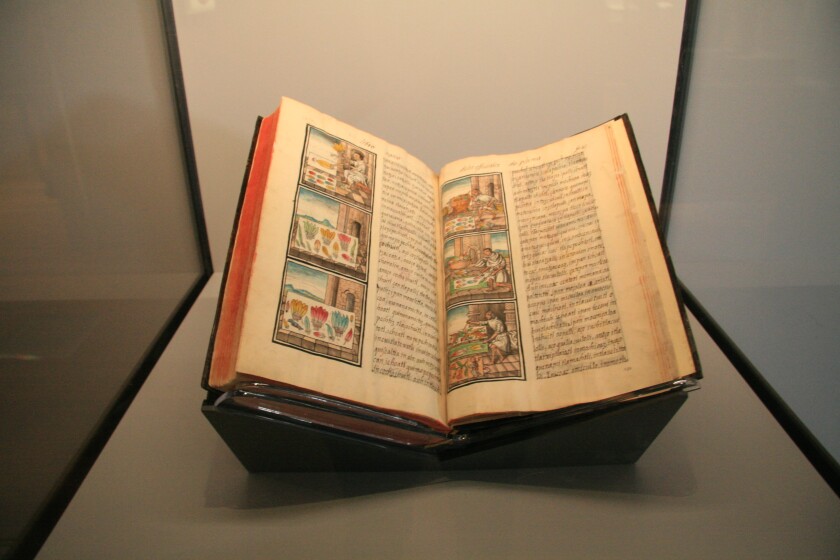
“The General History of the Things of New Spain” — better known as the Florentine Codex — is a massive 2,000-page compendium of Nahua (a.k.a. Aztec) life in the Valley of Mexico, where Mexico City is now located. In both Spanish and Nahuatl (the Nahua language), the codex is composed of 12 handwritten books featuring almost 2,500 illustrations, which are bound into three massive volumes that now reside at the Laurentian Library in Florence, Italy.
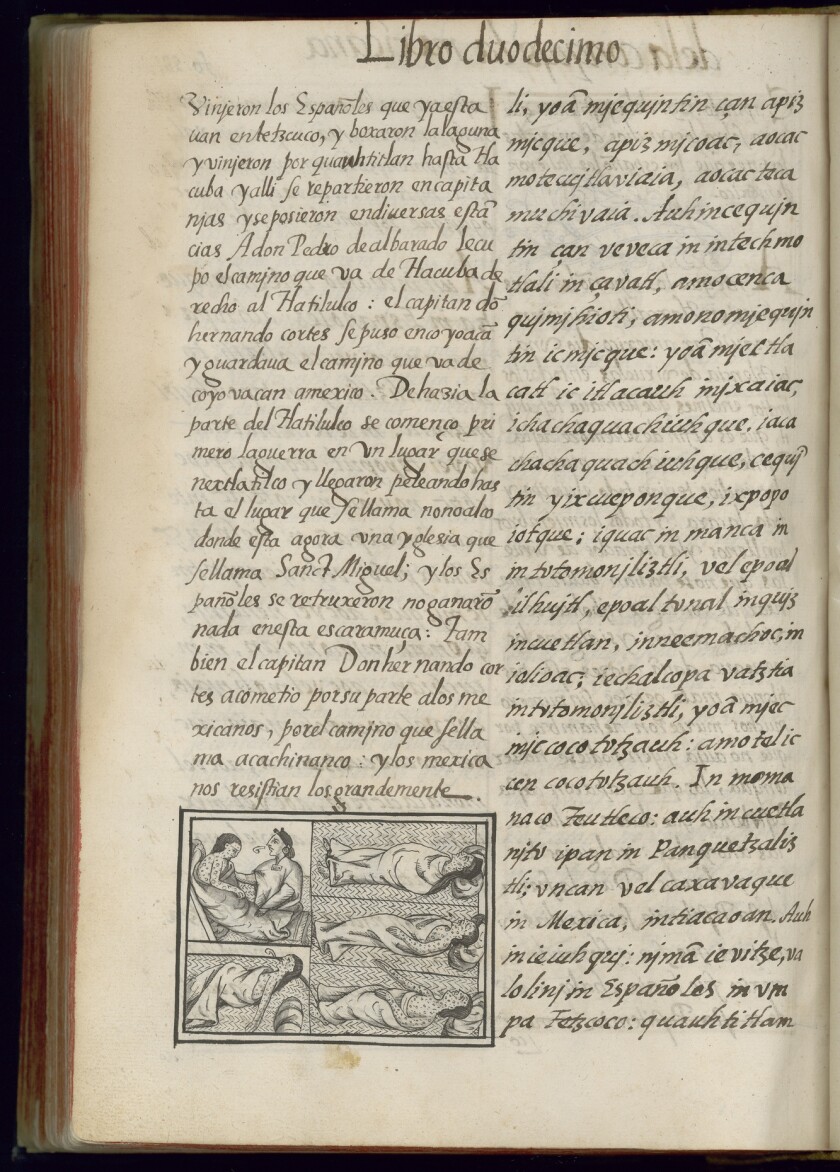
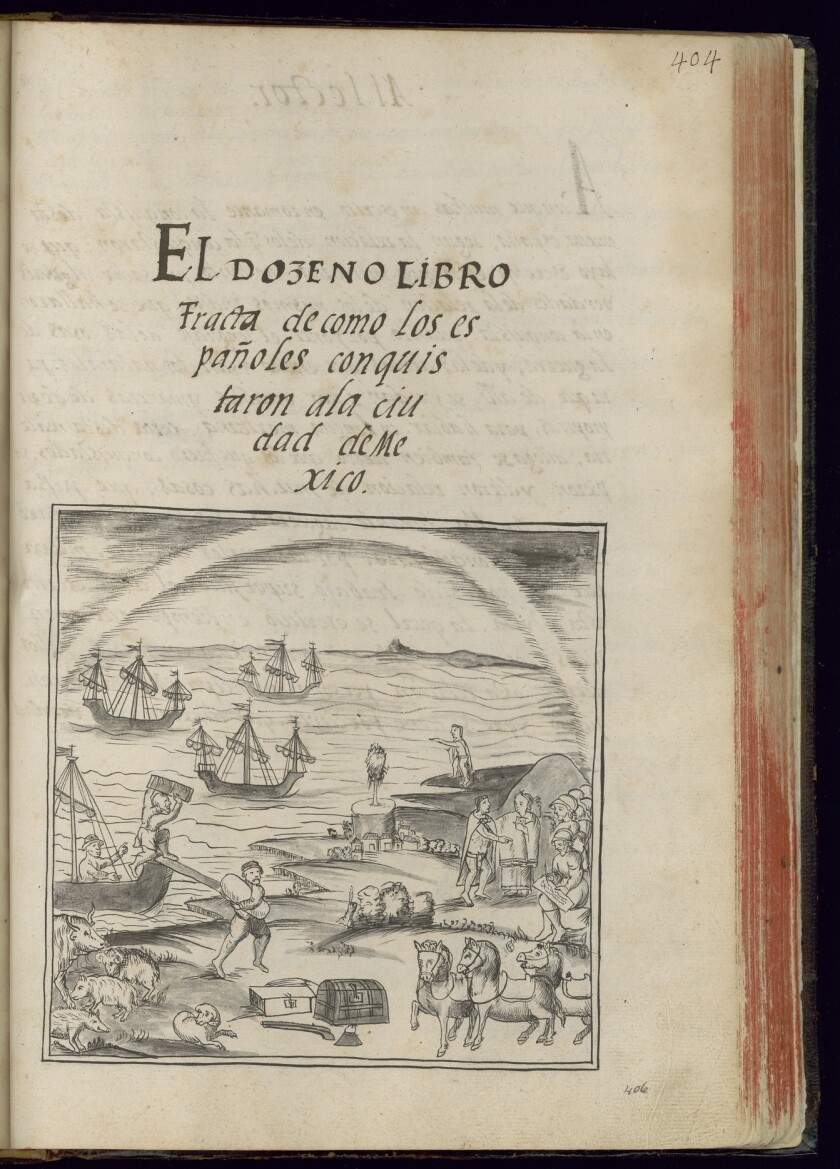
The last two books were created during a smallpox pandemic. As the contagion took its toll and supply lines for pigments fray, color disappears from the illustrations partway through Book 11. By Book 12, it’s as if all life has been drained out of it.
“To read that and see it,” says Mesoamerican scholar Kim Richter of the Getty Research Institute, “we can empathize with this text in a very different way now.”
If before the plague their goal was to create a historical record, it’s now become a race against time and disease: The pandemic is claiming lives outside of their walls. They continue to work even as they run out of pigments to color the illustrations that will accompany their text. It is simply too risky to leave the safety of their cloister to go looking for supplies.
“I don’t know how long it will last or how much harm it will do,” writes Bernardino de Sahagún, the Franciscan friar in charge of the endeavor. “I don’t know what will be of this pestilence.”
In a world turned head over heels by the new coronavirus, it is instructive to look at another cataclysm: the Americas during the 16th century, when European colonization shattered the old indigenous order through war, settlement and, most notably, disease. And not just one disease but several. A lethal cocktail of smallpox, measles and influenza — European illnesses to which indigenous people had no immunity — that decimated populations all over the continent.
(A study published by scientists at University College London in 2018 estimates that 90% of indigenous populations throughout the Americas died from disease in the 16th century — so many it cooled Earth’s climate for a number of decades as untended fields were taken over by carbon dioxide-absorbing overgrowth. It’s an event referred to as “the Great Dying.”)
I buried more than 10,000 bodies, and at the end of the epidemic, I caught the illness and was very ill.
BERNARDINO DE SAHAGÚN, FRANCISCAN FRIAR
In Mexico, this played out in a series of pandemics throughout the 16th century. The first, in 1520, came a year after explorer Hernán Cortés arrived on the shores of the Yucatán Peninsula.
“There came to be prevalent a great sickness, a plague,” reports Book 12 of the Florentine Codex on this terrible event. “There was indeed perishing; many indeed died of it. ... No longer could they move, no longer could they bestir themselves ... And when they bestirred themselves, much did they cry out.”
Similar pandemics struck in 1555 and 1576, the latter being the one that Sahagún refers to in the section in which he wrote: “Since the plague started until today ...the number of dead has increased; ten, twenty, thirty, forty, fifty, seventy, eighty die everyday.”
A page from Book 12 of the Florentine Codex records an early smallpox pandemic in colonial Mexico.
(Biblioteca Medicea Laurenziana / By permission of MiBACT)
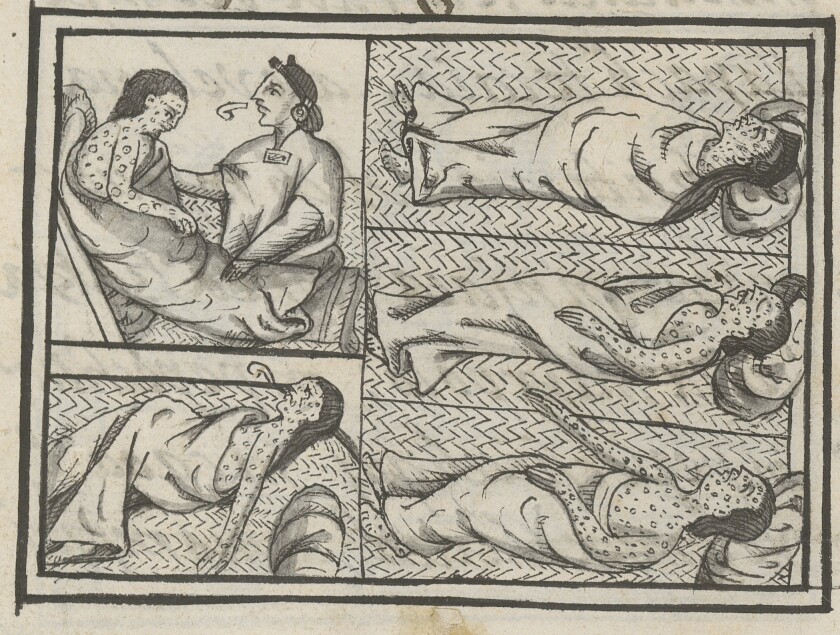
An illustrated detail shows a healer caring for patients lying on petates.
(Biblioteca Medicea Laurenziana / By permission of MiBACT)
If the Florentine Codex marks the creation of a historical artifact — and a brilliant, richly layered work of art — in the face of certain death, it is also an object that speaks to survival and resilience.
It is the story of a group of authors determined to record their history even as fatal illness strikes just beyond their walls.
It is also the story of a book, and the knowledge contained within it, that, against all odds, endured the ravages of history. Shortly after it was created it was sent to Spain, after which its whereabouts remained uncertain for centuries. It reemerged in Italy in the late 18th century — a time capsule of indigenous life, fully intact.
“It’s a connection to that world — all the animals, all the beings,” says Magaloni, who is a deputy director at the Los Angeles County Museum of Art. “It’s comprehensive knowledge. It’s something amazing.”
And it continuously reaches into the present.
This is partly because of the work of organizations like the Laurentian Library, which has lovingly preserved it, and the Getty Research Institute, which is currently funding a digitization effort that is creating a high-resolution scan of the codex, which it aims to put online by 2022 — with translations and tagged, searchable images.
But it has also remained alive through the work of scholars who have studied it for more than a century, and through the artists who have long been inspired by its virtuosity. (Over the last decade, volumes from the codex have been displayed around Los Angeles at the Getty Villa, the Getty Museum and the Huntington Library, Art Museum, and Botanical Gardens.)
Los Angeles painter Sandy Rodriguez creates contemporary paintings using materials of pre-Columbian artists, such as cochineal and mineral oxides. She is a student of the codex and its artistic methodologies, and for a recent show at L.A.'s Charlie James Gallery, which focused on the stories of Central American children who have died while in the custody of U.S. immigration authorities, she gathered a group of poets to create work inspired by Book 12 of the Florentine Codex, which tells the story of the conquest.
“We talked about imagining being one of the tlacuilos [scribes], sequestered and writing your history,” she says, “not being able to go out and get your materials.”
By the time of the show’s March 7 closing, the severity of the coronavirus pandemic had become all too evident in the U.S. — and what had been an interesting historical exercise now had new meaning.
“It’s like we performed this contemporary history in this contemporary moment,” she says.
It’s a moment, Rodriguez says, that she is still trying to process.
It goes without saying that the “Historia General de las cosas de la Nueva España,” as the Florentine Codex was originally titled in Spanish, wasn’t created simply because the Franciscans were in love with Aztec learning. Sahagún conceived of it as an anthropological tool that could provide an understanding of indigenous belief systems, and therefore help facilitate the conversion of the Nahua to Christianity.
To this end, he recruited a group of young men from the Colegio de Santa Cruz to help him research, write and illustrate the epic undertaking.
The colegio had been established at the Convent of Santiago in Tlatelolco in 1536 as a place to acculturate the sons of indigenous nobility to European ways, instruct them in a variety of subjects, and prepare some of them for eventual priesthood and, therefore, further Christian proselytizing. These were the intellectual crème de la crème of early Mexican society and they learned to read and write in a variety of languages, including Spanish, Latin and Nahuatl. (Already Spanish friars had devised a system of writing the previously unwritten Nahuatl using the Latin alphabet.)
It is estimated that Sahagún began work on the project in the late 1540s, assembling draft manuscripts (such as the Códices Matritenses, which still survive) and attempting to devise a taxonomy for how the tome would be organized. In its format and its ambitious scope, it nods to the work of the ancient Roman scholar Pliny the Elder and his “Naturalis Historia” (“The Natural History”).
“It’s based on the concept of the European encyclopedia,” explains Richter. “But it’s focusing on the cultures of the Aztecs and written in the generation after the conquest of the Aztec Empire.”
Sahagún ultimately settled on a bilingual, two-column system, one written in Spanish, the other in Nahuatl, that would cover the breadth of Nahua life: landscape, minerals, animals, food, belief systems, history, art, architecture, social classes and more. There is even an entry on “malas mugeres” — “bad women,” to quote the early modern Spanish — or sex workers.
What makes the book so dynamic is that the codex isn’t mere observation. The indigenous scholars working on the project — Antonio Valeriano, Alonso Vegerano, Pedro de San Buenaventura, Martín Jacobita, Diego de Grado, Bonifacio Maximiliano and Mateo Severino, among others — were actively interviewing the communities from which they hailed.
“They are capturing what their elders are saying, but also their colonial reality,” says Rebecca Dufendach, a research specialist at the Getty Research Institute who has been working with the codex for a decade. “They are trying to capture this world of knowledge.”
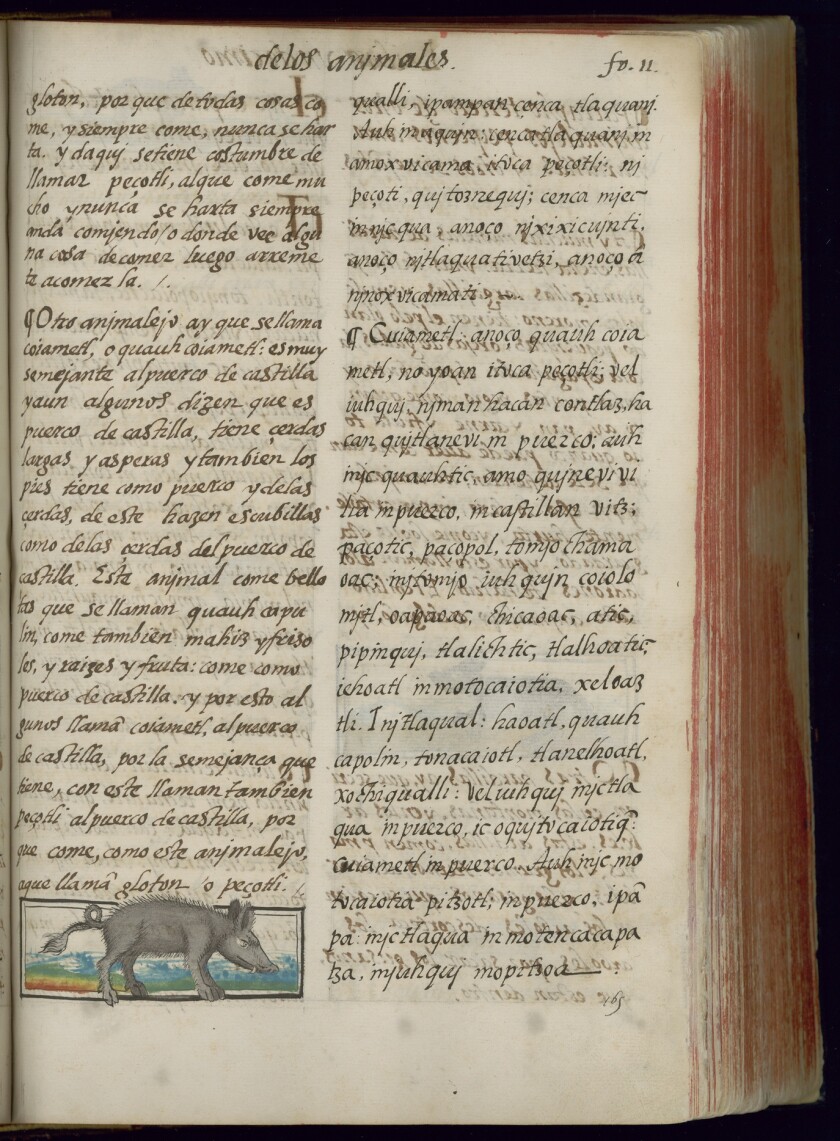
A page from Book 11 of the Florentine Codex, about Mexico’s natural history, features a buoyant illustration of a peccary. Spanish text is on the left, Nahuatl on the right.
(Biblioteca Medicea Laurenziana / By permission of MiBACT)
The Codex therefore reflects a distinct Nahua point of view — one that bears the imprint of people who had memory of a world before the arrival of the Spanish.
It is believed that the Nahuatl text was written first and the Spanish came after. “The Spanish is usually called a translation, but it’s more of an interpretation,” says Richter. “In some places, [Sahagún] leaves the Spanish out completely. At other times, he provides more interpretation.”
This means that the Florentine Codex isn’t simply a bilingual record of events, it’s a pair of world views, presented side by side.
Book 12, which focuses on the Spanish invasion, tells the story of the Matanza de Tóxcatl — known in English as the Massacre in the Great Temple, which took place in May 1520. In that event, Spanish soldiers massacred a group of indigenous nobles celebrating a religious ceremony at the Templo Mayor, an event whose brutality reverberated through the region.
“The Spanish text states very clearly: Here was this ritual that was happening and Pedro de Alvarado went in and killed innocent people,” says Richter. “They aren’t hiding it. But when you read the Nahua text, it’s a gruesome painful thing to read. Nahua is so poetic and it has certain repetitions. The cutting of the flesh and the cracking of bones and people trying to walk and their guts spilling.
“I get goose bumps thinking about it because it’s so awful.”
The first page of Book 12 of the Florentine Codex, showing the arrival of the Spanish to the Gulf of Mexico.
(Biblioteca Medicea Laurenziana / By permission of MiBACT)
These different worldviews are brought to bear in the sections that describe disease.
Dufendach says that Spanish texts frequently frame the smallpox pandemics as an act of God. “Sahagún says in the Codex, these people have diminished because of the plagues that God sends them,” she explains.
Whereas the Nahua texts attribute the pandemics to the indigenous concept of tlazolli. “It’s this invasion of filth that has caused the disruption of their entire society,” she explains. “It was not just the war-time invasion but a moral invasion.”
In many cases, the Nahuatl language had absorbed lone Spanish words to describe phenomena introduced by the Europeans — such as the word caballo, for horse. But Dufendach says the Codex never really embraces the use of viruela, the Spanish word for smallpox, in the portions that are written in Nahuatl.
“They are understanding it on their terms,” she says. “They are trying to describe it in the Nahua language.”
Disease shaped not just the ideas in the Florentine Codex, but its manufacture.
Sahagún interrupts an entry on Mexican road systems in Book 11 to write, in first person, about plagues past and present — including the one in 1555. “I buried more than 10,000 bodies,” he writes, “and at the end of the epidemic, I caught the illness and was very ill.”
In fact, it is partway through that book — about the natural world — in which color begins to disappear as the pandemic of 1576 begins to claim victims, disrupt supply lines and force its authors into quarantine.
Though it was set down on European wood-pulp paper, the pigments and other materials used for illustrations are almost entirely Nahua in origin: cochineal for red, indigo for blue, clays and orchid gums used to change tones and fix colors. Almost 500 years later, they remain in dazzling shape.
“What always strikes me is how crisp and how fresh these books look,” says Richter. “It’s so different when you hold the real thing in your hand. The colors, they look like they were painted yesterday.”
One of the three volumes of the Florentine Codex on view at the Getty Museum in the exhibition “Golden Kingdoms: Luxury and Legacy in the Ancient Americas,” which opened in the fall of 2017.
(J. Paul Getty Museum)
As they ran out of color, scribes used coded images to denote the tones of an object — say, placing a ladybug next to a flower to mark the red of its petals. They also reserved what pigments they had for the most important images.
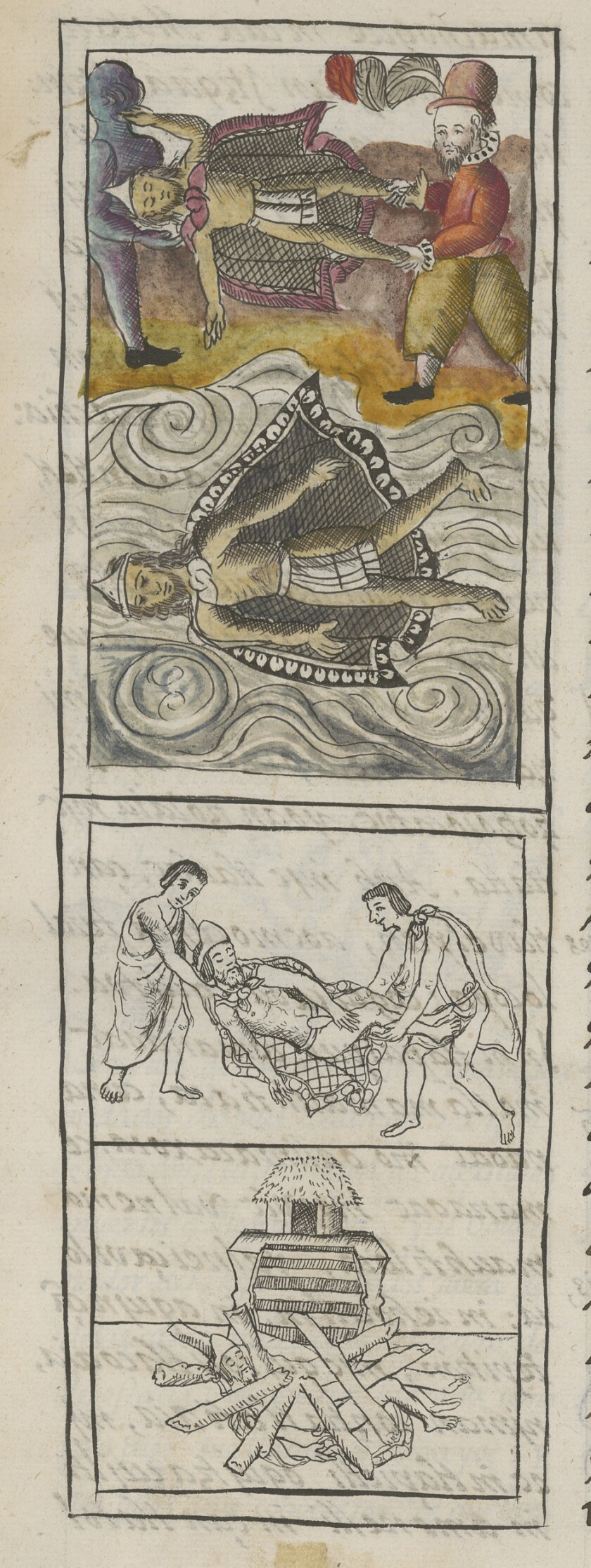
Book 12, the final book, contains only three color illustrations: one in which Cortés and his men are seen entering the Valley of Mexico, featuring a landscape rendered in brilliant shades of Mayan blue and green. Another shows the moment in which a pair of indigenous armies have defeated the Spanish in battle. The last shows two Spanish soldiers casually disposing of the dead bodies of Moctezuma and Itzquauhtzin, the leaders of Tenochtitlán and Tlatelolco, respectively.
“They were saving their pigments for things that were meaningful,” says Magaloni. “The world of color has meaning for them.”
There are three illustrations on the page that features Moctezuma and Itzquauhtzin. Only the image of the fallen indigenous leaders receives color.
A detail from Book 12 shows Spaniards tossing the dead bodies of Moctezuma and Itzquauhtzin into a canal. The artists reserved scarce pigments for this important scene.
(Biblioteca Medicea Laurenziana / By permission of MiBACT)
Little is known about the scholars who created the Florentine Codex or how they lived. Magaloni imagines a high degree of dedication — scholars attempting to put the world of their elders on paper, before it disappears — but also of deep introspection.
“It’s the opportunity to go inside ourselves and think about what we are doing,” she says, “to think about the most important things we could be doing.”
For Rodriguez, that means continuing to paint — much like the scribes of the 1570s.
“I’ve been burning my sage and my copal and asking for strength,” she says. “There would be no sanity to my world if I didn’t get up and read and then paint for a few hours.”
While others were out buying toilet paper, she was stocking up on her materials.
“I will have the supplies,” she says, “to tell the story of whatever goes down.”