Translate

Showing posts with label Aztecs. Show all posts

Sunday, March 30, 2025

POWERFUL TEXT FOR THESE TIMES: The Broken Spears (La Visión de lo Vencidos) by Miguel Leon Portilla

Friends,

I encourage everyone to read the truly magisterial text published in 1959 by the Universidad Nacional Autónoma de México (UNAM), The Broken Spears: The Aztec Account of the Conquest of Mexico by Dr. Miguel León-Portilla. Originally compiled from texts written in Nahuatl and translated into Spanish before being rendered into English by Lysander Kemp, this work provides invaluable insight into the Indigenous perspective on the Spanish conquest. The illustrations in the text, adapted from original paintings found in authentic codices, were created by Alberto Beltrán.

A crucial clarification: Dr. Miguel León-Portilla (February 22, 1926 – October 1, 2019) did not write The Broken Spears himself, aside from his introduction. Instead, this text is a meticulously compiled historical record that preserves firsthand Indigenous accounts written in the aftermath of the Spanish invasion of Tenochtitlán, now Mexico City. It's chock full of lessons for today—like right now with the dismantling of our own government institutions and processes.

The Broken Spears draws on evidence from codices and other writings, including formal pleas to King Philip of Spain, imploring his mercy in light of the devastation and trauma suffered by the Aztecs, or Mexica [pronounced me-chí-ca], following the Spanish-led invasion and the ultimate fall of Tenochtitlán in 1521. These accounts acknowledge the complexity of Indigenous responses to the Spanish presence—some groups aligned with Hernán Cortés, believing they were securing their own futures, only to have their trust cruelly betrayed by the invaders.

I sympathize with those who sought peace, for among the Mexica were true peacemakers who hoped for a harmonious coexistence. Yet their choices had lasting, unintended consequences, as is evident from the sorrowful and tragic letters to King Philip. The Indigenous peoples were divided, and some found elements of Christian teachings resonant with their own worship of the Sun God, making conversion to Christianity less alien than commonly assumed.

This text offers an unflinching and vivid portrayal of the fall of Tenochtitlán, immersing readers in the catastrophe as if it had happened yesterday. The narrative is gripping, haunting, and profoundly moving. Even after reading Dr. León-Portilla’s introduction—which is fascinating in its own right—one cannot help but be drawn deeply into the Indigenous testimonies. I highly recommend the audiobook version, which powerfully conveys the intensity of the events described.

Without a doubt, despite his extensive scholarship, The Broken Spears stands as Dr. León-Portilla’s most significant and enduring contribution. He was one of Mexico’s greatest anthropological minds, and La Visión de los Vencidos (the Spanish title of The Broken Spears) remains a groundbreaking work in the study of Indigenous perspectives on the conquest. It gives voice to the Nahuatl people, who perhaps foresaw that future generations would read their words and bear witness to their suffering and resilience. How prescient and thoughtful our ancestors were.

What I additionally find fascinating is it captures a moment in world history before the concept of race or racism existed, but rather ethnicity, including among the "Tenoch" peoples themselves and beyond. 

I look forward to a reading group we have formed that is dedicated to discussing this essential text, and I encourage all of you to read it as well. For ease of reference, I have included a video of Dr. León-Portilla speaking about The Broken Spears, as well as a Wikipedia entry on Miguel León-Portilla. 

Angela Valenzuela


Miguel León-Portilla (22 February 1926 – 1 October 2019)[1] was a Mexican anthropologist and historian, specializing in Aztec culture and literature of the pre-Columbian and colonial eras. Many of his works were translated to English and he was a well-recognized scholar internationally. In 2013, the Library of Congress of the United States bestowed on him the Living Legend Award.[2]

Early life and education[edit]

Born in Mexico City, Miguel León-Portilla had an interest in indigenous Mexico from an early age, fostered by his uncle Manuel Gamio, a distinguished archeologist. Gamio had a lasting influence on his life and career, initially taking him as a boy on trips to important archeological sites in Mexico and later as well.[3] León-Portilla attended the Instituto de Ciencias in Guadalajara and then earned a B.A. (1948) and M.A. summa cum laude (1951) at the Jesuit Loyola University in Los Angeles. Returning to Mexico in 1952, he showed Gamio a play he had written on Quetzalcoatl, which resulted in Gamio introducing his nephew to Ángel Garibay K., whose publications in the 1930s and 1940s first brought Nahuatl literature to widespread public attention in Mexico. Needing to make a living, León-Portilla began attending law school and worked at a financial firm. At the same time he taught at Mexico City College, an English-language school in the Condesa neighborhood. Other instructors included important scholars of Mexican indigenous history and culture, Wigberto Jiménez Moreno, Fernando Horcasitas, and Eduardo Noguera. Gamio persuaded León-Portilla to drop his law studies and job in business to work at the Inter-American Indian Institute [es; pt], a specialized organization of the Organization of American States,[4] which Gamio directed.[5] León-Portilla began graduate studies at the UNAM, completing his doctoral dissertation, La Filosofía Náhuatl estudiada en sus fuentes, in 1956, which launched his scholarly career.[6]

Career[edit]

His dissertation on Nahua philosophy was published in Mexico, and then translated to English as Aztec Thought and Culture: A Study of the Ancient Nahuatl Mind (1967) and then many other languages.[7] It was the first of his many works to be translated to English. His translations of Nahuatl and Spanish texts on the conquest of Mexico, first published in Mexico as Visión de los vencidos, translated to English as The Broken Spears, is the way many undergraduate students in the United States are introduced to accounts from indigenous participants and not Spanish conquistadors.[8]

León-Portilla spearheaded a movement to understand and re-evaluate Nahuatl literature and religion, not only from the pre-Columbian era, but also that of the present day, especially since Nahuatl is still spoken by 1.5 million people.[2] His works in English on literature included Pre-Columbian Literatures of Mexico (1986),[9] Fifteen Poets of the Aztec World (2000),[10] and with Earl Shorris, In the Language of Kings: An Anthology of Mesoamerican Literature, Pre-Columbian to the Present (2002).[11] He also compared the literature of the Nahuas with that of the Inca.[12] Another area of research was on indigenous religion and spirituality, with works including Native Meso-American Spirituality (1980),[13] and South and Meso-American Native Spirituality: From the Cult of the Feathered Serpent to the Theology of Liberation (1997).[14] He also published a work on the Maya, Time and Reality in the Thought of the Maya (1990).[15]

León-Portilla was instrumental in bringing to light the works of Franciscan Fr. Bernardino de Sahagún, a 16th-century primary source on the Aztec civilization, whose twelve-volume General History of the Things of New Spain, often referred to as the Florentine Codex, are crucial for understanding Nahua religion, society, and culture, as well as for providing an account of the conquest of Mexico from the Mexica viewpoint. León-Portilla was the first to denote Sahagún as the "Father of Anthropology in the New World".[16]

He contributed to the understanding of the development of the field of Mesoamerican history in Mexico. With Garibay, León-Portilla made contributions to the study of nineteenth-century Mesoamerican historian Manuel Orozco y Berra.[17][18] León-Portilla also published two volumes on the work of Mesoamerican humanists, including his mentor Garibay.[19]

In the field of colonial Nahuatl studies, particularly the New Philology, León-Portilla's work on a collection of late sixteenth-century wills in Nahuatl, The Testaments of Culhuacan, contributed to the understanding of local-level interactions within a Nahua town.[20][21]

A subordinate but important interest of León-Portilla was the early history and ethnography of the Baja California Peninsula. He addressed this region in more than 30 books and articles, including a 1995 volume collecting several of his earlier publications.[22]

Early in his academic career in 1969, he was awarded a Guggenheim Fellowship.[23] That was the first of many academic awards and recognitions, including the Belisario Domínguez Medal of Honor, the highest award bestowed by the Mexican Senate. In 1970, he was elected to membership of Mexico's National College[24] and, in 1995, to membership of the United States National Academy of Sciences.[25] From 1987 to 1992, he served as his country's permanent delegate to UNESCO, during which time he successfully nominated five pre-Columbian sites in Mexico for inclusion on the World Heritage List.[26] On 12 December 2013, León-Portilla received the Living Legend Award from the U.S. Library of Congress.[2] He was also a member of the Mexican Academy of Language and the Mexican Academy of History.[27]

Personal life[edit]

León-Portilla married Ascensión Hernández Triviño, a Spanish linguist and academic, in 1965. Their daughter, Marisa León-Portilla, is also a historian.[28]

León-Portilla died in Mexico City on 1 October 2019 after having been hospitalized for much of the year.[29] The federal Secretariat of Culture announced that his body would lie in state on 3 October 2019 at the Palacio de Bellas Artes.[29]

Notable works[edit]

Monday, October 26, 2020

Foods of the Americas: Amaranth, the Outlaw Grain, by Chola Con Chelo

Fascinating read on how it came to be that a food so nutritious to Mesoamerican peoples could be so dangerous that it was outlawed, especially since it helped form the "near-perfect core" of their diet. I think that all of the reasons provided below are mutually consistent in explaining why it was banned, particularly considering the end-goal of weakening native peoples so that they could be conquered and colonized.

If you've not tasted it, it's delicious. You find it in some cereals in some stores. I like it in my smoothies. I've eaten it in mole in Mexico, too. I was not aware of any of these aspects of its history, however, that I indeed find intriguing. 

-Angela Valenzuela

Foods of the Americas: Amaranth, the Outlaw Grain

By Chola con Chelo | Nov. 18, 2017

Huaútli is the Aztec name for a plant so important to the people, it was banned by the invading Spanish Empire led by Hernán Cortez and the Catholic Church in 1519.


Today huaútli is most commonly known as amaranth, a super-food gaining worldwide recognition as a high-protein plant edible that could easily figure into the solution for world hunger. Although not considered a grain, the tiny amaranth seeds contain eight to nine grams of protein in a one cup serving, offering a nutritionally complete plant food that has all the essential amino acids needed by the human body, without gluten.


Together with corn, beans and chia, amaranth was a key part of the near-perfect core diet of Mesoamerican Indian civilizations, and a tribute item demanded by the Aztecs. But the invading conquerors prohibited its cultivation and consumption calling it an ungodly pagan food, something full of sin. So for hundreds of years under the rule of Spain, amaranth all but disappeared from the face of the earth except in the highlands of Oaxaca and to the south among the Mayan people where its cultivation most probably began some 10,000 years ago.

Amaranth was a primary crop not only important as food, but central to the spiritual and ritual life of Mesoamerican indigenous civilizations; its precious seeds and leaves were nutritious and therapeutic; it was an offering to the gods as well as the ingredient used by midwives to bathe newborn babies; it was mixed into a paste and transformed into miniature reproductions of the child’s future attributes: a bow, an arrow, the hunter’s instruments; or perhaps a flower or an animal spirit-guide. Amaranth was not only food and medicine for the body it was also valued as a divine plant.

Prized as a gourmet food, amaranth was traditionally prepared like corn: cooked, popped or ground into a flour masa for tortillas, tamales and atolli (atole), a traditional hot beverage.

Image for post
Atolli or Atole, a traditional Mexican hot beverage, can be made of amaranth

But more importantly, it was used in religious rituals offered to certain deities, as a dish called tzoali, a delicacy of popped amaranth and sweet magüey blue agave syrup or honey, mixed together and shaped. Today those same tzoali are called alegrías and can be found in bakeries and stores throughout Mexico and in the Southwestern United States, or anywhere Mexican culture and cuisine flourish.


Today tzoali are called ‘alegrías’, meaning joy or happiness

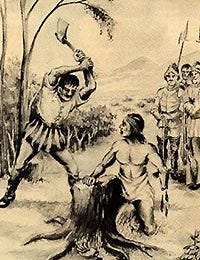
Yet when Spain invaded the Americas, they soon criminalized the cultivation of amaranth, as they did with the quinoa plant in South America. In doing so they banned the cultivation of one the world’s best sources of plant protein. The Spanish Empire imposed the most cruel and uncompromising punishments for growing huaútli, including cutting off the hands of those who dared to plant it.

Image for post
Cutting off the hands of those who dared to plant it

So why did this beautiful nutritious and mystical plant elicit such a savage response from the invaders? This atrocity was most likely triggered by the importance of amaranth both in the people’s diet and in their spiritual life, a plant rightly held in high esteem.

Image for post
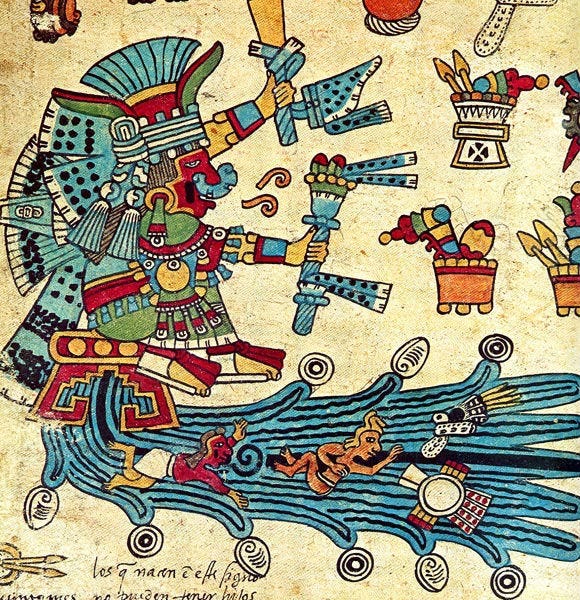
Chalchiutlicue, Aztec Goddess of Waters and Purifier of Newborn Babies

Upon their arrival, the Catholic priests were horrified to find that amaranth was considered a deity and used in religious ceremonial rituals. It was consumed and mixed, according to some sources, with the blood of people who were sacrificed, and was perhaps a tad too close to the religious ceremonial ritual of the holy Eucharist, the Catholic ritual that consecrates the body and blood of Christ and is also eaten. But the Eucharist is of course not considered savagery by the church. To the contrary, it is considered a blessed sacrament.

Mexica Aztec Warriors ate amaranth

As many scholars have noted, amaranth was an important part of the diet of warriors as well as a sacred plant that came into the cross-hairs of the Church’s war against paganism. So the more likely truth is that the criminalization of amaranth was both a military strategy intended to weaken the Aztec people allowing for an easier conquest. It was also a brutal tactic used by Catholic Church to eliminate any practices or evidence of an indigenous religion.

Like all warriors, the Mexica Eagle Guild Warriors ate amaranth and were responsible for fighting off and killing about 80% of the Spanish invaders who died in battle, despite their iron swords and their use of horses and dogs as weapons of war. So it was urgent for the Empire and the Church to weaken and crush the masses of people and their warriors by any


means necessary.

Despite its near extinction, today’s amaranth, the hardy survivor huaútli, can be found in contemporary cooking from granola to pancakes and is once again taking it’s place as an important plant food in defiance of its illicit past.

Diverse varieties of amaranth were cultivated all the way to the lands of the Inca people in the South American Andes, where it is consumed to this day. High in protein and the essential amino acid, lysine, amaranth found its way to Europe and is even consumed in India where it is known as rajeera, or the king’s grain.

How ironic that this offering of forbidden toasted amaranth seeds, held together by the sweetness of agave nectar and honey, made round in the shape of the sun and the circle of life, should survive to be called alegría, happiness or joy. No blood this time. Plenty of that was spilled by the Spanish invaders.

From Mesoamerica to East of The L.A. River, from street vendors to neighborhood mercados, bakeries and marketas you will find amaranth sold as the popular treat called alegría, the Spanish word for happiness or joy.

WRITTEN BY María Elena Gaitán (Chola Con Cello) writes about her obsessions, musings and rants from the heart of the universe, East of the Los Angeles River. This is first in a series about the global contribution, politics and cultural impact of Pre-Columbian foods. Thank you for following.


Friday, March 27, 2020

Small Pox, Historical Memory, and Divergent World Views: A Must-Read in The Time of #Covid19

Here is a definite must-read in the time of #Covid19, written by Los Angeles Times staff writer, Carolina A. Miranda.

Dating back to 1576, the "Florentine Codex" was co-constructed by the conquering and colonizing Spanish missionaries in Tenochtitlan (Mexico City today). 

The "lead editor," if you will, was a Franciscan Friar named Bernardino de Sahagún.  He, along with the "NextGen," post-Spanish-Invasion Mexica (Aztec) students of Tlatelolco in Tenochtitlan, generated this masterful 2,000-page tome.  With it, the students not only chronicled, but also interpreted, their own history and culture—motivated by the specter of annihilation brought on by the smallpox epidemic at the time.

Written in Nahuatl and Spanish in such a way that honored two distinct world views,  the "viruela," or small pox, was interpreted in dramatically different ways:
Dufendach says that Spanish texts frequently frame the smallpox pandemics as an act of God. “Sahagún says in the Codex, these people have diminished because of the plagues that God sends them,” she explains. 
Whereas the Nahua texts attribute the pandemics to the indigenous concept of tlazolli. “It’s this invasion of filth that has caused the disruption of their entire society,” she explains. “It was not just the war-time invasion but a moral invasion.”
At the end of this piece, Miranda considers the deep introspection that the writers of the Florentine Index must have experienced: They saw the world ending as they knew it, and they tasked themselves with chronicling "the breadth of Nahua life."  

Similarly, for us in this moment of quarantine, it's important and healthy to ask ourselves about "the most important things we could be doing.”  At this precise moment, I am pleased to be both blogging and sharing with you these most profound, encouraging texts I've read of late.  

Not only will this all eventually pass, but we can take this opportunity to engender new ways of knowing and being in the world—ways that celebrate and honor our individual and shared histories, languages, cultures, and identities.  Thanks to Juan Tejeda for sharing.

-Angela Valenzuela


How a vital record of Mexican indigenous life was created under quarantine


It is the middle of a plague — “a pestilence so great and universal, that already it has been three months since it started, and many have died and many more continue to die.”
This does little to stop a group of scholars who have sealed themselves off from the world in a Mexico City convent, where they toil on a series of volumes devoted to indigenous knowledge.
He wrote those words in 1576.
Almost 500 years later, they couldn’t be more resonant.
Sahagún’s potent descriptions of a terrible plague are tucked into a colonial encyclopedia created in the late 16th century by a group of indigenous scholars at the Colegio de Santa Cruz de Tlatelolco.
“The General History of the Things of New Spain” — better known as the Florentine Codex — is a massive 2,000-page compendium of Nahua (a.k.a. Aztec) life in the Valley of Mexico, where Mexico City is now located. In both Spanish and Nahuatl (the Nahua language), the codex is composed of 12 handwritten books featuring almost 2,500 illustrations, which are bound into three massive volumes that now reside at the Laurentian Library in Florence, Italy.
The last two books were created during a smallpox pandemic. As the contagion took its toll and supply lines for pigments fray, color disappears from the illustrations partway through Book 11. By Book 12, it’s as if all life has been drained out of it.
“To read that and see it,” says Mesoamerican scholar Kim Richter of the Getty Research Institute, “we can empathize with this text in a very different way now.”
If before the plague their goal was to create a historical record, it’s now become a race against time and disease: The pandemic is claiming lives outside of their walls. They continue to work even as they run out of pigments to color the illustrations that will accompany their text. It is simply too risky to leave the safety of their cloister to go looking for supplies.
“I don’t know how long it will last or how much harm it will do,” writes Bernardino de Sahagún, the Franciscan friar in charge of the endeavor. “I don’t know what will be of this pestilence.”
In a world turned head over heels by the new coronavirus, it is instructive to look at another cataclysm: the Americas during the 16th century, when European colonization shattered the old indigenous order through war, settlement and, most notably, disease. And not just one disease but several. A lethal cocktail of smallpox, measles and influenza — European illnesses to which indigenous people had no immunity — that decimated populations all over the continent.
(A study published by scientists at University College London in 2018 estimates that 90% of indigenous populations throughout the Americas died from disease in the 16th century — so many it cooled Earth’s climate for a number of decades as untended fields were taken over by carbon dioxide-absorbing overgrowth. It’s an event referred to as “the Great Dying.”)
I buried more than 10,000 bodies, and at the end of the epidemic, I caught the illness and was very ill. 
BERNARDINO DE SAHAGÚN, FRANCISCAN FRIAR
In Mexico, this played out in a series of pandemics throughout the 16th century. The first, in 1520, came a year after explorer Hernán Cortés arrived on the shores of the Yucatán Peninsula.
“There came to be prevalent a great sickness, a plague,” reports Book 12 of the Florentine Codex on this terrible event. “There was indeed perishing; many indeed died of it. ... No longer could they move, no longer could they bestir themselves ... And when they bestirred themselves, much did they cry out.”
Similar pandemics struck in 1555 and 1576, the latter being the one that Sahagún refers to in the section in which he wrote: “Since the plague started until today ...the number of dead has increased; ten, twenty, thirty, forty, fifty, seventy, eighty die everyday.”

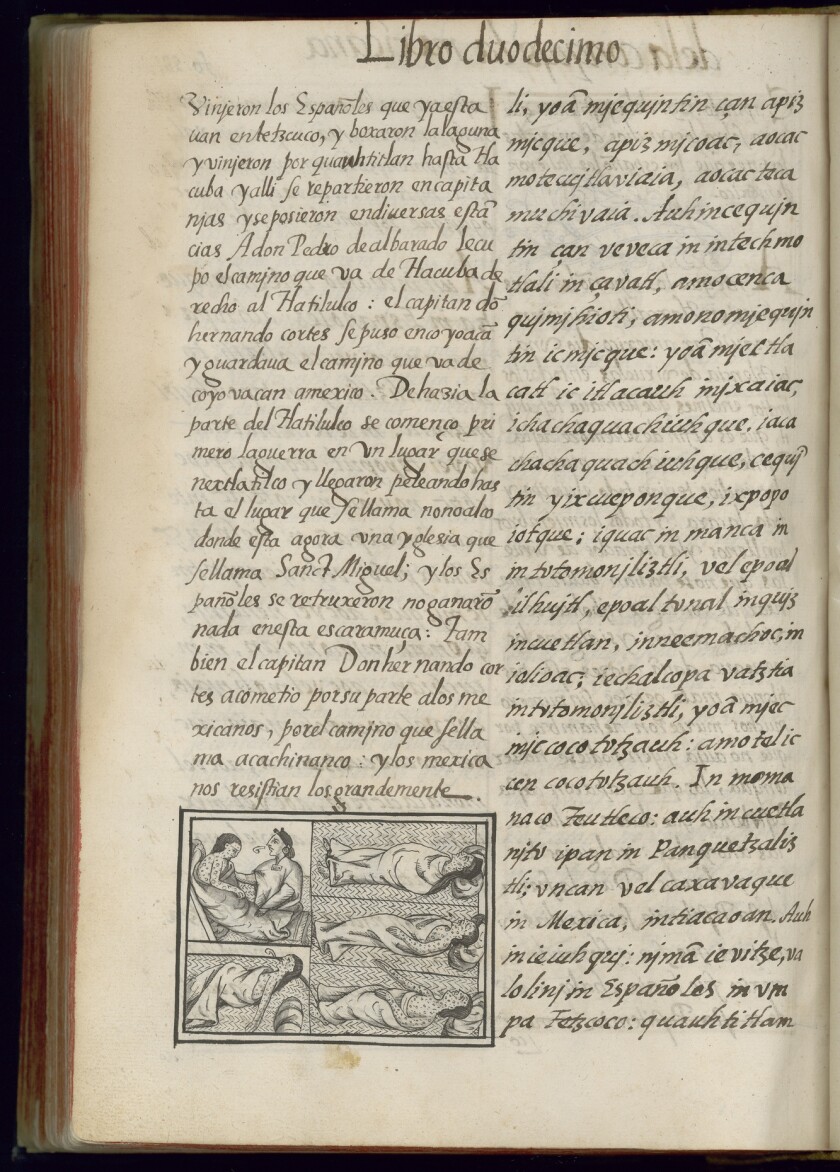
A page from Book 12 of the Florentine Codex records an early smallpox epidemic
A page from Book 12 of the Florentine Codex records an early smallpox pandemic in colonial Mexico.
(Biblioteca Medicea Laurenziana / By permission of MiBACT)

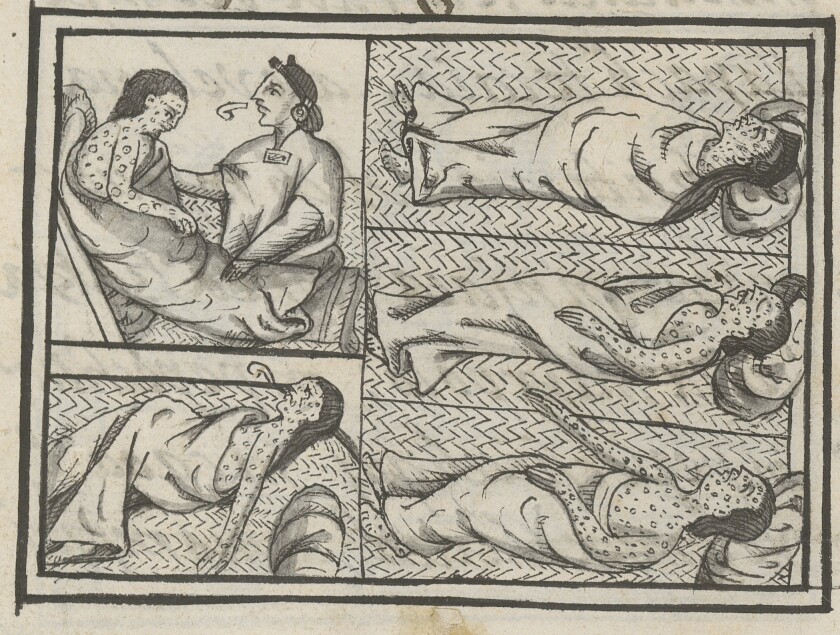
A healer caring for patients suffering from smallpox in Book 12 of the Florentine Codex
An illustrated detail shows a healer caring for patients lying on petates.
(Biblioteca Medicea Laurenziana / By permission of MiBACT)
If the Florentine Codex marks the creation of a historical artifact — and a brilliant, richly layered work of art — in the face of certain death, it is also an object that speaks to survival and resilience.
It is the story of a group of authors determined to record their history even as fatal illness strikes just beyond their walls.
“They would not have seen their mothers, their fathers, their sisters and their brothers,” says Diana Magaloni, author of “The Colors of the New World: Artists, materials, and the Creation of the Florentine Codex.” “And it was so that the memory of them would continue.”
It is also the story of a book, and the knowledge contained within it, that, against all odds, endured the ravages of history. Shortly after it was created it was sent to Spain, after which its whereabouts remained uncertain for centuries. It reemerged in Italy in the late 18th century — a time capsule of indigenous life, fully intact.
“It’s a connection to that world — all the animals, all the beings,” says Magaloni, who is a deputy director at the Los Angeles County Museum of Art. “It’s comprehensive knowledge. It’s something amazing.”
And it continuously reaches into the present.
This is partly because of the work of organizations like the Laurentian Library, which has lovingly preserved it, and the Getty Research Institute, which is currently funding a digitization effort that is creating a high-resolution scan of the codex, which it aims to put online by 2022 — with translations and tagged, searchable images.
But it has also remained alive through the work of scholars who have studied it for more than a century, and through the artists who have long been inspired by its virtuosity. (Over the last decade, volumes from the codex have been displayed around Los Angeles at the Getty Villa, the Getty Museum and the Huntington Library, Art Museum, and Botanical Gardens.)
Los Angeles painter Sandy Rodriguez creates contemporary paintings using materials of pre-Columbian artists, such as cochineal and mineral oxides. She is a student of the codex and its artistic methodologies, and for a recent show at L.A.'s Charlie James Gallery, which focused on the stories of Central American children who have died while in the custody of U.S. immigration authorities, she gathered a group of poets to create work inspired by Book 12 of the Florentine Codex, which tells the story of the conquest.
“We talked about imagining being one of the tlacuilos [scribes], sequestered and writing your history,” she says, “not being able to go out and get your materials.”
By the time of the show’s March 7 closing, the severity of the coronavirus pandemic had become all too evident in the U.S. — and what had been an interesting historical exercise now had new meaning.
“It’s like we performed this contemporary history in this contemporary moment,” she says.
It’s a moment, Rodriguez says, that she is still trying to process.
It goes without saying that the “Historia General de las cosas de la Nueva España,” as the Florentine Codex was originally titled in Spanish, wasn’t created simply because the Franciscans were in love with Aztec learning. Sahagún conceived of it as an anthropological tool that could provide an understanding of indigenous belief systems, and therefore help facilitate the conversion of the Nahua to Christianity.
To this end, he recruited a group of young men from the Colegio de Santa Cruz to help him research, write and illustrate the epic undertaking.
The colegio had been established at the Convent of Santiago in Tlatelolco in 1536 as a place to acculturate the sons of indigenous nobility to European ways, instruct them in a variety of subjects, and prepare some of them for eventual priesthood and, therefore, further Christian proselytizing. These were the intellectual crème de la crème of early Mexican society and they learned to read and write in a variety of languages, including Spanish, Latin and Nahuatl. (Already Spanish friars had devised a system of writing the previously unwritten Nahuatl using the Latin alphabet.)
It is estimated that Sahagún began work on the project in the late 1540s, assembling draft manuscripts (such as the Códices Matritenses, which still survive) and attempting to devise a taxonomy for how the tome would be organized. In its format and its ambitious scope, it nods to the work of the ancient Roman scholar Pliny the Elder and his “Naturalis Historia” (“The Natural History”).
“It’s based on the concept of the European encyclopedia,” explains Richter. “But it’s focusing on the cultures of the Aztecs and written in the generation after the conquest of the Aztec Empire.”
Sahagún ultimately settled on a bilingual, two-column system, one written in Spanish, the other in Nahuatl, that would cover the breadth of Nahua life: landscape, minerals, animals, food, belief systems, history, art, architecture, social classes and more. There is even an entry on “malas mugeres” — “bad women,” to quote the early modern Spanish — or sex workers.
What makes the book so dynamic is that the codex isn’t mere observation. The indigenous scholars working on the project — Antonio Valeriano, Alonso Vegerano, Pedro de San Buenaventura, Martín Jacobita, Diego de Grado, Bonifacio Maximiliano and Mateo Severino, among others — were actively interviewing the communities from which they hailed.
“They are capturing what their elders are saying, but also their colonial reality,” says Rebecca Dufendach, a research specialist at the Getty Research Institute who has been working with the codex for a decade. “They are trying to capture this world of knowledge.”

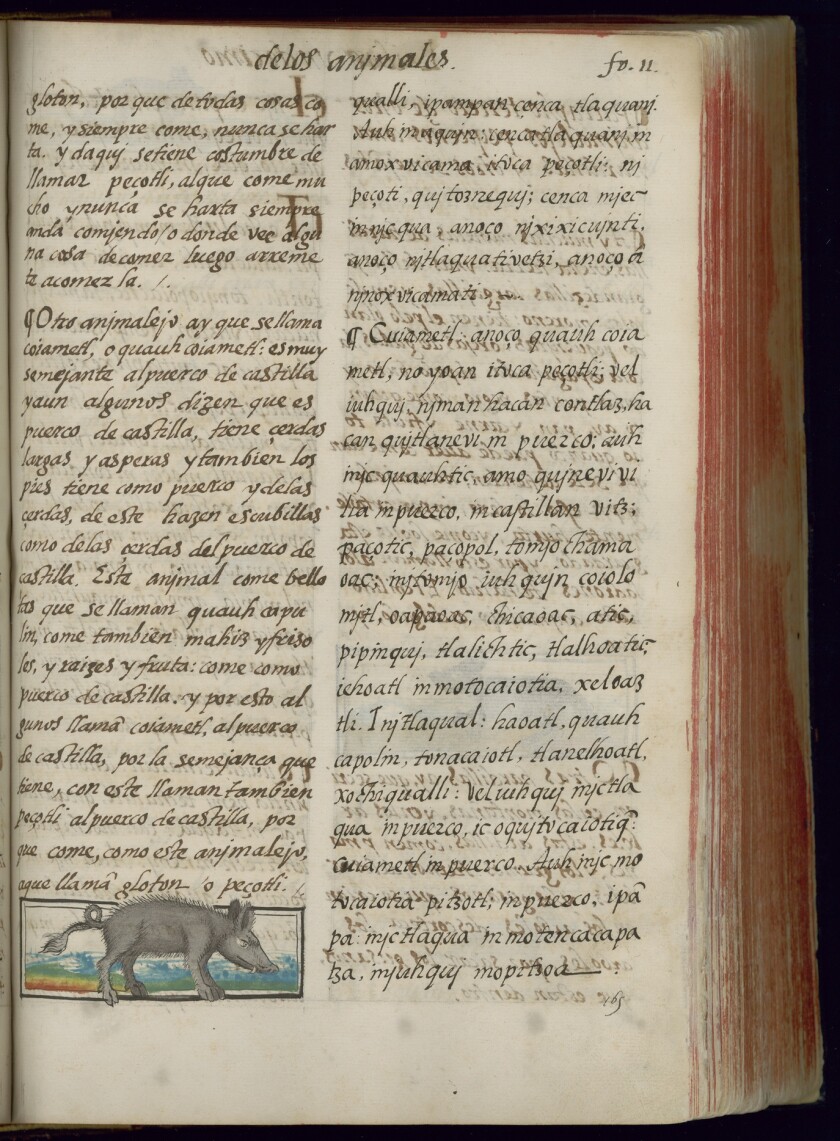
A page from the Florentine Codex features a rather buoyant painting of a peccary
A page from Book 11 of the Florentine Codex, about Mexico’s natural history, features a buoyant illustration of a peccary. Spanish text is on the left, Nahuatl on the right.
(Biblioteca Medicea Laurenziana / By permission of MiBACT)
The Codex therefore reflects a distinct Nahua point of view — one that bears the imprint of people who had memory of a world before the arrival of the Spanish.
It is believed that the Nahuatl text was written first and the Spanish came after. “The Spanish is usually called a translation, but it’s more of an interpretation,” says Richter. “In some places, [Sahagún] leaves the Spanish out completely. At other times, he provides more interpretation.”
This means that the Florentine Codex isn’t simply a bilingual record of events, it’s a pair of world views, presented side by side.
Book 12, which focuses on the Spanish invasion, tells the story of the Matanza de Tóxcatl — known in English as the Massacre in the Great Temple, which took place in May 1520. In that event, Spanish soldiers massacred a group of indigenous nobles celebrating a religious ceremony at the Templo Mayor, an event whose brutality reverberated through the region.
“The Spanish text states very clearly: Here was this ritual that was happening and Pedro de Alvarado went in and killed innocent people,” says Richter. “They aren’t hiding it. But when you read the Nahua text, it’s a gruesome painful thing to read. Nahua is so poetic and it has certain repetitions. The cutting of the flesh and the cracking of bones and people trying to walk and their guts spilling.
“I get goose bumps thinking about it because it’s so awful.”

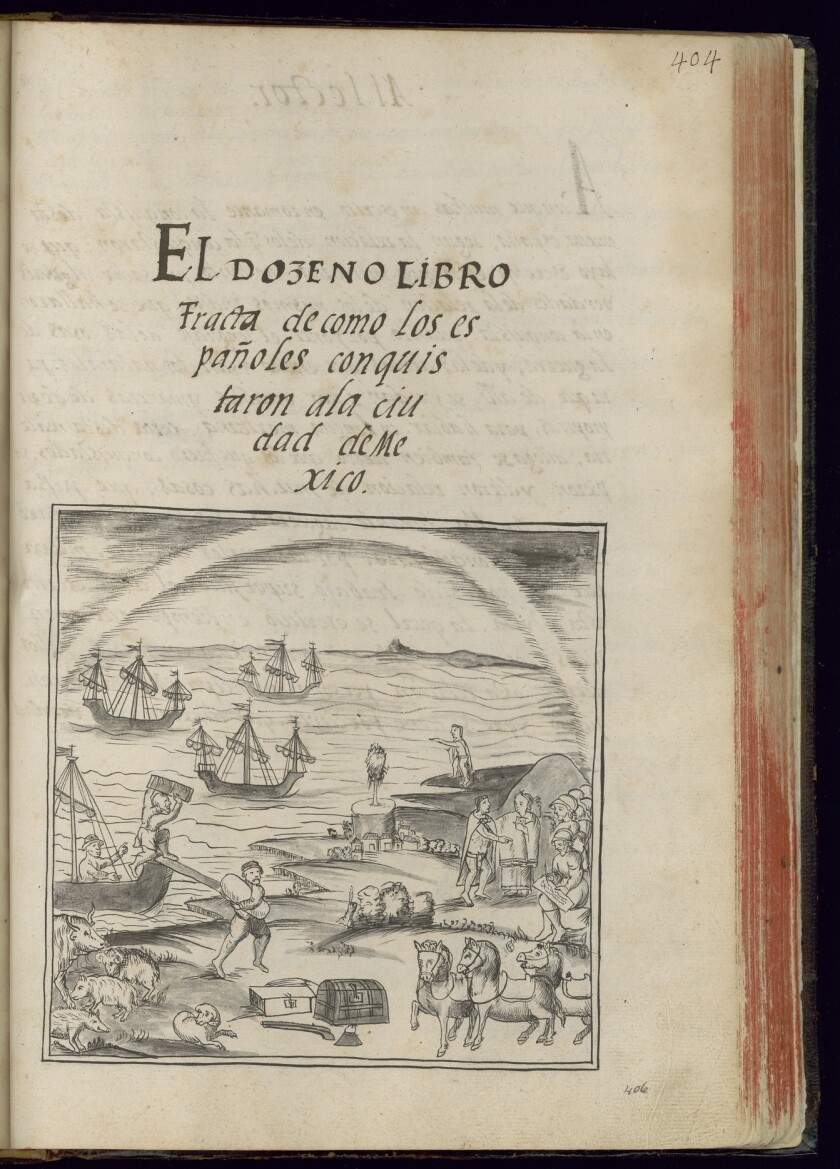
The first page of Book 12 of the Florentine Codex, which details the conquest
The first page of Book 12 of the Florentine Codex, showing the arrival of the Spanish to the Gulf of Mexico. 
(Biblioteca Medicea Laurenziana / By permission of MiBACT)
These different worldviews are brought to bear in the sections that describe disease.
Dufendach says that Spanish texts frequently frame the smallpox pandemics as an act of God. “Sahagún says in the Codex, these people have diminished because of the plagues that God sends them,” she explains.
Whereas the Nahua texts attribute the pandemics to the indigenous concept of tlazolli. “It’s this invasion of filth that has caused the disruption of their entire society,” she explains. “It was not just the war-time invasion but a moral invasion.”
In many cases, the Nahuatl language had absorbed lone Spanish words to describe phenomena introduced by the Europeans — such as the word caballo, for horse. But Dufendach says the Codex never really embraces the use of viruela, the Spanish word for smallpox, in the portions that are written in Nahuatl.
“They are understanding it on their terms,” she says. “They are trying to describe it in the Nahua language.”
Disease shaped not just the ideas in the Florentine Codex, but its manufacture.
Sahagún interrupts an entry on Mexican road systems in Book 11 to write, in first person, about plagues past and present — including the one in 1555. “I buried more than 10,000 bodies,” he writes, “and at the end of the epidemic, I caught the illness and was very ill.”
In fact, it is partway through that book — about the natural world — in which color begins to disappear as the pandemic of 1576 begins to claim victims, disrupt supply lines and force its authors into quarantine.
Though it was set down on European wood-pulp paper, the pigments and other materials used for illustrations are almost entirely Nahua in origin: cochineal for red, indigo for blue, clays and orchid gums used to change tones and fix colors. Almost 500 years later, they remain in dazzling shape.
“What always strikes me is how crisp and how fresh these books look,” says Richter. “It’s so different when you hold the real thing in your hand. The colors, they look like they were painted yesterday.”

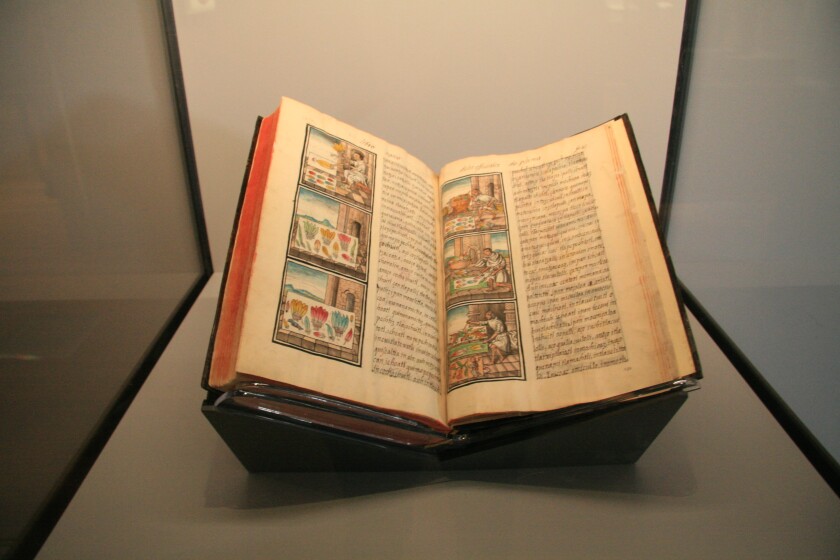
A volume from the Florentine Codex on view at the Getty Museum in “Golden Kingdoms”
One of the three volumes of the Florentine Codex on view at the Getty Museum in the exhibition “Golden Kingdoms: Luxury and Legacy in the Ancient Americas,” which opened in the fall of 2017.
(J. Paul Getty Museum)
As they ran out of color, scribes used coded images to denote the tones of an object — say, placing a ladybug next to a flower to mark the red of its petals. They also reserved what pigments they had for the most important images.
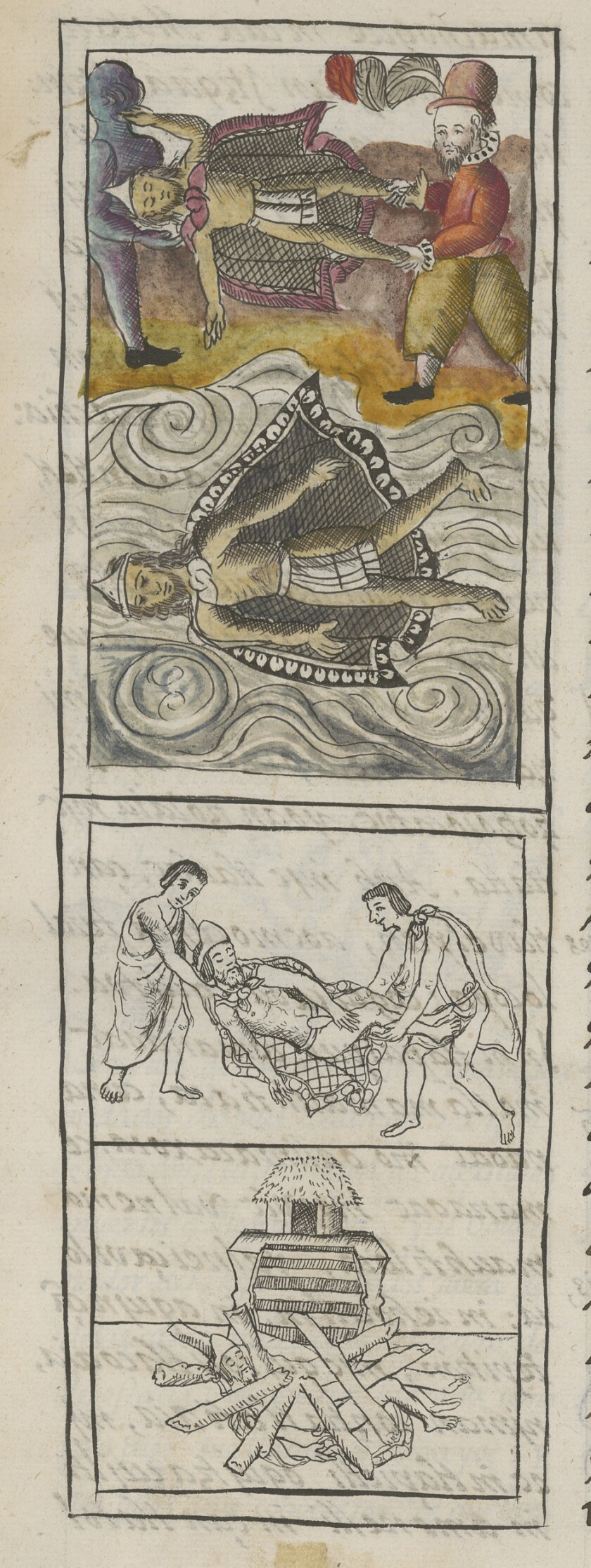
Book 12, the final book, contains only three color illustrations: one in which Cortés and his men are seen entering the Valley of Mexico, featuring a landscape rendered in brilliant shades of Mayan blue and green. Another shows the moment in which a pair of indigenous armies have defeated the Spanish in battle. The last shows two Spanish soldiers casually disposing of the dead bodies of Moctezuma and Itzquauhtzin, the leaders of Tenochtitlán and Tlatelolco, respectively.
“They were saving their pigments for things that were meaningful,” says Magaloni. “The world of color has meaning for them.”
There are three illustrations on the page that features Moctezuma and Itzquauhtzin. Only the image of the fallen indigenous leaders receives color.

A detail from the Florentine Codex shows Spaniards disposing of the dead bodies of leaders Moctezuma and Itzquauhtzin
A detail from Book 12 shows Spaniards tossing the dead bodies of Moctezuma and Itzquauhtzin into a canal. The artists reserved scarce pigments for this important scene.
(Biblioteca Medicea Laurenziana / By permission of MiBACT)
Little is known about the scholars who created the Florentine Codex or how they lived. Magaloni imagines a high degree of dedication — scholars attempting to put the world of their elders on paper, before it disappears — but also of deep introspection.
“It’s the opportunity to go inside ourselves and think about what we are doing,” she says, “to think about the most important things we could be doing.”
For Rodriguez, that means continuing to paint — much like the scribes of the 1570s.
“I’ve been burning my sage and my copal and asking for strength,” she says. “There would be no sanity to my world if I didn’t get up and read and then paint for a few hours.”
While others were out buying toilet paper, she was stocking up on her materials.
“I will have the supplies,” she says, “to tell the story of whatever goes down.”