Translate

Showing posts with label right-wing politics. Show all posts

Sunday, August 16, 2026

Who Gets to Control the University Curriculum? What's Shaping Up at the University of Iowa and Ohio University, by Angela Valenzuela, Ph.D.

Who Gets to Control the University Curriculum? What's Shaping Up at the University of Iowa and Ohio University

by

Angela Valenzuela, Ph.D.

August 15, 2026


University of Iowa—Main Campus

There is a development at the University of Iowa that deserves far more national attention.

The issue is not simply that the university now has a Center for Intellectual Freedom. Universities create centers all the time, including centers devoted to particular schools of thought, political traditions, and areas of intellectual inquiry.

What makes this one different is where its authority comes from and where that authority resides.

The Iowa legislature created the Center for Intellectual Freedom by law as an independent academic center under the Iowa Board of Regents. Its director reports directly to the Board of Regents rather than through the university's ordinary channels of academic leadership and governance. The director also has exclusive authority over hiring and termination within the center (Iowa General Assembly, 2025; University of Iowa, 2026).

And the state's involvement does not stop there.

Beginning with students entering in academic years on or after July 1, 2028, Iowa law requires University of Iowa undergraduates, with specified exceptions, to complete at least six credit hours in designated coursework. At the University of Iowa, the Center for Intellectual Freedom is designated as the sole academic unit responsible for offering courses that satisfy that requirement (Iowa General Assembly, 2026). 

That is not merely another educational experiment.

It represents a significant relocation of curricular power.

Universities have always been places of intellectual disagreement. Indeed, that is part of their purpose. Faculty argue over theories, methods, canons, requirements, evidence, and what constitutes an educated person. Departments disagree. Disciplines change. Students encounter ideas that excite them, unsettle them, and sometimes anger them.

But historically, those arguments have occurred primarily within the academic institution—through faculty deliberation, curriculum committees, departments, colleges, disciplinary standards, and systems of shared governance.

Iowa is moving that boundary.

The state is not simply asking universities to expose students to a wider range of ideas. It has created an academic entity through legislation, placed it under unusual governance arrangements, and guaranteed that entity a privileged position in the undergraduate curriculum.

That distinction matters.

One can strongly support intellectual pluralism—and I certainly do—while still questioning whether legislatures should determine which academic units every undergraduate must encounter in order to receive a degree.

In fact, these positions are entirely compatible.

Genuine intellectual freedom requires argument, experimentation, disagreement, dissent, and intellectual risk. It also requires institutions with sufficient independence to prevent political authorities from determining which intellectual traditions deserve institutional preference.

And Iowa is not alone.

Look at What Is Happening in Ohio.

The mechanism in Ohio is different, but the underlying shift in authority is strikingly similar.

Ohio's 2025 higher education legislation requires public universities to incorporate a state-defined conception of “intellectual diversity” into areas that reach deeply into academic decision-making. At Ohio University, institutional policy implementing the law now applies intellectual-diversity considerations to course approval, approval of general-education courses, student course evaluations, common-reading programs, departmental strategic goals, annual reviews, and student learning outcomes (Ohio Rev. Code § 3345.0217, 2025; Ohio University, 2026).

Consider the significance of that.

The state is no longer simply funding higher education, establishing broad degree requirements, or holding public institutions fiscally accountable. It has introduced a politically defined concept into the processes by which universities determine what courses should exist, what belongs in general education, how departments establish goals, and even how teaching and learning are evaluated.

Ohio law defines “intellectual diversity” in relation to differing perspectives on public-policy questions and separately identifies politically controversial matters such as climate policy, elections, foreign policy, DEI, immigration, marriage, and abortion (Ohio Rev. Code § 3345.0217, 2025).

Ohio has gone further still.

State law requires public universities to develop a three-credit American civic literacy course for students seeking bachelor's degrees. The legislature specifies substantial elements of what students must study, including the Constitution, Declaration of Independence, Federalist Papers, Emancipation Proclamation, Gettysburg Address, Martin Luther King Jr.'s Letter from Birmingham Jail, writings of Adam Smith, and the American economic system and capitalism. Students must also pass a cumulative examination assessing proficiency in the prescribed materials. Institutional trustees must approve the course plan, and the state chancellor reviews the plan and may require revisions (Ohio Rev. Code § 3345.382, 2025; Ohio University, 2025).

Again, my concern is not with teaching these texts.

Students should read the Constitution. They should read the Federalist Papers and the Declaration of Independence. They should read Adam Smith and Martin Luther King Jr. They should encounter competing interpretations of democracy, capitalism, equality, freedom, citizenship, and government.

The problem is not the presence of these ideas.

It is the changing answer to the question: Who decides?

At Iowa, the state has effectively constructed a new curricular lane and directed students into it.

In Ohio, the state has moved into the rules governing the curricular road itself.

Different mechanisms. Similar direction of travel.

Both developments blur an important boundary between legitimate public oversight of public universities and direct political involvement in academic judgment.

That boundary exists for a reason.

The longstanding principles of shared governance hold that faculty bear primary responsibility for curriculum, subject matter, methods of instruction, and degree requirements precisely because these are areas requiring academic expertise and disciplinary judgment. The AAUP has argued for decades that governing boards possess important institutional responsibilities but should overturn faculty academic judgment only under exceptional circumstances (American Association of University Professors [AAUP], 1966). More recently, the AAUP has warned that the erosion of institutional autonomy and shared governance can enable governments and governing boards to exercise increasing control over academic decisions (AAUP, 2026).

This does not mean universities should be unaccountable.

Public universities are public institutions. Legislatures appropriate money. Governing boards have fiduciary responsibilities. The public has every right to demand educational quality, fiscal stewardship, transparency, and accessibility.

But public accountability and political control of knowledge are not the same thing.

And that distinction is becoming increasingly important.

The vocabulary surrounding these interventions can make the shift difficult to see.

“Intellectual freedom.”

“Viewpoint diversity.”

“Civic education.”

“Accountability.”

“Excellence.”

Each refers to something that can be genuinely valuable.

But words can also change political function.

We witness in this moment, for example, the appropriation of broadly appealing democratic language in ways that can obscure a transfer of power occurring underneath it.

Freedom begins to mean something different when the state determines where students must go to receive it.

Diversity means something different when government defines the categories through which intellectual diversity is to be measured.

And institutional autonomy begins to mean very little when outside political bodies increasingly determine which forms of knowledge receive special standing, which criteria govern course approval, and which content students must encounter.

This is not an argument against conservative scholarship, constitutional studies, Western thought, civic education, or any particular intellectual tradition.

Quite the opposite.

A university worthy of the name should be capable of accommodating—and encouraging—serious disagreements among liberal, conservative, radical, religious, secular, nationalist, internationalist, and other intellectual traditions.

But pluralism created through intellectual inquiry is different from pluralism engineered through political authority.

That difference is at the heart of what is unfolding.

And the story extends well beyond Iowa and Ohio.

For readers seeking a deeper understanding of how seemingly separate state-level interventions fit into a broader political strategy, I highly recommend Isaac Kamola’s (2024) Manufacturing Backlash: Right-Wing Think Tanks and Legislative Attacks on Higher Education, 2021–2023. Published by the AAUP, this important report traces the political infrastructure behind the wave of legislation targeting higher education and shows how think tanks, advocacy organizations, model legislation, and state lawmakers have worked across state lines to transform debates over DEI, academic freedom, tenure, governance, and curriculum into a coordinated legislative agenda. 

What can appear, when viewed state by state, as a series of isolated controversies looks quite different when the larger architecture is brought into view. Kamola’s analysis helps us see that Iowa, Ohio, Texas, Florida, and other states should not necessarily be understood as disconnected cases, but as sites where related ideas, legislative strategies, and political networks are being translated into policy (Kamola, 2024).

In Texas, Florida, and other states, political authorities have been altering governance structures, restricting or restructuring academic programs, regulating DEI, modifying tenure and faculty oversight, imposing curricular requirements, and redistributing authority among faculty, administrators, governing boards, and legislatures.

The particulars differ.

The larger question does not.

The struggle over American higher education is increasingly becoming a struggle over the machinery of knowledge itself: who controls academic institutions, who determines what counts as legitimate knowledge, which fields receive resources and protection, what students must learn, and who gets the final word when academics and political authorities disagree.

That is why Iowa and Ohio deserve our attention. Texas universities and other states, obviously, too—and about which I have blogged substantially.

The most important debate may ultimately not be whether our universities contain enough liberal ideas or conservative ideas.

It may be about something more fundamental:

Who gets to decide what a university is for—and who gets to control what happens inside its classrooms?

References

American Association of University Professors. (1966). Statement on government of colleges and universitieshttps://www.aaup.org/reports-publications/aaup-policies-reports/topical-reports/statement-government-colleges-and

American Association of University Professors. (2026, July). Extorted compliance: A threat to institutional autonomy, academic freedom, and shared governancehttps://www.aaup.org/reports-publications/aaup-policies-reports/topical-reports/extorted-compliance-threat-institutional

Iowa General Assembly. (2025). House File 437: Center for Intellectual Freedom Acthttps://www.legis.iowa.gov/docs/publications/LGE/91/HF437.pdf

Kamola, I. (2024). Manufacturing backlash: Right-wing think tanks and legislative attacks on higher education, 2021–2023. American Association of University Professors. https://www.aaup.org/sites/default/files/Manufacturing_Backlash_final_0.pdf

Ohio Rev. Code § 3345.0217 (2025). https://codes.ohio.gov/ohio-revised-code/section-3345.0217

Ohio Rev. Code § 3345.382 (2025). https://codes.ohio.gov/ohio-revised-code/section-3345.382

Ohio University. (2025). Report—American Civic Literacy Course Work Group.
https://www.ohio.edu/provost/projects-initiatives/advance-ohio-higher-education-work-groups/american-civics-literacy-0

Ohio University. (2026). Advance Ohio Higher Education Act compliance (Policy 18.010). https://www.ohio.edu/policy/18-010

University of Iowa. (2026, June 22). Director, Center for Intellectual Freedom (Requisition No. 75977) [Job posting]. https://jobs.uiowa.edu/faculty/view/75977


Sunday, May 02, 2021

Bill to Ban Critical Race Theory from Texas Classrooms Passes House Committee

Friends,

Here is a super concerning bill. Members of the NAACS Tejas Foco, LULAC, TLEEC, and others plan to walk offices tomorrow. Just know that whatever you (think you might) learn from CRT here, the description below is incredibly oversimplified. 

For example, it alleges that "proponents of 'critical race theory' tend to critique equal treatment,"distorts CRT by excluding the principle that sameness in say, a resource or an outcome, relative to other groups, is not always optimal due to a history of unequal needs and circumstances due to segregation, poverty, health and income disparities, access to pre-K, quality teachers, ongoing discrimination, and the like—which is what "equity," not mentioned in this piece, actually addresses.

The deeper issue here is that certain privileged and powerful folks are doing what they can to legislate by fiat what Texas students should be learning in their classrooms, undermining administrator and teacher professionalism, student voice, and ultimately, the franchise.  This, along with current voter suppression bills in the Texas State Legislature (see Senate Bill 7) seek to disenfranchise Texas' growing demographic majority of minoritized youth. 

Do read the House Bill 3979.  It's a piece of work.

Stay tuned. More to come.

Angela Valenzuela


Bill to Ban Critical Race Theory from Texas Classrooms Passes House Committee

The legislation would also apply to fostering blame or guilt based on sex. It targets teacher training as well as the classroom.
 APRIL 28, 2021 | The Texan

https://thetexan.news/wp-content/uploads/2021/04/toth-and-white-1280x720.jpg

One Texas school district hired a diversity and inclusion consultant to potentially tweak teaching practices in the wake of the George Floyd protests. Two bills in the Texas legislature, one recently passed out of committee, would halt this plan.

State Reps. Steve Toth (R-The Woodlands) and James White (R-Hillister) are each carrying an identical duplicate of the bill, though the Public Education Committee of the Texas House only passed Toth’s. White’s twin never received a hearing.

The bill tackles a number of educational tactics feared by some Republicans to be nascent trends in the classroom, such as “action civics,” overly political curriculums, and a strain of sociological thought which organizes racism through structural rather than interpersonal terms, translated from academia to popular literacy by bestselling writers such as Ibram X. Kendi and commonly called “critical race theory.”

Specifically, the bill would adjust three key areas of education: the state curriculum, classroom education, and training for teachers and other employees.

It would require the State Board of Education to include an understanding of the country’s founding documents in the state curriculum standards, as well as an understanding of “the fundamental moral, political, and intellectual foundations of the American experiment in self-government.”

On top of barring teachers from asking students to engage in political activism, the bill would also forbid teachers from promoting racial preferences or concepts like inherent racism and racial guilt. It bans similar ways of teaching with regards to gender, such as fostering guilt on account of sex, teaching inherent or unconscious sexism, and encouraging worse treatment for one sex over another.

Lastly, it would forbid “training, orientation, or therapy that presents any form of race or sex stereotyping or blame on the basis of race or sex” for school employees.

“Action civics” is a name popularly given to teaching styles that encourage or require political activism. Proponents call it a hands-on approach that teaches children the political process more thoroughly than traditional books and blackboards. Critics say it skews to the left.

Massachusetts and Illinois have already implemented versions of this educational approach. Action civics proposals in the Texas legislature include SB 1740 by Sen. Judith Zaffirini (D-Laredo), which would have students participate in simulations of government processes and identify proper media sources. Another is HB 57 by Rep. James Talarico (D-Round Rock), which would require students to identify “issues in the community” before creating a public policy or action plan.” One by a Republican, Rep. Keith Bell (R-Forney), would create “civics academies” for teachers and administrators to learn how to guide classroom discussions in current events and teach citizenship with simulations and models of government processes. All three have languished in committee.

“Critical race theory” is the frequently used term for a system of belief, born out of decades-old academic discourse but more recently distilled into widely-read material, that defines racism not only as race-based hatred or discrimination but also as a prevalent and systemic problem that influences seemingly impartial aspects of American life as evidenced by gaps in achievement — such as school grades, arrests, or income — between some racial groups and others. It shares a common ancestry with academic feminism as well as other less familiar Marxist offspring like queer theory, altogether known as critical theory, and in its popular version informs corporate diversity efforts like personnel quotas and racial sensitivity training. Proponents of “critical race theory” tend to critique equal treatment.

While Toth’s bill would firmly prohibit teachers from giving credit for political advocacy or fomenting racial distress, its yoke weighs lighter on classroom discussions.

The bill says “no teacher may be compelled” by school policy to discuss current or controversial issues in class, but teachers may choose to do so. Those who do must “strive to explore such issues from diverse and contending perspectives without giving deference to any one perspective.”

The bill’s companion in the Texas Senate, Senate Bill (SB) 2202, passed on the second of three readings yesterday and is expected to pass to the House today.

The Senate has moved on a number of similar bills already, considering in committee a bill to foster “informed patriotism.” Like Toth’s bill, it begins by ordering the State Board of Education to require an understanding of America’s founding documents in the state curriculum, though it includes letters between the Founding Fathers alongside the Federalist Papers and other writings while Toth’s does not. Overall, by banning action civics and critical race theory from the classroom, Toth’s bill is more expansive.

Diversity and inclusion plans are not uncommon among Texas school districts. The Eanes plan has driven an unusually controversial and well-funded school board race seen by some as a referendum on how the school will treat race issues. Carroll ISD has attempted to establish a diversity and inclusion plan, sparking controversy with the use of the word “microaggressions,” but was stalled by a lawsuit alleging that the school board members violated the Open Meetings Act in their discussions of the plan.

Disclosure: Unlike almost every other media outlet, The Texan is not beholden to any special interests, does not apply for any type of state or federal funding, and relies exclusively on its readers for financial support. If you’d like to become one of the people we’re financially accountable to, click here to subscribe.

Monday, June 01, 2020

Far-Right Extremists Are Hoping to Turn the George Floyd Protests Into a New Civil War

There's a fair deal of nuance to this group that everybody should learn about by delving deeply into this piece mentioned below by author, Tess Owen, titled, "The Boogaloo Movement is not what you think."  Opposition to police brutality appears to be what unites the disparate, including far-right extremist, threads of this group.  Facebook is their primary recruitment and communication tool.

These things are really good to know about so that good people who seek justice for George Floyd and police brutality, in general, aren't viewed as the instigators or perpetrators of violence.

-Angela Valenzuela

Far-Right Extremists Are Hoping to Turn the George Floyd Protests Into a New Civil War
Armed extremists are showing up to protests and urging a “boogaloo” — code for civil war — online.
By Tess Owen | May 29 2020, 4:41pm


Far-right extremists are showing up, with guns, to the protests against police brutality that have exploded across the country.
Others are egging on the violence from behind their computers, urging followers to carry out acts of violence against black protesters with the goal of sparking a “race war.”
Their presence makes an uneasy addition to the escalating unrest, which was triggered by the death of George Floyd, a black man who was choked to death by a white Minneapolis police officer earlier this week.
But there’s a range of motivations that’s driving far-right interest toward the protests, which are being led by community members and Black Lives Matter, and bolstered by antifascists.
For example, the so-called Boogaloo Bois — a group of armed anti-government extremists made visible by their Hawaiian shirts — have reportedly shown up to some of the protests.
The “boogaloo” is code for impending civil war or violent confrontation with law enforcement, and that’s what they’re hoping to get out of the protests. Their main reason for being there is their antipathy toward law enforcement, and so they’re trying to position themselves as allies of Black Lives Matter protesters. They’ve made police brutality one of their central issues, which was explored at length in a Bellingcat article this week.
Their approach to police brutality links the victims of the deadly standoff with federal agents at Ruby Ridge in 1992, to the victims of modern police brutality, including Floyd. But unlike the vast majority of protesters, they refuse to acknowledge the fact that police brutality is an issue that disproportionately impacts people of color.
There have been scattered reports of Boogaloo Bois’ presence at the protests, which were compiled by a Bellingcat investigative journalist in a thread. He includes an audio clip (stripped of video per activists’ requests) of protesters saying they’d wrestled a handgun from a “white nationalist” agitator — whom he describes as a Boogaloo Boi who became overly rowdy.
Another photo, shared across private Boogaloo Facebook pages, showed one of their own unfurling their trademark flag during the Minneapolis protests.

 Continue reading here.

Wednesday, October 23, 2019

On the subject of right-wing extremism in Texas

Purchase of Texas GOP Nearly Complete

Dennis Bonnen played with fire and got burned by off-the-edge ideologues who now control Texas Republican leadership. 

Whether Dennis Bonnen fell into a trap or helped plan the conspiracy, his demise as Texas State House Speaker sends a clear message from Empower Texans' mouthpiece Michael Quinn Sullivan and his billionaire benefactors to the entire Texas GOP:  If you aren’t with us, we will take you out.  

Deep-pocketed ideologues' investment in the Texas GOP is paying off

The big money behind the takeover of Texas Republicans belongs tofundamentalist oil baron Tim Dunn and a cadre of mega-wealthy extremists.  Their return on investment is almost complete.  For years, Dunn and the other deep-pocketed ideologues have spent millions of dollars through various dark money front groups – chiefly Empower Texans – to move Texas policy and politics so far to the right it would make Mussolini blush

Dunn, Sullivan and the others have been on a mission to replace politicians they don’t like with ones who are willing to do their bidding.  Their brand of elected official includes those who believe that “rape is non-existent in marriage,” and others who really seem to enjoy filing legislation that endangers women.     

Dunn bankrolled the rise of the Texas Tea Party.  He controls extremistLieutenant Governor Dan Patrick.  He and his cabal of right-wing donors have also given hundreds of thousands to manipulate Greg Abbott’s agenda. The ridiculous “bathroom bill” that could have caused the state economic disaster?   The draconian anti-choice measures designed to limit women’s access to health care?  The idiotic removal of local control from cities and counties to manage their own communities? All occurred thanks to Empower Texans funded by Dunn and wealthy extremists.

Monday, August 13, 2018

Does Diversity Really Unite Us? Citizenship and Immigration: A View from the Extreme Right

Whether diversity really unites us shouldn't even be the question.  Diversity is a fact of life and always has been.

If you can stomach it, check out this piece by retired Cal State San Bernardino professor, Dr. Edward J. Erler, as he is widely cited online for his disturbing views cloaked with an air of legitimacy given him as a member of the academy.

It's important to know and recognize what pseudo-scientific propaganda by the extreme right looks like so that we can know the ideas and ideologies that they use to justify what truly troubles them.  Among these, diversity is king.

Despite voluminous scholarship in this area, Dr. Erler fails to cite in this tortured screed a single scholar or research study—yet writes as if he were an expert.  Accordingly, his piece is ahistorical, power-evasive, and white supremacist—and involves binary thinking, meaning whites versus "the other," who by definition, are non-white, much less his equal.

Atrociously, in support of Trump's indefensible, abjectly immoral, zero-tolerance immigration policy that resulted in 2 1/2 thousand children or so getting separated from their parents, he spreads the lie that this "had been a policy of the Obama and Bush administrations (see my related earlier post on this)."  Nor is he kind in this piece to George W. Bush or Ronald Reagan for being much too amenable to immigrants and immigration.

He argues that immigration policy should not at all be compassionate and thereby justifies separating children from parents and imprisoning them.  It's unfortunate that a scholar like this has had a platform for such racist thought and teaching for many years at the university.  

So that college students—and indeed, all of us—can know the enemy from within, I do think it's good to know the ideas that cycle, get recycled, and their origins  These are the extreme ethnocentrists and hate mongers that masquerade as scholars.  

As handmaidens to the extreme right wing politics that are responsible for so much harm and suffering in our country right now, do take note how individuals like Dr. Erler conceal their political ideologies and narrow-mindedness with high-sounding rhetoric and artifice.  

-Angela Valenzuela

#FamiliesBelongTogether
#FreeTheChildren

Does Diversity Really Unite Us? Citizenship and Immigration

by Edward J. Erler. The following is adapted from a speech delivered on April 11, 2018, at a Hillsdale College National Leadership Seminar in Colorado Springs.

President Trump’s zero-tolerance policy for illegal border crossers has provoked a hysterical reaction from Democrats, establishment Republicans, the progressive-liberal media, Hollywood radicals, and the deep state. What particularly motivated the ire of these Trump-haters was the fact that the zero-tolerance policy would require the separation of parents and children at the border. The hysteria was, of course, completely insincere and fabricated, given that the policy of separating children and parents was nothing new—it had been a policy of the Obama and Bush administrations as well. Furthermore, where is the compassion for the thousands of American children who are separated from their parents every year as a result of arrests and convictions for nonviolent crimes? Many of those arrested are single mothers whose infants become wards of the government until their mothers complete their sentences. No hysteria or effusive compassion is elicited by these separations, confirming that the object of the hysteria surrounding illegal border crossers is to force open borders on the nation under the guise of compassion for children.

Continue reading here.


Tuesday, January 16, 2018

The Undeclared War on Children by Bruce Lesley

Friends, 

Do read with urgency this powerful, if painful, piece authored by First Focus President Bruce Lesley who makes the convincing argument that our current government is engaged in a war against our youth.  We already knew it was (and is) against immigrants and the poor.  Centering children and youth makes all of this ever more critical.

Something you can do RIGHT NOW on January 16, 2018,  is call 
Verified account @UNITEDWEDREAM 
We are asking for the #DREAMAct by January 19, 2018.

In short, this a desperate call to action.  Not only should we not divest from resources designed to help our children and youth, but we should also invest considerably in our children's and grandchildren's futures.  Do read this in its entirety.  And let's all work to get these hateful leaders at state and national levels out of office.

Truly excellent work, Bruce, in these dark times.

Angela Valenzuela
c/s

The Undeclared War on Children


January 9, 2018 

The year 2017 may go down as the worst year in decades for children in Congress.

Children’s Health: CHIP, Medicaid, and the ACA

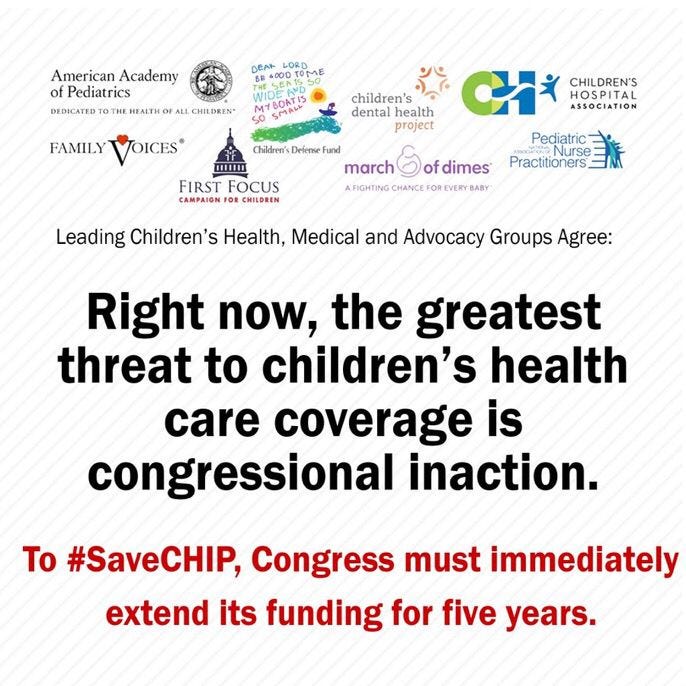
When the year begin, on January 3, 2017, the American Academy of Pediatrics, Children’s Defense Fund, Children’s Dental Health Project, Children’s Hospital Association, Family Voices, First Focus, and National Association of Pediatric Nurse Practitioners had one simple request of Congress when it came to the health of children Recognizing that 95 percent of children had health care coverage — a historic high — our organizations requested that Congress adopt a “do no harm to children standard.”


As these leading child advocates wrote:

Children must not lose ground: any health reforms must build on achievements already made to further improve coverage for children. We look forward to working with you to ensure no child is worse off as changes to our health care system are contemplated, and that we can work together to make even more progress for children.
This request was neither ambitious nor complicated.


Considering that President-elect Trump promised to make the health system better, the request by child advocates to “do no harm” seemed rather modest and reasonable. In an interview with 60 Minutes a year ago, President Trump promised, “I am going to take care of everybody. . . Everybody’s going to be taken care of much better than they’re taken care of now.”

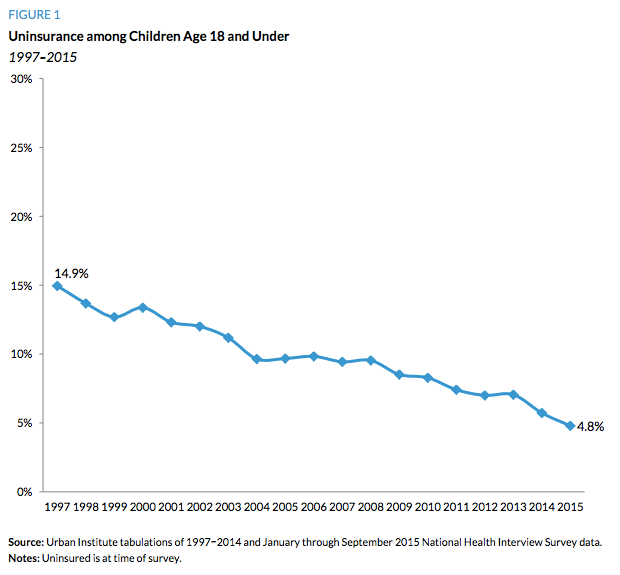
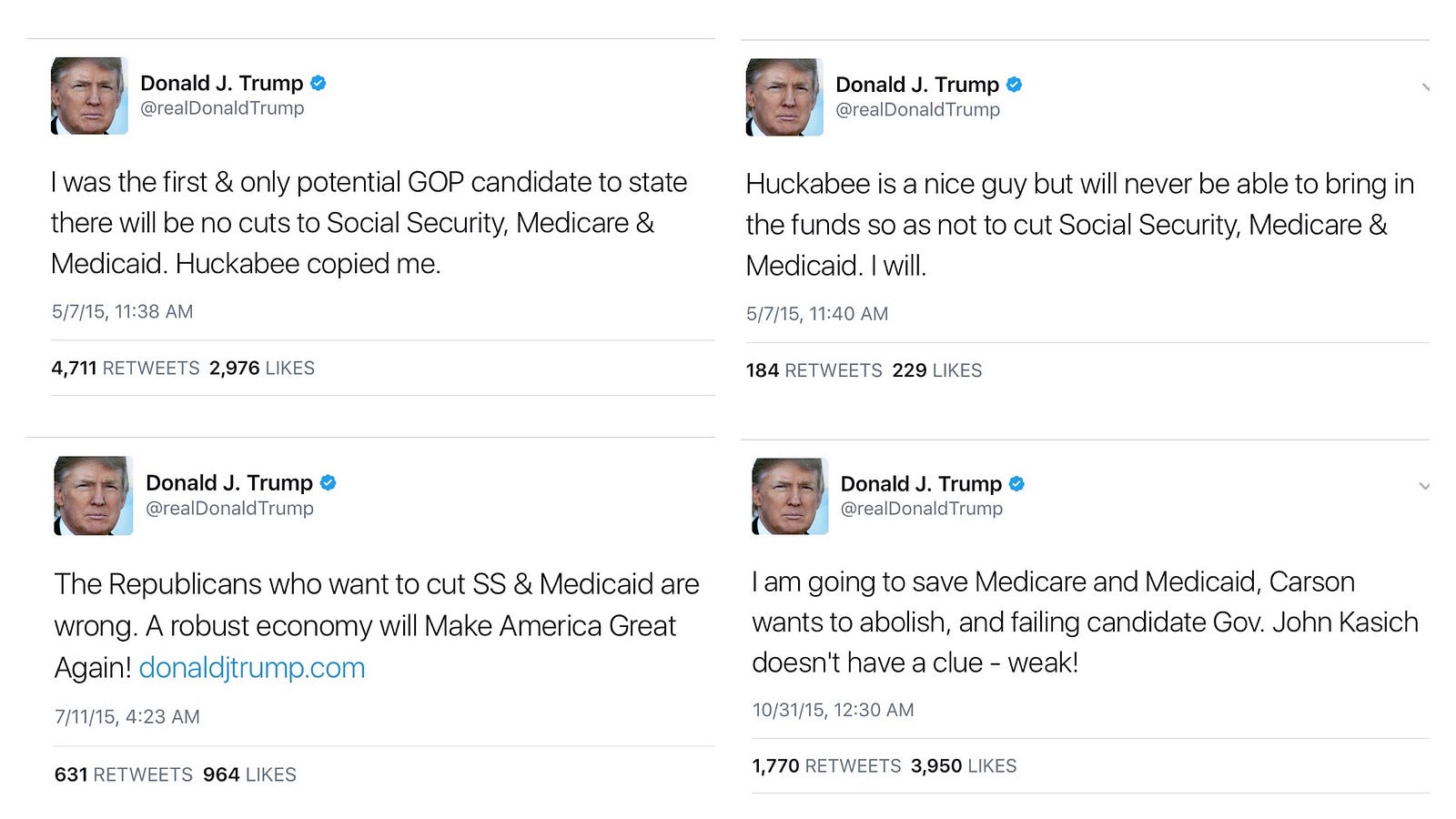
On the campaign trail and on Twitter, Trump also vowed to not cut Medicaid, which in tandem with CHIP, has helped cut the uninsured rate of children by two-thirds over the last two decades.


To meet a “do no harm” standard, Congress simply needed to take no action through its work on changes to the Affordable Care Act (ACA) or Medicaid that would leave children worse off. Congress also needed to simply “do its job” by extending funding for CHIP before its self-imposed expiration of the program in September, as inaction would threaten the health coverage for nine million children and pregnant women that are covered by CHIP.
Unfortunately, in a moment that foreshadowed what was to come, Senator Sherrod Brown (D-OH) offered an amendment last January that would have affirmed a “do no harm” standard for children by requiring the Congressional Budget Office (CBO) certify that any legislative changes to Medicaid, CHIP, or private health insurance “would not result in lower coverage rates, reduced benefits, or decreased affordability for children.” Under Brown’s amendment, if changes were to leave children’s coverage worse off, that bill could have been subjected to a point of order and require 60 votes to pass the Senate.
Despite numerous promises by President-elect Trump to cut Medicaid and by President-elect Trump and congressional leaders that “no one” would be harmed by Obamacare “repeal and replace” legislation, the Brown Amendment was defeated by a 49–49 vote (Roll Call Vote #25, 115th Congress).
Subsequently, in the House of Representatives, Rep. Jaime Herrera Beutler (R-WA) offered an amendment in the House Rules Committee that would have protected children’s health by barring the health bill from cutting, capping, or rationing Medicaid coverage for kids.
Unfortunately, the House Rules Committee not only rejected the Herrera Buetler amendment, but it prevented her amendment from even being offered on the House floor. Consequently, the Congresswoman voted against the legislation. In her words:
The difficulties this bill would create for millions of children still need to be addressed. For the last several weeks, I fought to include my amendment to strengthen the Medicaid safety net for the kids who depend on it for their health care. Protecting vulnerable children is a core purpose of the Medicaid program and when the program fails to do so, it fails entirely. I could not vote to let those kids fall through the cracks.
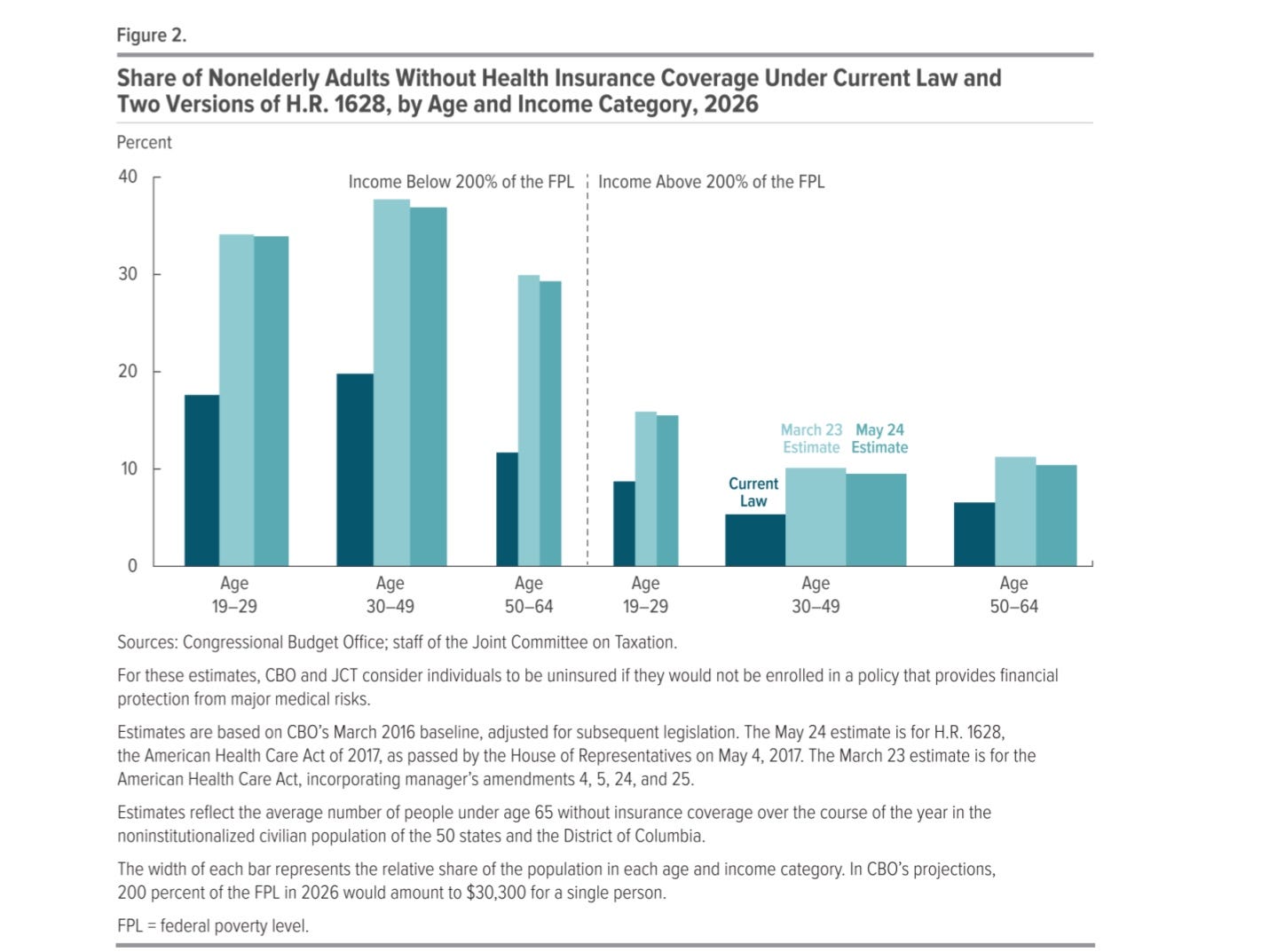
Estimates by the bipartisan Congressional Budget Office (CBO), found that millions of Americans, including children, would lose health coverage due to the Medicaid and ACA cuts in the House bill.


However, highlighting how children are far too often an afterthought in the halls of Congress, CBO’s own analysis provided data and the chart above as to how the bill would negatively impact coverage for adults, but it left out specifics on how children would be affected.
Moreover, despite President Trump’s campaign pledge not to cut Medicaid, the House and Senate bills proposed cuts to Medicaid by between $700 and $880 billion. These cuts would have certainly harmed low-income senior citizens, people with disabilities, and adults. And yet, during the nine-month debate, it was rarely acknowledged or understood by lawmakers that the cuts proposed by Congress would have been disproportionately damaging to children.
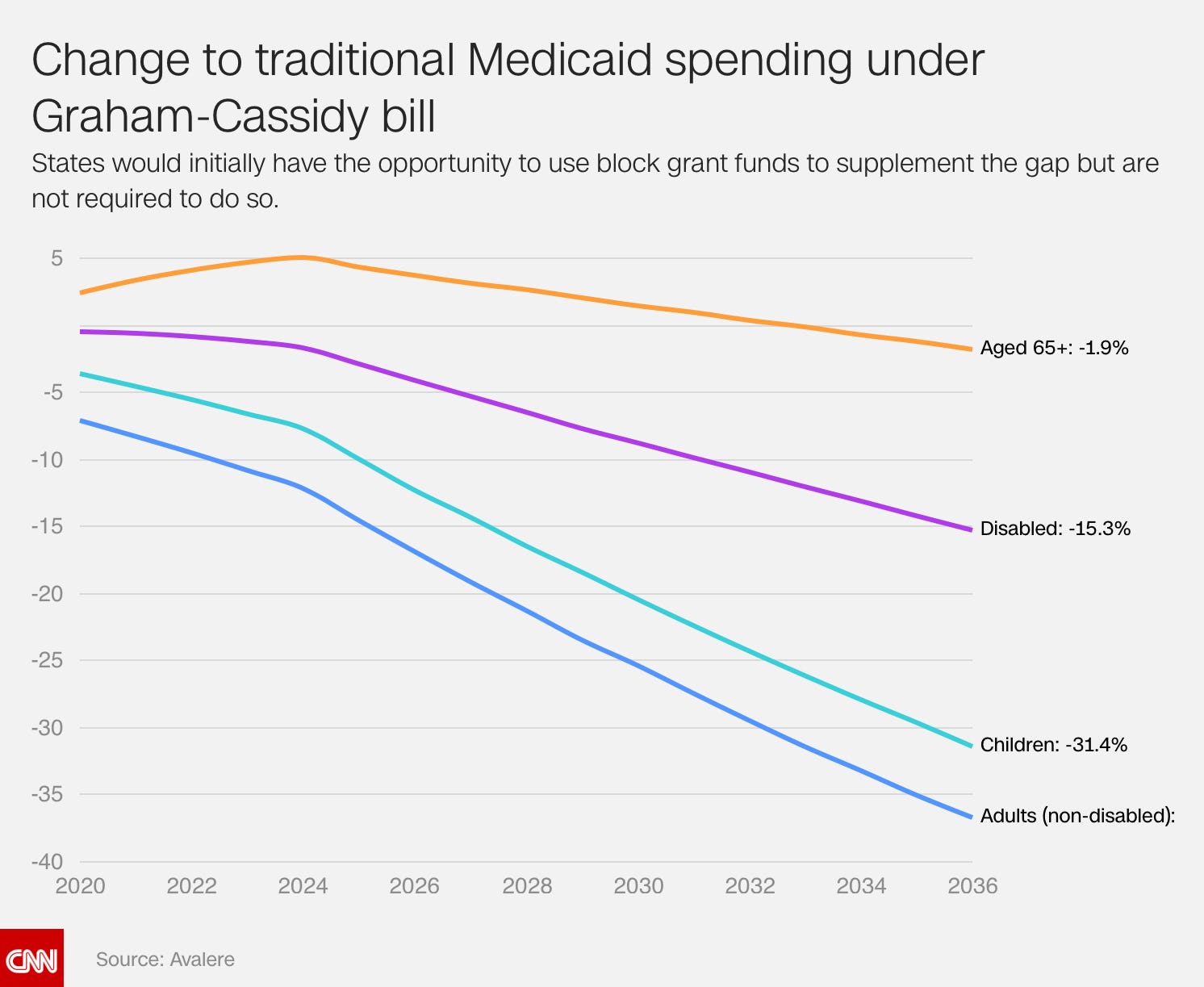
For example, in the Graham-Cassidy bill that was considered by the Senate in the waning days of September, Avalere Health estimated that the bill would have slashed Medicaid funding for senior citizens by 1.9 percent, people with disabilities by 15.3 percent, and children by an astounding 31.4 percent.


By definition, that is the opposite of “do no harm.” For example, Congress would have hurt children in a number of ways, including particular harm to newborns and children in foster care.
Despite pleas of child advocates, pediatricians, and even children, it is terribly disappointing that many lawmakers were fine to make such cuts to the health of vulnerable children.As Jimmy Kimmel said:
. . .no parent should ever have to decide if they can afford to save their child’s life. It just shouldn’t happen. Not here.
When the Graham-Cassidy proposal was finally withdrawn in the Senate in the last few days of September, promises were made to get a CHIP extension passed in early October. Unfortunately, Congress was then “too busy” to extend CHIP funding because it was focused on tax reform, which included a whole different set of threatens to the health of children, including the elimination of the medical expense deduction for children with special health care needs and disabilities and significant cuts to the Orphan Drug Tax Credit.
While child advocates were forced to work to get the medical expense deduction provision restored in the Senate after its elimination in the House, CHIP funding had expired on September 30th and has still not been fully extended — even more than 100 days later.
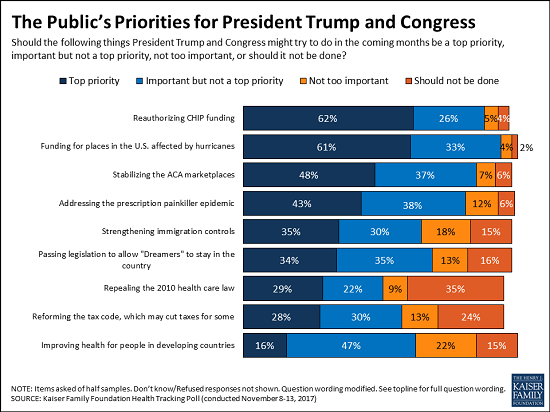
Throughout 2017, Congress ignored the public’s strong support for and prioritization of CHIP. In fact, according to a Kaiser Family Foundation poll, voters were more than twice as likely to say that President Trump and Congress should make CHIP a top priority (62 percent) than either reforming the tax code (28 percent) or repealing the Affordable Care Act (29 percent), even though Congress spent nearly the full year focused on the latter two issues while failing to extend CHIP funding.
Moreover, 88 percent of Americans said that CHIP should be either a top or important priority for President Trump and Congress, and yet, Congress is now more than 100 days past having failed to extend the program.


CHIP has been the victim of inattention, a double standard (the need for an offset has sidelined CHIP while Congress chose not to bother offsetting $1.5 trillion in tax cuts for wealthy Americans), and “hostage taking.”


Regardless, the failure to extend CHIP funding is increasingly dangerous to the health of children, and we enter 2018 with the crisis around CHIP growing with every passing day.


Compounding that worry, Medicaid will also be under renewed threat in 2018.

This would be particularly devastating to children under the age of three, as nearly one-half of them rely on either Medicaid or CHIP for their health care. Urban Institute researchers note, “Because young children and their parents rely on Medicaid at higher rates than older children and their parents, contractions of Medicaid funding would have outsize effects on families with young children.”

Infant and Child Mortality
A nation’s infant mortality rate is often considered a benchmark for a society’s overall health. If so, we are failing our most vulnerable children. As Zoe Carpenter reports in The Nation:
Each year in the United States, more than 23,000 infants die before reaching their first birthday. Though the mortality rate varies widely by state and county, the average in the United States is higher than in the rest of the world’s wealth countries, worse than in Poland and Slovakia.
This is, by definition, a life-and-death issue that demands national attention and urgency. Carpenter quotes Bevan Baker, Milwaukee’s commissioner of health, as pointing out, “If 100 people died from tuberculosis, then you would have a whole different approach. People would say we have a public-health emergency.” And yet, 23,000 infants are dying annually with virtually no attention or focus by our nation’s lawmakers.
Moreover, in a disturbing recent study published in Health Affairs, the United States was found to rank last in child mortality among the nation’s wealthiest nations. The study authors found “if the United States had performed as well as its peer countries between 1961 and 2010, more than 600,000 childhood deaths could have been avoided over those 50 years.”
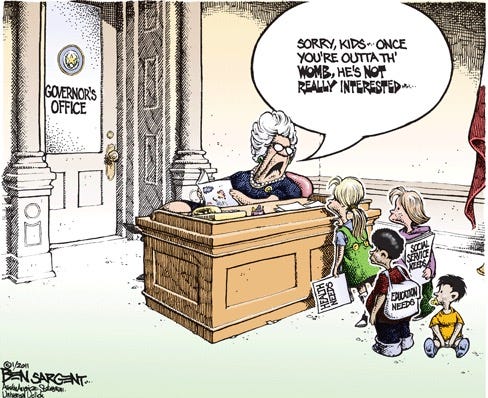
In the cartoon below, Ben Sargent perfectly captures the lack of interest in the health and well-being that children receive from many policymakers after they are born.


Cartoon by Ben Sargent in the Austin American-Statesman

Public Education
Public education was another area under assault from the first days of 2017. Beginning with the disastrous confirmation hearing and Vice President Mike Pence’s tie-breaking vote to confirm Betsy DeVos as Secretary of Education, the hits on our schools have been relentless. As Larry Ferlazzo summarizes the DeVos tenure in the Washington Post:
In addition to making a number of verbal miscues (no, public schools are not “taxis,” and school choice is not “Uber”; schools aren’t like “food trucks,” and education is not a “side of fries”; and historically black college and universities are not “pioneers of school choice”), she has also made many destructive policy decisions, including ones on civil rights and for-profit colleges. If her school choice plan is approved by Congress (or if she takes action on choice without congressional approval), her legacy will only get worse.
DeVos’s voucher proposals would not only undermine public schools, but NPR’s Cory Turner reports that students with disabilities could lose their federal protections with vouchers. This includes:
. . .guaranteed free and appropriate public education (FAPE), including access to necessary special education services and certified teachers. Another guarantee: that the education take place in the “least restrictive environment” possible. . . The law also includes some safeguards to make sure students aren’t disciplined inappropriately for disruptive behavior related to their disability.
Turner continues, “If parents use a publicly funded voucher to enroll their child in a private school, they leave many of those protections behind.”
At the state and local level, public school funding and investments in the education of our nation’s children continues to lag. In a study entitled “A Punishing Decade for School Funding,” the Center on Budget and Policy Priorities finds, after adjusting for inflation:
In 29 states, total state funding per student was lower in the 2015 school year than in the 2008 school year, before the recession took hold.
In education, money matters (see here, here, and here. Unfortunately, many of our policymakers are failing our children.
Moreover, the inequity in school funding particularly shortchanges low-income children — the very children that would benefit most from added resources. As Nobel Prize winner Joseph E. Stiglitz points out:
Most societies recognize a moral obligation to help ensure that young people can live up to their potential. Some countries even impose a constitutional mandate for equality of educational opportunities.
But in America, more is spent on the education of rich students than on the education of the poor. As a result, the US is wasting some of its most valuable assets, with some young people — bereft of skills — turning to dysfunctional activities. American states like California spend about as much on prisons as on higher education — and sometimes more.
Mineral Wells Independent School District Superintendent John Kuhn eloquently highlights this very problem within the Texas school finance system below.

2 School Districts, 1 Ugly Truth from S4E Media on Vimeo.

Making matters even worse, policymakers also continue to fail children, teachers, and schools through their inappropriate reliance upon testing. As Diane Ravitch says:

For the last 16 years, American education has been trapped, stifled, strangled by standardized testing. Or, to be more precise, by federal and state legislators’ obsession with standardized testing.
Children deserve so much better.

Tax Reform

Tax reform had the potential for having a positive impact on children and efforts to cut child poverty, as proposals by Sens. Marco Rubio (R-FL) and Mike Lee (R-UT) and Sens. Brown (D-OH) and Michael Bennet (D-CO) would have dramatically improved the Child Tax Credit (CTC).
Unfortunately, in the bill that passed the House of Representatives children were left worse off in 15 different provisions, including some that would have negatively impacted child health and education.
Although the Senate bill was not quite as awful for children as the House package, the Senate failed children by rejecting the positive amendments by both Sens. Brown and Bennet and Sens. Rubio and Lee. In fact, despite the fact that 68 senators were supportive of one or both of the votes to improve the tax bill’s CTC provisions for children and families, the two amendments sadly failed by votes of 48–52 (Roll Call Vote #295, 115th Congress) and 29–71 (Roll Call Vote #296, 115 Congress), respectively. This cost low- and middle-class children and families tens of billions of dollars annually.
Rather than working across the aisle to help families with children, partisan voting precluded the passage of either amendment. As Washington Post columnist Michael Gerson writes:
In their tax bill, Senate Republicans gave a break to private jet owners but refused to increase the corporate rate by 0.94 percentage points to cover the cost of helping an estimated 12 million working-class families. . . It was foolish of Senate Republican leaders not to see the obvious political benefit of this change to a bill that is currently unpopular. It was offensive that most Senate Democrats voted against the amendment, on the crassly partisan theory that nothing they oppose should be improved.
In the National Review, Joshua T. McCabe adds:
The Senate could have put families first. Instead it put politics first. . . The shameful failure of Republicans and Democrats to work together is responsible for the absence of CTC reforms that would have put the needs of the working class over those of the donor class.
Large families, low-income families, the children of immigrants, and families with children in college are among those left behind by the tax bill signed into law by President Trump.
Compounding the problem for the next generation, the final bill will increase the federal debt by between $1-to-2.2 trillion — a debt that will undoubtedly be passed on to our children to pay off.


We have seen this rodeo before. Here is an MoveOn ad that ran in January 2004 after the 2001 and 2003 tax cuts enacted during the George W. Bush Administration began to sharply increased the federal deficit.


In short, the tax bill just signed into law fails our nation’s children. As Ron Brownstein said in The Atlantic:
The House and Senate measures shower enormous benefits on households at the top of the economic ladder, a group that by all indications is older and whiter than the population overall. Then it hands the bill for those benefits largely to younger generations, who will pay through more federal debt; less spending on programs that could benefit them; and, eventually, higher taxes.
The Federal Budget
Quoting his father, Vice President Joe Biden has said, “Don’t tell me what you value. Show me your budget, and I’ll tell you what you value.”
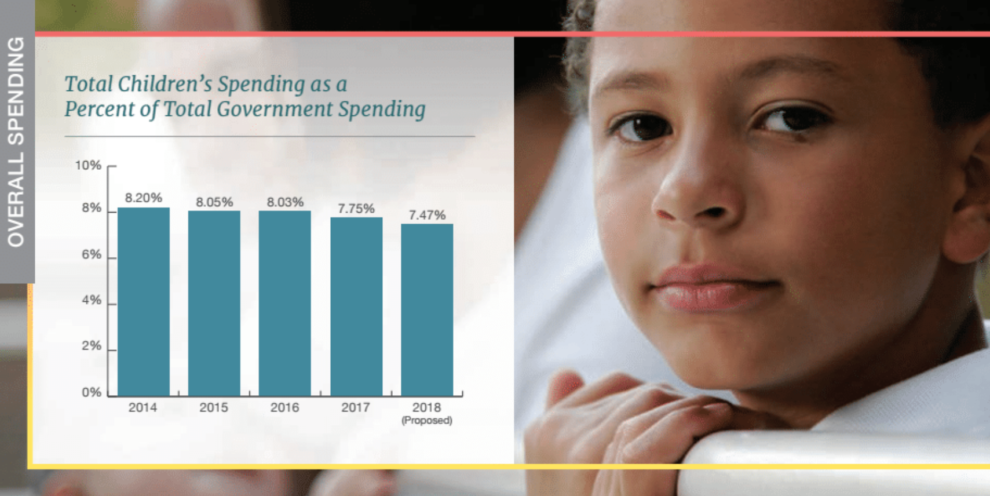
Unfortunately, Congress’s failure to make children a priority in the tax bill has been mirrored in the federal budget. The federal share of spending dedicated to children peaked in 2010 at 8.45 percent, but has since dropped rather dramatically.
According to our report, Children’s Budget 2017, the children’s share of all federal spending dropped to just 7.75 percent in FY 2017 and President Trump’s budget proposal for FY 2018 would have cut that further to just 7.47 percent.


Source: First Focus, Children’s Budget 2017

Child Poverty
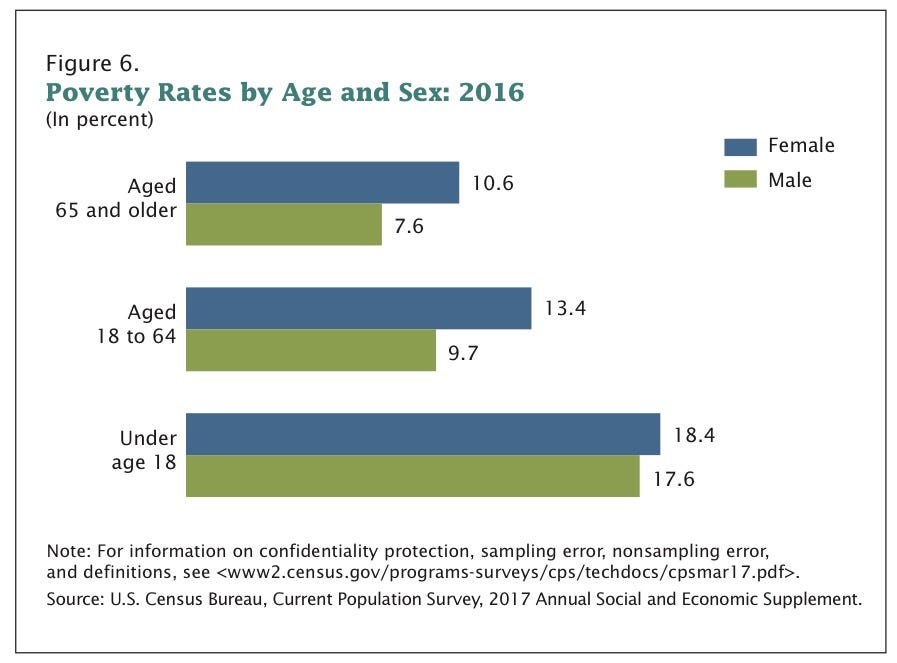
According to the U.S. Census Bureau, 18.0 percent or more than 
1 in 6 children were living in poverty in 2016. In the United States, children are living in poverty at a rate that is 63 percent greater than that in adults.


This is an outright tragedy that continues to receive little attention from policymakers, despite it costing the economy an estimated $672 billion a year.
Members of the Child Poverty Action Group (CPAG), including First Focus Campaign for Children, Save the Children Action Network, Child Welfare League of America, National Center for Children in Poverty, American Federation of Teachers, UnidosUS (formerly the National Council of La Raza), PICO National Network, and the National Black Child Development Institute, have called upon Congress to adopt a Child Poverty Target as a national strategy and to commit to cutting the child poverty rate within a decade.
Sen. Bob Casey (D-PA) and Rep. Danny Davis (D-IL) introduction legislation, the “Child Poverty Reduction Act of 2017” (S. 1630/H.R. 3381), that would commit the nation to such a target. These bills deserve much greater attention in the coming year.

Home Visiting/MIECHV
Members of the Home Visiting Coalition, which includes First Focus, have been working hard for well over a year to make the case to preserve and extend voluntary and evidence-based Maternal Infant Early Childhood Home Visiting (MIECHV) program.
Home visiting programs under MIECHV have been shown to improve outcomes for newborns, including improvements in prenatal care and birth outcomes, early childhood health and development, school readiness, parenting practices, and economic stability, while also reducing child abuse, neglect and injuries, juvenile delinquency and crime, and dependence on public assistance.
MIECHV has strong support from across the country and bipartisan support in Congress. Yet, just like CHIP, Congress did not make it a priority and failed to reauthorize the program before its expired at the end of September 2017. This is another program that demands reauthorization and full funding in 2018.


Child Abuse and Neglect
Research shows that keeping children in their families whenever it is safe to do so and providing supports for the family is much more cost-effective and causes less trauma to the child than foster care and group home settings. Consequently, child advocates and former foster youth have been working to push policymakers at the federal, state, and local levels to make investments in child abuse prevention, family support services, and kinship care as alternatives to foster care and group homes.
After there have been some important progress made over the last decade in reducing the number of children in the foster care system and improving services for children in improve outcomes, the number of foster children have been on the rise in recent years due in large part to the increase in parental drug abuse associated with the opioid epidemic.

In fact, according to data from the Children’s Bureau in the Department of Health and Human Services, parental drug abuse was involved in 34 percent, or over 92,107 of the 273,546 cases, in which children entered foster care in 2016.

Although there has been a great deal of attention to the opioid epidemic in adults, the fallout this crisis is having on children has been largely ignored, despite the best of efforts of child advocates, including First Focus.

. . .we as a society simply have not made these kids our priority. . . Foster youths are, by definition, wards of the state, but when was the last time you heard any elected official talking about them?
It is a heartbreaking paradox that few people in the nonprofit, philanthropic or government sectors seem to think the foster care crisis is their problem, even though it is at the root of so many problems, such as mass incarceration and economic inequality, that they are so diligently trying to resolve.
Children in foster care desperately need their help. . . Our government must treat the child welfare crisis like the emergency it is and respond with more funding and better policies. We need more philanthropists, advocates and celebrities to champion this cause and more families to open their homes and hearts.
The Children of Immigrants

Approximately 1 in 4 children in the United States have at least one immigrant parent. The vast majority of these kids are American citizens. Their human potential is critical to the future success of our country, and yet, immigration policies pursued by the Trump Administration and some in Congress are detrimental to their progress.

Between the Trump Administration’s recession of Deferred Action for Childhood Arrivals (DACA), the failure of Congress to pass the bipartisan DREAM Act, administrative proposals to separate refugee and immigrant families, the push by Trump to build a border wall, threats to end birthright citizenship for children born in the United States, and a disturbing increase in racist white nationalism in the country, the impact on children has been substantial.


How children will suffer in the latest immigration battle

If we are going to treat the U.S.-born children of people living in the country illegally as second-class citizens, let…www.chicagotribune.com


Other Policy Issues Where National Leaders Are Failing Children

As if all of this isn’t quite bad enough, federal policymakers are failing children in a number of other ways as well.

First, despite the overwhelming evidence as to the importance of providing high-quality early childhood education for the cognitive, social, and moral development of our youngest citizens, the United States continues to rank well behind other developed nations in providing child care for and the education of young children.

In a survey of more than 26,000 young people and their families across the country, Chapin Hall at the University of Chicago found that 1 in 10 people ages 18 to 25 had experienced child and youth homelessness. According to Matthew Morton, a Chapin Hall research fellow, “Homelessness is young. It’s more common than people expect and it’s largely hidden.”

He adds that the findings from the survey are “staggering” but “not necessarily surprising. Many young people are getting hammered in this economy. . .and far too many youth have experienced trauma and lack stable family situations. You have a major affordable housing crisis.” To help address this problem, bipartisan legislation entitled the “Homeless Children and Youth Act” (S. 611/H.R. 1511) deserves much greater attention in 2018.

Child hunger remains a significant problem in our country. According to the U.S. Department of Agriculture, “. . .households with children had a substantially higher rate of food insecurity (16.5 percent) than those without children (10.5 percent).” Unfortunately, there is growing concern that, rather than working to reduce this problem, the Congress may instead work to cut the food stamps or Supplemental Nutrition Assistance Program (SNAP) in 2018.

Between 1991 and 2015, the teenage pregnancy rate dropped from 62 per 1,000 females to an all-time low of 22 per 1,000. And yet, in August, the Trump Administration notified 81 institutions receiving funding through the Teen Pregnancy Prevention Program (TPPP) that their grants would be cut short by two years. The Big Cities Health Coalition argues, “Cutting TPPP funding and shortening the project period will not only reverse historic gains made in the U.S. in reducing teen pregnancy rates, but also make it difficult to truly understand what practices are most effective in our communities across the nation.”

The long-term impact on the children of Puerto Rico and their physical, cognitive, and emotional development in the aftermath of Hurricane Maria will be immense. Unfortunately, the nation’s response to this crisis has been less than adequate.


With regard to lead poisoning, the opening line in a report entitled Children At Risk by Safer Chemicals, Healthy Families and released in January 2017 reads, “There is no safe level of lead in a child’s blood. Very young children are particularly vulnerable, even at low levels.” Due to the lack of federal action or update with the standards since 2001 on lead, in the waning days of 2017, a federal court ordered the Environmental Protection Agency (EPA) to update standards for lead in paint and dust to protect children’s health within 90 days. This is a critically important development, as the science has progressed over the years but the standards have not been updated since at least 2001.
Juvenile justice needs significant reforms to reduce the incarceration of youth, but instead, Attorney General Jeff Sessions has taken action to make the issue worse for children when he “rescinded legal guidance, written under the Obama administration, that urged state and local courts to reduce or eliminate juvenile fines and fees,” explains Nila Bala in Newsweek.

And finally, with respect to climate change, children have had to take matters in their own hands by suing the federal government over the issue.


“Our True Face as a Society”
Pediatrician Dipesh Navsaria sums up the status of children among policymakers in 2017 very well in an editorial published on New Year’s Day. As Dr. Navsaria writes:
Child should not be used for leverage to accomplish other policy goals. All of these make me wonder where our priorities lie when we proclaim our love and support for the well-being of children but then consider enacting budgets and policies that use them as pawns. Budgets and policies are moral documents that show our true face as a society. Are we comfortable with what we see?
Nobody concerned about the future of the next generation should be.