Translate

Sunday, December 04, 2016

Latino superintendents lead the way in Texas' largest school districts

Important observations of the superintendency in light of the broader context in Texas:
  • For the first time in Texas, four of the state's largest six school districts — Houston, Dallas, Austin and Fort Worth — have Latinos at the helm.
  • The quartet in power is not only an indicator of the demographic transformation Texas has undergone over the past two decades, but the strides Latino educators have made, too.
  • Of the 100 largest districts in Texas, 28 have a Latino educator at the helm.
  • While it is far from reflecting the state’s current student demographic makeup, the number of Latino principals and teachers has been on a steady rise over the last decade, according to TEA figures. Nearly 26 percent of Texas teachers and 23 percent of principals are Latino. 
  • [O]nly 16 Latinas hold superintendent-level positions statewide.

These changes are in great part motivated by changing demographics, as well as due to a growing appreciation and understanding of just how crucial, in particular, it is for our cities and school districts to get it right with Latinos since they are the demographic whose well-being are important to an economy.

Angela Valenzuela
c/s


Latino superintendents lead the way in Texas' largest school districts


When Richard Carranza was named superintendent of Houston ISD on Aug. 18, he addressed those in attendance in English and Spanish. Hired from San Francisco, the 49-year-old Carranza grew up in Tucson, the grandson of Mexican immigrants. When he entered elementary school, he didn't speak English.
After his short speech, Carranza — an advocate of Mariachi programs at every stop along his educational career — broke into an old standard, "El Rey," with an ensemble made up of Houston ISD students behind him.
His hiring is but one voice in a louder chorus.
For the first time in Texas, four of the state's largest six school districts — Houston, Dallas, Austin and Fort Worth — have Latinos at the helm.
The quartet in power is not only an indicator of the demographic transformation Texas has undergone over the past two decades, but the strides Latino educators have made, too.


Richard Carranza was named superintendent of Houston ISD, the state's largest school district, in August. With his hiring, four of the state's six largest school districts are led by Latino educators. (Houston ISD)
Richard Carranza was named superintendent of Houston ISD, the state's largest school district, in August. With his hiring, four of the state's six largest school districts are led by Latino educators. 
(Houston ISD)
“With 62 percent of the students in Houston being Latino, being Hispanic, I think it’s important for those students to see in the superintendency somebody who looks like them, somebody that perhaps comes from their background, and spoke only Spanish when they entered school,” said Carranza. “I think it’s just important to have role models, and if I’m honored enough to be considered a role model for those students, then so be it.”

‘THE FUTURE IN TEXAS’

The rise in Latino educators at all levels — from teachers to principals to superintendents — reflects the demographic shift that’s been occurring in the state over the past two decades. Texas’ current K-12 public school enrollment is 52 percent Latino, up from 40 percent in 2000.
“The [population] shift has been seismic for Texas,” said Stan Paz, executive director of the Texas Association of Latino Administrators and Superintendents. “And it’s not happened without people and districts noticing it.”
Even so, only 97 of the 1,012 school districts in the state (9.6 percent) were led by Latinos in 2015-16, according to data from the Texas Education Agency. Nevertheless, the prevalence of Latino superintendents is greater in larger districts. Of the 100 largest districts in Texas, 28 have a Latino educator at the helm.
“Not only do we have some of the largest [districts] being led by Latinos, but they are quality,” Fort Worth ISD superintendent Kent Paredes Scribner said. “In Texas, we have both quality and diversity. You need to have both.”
Paz attributed the unequal distribution among large and smaller districts to two factors: the explosive population growth in the Rio Grande Valley, an area where Latino administrators are traditionally more prevalent, and that districts in the urban centers of Dallas/Fort Worth, Austin and San Antonio are becoming more diverse in their hiring practices.
“Urban centers have been quicker to respond to shifting demographics,” Paz said.
In the Dallas area, in addition to Dallas and Fort Worth, Irving and Arlington have Latino superintendents: Arlington’s Marcelo Cavazos was recently named the state’s Superintendent of the Year by the Texas Association of School Boards.
Nationally, less than 3 percent of schools have Latino superintendents; Texas and California — the two states with the largest Latino student populations — have been pioneers in hiring Latino educators, Paz said.
If Texas education is going to thrive in the coming decades, Paz said, it is essential that leaders understand and educate the state’s Latino population.
“Clearly, the future in Texas in public education is Latino students,” he said.

DIVERSITY AND EMPATHY

When Austin ISD superintendent Paul Cruz was a child, his family moved from the nearly exclusively Latino community of Robstown to a white-majority district on the outskirts of Corpus Christi.
Nearly four decades later, Cruz, 51, vividly recalled the discrimination — both open and covert — that he and his family faced. Bilingual students were dissuaded from speaking Spanish, called “rude.” Black and Hispanic students were often clustered in lower- and mid-level classes, while the more rigorous classes were nearly all white.
On the first day of school, Cruz’s older brother, Carlos, was walking into an algebra class when he was diverted by a teacher.


Austin ISD superintendent Paul Cruz, who became Austin's first Latino leader in 2015.(Austin ISD)
Austin ISD superintendent Paul Cruz, who became Austin's first Latino leader in 2015.
(Austin ISD)
“This isn’t Fundamentals of Math,” she said — assuming Carlos was enrolled in an introductory course.
“We talk about it today,” Cruz said. “It still stays in you. All of that to fast-forward to today, kids also talk about that. Why is there disparity between students because of their skin color, because of their background or because they speak another language?
“Having been treated differently, I see how that can be very harmful for a student ... how low expectations can affect a student. We’re not going to be that type of organization.”


This blend of cultural competency, empathy and expectations helped Cruz become Austin ISD’s first Latino superintendent in 2015, promoted from an interim role.
“I do think that diversity needs to be represented — I absolutely believe that,” he said. “To me, if I was the one who brought that diversity, it’s a good thing.”
When Michael Hinojosa returned for his second stint as Dallas’ superintendent, Hillcrest senior Edward DeLeon said he and his family were happy with the change.
Not only would Hinojosa — a Sunset graduate — know the lay of the land in DISD, but being Latino, he was aware of the challenges the district’s Latino students faced and would be better positioned to help them, DeLeon said.
“I know he wants children from Mexico to rise up and do something different,” he said.
A son of Mexican immigrants, DeLeon has thrived in Dallas ISD; the senior has designs to attend Rice University next year, with law school to follow.
But not all his classmates have been so fortunate. The school’s student council president said he sees the struggles of recent immigrants from Mexico and Central America, how difficult it is for them to assimilate and succeed academically.
“They are always in their own group, only speak the language they were born with ... it’s hard to actually learn English in such a short period of time,” DeLeon said.
Fort Worth’s Scribner — whose father is from Bar Harbor, Maine, and mother is from Coatzacoalcos, Veracruz — said it was critical for Texas educators to view these students, English-language learners, with “an asset perspective.”
“They are not problems that need to be solved, but assets that need to be invested in,” he said. “Having leaders who are culturally competent — perhaps who also might have the linguistic ability to interact with the students who are in their schools — is essential.”

'TRYING TO PAY IT FORWARD'

For Hinojosa, the strides Latino educators have made over his career have been revelatory, he said.
Initially, Hinojosa couldn’t get an interview to become an assistant principal in Dallas, serving as a teacher and coach at Adamson for seven years. Instead, he went to Grand Prairie, where he became the district’s first Latino administrator as an assistant principal in 1987.
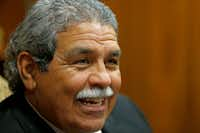


Superintendent Michael Hinojosa (Jae S. Lee/The Dallas Morning News)
In a span of a decade, Hinojosa went from that position to superintendent at Fabens ISD, at the time a “97 percent Hispanic district, seven miles from the border, with seven Hispanics on the board.”
With the help of mentors like Paz — whom he met at Fabens when Paz was El Paso’s superintendent — and the changing demographics that made Latino administrators more sought-after, Hinojosa jumped from district to district, eventually ending up back in his hometown.
In an intriguing twist, Paz also served as inspiration and adviser to Carranza, during Paz’s two stints as a high-level administrator and later superintendent of Tucson Public Schools when Carranza was a student and young teacher.
“I didn’t see a lot [of Latinos], but there were enough that gave me the vision that, well, maybe I could go that route one day,” Carranza said.
Paz said it’s critical to cultivate similar relationships with young teachers and administrators to develop a farm system of talent in smaller markets, ready to be “called up to the big leagues.”
While it is far from reflecting the state’s current student demographic makeup, the number of Latino principals and teachers has been on a steady rise over the last decade, according to TEA figures. Nearly 26 percent of Texas teachers and 23 percent of principals are Latino.
Paz’s group, TALAS, is hoping to target talent in the state’s big markets as well as the Rio Grande Valley, and encourage prospective leaders to be more mobile, taking jobs in smaller districts in areas vastly underrepresented by Latinos, such as East Texas. He also hopes to expand the role of Latinas in administration; according to Paz’s numbers, only 16 Latinas hold superintendent-level positions statewide.
“There’ve been so many obstacles that have been placed in front of Dr. Hinojosa and others like myself,” Paz said. “I’m just thankful that I’ve lived long enough to see people like Michael or Richard Carranza in those leadership roles. I’ve just been trying to pay it forward ever since.”


Austin school district to consider campus closures, reconstruction

Change is in the forecast for AISD Schools. Time to get involved if you're not already involved.

-Angela

Austin school district to consider campus closures, reconstruction


T.A. Brown to remain shuttered after school deemed unsafe
Austin American-Statesman

Highlights

The Austin district could close up to 10 schools that are in poor condition, consolidating or replacing them.
If LASA is moved to Travis High School, it could nearly double in size to 2,000 students.
It’s unclear which projects will be recommended to the school board to include in a November 2017 bond package.
The Austin district could close up to 10 aging schools that are in poor condition, consolidating them with others or replacing them, according to a preliminary report from consultants working on a 25-year master plan.
Six new schools across the district could be built, and the nationally ranked Liberal Arts and Science Academy, LASA, now located on the LBJ High School campus, could be moved.
District leaders said the goal is to modernize the district and its campuses with help from a building-by-building assessment that was completed this fall. The district’s average facility is 40 years old, and some are over 100 years old. One in three has been determined to be in poor condition.
The abrupt closure of T.A. Brown Elementary School last month underscores the problems at some schools, which persist after voters rejected $400 million of $892 million in bond funding the district sought in 2013.
The list of possible closures, consolidations and other options is the beginning of the brainstorming and community work that the district plans over the coming months as it prepares for the next bond package, which could come as early as November 2017.
The projects will come with a steep price tag, as the district already has about $2 billion in deferred maintenance. A new elementary school costs roughly $30 million, while a new high school costs about $100 million.
The consultants’ options were presented Wednesday night to a facilities and bond planning advisory committee. In coming weeks that committee will have a series of high-stakes meetings to determine which options to present to the public.
“We can accept them individually or not make them at all,” said Rich DePalma, a committee member. “I feel comfortable hearing their options, but I see it as just another data point. I want people to be involved in the process and be participating in the process. This committee is focused on the community’s interest and is thinking of the district as a whole. We are thinking of the kids and that’s whose back we have.”
The projects the district moves forward with are likely to be broken into a series of bonds over the next two decades, with high-need items first. It’s too early to determine which projects will be recommended to the school board to include in a November 2017 bond package, district officials said.
District Chief Financial Officer Nicole Conley said the facilities and bond planning committee members will examine the options and will create an initial proposal for the community to vet at the end of January.
“They have to layer on the qualitative information and take into account the academic needs that haven’t been incorporated here, our reinvention projects, administrative concerns,” Conley said. “There are a lot of things that haven’t been factored in that have to be coalesced into an ultimate proposal that will be vetted by the community. … It will look dramatically different by the time we get to the end.”
For now, some of the options include:
  • Six new campuses, including an elementary in the Mueller neighborhood for Pecan Springs Elementary students; an elementary school in Northwest Austin; an elementary school in Southwest Austin; and an elementary, middle and high school in Southeast Austin.
  • Moving the nationally ranked Liberal Arts and Science Academy, LASA, to Martin or Covington middle school, which would close those campuses and would allow LASA to slightly grow. Or LASA could be moved to Travis High School, allowing it to nearly double. Students at the high school could possibly move into neighboring high schools until a new high school in Southeast Austin is built.
  • Rebuild or overhaul: Brentwood, Casis, T.A. Brown elementary schools; the Rosedale school; Ann Richards School for Young Women Leaders and Sadler Means Young Women’s Leadership Academy.
  • Consolidate the Webb Primary Center, which is exclusively in portable buildings, into Webb Middle School to create a K-8 campus.

Shaun Cranston, the Greater Austin Chamber of Commerce chairman for education, lauded the work by Superintendent Paul Cruz’s administration.
“Dr. Cruz and his team deserve a lot of credit for tackling this complex issue,” Cranston said. “By presenting these options, we encourage AISD and the community to work together to finalize a master facility plan which looks to the future and renovates, modernizes and effectively uses each building in the district, while continuing to serve its current students.”
District officials said their decision to release all of the options early, with calls for the community to weigh in, is meant to avoid the kind of backlash that came over a former facilities plan that incited protests from the community in 2011. That proposal included nine campus closures to save $11 million, and it prompted more than 1,500 parents and community members to pack meetings to rally to save their neighborhood schools.
“We’re looking at ways to put our kids in better, more modern spaces but at the same time repurposing some of our physical assets to meet new needs in the communities, (and) leverage those assets to make investments in those communities,” Conley said.

STANDING ROCK PRAYER SONG with a strong message from Ger Lyons


Woke up thinking of Standing Rock.
Beautiful song. Without water we will indeed die.

Angela

Saturday, December 03, 2016

Contronym and Controversy by Dr. Michael Olivas

Important read by University of Houston - Downtown President Michael Olivas on the situation that DACA students find themselves in today in the wake of Trump's election to the presidency.  I quote from within.

And I cannot promise these students that positive results will come of all this. I have urged them to be careful in expressing themselves in ways that might give rise to thermodynamic reactions, as have begun to surface. Getting arrested and convicted of any transgressions would give real rise to possibilities of deportation. And they should be careful about using social media in a way that might expose their parents to possible harm. I will not urge them to march into the valley of death or to put themselves at risk, although I will agree that the peaceful marchas galvanized public attention in 2006. American citizens who urge this option for DREAMers should examine their consciences and not encourage these students to put themselves in harm's way. At the very least, we should do no harm.

So what to do? He suggests that we advocate vigorously for comprehensive immigration reform. Thanks to Jaime Puente for sharing.

Angela Valenzuela 

Contronym and Controversy

It's doubtful that sanctuary proposals for immigrant students will provide actual sanctuary or create any genuine change, argues Michael A. Olivas, who calls on campuses to take much more meaningful actions.
November 29, 2016
 
 
I do not live in a bubble, and one of the ways I work things out is to write. So I have put this piece together as a means of expiating my own grief over the results of the recent presidential election.
At first, I wanted to keep my mourning private, especially as my current role as a college president requires me to tread carefully and not give an institutional patina to my personal thoughts. I have also not wanted to invite the various trolls who consider my views like catnip. But I have come to the view that silence will probably cause greater harm to our country's immigrant students, particularly those "DREAMers" -- the hundreds of thousands of students in the 2012 Deferred Action for Childhood Arrivals program, who were brought to this country as children and have been allowed to attend college. The 1982 Supreme Court case Plyler v. Doe allowed them to stay in school, while DACA gave them employment authorization, lawful presence and Social Security numbers. It is by no means legalization, but it has been a transformative program while Congress has fiddled over immigration reform.
Indeed, I have dedicated my entire life to many ideals, but the ones that matter the most were repudiated on election night. Since then, I have arranged over a dozen conference calls with DREAMers, immigration lawyers, college presidents and reporters. Many know I helped write the Texas statutes that give many of the DREAMers resident Texas tuition and financial aid. Inasmuch as I have taught higher education law and also immigration law for 35 years, these are my fields. I have won many more contests in this terrain than I have lost, but this one hurts, and I feel as if we all let down my students, a dereliction of duty that I feel deeply. I fear for the DACA students, many of them in my own institution, who placed their lives and hopes in higher education and the polity. I urged them to trust we would do the right thing if they took responsibility for their own lives by studying and coming forward. They have done so, but now we have not held up our part of the bargain.
In the wake of the election, a number of colleges and universities are declaring themselves "sanctuary campuses," saying they will limit their cooperation with federal immigration authorities. However, the various proposals for carving out sanctuary campuses have occasioned even more vexation for me, and this viral-fed option is what finally moved me to write this article.
These well-intentioned efforts to establish a sanctuary use the term in its root ecclesiastic meanings, such as providing safe harbor. But from whom?
"Sanctuary" is also a contronym -- an example of a single word that has opposite meanings. ("Sanction" is another.) To many folks, the term depicts a defiance of law and serves as a trope for unauthorized immigration and liberal pieties. That it has become tinged with racist and anti-Mexican sentiment renders the term even more poisonous. One person's safe harbor is another person's harboring, in the dueling metaphors, if not the actual immigration law.
My view on these proposals is that they provide a chimerical outlet for people who are frustrated and have no other pathways to ameliorate the situation. But the term "sanctuary" is a term that is too fraught with restrictionist meanings or misunderstandings about the difference between "defying the law" or choosing not to implement discretionary practices, for policy, efficacy or other reasons. Worse, it has no legal meaning and the admonitions are vague and impossible to implement, which will only frustrate people more.
I have urged all those people who have called me to be very cautious in suggesting that a legal cocoon is possible or even needed for students -- who, after all, are not lawbreakers. Of course, institutions should provide support and services, as they would for all their students, especially vulnerable ones. But exacting pledges that cannot be kept will do no one any good.
And there are longstanding rules of engagement, or, in this context, nonengagement in higher education, such as the current Immigration and Customs Enforcement policy on such enforcement. As it notes, schools and colleges are exceedingly low priorities, and forms of this policy have been in place for many years. Virtually no campus has ever been raided for students in unauthorized status or undocumented campus workers, and they are unlikely to be.
But just as I cannot tell you how to react to any rollbacks of the Affordable Care Act, I cannot tell people what could happen and what the alternatives are. I know it will not be good, if for no other reason than it has already exposed vulnerable populations -- who are not "criminal," and who actually may be lawfully present (such as DACA holders) or in legal status (such as F-1 students from Muslim countries).
And I cannot promise these students that positive results will come of all this. I have urged them to be careful in expressing themselves in ways that might give rise to thermodynamic reactions, as have begun to surface. Getting arrested and convicted of any transgressions would give real rise to possibilities of deportation. And they should be careful about using social media in a way that might expose their parents to possible harm. I will not urge them to march into the valley of death or to put themselves at risk, although I will agree that the peaceful marchas galvanized public attention in 2006. American citizens who urge this option for DREAMers should examine their consciences and not encourage these students to put themselves in harm's way. At the very least, we should do no harm.
Feel-good actions and solidarity are fine and have an important place in the civil-rights narrative. But I do not hold out hope that the sanctuary proposals will make any genuine change or provide actual sanctuary -- whatever that empty vessel means to anyone on either side of the issue. And so I prefer more meaningful actions, such as working with student groups and their supporters: advocacy groups, bar associations, social service agencies, philanthropies and the usual support infrastructures for colleges and communities. The University of Houston Law Center, where I have spent most of my professional life, has stepped up, and my colleagues and law students are providing technical assistance and advice, as have many of my immigration law professor colleagues.
We will know more closer to the change of administrations, and all of us should keep perspective so as not to frighten or to give false hope to these students, who have kept their part of the bargain. And we should work to support those who do this over the long haul, such as the Mexican American Legal Defense and Educational Fund and the National Immigration Law Center, which have posted useful FAQs.
I ride with my students in the university's elevators every day, and it always is a life-affirming experience, as so many are first-generation students, immigrants and students of color. When they recognize me, they relate their experiences and their triumphs and concerns. In the last two weeks, they have actually cheered me up -- not for the first time. I have dedicated my entire life to them, and they have reciprocated. One of them sensed my own dread and said to me, "Llegamos tan cerca (We came very close)."
What can we do? We still have more than 20 states in this country that provide resident tuition for the undocumented. But the students' trajectory would clearly be altered if DACA were abolished or allowed to expire. It would be a foolish and tragic policy to demonize and deport these DREAMers, even as their parents have been criminalized in the narrative. We need these students, and they surely need us now. Can't we all agree that comprehensive immigration reform is overdue 30 years since the Immigration Reform and Control Act of 1986? If we want to do something constructive, such advocacy has never been more necessary.
That will be a tremendous fight, under the circumstances. But these students in whom we have invested should be at the front of that line, when Congress recognizes its responsibilities. That is where we should all focus our efforts.

Pray for the protesters at Standing Rock, and for the Oppressors, too. We need justice.

Pray for the protesters at Standing Rock, and for the oppressors, too. 

They are peaceful, non-violent protesters. We need justice.

-Angela


Jane Fonda: Standing Rock Is Greed Vs. Humanity’s Future


Activists Around the World Take #NoDAPL Fight to the Banks

Global demonstrations are calling on banks to divest from the controversial Dakota Access Pipeline, citing human rights abuses against water protectors.


Standing Rock Pipeline Protesters, Ordered to Leave, Dig In

Photo
Protesters facing off with the police on Friday outside the Oceti Sakowin camp in North Dakota. The authorities have ordered the protesters to evacuate the camp by Monday. Credit Cassi Alexandra for The New York Times
CANNON BALL, N.D. — Lee Plenty Wolf knows the government wants him to clear out of the snowbound tepee where he stokes the fire, sings traditional Oglala songs and sleeps alongside a pair of women from France and California who came to protest an oil pipeline in the stinging cold. But he and thousands of other protesters are vowing to make what may be their last stand at Standing Rock.
The orders to evacuate the sprawling protest camp on this frozen prairie just north of the Standing Rock Sioux Reservation came down last week from the U.S. Army Corps of Engineers and the North Dakota governor’s office. After four months of prayer marches and clashes with law enforcement officials who responded with tear gas and water cannons, the protesters now have until Monday to leave.
The government said it would not forcibly remove anyone, but could cite people for trespassing or other offenses.
At the camp, defiance is rising like smoke from the stovepipe of Mr. Plenty Wolf’s tepee. People are here to stay. They are building yurts and hammering together plywood for bunkhouses and lodges. The communal kitchen stops serving dinner at 9:30 p.m.; it reopens a half-hour later as a sleeping space.

Continue reading the main story

#NoDAPL 

Let's Decolonize Higher Education

Powerful piece that calls for a decolonization of higher education through the very themes, topics, and methodologies utilized by ethnic studies, as well as by scholars in women and gender studies:

If there are areas of study that deserve more attention after the elections, they are the fields that were at the forefront of critiquing and opposing the extremely and largely intentional slow and ineffective post-racial script of “diversity and inclusion” all along, namely, critical, intersectional and decolonial Ethnic Studies fields as well as Women’s and Gender Studies. Support of these areas may represent the most direct and firm challenge to the current neo-fascist trend in society and to the liberal post-racialism in the academy. They are also the areas that are best prepared to equip students to critically analyze and oppose fascist, racist, and dehumanizing tendencies.

 Thanks to Dr. Aimee Villarreal for sharing. 

Angela Valenzuela

The U.S. Elections, Ethnic Studies, and the University : A View from the Historically Disenfranchised

Nelson Maldonado-Torres
Rutgers University, New Brunswick
University of South Africa
Frantz Fanon Foundation


Responses to the results of the U.S. presidential election in the U.S. academy have included the idea that the field of political science finally proved to be defunct, and that the times call for more respect and support to areas such as philosophy and the humanities. What these responses miss is that, if anything, the elections made visible the problematic character of hegemonic models of the entire field of “arts and sciences,” including political science, philosophy, and the humanities. They also miss that the most relevant areas of scholarship at the moment might be the ones that are typically relegated to a second-class status or worse : Ethnic Studies, Women’s and Gender Studies and related fields.
I will avoid commenting much on the overwhelming lack of “diversity” in areas like philosophy and political science, which I think is connected to the very real limit that these areas find in responding adequately to the current situation. But I will note that considering that the racial composition of philosophy departments may be as bad or worse than the collective of Trump supporters in his rallies and the now in power Republican Party, I had a hard time reading a recent defense of college philosophy education as a serious response to the post-election crisis.
In many ways, the university is an engine as well as a mirror of the world, far from its usual presentation as an exceptional space. The same racism, structural inequalities, and phobias that are present in society can be found in the university, just often, but not always, with different codes. Needless to say, racism is not only found in some fraternity parties, but also sometimes in more sophisticated and lethal forms in faculty and administrator’s meetings and projects, including “diversity and inclusion” initiatives.
Consistent with the racial bias in higher education, many academics tend to look at Ethnic Studies fields as illegitimate intruders that challenge the quality of education, or as temporary remedial areas that provide refuge to students of color while the important fields (such as History, Sociology, and English, among other areas) subsume the scholarship produced in those fields and improve it. This is part of the reason why universities have not invested significantly in these fields, and why, what these fields do never gets to represent an important part of the rankings that universities use to rationalize their choice of supporting the units that already benefit from their large size and their alignment with the established rankings. Little attention is given to the limits and problems of criteria for excellence and prestige created and designed in contexts where racial denial and the racist construction of knowledge have been normative.
I would dare to say that many, if not most, of us faculty of color in institutions of higher learning feel like Dave Chappelle and Chris Rock in the Saturday Night Live’s skit where they hang out with white friends in election night. [1] The difference is that we cannot afford to laugh because the university space is not as unforgiving as their nice living-room where they hanged out with their white friends. We live in a context where our contributions and the fields that have so prominently called for attention to the significance of racism, sexism, and multiple other forms of structural inequality and phobias keep being ignored and in many cases are aggressively limited and shut down, while white academics share in the scandal of discovering that the country is racist, that race counted for so much, or that people seem to easily disregard racism and the threat on multiple communities as long as they are promised better economic conditions—of course, better economic conditions alone is not solely what many of they want. At the same time, the very same academics tend to remain blind to the racism, sexism, and structures of inequality and phobias that they perpetrate and that are constitutive of the academy itself.
Sanctuaries and the Decolonization of the University
If there are areas of study that deserve more attention after the elections, they are the fields that were at the forefront of critiquing and opposing the extremely and largely intentional slow and ineffective post-racial script of “diversity and inclusion” all along, namely, critical, intersectional and decolonial Ethnic Studies fields as well as Women’s and Gender Studies. Support of these areas may represent the most direct and firm challenge to the current neo-fascist trend in society and to the liberal post-racialism in the academy. They are also the areas that are best prepared to equip students to critically analyze and oppose fascist, racist, and dehumanizing tendencies. This includes not only the theoretical tools and multiple research projects, but also their attention to pedagogies that challenge the walls of separation between our campuses and the communities that surround them.
The critical and intersectional tools and pedagogies developed in decolonial Ethnic Studies and Women’s and Gender Studies programs allow us to see, for example, that while calls for making university campuses “sanctuaries” for the undocumented are extremely valuable today, our campuses have never offered a consistently safe space for students or communities of color. Even faculty of color are treated as threatening outsiders sometimes, and students of color take on the added responsibility of reaching out to their communities while their overall time for studying is reduced by added hours at work.
Universities cannot become real sanctuaries for people of color as long as what they consider sanctum continues to be premised on our secondary status, if not the expectation of our disappearance and the mere “inclusion” of our scholarship in the very same fields and structures that have denied those issues entry for so long. We will not go far if we fail to confront the reality that the liberal arts and sciences themselves, not neo-fascist ideologues, are responsible for all this. Likewise, our efforts to address and counter the racist forces that are becoming so obvious today—but that have been dominant all along—will be undercut if calls for increasing the number of sanctuaries for the undocumented collapse into the affirmation of discourses and practices of inclusion, instead of becoming part of the struggle for decolonization.
The opposite of exclusion, in contexts structured by coloniality is not inclusion, but decolonization. Inclusion, in these contexts, is just another form of coloniality.
Long before Trump promised a wall, universities have been increasing their disconnection with their surrounding communities and making it more difficult for those communities to consider universities not only accessible, but also relevant. University policies of “diversity and inclusion” and the increasing disconnect of universities from communities contributed to failing in the effort to produce the kind of student body and scholars who would stand up to the neo-liberal and neo-fascist challenges of the time.
In this context, neither rejecting the vulgar racism and sexism of the Trump campaign, nor voting for Clinton, nor joining campaigns to increase the number of sanctuaries for the undocumented assume the depth and weight of the challenge. The struggle is against racial liberalism, racial neoliberalism, white supremacy, sexism, heteronormativity, and neo-fascism combined, all of which represent a challenge to excellence in knowledge production, not to mention a threat to historically disenfranchised communities, among others. For this reason, as much as calls to secure college campuses as sanctuaries for the undocumented are important, the real challenge for white academics and those who share the perspectives that seem to be most dominant among them is not so much joining these campaigns, but becoming part of the struggle to decolonize the university. That, I anticipate, will be much more difficult to all of them. To be sure, this does not mean that there should not be efforts to bring different sectors together in favor of the sanctuaries—clearly we should strive for that—, but only that a) we cannot allow this cause to become yet another means of strengthening post-racialism, liberal inclusion, and the redemption (without reparations) of whiteness, and b) this is only part of a larger struggle that includes the desegregation and the decolonization of the university.
Critical, Intersectional, and Decolonial Thinking and Research Today
The times call, not for yet another round of self-congratulatory efforts from scholars in the humanities and the humanistic social sciences who aim to “save” their units in a context of austerity and now moral outrage, but for a serious reflection on the entanglement of all of these areas with the order of knowledge, being, and power that naturalizes race and other forms of structural inequalities and phobias. Likewise, the current moment provides yet another opportunity for academics to learn from and support the most rigorous and consistent anti-racist, anti-sexist, and decolonial scholarship and pedagogy there is, found in Ethnic Studies, Women’s and Gender Studies, as well as in Sexuality Studies fields.
This is a moment to identify and develop new strategies of transformation beyond “diversity and inclusion” initiatives. Here is an opportunity to break from the spell of academic liberalism and to support the kind of research that has always identified the limits of post-racial discourses in the academy. Administrators will unlikely find more direct legal means of opposing the neo-fascist trends than by aggressively supporting Ethnic Studies and related areas that have a substantial record of producing critical, intersectional, and decolonial scholarship.
Critical, intersectional, and decolonial epistemic and research fields should receive enough support to serve as matrixes for the transformation of the humanities, the sciences, and, as Johnella Butler has put it, the common good. [2] Their task should include not only innovate research, theory, and methods, but also the creation of civic engagement opportunities that can make universities, not isolated bubbles or quasi-commercial malls that remain inaccessible to working class and immigrant communities, but sanctuaries as well as houses for empowerment and bridges to historically disenfranchised communities.
These units should be given an opportunity to take the lead in challenging the divides between intellectual movements and scholarly contributions, on the one hand, and social and artistic movements, on the other, with the idea that they all can contribute to the task of desegregating and decolonizing our epistemic and social formations. Ethnic Studies and related units that are truly oriented by critical, intersectional, and decolonial perspectives can lead an intellectual and pedagogical wave of critical, intersectional, and decolonial work that can make the entire university more relevant than ever to the 21st century and more responsive to the challenges of our liberal, neo-liberal, and neo-fascist times. Likewise, trailblazers in the efforts to counter the post-racial narrative that greatly contributed to our current situation, and tested leaders in the effort to decolonize the university should be given opportunities to shape the current responses to neo-fascism and to move the university forward in the 21st century.
There are no laws that make these changes impossible. It is rather a question of vision and priorities. Every day that goes by without firm and serious steps in this direction is yet another unnecessary postponement, another lost opportunity.


Notes

[1See Saturday Night Live, “Election Night,” Nov. 13, 2016. URL : https://www.youtube.com/watch?v=SHG0ezLiVGc
[2See Johnnella E Butler, "Ethnic Studies as a Matrix for the Humanities, the Social Sciences, and the Common Good." In Color-Line to Borderlands : The Matrix of American Ethnic Studies, edited by Johnella E. Butler, 18-41. Seattle : University of Washington Press, 2001.

Principal's Meeting with Nuestro Grupo, School Board Member Paul Saldaña, and ELL Director David Kauffman

So fortunate to have had a great meeting today with our city and district partners, including our participating principals, Nicole Anderson (Zavala El), Azucena Garcia (Sanchez El), and Ellen Diaz-Camarillo (Houston El), together with ELL Bilingual Education director David Kauffman, School Board Member Paul Saldaña, and the rest of us in Nuestro Grupo that work collectively in partnership on Academia Cuauhtli, our Saturday academy at the Emma S. Barrientos Mexican American Culture Center in Austin, Texas. We offer a co-constructed, researched-based curriculum in Tejano history, local history, cultural arts, immigration, and indigenous heritage. 

We'll expand soon to la mujer Tejana/Chicana/Latina, a couple of units on Islamophobia/Critical Islamic Studies, and LGBTQ studies instruction for the 4th graders that receive our curriculum. Our goal is for 100% of our curriculum to be available district-wide (only around 45% of it is currently available) in both English and Spanish. Another goal is to grow our own teachers so that they can grow up to be the critically-conscious, culturally relevant, community-anchored, social justice teachers that we so desperately need.

Many thanks to both the National Latino Education Research and Policy Project (NLERAP) and the Tejano Monument Curriculum Initiative for giving us an actionable framework and curriculum, respectively, as well as to our participating teachers, and so many other individuals and community and district leaders, faculty, undergraduate and graduated students, Rosa Tupina y los danzantes that have gifted us with ceremony, a way of knowing and being in the world that sets a very high bar.  


We don't just want for our children to just do good on tests ("score high")—at some arbitrary level of "proficiency" based on a cutoff score that is itself not a scientific, but rather political, decision.  Our deepest hope is that our young people get the opportunity to experience the abundant life of the community if for no other reason than the hope that it inspires—particularly important in an age of cynicism.

Thanks to all for nurturing a powerful and abundant sense of hope and possibility for a brighter tomorrow. This is a labor of love ❤️ that we hope becomes a model for the nation.

Sí se puede!  Yes we can! 

Angela Valenzuela
c/s

P.S. Like us on Facebook: https://www.facebook.com/AcademiaCuauhtli/ 

#AcademiaCuauhtli

Friday, December 02, 2016

6 Potential Brain Benefits Of Bilingual Education

Buenos días! A lot to consider here with respect to education policy—oh yes, and just how great speaking and learning another language is for our brains!

Read in tandem with this Hechinger Report titled, "Dual-language programs benefit disadvantaged black kids, too, experts say," suggesting it's great for equity, too.

Que tengan todos un día bonito! May all have a beautiful day!

Angela Valenzuela

6 Potential Brain Benefits Of Bilingual Education

Bilingual student
Chelsea Beck/NPR
Part of our ongoing series exploring how the U.S. can educate the nearly 5 million students who are learning English.
Brains, brains, brains. One thing we've learned at NPR Ed is that people are fascinated by brain research. And yet it can be hard to point to places where our education system is really making use of the latest neuroscience findings.
But there is one happy nexus where research is meeting practice: bilingual education. "In the last 20 years or so, there's been a virtual explosion of research on bilingualism," says Judith Kroll, a professor at the University of California, Riverside.
Again and again, researchers have found, "bilingualism is an experience that shapes our brain for a lifetime," in the words of Gigi Luk, an associate professor at Harvard's Graduate School of Education.
At the same time, one of the hottest trends in public schooling is what's often called dual-language or two-way immersion programs.


Traditional programs for English-language learners, or ELLs, focus on assimilating students into English as quickly as possible. Dual-language classrooms, by contrast, provide instruction across subjects to both English natives and English learners, in both English and in a target language.
The goal is functional bilingualism and biliteracy for all students by middle school.
New York City, North Carolina, Delaware, Utah, Oregon and Washington state are among the places expanding dual-language classrooms.
The trend flies in the face of some of the culture wars of two decades ago, when advocates insisted on "English first" education. Most famously, California passed Proposition 227 in 1998. It was intended to sharply reduce the amount of time that English-language learners spent in bilingual settings.
Proposition 58, passed by California voters on Nov. 8, largely reversed that decision, paving the way for a huge expansion of bilingual education in the state that has the largest population of English-language learners.
Some of the insistence on English-first was founded in research produced decades ago, in which bilingual students underperformed monolingual English speakers and had lower IQ scores.
Today's scholars, like Ellen Bialystok at York University in Toronto, now say that research was "deeply flawed."
"Earlier research looked at socially disadvantaged groups," agrees Antonella Sorace at the University of Edinburgh, in Scotland. "This has been completely contradicted by recent research" that compares more similar groups to each other.
So what does recent research say about the potential benefits of bilingual education? NPR Ed called up seven researchers in three countries — Sorace, Bialystok, Luk, Kroll, Jennifer Steele, and the team of Wayne Thomas and Virginia Collier — to find out.
Attention
It turns out that, in many ways, the real trick to speaking two languages consists in managing not to speak one of those languages at a given moment — which is fundamentally a feat of paying attention.
Saying "Goodbye" to mom and then "Guten tag" to your teacher, or managing to ask for a crayola roja instead of a red crayon, requires skills called "inhibition" and "task switching." These skills are subsets of an ability called executive function.
People who speak two languages often outperform monolinguals on general measures of executive function. "[Bilinguals] can pay focused attention without being distracted and also improve in the ability to switch from one task to another," says Sorace.
Do these same advantages accrue to a child who begins learning a second language in kindergarten instead of as a baby? We don't yet know. Patterns of language learning and language use are complex. But Gigi Luk at Harvard cites at least one brain-imaging study on adolescents that shows similar changes in brain structure when compared with those who are bilingual from birth, even when they didn't begin practicing a second language in earnest before late childhood.
Empathy
Young children being raised bilingual have to follow social cues to figure out which language to use with which person and in what setting. As a result, says Sorace, bilingual children as young as age 3 have demonstrated a head start on tests of perspective-taking and theory of mind — both of which are fundamental social and emotional skills.
Reading (English)
About 10 percent of students in the Portland, Ore., public schools are assigned by lottery to dual-language classrooms that offer instruction in Spanish, Japanese or Mandarin, alongside English.
Jennifer Steele at American University conducted a four-year, randomized trial and found that these dual-language students outperformed their peers in English-reading skills by a full school year's worth of learning by the end of middle school.
Such a large effect in a study this size is unusual, and Steele is currently conducting a flurry of follow-up studies to tease out the causality: Is this about a special program that attracted families who were more engaged? Or about the dual-language instruction itself?
"If it's just about moving the kids around," Steele says, "that's not as exciting as if it's a way of teaching that makes you smarter."
Steele suspects the latter. Because the effects are found in reading, not in math or science where there were few differences, she suggests that learning two languages makes students more aware of how language works in general, aka "metalinguistic awareness."
The research of Gigi Luk at Harvard offers a slightly different explanation. She has recently done a small study looking at a group of 100 fourth-graders in Massachusetts who had similar reading scores on a standard test, but very different language experiences.
Some were foreign-language dominant and others were English natives. Here's what's interesting. The students who were dominant in a foreign language weren't yet comfortably bilingual; they were just starting to learn English. Therefore, by definition, they had much weaker English vocabularies than the native speakers.
Yet they were just as good at decoding a text.
"This is very surprising," Luk says. "You would expect the reading comprehension performance to mirror vocabulary — it's a cornerstone of comprehension."
How did the foreign-language dominant speakers manage this feat? Well, Luk found, they also scored higher on tests of executive functioning. So, even though they didn't have huge mental dictionaries to draw on, they may have been great puzzle-solvers, taking into account higher-level concepts such as whether a single sentence made sense within an overall story line.
They got to the same results as the monolinguals, by a different path.
School performance and engagement.
Wayne Thomas and Virginia Collier, a husband and wife team of professors emeritus at George Mason University in Virginia, have spent the past 30 years collecting evidence on the benefits of bilingual education.
"Wayne came to our research with skepticism, thinking students ought to get instruction all day in English," says Virginia Collier. "Eight million student records later, we're convinced," Wayne Thomas chimes in.
In studies covering six states and 37 districts, they have found that, compared with students in English-only classrooms or in one-way immersion, dual-language students have somewhat higher test scores and also seem to be happier in school. Attendance is better, behavioral problems fewer, parent involvement higher.
Diversity and integration.
American public school classrooms as a whole are becoming more segregated by race and class. Dual-language programs can be an exception. Because they are composed of native English speakers deliberately placed together with recent immigrants, they tend to be more ethnically and socioeconomically balanced. And there is some evidence that this helps kids of all backgrounds gain comfort with diversity and different cultures.
Several of the researchers I talked with also pointed out that, in bilingual education, non-English-dominant students and their families tend to feel that their home language is heard and valued, compared with a classroom where the home language is left at the door in favor of English.
This can improve students' sense of belonging and increase parent involvement in their children's education, including behaviors like reading to children.
"Many parents fear their language is an obstacle, a problem, and if they abandon it their child will integrate better," says Antonella Sorace of the University of Edinburgh. "We tell them they're not doing their child a favor by giving up their language."
Protection against cognitive decline and dementia.
File this away as a very, very long-range payoff. Researchers have found that actively using two languages seems to have a protective effect against age-related dementia — perhaps relating to the changes in brain structure we talked about earlier.
Specifically, among patients with Alzheimer's in a Canadian study, a group of bilingual adults performed on par with a group of monolingual adults in terms of cognitive tests and daily functioning. But when researchers looked at the two groups' brains, they found evidence of brain atrophy that was five to seven years more advanced in the bilingual group. In other words, the adults who spoke two languages were carrying on longer at a higher level despite greater degrees of damage.
The coda, and a caution
One theme that was striking in speaking to all these researchers was just how strongly they advocated for dual-language classrooms.
Thomas and Collier have advised many school systems on how to expand their dual-language programs, and Sorace runs "Bilingualism Matters," an international network of researchers who promote bilingual education projects.
This type of advocacy among scientists is unusual; even more so because the "bilingual advantage hypothesis" is being challenged once again. A review of studies published last year found that cognitive advantages failed to appear in 83 percent of published studies, though in a separate meta-analysis, the sum of effects was still significantly positive.
One potential explanation offered by the researchers I spoke with is that advantages that are measurable in the very young and very old tend to fade when testing young adults at the peak of their cognitive powers.
And, they countered that no negative effects of bilingual education have been found. So, they argue that even if the advantages are small, they are still worth it.
Not to mention one obvious, outstanding fact underlined by many of these researchers: "Bilingual children can speak two languages! That's amazing," says Bialystok.

'Invisible' Children: Raised In The U.S., Now Struggling In Mexico

Students engage in a class project at the Escuela 20 Noviembre school in Tijuana, Mexico.
Sandy Huffaker for NPR
Part of our series exploring how the U.S will educate the nearly 5 million students who are learning English.
Children and teenagers of Mexican descent make up one of the fastest-growing populations in the nation's public schools.
That's a well-known statistic, but less known is that, in the last eight years, nearly 500,000 of these children have returned to Mexico with their families. Nine out of 10 are U.S. citizens because they were born in the U.S. That's according to Mexican and U.S. government figures compiled by researchers with the University of California system, and the Civil Rights Project at UCLA.
These families have returned to Mexico because of the economic downturn in the U.S. Many others were deported and had no choice but to take their U.S.-born children with them.
Whatever the reason, Mexican schools have been caught off guard, totally unprepared to receive them. Researchers with the U-C Mexico Initiative say these students will in all likelihood travel back and forth between both countries so schools on both sides of the border need to work together to make sure they get a quality education.
In Mexican schools, the single-biggest problem these U.S.-born children and teenagers face is that they can't read or write in Spanish. In the U.S. schools they previously attended, many lacked the academic English they needed to do well. They're often labeled "English Language Learners" or ELLs.
Patricia Gandara, co-chair of the Civil Rights Project, has been tracking these students in both countries. She says both the U.S. and Mexico struggle with these transient students, and she says Mexican schools can learn a lot from educators who work with these kids in this country.
Gandara and others call these children Los Invisibles: the Invisible Ones.
She organized a bi-national symposium in Mexico City recently to discuss the latest research about these children and how best to educate them.

You say this has become an urgent issue for both the U.S. and Mexico. Why?
First of all, people on both sides of the border don't realize this many children have returned to Mexico from the U.S. Massive deportations and the economic downturn from 2007 to 2009 were big contributors to this. Jobs just dried up, so families went back with their kids. About 450,000 have enrolled in schools in Mexico that we know of. We don't know how many are not enrolled because not all have access to schools.

The fact that most of these students can't read or write in Spanish is just one hurdle. Their parents don't know how to navigate Mexico's education system. Mexican schools often don't accept transcripts from U.S. schools. They don't evaluate U.S.-born children in English, their primary language. At least that's what you and your fellow researchers have documented. But your research points to a bigger problem that makes it hard for U.S. born Mexican students to receive the help they need.
Mexico, not unlike the U.S, also has very segregated schooling and segregated communities. Most indigenous children, for example, grow up [in isolated communities] where the government is not trying to integrate them into the mainstream. The humiliation they experience in school is part of the humiliation indigenous people experience in other walks of life in Mexico. [Now,] there's discrimination targeting Mexican kids who've returned from the U.S., because they don't speak Spanish.
Anthony David Martinez raises his hand in class at the Escuela 20 Noviembre school in Tijuana, Mexico.
Sandy Huffaker for NPR
At the bi-national conference you helped organize in Mexico City, researchers talked about best practices and what both the U.S. and Mexico can learn from each other in addressing the needs of these transient students. But aren't there big differences in how each country approaches language minority students?
One big difference in terms of how schools in the U.S. and Mexico deal with language minorities seems pretty glaring. In Mexican schools, the goal is to transition children as quickly as possible to Spanish fluency — because it's the only language that matters. We've tried to estimate the percentage of classroom teachers in Mexico who speak English at a level that they can communicate with these [U.S.-born] kids, and found that fewer than 5 percent in public schools across [Mexico] can communicate with these children.
In the U.S., we don't accept the idea that children come to us as blank slates. [Immigrant] children know a lot, but they know it in their primary language, not English. We want to build on their primary language and not start from zero.
Also, in the U.S., the English-only, "sink or swim" approach has slowly given way to dual-language programs and bilingual education. Parents today see the value of teaching children to speak, read and write in Spanish and English. But only if it's done right. Poor quality programs can do more damage than good.
Finally, you worry that schools in Mexico have been too slow in developing new programs and policies to help these students. So what are you and your bi-national group of researchers recommending that Mexican schools do?
Number One: Schools need to welcome parents and help them understand how the [Mexican] system works and how they can support their children. Many of these families arrive with tremendous needs that hinder parents' ability to support their children. Second, schools need to fully assess what children know in their primary language. Too often, a child's knowledge is discarded because its in another language. Educators in both Mexico and the U.S. have to understand that young people who've been educated in both countries can be our future. Whether your primary language is English or Spanish or you live in Mexico or the U.S., we can't afford to lose these children. Its a social and economic loss.