Translate

Showing posts with label DACA. Show all posts

Saturday, May 02, 2026

Undermining Our Future: Deportations, DACA, and Lost Potential, by Angela Valenzuela, Ph.D.

Undermining Our Future: Deportations, DACA, and Lost Potential

by

Angela Valenzuela, Ph.D.
May 2, 2026

In a February 26, 2026 piece authored by Bazail-Eimil in Politico, we learn that
Kristi Noem and the 
Department of Homeland Security (DHS) deported 86 DACA students despite longstanding protections, exposing a stark and troubling reality about the fragility of that promise. Sadly, by now, this number is certainly higher.

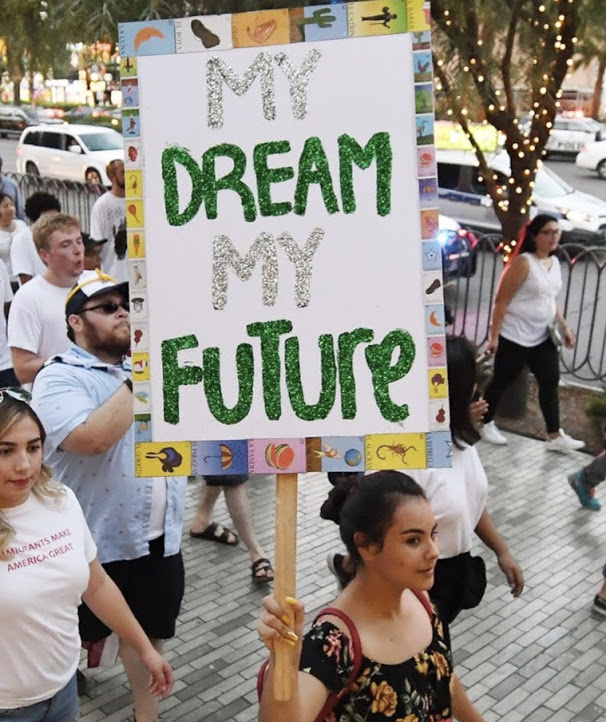
There is no other way to describe it: this is a betrayal. Young people brought to this country as children—many of whom have done everything asked of them—are now being detained and deported by the very system that once told them they could study, work, and build a future here.

These are not abstract policy decisions. They are lives disrupted. 

DACA recipients undergo repeated background checks, pursue education, and contribute to their communities. Yet they are now being swept up under shifting enforcement priorities, sometimes for minor or unproven infractions. I am aware that due to their assimilation in U.S. schools, many of them are not fully literate in the Spanish language—even if they can speak it—and, as a result, face uncertain futures in their parents' home countries. 

When our government callously discards a generation it helped raise and educate, it sends an unmistakable message: no amount of effort, achievement, or compliance is enough to guarantee belonging, and even those who play by the rules can be cast aside without warning.

Moreover, this is where the idea of “wasted talent"—a topic covered in the documentary I just posted—becomes painfully real. 

Many DACA recipients are students, professionals, and essential workers—individuals who have already invested in this country and are poised to give even more. Deporting them does not just harm them and their families personally, it strips the nation of skills, ambition, and potential that cannot easily be replaced. At a time when the U.S. depends on a strong, educated workforce, these actions undermine our own capacity to compete and thrive.

How does shooting ourselves in the foot like this make any sense?

They are exactly the kind of young people the U.S. claims to need—bilingual, educated, and ready to contribute in high-demand fields. Deporting them is not just a moral failure; it is a strategic one. It drains the country of human capital we have already helped develop, weakening our workforce at a time when global competition for talent is intensifying.

The consequences reach far beyond immigration policy. We are actively undermining our own future. A country that turns away its own investment in human potential is not just being short-sighted and dishonest about its expressed concerns regarding "return in investment" (ROI)—it is choosing decline. The loss is not abstract. It will be felt in classrooms, industries, and communities for years to come.

Policies that disproportionately target Latino communities and dismantle pathways like DACA echo a broader pattern that many see as rooted in white nationalist thinking about who deserves to be American. A country that embraces that logic is choosing division over shared prosperity, and risking a future diminished by its own decisions.

Reference

Bazail-Eimil, E. (2026, February 26). DHS admits it deported more than 80 DACA recipients, Politicohttps://www.politico.com/news/2026/02/26/dhs-daca-immigration-noem-dreamers-00801921


DHS admits it deported more than 80 DACA recipients
“Dreamers” who came to the U.S. as children are protected under U.S. law, so deportations of them are unusual.
Homeland Security Secretary Kristi Noem said in her letter to senators that Deferred Action for
Childhood Arrivals “comes with no right or entitlement to remain in the United States indefinitely.”
| Caitlin O'Hara/AP

By Eric Bazail-Eimil / 02/26/2026 04:05 PM EST

Wasted Talent in Plain Sight: Universities, Latinos & Trump / Talento Desperdiciado: Universidades, Latinos y Trump / Noticias Telemundo

Friends: 

I encourage you to view this excellent Spanish-language documentary titled "Talento Desperdiciado: Universidades, Latinos y Trump," by Noticias Telemundo.

It looks at how colleges and universities are often seen as pathways to opportunity, yet that promise remains uneven for many Latina/o/x students.

Despite being one of the fastest-growing demographics in higher education, Latina/o/x students face persistent barriers such as financial hardship, limited institutional support, and immigration-related challenges. These obstacles prevent many from completing their degrees, resulting in a loss of potential that affects not only individuals but the nation as a whole.

The political climate during the Trump administration intensified these difficulties, particularly for students from undocumented or mixed-status families. Uncertainty surrounding immigration policies and programs like DACA created fear and instability, forcing students to balance their academic goals with concerns about their future in the country. This environment made it harder for many to stay focused, enrolled, and on track to graduate.

A big focus is on funding streams to Hispanic Serving Institutions (HSIs) that benefit not just Latina/o/x students, but the universities themselves so that they can truly serve this population. Regardless, the Trump administration reduced HSI funding, resulting in a mix of continued baseline funding alongside significant cuts to key grant programs, together with shifts toward “race-neutral” policies that reduce targeted support, and ongoing uncertainty in how funds were distributed. Taken together, this meant that while some funding technically remained, the overall effect was a weakening and destabilization of dedicated support for HSIs, that obviously serve large Latino populations.

Changes in funding and policy directly affect the availability of scholarships, grants, and support services that many students rely on. When these resources are reduced, educational gaps widen, making it even more difficult for underrepresented students to succeed.

In places like Texas, Florida, California, Arizona, New York, and Illinois, where Latina/o/x students represent a significant share of the college population, the stakes are especially high. Their success is closely tied to the state’s economic and social future. If these students are not supported, the consequences will extend far beyond individual campuses—impacting workforce readiness, economic growth, and civic life. 

The documentary makes clear that this is not just an issue of access, but of national interest: investing in Latino students is essential, and failing to do so is a deliberate choice to leave talent, innovation, and opportunity unrealized.

-Angela Valenzuela, Ph.D.


Sunday, August 31, 2025

'Chilling Attempt to Evade Accountability': Trump to Boycott UN Human Rights Review--Time for Action!

Friends, Students, Community Members, and Colleagues:

The Trump administration has once again turned its back on global human rights accountability—this time by refusing to participate in the United Nations’ Universal Periodic Review (UPR), the process where every country is asked to account for its human rights record. The U.S. has taken part in every review since 2010, but this year it walked away—at the very moment when international scrutiny is most urgent.

The ACLU blasted the boycott as “a chilling attempt to evade accountability,” warning it emboldens authoritarian regimes and weakens protections for basic freedoms at home and abroad. It’s not hard to see why Trump is ducking the process: the U.S. government is already facing mounting criticism for human rights violations committed by ICE—ripping families apart, caging children, and forcing undocumented immigrants into what can only be described as modern-day concentration camps.

By abandoning the UPR, the administration is shielding itself from global accountability while doubling down on its attacks on vulnerable communities. This is not leadership—it is complicity in cruelty.

We cannot stay silent. Communities, students, and allies must make clear that we reject bigotry, authoritarianism, and the dismantling of democratic institutions.

Join Austin SDS Rally—UT Students in Opposition to the Trump Administration’s Bigoted and Reactionary Agenda! Thursday, September 4th at 5PM.

-Angela Valenzuela

Reference

Corbett, J. (2025, Aug. 28). 'Chilling Attempt to Evade Accountability': Trump to Boycott UN Human Rights Review, Common Dreams. https://www.commondreams.org/news/trump-un-human-rights-council


Join Austin SDS Rally—UT Students in Opposition to the Trump Administration’s Bigoted and Reactionary Agenda! Thursday, September 4th at 5PM

@austin.sds


Join Austin SDS and other UT students in opposition to the Trump administration’s bigoted and reactionary agenda!

Deportations have only increased since Trump was inaugurated last January, tearing apart families and forcing many undocumented immigrants into modern-day concentration camps. Meanwhile, Israel’s genocide against Palestine continues, with our government supplying Israel with money and arms, while also repressing activists for speaking out against the very same atrocities that our government is funding. Coupled with the many attacks against LGBTQ rights at the federal level, it’s necessary that we, the students, continue our historic fight toward progress and stand up against these injustices!

📆 Date: Thursday, September 4th
🕛 Time: 5:00 PM
📍 Location: Main Mall (Outside the UT Tower)

Stop Trump’s Agenda!
No Deportations!
Protect Immigrant Students!

Sunday, November 13, 2022

'I can't keep fighting the system': DACA recipients are leaving the US, disheartened by years of instability

DACA is the progeny of in-state tuition bills that culminated in the Federal DREAM Act that still has yet to get passed by Congress. It has endured a lot of twists and turns, and remains in need of a legislative solution. As quoted herein, it would be harmful to the U.S. economy to lose workers, especially educated labor:

"DACA recipients from across the country will gather in Washington on Wednesday to make their case to members of Congress. Apple, Google and other large U.S. companies and business groups recently wrote a letter to congressional leaders warning that ending DACA would worsen the worker shortage and cost the U.S. economy $11.7 billion annually. Legislation would require at least 10 Republican votes to pass the Senate."

The economic impacts aside, I can only imagine just how unnerving it can be to always be in the situation of having a time-limited "membership" in this country when you've spent so many years here. I hope that this time around, the DREAM Act—together with Comprehensive Immigration Reform—will get considered and pass to make these 600,000 youth whole. 

-Angela Valenzuela

'I can't keep fighting the system': DACA recipients are leaving the US, disheartened by years of instability

Andrea Castillo, Los Angeles Times on 

Published in News & Features


Tawheeda Wahabzada was tired of hoping she would ever have a permanent place in the country that had been home for nearly her entire life. So in February 2020, after hosting a “self-deportation party” where she said goodbye to her friends and family, she left the U.S.

Wahabzada, 32, moved to Toronto, where she was born to Afghan refugee parents before they joined extended family in Nevada, where she grew up.


She thought starting over would be exciting, that she’d be busy making new friends, exploring her new surroundings and traveling. Instead, the pandemic shutdown kept her indoors and Wahabzada had to face the full weight of her decision. Lonely and isolated, she wanted to make sure others in her position wouldn’t have the same experience.

“I basically had to confront the consequences,” she said. “But I made myself a promise: If I’m 30 and I still have DACA, I’m going to leave. I can’t wait for an idea. I spent my 20s in this survival mindset and I couldn’t really enjoy life.”

Since 2012, Deferred Action for Childhood Arrivals has protected from deportation more than 800,000 immigrants brought to the U.S. as children, allowing them to work, drive and travel legally. But the program, which now has fewer than 600,000 enrollees, never offered a pathway to citizenship. It was “a temporary stopgap measure,” then-President Obama said when he introduced DACA in 2012.

A decade later, the program and the lives of many of its enrollees are hanging by a thread. A small but growing number of DACA recipients, disheartened after years of instability, are voluntarily moving to countries where they can acquire permanent legal status. Some, like Wahabzada, are going back to where they were born; others have transferred jobs or applied for student programs in unfamiliar places.

Last year, Wahabzada connected with two other former “Dreamers”: Monsy Hernandez, who now lives in Germany, and Eun Suk “Jason” Hong, who lives in Spain. Together they formed ONWARD, or Our Network for the Wellbeing and Advancement of Relocated Dreamers. On Facebook, the support group has gained several hundred followers since its inception.

“It’s not that we’re encouraging them to leave,” Wahabzada said of DACA recipients. “It’s a big decision. It’s a scary decision. It kind of feels like a stigma to give up on our status. I felt alone on that journey.”

Requirements regarding age, when the person arrived in the U.S., education and criminal history excluded many immigrants when the program initially rolled out. More than 100,000 others have come of age without benefits because they were too young to qualify before DACA became embroiled in litigation and court rulings prevented additional first-time applicants, limiting the program to renewals.

Last month, a federal appeals court affirmed an earlier decision in Texas by U.S. District Judge Andrew Hanen, a George W. Bush appointee, that found DACA to be illegal. But the ruling kept the protections in place as a lawsuit challenging the program was sent back to the lower court for further proceedings.

The case is anticipated to reach the Supreme Court, where legal experts believe the conservative majority will also rule that the program is illegal.

DACA earlier withstood the Trump administration’s effort to end it when the Supreme Court ruled in 2020 that the administration had failed to follow proper procedure to do so.

Meanwhile, the program’s beneficiaries have been on an emotional roller coaster, closely following each court hearing and ruling, and breathing sighs of relief every time the program survives another day. Negotiations on congressional efforts to establish permanent residency for DACA recipients haven’t advanced.

After the latest court ruling, advocates increased pressure on the Senate to pass legislation that would permanently protect Dreamers, seeing the lame-duck period after midterm elections as a new opportunity to act.

DACA recipients from across the country will gather in Washington on Wednesday to make their case to members of Congress. Apple, Google and other large U.S. companies and business groups recently wrote a letter to congressional leaders warning that ending DACA would worsen the worker shortage and cost the U.S. economy $11.7 billion annually. Legislation would require at least 10 Republican votes to pass the Senate.

Roberto Gonzales, a sociology professor at the University of Pennsylvania who has extensively studied DACA, said beneficiaries are frustrated that while the program provided the possibility of upward mobility, their legal status has remained unchanged.

“If they had a choice to adjust their status, overwhelmingly they would,” he said. “Their roots are here, their education is here, their job experience is here, and they know what it would entail to move to another country. But it’s complicated because that’s not their choice. Their future may be more opaque today than it was in 2012.”

Gonzales, who has tracked the experiences of 500 DACA recipients since 2013, said the calculus has changed with the imminent threat that the program could end. Many have told him they are contemplating two separate futures — one in the U.S. and one elsewhere. A few people have already left.

“While many haven’t gone as far as to get visas or apply for jobs, what they’re doing actively is thinking about where they could live,” he said. “This is increasingly at the front of their mind.”

Selene Hernandez, 33, is among those considering a move. Hernandez, who is in a master’s program at Cal State Fullerton and hopes to become a marriage and family therapist, said it’s highly likely that she’ll move back to Mexico within a couple of years of graduating.

Hernandez was 10 when her parents brought her to the U.S. Before DACA, she paid her way through community college and then got a bachelor’s degree at Cal State L.A. She was unable to participate in extracurricular school activities, or apply for a driver’s license, a bank account or a tutoring job. Her first job as a cashier paid less than minimum wage.

The first time she considered leaving was in 2017. She had applied for a study abroad program through advance parole — a provision under DACA that allows beneficiaries to travel legally for school, work or humanitarian reasons — but when Trump terminated DACA and ended the travel benefit, her trip was canceled.

It would’ve been her first time seeing her mother, who had returned to Mexico after she divorced Hernandez’s father, since she was 18.

Last year, Hernandez finally was able to visit. Earlier this year, she went back again for two months.

She researched what her life could look like if she moved there. She visited the National Autonomous University of Mexico and was shocked to learn tuition is free. She pictured herself opening a therapy practice.

“I felt free. This is my country, this is where I was born, these are my people, they speak my language. It just felt very much like home,” she said. “That’s when it kind of hit me: I can live here.”

Coming back to the U.S., Hernandez said she felt trapped. She started saving money and asked her father, who also lives in Los Angeles, if he would sell her his house near Mexico City. She told her friends about her plan.

Hernandez said she feels fortunate to have a job she loves, a career she’s excited about and a generally happy life. But she misses her mother and younger brother in Mexico.

“I feel I’ve done my part,” she said. “I’ve been a good citizen, I’ve done things right, and yet here I am with a two-year membership to this country. I can’t keep fighting the system.”

Julia Gelatt, senior policy analyst at the Migration Policy Institute, said the rise of remote work expanded the possibility for many people to live far away from their jobs. But for DACA recipients, deciding to leave the U.S. involves considering multiple complicating factors, including cost, the possibility of a job transfer, personal connections to the other country and whether the recipient has U.S.-born children or other family to take into account.

Another significant factor is whether a recipient is able to return to the U.S. to visit loved ones. Immigrants who leave the U.S. after entering without authorization are penalized. For example, a person who has lived in the U.S. for six months to a year is barred from returning for three years, and someone who stays longer than a year is barred for 10 years. For the most part, Gelatt said, Dreamers have stayed put in the U.S.

Wahabzada is among those affected by the ban. She especially misses her mother, who is still hopeful for immigration reform, and the grandmother who helped raise her. She doesn’t know when she’ll see them next.

But she has no regrets about her decision to leave her home in Washington, D.C., and continue her work remotely for a global development organization. She said it’s a privilege to keep her job and stay in the same time zone in a city where she has extended family.

Before leaving, she wrote an opinion piece in the New York Times. The headline: “No need to deport me. This Dreamer’s dream is dead.”

“I was so jaded at that point,” she said. “A lot of my friends said, ‘You’re leaving right before the election — what if something happens after?’ But waiting for an idea is kind of self-destructive.”

Wahabzada said her status no longer feels like a burden. A few months after arriving in Canada, she came across an article about another Dreamer who had self-deported and reached out to him. It was Hong, who moved to Spain.

Hong became a DACA recipient his senior year of college at the State University of New York at Binghamton, where he studied finance. He landed a job at a life insurance company and felt like he could finally start building a successful future. But when Trump decided to end the program, he said, “that’s when I first realized my life is actually not in my control.”

Hong had considered pursuing a master’s degree in the U.S., but he started looking elsewhere. In 2018, he found a business school in Madrid where he could enroll for a fraction of the cost he would’ve otherwise paid.

Realizing he knew of no one else in his situation, he got cold feet and deferred his enrollment for a year. Then he read Wahabzada’s op-ed, which provided the confidence he needed to leave.

Hong said he’s glad he can now offer support to others. But his feeling of fulfillment is mixed with unease.

“Every time I go into Facebook and see a notification that a person wants to join our group, it’s really sad,” he said.

“Usually when there’s a number-of-followers increase, it’s something to be happy about. Not for this one. We know exactly how that feels.”

©2022 Los Angeles Times. Visit latimes.com.

Tuesday, June 02, 2020

Fall 2020 DACA Scholarships for DREAMERS

Thanks to Bob Kimball, welcome to information on scholarships for DACA students.  Please share the website with students and others https://www.scholarshipsfordreamers.org/

For additional scholarship opportunities, please check out this earlier post:  http://texasedequity.blogspot.com/2019/12/2020-scholarship-fellowship-lists-for.html 
Sí se puede! Yes we can!
-Angela Valenzuela 

Fall 2020 Scholarship

Deadline: August 1, 2020

Description

The philanthropic purpose of the Dreamers Scholarship Fund is to provide academic scholarships to students who have been approved under the US Government’s Deferred Action for Childhood Arrivals (DACA). DACA enables certain people who came to the U.S. as children and who meet several key guidelines to request consideration for deferred action. It allows non-U.S. citizens who qualify to remain in the country for two years, subject to renewal. They are shielded from deportation and eligible to work and or attend colleges. DACA students are not eligible for federal , state loans or grants and need programs like the Dreamers Scholarship Fund to help achieve their dreams. The scholarship was founded and funded by Dr. and Mrs. Robert Kimball.

Eligibility

  • Applicants must have been granted Deferred Action for Childhood Arrivals (DACA) by the USA government.
  • Must be currently enrolled as a full-time student (12 credits hours minimum) in a program at a college or university that will lead to a Bachelor of Arts or Bachelor of Science (not intended for vocational programs).
  • Student grades, credit hours completed, and a personal essay will be used to determine awardees. Financial need will not be used as a criterion.

Application Procedure

  • Download and complete the Dreamers Scholarship Fund application
  • Mail application and necessary documents in time to be received by the application deadline of either January 1 or August 1
  • Awardees will be notified  no later than January 15 for the spring semester or August 15 for the fall semester

Thanks

Bob Kimball

Sunday, November 10, 2019

A Quarter Of A Million U.S. Citizen Children Would Be Harmed If The Trump Administration Cancels DACA

FOR IMMEDIATE RELEASE: November 7, 2019
Contact: Lynn Tramonte (latramonte@gmail.com/202-255-0551) OR Tom Salyers (tsalyers@clasp.org/202-906-8002)

On November 12, U.S. Supreme Court To Consider the Fate of DACA Recipients and their Children

Washington, DC - A quarter of a million U.S. citizen children would be harmed if the Trump administration cancels Deferred Action for Childhood Arrivals (DACA), and their parents lose this vital family protection. Pediatricians, children’s advocates, and parents across the nation are asking the U.S. Supreme Court to consider this fact when reviewing the Trump administration’s closure of the program. 

They filed an amicus brief (appendix here) with the U.S. Supreme Court that details the harm that rescinding DACA would have on young children. The brief explainsthat society has a moral imperative to protect children from harm and promote family unity.

The Center for Law and Social Policy (CLASP) supported the development of this brief, working with the American Professional Society on the Abuse of Children, the American Academy of Pediatrics, and dozens of children’s advocacy organizations, medical professionals, and child development experts. The brief was written by Persyn Law & Policy and Orrick, Herrington & Sutcliffe LLP.
In an interview with the Mountain West News Bureau, a group of public media stations in CO, ID, MT, UT, and WY, Wendy Cervantes, CLASP’s director of immigration policy, said “We know from current research that even the fear of deportation alone can have really significant impacts on children’s mental health and can lead to symptoms of post-traumatic stress disorder.” The amicus brief 
Marlen Ortiz, a mother of a young son from South Bend, Indiana, shared her concerns about the future with Telemundo. “They are playing with our lives,” she said. “But this is something serious for me. I fear for my security and that of my child…. My son lives in constant fear that they could deport me… I don’t know what more they want us to do.”
The DACA case affects children in every state, but the largest number live in: Arizona, California, Colorado, Florida, Georgia, Illinois, New Jersey, New York, North Carolina, Oregon, Tennessee, and Texas.

Read the amicus brief filed in United States Department of Homeland Security v. Regents of the University of California; Donald J. Trump, President of the United States v. National Association for the Advancement of Colored People; and Kirsten M. Nielsen, Secretary of Homeland Security v. Martin Jonathan Batalla Vidal[consolidated cases] here, with appendix.

Data about the contributions and family ties of DACA beneficiaries can be foundhere, including the number of U.S. citizen children affected by the policy in each state.

Saturday, November 09, 2019

Walkout! and Rally! In Support of DACA and Dreamers, Tuesday, Nov. 12, 2019, 12:00PM Austin, Texas

Mark your calendars, my friends, November 12 is day that the Supreme Court has chosen to hear arguments on the unlawful ending by the Trump administration of the DACA program.  Let's meet up at Texas AFL-CIO, and make a good showing to the Supreme Court and our own Texas Attorney General Ken Paxton that we, the American people, support DACA and Dreamers. If you'e in Austin, let's meet 1106 Lavaca St., Austin, TX 78701.

-Angela Valenzuela

#HereToStay
#FreeToStay
@UnitedWeDream


Tuesday, October 08, 2019

TX and National Child Health Experts File Amicus Brief in Supreme Court Describing Traumatic Impact of DACA Rescission on Recipients’ Children

The Children’s Defense Fund of Texas and the Texas Pediatric Society have just put out this press release that makes a strong case against cancelling DACA.  Reach out to whoever represents you to let them know just how traumatic ending DACA will be to recipients' children.  -Angela

FOR IMMEDIATE RELEASE: October 7, 2019
Contact: Lynn Tramonte (latramonte@gmail.com/202-255-0551) OR Tom Salyers (tsalyers@clasp.org/202-906-8002)

TX and National Child Health Experts File Amicus Brief in Supreme Court Describing Traumatic Impact of DACA Rescission on Recipients’ Children 

Cancelling DACA would harm 250,000 children in U.S.,
including 46,700 in Texas

Washington, DC - At least a quarter of a million young childrenincluding 46,700 in Texaswould be harmed developmentally, psychologically, and economically by the cancellation of Deferred Action for Childhood Arrivals (DACA). The Trump administration failed to consider their interests when repealing the program in 2017.

On Friday, Children’s Defense Fund, TX and Texas Pediatric Society joined nearly three dozen other organizations and leaders in filing an amicus brief (appendix here) with the U.S. Supreme Court, asking the court to consider the impact of rescinding DACA on beneficiaries’ children, who are U.S. citizens. Oral arguments are scheduled for November 12, 2019.

The DACA case affects children and families in every state, but Texas is home to one of the largest numbers. More quotes from national and state leaders can be found here.

As the brief explains, society has a moral imperative to protect children from harm; this imperative is recognized in numerous laws and policies, including the Family First Prevention Services Act of 2018. Failing to consider the needs of these children puts their futures in jeopardy, to the obvious detriment of the communities in which they live. 

The “friend of the court” brief states: “The imminent threat of losing DACA protection places children at risk of losing parental nurturance, as well losing income, food security, housing, access to health care, educational opportunities, and the sense of safety and security that is the foundation of healthy child development.”

Patrick Bresette, Executive Director of Children's Defense Fund - Texas, said: "As an organization dedicated to the health and wellbeing of all children in Texas, we are alarmed at the devastating harm that rescinding DACA would cause. We work every day to help families connect their children to affordable health coverage and many of those families include DACA parents. In communities across our state nearly 50,000 children are in such households. We should be doing everything we can to support and protect these young families, not threatening their futures."

In the amicus brief, Texas Pediatric Society wrote: “TPS agrees with the AAP that the future prosperity and well-being of the United States depends on the health and vitality of all of its children, without exception. TPS has consistently and firmly stated that children who are citizens should not be subjected to the separation, or fear of separation from non-citizen parents or their caregivers.”

The brief was co-authored by Persyn Law & Policy and Orrick, Herrington & Sutcliffe LLP for the American Professional Society on the Abuse of Children, the American Academy of Pediatrics, the Center for Law and Social Policy, and other children’s advocacy organizations, medical professionals, and child development experts.

Kyle Yasuda, MD, FAAP and President of the American Academy of Pediatrics said: “Rescinding the Deferred Action for Childhood Arrivals (DACA) policy would have multi-generational health consequences; it not only impacts the DACA recipients themselves, but also their children. When children live in fear of their family being separated, it can have detrimental effects on their health and development, both in the short- and long-term. As pediatricians, we know children fare best when they can grow up in supportive families and thrive.”

Olivia Golden, Executive Director of the Center for Law and Social Policy (CLASP), said: "CLASP recognizes the critical role the DACA program has played in pulling entire families out of poverty and promoting the healthy development of children. We also know from our 2018 research report that harmful immigration policies—like the Administration’s decision to terminate the DACA program—are subjecting young children to fear, instability, and reduced access to critical health and nutrition supports. We urge the Supreme Court to consider what’s at stake for hundreds of thousands of our youngest citizens and the future of our country should the DACA program be rescinded."

"The American Professional Society on the Abuse of Children gratefully joins many of this nation's leading child advocacy organizations in opposing the needless termination of DACA, a critically important protection afforded to persons who arrived in the United States as children and have made lives and families here in the only home they know. The trauma that is being inflicted on the children of DACA recipients by even the threat of their parents' deportation is cruel and serves no meaningful public policy purpose. Over time, these children and the communities in which they live will suffer greatly from this pointless infliction of harm,” stated David Corwin, President of the APSAC Board; Janet Rosenzweig, Executive Director; and Frank Vandervort, Chair of the Amicus Committee.

Read the amicus brief filed in United States Department of Homeland Security v. Regents of the University of California; Donald J. Trump, President of the United States v. National Association for the Advancement of Colored People; and Kirsten M. Nielsen, Secretary of Homeland Security v. Martin Jonathan Batalla Vidal[consolidated cases] here, with appendix.

Additional data about the economic contributions and family ties of DACA beneficiaries in Texas can be found here.