Translate

Showing posts with label #SayNoToFascism #Fascism. Show all posts

Thursday, March 31, 2022

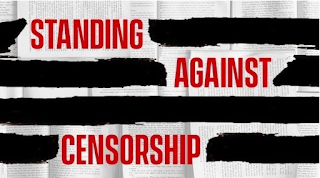
PETITION TO THE TEXAS STATE BOARD OF EDUCATION In Favor of Necessary Truth and Against the Nonsense of Censorship

Friends:

Next Wednesday, the Texas State Board of Education (SBOE) is hearing testimony on Social Studies TEKS standards (Item 10), the very ones that attach to the extremist move against the 1619 Project and Critical Race Theory (CRT) which we know is not actually taught in K-12 schools. Regardless, this law that the SBOE now has to interpret and implement—risks creating a chilling effect for K-12 teachers on the teaching of race in the schools.

Please read this change.org petition below and consider signing it as a statement against censorship that Senate Bill 3—Texas' anti-CRT bill—represents. We support instead teaching that is honest, hopeful, and healing: https://www.change.org/p/in-favor-of-necessary-truth-and-against-the-nonsense-of-censorship?signed=true (Note: copy and paste link in your browser if this link doesn't work.)

Also, if you're in the Austin area next Wednesday when the item will get heard, consider the following additional possible actions

  1. Attend our press conference against censorship at 10:30AM next Wednesday in the inside foyer of the William B. Travis State Office Building—home to the Texas Education Agency—at 1701 North Congress Ave., Austin, Texas, located across the street from the Bullock History Museum Building.
  2. Sign up TODAY to testify on Item 10 of the TSBOE that focuses on the social studies TEKS. Agenda: https://tea.texas.gov/node/358496 

  3.  (Links to an external site.)
    Sign up here TODAY to testify: https://tea.texas.gov/about-tea/leadership/state-board-of-education/sboe-meetings/public-testimony-registration 
Remember that your testimony needs to be focused on the actual item—in this case, Item 10 on which you intend to testify; also when you testify, you only get two minutes to speak. However, the board may ask you questions, extending your time, and you can also always submit written testimony.

The Texas SBOE is a 15-member board and you can locate your SBOE member here. While we keep pushing for Ethnic Studies in the legislature and at the Texas SBOE, regardless of SB3, we desperately need to continue advocating for more diverse representation in our state's K-12 content social studies standards as well as throughout the entire curriculum. Many organizations and coalition members are expected to be in attendance.

See y'all on Wednesday!

-Angela Valenzuela

#PutinizationOfPublicEducation
#SayNoToFascism #Fascism


In Favor of Necessary Truth and Against the Nonsense of Censorship

National Association for Chicana and Chicano Studies Texas Chapter


“Without Freedom of Thought, there can be no such Thing as Wisdom; and no such Thing as public Liberty, without Freedom of Speech.” — Benjamin Franklin

“Restriction of free thought and free speech is the most dangerous of all subversions. It is the one un-American act that could most easily defeat us." — Supreme Court Justice William O. Douglas


A very old enemy—CENSORSHIP—raises its ugly head as educators across the country have been advocating for an expanded public school curriculum that includes under-represented groups like Mexican Americans, African Americans, Indigenous communities, Asian and Pacific Islanders, and women. The Texas Legislature’s House Bill 3979 and Senate Bill 3—the latter signed by the governor—have given new life to CENSORSHIP by questioning the teaching of race in our schools and outlawing the 1619 Project, a reasonable proposal to incorporate a broader understanding of African American history into U.S. history. The Texas State Board of Education (SBOE) will now consider implementing the misdirected will of the Texas Legislature and giving new life to CENSORSHIP.

The problem is that the bills—and now the law—call for CENSORSHIP with the baseless argument of reverse discrimination that accuses our schools of knowingly and purposefully making White youth feel responsible for the racial “sins of their fathers.” The SBOE is now being called to embrace hateful CENSORSHIP and, in the process, discard two of its bedrock principles, that verifiable and trustworthy history serves as the foundation for our state’s standard curriculum; and that teacher training and certification programs as well as tested ethical principles in the profession and the ongoing oversight work of the SBOE assure the proper social-emotional development of all youth. The directive from the Legislature and the Governor’s office, in other words, not only proposes to CENSOR the teaching of subjects related to race; it also questions the integrity of public servants in the SBOE and the good judgment of well over 300,000 professional teachers in Texas.

The members of the SBOE and the general public should consider the legislative intent endorsed by the bills and the governor who signed SB3. According to State Representative Steve Toth, the author of the initial bill, the teaching of race and the 1619 Project cause “hateful classroom activities and a racially discriminatory curriculum” (Toth: Letter to members of the Texas House of Representatives, May 7, 2021). In his letter to fellow legislators, Toth offered as evidence one single children’s book that teachers from the Dallas Highland Park School District supposedly recommended to some of their students. Never mind that the book, Not My Idea; A Book about Whiteness (by Anastasia Higginbotham) represents a single reading recommendation, that an undetermined number—possibly one or a few—made. Whoever these teachers in question are, their recommendation arguably carries more weight than Mr. Toth who found its contents inappropriate for use in Texas classrooms (Consult the following site for a different view of the book, https://www.google.com/search?client=firefox-b-1-d&q=not+my+idea+video).

Mr. Toth adds insult to injury when he makes the unfounded and specious association of a growing rate of suicide among White youth with the teaching of race. He warns that suicide among children between the ages of 10 and 14 has “exploded” from .9 to 2 per hundred thousand between 2010 and 2021. Aside from failing to demonstrate the association of suicides with the teaching of race, Mr. Toth’s strained logic offers no substantiation for his observation, while also callously exploiting a mental health issue for political gain and, no doubt, injuring the sensibilities of Texas families who are indeed suffering such losses.

Although CENSORSHIP is being sold as an act of caring for White youth, it is having the opposite effect. According to the American Medical Association’s Everyday Health,

While parents may be tempted to shelter their children from issues that they find unfavorable or offensive, they may be restricting their child’s ability to grow and learn at the same time. These restrictive world views are the seeds of bigotry, with the implication being that anyone who believes differently from you must be foolish or misinformed. https://www.everydayhealth.com/kids-health/censorship-schools-effects-on-our-children/

Our goal as educators and parents is not to create obstacles to a healthy understanding of the world so that our children can be productive members of society. This is not a partisan issue. According to a CBS News poll, 80% of Americans favor the teaching issues related to race and the country's history of racism. The authors of the subsequent report conclude that “The idea that teaching about race makes students feel guilty about past generations or makes them less racially tolerant today gets little traction with most Americans.”

We are facing a massive shortage of teachers in the classroom, and the specter of censorship and book banning only serves to add undue stress on an already overburdened profession. Moreover, CENSORSHIP spreads fear of others and the banning of books does nothing more than foster anxiety and dread when learning should be purposeful and enjoyable. It is this fear that led the framers of the Constitution to ensure our freedom of speech as a core feature of democratic life.

Since the inception of this country, our very first act was to establish the freedom of speech. The very first Amendment to our Constitution states that,

Congress shall make no law respecting an establishment of religion, or prohibiting the free exercise thereof; or abridging the freedom of speech, or of the press; or the right of the people peaceably to assemble, and to petition the Government for a redress of grievances. https://constitution.congress.gov/constitution/amendment-1/

This cherished core value has been under attack during the past hundred years, but especially in recent times. The recent official view of the AFL-CIO underscores this fact:

The guarantee of access to a free and quality public education should be a right accorded to every child in this country. Securing that guarantee should be a goal and a value that unites all Americans and is supported by our public policies and policymakers at every level. [https://aflcio.org/about/leadership/statements/fighting-importance-public-education-our-children-our-economy-our.]

Clearly, our lawmakers seek to curtail an honest and diverse teaching of history and contemporary society and, in the process, hinder our children’s ability to fully understand and appreciate the complexity of our current world.

In response to the CENSORS, we say, EXPAND KNOWLEDGE, SUPPORT OUR TEACHERS, ENCOURAGE TRUTH-TELLING AND BUILD A BETTER WORLD OF UNDERSTANDING AND AUTHENTIC CARING.


Christopher Carmona, Ph.D.

Emilio Zamora, Ph.D.

Wednesday, September 30, 2020

Op-Ed: Trump’s ‘historic bloc,’ like fascist movements, unifies groups with opposing interests

Excellent political theory and analysis of why conservative Latinos support Trump by Dr. Alfonso Gonzales Toribio, professor of Ethnic Studies and director of the Latin American Studies Program at UC Riverside. To this, I would add their own lack of understanding of history that Trump exploits as follows:

"The point of the MAGA slogan is to bury history with its deep class and racial disparities and to conceal the crises of our time: savage inequality, climate change, pandemics and racial conflict."

His approach is seductive to those that have internalized racism—meaning that they have adopted the dominant, pejorative image of their group—and that, as a consequence, need someone to blame. 

-Angela Valenzuela

#vote2020

#EthnicStudiesNow

#SayNoToFascism #Fascism

Op-Ed: Trump’s ‘historic bloc,’ like fascist movements, unifies groups with opposing interests

How is it that working-class whites and a significant number of Latinos could support Donald Trump, a self-aggrandizing billionaire with nothing in common with them and little understanding of their lives?

The Italian political theorist and leader Antonio Gramsci asked a similar question about the appeal of fascism among the working class. Why was it that fascism, a project that favored the capitalist class, could have so much support among working-class people, who by the conventional wisdom of the time were expected to side with the left? This was the fundamental question that Gramsci contemplated in his famed prison notebooks, written from his cell after his arrest by the Italian fascist government in 1926.

To describe this dynamic, Gramsci put forward the idea of the “historic bloc,” among other concepts, to explain the unification of a constellation of groups with opposing interests into an apparently seamless front. Such a bloc, he argued, blurs the lines between the state and society and functions to repress dissent in moments of crisis and intense labor and social-movement militancy, like the one we are living in now.

These blocs congeal by demonizing their enemies foreign and domestic, declare states of emergency and criminalize legitimate social protest in the name of national unity. They can unleash a viciousness among the state security forces and among armed citizens. Such blocs don’t have to be based on truth, facts or coherent arguments.

Never rational, such authoritarian movements are based on pure emotion and a sort of identity politics of the right, using common-sense ideas about how the world works among the working class to draw them from the left. The bloc depends on an intense identification with a strong-man leader, the romanticizing of violence for resolving conflicts and a selective reading of history and national culture that appeals to groups that find protection by joining the bloc even if in a subordinate position.

Although the base of the Trumpian bloc is overwhelmingly white and male, 26% of Latinos support Trump over Biden. Many conservative Latinos identify with macho political posturing, pro-2nd Amendment rhetoric, simple law-and-order solutions to complex problems, demonization of the left and disdain for the Black Lives Matter movement.

This bloc, under the “Make America Great Again” banner, requires its supporters — particularly subordinate groups — to accept a degree of cognitive dissonance in submitting to the emotional appeal to a mythical moment of American greatness. For many of the white working class, that moment is before the rise of the civil rights movement, Latino immigration and multiculturalism, the idea that diverse people should have representation and rights in pluralist society.

For right-wing Latinos, this means ignoring both the historical and the contemporary injustices inflicted on their community, such as the lynching of Mexicans by the Texas Rangers in the 1920s, the deportation of at least 1 million Mexicans in the 1950s, the separation of children from their parents at the border or the alleged coerced hysterectomies of Latina migrant women in immigration detention centers now.

The point of the MAGA slogan is to bury history with its deep class and racial disparities and to conceal the crises of our time: savage inequality, climate change, pandemics and racial conflict.

Racism and xenophobia have historically provided the ideological glue that has kept the white working class supporting the most rabid sectors of the capitalist class and from seeing their fate linked with racial others and immigrants. Even during the current economic disaster, it is easier for many working-class whites to identify with the Trumpian bloc, led by a billionaire rooted in the transnational capital class, than to have a sense of solidarity with Latinos or Black people.

Historic blocs of the right emerge precisely at that moment when the left is strong and when the right decides to stop playing by the rules of liberal democracy, the system for resolving conflicts through representative government and respect for individual rights.

These are dangerous times that compel us to recall the fascist bloc that emerged in Italy as a reaction to the Biennio Rosso, the great workers movement of 1919 and 1920, when workers took over factories and continued production in defiance of the owners.

It emerged in Germany on the heels of the Weimar Republic, a liberal government, in the context of intense labor struggles and one of the strongest communist parties in Western Europe at the time. And in the 1930s, authoritarian blocs in El Salvador, Nicaragua, Guatemala and the Dominican Republic led to dictatorships and brutal repression that lasted for much of the 20th century.

In the name of redeeming a victimized nation, fascist leaders like Mussolini and Hitler created historic blocs that destroyed liberal democratic institutions, outlawed dissent and even murdered their opposition, and channeled the anger of the working class into an ultra-nationalist project at the service of capital. Fascism eventually led to the collapse of democracies in Italy, Germany, Spain and Portugal and the death of 85 million people by the end of World War II.

These are unprecedented times, with a pandemic raging, millions unemployed, rising hunger and poverty, racial tensions and clashes between police and protesters. The stability of the imperfect American democratic experiment is being threatened by a historic bloc that empowers the president to undermine democratic institutions and promote the use of violence against protesters and dissenters in the name of law and order.

Trump maybe created new symbols, like his red MAGA hat, and slogans to try to differentiate himself from the fascisms of the 20th century. But Robert O. Paxton, a leading historian of fascism, has noted in his classic book “The Anatomy of Fascism” that “a fascism of the future — perhaps an emergency response to some still unimagined crisis — need not resemble classical fascism perfectly in its outward signs and symbols” to be any less dangerous.

Alfonso Gonzales Toribio is a political theorist and associate professor of ethnic studies and director of the Latin American Studies Program at UC Riverside. He is the author of “Reform Without Justice: Latino Migrant Politics and the Homeland Security State.”


Sunday, September 27, 2020

EDUCATING FOR DEMOCRACY DEMANDS EDUCATING AGAINST WHITE SUPREMACY: A Statement by U.S. Educators & Educational Scholars

Educators, Scholars, and Organizations in the U.S., Do read and sign this petition germane to this administration's flagging of trainings pertinent to Critical Race Theory and white privilege, particularly at a time where we need anti-racist training everywhere lest we unknowingly disenfranchise our youth and communities.

It's encouraging to see the hundreds of folks that have signed, myself included.

-Angela Valenzuela

EDUCATING FOR DEMOCRACY DEMANDS EDUCATING AGAINST WHITE SUPREMACY:
A Statement by U.S. Educators & Educational Scholars


There is wide agreement that U.S. schools should prepare young people for democratic engagement in a diverse world, but there is disagreement about what exactly that should look like. The battle over what story about the United States gets taught in schools and who gets to tell that story is what has made education, particularly history curriculum, one of the main sites of ideological struggle. Today, as has happened repeatedly before, those who insist on teaching only a white supremacist rendition of U.S. history claim that curricula about the historical and systemic nature of race and racism are based on lies, biased, divisive, and un- or anti-American—but research soundly rejects such claims.

Curriculum can never be neutral on issues of diversity because it cannot help but to include only certain events, experiences, perspectives, and actors, while excluding all others. The fact that curriculum is always and necessarily partial requires of any learned individual the capacity and commitment to ask: who or what is included and excluded; what is the story or message that results; and, what is the impact of that underlying story on me and those around me, and in particular, whose interest does it serve? Decades of research has detailed the whitewashed nature of traditional curriculum in U.S. schools and the ways that such curriculum is framed around the perspectives and experiences of white people; is incomplete in its exclusion of the experiences and perspectives of communities of color; and is misleading in its privileging of whiteness as normalized (equating Americanness with whiteness) and normative (equating whiteness with superiority). Further, the traditional curriculum is anti-democratic in its suppression of the central role of dissent, resistance, and revolution in the making of our country and the world. Schools are teaching about race and normalizing whiteness all the time; we just do not always realize that we are doing so, or how.

As a result, students are learning only a limited range of the knowledge and skills needed for critically examining, understanding, and addressing any range of injustices. For example, when schools teach about enslavement, such lessons are often taught without adequate contextualization of broader historical, economic, political, and racial forces; and are largely centered on white experiences and perspectives that emphasize underlying narratives that our society has made much progress when it comes to race and racism. Such lessons rarely connect with ongoing legacies of white supremacy, colonialism, imperialism, and other injustices and their embeddedness through any number of laws and institutions, which is the focus of inquiry in such fields as Critical Race Theory. Without such inquiry, many in the United States today have difficulty understanding, say, the demands of the Movement for Black Lives, the controversies over Confederate monuments and symbols, and the inadequacy of programs meant to alleviate the large and persistent racialized wealth gap when they fail to tackle its structural causes.

The research is clear that a race-conscious curriculum does not fuel divisiveness; on the contrary, it improves cross-racial attitudes and relationships. A race-conscious curriculum does not detract from academics; on the contrary, particularly for students of color, who are now the majority of U.S. K-12 students, it increases learning, retention, and graduation. None of this should be surprising: children and youth bring to school their ongoing experiences with racism, and many welcome curricula that help them name and make sense of those experiences.

Race-conscious curricula about systems and legacies of racism in the United States are not new, nor are attacks on them. Think of the multicultural curriculum of the Civil Rights era and A People’s History of the United States by Howard Zinn, and more recent struggles to include Ethnic Studies curriculum and The New York Times’ 1619 Project initiated by Nikole Hannah-Jones in schools nationwide. Scholars and educators have long argued that curriculum is irresponsible, misleading, and undemocratic when it fails to include the experiences of marginalized groups and the dynamics, systems, and ideologies that caused or perpetuated their disenfranchisement. Not surprisingly, it is curriculum entrenched in white supremacy that gets normalized as objective and neutral, whereas efforts to raise awareness about the discomforting realities of race and racism get dismissed as, in Trump's words, “toxic propaganda” and “child abuse”—or, in the case of the Arizona state legislature’s framing of Ethnic Studies in 2010, as promoting separatism, “resentment toward a race or class of people,” and even “the overthrow of the United States government.” 


On September 4th, the White House issued a directive against using taxpayer dollars to support “divisive, un-American propaganda training sessions.” By explicitly flagging trainings about Critical Race Theory and white privilege, the directive illustrated the easy tendency to conflate studying racism with being divisive or weakening the nation. At the September 17th White House History Conference, Vice President Pence warned that, in schools, “some are seeking to erase our history.” President Trump attributed this erasure to “decades of leftwing indoctrination” by the likes of Zinn, even threatening to withhold funding from California schools that teach the 1619 Project. Earlier that day, Education Secretary DeVos praised the 1776 Unites Curriculum for its more positive portrayal of the experience of African Americans when compared to the 1619 Project, and Trump echoed this praise and suggested that the government should support the creation of more such “pro-American” curriculum.

The condemnation of race-conscious curriculum often goes hand-in-hand with calls for “pro-American” curriculum, which is a concept that can veil American exceptionalism or colonialism, and itself has a long history. A year after 9/11, President George W. Bush called for schools to teach patriotism. He argued that students need to learn "the great cause of America;” that “the principles we hold are the hope of all mankind;" and that, “when children are given the real history of America, they will also learn to love America." In the 1980s and 90s, conservative backlash to the multicultural curriculum of the 1960s and 70s and to the publication of Zinn’s A People’s History in 1980 consisted of calls for such things as “back to basics,” “cultural literacy,” and a national curriculum. Almost a century ago, in 1933, Carter G. Woodson’s The Mis-Education of the Negro highlighted the racist nature of curriculum in segregated schools for Black students, not unlike the analyses of racist “Americanization” curriculum in the American Indian Boarding Schools throughout the continental United States in the late 1800s and early 1900s—both types of curriculum served to teach subservience in a white-dominated society.


Our country cannot become more just and democratic without illuminating, addressing, and healing from its long legacies of injustices, including imperialism, colonialism, and racism. As educators and educational scholars who specialize in early-childhood, K-12, and higher education across the United States, we reject the renewed calls to deny or ignore the legacies and systems of racism that have long defined and shaped U.S. schools and society and that continue to do so. Our job is to teach toward democracy by teaching the truth, and we proudly work collectively and in solidarity with the communities most impacted by injustice to do so.

Wednesday, July 01, 2020

"Trump’s Il Duce Routine" by Roger Cohen New York Times

My husband, Emilio, and I went to vote today.  If you live in Austin or somewhere in Travis County, here is a list of early voting locations for the July 14, 2020 Joint Primary Election Runoff and Special Election. We must all get out to vote as part of the larger fight against fascism. 
Great read from February 29, 2016 on where Europeans knew us to be headed.  We've all lived it, but not all have recognized it for what it is.  Read history.  Remember Mussolini. Remember Adolf Hitler.  
As acknowledged in the opening sentence to this New York Times post by Roger Cohen, fascism is an ideology that is not of this land, not of this continent.  
It is a foreign import that will die hard. But die, it must, for the sake of humanity and the planet.
Get out and vote like your life depends on it.
After all, it actually does.
-Angela Valenzuela

Europe, the soil on which Fascism took root, is watching the rise of Donald Trump with dismay. Contempt for the excesses of America is a European reflex, but when the United States seems tempted by a latter-day Mussolini, smugness in London, Paris and Berlin gives way to alarm. Europe knows that democracies can collapse.
It’s not just that Trump retweets to his six million followers a quote attributed to Mussolini: “It is better to live one day as a lion than 100 years as a sheep.” It’s not just that Trump refuses to condemn David Duke, the former grand wizard of the Ku Klux Klan, who has expressed support for him. It’s not just that violence is woven into Trump’s language as indelibly as the snarl woven into his features — the talk of shooting somebody or punching a protester in the face, the insulting of the disabled, the macho mockery of women, the anti-Muslim and anti-Mexican tirades. It’s not just that he could become Silvio Berlusconi with nukes.
It’s the echoes, now unmistakable, of times when the skies darkened. Europe knows how democracies collapse, after lost wars, in times of fear and anger and economic hardship, when the pouting demagogue appears with his pageantry and promises. America’s Weimar-lite democratic dysfunction is plain to see. A corrupted polity tends toward collapse.
Trump is telling people something is rotten in the state of America. The message resonates because the rot is there.

He has emerged from a political system corrupted by money, locked in an echo chamber of insults, reduced to the show business of an endless campaign, blocked by a kind of partisanship run amok that leads Republican members of Congress to declare they will not meet with President Obama’s eventual nominee for the Supreme Court, let alone listen to him or her. This is an outrage! The public interest has become less than an afterthought.
Enter the smart, savvy, scowling showman. He is self-financed and promises restored greatness. He has a bully’s instinct for the jugular and a sense of how sick an angry America is of politics as usual and political correctness. He hijacks a Republican Party that has paved the way for him with years of ranting, bigotry, bellicosity and what Robert Kagan, in The Washington Post, has rightly called “racially tinged derangement syndrome” with respect to President Obama.
Trump is a man repeatedly underestimated by the very elites who made Trumpism possible. He’s smarter than most of his belittlers, and quicker on his feet, which makes him only more dangerous.
He’s the anti-Obama, all theater where the president is all prudence, the mouth-that-spews to the presidential teleprompter, rage against reason, the backslapper against the maestro of aloofness, the rabble-rouser to the cerebral law professor, the deal maker to the diligent observer. If Obama in another life could have been a successful European social democrat, Trump is only and absolutely of America.
Part of the Trump danger is that he’s captured an American irredentism, a desire to reclaim something — power, confidence, rising incomes — that many people feel is lost. Trump is a late harvest of 9/11 and the fears that took hold that day. He’s the focus of vague hopes and dim resentments that have turned him into a savior in waiting. As with Ronald Reagan, it’s not the specifics with Trump, it’s a feeling, a vibration — and no matter how much he dissembles, reveals himself as a thug, traffics in contradictions, the raptness persists.
Europe is transfixed. The German newsweekly “Der Spiegel” has called Trump “the world’s most dangerous man” and even waxed nostalgic for President George W. Bush, which for a European publication is like suddenly discovering a soft spot for Dracula.
The French prime minister, Manuel Valls, has tweeted that Trump “fuels hatred.” In Britain, Prime Minister David Cameron has attacked Trump’s proposed ban on non-American Muslims entering the United States, and more than half a million people have signed a petition urging that he be kept out of Britain. This weekend Britain's Sunday Times ran a page-size photo of Trump in Lord Kitchener pose with a blaring headline: “America Wants Me.”
So do a few Europeans, among them the French rightist Jean-Marie Le Pen. Vladimir Putin, the Russian president, is a fan, as are some Russian oligarchs. Judge a man by the company he keeps.
This disoriented America just might want Trump — and that possibility should be taken very seriously, before it is too late, by every believer in American government of the people, by the people, for the people. The power of the Oval Office and the temperament of a bully make for an explosive combination, especially when he has shown contempt for the press, a taste for violence, a consistent inhumanity, a devouring ego and an above-the-law swagger.
As Europe knows, democracies do die. Often, they are the midwives of their own demise. Once lost, the cost of recovery is high.
A version of this article appears in print on , Section A, Page 29 of the New York edition with the headline: Trump’s Il Duce RoutineOrder Reprints | Today’s Paper | Subscribe