Translate

Showing posts with label Chicano Studies. Show all posts

Monday, November 08, 2021

Rodolfo F. Acuña: The purpose of Chicano Studies was “to liberate students through literacy”

Beautiful 2012 piece by Dr. Rudy Acuña. His powerful words on the purpose of Chicana and Chicano (or Mexican American) Studies still resonate. Liberation is simply not achievable without a vigorous life of the mind that a critical education provides. Expressed differently, literacy gets corrupted when it's about testing companies making tests, young people hopefully scoring highly on them, and even internalizing the results as saying something meaningful about them.

Once we relax these assumptions about students' test scores, we must ask not only why they have such a grip on both students' and educators' lives, but also what they say about students' education? 

Dr. Acuña provides some key insights that link pedagogy to the practice of freedom.

-Angela Valenzuela


Rodolfo F. Acuña: The purpose of Chicano Studies was “to liberate students through literacy”


By Rodolfo F. Acuña

June 13, 2012

LatinaLista

“Education either functions as an instrument which is used to facilitate integration of the younger generation into the logic of the present system and bring about conformity or it becomes the practice of freedom, the means by which men and women deal critically and creatively with reality and discover how to participate in the transformation of their world.”-Paulo Freire. Pedagogy of the Oppressed

I always start a meeting with the farm worker handclap in a tribute to University of Arizona Professor Mark Stegeman, the former president of the Tucson Unified School District, who as a pretext for eliminating the TUSD’s Mexican American Studies (MAS) Program, said that he went after MAS because after listening to Mexican Americans use the clap, he knew that Mexican American Studies was a cult. Stegeman’s statement proves my mother’s saying that “Para pendejo no se estudia. Se nace.”

I joined the struggle to Save Ethnic Studies in Arizona because the stupidity of xenophobes and their intent to destroy all the educational reforms that Mexican Americans have struggled for.

In this context I pay tribute to Paulo Freire who has become a legend so much so that we know the legend, but have contesting views of Freire. Our understanding of Freire and his relevance differ due to the fact that several generations separate us and time has a way of distorting reality. In other words, we do not have a common epistemological base, although we are all concerned with education.

Not everyone wants to be educated, however. The forces who benefit from the status quo want this generation to conform to their interests. Consequently, they see Freire as a subservice and worse, according to them, un-American. This is at the crux of the inquisition in Tucson.

When I first read Freire, it was in the context of another time. He was not a legend yet but one among other progressive educators.

The Sixties were a time when we wanted to transform society and create the underpinnings of a democratic and just society. Educators such as Freire were the antithesis of today’s “No Child Left Behind” which reduces learning to indoctrination with subject matter drilled into students.

Education today is reduced to “Roses are red and violets are blue” with no other answer acceptable.

As a junior high school teacher, my education included the great John Dewey who wrote, “Education is not preparation for life; education is life itself.” The purpose of teaching was to educate – to motivate, to engage students to learn – and if they did not, it was your fault not theirs.

Dewey gave literacy a meaning beyond reading the bible. Dating back to the days of Plato and the birth of the notion of democracy literacy has been associated with citizenship.

An American myth is that what makes this nation exceptional is its commitment to public education. The reality is that while Massachusetts Bay Colony had schools, eligibility was limited to race – blacks and Indians could not attend them. As the nation developed, former colonies became states. Compulsory education became more common.

Yet this changed with the growth of cities and the growing number of immigrants; by the second half of the 19th century, education was neither compulsory nor available to the children of immigrants. Reformers fought for compulsory education for the newcomers and the various states passed compulsory education laws — California in 1874 and Texas in 1915. However, the laws were not enforced, especially in the case of migrant children.

As the number of Mexicans grew, organizations such as the Alianza Hispano-Americana and the League of United Latino American Citizens pressed for educational reform. After World War II, educators such as George I. Sánchez demanded better education for Mexican American children and advocated for pedagogies such as bilingual education.

In 1960, the median education of Mexicans in Texas was the third grade and in California the eighth. However, teachers knew that this was an illusion and that large numbers of Mexican Americans were functionally illiterate. They knew that the schools were not teaching Mexicans rather warehousing them.

Reformers were also motivated by Vatican II which began in 1962; it gave birth to Liberation Theology. The poor had the right to enjoy the bounties of the earth – salvation was communal.

This environment produced giants such as Ivan Illich who in 1960 established a center in Cuernavaca, Mexico — CIDOC (Centro Intercultural de Documentación). It was a watering hole for educators and intellectuals throughout the Americas. His books Deschooling Society and Tools of Conviviality were anchors.

Many educators, myself included, looked at a lasting transformation emanating from education. Literacy was not the possession of communism or any other ideology, although note was taken of Mao’s literacy campaign in China.

Educators knew that literacy had broken the isolation of Helen Keller, a blind child with a limited vocabulary. Words freed Keller and words made her a world intellectual.

It did not take much to look around the schoolyard and recognize students mired in poverty and hopelessness. Many would go to jail because of a lack of literacy. I remember teaching literature from Classic Comic Books and occasionally motivating students to read.

I remembered my mother who had been legally blind since the age of four reading the Encyclopedia Britannica peering through the largest magnifying glass I had ever seen. Although she could not help me, she wanted me to read.

In this context I read The Invisible Minority (NEA) in 1966. An essay by a 13 year-old Mexican girl caught my senses:

MeTo begin with, I am a Mexican. That sentence has a scent of bitterness as it is written. I feel if it weren’t for my nationality I would accomplish more. My being a Mexican has brought about my lack of initiative. No matter what I attempt to do, my dark skin always makes me feel that I will fail. Another thing that “gripes” me is that I am such a coward. I absolutely will not fight for something even if I know I’m right. I do not have the vocabulary that it would take to express myself strongly enough…

How could someone who looked at herself in this way learn?

I looked for inspiration to the work of humanist psychiatrist Frantz Fanon. His writings gave me goose pimples:

I ascribe a basic importance to the phenomenon of language. To speak means to be in a position to use a certain syntax, to grasp the morphology of this or that language, but it means above all to assume a culture, to support the weight of a civilization.

When students created an opening in 1968 and 1969, I became part of the first wave of hires. The mission was to set up a Chicano Studies Department.

My epistemological underpinnings differed from most activists — I did not consider the disciplines to be at the core of Chicano Studies. For me, its purpose was to liberate students through literacy. Its purpose was pedagogical.

This discipline-pedagogy dialogue consumed the next forty-two years. No one seemed to be listening until one day I was invited to speak at the 12th Annual Institute for Transformative Education sponsored by the TUSD Mexican American Studies Department.

I had written about the Arizona-Sonoran Border and published Corridors of Migration (Arizona 2008).

In the early 2000s I accompanied Armando Navarro and others to the border to protest the growing violence against Mexican immigrants. But participating in this conference and witnessing their resurrection of Freire reminded me of an encounter I had had in the 1980s when I got a call to go up to La Paz, the United Farm Workers headquarters.

I was not thrilled at the prospect of spending time there, I was not into rabbit’s food. However, I greatly admired César Chávez.

Much to my surprise when I go there I was introduced to Paulo Freire; César and he were to have a special encuentro. César arrived late and immediately launched into dialectic on how he was in the middle of union business and as a poor man could only control his time so it was a duty to use that time for the union.

I had feared that César was going to get blown away. However, after he finished, Freire got up emotionally and pointed to him and said only one word “praxis.”

My emotions so overwhelmed me at Tucson that I too could only think of the word “praxis” when I met Sean and the MAS teachers. These people were teachers.

So when the “rose are red” people tried to eliminate them I had no other choice but to enlist.

In this struggle I have often recalled the words of Fanon,

Sometimes people hold a core belief that is very strong. When they are presented with evidence that works against that belief, the new evidence cannot be accepted. It would create a feeling that is extremely uncomfortable, called cognitive dissonance. And because it is so important to protect the core belief, they will rationalize, ignore and even deny anything that doesn’t fit in with the core belief.— Frantz Fanon (Black Skin, White Masks)

I understand this but as a teacher I also understand that everyone has the right to be “Me” and feel proud of themselves. Roses can be blue and violets red.

Dr. Rodolfo Francisco Acuña, called the “father of Chicano Studies,” is a historian, professor emeritus, activist and the author of 20 titles, 32 academic articles and chapters in books, 155 book reviews and 188 opinion pieces. Currently, he teaches Chicano Studies at California State University, Northridge.

Sunday, August 25, 2019

A Central Valley man’s lifelong quest to build his own Chicano library

This piece by Julia Wick in the Los Angeles Times is a wonderful story about Richard Soto who single-handedly, through the help of a non-profit he established in 2016 and his own personal resources, set up his own Chicano library in Stockton, California, that boasts over 20,000 books and journals.  Anyone of us would be astounded to enter into just such a space.  

Hopefully, we all also have our own libraries in our homes, but this clearly takes it to another level.  I'm  sure there are multiple  treasures on every shelf.

How beautiful and important to be a keeper of the history and knowledge!

-Angela Valenzuela

Newsletter: A Central Valley man’s lifelong quest to build his own Chicano library


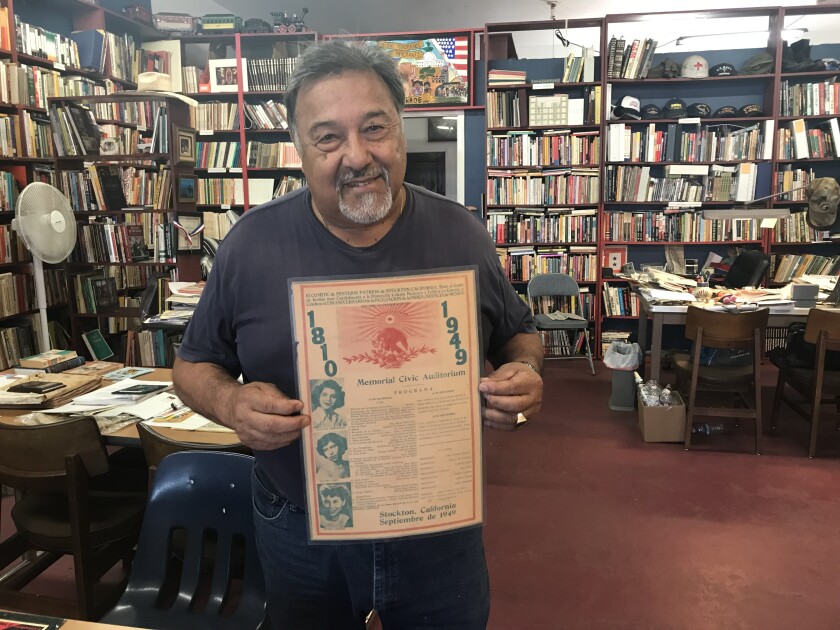
Richard Soto holding a book about Ruben Salazar at the Chicano Research Center in Stockton.
(Julia Wick / Los Angeles Times)

Good morning, and welcome to the Essential California newsletter. It’s Thursday, Aug. 22, and I’m writing from Stockton.
History usually belongs to the conquerors, or the esteemed academics. But sometimes it also gets told by whoever most carefully corrals all the pieces and wrestles them into place.
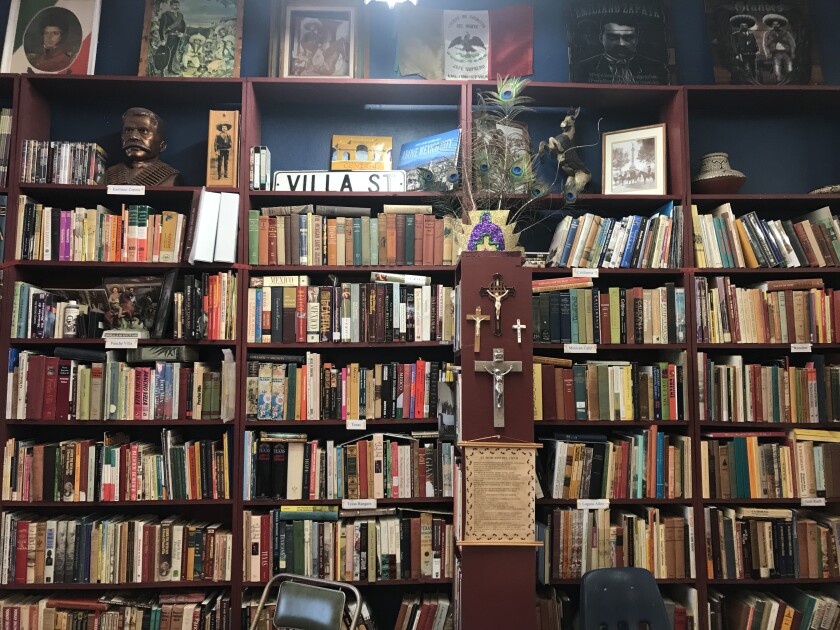
The Chicano Research Center, a storefront library on a rundown stretch of Stockton’s east side, is the product of one Central Valley man’s obsessive, expansive quest.
Richard Soto, a 75-year-old, semi-retired educator, has spent the lion’s share of his life quietly building his collection of Chicano literature and history — first as a young man hungry to learn more about his own identity, and later with the dream of someday sharing it with the public like this.
He opened the Chicano Research Center as a nonprofit in 2016. All are welcome to come in, and Soto will probably offer you coffee at the door. He estimates that he has about 20,000 books, journals and ephemera (along with cases of corrido-filled CDs and LPs) housed in this former panaderia.
He built the bookshelves lining every inch of the room himself, with $3,000 worth of pine wood (including his 10% U.S. veteran discount) from Home Depot.
The library is organized according to the self-described “Soto” method, starting with indigenous history in the front corner of the room furthest from his desk, and wrapping all the way around to the present day, with labeled sections based on historical periods and events, individuals and other topics. (The library’s focus includes Mexican history as well as Mexican American history: “One of the things that I learned is that you can’t read Chicano literature, and appreciate and understand it if you don’t know Chicano Mexican history,” Soto explained.)
See also: “Chicano Research Center is freeze-frame into the past” in the Stockton Record]

The walls are brightly punctuated with art, flags, and framed awards and accolades from Soto’s career as an educator, as well as a certificate honoring him for his bravery as a Brown Beret medic during the Chicano Moratorium.

chicano research center
A section of books at the Chicano Research Center in Stockton. 
(Julia Wick / Los Angeles)
Soto’s collecting quest began when he was a young man, just back from Vietnam and participating in the Chicano Movement. He went looking for the books that would speak to his story — as a Mexican American born in the United States — but the books he wanted didn’t seem to exist.
“I wanted to know what contributions had we made and what had we done,” Soto said. “And for me, I always wanted to know why people hated me. You know, I pretty much let people alone, but for some reason they had this, I don’t know, hereditary hatred for me.”
During his two years at San Joaquin Delta College, he “found all of maybe five books.” He went to Sacramento State and “found 10 more.” It was only when he left Sacramento for San Francisco that he started to really find what he was looking for, at a now-shuttered progressive bookstore called Modern Times in the Mission District.
After getting his master’s in counseling from San Francisco State, Soto returned to his Central Valley hometown of Tracy, where he worked as a high school counselor for nearly 40 years. He’d loan his students books to learn their history and build their self esteem, parceling out poetry or history or biography depending on what they seemed to need.
“There’s so much beautiful Mexican history. There are so many dynamic Mexican men and women, social political activists that have done something that is just not out there,” he said. “So, I started buying all this stuff.”
Time marched forward and all the while he quietly built his collection, bit by bit. He bought what he could, when he could and stored it where he could. “Everywhere I went, I created a room for all the books.”
When he officially retired, he took another full-time job teaching at an adult school. Suddenly, he had an income and a pension.
“I had a lot of extra money. So I thought man, I’m gonna really hit this,” he recalled. He would turn to the bibliographies in history books and mark off everything he already had, to see what was still missing. Then he would spend a few hours every morning on eBay, looking for discarded library books.


Richard Soto
Richard Soto holds an item from his collection — a laminated program from a 1949 event featuring a young Dolores Huerta (then known as Dolores Fernandez) — at his Chicano Research Center in Stockton, Calif. 
(Julia Wick / Los Angeles Times)
And finally, he found this space and carefully renovated it to house and share his glorious, sprawling collection.
“Most people, when they come here, they’re overwhelmed,” he said. “They can’t believe that something like this exists.”

Sunday, July 09, 2017

Big news coming out of El Paso: UTEP Launches Online Chicano Studies Program

Big news coming out of El Paso.  They are launching a "Chicano Studies" online program out of the University of Texas El Paso (UTEP). If you are not from the U.S., it is important to know that there is a direct tie of the self-referent, "Chicano," to the Mexican American Civil Rights Movement that took place in the late 1960s and throughout the 1970s in it hey day. Names and labels are complicated, as I've commented previously here on this blog before.
Among the other names for Chicano Studies, by the way, are "Mexican American Studies," "Tejano Studies" (in Texas), and "Mexican American and Latino Studies" (as we have here in Austin at UT).  
Though from a disciplinary perspective, there is overlap, Chicano Studies is not the same as Latin American Studies which focuses largely on Latin America instead of the domestic. U.S. population.  This is, of necessity, a broad stroke since many scholars' work overlaps.  That said, these are very distinct disciplines with distinct intellectual concerns, frameworks, bodies of knowledge, conferences, scholarly identities, journal/publishing outlets, and so on.
Back to UTEP.  I would think that the decision to name themselves was an involved ordeal like it usually is. Regardless, what should not get lost in the mix are at least the following three items that are worthy of note:  
First, the enduring affinity to that moment in history when our 60s and 70s activists first called for culturally inclusive curriculum in our public schools as part of a larger struggle for transforming the challenging social, cultural, political, and economic conditions that they faced.  
Second, this is occurring in the context of what truly is a robust revival of the movement's call for Mexican American Studies curriculum in the current moment—and not just in Texas, but also in California, Arizona, New Mexico, Colorado, and Oregon.  

In Texas, to the best of my knowledge, the following districts—all very large—have endorsed Ethnic Studies and are in the process of developing curriculum:  Austin ISD, El Paso ISD, and Fort Worth ISD.  
Lastly, all of this is happening in the wake of the successful #RejectTheText battle involving a racist textbook, against the Texas State Board of Education that has roots in an earlier statewide initiative in 2012 by the Mexican American community, spearheaded by South Texas banker, Renato Ramirez and the Tejano Monument Committee, to establish a Tejano Monument on the grounds of the Texas State Capitol.
So now Texas, UTEP, in particular, boasts an on-line Chicano Studies curriculum.  It is encouraging and inspiring to consider that now the world has access to Chicano Studies (Note: see this website scholar-led website, MAS Texas Education , for additional curriculum and other resources).  It is not only a new day, but a long-awaited one.
Remember that, as bellwether states, so goes California and Texas, so goes the nation. Rather than resisting this, our school boards, school districts, schools, and states should embrace it and join the movement for Ethnic Studies.  If done well, you and your children will be the better for it anyway.  I promise. 😀

Angela Valenzuela
c/s


UTEP Launches Online Chicano Studies Program


The Chicano Studies Program at The University of Texas at El Paso has recently launched a new online Bachelor of Arts in Chicano Studies option enabling students across the United States and around the globe to have access to one of the oldest and most respected Chicano Studies programs in the nation.
In 1971, UTEP became the first university in Texas to introduce a Chicano Studies program.
UTEP’s online option will follow a similar curriculum to that of the University’s on-campus Bachelor of Arts in Chicano Studies program with one major difference: online students will be able to attend classes from anywhere in the world they have a computer and Internet access.
“There are large concentrations of ethnic Mexicans residing throughout the country who hunger for knowledge about history and culture, who want to see themselves in the grand narrative of the United States,” said Dennis Bixler-Márquez, Ph.D., director of Chicano Studies. “This program provides them with that space.”
The multi- and interdisciplinary Chicano Studies program is 100 percent online and is ideal for aspiring professionals seeking to work in positions (both in the private and public sector) that require knowledge of the Mexican origin population together with literacy and digital communication skills.
The curriculum emphasizes the dynamics of the U.S.-Mexico border and the Latino presence throughout the nation and provides an opportunity for students to link that knowledge with other disciplines and professional careers. Chicano Studies majors will complete 30 hours of core courses in Chicano literature, cultural diversity, immigration, social justice and more.
UTEP’s strategic location on the U.S.-Mexico border will enable students to gain substantial expertise on the historical, cultural and geographic context of the Mexican origin population – the largest ethnic minority group in the U.S.
Chicano Studies majors will engage with students from different backgrounds through online group work and discussion boards. They also will also develop team, organizational and planning skills and become proficient with computer software programs.
Chicano Studies graduates often continue on to law school, public health administration, social work, national security, and master’s and doctoral programs in these areas and more.
The online program is offered through UTEP Connect, the University’s collection of fully online baccalaureate, graduate and certificate programs.
For information about the online Bachelor of Arts in Chicano Studies, visit their website.
To learn more about the UTEP Connect suite of programs, visit utepconnect.utep.edu.

Friday, March 02, 2012

IF GEORGE WASHINGTON’S MY FATHER, WHY WASN’T HE CHICANO? by Felipe de Ortego y Gasca


IF GEORGE WASHINGTON’S MY FATHER, 
WHY WASN’T HE CHICANO?
Presented at the Forum on the Elimination of Mexican American Studies and Banning of Chicano Books in the Tucson Unified School District,  Western New Mexico University, February 21, 2012.

By Felipe de Ortego y Gasca
Scholar in Residence, Department of Chicana/Chicano and Hemispheric Studies, Western New Mexico University

The title of this piece are the last lines of a poem by Richard Olivas penned some years ago. Sitting in his history class, Olivas asked: “If George Washington’s, my father, why wasn’t he Chicano? The question raised in the poem embodies the reason for the emergence of Mexican American/Chicano Studies.
Indeed, the White Studies curriculum of American schools indoctrinates students in American classrooms in the apodictive historical perspective of the nation—myths and all. Until the advent of the Chicano Movement Mexican Americans knew little about their history in the United States as a colonized people.

Mexican America as an internal American colony

Blame it on Manifest Destiny! By hook or crook, the United States was determined to extend its domain from sea to shining sea. But Mexico was standing in the way. In 1846, President James K. Polk declared war on Mexico on the pretext that Mexico had invaded the United States by crossing into Brownsville, Texas, with armed troops. Only the year before, the United States had admitted Texas into the union even though Mexico had never acknowledged the break-away independence of its Texas province. Despite this international state of affairs with Texas, dead-set on adding Texas to the union, the United States annexed Texas in 1845.

The U.S. War against Mexico lasted less than 2 years, after which per the Treaty of Guadalupe Hidalgo signed on February 2, 1848, the United States dismembered Mexico and annexed more than half of its territory, permitting Mexicans (by choice) to remain in the American acquired territory of Mexico or to relocate to the new boundaries of Mexico. My father’s family chose to relocate to Guanajuato, Mexico; while my mother’s family chose to remain in San Antonio, Texas, where they had settled in 1731, some 45 years before the break-away American colonies of England in 1776. Most Mexicans opted to stay with what they considered their homeland.

As an internally colonized people, Mexicans—now Americans by fiat—had to learn English, how to navigate the American political system, and how to survive the American schools. I wrote about that survival in 1970 in a piece entitled “Montezuma’s Children,” published as a cover story by The Center Magazine of the John Maynard Hutchins Center for the Study of Democratic Institutions. The piece was read into the Congressional Record by Senator Ralph Yarbrough of Texas in 1970 and was recommended for a Pulitzer. 
 
Mexican America comes of Age

For 162 years—from 1848 to 1960—Mexican Americans sought to become the citizens the United States expected them to be: They fought in every American war since then, distinguishing themselves in World War II as the only group to win more Medals of Honor than any other group. Of the 16 million Americans who served in that conflict, 1 million were Mexican Americans. When the United States called on Americans to defend the nation, Mexican Americans have responded overwhelmingly.

Mexican American loyalty and allegiance to the American flag has not waned. What changed was Mexican American expectations of equality for their service to the nation. Those expectations surfaced in 1960 with the Chicano Movement—a groundswell of patriotism in search of recognition. Out of that groundswell emerged the Chicano Renaissance: a literary recognition of their evolution in the American mosaic. In the Fall of 1969 I taught the first course in Mexican American/ Chicano literature at the University of New Mexico. In 1971 I completed Backgrounds of Mexican American Literature (University of New Mexico, 1971), first historical and taxonomic study in the field. In 1960, only 10 novels by Mexican Americans had been published in the United States. Since then, the count has swelled to hundreds. Overall, the count of books by Mexican Americans in the American publishing arena is in the thousands. Mexican Americans realized that if America is to know who Mexican Americans are, then Mexican Americans must write their own stories. Mexican Americans are not who mainstream America says they are; Mexican Americans are the only ones who can say who they are.

Today, the most egregious example of prejudice and discrimination based on ethnicity and ancestry is the situation in the Tucson Independent School District where Mexican American Studies has been eliminated as a program of study and a list of particular books bans their use in classrooms. These are books by eminent Chicano and Native American scholars. Banned also are Civil Disobedience, Brave New World and Shakespeare's The Tempest. The logic defies understanding except that it seems to be based on ethnicity and ancestry.

All of this hullaballoo is the result of Arizona House Bill 2281 signed by Governor Jan Brewer banning Ethnic Studies Programs (which includes Chicano Studies) on the grounds that these Programs advocate ethnic separatism and encourages Latinos to rise up and create a new territory out of the southwestern region of the United States. Perhaps those Xenophobes need a history lesson on how the Hispanic Southwest came into the American fold. They also need to look at school textbooks to see how under-represented Asian Americans, African Americans, Native Americans, and Mexican Americans are in those textbooks. Which is why we need Asian American Studies, African American Studies, Native American Studies, and Mexican American Studies. What are white Arizonans really afraid of? HB 2281 has come to the attention of the United Nations which condemns the Bill, citing Arizona’s rage against immigration and ethnic minorities as “a disturbing pattern of hostile legislative activity.” The better word would be “racism.”

Chicano Studies as the Voice of Chicanos

Forty-eight years ago when I began university teaching after some years as a high school teacher of French, there was no Chicano Stud­ies. That is, no Chicano Studies as an organized field of study. To be sure, there were Mexican American scholars working on various aspects of Mexican Amer­ican life and its cultural productions, scholars like Aurelio Espinosa, Juan Rael, Arturo Campa, Fray Angelico Chaves, George I. Sanchez, Americo Paredes, and others. Important as this scholarship was, it emerged amorphously, reflecting independ­ent intellectual interests rather than a scholarship reflecting a field of study. This is not to say that some of these scholars may not have considered their work as part of a field of study conceptualized as Mexican American Studies. Despite its lack of an under-pinning, it was a field of Mexican American Studies, its constituent parts subsumed as American folklore. 
 
This situation created a critical barrier to the public discussion and dissemination of information about the presence of Mexican Americans in the Unit­ed States and their contributions to American society. Until 1960 and the emergence of the Chi­cano Movement, Mexican Americans were charac­terized by mainstream American schol­ars–-principally anthropologists and social work­ers–-in terms of the queer, the curious, and the quaint. That is, Mexican Amer­icans were categorized as just another item in the flora and fauna of Americana.

The Chicano Movement–that wave of concientizaci­on that came to bloom among Mexican Americans in the 60's transforming them into Chica­nos– help­ed to change American perceptions about Mexican Americans. While Mexican Americans knew much about Anglo Americans, Anglo Ameri­cans knew little about Mexican Americans.

In 1970 I was recruited to be founding director of the Chicano Studies Program at the University of Texas at El Paso, first such program in the state (and still there). By this time, I had become “conscien­tized” as a Chicano. From 1967 on, I had become identified as a Quinto Sol Writer, that is, among the first wave of Chicano writers of the Chi­cano Renaissance which had its beginning in 1966 with the creation of Quinto Sol Publica­tions.

The Arizona Challenge

Mexican American accounts of who they are are being challenged in Arizona. The Tucson Unified School District in Arizona made headlines in recent weeks when it eliminated its Mexican American Studies program. John Huppenthal, the Arizona Superintendent of Public Instruction, declared the program illegal under a state law that bans racially-divisive classes. Books by Mexican American authors have been yanked from TUSD classrooms: Message to Aztlán by Rodolfo Corky Gonzales (2001) and Chicano! A History of the Mexican Civil Rights Movement by Arturo Rosales (1997).

Everywhere, there are xenophobic and fas­cist forces that threaten the existence of Chicano Studies. Mainstream suspicions about the ideological agenda of Chicano Studies has become paranoiac. In Arizona there are legislative initiatives to remove from the schools programs deemed to be seditious, programs that promote divisiveness and breed revo­lution, programs like Chic­ano Studies–any ethnic studies program that challen­ges Western values. One Arizona legislator believes that such an initiative will restore the image of the United States as a “melt­ing pot”—that relic salvaged from the reliquary of dystopic America.

Tony Diaz, founder of the literary nonprofit Nuestra Palabra: Latino Writers Having Their Say is organizing a caravan from Houston to Tucson over spring break to raise awareness about the situation and taking Hispanic books to Tucson students. He calls it the Librotraficante movement. It begins in Houston on Monday, March 12 and ends in Tucson on Saturday, March 17. Along the way, the caravan will stop in San Antonio, El Paso and Albuquerque, for read-ins and other activities. The caravan will be filled with authors and activists, accruing people as it proceeds toward Tucson.

Como una hija querida, tenemos que defender Chicano Studies porque si no, perderemos nuestro futuro. That’s too important a future to lose, too ex­acting a price to pay. This is the exact moment of history for Chicanos to rise to the occasion. Inaction sustains the status quo. Now, more than ever, we must band together in common cause. Chicano Stud­ies deserves no less. Actually, all Americans must stand up to this current wave of xenophobia.

WORKS CENSORED OR BANNED BY THE TUCSON SCHOOL DISTRICT PER SB 2281
American Government/Social Justice/Education
  • Rethinking Columbus: The Next 500 Years (1998) by B. Bigelow and B. Peterson
  • The Latino Condition: A Critical Reader (1998) by R. Delgado and J. Stefancic
  • Critical Race Theory: An Introduction (2001) by R. Delgado and J. Stefancic
  • Pedagogy of the Oppressed (2000) by P. Freire
  • United States Government: Democracy in Action (2007) by R. C. Remy
  • Dictionary of Latino Civil Rights History (2006) by F. A. Rosales
  • Declarations of Independence: Cross-Examining American Ideology (1990) by H. Zinn
American History/Mexican American Perspectives
  • Occupied America: A History of Chicanos (2004) by R. Acuña
  • The Anaya Reader (1995) by R. Anaya
  • The American Vision (2008) by J. Appleby et el.
  • Rethinking Columbus: The Next 500 Years (1998) by B. Bigelow and B. Peterson
  • Drink Cultura: Chicanismo (1992) by J. A. Burciaga
  • Message to Aztlán: Selected Writings (1997) by R.  Gonzales
  • De Colores Means All of Us: Latina Views Multi-Colored Century (1998) by E. S. Martínez
  • 500 Años Del Pueblo Chicano/500 Years of Chicano History in Pictures (1990) by E. S. Martínez
  • Codex Tamuanchan: On Becoming Human (1998) by R. Rodríguez
  • The X in La Raza II (1996) by R. Rodríguez
  • Dictionary of Latino Civil Rights History (2006) by F. A. Rosales
  • A People's History of the United States: 1492 to Present (2003) by H. Zinn
English/Latino Literature
  • Ten Little Indians (2004) by S. Alexie
  • The Fire Next Time (1990) by J. Baldwin
  • Loverboys (2008) by A. Castillo
  • Women Hollering Creek (1992) by S. Cisneros
  • Mexican White Boy (2008) by M. de la Pena
  • Drown (1997) by J. Díaz
  • Woodcuts of Women (2000) by D. Gilb
  • At the Afro-Asian Conference in Algeria (1965) by E. Guevara
  • Color Lines: "Does Anti-War Have to Be Anti-Racist Too?" (2003) by E. Martínez
  • Culture Clash: Life, Death and Revolutionary Comedy (1998) by R. Montoya et al.
  • Let Their Spirits Dance (2003) by S. Pope Duarte
  • Two Badges: The Lives of Mona Ruiz (1997) by M. Ruiz
  • The Tempest (1994) by W. Shakespeare
  • A Different Mirror: A History of Multicultural America (1993) by R. Takaki
  • The Devil's Highway (2004) by L. A. Urrea
  • Puro Teatro: A Latino Anthology (1999) by A. Sandoval-Sanchez & N. Saporta Sternbach
  • Twelve Impossible Things before Breakfast: Stories (1997) by J. Yolen
  • Voices of a People's History of the United States (2004) by H. Zinn
  • Live from Death Row (1996) by J. Abu-Jamal
  • The Lone Ranger and Tonto Fist Fight in Heaven (1994) by S. Alexie
  • Zorro (2005) by I. Allende
  • Borderlands La Frontera: The New Mestiza (1999) by G. Anzaldua
  • A Place to Stand (2002), by J. S. Baca
  • C-Train and Thirteen Mexicans (2002), by J. S. Baca
  • Healing Earthquakes: Poems (2001) by J. S. Baca
  • Immigrants in Our Own Land and Selected Early Poems (1990) by J. S. Baca
  • Black Mesa Poems (1989) by J. S. Baca
  • Martin & Mediations on the South Valley (1987) by J. S. Baca
  • The Manufactured Crisis: Myths, Fraud, and the Attack on America's Public Schools (1995) by D. C. Berliner and B. J. Biddle
  • Drink Cultura: Chicanismo (1992) by J. A Burciaga
  • Red Hot Salsa: Bilingual Poems on Being Young and Latino in the United States (2005) by L. Carlson & O. Hijuielos
  • Cool Salsa: Bilingual Poems on Growing up Latino in the United States (1995) by L. Carlson & O. Hijuelos
  • So Far From God (1993) by A. Castillo
  • Address to the Commonwealth Club of California (1985) by C. E. Chávez
  • Women Hollering Creek (1992) by S. Cisneros
  • House on Mango Street (1991), by S. Cisneros
  • Drown (1997) by J. Díaz
  • Suffer Smoke (2001) by E. Diaz Bjorkquist
  • Zapata's Discipline: Essays (1998) by M. Espada
  • Like Water for Chocolate (1995) by L. Esquievel
  • When Living was a Labor Camp (2000) by D. García
  • La Llorona: Our Lady of Deformities (2000), by R. Garcia
  • Cantos Al Sexto Sol: An Anthology of Aztlanahuac Writing (2003) by C. García-Camarilo et al.
  • The Magic of Blood (1994) by D. Gilb
  • Message to Aztlan: Selected Writings (2001) by Rodolfo "Corky" Gonzales
  • Saving Our Schools: The Case for Public Education, Saying No to "No Child Left Behind" (2004) by Goodman et al.
  • Feminism is for Everybody (2000) by b hooks
  • The Circuit: Stories from the Life of a Migrant Child (1999) by F. Jiménez
  • Savage Inequalities: Children in America's Schools (1991) by J. Kozol
  • Zigzagger (2003) by M. Muñoz
  • Infinite Divisions: An Anthology of Chicana Literature (1993) by T. D. Rebolledo & E. S. Rivero
  • ...y no se lo trago la tierra/And the Earth Did Not Devour Him (1995) by T. Rivera
  • Always Running - La Vida Loca: Gang Days in L.A. (2005) by L. Rodriguez
  • Justice: A Question of Race (1997) by R. Rodríguez
  • The X in La Raza II (1996) by R. Rodríguez
  • Crisis in American Institutions (2006) by S. H. Skolnick & E. Currie
  • Los Tucsonenses: The Mexican Community in Tucson, 1854-1941 (1986) by T. Sheridan
  • Curandera (1993) by Carmen Tafolla
  • Mexican American Literature (1990) by C. M. Tatum
  • New Chicana/Chicano Writing (1993) by C. M. Tatum
  • Civil Disobedience (1993) by H. D. Thoreau
  • By the Lake of Sleeping Children (1996) by L. A. Urrea
  • Nobody's Son: Notes from an American Life (2002) by L. A. Urrea
  • Zoot Suit and Other Plays (1992) by L. Valdez
  • Ocean Power: Poems from the Desert (1995) by O. Zepeda
UPDATE, Monday, January 16, 2012
Bless Me Ultima by Rudolfo Anaya
  • Yo Soy Joaquin/I Am Joaquin by Rodolfo Gonzales
  • Into the Beautiful North by Luis Alberto Urrea
  • The Devil's Highway by Luis Alberto Urrea