Translate

Showing posts with label Rudy Acuña. Show all posts

Tuesday, December 24, 2024

The Beginning of the End of the Public University, by Rodolfo "Rudy" Acuña, Ph.D.

This historical perspective reflecting on the student movement of the 1960s and early 70s by Dr. Rudy Acuña is helpful as we deconstruct the political moment we're in with respect to civil rights and higher education. I would definitely read this in tandem with a recent historical and important post titled, "The Free Speech Movement at Sixty and Today’s Unfree Universities" by Robert Cohen, AAUP. One of more insightful comments from Dr. Acuña's piece is the following:
"Tom Hayden in an article on Mario Savio argued that “The current era of privatization and neoliberalism was born in Berkeley as a countermovement to the ’60s.” We did not see what was on the horizon, too caught up with our perceived victories perhaps to see a reaction building that would change higher education."
We need a new student movement to reign in neoliberalism that envisions and works toward a more equitable and sustainable future, prioritizing social justice, diversity and inclusion, environmental stewardship, and collective well-being over profit and exploitation. To move in this direction, we must consider what a caring university and economy might be, both of which exist in reciprocal relationship to Mother Earth. On that note,
Merry Christmas! Feliz Navidad! Joyeux Noël, Buon Natale, Feliz Natal, 圣诞快乐 (Shèngdàn Kuàilè), С Рождеством (S Rozhdestvom), Nollaig Shona, मैरी क्रिसमस (Meri Christmas), Mutlu Noeller, Весела Коледа (Vesela Koleda), Frohe, Weihnachten, Happy Hanukkah, & Happy Kwanzaa!!! 
-Angela Valenzuela

"They tried to bury us, but they didn’t know we were seeds."

-Chicana/Chicano/Indigenous Proverb

The Beginning of the End of the Public University
Rudy Acuña: We were too young, naive or preoccupied with the Vietnam War, campus turmoil and the excitement of times to recognize the significance of the changes.
by Rodolfo F. Acuña | Jan 19, 2015 LA Progressive

“The best of times …the worst of times.”
The 1960s were “the best of times …the worst of times.” As one author put it, a backlash was underway that marked the “Slow Death of Public Higher Education.” In less than a decade California went from Master Plan to No Plan. The ill wind was ushered in by Ronald Reagan’s election as governor of California in 1966.

It should have been no surprise; Reagan had vowed to “clean up that mess in Berkeley,” harping about “sexual orgies so vile that I cannot describe them to you.” Reagan proposed tuition to make the bums work so they would be too tired to carry picket signs.

In office, Reagan reduced state funding for higher education, and laid the foundation for a shift to a tuition-based funding model. When students protested Reagan called the National Guard and crushed them.

Reagan shifted the political debate over the meaning and purpose of public higher education in America. He declared war on the poor, proposing to throw the “bums” off welfare. According to Reagan, universities along with an expensive welfare program were a problem and they took California dangerously close to socialism.

Tom Hayden in an article on Mario Savio argued that “The current era of privatization and neoliberalism was born in Berkeley as a countermovement to the ’60s.” We did not see what was on the horizon, too caught up with our perceived victories perhaps to see a reaction building that would change higher education.

At the time, however, we were too young, naive or preoccupied with the Vietnam War, campus turmoil and the excitement of times to recognize the significance of the changes. They were slow in coming – by 1970 the fees had increased to $50 a semester, which was affordable.

Berkeley was temporarily galvanized by the firing of Clark Kerr. In response to student protests, Reagan ordered 2200 national guardsmen onto the Berkeley campus. Because of the prestige of Berkeley and UCLA for all intents and purposes privatization began earlier there with the admission of significant numbers of out-of-state and international students and an avalanche of lucrative private and public grants.

Meanwhile, by 1959, San Fernando Valley State was no longer a satellite of Los Angeles State College. It was situated in a moderately conservative and overwhelmingly white suburbia. Spurred by freeways, it grew tremendously during the 1960s, and by June 1972 the college officially named itself California State University, Northridge.

My first student teaching assignment was in 1957 at SFVSC through LA State College. Over the years, I taught junior high, high school and at Pierce College in the Valley. Active in theLatin American Civic Association and the Mexican American Political Association, we lobbied SFVSC for programs. There were a few sympathetic professors such as Betty Brady and of course, Julian Nava.


Valley State was a Mormon institution, controlled by a Mormon hierarchy. The professors wore white shirts, ties and coats. There was a faculty dining hall (cafeteria). At the time I did not realize it, but although we were a cow college, there was a feeling of tradition. Most faculty members respected the liberal traditions of a university education, and consequently reacted toward any threat to these traditions. Governance was part of that mindset and it was defended by the faculty senate.

The selection of James Cleary in 1969 marked a transition from Mormon rule. Cleary was regarded as a genuine scholar, although his publications largely rested on his editorship of Robert’s Rules of Law. He had been a professor and administrator at the University of Wisconsin/Madison. He was Catholic and looked presidential, always with his pipe in hand.

He led CSUN to 1992. Cleary, for all of his warts, respected faculty governance and fought for the autonomy of the university. I cannot remember an instance during his tenure when he overturned the decision of the faculty senate. However, changes were taking place during the 1970s like the draconian Proposition 13. He and other administrators unlike today’s managers used their moral authority to slow down encroachments.
The decline in the traditions of the liberal university and the protection of faculty of the principle of faculty governance in all probability was facilitated by the decline of tenured track faculty and the rise in the number of part-time faculty.

By 1977, enrollment at CSUN cost $95. Eleven years later it rose to a $342 tuition fee. Until the early 1990s, tuition and fees remained low. Nevertheless, tuition and fees more than doubled from the late 1980s to early 1990s. By fall 2006, the University had tuition of $1,260. Spurred by the 2008 recession it went to $2,000 per year. By 2011–12, it rose to over $6,000 per year at CSU. ($3,272.00 in the spring 2015).

It is merely speculative, but the decline in the traditions of the liberal university and the protection of faculty of the principle of faculty governance in all probability was facilitated by the decline of tenured track faculty and the rise in the number of part-time faculty. There were also structural changes; full time faculty was only required to be on campus two days a week. Today, many professors lack a sense of place; it is a job rather than an institution.

Administrators have also changed. They are not cut in the image of the pipe smoking Cleary, and not one since his departure can be called a scholar. They are what the neoliberal-privatized university require, overseers. Under their rule, faculty governance has declined and even the department chairs are today part of the administrative staff.

In a recent address to the faculty, Provost Harry Hellenbrand titled “Molting Season” defended the privatization of CSUN and rationalized the increase in tuition: “Yes, CSUN Charges students more than they paid fifty years ago. But factor in $150,000,000 more in aid.”

This echoes CSUN President Dianne Harrison who told members of Chicana/o Studies that students could afford high tuition and dorm costs because they were getting Pell Grants. It is cynical and it is important to note that even the conservative Chancellor Glenn S. Dumke had opposed the notion of tuition.

The “slow death of Public Higher Education” has come about from within. The managers have benefitted handsomely in terms of salaries, staff increases and slush funds. When a president comes in many of her housing perks are paid by non-state funds that do not have the restraints or scrutiny of state funds. Administrators have slush funds from which they can pay off cronies.

On the CSUN campus we have a private university that “molted” from the public institution. Privatization has contributed to the escalation of student costs with less and less public funds expended on education.

Privatization and neoliberalism that began in Berkeley as a countermovement to the ’60s is today in full swing. They are bringing about changes that will end public higher education and limit access to public higher Ed to the upper 50 percent.

Meanwhile, academicians will put together the narrative of the privatization and death of the public university. The patterns are easily discerned. More difficult will be to recognize and describe the changes that they have brought about in we the people.


Rudy Acuña

The opinions expressed here are solely the author's and do not reflect the opinions or beliefs of the LA Progressive.

Saturday, November 12, 2022

"Unrest: The Founding of the Cal State University Northridge Chicana/o Studies Department" [documentary]

Institutional histories like that of Cal State Northridge (CSUN) featured here in this Wikipedia entry  are themselves interesting. Within these are micro-histories such as the story recounted here on the founding of the Chicana and Chicano Studies Departments that took place in 1969 in the tumult of the Civil Rights and anti-war movements of the late 1960s. It coincided with the founding of the Department of Africana Studies at CSUN.

It's interesting learning about how the department's first chair, the legendary Rodolfo "Rudy" Acuña, author of the classic Chicana/o Studies text, "Occupied America: A History of Chicanos," currently in its 8th edition,
leveraged full professor status on his way in and then wrote an extensive curriculum that the university approved and enjoys today. Much is owed to the beloved Dr. Rudy Acuña who is up in years, but still doing what he can to move the needle on our collective consciousness to make us critical consumers of knowledge and agents of change and transformation for a better world.

It's easy to take for granted the struggles for our education that took place long before any of us ever took our first step on the college campus simply because we're not educated or taught of the immense struggles and sacrifice undertaken by those before us—like the many activists featured in this film—so that we can take advantage, and make the best, of educational opportunities today.

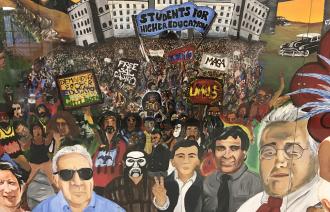
detail of mural showing student and faculty protesters
Without a doubt, there is still much work to do in getting underserved communities into higher education. I think documentaries like these help us to understand both the barriers we continue to face today, but also the importance of advocacy and struggle for the education we want and deserve as communities without which our democracy  is diminished.

Check out the CSUN Chicana/o Studies Department page to learn more about the department.

Thanks to Dr. Tara Yosso for sharing this with me. Enjoy!

-Angela Valenzuela


Monday, June 13, 2022

Honoring Rodolfo “Rudy” Francisco Acuña 7th Annual Statewide Summit on Mexican American Studies, 2022

Dr. Emilio Zamora delivered a powerful tribute to the legendary Dr. Rodolfo "Rudy" Acuña last Saturday at our 7th Annual Mexican American Studies Summit. I have posted Dr. Acuña's opinion-editorials over the years.

 Beginning with his seminal text, Occupied America, A History of Chicanos that is currently in its 9th edition, his contributions to Mexican American Studies are incalculable. Our dear friend and colleague is up in years and so I am glad that Emilio delivered this beautiful tribute.

Do check out his other best-known books listed below.

-Angela Valenzuela


Honoring Rodolfo “Rudy” Francisco Acuña

7th Annual Statewide Summit on Mexican American Studies, 2022

by

Emilio Zamora


Today, we honor Dr. Rodolfo “Rudy” Francisco Acuña, the extraordinary historian, educator and social activist in Chicano, or Mexican American Studies.  Rudy was born on May 18, 1932 in Boyle Heights, Los Angeles, California to Alicia Elías, from Sonora, and Francisco Acuña, from Jalisco. He was unable to be with us, but sends his greetings.  Rudy graduated from Loyola High School in 1951 and earned a Ph.D. in Latin American Studies in 1968 from the University of Southern California. 

Rudy’s achievements are many. His best known publication is the landmark history on Mexicans in the United States, Occupied America, A History of Chicanos. The book was published in 1972—fifty years ago—and it is currently in its 9th edition. Occupied America is one of the earliest textbooks on the subject. It is also known for its bold and truth-telling chronicling of Mexican American history. No other historian has written deliberately and forthrightly as an advocate for social justice for his people.

Rudy is the founding chair of the Chicana/o Studies department at San Fernando Valley State (California State University at Northridge)—the largest Chicana/o Studies Department in the United States with 27 tenured professors. Here too, Rudy has self-consciously embraced a social justice agenda as a Mexican American intellectual and activist. 

Besides maintaining a heavy teaching load and busy administrative work, Rudy has published 24 books and hundreds of scholarly articles and essays for public consumption. He has published three children’s books and more than 200 academic, in addition to over 160 book reviews in academic journals, hundreds of essays in blogs, newspapers and other public outlets, and an interactive Student/Teacher Guide to Chicana/o Studies.

Some of his best known books include: The Story of the Mexican American (1969); Sonoran Strongman: Ignacio Pesqueira and His Times (1974); A Community Under Siege: A Chronicle of Chicanos East of the Los Angeles River, 1945-1975 (1984); Anything But Mexican: Chicanos in Contemporary Los Angeles (1996); Sometimes There is No Other Side; In the Trenches of Academe (1998); U.S. Latino Issues (2004); Corridors of Migration; The Odyssey of Mexican Laborers, 1600-1933 (2007); Voices of the U.S. Latino Experience (2008); The Making of Chicana/o Studies (2011); U.S. Latino Issues (2013); and Assault on Mexican American Collective Memory, 2010-2015: Swimming with Sharks (2019).

Rudy has received many deserving recognitions, including: Ford and Rockefeller Foundation Research Grants; The Gustavus Myers Award for the Outstanding Book on Race Relations in North America; The John Hope Franklin Distinguished Scholar Award from Diversity in Higher Education; The National Hispanic Hero Award from the United States Hispanic Leadership Institute; The National Hispanic Institute Lifetime Achievement Award; A Life Time Achievement Award from the Mexican American Legal Defense and Education Fund; The Distinguished Scholar Award from the National Association for Chicana and Chicano Studies; The Emil Freed Award for Community Service; The Founder's Award for Community Service from the Liberty Hill Foundation among others; One of the “100 Most Influential Educators of the 20th Century” from the Black Issues in Higher Education; and The Activist/Scholar Award from the Community Coalition of South Central Los Angeles.

Rudy has also fought important battles. For instance, when the Chicano Studies Department of the University of California at Santa Barbara unfairly denied him a faculty position In 1990, he sued the university for political and age discrimination and prevailed. After a three-year fight, a federal jury agreed that the university was guilty of age discrimination and awarded Rudy $326,000. The principled person that he is, Rudy used the funds to create a non-profit foundation, the Chicana Chicano Studies Foundation, which provided legal advice and awarded grants to victims of discrimination in higher education. The foundation now also awards educational scholarships.

Rudy continues to advocate for progressive change with his public presence as a scholar/activist, speaking out on issues such as the Iraq and Afghanistan wars, the plight of undocumented Latino workers in the United States. and the censorship of ethnic studies in the public schools of Arizona. Most recently, Dr. Acuña has been involved in advancing Mexican American studies in our public schools, especially in California, New Mexico, Arizona and Texas.

 Today, we raise Rudy’s name and work with our praise, thanks and respect. His unceasing and admirable scholarship and community work on our behalf as a Mexican/Latino community, are modeling invocations of the righteous spirit in action. Con aprecio y respeto, te honramos Maestro.

Monday, November 08, 2021

Rodolfo F. Acuña: The purpose of Chicano Studies was “to liberate students through literacy”

Beautiful 2012 piece by Dr. Rudy Acuña. His powerful words on the purpose of Chicana and Chicano (or Mexican American) Studies still resonate. Liberation is simply not achievable without a vigorous life of the mind that a critical education provides. Expressed differently, literacy gets corrupted when it's about testing companies making tests, young people hopefully scoring highly on them, and even internalizing the results as saying something meaningful about them.

Once we relax these assumptions about students' test scores, we must ask not only why they have such a grip on both students' and educators' lives, but also what they say about students' education? 

Dr. Acuña provides some key insights that link pedagogy to the practice of freedom.

-Angela Valenzuela


Rodolfo F. Acuña: The purpose of Chicano Studies was “to liberate students through literacy”


By Rodolfo F. Acuña

June 13, 2012

LatinaLista

“Education either functions as an instrument which is used to facilitate integration of the younger generation into the logic of the present system and bring about conformity or it becomes the practice of freedom, the means by which men and women deal critically and creatively with reality and discover how to participate in the transformation of their world.”-Paulo Freire. Pedagogy of the Oppressed

I always start a meeting with the farm worker handclap in a tribute to University of Arizona Professor Mark Stegeman, the former president of the Tucson Unified School District, who as a pretext for eliminating the TUSD’s Mexican American Studies (MAS) Program, said that he went after MAS because after listening to Mexican Americans use the clap, he knew that Mexican American Studies was a cult. Stegeman’s statement proves my mother’s saying that “Para pendejo no se estudia. Se nace.”

I joined the struggle to Save Ethnic Studies in Arizona because the stupidity of xenophobes and their intent to destroy all the educational reforms that Mexican Americans have struggled for.

In this context I pay tribute to Paulo Freire who has become a legend so much so that we know the legend, but have contesting views of Freire. Our understanding of Freire and his relevance differ due to the fact that several generations separate us and time has a way of distorting reality. In other words, we do not have a common epistemological base, although we are all concerned with education.

Not everyone wants to be educated, however. The forces who benefit from the status quo want this generation to conform to their interests. Consequently, they see Freire as a subservice and worse, according to them, un-American. This is at the crux of the inquisition in Tucson.

When I first read Freire, it was in the context of another time. He was not a legend yet but one among other progressive educators.

The Sixties were a time when we wanted to transform society and create the underpinnings of a democratic and just society. Educators such as Freire were the antithesis of today’s “No Child Left Behind” which reduces learning to indoctrination with subject matter drilled into students.

Education today is reduced to “Roses are red and violets are blue” with no other answer acceptable.

As a junior high school teacher, my education included the great John Dewey who wrote, “Education is not preparation for life; education is life itself.” The purpose of teaching was to educate – to motivate, to engage students to learn – and if they did not, it was your fault not theirs.

Dewey gave literacy a meaning beyond reading the bible. Dating back to the days of Plato and the birth of the notion of democracy literacy has been associated with citizenship.

An American myth is that what makes this nation exceptional is its commitment to public education. The reality is that while Massachusetts Bay Colony had schools, eligibility was limited to race – blacks and Indians could not attend them. As the nation developed, former colonies became states. Compulsory education became more common.

Yet this changed with the growth of cities and the growing number of immigrants; by the second half of the 19th century, education was neither compulsory nor available to the children of immigrants. Reformers fought for compulsory education for the newcomers and the various states passed compulsory education laws — California in 1874 and Texas in 1915. However, the laws were not enforced, especially in the case of migrant children.

As the number of Mexicans grew, organizations such as the Alianza Hispano-Americana and the League of United Latino American Citizens pressed for educational reform. After World War II, educators such as George I. Sánchez demanded better education for Mexican American children and advocated for pedagogies such as bilingual education.

In 1960, the median education of Mexicans in Texas was the third grade and in California the eighth. However, teachers knew that this was an illusion and that large numbers of Mexican Americans were functionally illiterate. They knew that the schools were not teaching Mexicans rather warehousing them.

Reformers were also motivated by Vatican II which began in 1962; it gave birth to Liberation Theology. The poor had the right to enjoy the bounties of the earth – salvation was communal.

This environment produced giants such as Ivan Illich who in 1960 established a center in Cuernavaca, Mexico — CIDOC (Centro Intercultural de Documentación). It was a watering hole for educators and intellectuals throughout the Americas. His books Deschooling Society and Tools of Conviviality were anchors.

Many educators, myself included, looked at a lasting transformation emanating from education. Literacy was not the possession of communism or any other ideology, although note was taken of Mao’s literacy campaign in China.

Educators knew that literacy had broken the isolation of Helen Keller, a blind child with a limited vocabulary. Words freed Keller and words made her a world intellectual.

It did not take much to look around the schoolyard and recognize students mired in poverty and hopelessness. Many would go to jail because of a lack of literacy. I remember teaching literature from Classic Comic Books and occasionally motivating students to read.

I remembered my mother who had been legally blind since the age of four reading the Encyclopedia Britannica peering through the largest magnifying glass I had ever seen. Although she could not help me, she wanted me to read.

In this context I read The Invisible Minority (NEA) in 1966. An essay by a 13 year-old Mexican girl caught my senses:

MeTo begin with, I am a Mexican. That sentence has a scent of bitterness as it is written. I feel if it weren’t for my nationality I would accomplish more. My being a Mexican has brought about my lack of initiative. No matter what I attempt to do, my dark skin always makes me feel that I will fail. Another thing that “gripes” me is that I am such a coward. I absolutely will not fight for something even if I know I’m right. I do not have the vocabulary that it would take to express myself strongly enough…

How could someone who looked at herself in this way learn?

I looked for inspiration to the work of humanist psychiatrist Frantz Fanon. His writings gave me goose pimples:

I ascribe a basic importance to the phenomenon of language. To speak means to be in a position to use a certain syntax, to grasp the morphology of this or that language, but it means above all to assume a culture, to support the weight of a civilization.

When students created an opening in 1968 and 1969, I became part of the first wave of hires. The mission was to set up a Chicano Studies Department.

My epistemological underpinnings differed from most activists — I did not consider the disciplines to be at the core of Chicano Studies. For me, its purpose was to liberate students through literacy. Its purpose was pedagogical.

This discipline-pedagogy dialogue consumed the next forty-two years. No one seemed to be listening until one day I was invited to speak at the 12th Annual Institute for Transformative Education sponsored by the TUSD Mexican American Studies Department.

I had written about the Arizona-Sonoran Border and published Corridors of Migration (Arizona 2008).

In the early 2000s I accompanied Armando Navarro and others to the border to protest the growing violence against Mexican immigrants. But participating in this conference and witnessing their resurrection of Freire reminded me of an encounter I had had in the 1980s when I got a call to go up to La Paz, the United Farm Workers headquarters.

I was not thrilled at the prospect of spending time there, I was not into rabbit’s food. However, I greatly admired César Chávez.

Much to my surprise when I go there I was introduced to Paulo Freire; César and he were to have a special encuentro. César arrived late and immediately launched into dialectic on how he was in the middle of union business and as a poor man could only control his time so it was a duty to use that time for the union.

I had feared that César was going to get blown away. However, after he finished, Freire got up emotionally and pointed to him and said only one word “praxis.”

My emotions so overwhelmed me at Tucson that I too could only think of the word “praxis” when I met Sean and the MAS teachers. These people were teachers.

So when the “rose are red” people tried to eliminate them I had no other choice but to enlist.

In this struggle I have often recalled the words of Fanon,

Sometimes people hold a core belief that is very strong. When they are presented with evidence that works against that belief, the new evidence cannot be accepted. It would create a feeling that is extremely uncomfortable, called cognitive dissonance. And because it is so important to protect the core belief, they will rationalize, ignore and even deny anything that doesn’t fit in with the core belief.— Frantz Fanon (Black Skin, White Masks)

I understand this but as a teacher I also understand that everyone has the right to be “Me” and feel proud of themselves. Roses can be blue and violets red.

Dr. Rodolfo Francisco Acuña, called the “father of Chicano Studies,” is a historian, professor emeritus, activist and the author of 20 titles, 32 academic articles and chapters in books, 155 book reviews and 188 opinion pieces. Currently, he teaches Chicano Studies at California State University, Northridge.

Friday, November 06, 2015

On The Bacon Trail: Exposing Historical Myopia by Rodolfo F. Acuña

I, too, am a fan of David Bacon​—who is indeed, as renowned scholar, Rodolfo Acuña​ aptly states in his blog—"A modern day Jack London without xenophobic biases."  David Bacon is a photojournalist that has analyzed NAFTA's impacts, including Mexico's importation of pork and the loss of 4,000 pig farms in Mexico. Subsidized corn in the U.S. by our government similarly creates impossible competition for corn growers in Mexico.  These "reforms" have fueled immigration to the U.S.
a smithfield 
In the meantime, H2-A visas from the U.S. have led to an abandonment of the countryside in Mexico.  At least half of Mexico today live in poverty—many in extreme poverty, living in deplorable conditions. The short of it is that NAFTA caused downward shifts in Mexican families' well-being, and as a consequence, Mexican migration.  He recounts in his photos and writings many heroic tales where people aren't simply victimized, but they also unionize against great odds.  The union is their school; it is their only route to survival.  

Rather than despising immigrants and immigration from Mexico and Latin America, policymakers and the public would do well to question the impacts of neoliberal policies like NAFTA and own the fact that recent flows of immigrants to the U.S.  are largely the progeny of our own policies. Just as importantly, we should recognize that what now we term, "border insecurity," is the actual, predictable outcome of this same neoliberal agenda.  The insurgency of the Zapatistas in the wake of NAFTA's passage speaks to the clear, expected harmful impacts of regressive, capitalistic policies and structures on the poor.

Thanks to Dr. Acuña for recognizing David Bacon for his contributions.  We brought him to the University of Texas to speak a couple of  years ago.  Helpful links to Bacon's work appear below. 

-Angela


a handsOn The Bacon Trail: Exposing Historical Myopia
       by
Rodolfo F. Acuña

Historical myopia causes nearsightedness, distorting one’s view of current and past events. It interferes in distinguishing details. Consequently, we don’t pay much attention to how and why the present has come about.
In general American culture discourages complex thinking. Almost everything is viewed through the prism of faith. Learning is reduced to bullet points with minimal evidence required. The historian acts like a prosecuting attorney obsessed with proving his hypothesis.
Without access to witnesses, knowledge is rarely tested by experience. The historians’ presentations are thus based largely on suppositions rather than facts. History is formed by institutional memories constructed by the state.

This is why I find the work of David Bacon so refreshing. Every time I look at his photographs or read his blogs or his books, I realize how myopic we have become, and what is wrong with the education of so-called scholars. For some time, I have admired Bacon’s photographs especially those of farmworkers. However, I did not begin to look behind the photographs until recently.

About five years ago I got involved with the struggle to save the Tucson Unified School District’s Mexican American Studies program as well the fight against Arizona’s xenophobia. My fight against NAFTA (North American Free Trade Agreement) alerted me to the privatization of Arizona and I could thus see the issues clearly.

Bacon’s writings like his photographs are art for change’s sake. He is the author of books on labor, immigration, globalization and privatization, and has published articles for TruthOut, The Nation, The American Prospect, The Progressive, and the San Francisco Chronicle, travelling frequently to Mexico, the Philippines, Europe and Iraq. Bacon is a modern day Jack London without xenophobic biases.

Bacon is a scholar, not an academician. He does not wear degrees on his chest like battle ribbons. His knowledge comes from life experiences; “Unions are schools. People learn about the realities of the world and raise their expectations of what they want their world to be like.”
I found a 2012 article in The Nation “How US Policies Fueled Mexico’s Great Migration instructive. Bacon tells the story of Roberto Ortega, a displaced Veracruzana butcher. NAFTA opened up Mexican markets to massive pork imports from US companies like Smithfield Foods. Ortega, a small-scale butcher, was wiped out as prices dropped. In 1999 he was forced to migrate to Tar Heel, North Carolina, where he worked ironically for Smithfield in the world’s largest pork slaughterhouse.

Smithfield’s Tar Heel packinghouse became Veracruz’s displaced the farmers’ number-one US destination. “Tens of thousands left Mexico, many eventually helping Smithfield’s bottom line once again by working for low wages on its US meatpacking lines.” Meanwhile, businesses in the Vera Cruz went broke.
a meatpacking300Under NAFTA Smithfield had access to subsidized US corn, an advantage that drove many Mexicans out of business, as US corn “was priced 19 percent below the cost of production.” Moreover, NAFTA allowed it to import pork in Mexico. By 2010 pork imports grew more than twenty-five times, to 811,000 tons.
As a consequence of imported pork, Mexico lost 4,000 pig farms, 120,000 jobs. Rural poverty rose from 35 percent in 1992–94 to 55 percent in 1996–98. By 2010, 53 million Mexicans were living in poverty—half the country’s population almost all in rural areas.
Bacon strings verbal photos showing the effects of the expansion of the H2-A visa program that “allows US agricultural employers to bring in workers from Mexico and other countries, giving them temporary visas tied to employment contracts.” The pull of landless tobacco farmers from Veracruz added to the pool of migrant workers in the Carolinas.
In Mexico Smithfield and other American operations were unburdened by the environmental restrictions. Carolina Ramirez, who heads the women’s department of the Veracruz Human Rights Commission, said that “the company can do here what it can’t do at home.” In early 2009, the first confirmed case of swine flu spread to Mexico City. By May, forty-five people were confirmed with swine flu and schools closed.
Bacon shows how NAFTA caused the Mexican Migration. He also shows how in the face of disaster Mexican workers organized against the physical repression of Smithfield and other companies as well as the complicity of the American media.
It is clear that the Union is Bacon’s leader, and the key to resistance on both sides of the border. “We are fighting because we are being destroyed,” says Roberto Ortega. “That is the reason for the daily fight, to try to change this.”
Bacon’s book The Children of NAFTA, Labor Wars on the U.S./Mexico Border is a word picture that according to Bacon, is a world hidden from our view. Again the dragons are NAFTA, poverty and repression. Bacon exposes the exploitation in places such as the Mexicali Valley, and the deplorable housing in Tijuana and other border cities. The heroes are the tireless union organizers. The link between neoliberal polices and the suffering is clear.
The bottom-line poverty forces Mexicans to move to the USA, with the chickens coming home to roost.
A critique all of Bacon’s writing and photo essays is beyond the scope of this blog. The strength of David is his grasp of details and his ability to weave them into the fabric of current history. It exposes the reasons for Enrique Peña Nieto’s privatization and his crude repression of the Normalistas.
David lays it out in US-Style School Reform Goes South: “Just weeks after taking office, Mexico’s new president, Enrique Peña Nieto, ordered the arrest of the country’s most powerful union leader, Elba Esther Gordillo, a longtime ally. The press said PRI was cracking down on corruption. But, Bacon wanted to know the real reason for her arrest, notwithstanding the obvious fact that she was corrupt.
Progressive Mexican educators saw it as an attack on public education and the rights of teachers. They fought back, and the state tried to silence the growing opposition to U.S. style PRI proposals to standardized tests and remove the voice of the union in hiring. They were not “Waiting for Superman” and standing by while Mexican education was privatized. Significant to the teachers was that “Superman” was first screened on the twenty-fourth-floor offices of the World Bank rather than in movie theaters.
Bacon wrote, “A network of large corporations and banks extends throughout Latin America, financed and guided in part from the United States, pushing the same formula: standardized tests, linking teachers’ jobs and pay to test results, and bending the curriculum to employers’ needs while eliminating social critique. In both countries, there was grassroots opposition—from parents and teachers. In Seattle, teachers at Garfield High refused to give the tests. In Michoacan, in central Mexico, sixteen teachers went to jail because they also refused.”
PRI accused teacher-training schools (“normal schools”) of leading opposition to charter schools. PREAL, established by the Inter-American Dialogue in Washington, D.C. and the Corporation for Development Research in Santiago, Chile, in 1995, set the neoliberal agenda. PREAL’s mission was building a broad and active constituency “for education reform”. Behind PREAL were powerful forces led by Ford and the World Bank. Moreover, PREAL received grants from the US Agency for International Development (USAID allegedly a CIA front).
Normal schools throughout Mexico are battling neoliberal reforms. The election of PRI in 2012 galvanized this opposition. It was clear to PRI that the power of the Normalistas had to be broken if it was to gain popular support. It was a war for the control of Mexico’s historical memory.


http://www.google.com/imgres?imgurl=http://t0.gstatic.com/images%3Fq%3Dtbn:ANd9GcQIlH4vYQcgyvPokK8wfZZDO4SIpNA7Dl3Y5uFPDnGjCudEWIDS&imgrefurl=http://books.google.com/books/about/The_Children_of_NAFTA.html?id%3DSMn9-AdGXCMC%26source%3Dkp_cover&h=646&w=454&tbnid=yD3Sc7UoaabHwM:&tbnh=160&tbnw=112&usg=__9XIX532_1Jbk-iqQMvdSSJen-Wo=&docid=Cd5YX91wtjQ7xM&itg=1
http://www.businessinsider.com/universities-should-ban-powerpoint–it-makes-students-stupid-and-professors-boring-2015-6#ixzz3iKwLToPg
http://www.sfgate.com/bayarea/article/PROFILE-DAVID-BACON-UNION-SPIRIT-Berkeley-2934617.php
http://www.thenation.com/article/how-us-policies-fueled-mexicos-great-migration/
http://www.goodreads.com/book/show/204121.The_Children_of_NAFTA
http://www.thenation.com/article/us-style-school-reform-goes-south/
http://tfitzjake.blogspot.com/2010/10/waiting-for-superman-nea-response.html

Sunday, January 25, 2015

Neoliberalism Privatization: Impact on Professors and We the People by Rudy Acuña

Neoliberalism Privatization
Impact on Professors and We the People
By
Rodolfo F. Acuña

Stanley Fish, “Neoliberalism and Higher Education”, wrote that few of his colleagues had ever come across the term “neoliberalism” or knew what it meant.  

According to Fish, neoliberal principles are embedded “in culture’s way of thinking [and its] institutions.” While the term neoliberal is not frequently used, its supporters “mime and extend neoliberal principles on every opportunity.”

On university campuses in a relatively brief time this ideology has changed the mission of academy from an institution searching for the truth to a marketplace.

Privatization is the cornerstone of neoliberalism. Privatization is touted as the silver bullet that will solve the funding woes of “social security, health care, and K-12 education, the maintenance of toll–roads, railways, airlines, energy production, and communication systems.” According to them, the private sector can run them cheaper and more efficiently.

Americans, puzzled as to why Europeans tolerate being taxed so heavily, ask why do Europeans support such an expensive welfare state? The answer is that much of Europe is based on communitarianism, a philosophy that emphasizes the connection between the individual and the community rather than like the U.S. where individualism is taken to an extreme.

Critics of neoliberalism such as Noam Chomsky argue that neoliberalism benefits the rich and increases inequalities “both within and between states.”

Cash strapped public universities, after years of resistance, have succumbed to the failed philosophy of the Reagan Revolution and reproduced a new narrative that claims that the “withdrawal of the percentage of a state’s contribution to a college’s operating expenses” actually increases demand for the “product” of higher education which will lower the cost of delivering it without the need to raise taxes.

Meanwhile, in order to offset the lack of public funding, administrators have raised tuition with students becoming the primary consumers and debt-holders. Iinstitutions have entered into research partnerships with industry shifting the pursuit of truth to the pursuit of profits. To accelerate this “molting,” they have “hired a larger and larger number of short-term, part-time adjuncts.” This has created large armies of transient and disposable workers who “are in no position to challenge the university’s practices or agitate for “democratic rather than monetary goals.”

The problem is aggravated by the fact that most administrators do not know what neoliberalism is. Many come out of the humanities and the arts and those coming out of the social sciences have a rudimentary knowledge of economics.

Neoliberalism in order to grow must build a justification. Take the case of Shirley V. Svorny, a Professor of Economics and former chair of the department. In a Los Angeles Times Op-Ed piece titled, “Make College Cost More” (November 22, 2010), Svorny argued that “Artificially low fees attract some students to higher education who simply aren’t suited to the academic rigors of a university.”  Svorny blamed unqualified students for tuition increases.

As insulting as her premise is the controversy was ignored by the administration and the faculty who increasingly retire to their “professional enclaves…” concentrating on their specialties that lack “a clear connection to the public interest.”

Most public colleges and universities are nonprofit institutions in name only. They are marketplaces pursuing neoliberal agendas.  “Forty years of privatization, stagnant wages, a weak economy, a lack of jobs, and budget cuts have forced college administrators to find alternative forms of funding.”

The market logic is omnipotent. It guides faculty, academic managers and managerial professionals seeking commercial gain related to academic and nonacademic products. Faculty and students are rewarded, and programs are developed whose purpose it is to generate revenue with little attention paid to “pedagogical or knowledge-related outcomes.”  

Few studies are available on the effects of neoliberal discourse on the behavior of students. Research on the motivation, scope, and how they shift institutional priorities are rare. Even Alexander W. Astin’s (1998) study fails “to connect [the theme] to the rise of academic capitalism or the power of neoliberalism.”  

Essential to understanding students’ motivations is knowing the pressures of conformity. The Italian intellectual Antonio Gramsci called it the hegemonic project, i.e., the process where the ruling class’s ideas and beliefs become the common sense values of society. Through this process, neoliberalism becomes internalized and unequivocally accepted.

From my experience, the hegemonic process has had a profound impact on administrators, professors and students in making their choices. Students select majors and research topics in terms of marketability.

In my opinion, this mindset spells doom for students at the lower margins as well as ethnic studies programs. Since the 1990s, this has become very noticeable with many new faculty lacking communitarian values common to those in the 1970s.

The importance of the common good has given way to what is good for me, which overemphasizes personal autonomy and individual rights. Asking what promotes the common good is less common.

Neoliberalism also interferes with understanding or dealing with community needs. This is very noticeable among recently hired faculty members. They participate less in student events and faculty governance.

According to Gramsci, the bourgeoisie establishes and maintains its control through a cultural hegemony, Therefore, it is natural that new professors who have spent most of their lives in the academy adopt the culture of the university. For them, bourgeois values represent the "natural" or "normal" values of society.

Forty years ago, these bourgeois ideas were countered by a few ideological members who  sought to construct an academic community. These dissidents heavily influenced intellectual discourse. This potential for political or ideological resistance has weakened, however.

In today’s academy, ideology is passé. There is noticeably less concern for the common good and more with the individual product. New faculty spends less time in the department and more time visiting  colleagues in their discipline than meeting with students or Chicana/os studies faculty.

The first thing some new faculty complain about is the size of their offices. When it is explained that we have small offices by choice – the students have a reception area in exchange for a reduction in the size of our faculty offices – they ask who made this decision? The conversation is about their product and its value.

Other faculty members spend more time in departments of their discipline, although many of these departments have refused to accept them as permanent members. It is the product that is important and they  believe it is enhanced by associating with scholars outside the Chicana/o community.

Part timers often do not want to do anything to damage their product. Take the UNAM (National University of Mexico) controversy: they ignored the political ramifications of neoliberalism. It did not matter to them. Neither did the human rights atrocities in Mexico, i.e., the disappearance of the 43 normalistas.

They are not sellouts in the popular sense of the word. They care about the issues as long as they do not affect the value of their product. Economics for them is an ideology and supply and demand are the only important factors in their decisions, Ultimately what is important is sustaining the value of the product they are selling.

Saturday, November 01, 2014

Normalistas: “Mexico Is a Mass Grave,” by Rodolfo F. Acuña, Nov. 1, 2014

Tough, but important, read by Cal State Northridge Professor, Dr. Rudy Acuña. Trigger warning. I've published Rudy Acuña's piece as is. 

The neoliberal nightmare plagues so much of rural Mexico. What should not get lost in the mix is that much of this violence has its roots in North America's insatiable appetite for drugs. So much for the "drug wars," which are more about performance than substance. Clearly, exorbitant profits for banks, kingpins, and cartels play a role in this. 

It's abundantly clear to me that policy that takes the profit out of drugs is the way to go. Let's medicalize it and treat drug addiction instead of putting untold numbers of folks into prison.

Plus, this would pave the way toward the regulation of drugs since God knows what they're laced with. Way too many families are being harmed by miscalculations their children make when they unknowingly take their lives with harmful drugs. Here is a helpful source from the DEA in 2020 on Fentanyl flows into the U.S. 

So much suffering on both sides of the U.S.-Mexico border. It doesn't have to be this way.

-Angela Valenzuela


Political Graffiti
Part IV
Historical Truth Matters
Normalistas
“Mexico Is a Mass Grave”
By
Rodolfo F. Acuña


In a world of molting (AKA distortions) the disappearance of 43 normalistas from Ayotzinapa on September 26 in Iguala, Guerrero will soon be forgotten. Like most human travesties they will be remembered only by those who cared or loved them. We live in a world where the truth does not matter and reality can be erased by a wagging of the dog. https://www.usingenglish.com/reference/idioms/wag+the+dog.html
a 43
American media has given this event cursory attention much as the case of the wars in the Middle East. The attitude is that if it is not reported it does not exist. Indeed, I have only seen only one item in the Los Angeles Times, a paper that used to boast that if it did not report it, it was not news.
The narrative is easy enough to understand. Normalistas are college students training to be teachers. Students at the Ayotzinapa Normal School traveled to the small city of Iguala to ask for donations to help finance their trips to Mexico City for the annual march commemorating the 1968 Tlatelolco student massacre.
Apparently the impending visit unsettled Iguala Mayor José Luis Abarca and his wife María de los Angeles Pineda Villa who were hosting a parade and fiesta celebrating María’s charitable work. Not wanting María de los Angeles’ party spoiled the couple entered into an arrangement with the local drug cartel, Guerreros Unidos, (http://www.borderlandbeat.com/2014/10/what-is-guerreros-unidos.html) and police Chief Felipe Flores Velazquez, to have the problem disappear. Two of María de los Angeles’ brothers were senior members of the cartel.
On September 26, 2014, a bus carrying 43 students from the Raúl Isidro Burgos Rural Teachers College of Ayotzinapa was intercepted by the local police and handed over to Guerreros Unidos. What happened then is open to conjecture. Some have testified that the students were burned alive; others say that they were disposed of by the cartel.
a Body of Normalista student Julio César Mondragón found torturedThe truth be told, violence in Mexico has increased since the 1980s, and it has molted into a neo-liberal state. In the current crisis, the government trying to take the heat off PRI have uncovered multiple graves in the area, leading one observer to remark “Mexico Is a Mass Grave.”
In order to understand the political significance of the Ayotzinapa normalistas, it is important to understand who they are and know their history. The massacre at Tlatelolco is well known even in the United States. Lesser known is la matanza that occurred in September 1968 in San Miguel, Canoa in Puebla on the advent of Tlatelolco. Five hikers who were employees of the Autonomous University of Puebla were lynched by 2,000 town people who had been whipped into a frenzy by the local priest. (http://www.youtube.com/watch?v=pUfp3QzVn-I).
Tensions in Mexico have accelerated since the signing of the North American Free Trade Agreement in 1994. The majority of the 43 disappeared normalistas grew up in rural Guererro farm towns devastated by Mexico’s post-NAFTA economy and the privatization of the Mexican economy that has wiped out the Mexican rural farms and increased rural poverty and lawlessness.
During these years Mexico has become of vassal of the United States adopting its neo-liberal economic policies. It has fought the U.S.’s war on drugs increasing violence and unrest. The Mexican government has fast-tracked the molting of Mexico – stripping the people of the constitutional guarantees of the Mexican Constitution of 1917 and has privatized Mexico’s public resources.
History matters to many Mexicans who still bask in the memories of the Mexican Revolution of 1910, the first social, political and cultural revolution of the 20th Century, paving the way for Bolshevik Revolution in 1917 and the anti-colonial wars of the century. The ghost of Zapata still rides down streets Iguala.
The Mexican Revolution began on November 20, 1910, and raged for a decade. More than a million Mexicans fled to the United States during this period with another million dying trying to create a new society.
The Ayotzinapa Normal School was founded in 1926 in the aftermath of the Mexican Revolution as a teachers’ boarding school. The normalistas of Ayotzinapa took this tradition seriously and participated in the progressive struggles of the nation. They were part of what is known in Mexico as the rural school movement where Mexican youth went into the countryside to teach rural Mexicans to read and write.
Mexicans know their history of self-sacrifice. I know Mexicans of my age group who remember the rural teachers who would come for one or two years. Many were not trained but they were enthusiastic with dreams of building a new society as they taught their young charges the words to the International. (http://www.youtube.com/watch?v=zf6z2Vrfcmg)
The rural schools were founded in the post-revolutionary period for children of peasant families. Teachers have defended revolutionary values even in the face of the government’s move to privatize, globalize and atomize Mexico. Today’s student protests are about so-called education reforms modeled after US programs that are increasingly for the one percent.
In our world a normal school is a teachers’ college. Many American universities started out as normal schools, e.g., University of California at Berkeley, UC Santa Barbara, the California state College system, etc. They have a long tradition.
Contrary to popular belief education in the United States has not always been universal. More often than not it was democratic. The vaunted Puritan educational system was for the faithful and limited to those elected by god.
During the 19th century very few venues extended free public education to new immigrant. In 1872 the New York Times wrote the principle of universal education had been popularized “in New England and other portions of the country” was changing owing “to foreign immigration and to unequal distribution of wealth, large numbers of people have grown up without the rudiments even of common-school education.” Over 5.6 million people in the United States did not know how to read or write. Only four states had compulsory education laws.
By the turn of the century, California was one of the few Southwestern states that compelled children to go to school, but even then law was enforced occasionally. Texas had enacted a compulsory education bill in the second decade of the 20th Century that was not enforced until modern times.
During this period the United States ranked last among the “civilized” nations of the world in the length of the school day and year. Texas ranked thirty-eighth in the number of children enrolled in school and New Mexico ranked fortieth. By 1913 only seven of eighty-seven students graduating from New Mexico’s public high schools were of Mexican origin.
There are those who forget history and those who never read it. In a recent letter to the faculty California State University Northridge Provost Harry Hellenbrand boasted that molting (the privatization) would take the university to a higher level. Harry said that the only thing that was slowing CSUN down was a few critics. If the provost had read a history book, he would know that progress is brought about not by molting, not by the “invisible hand” of the market, but by people like the normalistas who were willing to sacrifice themselves and to say this is not right! This is not fair!