Translate

Showing posts with label Jesse Hagopian. Show all posts

Thursday, June 08, 2023

History Is a Human Right, by Jesse Hagopian


Great piece by Jesse Hagopian. This quote connects well to the earlier piece on fascism that I just posted:

"We now live in an era defined by the rise of anti-truth and anti-history laws. The outlawing of an honest education represents a sharp turn toward authoritarianism in the United States — what historian Barbara Ransby has called proto-fascism — where now almost half of students are subjected to some form of banning of the truth about systemic racism and oppression.

The goal of these laws is to deny young people access to the lessons of history that could aid in building struggles against inequity."

Let's not reproduce the nonsensical statement that we live in a
"post-truth" world when it's really fascism that's at play.

History absolutely is a human right—and it's essential to the fight against book bans and for trans rights, Ethnic Studies, women and genders studies, and so on. and youth and community empowerment. Go to this link by the Zinn Education Project if you want to connect to the June 10th national Teach The Truth mobilization happening on Saturday.

Great job, Jesse!

-Angela Valenzuela

#TeachTheTruth


From Stone Mountain to the Stonewall Inn, the #TeachTruth National Day of Action fights back against anti-history legislation. 

Jesse Hagopian 
May 24, 2023
Word in Black 

Pasadena MD at Banned Books Photo Booth, June 2022, Photograph courtesy of Lynda Davis, Zinn Education Project

With almost half of all students in the United States attending a school whose educators have been given educational gag orders to prohibit them from teaching honestly about the history of systemic racism, a grassroots network of educators, parents, and students across the country are organizing a #TeachTruth National Day of Action on June 10, 2023, to fight back.

Research from the CRT Forward Tracking Project out of the UCLA Law School reveals that measures attacking truthful teaching about race have been passed at either the federal, state, or local level in every state except Vermont — laws that impact “over 22 million public school children, almost half of the country’s 50.8 million public school students.”

The impact of these anti-history laws is difficult to overstate. In Iowa, high school teacher Greg Wickenkamp asked his superintendent, “Knowing that I should stick to the facts, and knowing that to say ‘slavery was wrong,’ that’s not a fact, that’s a stance, is it acceptable for me to teach students that slavery was wrong?” Instead of giving the only morally acceptable answer—”Yes! Slavery was wrong” — Noll replied: “We had people that were slaves within our state. We’re not supposed to say to [students], ‘How does that make you feel?’ We can’t — or, ‘Does that make you feel bad?’ We’re not to do that part of it.”

Wickenkamp described another attack on an Iowa educator that highlights that the worst attacks have been perpetrated against women of color: “I had a colleague who was a Latina teacher. She was pushed out because of hostile treatment. The strain and hostility she faced was much worse than anything I faced. I don’t know if she’ll return to teaching or not, but she was the first generation in her family to go to college — her case is markedly more challenging because of systemic factors.”

Experiences such as those in Iowa have been all too common around the country as attacks on truthful teaching about race, gender, and sexuality are being used as a campaign strategy for the Republican Party. Chris Guerrieri, a 22-year veteran teacher from Duval County, Florida, explained to local media, “An admin of the district recently told the media specialist that if you’re teaching slavery, make sure you’re teaching the positive sides of it as well.”

An admin of the district recently told the media specialist that if you’re teaching slavery, make sure you’re teaching the positive sides of it as well.

Chris Guerrieri, 22-year veteran teacher in Florida

Another educator — in Florida, where a bill was recently passed to make it a third-degree felony (carrying up to five years in jail and a $5,000 fine) to be caught with verboten books on race, gender, or sexuality — responded to a survey by the Zinn Education Project (ZEP), saying, “I’m terrified to say anything about enslavement because it might make students ‘uncomfortable.’ I also can’t recommend ANY books because a parent might not like it and then I could be charged with a felony.”

Another spoke to the way these laws are discouraging many educators from engaging in antiracist lessons: “It is creating a chilling effect on education. We continue to teach the truth, but with much less certainty what the consequences will be for doing so.” As of June 2022, The Washington Post had identified at least 160 educators who lost their job or resigned because they taught about race or LGBTQ+ issues — and there are undoubtedly scores more charged with violating anti-truth laws who have been pushed out of the classroom that have gone unreported.

Faced with this assault on the truth, educators around the country are turning the world into their classroom on June 10 and defying the billionaires funding the attack on antiracist education with public pedagogy at an array of creative events. In Lansing, Michigan, organizers are gathering at the corner where Earl Little — father of Malcolm X — was almost certainly lynched by being thrown in front of a streetcar. They’re walking to the hospital where he died to deliver banned children’s books to the kids in their care. Along the way, they plan to chalk the sidewalks with historical information about the Black Freedom Struggle.


In Boston, the Ethnic Studies Organizing Committee is meeting at the former headquarters of the city’s Black Panther Party chapter to help educate people about history that often gets left out of corporate textbooks.

In New York City, there are multiple gatherings, including one at the Stonewall Inn, where legendary Black transgender activist Marsha P. Johnson helped lead a rebellion against a police raid that became the inspiration for the annual Pride demonstrations around the country.

“At Stonewall, we will discuss what took place within those historic walls in 1969, and what action we can take to support LGBTQIA+ rights today,” organizers wrote. “We will share stories about LGBTQIA+ history that often go overlooked.”

In Stone Mountain, Georgia, the Stone Mountain Action Coalition, and other groups are organizing a rally at Stone Mountain Park, site of the largest Confederate monument in the world. The engraving on the side of Stone Mountain depicts Confederate President Jefferson Davis and Confederate Generals Robert E. Lee and Thomas J. “Stonewall” Jackson.

Organizers will read aloud the picture book, “That Flag” (by Tameka Fryer Brown, illustrated by Nikkolas Smith), a story about two young girls — one Black, one white — whose friendship is tested when the white girl’s family displays the Confederate flag and they learn the truth about its racist history.

It is creating a chilling effect on education. We continue to teach the truth, but with much less certainty what the consequences will be for doing so.

In Harmony, Mississippi, organizers are planning an event to highlight the rich contributions to the Black Freedom Struggle that people from their town have made. During the summer of 1964, members of the Student Nonviolent Coordinating Committee organized a Freedom School site in the Harmony community.

The Teach Truth Day of Action events respond to right-wing attacks that have deep roots. During the late 1940s and 50s, the second Red Scare (characterized by the attacks led by Sen. Joseph McCarthy and others on anyone they wanted to discredit by labeling them communists) was accompanied by the Lavender Scare — the repression of LGBTQ+ people and their mass firing from government service. The combination of the Red Scare and the Lavender Scare led to the firing of thousands of teachers around the country.

Just as the Red Scare and Lavender Scare were used to purge teachers and prohibit discussion of social and racial justice in school, the attacks on what history deniers have labeled “critical race theory” and “gender ideology” are used today to fire educators and exclude discussions about structural racism, sexism, transphobia, and homophobia.

We now live in an era defined by the rise of anti-truth and anti-history laws. The outlawing of an honest education represents a sharp turn toward authoritarianism in the United States — what historian Barbara Ransby has called proto-fascism — where now almost half of students are subjected to some form of banning of the truth about systemic racism and oppression.

The goal of these laws is to deny young people access to the lessons of history that could aid in building struggles against inequity.

The goal of these laws is to deny young people access to the lessons of history that could aid in building struggles against inequity.

History is a human right. The struggle for social justice is many things. However, especially in this era, it must include the recognition of the right to learn honest history — particularly about social movements that have challenged injustice. Without truthful accounts of history and the truthful transmission of that history to the next generations, young people are robbed of the first condition of a democratic society — access to the knowledge needed to shape the future.

You, too, can join the #TeachTruth National Day of Action on June 10. Find an event near you. Or, organize your own. An increasing number of communities refuse to repeat the scapegoating and paranoia of the McCarthy era; we won’t let them use race, gender, and sexuality to divide and conquer us.

Tyler Walker, a high school language arts teacher from Austin, Texas, drove this point home when he signed the Zinn Education Project’s “Pledge to Teach the Truth” and wrote “Students need to know the wonderful stories of the brave folks that fought against systems of oppression and sparked hope and solidarity for the creation of a freer, kinder world.”

Get Word In Black directly in your inbox. Subscribe here today

Jesse Hagopian is a high school teacher in Seattle, an editor for Rethinking Schools magazine, an organizer with Black Lives Matter at School, and serves on the leadership team of the Zinn Education Project. Jesse is the author of the forthcoming book from Haymarket Books, Teach Truth: The Attack on Critical Race Theory and the Struggle for Antiracist Education, and the co-editor of the books, Teaching for Black Lives, Black Lives Matter at School, and Teachers Unions and Social Justice. You can connect with Jesse on Twitter, @jessedhagopian, or IG, @jessehagopian.

Saturday, May 08, 2021

GOP demands removal of "1619 Project" from grant programs


As is evident in Texas' House Bill 3979—about which I have been blogging of late—the current attack on the teaching about racism in our state's Social Studies classrooms is a national campaign reflected in bills that are getting filed by republicans across the country. 

I appreciate how award-winning teacher, Jesse Hagopian, notes the importance of the very history like the "1619 Project" that republicans seek to silence for teaching the truth about history. 
He, like teachers generally, I presume, refuses to lie to his students about the truth of our history. 

Moreover, Hagopain is right in saying that the teaching of this curriculum is actually about empathy and solidarity for improving society.

We're not just teaching about oppression," he says, but also about a long history of talking across race and difference so that we can achieve great understanding across difference in a deeply divided world and society. Just as with any problem, if one doesn't name it, one cannot solve it. 

Incidentally, House Bill 3979 is up for a vote on the House floor this week. Please reach out to whoever represents you to register your views and concerns. I particularly hope that educators speak up since this directly impacts their classrooms.

-Angela Valenzuela

Wednesday, August 01, 2018

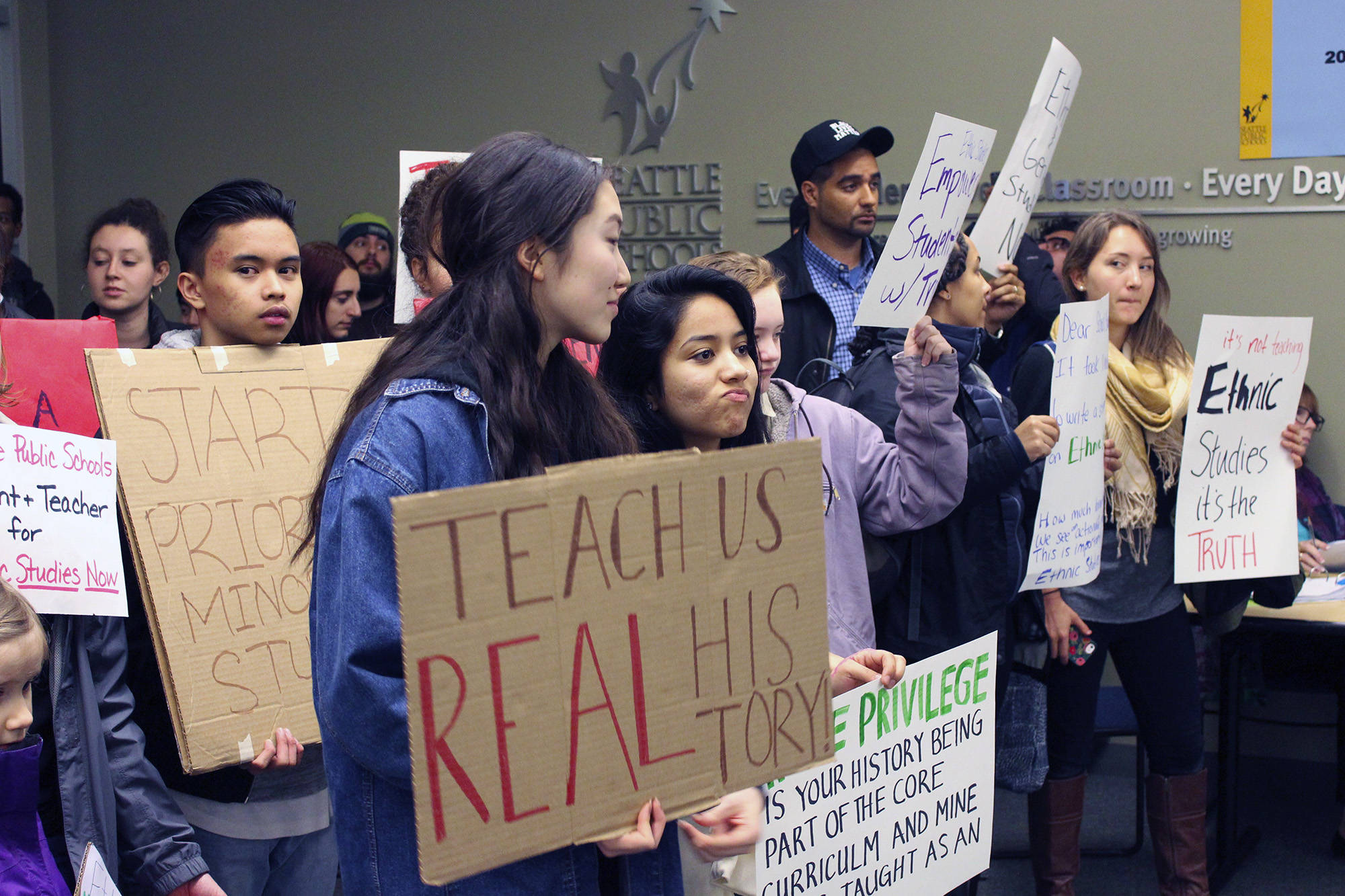
Ethnic Studies In Seattle: A look inside the classrooms of antiracist educators


Happy to share these news from educator Jesse Hagopian about Ethnic Studies in Seattle Public Schools that got birthed last year out of the Black Lives Matters movement.  What he and others say about his experience of teaching Ethnic Studies is what I hear everywhere.  Where better than in the city and school district named after the legendary Chief Seattle.  The enthusiasm is palpable.  
Like I always say, some day Ethnic Studies will just be called a "good education." 
So exciting!
-Angela Valenzuela

Ethnic Studies In Seattle: A look inside the classrooms of antiracist educators


Image result for ethnic studies seattleThe Seattle Public Schools recently wrote the below article about the powerful pedagogy of local educators who are piloting a new Ethnic Studies program.  The Ethnic Studies initiative in the Seattle Public Schools is the result of an on going movement that was birthed from the Black Lives Matter At School action last school year.  Building on that action, the Seattle NAACP teamed up with teachers, parents and students to lead a campaign to integrate Ethnic Studies across the school district.
The below article highlights the work of several educators in Seattle including Tracy Gill, one of the lead organizers of the movement for Ethnic Studies, and Donte Felder,  head teacher at Orca K-8, who are piloting the new program.
My classroom is also featured, the first standalone Ethnic Studies class in the Seattle Public Schools.  Teaching this class has truly been my best year in the classroom.  I have drawn from The University of California, Berkley’s definition of Ethnic Studies to engage students in,
The critical and interdisciplinary study of race, ethnicity, and indigeneity with a focus on the experiences and perspectives of people of color within and beyond the United States. Since the emergence of ethnic studies as an academic field in the late 1960s, scholars have analyzed the ways in which race and racism have been, and continue to be, powerful social, cultural, and political forces and their connections to other axes of stratification, including gender, class, sexuality, and legal status.
This approach has led to some of the most dynamic discussions I have ever had in the classroom about race, ethnicity, identity, and intersectional movements for social change.  With hate crimes on the rise and racist rhetoric and policies spewing out of the White House on a regular basis, these conversations are desperately needed. This movement won’t stop until every student in the Seattle Public Schools has the opportunity to take an Ethnic Studies class; Knowledge of self is a human right!
———–

Ethnic Studies at Seattle Schools


Ethnic Studies: A Movement Toward Equity
Posted by Seattle Public Schools on 05/11/2018
A quilt with words "We all belong"

Ethnic Studies: A Movement Toward Equity

In Jesse Hagopian’s multigrade classroom at Garfield High School, students are learning about U.S. History as time travelers. They close their eyes at the sound of a DeLorean playing over the projector and engines whirring, they are transported to 1964. At once, they are immersed in the experiences of young leaders in the Student Non-Violent Coordinating Committee (S.N.C.C.). Students are asked to role-play, using historical evidence, and imagine themselves as freedom riders, writing letters back home to their families. Through the lesson, students are encouraged to find connections between the role of young people in the civil rights movement and the contributions of young people in the world today.
The class is ethnic studies. It’s part of a pilot being rolled out in six schools across the district aimed at engaging students in perspectives of historically marginalized groups.
In the summer of 2017, the Seattle School Board passed a resolution encouraging, “departments, schools and staff to increase their efforts to expand and improve ethnic studies for all students in the Seattle Public Schools.” The formal expression came after a resolution and tremendous community support from the Seattle Chapter of the National Association for the Advancement of Colored People (NAACP), Seattle Education Association (SEA), Seattle Public Schools educators and various community partners.
Hagopian’s class is the first ethnic studies course offered for students as a result of the resolution. To provide context for student’s learning, Hagopian began the semester with dialogue about the history of ethnic studies; the emphasis on engaging students in ways they know and understand, utilizing systemic critiques of oppression and applying critical consciousness. On any given day in the ethnic studies course, students are critically analyzing historical events through a multidisciplinary lens.
Seattle Public Schools educators have long known about the importance of the field of ethnic studies and with the introduction of the board resolution, were able to formally integrate curriculum into their classrooms. About 35 teachers committed to piloting ethnic studies core content, with six official pilot schools in the spring semester:
  • The Center School
  • Cleveland High School
  • Denny International Middle School
  • Garfield High School
  • John Muir Elementary School
  • Orca K-8 School
Teachers participating in the pilot check in with each other regularly about the implementation and success at each of their buildings. Application of the curriculum differs based on grade levels and across schools.
At Orca K-8, students are creating connections across disciplines as Ethnic Studies is integrated in a variety of subjects. Science educator, Zelda Padmananbhan lead her class through a lesson on cells through a discussion of the HeLa cell line, the first immortalized cell line and one of the most important cell lines in medical research, sourced from Henrietta Lacks, an African-American woman who did not grant permission for her cells to be used. Through a unique opportunity, students examined the official HeLa cells, read literature and watched portions of a movie about Lacks’ life.
Across the school, young learners are creating storied quilts, analyzing race through the production of a musical and practicing their oratory skills through original speeches about relevant social justice issues.
Donte Felder, head teacher at Orca K-8, speaks to the impact of learning about rich and complex histories, “Ethnic studies will provide teachers, parents and students a space to engage in challenging and courageous discourse around race and classism, gender and ethnic stereotypes, but more importantly, it will provide students with complex narratives with themes of perseverance and hope that will speak to all of our students.”

Listening to the Youth

The Seattle Public Schools Ethnic Studies Task Force defined the field as aiming to “empower all students by making the curriculum relevant to their lives, background and circumstance.”
Sixth-grade scholars in Tracy Gill’s social studies classroom at Denny International Middle School participated in the spring ethnic studies pilot. When prompted to answer about the value of studying ethnic studies after her involvement, student Karla answered, “It gives students of color a chance to see powerful people like them through history and not feel oppressed by what they are learning. When students are taught ethnic studies, they know that someone like them worked hard and made a change in history…This has made me feel like I belong because I know more about people like me.”
Sixth-grade student Noah shared his thoughts about the potential impact on teacher practice, “I think teachers should be taught more about ethnic studies because teachers are learning, then passing on that knowledge onto kids. My evidence to support that is, my teacher is always learning new things at her teacher trainings and passing that information on to us.”

The Impact on Learning

There is emerging research that demonstrates that a well-designed program of ethnic studies, whether incorporated into existing courses or as independent courses, helps improve literacy skills, attitudes toward learning and overall engagement in academic studies in students of color.
“As an ethnic studies student who learned the history of my community and those of others who were disenfranchised, I found a pathway to working for a more socially just world,” explains Kyle Kinoshita, chief of Curriculum, Assessment and Instruction for Seattle Public Schools. “In doing so, I found a strong and confident identity.”
Curricula that are relevant to the life experience of students from diverse backgrounds have been shown to have a positive impact on the development of a strong identity connected to achievement. As an administrator, Kinoshita sees the same transformation in today’s students of color whose teachers root them in the tradition of resilience and liberation against social and racial injustice. He says, “We owe all students these opportunities, and that’s why we won’t stop until ethnic studies is a basic component of the curriculum in Seattle Public Schools.”
The Ethnic Studies Working Group will begin the process in June 2018 of collaborating with Seattle Public Schools educators as they write curriculum for courses and grade levels, starting with secondary social studies. Looking toward the future, the group plans for a quality review of written curriculum, professional development, implementation and potential district adoption.
Read more about the Ethnic Studies Task Force.