Translate

Showing posts with label climate crisis. Show all posts

Tuesday, June 23, 2026

Texas Is Legislating Growth on a Drying Planet—and the $174 Billion Bill for Texas’ Growth Machine Is Coming Due, by Angela Valenzuela, Ph.D.

Texas Is Legislating Growth on a Drying Planet—and the $174 Billion Bill for Texas’ Growth Machine Is 
Coming Due

by 

Angela Valenzuela, Ph.D.

June 24, 2026

Chris Tomlinson’s recent column posted below, “Texas is running out of cheap water, and will need to make salty water sweet,” should land like an alarm bell across the state. His central point is simple and sobering: Texas is outgrowing its freshwater supply. Population growth, drought, fracking, semiconductor production, data centers, and the vast water needs of artificial intelligence are converging into a crisis that can no longer be deferred.

Link to PDF here
According to the Texas Water Development Board’s Draft 2027 State WaterPlan, implementing the recommended water management strategies is estimated to cost $174 billion, more than double the $81 billion estimated in the 2022 plan (Texas Water Development Board, 2026, p. 28). That number should stop us in our tracks. It tells us that the old bargain—grow endlessly, build endlessly, extract endlessly, and assume water will somehow be there—is breaking down.

Tomlinson rightly points to Corpus Christi as the canary in the coal mine. There, the city’s surface water supplies are running low, new groundwater wells have not delivered as hoped, and desalination remains expensive. 

Meanwhile, the endless drive to attract industry is increasingly ill advised, stretching the water supply beyond what residents can reasonably bear. The result is a familiar Texas pattern: public resources get promised to private growth, and ordinary people are left to pay the bill.

This is where the water crisis becomes more than an infrastructure problem. It is a democracy problem. Who gets to decide how much growth is too much? Who benefits from water-intensive development? Who pays when systems fail? Who is asked to conserve while industries expand? And whose communities are treated as sacrifice zones in the name of “economic development”?

These questions echo themes I have raised in other posts about the Hot Earth, climate disruption, and the extractive logic that governs so much of our public policy. Climate change is not some distant abstraction. It is arriving through heat, drought, flood, fire, migration, insurance costs, utility bills, and water scarcity. It is arriving through the quiet violence of unaffordability. It is arriving through the realization that the poor, the elderly, rural communities, and working families will be the first to experience what policymakers long treated as someone else’s future.

Tomlinson’s column is especially important because it pierces the illusion of cheapness. Texas has “run out of cheap water,” as Sen. Charles Perry put it. That statement deserves our full attention. Cheap water was never really cheap. It was subsidized by aquifers, rivers, ecosystems, Indigenous dispossession, rural extraction, underpriced infrastructure, and future generations who were never asked for consent. Now the bill is coming due.

Desalination may become part of the state’s water future, but it is not a magic wand. Making salty water sweet requires enormous energy. It also produces concentrated brine that must be handled carefully to avoid serious environmental harm. If desalination becomes another excuse for unrestrained growth, we will have learned nothing. We will simply be using more energy to solve the water crisis while worsening the climate crisis that intensifies drought in the first place.

The same concern applies to artificial intelligence and data centers. As I have written elsewhere in reflecting on AI and extraction, artificial intelligence is not weightless. It is not merely “in the cloud.” It is physical infrastructure: land, water, energy, minerals, labor, servers, cooling systems, and communities asked to absorb the costs. The language of innovation often hides the material reality of extraction. In Texas, that reality is becoming increasingly visible as rural communities confront large-scale data centers that demand huge amounts of water and electricity.

It is telling that even Texas Agriculture Commissioner Sid Miller has called for a moratorium on new data centers, warning that rural communities that have conserved water and land for generations are now being asked to compete with corporate giants whose demands could overwhelm local resources. 

That alone should widen the conversation beyond partisan politics. This is not simply a left-right issue; it is a question of stewardship, fairness, and whether Texas will protect the communities that have long sustained the state before handing scarce resources over to the highest bidder.

Water also forces us to rethink what we mean by prosperity. For too long, Texas leaders have equated growth with success. More highways. More subdivisions. More warehouses. More data centers. More fossil fuel extraction. More tax incentives. More ribbon cuttings. But growth without ecological limits is not prosperity. It is debt. It is risk. It is a form of policy denial.

And as with so many policy debates in Texas, inequality sits at the center. Wealthier households will absorb higher water rates more easily. Poor and working-class families will not. Rural communities may see their aquifers strained by development they did not invite. Colonias and historically underserved communities may face the worst infrastructure deficits. Urban residents may be told to conserve while industry receives favorable treatment. This is how environmental crisis becomes social crisis.

We should be deeply concerned that Texas is discussing water scarcity largely as an engineering challenge rather than a justice challenge. Pipes matter. Treatment plants matter. Desalination facilities may matter. But governance matters, too. Public voice matters. Conservation matters. Climate policy matters. Land-use planning matters. Accountability matters. Without these, water policy will reproduce the very inequities that brought us here.

The Legislature will have to confront this in 2027. But Texans should not wait for lawmakers to frame the issue for us. We need a broader public conversation now—one that includes educators, scientists, farmers, Indigenous communities, rural residents, environmental advocates, labor, students, and families already struggling with the cost of living.

Water is life. It is also memory, land, culture, food, health, and public trust. It is the connective tissue of ecology and democracy.

Texas can still choose a different path. We can invest in infrastructure, conservation, reuse, repair, and fair pricing. We can scrutinize water-intensive industries before granting them public support. We can protect communities from being overrun by extractive development. We can treat climate disruption as real rather than optional. We can insist that economic development serve the public good rather than private accumulation alone.

But we cannot keep pretending that endless growth is compatible with finite water.

Tomlinson’s column is a warning. Corpus Christi is a warning. The draft State Water Plan is a warning. The Hot Earth is warning us, too.

The question is whether Texas will listen before scarcity becomes policy, before crisis becomes normal, and before ordinary Texans are told—once again—that there is no alternative but to pay for decisions they did not make.

References

Texas Water Development Board. (2026). 2027 state water plan: Draft, phase 1. https://www.twdb.texas.gov/waterplanning/swp/2027/docs/DraftSWP27-Water-For-Texas.pdf

Tomlinson, C. (2026, May 21). Texas is running out of cheap water, and will need to make salty water sweet. Houston Chronicle. 

Texas faces a costly water crisis as growth, drought and industry outpace freshwater supplies statewide, writes columnist Chris Tomlinson.

By ,Columnist

Texas is outgrowing its freshwater supply.

Communities across the state need billions of gallons more water for growing populations and thirsty industries like oil and gas fracking, computer chip etching and artificial thinking. What happens this summer in Corpus Christi is a sign of what’s coming for all Texans.

The price of creating freshwater and keeping the economy growing will leave consumers with sticker shock, state lawmakers recently acknowledged. A draft of the 2027 State Water Plan says Texas will need to spend $174 billion to meet the water needs of the next 50 years — twice as much as lawmakers estimated just four years ago.


“The taxpayer is going to pay for this stuff one way or the other, be it property tax or be it fees, or be it insurance cost increases,” state Sen. Charles Perry, chairman of the Senate Water, Agriculture and Rural Affairs Committee, said during a hearing last week. “There is no free lunch here, or if they don’t pay, we end up with a Third World state.”


Inconvenient truths

Lawmakers will need to have “a big conversation” when they gather in Austin next year, Perry predicted. The level-headed Lubbock Republican is not prone to hyperbole or known for rhetorical flourish. When he speaks up, Texans best listen up.


Droughts and floods have complicated life in Texas for eons. The population and economy only began to grow once people started damming rivers and drilling into aquifers. But experts say those water sources are insufficient for a growing state.


Corpus Christi is the canary in our coal mine. The city’s surface water supplies are running low, new groundwater wells have disappointed, and citizens can’t afford to make seawater drinkable.

In the City Council’s drive to attract industry and bring in new jobs and revenue, it stretched the water supply too thin. Now that the inevitable drought has arrived, the council will likely declare an emergency and impose strict rationing.

Experts told the Senate committee on May 11 that while 57% of city-owned water utilities say they have long-term plans with sufficient funding, 10% have no plan, and 43% do not have enough money.

This year was the first time the State Water Implementation Fund for Texas fell short, capable of providing only $1.28 billion of the $4.2 billion that water utilities requested. The Legislature created the fund 11 years ago to help local authorities pay for water projects.

The Texas Water Development Board, which administers the fund, rejected the Nueces River Authority’s request for help financing a Corpus Christi desalination plant, claiming it had to prioritize other projects. 

Statewide, Texas doesn’t know where it will find 10 million to 12 million acre-feet of the 17 million the state will need over the next 50 years, Perry warned (an acre-foot is about 325,000 gallons). Making existing water treatment plants and pipelines more efficient will only meet 3% of the need.

“If I have to pick between spending all of my dollars on leaky pipes or all my dollars on supply, I will pick supply every day,” Perry said.

Water users will need a lot of dollars.

Well runs dry

Producing drinking water from ground or surface sources typically costs between $1.10 to $4.30 per 1,000 gallons, according to the Texas Comptroller’s Office. Desalination costs range from $7.50 to $11 per 1,000 gallons.

“Everyone in the audience is going to say, ‘That’s too much, that’s double what we’re paying,’” Perry said. “But that’s the cost of new water in Texas … we have run out of the cheap water.”

If Texans will pay those rates, utilities will deliver. Companies are working to permit three seawater desalination plants, with state officials anticipating seven plants along the coast over the next decade.

Arid nations around the world use desalination, but in addition to requiring a lot of energy, they produce a brine that is twice as salty as the water going in. If the waste stream isn’t handled properly, it can cause severe environmental problems.

Critics question the wisdom of trying to grow Texas beyond what its natural resources can sustain. Community activists want to prioritize residents’ quality of life over industrial development, and environmentalists want conservation over development.

Sid Miller, the Republican agriculture commissioner, called for a moratorium on data centers to conserve water.

“They draw massive volumes of water for cooling, even amid ongoing drought,” Miller wrote in a press release on Monday. “Rural communities that have conserved resources for generations now compete with corporate giants.”

Should a higher power grant South Texans' prayers and bring a week or more of steady rain, a heaven-sent storm will not solve the state’s long-term water shortage. We’ll still need to turn salty water sweet.

“We have a lot of poor people that aren’t going to be able to live in Texas much longer if we don’t figure this out, and there needs to be a sense of urgency about it,” Perry warned. “The status quo has to break.”

Award-winning opinion writer Chris Tomlinson writes commentary about money, politics and life in Texas. Sign up for his “Tomlinson’s Take” newsletter at houstonchronicle.com/tomlinsonnewsletter or expressnews.com/tomlinsonnewsletter.


Business Columnist

Chris Tomlinson writes commentary about money, politics and life in Texas for Hearst Newspapers. He can be reached at ctomlinson@hearstcorp.com.

In 2025, Tomlinson was inducted into the Texas Institute of Letters, an honor society that recognizes distinctive literary achievement. In 2021, the Texas Association of Managing Editors awarded him columnist of the year, and the Headliners Foundation named him Texas's Star Opinion Writer. He’s authored two New York Times Bestsellers, “Forget the Alamo: The Rise and Fall of an American Myth” and “Tomlinson Hill: The Remarkable Story of Two Families Who Share the Tomlinson Name - One White, One Black.”

Before joining the Houston Chronicle in 2014, he spent 20 years with The Associated Press reporting on politics, economics, conflicts and natural disasters from more than 30 countries in Africa, the Middle East and Europe.

Sunday, October 26, 2025

Dr. Rosa Rivera-Furumoto and the Call for Climate Justice: Mothers, Memory, and the Earth, by Angela Valenzuela, Ph.D.

Dr. Rosa Rivera-Furumoto and the Call for Climate Justice: Mothers, Memory, and the Earth

by 

Angela Valenzuela, Ph.D.

I recently watched Cal State Northridge Chicana/o Studies professor, Dr. Rosa Rivera-Furumoto’s powerful KAN Talk on Climate Justice, and I have not stopped thinking about it. Her message—delivered with the grace of an educator and the urgency of an activist—reminds us that the fight for environmental sustainability is inseparable from the struggle for cultural survival, educational justice, and community well-being. 

She asks the hardest questions like what difference does policy make if we no longer have clean drinking water? Grounded in the lived experiences of Mexican American and Latina/o mothers, grandmothers, community members, and university students and an organization, Padres Pioneros/Parent Pioneers, that she co-founded, her work reveals how climate justice is also a story of love—for family, for culture, and for the Earth itself.

Dr. Rivera-Furumoto’s model begins with the preservation and revitalization of language, culture, values, and traditions drawn from Chicana/o, Latina/o, and Native American communities. This is not nostalgia; it is survival. The ancestral ways of knowing that she uplifts—reciprocity, gratitude, respect for the land and water—hold deep ecological wisdom that our contemporary systems have forgotten. In her hands, sustainability is not a new idea but an ancient memory calling us home, inviting us to listen again to the teachings of our elders and to the Earth.

Drawing inspiration from Freirean pedagogy, Dr. Rivera-Furumoto teaches climate literacy as liberation. Her practices invite critical reflection and collective action, connecting local challenges such as food deserts, rising heat, and air pollution to global systems of inequality and environmental racism. Through dialogue and shared inquiry, participants learn to see themselves as agents of change rather than passive recipients of environmental harm. It is a pedagogy of hope rooted in praxis—the joining of reflection and action for transformation.

None of this is easy. It is nevertheless a growing movement of educators, mothers, and students leading community-based sustainability efforts rooted in culture and compassion. Her example reminds us that even in the face of systemic inequity, grassroots efforts can plant the seeds of transformation.

Her call echoes loudly here in Texas, where the climate crisis is no longer a distant threat but a daily reality. As heat waves intensify, water grows scarce, and vulnerable communities suffer most, we must recognize that climate justice and educational justice are inseparable. The same structures that devalue public education also devalue the planet and its people. Addressing one without the other only deepens the harm.

Her approach is intergenerational, creating spaces of learning that bring together children, parents, grandparents, and extended kin, where knowledge flows in every direction. In community gardens and workshops, young people dig their hands into the soil beside elders who share stories of traditional planting cycles and herbal medicine. These gatherings transform environmental education into cultural renewal. 

If we are to confront the climate crisis with honesty and courage, we must also confront the systems that disconnect us from the land and from one another. Dr. Rivera-Furumoto shows us that resistance can bloom in gardens, in classrooms, and in every act of care that restores balance to our world. The future, she reminds us, is not something we await—it is something we grow.


Call to action on climate change. Description of some of the strategies and practices employed by Mexican American and Latina/o mothers, grandmothers, community members, and university students to address climate change and sustainability issues in a low-income Latina/o community.  The talk will address challenges and future directions. The model is based on these key principles and practices: 1 Preservation and revitalization of the language, culture, values, and traditions of Chicana/o/Latina/o and Native American community members;
2 Involvement and engagement of multiple generations in the teaching and learning processes including children, parents, grandparents, and other kin and community members;
3 Critical pedagogical practices to promote critical thinking, reflection and action regarding climate change, sustainability, and other social justice issues and;
4 Promoting connection, love, and respect for nature and the environment via outdoors exploration and the establishment of urban gardens and forests.

Monday, January 23, 2023

Climate Change, Drought Conditions, and their Future Implications for Austin and Central Texas

Both Austin's "unseasonably warm" temperatures and erratic weather are becoming the norm. Our leaders at all levels seem indifferent to climate change and what we need to do about it in order to avert—or at least decelerate—the frequency of catastrophic weather events. This article duly warns us here in Central Texas that places like Austin and the Hill Country will turn into a dust bowl like so much of West Texas already has, including my hometown of San Angelo to which Austin is compared herein.

If anyone keeps up with Texas drought statistics, 2022 ranked second driest in 11 years, a terrible year that devastated Bastrop County with fires on Labor Day weekend.

As someone like myself who likes to garden and who is also concerned about the environment, this Statesman piece with its tongue-in-cheek title, sounds the alarm on climate change. It refers not to some far-away land, but right here where we live. 

I recommend reading David Wallace-Wells' "The Uninhabitable Earth"—also available on Audible.com.  Jess Goodell's piece titled, "Hothouse Earth Is Merely the Beginning of the End," featured in the Rolling Stone, is also informative. Without a doubt, we in the U.S. have a special responsibility to address climate change due to our excessive carbon footprint that's killing the planet.

It also references an authoritative volume written by hemispheric scientists in 2011 published by the University of Texas Press titled, The Impact of Global Warming on Texas, now in its second edition. It goes into depth on what holds for the future of Central Texas while recommending corrective action for policymakers if we are to avert the unthinkable—that is, consequences that are no longer manageable.

-Angela Valenzuela

'If you die, you will be replaced by a succulent.' How 2 Texas gardeners handle heat, drought


by Michael Barnes and Sengupta Stith | 7.26.22


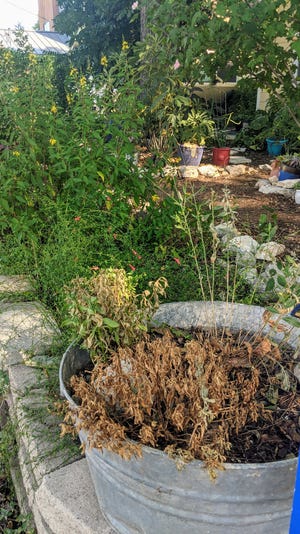
Opting to forgo summer annuals this year, Deborah Sengupta Stith hasn't replaced the snapdragons and African daisies that made this pot a showpiece in the early spring. Even the Texas native Gaura is struggling. In the garden bed behind the pot, a firecracker bush and a golden thryallis are thriving.
  • During a Central Texas summer, your plants need hand-watering and tender loving care.
  • The last bad drought for Central Texas was in 2011, and nobody who lived through it can forget it.
  • Climate change might make Austin more like San Angelo.

Just a few months ago, a deep freeze struck some Austin gardens to their very roots.

Now those precious plants are dealing with historic heat and the threat of longterm drought.

At this point, Austin yards are taking on a crispy golden hue that looks more like late August or early September than mid-July.

Climate change is not helping.

In 2011, during a previous devastating Central Texas drought, one scientist predicted that, within a couple of generations, Austin would look more like the West Texas city of San Angelo than our comparatively green hills and wooded prairies of Central Texas.

Toward the end of the century, Austin "will be a lot like the Dust Bowl," said Gerald North, a Texas A&M University atmospheric scientist and an editor of the book, "The Impact of Global Warming on Texas."

Just so you know, San Angelo can get so dry that, in the early 1970s, one of its reservoirs caught fire.

More:Austin's summer weather: May was hottest ever. June was hottest ever. July: Hold my beer.

"Within the next century, hotter weather in Central Texas will lead to longer droughts, the amount of water making its way into the Edwards Aquifer will drop," reported environmental writer Asher Price in the American-Statesman in 2011, "crops may wither, wildfires might grow more frequent, and the tree line that divides lush East Texas and bone-dry West Texas — it now sits along Interstate 35 — might push east, Texas research scientists and academics predict."

Yikes! What's an Austin gardener to do with this unhappy news?

Plan accordingly.

On April 1, after this year's freeze, two gardening enthusiasts on our Austin360 staff, Deborah Sengupta Stith and Michael Barnes, shared some hard-won plant wisdom under the headline: "Want your garden to survive Texas freezes, floods, heat, droughts? What to plant and when." Sengupta Stith employs containers in her shady East Austin yard to echo the planned naturalness of an English garden; Barnes concentrates on trees, shrubs, vines and ground cover — along with a few herbs and veggies — at his South Austin home.

They are back to answer questions on how they have adapted — or plan to adapt — their gardens to the heat and the drought. We've also asked an expert from San Angelo to give advice on long-range planning, as climate change transforms Central Texas into something more like West Texas.

What are you doing right now to protect your most vulnerable plants?

Sengupta Stith: Honestly, not much. I have a small assortment of unusual philodendrons and monsteras — survivors of my early pandemic indulgence in the collector houseplant craze — on my shady balcony. Those guys get watered almost daily. I treat everyone else to a few waterings a week plus a stern warning: "If you die, you will be replaced by a succulent."

I have many new succulents.

Have I lost plants that I loved with this approach? Absolutely. The side of my house is littered with empty pots. But I'm a big believer in trying to work with the environment and I'm not willing to fight for something that is not suited to these harsh conditions that are starting to feel like the new normal for Central Texas gardeners. I am only here for the tender tropicals that survive my willful neglect.

Barnes: Potted plants are the most vulnerable, I think, because they bake in their terra cotta. The herbs are particularly hard hit this time of year. The potted succulents and some ferns are survivors, at least during this summer.

I've increased my watering rotation. We've lost probably a half dozen small, recently planted shrubs. One was a tropical that I knew had no business in our ground, but it winked at me at the neighborhood nursery. I still haven't learned to avoid "impulse planting."

On an upbeat note, this is the time of year when all that spring mulching and composting benefits the entire garden by preserving moisture in the soil.

Saturday, September 19, 2020

15 fatalities confirmed. North Complex now among state’s top 5 deadliest fires

These ferocious fires in California are not something that anyone can simply write off because they don't affect you. To the contrary, this is catastrophic, impacting us all at some level, even if solely spiritually or psychologically. Despite what I feel is a severe lack of media attention to these fires—such as the North Complex fire described below that burned more than 269,000 acres, one of the largest fires in state history—we should see them as minimally on the scale as the environmental disaster that unfolded in the Gulf of Mexico back in the summer of 2019 not so very long ago. 

If we connect this to the cataclysmic Australian fires, as we should, that took place less than a year ago, we should further heed the warnings of extinction as in this piece titled, "Scientist warns of ‘extinction crisis’ as Australia wildfires wipe out a billion animals."

This is not science fiction. This is the real deal. Our Earth mother is on fire. 

What we are witnessing was predictable. Yet since the Nixon presidency, there has been precious little leadership either on climate change—more appropriately termed a "climate emergency," or in educating our children and communities about it though we are all impacted. Education can play a massively important role in all of this, yet where is the leadership? Like Nero, Trump tweets as our country burns.

To wit, fire season is hardly an abstraction here in Central Texas as you can learn about from this August 24, 2020 piece in the Austin American Statesman titled, "Bastrop County prays for rain as fire season heats up." I don't see this primarily as a policy issue that we "fix," but rather as a major shift that we have to undergo immediately in no uncertain terms if we are to survive as a human species.

To get a really good sense of the science behind all of this, consider reading this post featuring David Wallace-Wells titled, "The Uninhabitable Earth, Annotated Edition | New York Magazine"—whose book is worth listening to on Audible.com—together with Jess Goodell's piece in the Rolling Stone titled, "Hothouse Earth Is Merely the Beginning of the End." 

Earth is going to be fine, by the way. However, by the way things are going, it's humans that aren't, sadly and tragically as we see all of this play out before our eyes in living color.

The point here is not to trigger your "eco-anxiety," which is a real syndrome that so many are experiencing right now, but rather to encourage you to vote. We all have a vote and a voice in a democracy. We must insist that those in power lead on the climate crisis that we're currently in.

Below are several hashtags that I've come across that will allow you to track all of this on Twitter and other social media.

-Angela Valenzuela

#GreenNewDeal #ExtinctionRebellion #Vote2020 @algore #InconvenientTruth @EnvironmentTex @SierraClub @TexasSierraClub  @TXWaterFuture #OneWaterTexas #gogreen #sustainable #SustainabilityTexas @EnvDefenseFund #ClimateEmergency 

#climateaction #environment #nature #climatechange #ClimateDenial #sustainability #ecofriendly #savetheplanet #green #zerowaste #earth

15 fatalities confirmed. North Complex now among state’s top 5 deadliest fires

            Firefighters search a burned-out residence Tuesday in the Berry Creek neighborhood near Oroville, Calif.
            (Josh Edelson / AFP / Getty Images)

The confirmed death toll from California’s unprecedented firestorm has risen to 25 as crews work to hem in some two dozen major blazes still burning statewide.

Another fatality was confirmed Monday in the area of the North Complex fire near Oroville — boosting that fire’s death toll to 15, according to the Butte County Sheriff’s Office. In recorded state history, only four blazes have been deadlier.

Authorities have released the names of seven fire victims: John Butler, 79; Sandra Butler, 75; Jorge Hernandez-Juarez, 26; Philip Rubel, 68; Khawar Bhatti, 58; Millicent Catarancuic, 77; and Josiah Williams, 16.

All were residents of Berry Creek, a mountain town northeast of Oroville that was devastated by the fire.

As of Tuesday morning, officials said the North Complex was 39% contained. At more than 269,000 acres, it is now the eighth-largest fire in state history, according to the California Department of Forestry and Fire Protection.

It also ranks among the most destructive fires California has ever seen, consuming or damaging 723 structures so far, officials said.

The North Complex is just one of several historically large conflagrations that have ignited over the past month. So far this year, fires have chewed through more than 3.2 million acres statewide — an area larger than the state of Connecticut.

The statewide firestorm has destroyed more than 4,200 structures and forced over 60,000 people from their homes, according to Cal Fire.

The breakout of blazes includes what is listed as easily the largest wildfire recorded in California: the August Complex in Mendocino, Humboldt, Del Norte and Trinity counties.

The overall complex — which now includes two enormous fires, previously called the Doe and the Elkhorn, under its umbrella — has burned more than 794,000 acres and is 30% contained.

“Critically dry fuels” are continuing to challenge firefighting efforts on that complex, officials said Tuesday.

Sunday, April 19, 2020

IMPORTANT ANNOUNCEMENT: Earth Day Livestream Mobilization, April 22-24, 2020

Friends,

Very exciting announcement that provides a way for you to make a difference in this time of quarantine and climate change.  Remember that COVID and climate change absolutely go hand in hand.  But that's not enough.  We must all also get involved is saving our planet.

Parents, for children and youth, being a part of this could satisfy at least partial credit in science.

As many of us as possible, let's join Earth Day that's coming up this week on April 22-24, 2020.  Check out this announcement to which you can connect directly here.

The webpage will ask you to register and to text "earthvote" to the number 565-25. 
Earth Day will feature a 3-day livestream, such that we'll all get connected to millions of people around the world in order to participate in community building and storytelling.  Exciting presentations, music, and performances by many people are featured.  I look forward to hearing, including Al Gore, Bill McKibben, Stacey Abrams, Alyssa Milano, and Alexandria Ocasio-Cortez, together with the voices of Indigenous leaders and youth activists.

You can also connect to local sessions to address struggles and opportunities closer to home.  

Enjoy!

-Angela Valenzuela

#EarthDay #nature #earth #climatechange  #environment #savetheplanet #green #zerowaste


From April 22, the 50th anniversary of Earth Day, to April 24, activists, performers, thought leaders, and artists will come together for an empowering, inspiring, and communal three day livestream mobilization.

The fights against the coronavirus and the climate crisis go hand-in-hand, and as we work to flatten the curve of this pandemic, we must strive toward the longer term goal of building a society rooted in sustainability and justice.


PARTICIPANTS

Separator

Featuring Adam Gardner (Guster) • Al Gore • Alex Macnicoll • Rep. Alexandria Ocasio-Cortez • Aloe Blacc • Alyssa Milano • Amanda Palmer • Amber Valletta • Angela Rye • Angelique Kidjo • Ani DiFranco • Bill McKibben • Chef Alejandra Schrader • Chef Dominique Crenn • Chelsea Handler • Cody Simpson • Daniel Fernandez • David Wallace-Wells • Devendra Banhart • DJ Spooky • Dr Michael Greger • Dr. Sweta Chakraborty • Ed Begley Jr. • Emily Wells • Graham Riley • Ilyasah Shabazz • Jack Johnson • Jameela Jamil • Jason Mraz • Joaquin Phoenix • Kathryn Budig • Kirsten Vangsness • KT Tunstall • Lil Dicky • Lisa Edelstein • Local Natives • Louie Schwartzberg • Luke Baines • Madame Gandhi • Margaret Klein Salamon • Mark Ruffalo • Mary Heglar • Matt McGorry • Michael Franti • Moby • Monica Dogra • Mumu Fresh • Mustafa Santiago Ali • Nahko Bear • Ndaba Mandela • NUKA • Other Lives • Patricia Arquette • Patrisse Cullors • Questlove • Rachael Ray • Rep. Lauren Underwood • Rep. Ted Lieu • Reverend Dr. William Barber II • Robby Romero • Rosanna Arquette • Secretary John Kerry • Sharon Carpenter • Shepard Fairey • Siva Kaneswaran • Smiles Davis • Soul Clap • Stacey Abrams • Stella McCartney • Talib Kweli • Tank and the Bangas • The Both -w- Aimee Mann and Ted Leo • Tim Heidecker • Tony Revolori • Vote Party • Will Anderson (Parachute)

And many more to be announced soon!

Saturday, November 16, 2019

NACCS – STATEMENT ON THE CLIMATE CRISIS


This recently-published statement by the National Association for Chicana and Chicano Studies takes an unblinking look at the climate crisis and burgeoning "climate chaos" that we're in and how low-income people of color bear the brunt of it. This statement, in particular, points to the limits to policy when the underlying ways of knowing are untouched.
"The climate crisis is not amendable through “technological fixes” or “green consumerism,” because the climate crisis is deeply rooted in a particular type of settler colonialism and capitalism that prevents, and even erases, the sustainable livelihoods of Chicana/o and Latinx people and communities. The National Association for Chicana and Chicano Studies recognizes that while the climate crisis becomes more perilous by the day, Chicanas/os and Latinx peoples have always been engaged in struggles to improve our environments."
Check out the list of policy and advocacy recommendations provided below.  We all owe NACCS scholar Dr. Devon Peña a debt of gratitude for his perseverance and deep subject matter knowledge of the environmental crisis, and his support for a Green New Deal and a larger vision of community-based, grassroots organizing if we are to restore "our wounded watersheds and ecosystems."  

Thanks to our NACCS leadership, as well, for making climate change a front-burner issue.

-Angela Valenzuela

Released: October 29,2019 8:45AM, NACCS National Office, San Jose State U.


The NACCS board believes it is important to have our voice as part of the global movement against climate chaos, and we have asked NACCS environmental scholars Dr. Devon Peña and Dr. Gabriel Valle to compose the following statement:

The NACCS Climate Crisis Statement


The climate change crisis is affecting all living organisms and ecosystems on the planet but the enduring effects of decades of environmental racism are resulting in disparate impacts. Black, Indigenous, and other People of Color (BIPOC), including Chicanx/Latinx populations, are already suffering major deleterious effects from this global process of environmental violence. It is important to understand first of all that climate chaos is not simply driven by anthropogenic (human-caused) forces but by the type of ravenous destruction of the planet’s life support systems of the global capitalist economy. The combination of extreme heat and cold weather events illustrates for us how so-called “global warming” and even “climate change” are inadequate terms to describe what is occurring and that the concept of 
climate chaos illustrates how the entire climate system is characterized by unpredictable disruptions with cumulative effects that scientists are only now recognizing and understanding. It is also important to understand how the effects of climate chaos are destroying ecological systems that we depend on to produce our food, medicine, clothing, and shelter. Climate chaos destroys the natural conditions of material cultures. 

We are facing a crisis in which Native communities from the Arctic to the Andes and the Pacific Rim island nations are already being devastated by the chaos of climate change. We are facing a crisis in which BIPOC and low income persons are already being killed or displaced by the effects of climate change.

The evidence of disparate impacts must be weighed when we consider what our policy and political needs are in light of these devastating processes: 

1. Urban heat islands. Research confirms that African Americans are 52% more likely than whites to live in “urban heat islands” (UHIs) defined as microclimates that can get an extra 5 to 10 degrees hotter during heat waves. Asian Americans are 32% more likely and Latinxs are 21% more likely to live in UHIs. In the Phoenix area, the mostly Native American neighborhood of Guadalupe suffered more than a dozen deaths during the summer heat wave of 2017 which led to 155 people dying. That set a record for the state of Arizona, passing the 2016 total of 150. Most of these deaths involve BIPOC communities. These differences are results of the longstanding shameful practice of residential segregation and a lack of open green spaces and tree cover in these segregated neighborhoods. 
2. Extreme Cold Weather Mortality and Illness. Beyond the effects of heat waves, BIPOC populations are also suffering higher rates of mortality and illness as a result of extreme cold weather events affecting urban low-income barrios and rural communities including reservations. 
3. Farm and other natural resource workers. There are 2.5-3 million farmworkers in the United States. Of these 80% are Latinx and more than half of these are Mexican-origin workers an increasing number of whom are Native Mesoamericans. Between 2000 and 2010, 359 occupational heat-related deaths were identified in the U.S., for a yearly average fatality rate of 0.22 per 1 million workers. Highest rates were found among Latinx males in the agriculture and construction industries. Farm and construction workers accounted for nearly 58 percent of occupational heat deaths from 2000 to 2010, and Latinxs had three times the risk of heat-related death on the job than did non-Latinxs.[1] 
Source: Deborah Mills, et al., La Frontera: Mi Viaje con Papa. Barefoot Books.

4. Climate refugees (Central America, Mexico). The so-called “Dirty Wars” and decades of neoliberal “Shock Doctrine” (including NAFTA) initiated a set of violent forces that – combined with severe drought and climate change impacts – have led to a mass forced migration of mostly Indigenous populations. These are the same populations that are being dehumanized and terrorized by US border and immigration control forces that are separating families and placing their children in cages.

5. Displacement of ‘cultures of habitat’. Indigenous peoples are recognized for their deep traditions of resilient inhabitation of ancestral territories and are renowned for providing ecosystem services to the Earth. This is why ethnoecologists the world over have long defended “ecosystem peoples” or “cultures of habitat” and their resilient and regenerative livelihood traditions and practices.[2] The same corporate and settler colonial nation state agencies that are underlying forces of climate chaos are actively engaged in the forced relocation of Indigenous communities. In the Southwest, Native American/Chicanx acequia communities are facing the prospect of extinction and displacement due to declining mountain snowpack that serves as the water source for these celebrated community irrigation systems.[3] The cultural landscape and ecological services of the acequia systems are being damaged by the effects of drought, past and ongoing deforestation, and extreme fluctuations in weather patterns. In Alaska, the Iñupiat village of Kivalina is being relocated due to rising sea levels and it is only one of many dozens of such Arctic communities directly affected by climate chaos. 

6. Food system and food sovereignty impacts. BIPOC communities are already disproportionately affected by hunger and malnutrition. A USDA study of so-called “food insecurity” demonstrates that Mexican immigrant children suer the highest rates of hunger and malnutrition in the U.S. BIPOC communities have long faced death by “nutricide” and are already increasing experiencing the loss of traditional foods, foodways, and heritage cuisines and of the agroecosystems and land and waterscapes that support our direct livelihood traditions and food cultures. Climate chaos is intensifying these deleterious losses of heritage cuisine, and traditional foodways and undermining our agroecosystems and our access to traditional hunting, foraging, and fishing areas. 


Source: Just Seeds.


7. Air Quality. In 1987, the Commission for Racial Justice at the United Church of Christ released the groundbreaking report, Toxic Waste and Race in the United States.[4] The report was one of the first documents to use the term “environmental racism” to explain how communities of color are more likely to be exposed to unhealthy air, which can lead to conditions of asthma, among other things. The report shows that three-fifths of BIPOC communities live in or near areas of toxic waste. These conditions are not simply because many of these communities live in urban areas, but because of the historical process of urban planning and policy making that dictates where industrial business reside, where freeways are built and expanded, and even the flight patterns of air traffic. The commission released a second report, Toxic Waste and Race at Twenty 1987-2007, and their findings show that in spite of laws and policies created to promote justice, the conditions in many BIPOC communities remain much the same.[5] In the coming years, the climate crisis will exacerbate these conditions. In urban communities, the heat island effect (see item 1) will worsen air quality and increase the prevalence of asthma. In rural communities, the climate crisis will compound drought conditions. Air quality in Fresno, CA, recently received an F by the American Lung Association’s State of the Air 2019 report.[6] Today, approximately 43.3 percent of Americans live in counties that have unhealthy ozone and/or particle pollution – that is more than 141 million people exposed to unhealthy air.

8. Water and Water Quality. The availability and the quality of water are both exacerbated by the climate crisis. A recent report notes that half the world’s population will live in water-stressed areas by 2025. According to the World Health Organization (WHO), “Even in non-water stressed areas, the quality of surface water could deteriorate as more rain and storms drive erosion and the release of toxins. These dynamics could affect everything from the availability of drinking water for people to a shortage of water for livestock and crops (with negative effects for the food supply) to decreases in hydroelectric power generation.”[7] These water quality impacts are already affecting the health of U.S. urban BIPOC communities. We have learned that Flint, MI, is not an isolated incident, but just the tip of the iceberg. Municipalities access the country are being to realize this. In predominantly Latino, agricultural communities that rely on groundwater, community members experience elevated and long-term exposure to nitrates in their drinking water. Epidemiological evidence suggests an elevated risk of cancer and congenital disabilities in communities that experience nitrate exposure at levels below U.S. EPA’s drinking water standard (10 mg/L NO3-N).[8] Recent findings have shown high levels of lead in public schools. In California, the Community Water Center conducted as state-wade report that concludes from 2003-2014 over one million students attended schools that did not meet primary safe drinking water standards. The report also finds the schools impacted by unsafe drinking water had higher percentages of BIPOC students.[9] The struggle over water, while frequently framed as an environmental problem (i.e., drought), is, in fact, a highly political matter that influences the livelihood and wellbeing of urban and rural BIPOC communities. Climate chaos is only worsening these problems aided and abetted by the perverse logic of neoliberal policies that eliminate the investments in environmental quality and the protection of the Earth’s life-support systems like air, land, and water. 

Source: Globalclimatestrike.net toolkit.
Therefore, the National Association for Chicana and Chicano Studies declares the climate crisis the most paramount issue of our time. The systems and institutions that destroy the environmental conditions needed for clean air and water are the same systems and institutions that have historically denied Chicana/o and Latinx peoples a means to self-determination. The climate crisis is not amendable through “technological fixes” or “green consumerism,” because the climate crisis is deeply rooted in a particular type of settler colonialism and capitalism that prevents, and even erases, the sustainable livelihoods of Chicana/o and Latinx people and communities. The National Association for Chicana and Chicano Studies recognizes that while the climate crisis becomes more perilous by the day, Chicanas/os and Latinx peoples have always been engaged in struggles to improve our environments. From the acequia farmers improving soil health and agrobiodiversity through traditional agricultural practices,[10] to the mujeres organizing against polluting industry,[11] we have been there. From the campesinxs resisting pesticides,[12] to the ciudadanxs reusing coffee tins,[13] we have been there. The National Association for Chicana and Chicano Studies declares that in order to truly address the climate crisis, we must remake our social, political, and economic systems to promote diversity, autonomy, resilience, and a just sustainability. 


The NACCS Board of Directors specifically calls for the following actions in support of the vital climate justice movement:


  • NACCS endorses the climate strike actions that youth across the U.S. and the rest of the planet have launched and call for continued widespread activism by BIPOC youth and their allies in these campaigns for climate justice.
  • We call on U.S. universities and colleges to divest themselves of stocks in fossil fuel and other extractive industries that are the principal drivers of this environmental violence.
  • We further call on higher education institutions to end their participation in the global “land grabs” that are displacing Indigenous and other land- and water-based communities because this robs the first peoples of their ancestral lands while the world as a whole suffers the consequences of the loss of these sustainable, resilient, and equitable cultures of habitat that protect the planet.
  • We resolve that the Green New Deal is an essential tool for education and civic engagement and especially call on the shapers of this initiative to include community-based and  grassroots-led projects for ecological restoration of our wounded watersheds and ecosystems.
  • We call for legal recognition of access to safe water and culturally appropriate food as basic universal human rights.
  • We support reparations associated with climate chaos and the harm this has caused to Indigenous and other land and water-based communities in the U.S. and the world. The primary reparations must involve investments to return Native lands to rightful Indigenous care-giver heirs and to heal the colonial wounds suffered by the land, water, air, and people.  


Endnotes
[1] Gubernot, Diane M et al. 2015. Characterizing occupational heat-related mortality in the United States, 2000-2010: An analysis using the Census of Fatal Occupational Injuries database. American Journal of Industrial Medicine 58:2: 203-11.
[2] Nabhan, Gary P. 1997. Cultures of Habitat: On Nature, Culture, and Story. Washington DC: Counterpoint. Nazarera, Virgina, Ed. Ethnoecology: Situates Knowledge, Located Lives. Tucson: U. Arizona Press.
[3] Elias, E. H., et al., 2015. Assessing climate change impacts on water availability of snowmelt- dominated basins of the Upper Rio Grande basin. Journal of Hydrology: Regional Studies 3: 525- 46. URL:http://dx.doi.org/10.1016/j.ejrh.2015.04.004. Peña, Devon G. 2019. “Climate Chaos, Acequias, and Land Grants Sin agua no hay vida, sin tierra no hay paz.” Paper presented at the 46th Annual Conference of the National Association for Chicana and Chicano Studies, Thematic panel: “Land and Water Wisdom: Exercising Cultural Resistance and Sustainability Practices.” Albuquerque, NM, April 4-6, 2019.
[4] United Church of Christ. 1987. Toxic Waste and Race in the United States. Commission for Racial Justice. New York.
[5] United Church of Christ. 2007. Toxic Waste and Race at Twenty. Commission for Racial Justice. New York.
[6] American Lung Association. 2019. State of the Air Report https://www.lung.org/our- initiatives/healthy-air/sota/
[7] Goldman Sachs. 2019. Sustainable Growth: Taking a Deep Dive into Water. URL: https://www.goldmansachs.com/insights/clean-technology-and- renewables/cohen/report.pdf. Accessed October 10, 2019.
[8] Schaider, Laurel, Lucien Swetschinski, Christopher Campbell, Ruthann Rudel. 2019. “Environmental justice and drinking water quality: are there socioeconomic disparities in nitrate
levels in U.S. drinking water?” Environmental Health 18(3) URL: https://ehjournal.biomedcentral.com/articles/10.1186/s12940-018-0442-6#Abs1
[9] Community Water Center. 2016. “Are We Providing Our School Kids Safe Drinking Water? An
Analysis of California Schools Impacted by Unsafe Drinking Water.” Full Report available at URL: https://d3n8a8pro7vhmx.cloudfront.net/communitywatercenter/pages/824/attachments/original/1462656752/CWC_MCL_05.07.16a.pdf? 1462656752
[10] Gallegos, Joseph. 2017. “Chicos del horno: A Local, Slow, and Deep Food.” In Mexican-Origin Foods, Foodways, and Social Movements: Decolonial Perspectives. Eds. Devon G. Peña, et al. Fayetteville: University of Arkansas Press.
[11] Pardo, Mary. 1998. Mexican American Women Grassroots Community Activists. Philadelphia: Temple University Press.
[12] Pulido, L. 1996. Environmentalism and economic justice: Two Chicano struggles in the Southwest. University of Arizona Press.
[13] Diaz, David. 2005. Barrio Urbanism: Chicanos, Planning and American Cities. New York: Routledge.
Posted 3 weeks ago by Devon G. Peña