This blog on Texas education contains posts on higher education, as well as preK-12 policy accountability, testing, bilingual education, immigration, school finance, race, class, and gender issues at both the state and national level. It also represents my digital footprint, of life and career, as a community-engaged scholar in Texas.
DeSantis' decision to disallow the teaching of AP African American Studies in Florida schools takes me back to when John Huppenthal did this to Mexican American Studies (formerly called "Raza Studies") in the Tucson Unified School District.
Referencing this court case in which I served as expert witness on curriculum, Civil Rights Attorney Ben Crump is correct in noting the unconstitutionality of robbing youth of their right to this curriculum. The teacher and student plaintiffs in TUSD won this case in 2017, following a 7-year court battle. I blogged about it for at least a couple of years (note: keyword search "MAS," "TUSD," "TUSD Ethnic Studies," and "Tucson" to locate posts).
Folks in Florida are justifiably outraged, calling out DeSantis' gravitation toward these divisive, "red-meat" issues as objectionable when according to State Sen. Shevrin Jones (D) he should be "addressing issues that matter to Floridians like 'crumbling schools, dilapidated buildings in our communities” and high property insurance costs.'"
“These are the issues that‘s being ignored because we have to deal with the promotion of Jim Crow 3.0 by people who don’t know and don’t care about what’s happening in Black communities, but they desire to referee how you teach our history,” Jones said.
This IS Jim Crow 3.0, or as we say in Texas among Mexicans for whom this is
also true, "it's Juan Crow." Check out the signage on stopping the "Black Attack" rally that took place yesterday at the state capitol in Tallahassee.
In the meantime, we continue with our own similar struggles in our own state of Texas with a Governor like DeSantis who has similar political aspirations and ideological perspectives.
If any good comes out of this, it's that we come to appreciate in deep and meaningful ways the importance and viability of Black Brown unity.
Updated January 26, 2023 at 10:13 a.m. EST|Published January 25, 2023 at 7:37 p.m. EST
Civil rights attorney Ben Crump stands with Elijah Edwards, 14, a student at Sail High School during a “Stop The Black Attack” rally in Tallahassee on Wednesday. (Octavio Jones/Reuters)
Florida Gov. Ron DeSantis is facing mounting backlash regarding his administration’s decision to prohibit an Advanced Placement high school course on African American studies, with Black leaders rallying in the capital, a prominent civil rights lawyer threatening to sue and state lawmakers urging him to reverse the decision.
Attorney Ben Crump accused DeSantis of violating the federal and state constitutions Wednesday by refusing to permit the course. His legal team noted that a federal judge found a 2010 law in Arizona that banned a Mexican American studies program from Tucson schools unconstitutional and officials “motivated by racial animus.”
So glad to see our youth standing up to this by walking out of school and protesting. This reminds me of a student who shared in class recently who said that Texas' ban on specific books has made these books hugely popular in her Central Texas secondary school, backfiring on those in support of this. If anything, censorship is politicizing many of our students even more.
It actually all so predictable. All of a sudden, this "forbidden fruit" becomes attractive and lots of students are now reading books that they likely would never have read under ordinary circumstances.
The two school board members who opposed the ban, Steven Schwartz and Allison Barclay, plan to propose rescinding it at the Tuesday, Jan. 31, meeting.
At Temecula Valley High School, more than 200 students began leaving campus about 10:30 a.m. and headed to nearby Ronald Reagan Sports Park.
Some of the teens carried handmade signs with slogans such as “Stop censorship,” “End racism,” and “If history makes you uncomfortable, imagine how they felt.” Some shouted as they demonstrated. Many said they fear the ban could censor their education and that of younger students, while affecting the representation and safety of students of color and LGBTQ students. About 20 to 30 adults — apparently parents and residents there to ensure students were safe — also attended.
“Teach all history!” students shouted while gathered around the sports park’s parking lot. “We are here.”
Genesis Kekoa, president of Temecula Valley High’s Black Student Union, said she has been emailing Temecula Valley school board members about reversing the ban, which she believes silences students’ voices.
“I hope they realize we’re not going to be silent,” Kekoa, a 16-year-old junior at Temecula Valley High said. “We’re not being told by parents or teachers to do this; we’re doing it ourselves. We have a voice. I’m scared students are not going to be taught our history. Everyone deserves to be seen. Everyone’s culture and history deserves to be taught.”
A friend recently shared this Fox News video from 5 years ago of a major disagreement on undocumented immigrants between Attorney Michele Byington and Houston community activist Quanell X. As per my earlier post today, this video for me is a boost in the arm as we struggle against anti-diversity bills House Bill 1607 and House Bill 1006 in the Texas State Legislature.
I like and appreciate how Quanell X not only refuses to take the bait of falling into the anti-immigrant trope, but how he pivots and calls for Black-Brown unity.
That's what's needed. Once this happens in all places everywhere possible, this will be a game-changer.
Drs. Sleeter and Jameson Brewer critique this as relying on cherry-picked data and bias. In short, it is a, in their words, a "shoddy advocacy report."
Key Review Takeaway: Shoddy advocacy report attempts to justify deregulation of the charter school sector for the purpose of decreasing “wokeism” in charter schools.
BOULDER, CO (January 24, 2023)—In one of the more unusual reports NEPC has ever reviewed, Heritage Foundation authors recently argued for school-choice deregulation by comparing the amount of “wokeness” terminology in parent/student handbooks in U.S. charter schools with the level of charter school regulation in their states.
Christine Sleeter of California State University Monterey Bay and T. Jameson Brewer of the University of North Georgia reviewedEmpowering Parents with School Choice Reduces Wokeism in Education and found significant flaws in reasoning, even beyond the report’s disconcerting premise.
The Heritage report finds that increased manifestations of “woke” terminology are associated with higher state levels of charter school regulation. On this basis, the report concludes that while charter schools represent a safe space away from “woke indoctrination” in public schools, further deregulation and less bureaucracy will allow the charter sector to truly respond to parent desires to avoid “leftist” curriculum.
Notwithstanding its provocative thesis, apparently intended to tap into current turmoil, the report has at least five significant weaknesses. It assumes that parent/student handbooks are good proxies for curriculum; it completely ignores the diversity of parents and relevant research about what large proportions of parents actually want; it conflates correlation with causation; it relies on undefined conceptions of what constitutes “wokeness”; and it possibly uses cherry-picked data and methods that suit ideological bias.
These shortcomings render the report useless for understanding or developing policy. Instead, the report serves merely as an example of strategically employing dog whistles and fear, embedded in shoddy methodology for the sole purpose of affirming a solution (school choice) in search of a problem (“wokeness”).
NEPC Reviews (http://thinktankreview.org) provide the public, policymakers, and the press with timely, academically sound reviews of selected publications. NEPC Reviews are made possible in part by support provided by the Great Lakes Center for Education Research and Practice: http://www.greatlakescenter.org
The National Education Policy Center (NEPC), a university research center housed at the University of Colorado Boulder School of Education, produces high-quality information in support of democratic deliberation about education policy. We publish original research, policy briefs, and expert third-party reviews of think tank reports. NEPC publications are written in accessible language and are intended for a broad audience that includes academic experts, policymakers, the media, and the general public. Visit us at: http://nepc.colorado.edu
Just as we anticipated, here is the "Anti-CRT-for-Higher-Education bill," House Bill 1607 authored by Rep. Cody Harris (R-District 8) who represents Palestine, Texas, where whites are the majority, located just North of Houston.
As someone who has taught Critical Race Theory at the University of Texas at Austin for well over a decade, I can tell you that it's not even a curriculum at the higher education level. It is but one framework among so many others that we teach, including human capital theory, social and cultural reproduction, resistance theory, linguistic studies, discourse theory, policy network theory, feminist frameworks, disability studies, postcolonial frameworks, and so on. Too many to name.
This is obviously a "red meat" issue that plays to the ideologies of narrow constituencies and is potentially injurious to higher education faculty in terms of what we know and enjoy as academic freedom in the academy.
Moreover, together with HB 1006, these proposals potentially put our entire enterprise in the crosshairs of a legislative agenda that is not only about censorship—and thusly, profoundly anti-democratic—but also squanders our loftiest purposes on the value not just of higher education, but any education that encourages youth to think in complex, meaningful ways to make a better world.
Stay tuned. More to come.
-Angela Valenzuela
#SayNoToCensorship #HB1607 #HB1006
88R8371 KJE-D
By: Harris of Anderson
H.B. No. 1607
A BILL TO BE ENTITLED
AN ACT
relating to prohibiting certain instruction as part of a course at a
public institution of higher education.
BE IT ENACTED BY THE LEGISLATURE OF THE STATE OF TEXAS:
SECTION 1. Subchapter Z, Chapter 51, Education Code, is
amended by adding Section 51.982 to read as follows:
Sec.51.982.CERTAIN INSTRUCTION PROHIBITED. (a) In this
section, "institution of higher education" has the meaning assigned
by Section 61.003.
(b)An institution of higher education may not require or
make part of a course inculcation in the concept that:
(1)one race or sex is inherently superior to another
race or sex;
(2)an individual, by virtue of the individual's race
or sex, is inherently racist, sexist, or oppressive, whether
consciously or unconsciously;
(3)an individual should be discriminated against or
receive adverse treatment solely or partly because of the
individual's race or sex;
(4)an individual's moral character, standing, or
worth is necessarily determined by the individual's race or sex;
(5)an individual, by virtue of the individual's race
or sex, bears responsibility, blame, or guilt for actions committed
by other members of the same race or sex;
(6)meritocracy or traits such as a hard work ethic are
racist or sexist or were created by members of a particular race to
oppress members of another race; or
(7)with respect to their relationship to American
values, slavery and racism are anything other than deviations from,
betrayals of, or failures to live up to the authentic founding
principles of the United States, which include liberty and
equality.
(c)An institution of higher education that violates this
***Open to the Public: Please Disseminate Widely***
Dear Friends, Students and Colleagues:
Want to share this virtual panel presentation that Dr. Ricardo Rosa—on behalf of Uniting to Save Our Schools (USOS) and organizations in solidarity with them—has organized an important event. Dr. Rosa works at the Massachusetts Teachers Association.
Register here to attend the event via Zoom on Wednesday, February 8th from 6-7:30PM CST / 7-8:30PM EST / 4-5:30PM PST.
I am so very honored to appear on this panel with Congressman Jamaal Bowman and such great scholars and advocates addressing, as the title says, the "Moral Injuries and Oppressive Impacts of High-Stakes Tests." Boy, do we know all about this here in Texas.
Though not necessarily in this order on the day of, here is the presentation lineup:
To prepare for this event, I encourage everyone to read this earlier blog post titled, "Why the Academic Achievement Gap is a Racist Idea By Ibram X. Kendi." Check out the FairTest website, too, as they have carried the water on the battle against high-stakes testing at the national level for decades. Test-based entrance exams like the SAT and ACT, in higher education, as well.
Finally, if you're in Texas and want to know what we're advocating for here in the context of the 88th Session of the Texas State Legislature currently underway, check out the Raise Your Hand Texas Legislative Agenda.
Give the Spanish-speaking communities' increasingly decisive role in a number of election outcomes, Fox News is building on this momentum by expanding news media to this demographic.
Most importantly, this piece suggests what progressive media should be doing—or doing more of. Spanish-speaking Latinos are not only a diverse, but largely excluded constituency that Fox News in Spanish is capitalizing on.
Ahead of the campaign, Americano Media wants to sway Hispanic opinion toward the GOP.
CNN exit poll data in November found that Democrats’ lead with Latino voters has narrowed by nearly 10 percentage points since the 2018 midterm election. | Matt Rourke/AP Photo
Republicans have made notable inroads among Hispanic voters in recent election cycles. Now, a conservative media network is looking to cement and further those gains by trying to become the Fox News of Spanish-speaking America.
Americano Media, which launched in March, is embarking on an aggressive expansion plan to shape center-right Hispanic opinion during the upcoming election cycle. The network has hired more than 80 Latino journalists and producers, are expanding their radio presence to television, and by the end of the year will have studios in Miami, Las Vegas and D.C. with reporters covering the White House, Congress and embedding in 2024 presidential campaigns. This month, Americano is launching a $20 million marketing campaign to draw in new viewers.
It’s the latest development in an arms race to reach and win over the nation’s second-largest demographic group, one playing an increasingly critical role in election outcomes.
“We don’t have a Fox News in Spanish, and that’s what Americano intends to be,” said the network’s CEO and founder Ivan Garcia-Hidalgo. He said he has listened to Hispanic Republican leaders lament for 25 years about the need for something like it, but no one ever took serious action.
Garcia-Hidalgo, who worked as a Hispanic surrogate for Donald Trump’s 2020 campaign after a career in telecommunications with Tyco, AT&T and Sprint, said he wants to “blow up” the traditional ways in which conservative Hispanics interact with the media, which he said consisted of going on liberal-leaning networks to “apologize for being Republican, bow your head and take a beating for an hour.”
Americano started with a suite of radio shows out of Miami, where it remains headquartered, but plans to have a presence on television and radio in battleground states across America in the next year, in addition to driving Spanish-speaking audiences to its online and streaming platforms.
To date, Americano Media has raised $18 million from its first three investors, and is set to complete its first and only round of equity investment this spring to generate another $30 to $50 million, Garcia-Hidalgo said. Thomas Woolston, a northern Virginia patent attorney, and Doug Hayden, a San Jose, Calif.-based investor, were the first to provide capital; Americano declined to disclose the third investor.
As a sign of Americano Media’s growth, the network has scored recent interviews with Donald Trump and several top elected Republicans. | Andrew Harnik/AP Photo
Thanks to Schoolhouse Rock, I am happy to provide you with enjoyable representations for children—and to some extent, for adults—on how a bill (or bill proposal) becomes a law in the U.S. Congress.
The first, 2016 video maps on well, albeit in the most general of ways, what happens in our state legislatures. The 2021 version adds complexity to how a bill becomes a law in the U.S. Congress.
You can view this link to learn about how a bill officially becomes a law from the perspective of the Texas State Legislature. If you scroll to the bottom of the document, there are helpful graphics in this document that outline the process. Not nearly as fun a Schoolhouse Rock, but nevertheless about how we do business in a democracy.
These are helpful instructional videos for elementary and secondary classrooms so that children and youth aren't left completely in the dark about what politicians are up to when they make laws, especially those impacting them.
Both Austin's "unseasonably warm" temperatures and erratic weather are becoming the norm. Our leaders at all levels seem indifferent to climate change and what we need to do about it in order to avert—or at least decelerate—the frequency of catastrophic weather events. This article duly warns us here in Central Texas that places like Austin and the Hill Country will turn into a dust bowl like so much of West Texas already has, including my hometown of San Angelo to which Austin is compared herein.
As someone like myself who likes to garden and who is also concerned about the environment, this Statesman piece with its tongue-in-cheek title, sounds the alarm on climate change. It refers not to some far-away land, but right here where we live.
I recommend reading David Wallace-Wells' "The Uninhabitable Earth"—also available on Audible.com. Jess Goodell's piece titled, "Hothouse Earth Is Merely the Beginning of the End," featured in the Rolling Stone, is also informative. Without a doubt, we in the U.S. have a special responsibility to address climate change due to our excessive carbon footprint that's killing the planet.
It also references an authoritative volume written by hemispheric scientists in 2011 published by the University of Texas Press titled, The Impact of Global Warming on Texas, now in its second edition. It goes into depth on what holds for the future of Central Texas while recommending corrective action for policymakers if we are to avert the unthinkable—that is, consequences that are no longer manageable.
During a Central Texas summer, your plants need hand-watering and tender loving care.
The last bad drought for Central Texas was in 2011, and nobody who lived through it can forget it.
Climate change might make Austin more like San Angelo.
Just a few months ago, a deep freeze struck some Austin gardens to their very roots.
Now those precious plants are dealing with historic heat and the threat of longterm drought.
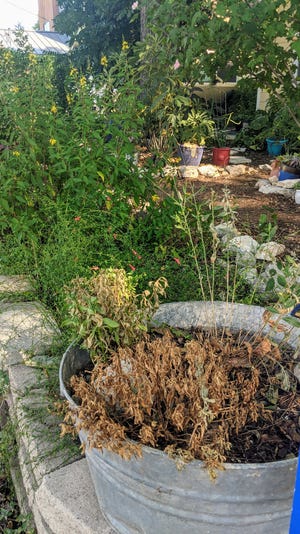
At this point, Austin yards are taking on a crispy golden hue that looks more like late August or early September than mid-July.
Climate change is not helping.
In 2011, during a previous devastating Central Texas drought, one scientist predicted that, within a couple of generations, Austin would look more like the West Texas city of San Angelo than our comparatively green hills and wooded prairies of Central Texas.
Toward the end of the century, Austin "will be a lot like the Dust Bowl," said Gerald North, a Texas A&M University atmospheric scientist and an editor of the book, "The Impact of Global Warming on Texas."
Just so you know, San Angelo can get so dry that, in the early 1970s, one of its reservoirs caught fire.
"Within the next century, hotter weather in Central Texas will lead to longer droughts, the amount of water making its way into the Edwards Aquifer will drop," reported environmental writer Asher Price in the American-Statesman in 2011, "crops may wither, wildfires might grow more frequent, and the tree line that divides lush East Texas and bone-dry West Texas — it now sits along Interstate 35 — might push east, Texas research scientists and academics predict."
Yikes! What's an Austin gardener to do with this unhappy news?
Plan accordingly.
On April 1, after this year's freeze, two gardening enthusiasts on our Austin360 staff, Deborah Sengupta Stith and Michael Barnes, shared some hard-won plant wisdom under the headline: "Want your garden to survive Texas freezes, floods, heat, droughts? What to plant and when." Sengupta Stith employs containers in her shady East Austin yard to echo the planned naturalness of an English garden; Barnes concentrates on trees, shrubs, vines and ground cover — along with a few herbs and veggies — at his South Austin home.
They are back to answer questions on how they have adapted — or plan to adapt — their gardens to the heat and the drought. We've also asked an expert from San Angelo to give advice on long-range planning, as climate change transforms Central Texas into something more like West Texas.
What are you doing right now to protect your most vulnerable plants?
Sengupta Stith: Honestly, not much. I have a small assortment of unusual philodendrons and monsteras — survivors of my early pandemic indulgence in the collector houseplant craze — on my shady balcony. Those guys get watered almost daily. I treat everyone else to a few waterings a week plus a stern warning: "If you die, you will be replaced by a succulent."
I have many new succulents.
Have I lost plants that I loved with this approach? Absolutely. The side of my house is littered with empty pots. But I'm a big believer in trying to work with the environment and I'm not willing to fight for something that is not suited to these harsh conditions that are starting to feel like the new normal for Central Texas gardeners. I am only here for the tender tropicals that survive my willful neglect.
Barnes: Potted plants are the most vulnerable, I think, because they bake in their terra cotta. The herbs are particularly hard hit this time of year. The potted succulents and some ferns are survivors, at least during this summer.
I've increased my watering rotation. We've lost probably a half dozen small, recently planted shrubs. One was a tropical that I knew had no business in our ground, but it winked at me at the neighborhood nursery. I still haven't learned to avoid "impulse planting."
On an upbeat note, this is the time of year when all that spring mulching and composting benefits the entire garden by preserving moisture in the soil.
In honor of the Reverend Dr. Martin Luther King, here is a short, instructional video from the Othering and Belonging Institute at UC Berkeley on structural racism.
We must collectively build a world where we all share in a sense of belonging, a world where there is no "other," or anyone who is "less than." More immediately, an ounce of knowledge can be a pound of cure.
Enjoy!
-Angela Valenzuela
The “Structural Racism Explained” video draws upon many varied sources in formulating specific definitions for different types of racism. The video and prompts provided in this video and teaching guide (download here: https://belonging.berkeley.edu/struct...) are designed primarily for teachers to help students clarify and sharpen their understanding of the material, spur and support classroom discussion of the video and ideas, and provide ideas and leads for further research. But the materials are also useful for people who work in diversity, equity, and inclusion (DEI) spaces and local governments.
Teachers should feel encouraged to prod students to read and engage with source materials. The video and prompts provided here are designed and developed primarily for high school students, but can also be used by upper-level middle school systems or undergraduate university students, with tailoring.
If you have any questions or suggestions concerning these materials, please get in touch at belonging@berkeley.edu.
The video script and teaching guide were developed by Stephen Menendian.
 also true, "it's Juan Crow." Check out the signage on stopping the "Black Attack" rally that took place yesterday at the state capitol in Tallahassee.